
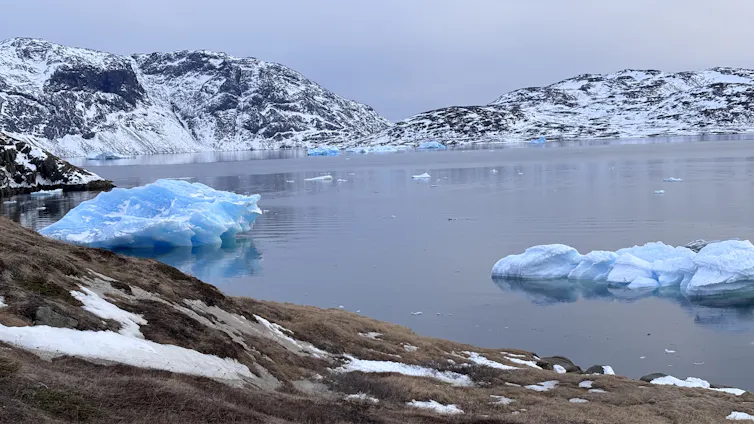
The morning sun lights up the ice-covered mountains around Narsaq, a small village in South Greenland. Turquoise icebergs float by the shores of the fjords, and seagulls gather on the cliffy rocks. An old man walks slowly along the colourful houses on the hill.
The picturesque scene feels almost surreal, but this is indeed where I find myself as a researcher of public art projects (like street art and murals) and how they shape local communities.
I am about to visit the social services and training centre for young people, “Inusullivik Piareersarfik”, where many come to prepare for the job market and engage in artistic projects in Narsaq.
Some come here because they are having a hard time. They worry about what comes next – work, school, life at home – or they are simply trying to figure out who they are.
For those who are having difficulties, the centre offers counselling through creative activities, where young people take classes in painting, music and carpentry.
Kathrin Maurer, Author provided (no reuse)
Art in local communities
I am in Greenland to study the Sanasa Art Route Project, one of the initiatives at the centre. The project brings together teenagers, artists and community workers to create large-scale murals across South Greenland.
Art has long held an important place in the communities of South Greenland, with various artists and musicians from this region helping shape modern culture and identity.
Award-winning Greenlandic filmmaker Inuk Jørgensen’s recent film Entropy, for example, explores how the destruction of the Greenland ice sheet is threatening the spiritual relationship between the Inuit and nature.


Kathrin Maurer, Author provided (no reuse)
Then there is singer, guitarist and producer Malik Høegh from the influential Greenlandic rock band, Sume who also hails from South Greenland, and was integral in creating the first Greenlandic long-playing vinyl record Sumut, meaning “Where to?”
Vittus Nielsen, the workshop supervisor at the centre in Narsaq, greets me warmly and hands me a cup of coffee. A group of teenagers sit nearby. They give me a slight nod, some smile.
Someone says something in Greenlandic, and the group laughs. I do not understand the words, but I am glad to be sitting among them.
Nielsen and I talk about the Sanasa Art Route Project, founded in 2018 by master painter and decorator Heidi Zilmer, who also has Greenlandic roots.
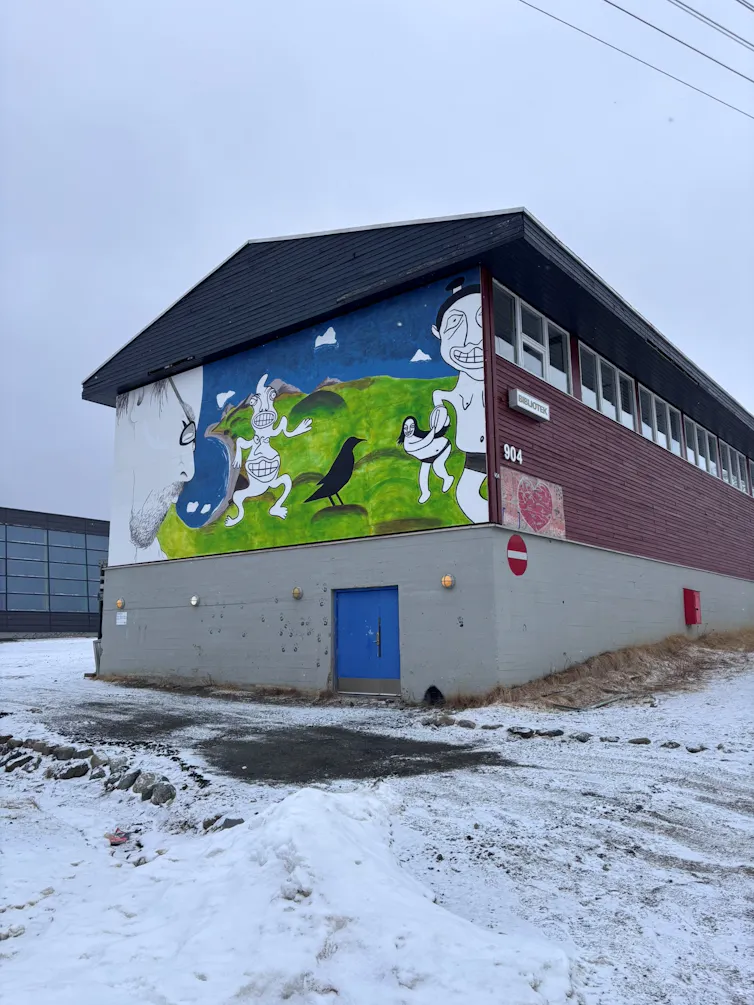
The project brings young people from several villages in South Greenland together with artists and community workers to paint vibrant murals on school walls, old factories, or harbour containers.

Kathrin Maurer, Author provided (no reuse)
These murals illustrate motifs about Greenlandic identity, myths and cultural traditions – painted and developed by over 200 young adults from all over Greenland.
In times of uncertainty and political polarisation, these murals and paintings have become anchors; places where people gather, see themselves reflected and connect with each other.
Let’s build something
In Greenland, villages are often measured by large infrastructure developments, roads built, and funds invested.
But the Sanasa project shows that another form of infrastructure is just as essential. One that is visual and cultural rather than physical.
Sanasa means “let’s build something” in Greenlandic. And that is what the members of the Sanasa Art Project certainly want to do: to build a strong local community, where people feel at home, help each other and stay for future generations.
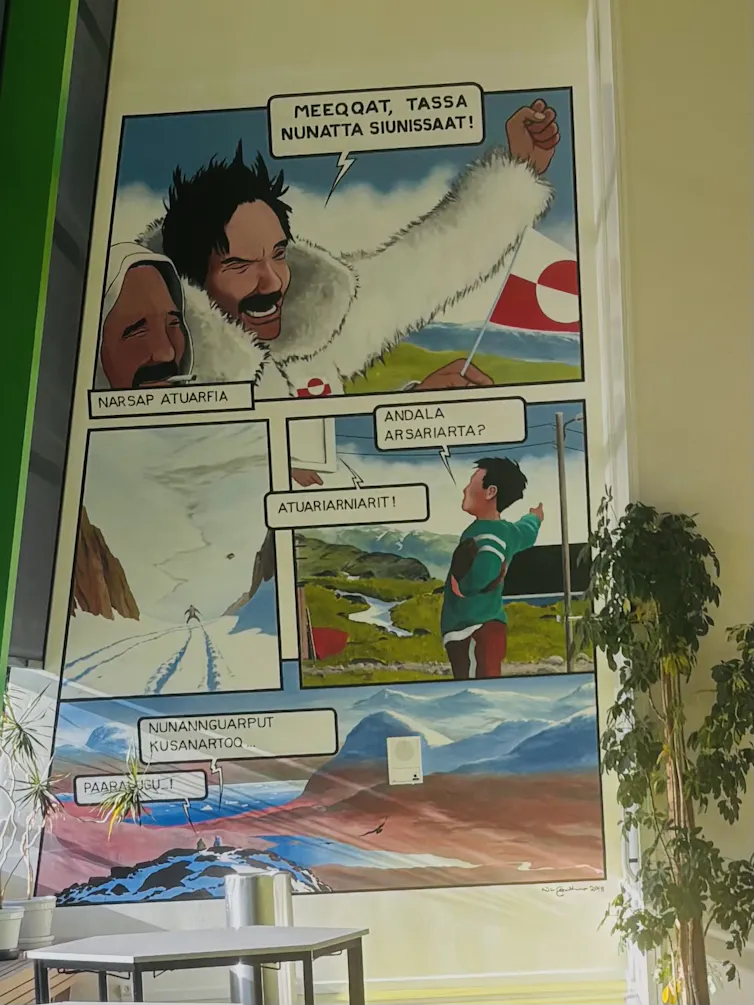
One of the murals, Andala inside the public school in Narsaq, by the artist Konrad Nuka Godtfredsen, is painted in a comic strip style. It has a clear message: education is your future.
Kathrin Maurer, Author provided (no reuse)
In times of uncertainty
But life in Narsaq has become increasingly uncertain in recent years, as the village faces population decline and shifting infrastructure.
Just before I visited, the Narsasuaq Airport – about 18 miles from Narsaq and a former US military base – was downscaled to a heliport. This means fewer visitors for the area.
At the same time, there is the proposed mine of rare earth and uranium in the Kvanefjed area, a short distance from the village. The question of mining has raised concerns locally about contamination to the surrounding sheep farms and fisheries, prompting widespread protests.
And then there is US President Donald Trump with his repeated interest in acquiring Greenland. The capital, Nuuk, remains overrun by journalists, researchers and tourists because of this. Indeed, I saw signs at museums and cafes that state: “We do not give interviews about the political situation!”

Kathrin Maurer, Author provided (no reuse)
A guide at the Narsaq Museum – a small exhibition house dedicated to local culture, history, fashion and industry – told me:
Trump has destroyed everything. Everything. I always liked the Americans as neighbours, but now, he ruined everything. We are very worried.“
But amid these geopolitical tensions and regional challenges, I saw communities in South Greenland rediscover their resilience through public street art and find a renewed sense of hope.
Kathrin Maurer, Author provided (no reuse)

Art and a new airport
The next day, I take a boat to Qaqortoq, the largest town in South Greenland, where the atmosphere is noticeably different. Everybody is talking about the opening of the new Qaqortoq Regional Airport – now large enough for passenger flights, medical transport and freight. Before this, access was only possible by boat and helicopter.
In Qaqortoq, change shows up not only in infrastructure, but also in what you see around you.
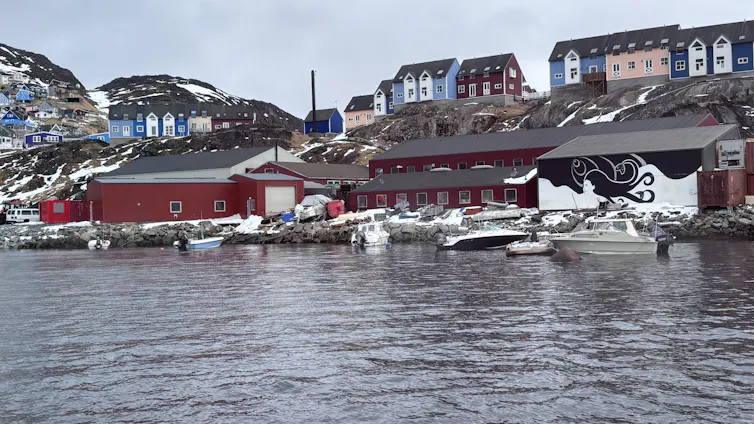
The town is part of the same Sanasa Art Route Project, and murals are visible across public spaces. One of them, Arferup Pania by Hollie Kielsen Olsen, interprets a Greenlandic myth about a girl abducted by a whale.
Kathrin Maurer, Author provided (no reuse)
This also relates to the famous Greenlandic myth, Sassuma Arnaa, meaning “mother of the sea”. The Sanasa Project website explains that in Olsen’s interpretation, the whale and the girl have a daughter, Arferup Pania, described as a symbol of beauty after a storm.
Olsen says that painting this mural was a way to connect her to her Greenlandic identity, and it made her feel positive about the future.
That is like what I experienced in South Greenland. Even in stormy times, these communities are finding beauty, reconnecting with their culture and rekindling hope through art.
This article was commissioned as part of a partnership between Videnskab.dk and The Conversation. You can read the Danish version of this article here.
You must be logged in to post a comment Login