




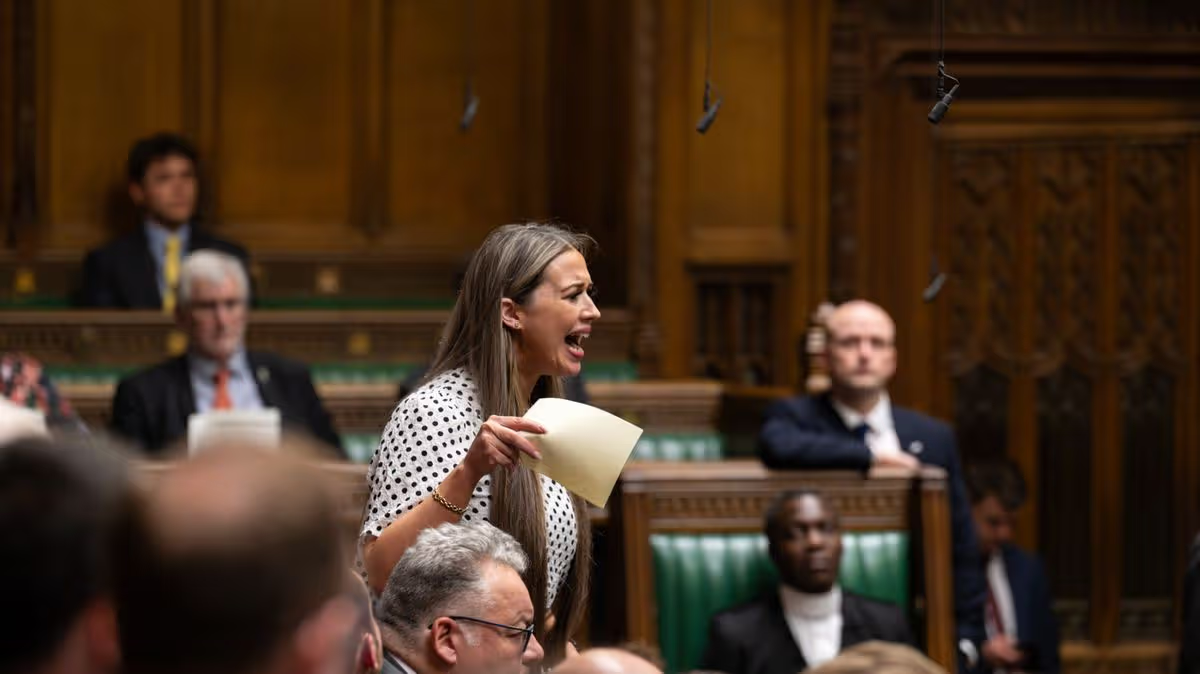
“We are operating in a political ecosystem where attention is the most valuable currency, and attention is not won through careful, methodical argument alone.”
Sorcha Eastwood knows exactly what she is doing and, for the most part, it is working.
Unless you have been living under a rock, you will have seen the Alliance Lagan Valley MP cutting through the noise in the House of Commons with a series of pointed, emotionally charged interventions on the Peter Mandelson scandal. The clips have travelled far beyond Westminster’s usual audience, racking up views, shares and commentary at a pace most politicians can only envy. That reach has brought with it an unusual coalition of praise, from mainstream observers to figures on the political fringes such as Tommy Robinson and Fox News commentator T. J. McCormick. That alone should give pause for thought, but it should not obscure what is actually happening here.
Sorcha Eastwood’s performances in the chamber are, undeniably, performances. The clip that first caught widespread attention, where she declared herself “indignant” and “outraged” at the Prime Minister’s handling of the affair, was delivered with the kind of intensity that felt closer to political theatre than procedural scrutiny. It was reminiscent, in tone if not in context, of the firebrand style associated with Bernadette Devlin in her early parliamentary days. I do not make that comparison lightly as it speaks to a tradition in Northern Irish politics where rhetoric is used as a tool for disruption. The uncomfortable truth is that disruption is now the point.
We are operating in a political ecosystem where attention is the most valuable currency, and attention is not won through careful, methodical argument alone. It is won through sharp, emotive, easily digestible moments that can be clipped, shared and consumed in seconds. Sorcha Eastwood understands this better than most. The cadence, the phrasing, the controlled flashes of indignation are not incidental. They are calibrated for an audience that increasingly experiences politics not through Hansard, but through a phone screen. That does not make it dishonest. But it does make it different.
There is a tendency, particularly among more traditional observers, to dismiss this style as superficial or even cynical. At Stormont, Edwin Poots has already raised concerns about MLAs delivering what he describes as “pre-scripted” contributions designed primarily for social media rather than genuine debate. The implication is that something essential is being lost when political speech is shaped with the algorithm in mind.
He is not entirely wrong. There is a risk that substance becomes secondary to delivery, that complex issues are flattened into viral soundbites, and that the chamber itself becomes little more than a backdrop for content creation. But the critique often stops short of acknowledging a more fundamental shift as the audience has moved and politics has followed.
If you want a message to land now, it has to travel. And to travel, it has to engage. I have seen this dynamic play out first-hand. Clips of parliamentary contributions, many of them from Sorcha Eastwood, have reached hundreds of thousands of viewers within hours on my own TikTok account, which has a relatively modest following. That level of engagement would have been unthinkable a decade ago for a backbench intervention. It changes the incentives, it changes how politicians communicate, and, crucially, it changes who is actually listening. In that context, theatricality is undoubtedly a strategy.
The question, then, shifts from whether politicians should perform to how far that performance should go. There is a line which is often blurred between emphasis and exaggeration and between clarity and distortion. When rhetoric outpaces reality, when outrage is deployed as a default rather than a measured response, the credibility that underpins effective communication erodes.
Sorcha Eastwood, to her credit, has not crossed that line in any obvious or sustained way. Her interventions, while heightened, remain anchored in a recognisable political argument. They are forceful without being incoherent, which is key as once the performance becomes the story, rather than the issue at hand, the entire exercise risks collapsing into noise.
There is also a broader political implication that should not be ignored. The amplification of these clips, particularly when they attract endorsement from figures well outside the mainstream, can create strange and sometimes uncomfortable alignments. Praise from the likes of Tommy Robinson risks reframing the message, whether intentionally or not, and places the speaker in a wider ecosystem of interpretation that they do not fully control.
Yet, for all of that, the underlying reality remains stubbornly simple. Politics that does not cut through does not register. And politics that does not register cannot influence, cannot persuade, and ultimately cannot deliver.
So yes, Sorcha Eastwood is performing. But she is performing in the service of being heard. The real challenge is not to retreat from that reality, but to navigate it with discipline. Theatricality can open the door, but it cannot carry the argument on its own. At some point, beyond the social media virality, the substance still has to stand up.
If Sorcha Eastwood and others who follow this model can maintain that balance, then this evolution in political communication may prove not just inevitable, but effective. If they cannot, then what looks like a breakthrough risks becoming little more than a well-lit distraction.
For all the latest news, visit the Belfast Live homepage here and sign up to our daily newsletter here.


















































You must be logged in to post a comment Login