Connect with us
DAPA Banner

NewsBeat

How the war in Iran is already affecting UK farmers and food production

Published

on

How the war in Iran is already affecting UK farmers and food production

The conflict in Iran and the disruption to the strait of Hormuz are already starting to affect UK farmers. The closure of this vital shipping route threatens supplies of two essential agricultural necessities: fuel and fertiliser.

The immediate impact on farmers has been a sharp increase in the cost of red diesel – the rebated fuel widely used in agriculture – which has already risen by approximately 60%, far outpacing increases seen at retail fuel pumps for car owners.

Concerns for farmers include the cost of fertiliser, particularly nitrogen. As the key nutrient driving growth in two key crop groups grown extensively in the UK, cereals and oilseeds, nitrogen is essential for achieving high yields. A wheat crop may require over 200kg per hectare during the growing season, depending on soil conditions, weather, and yield expectations.

The UK imports around 60% of its nitrogen fertiliser. Although much of this supply does not originate directly from the Middle East, global market dynamics mean prices are highly sensitive to disruptions. Around one-third of the global fertiliser trade passes through the strait of Hormuz, contributing to price increases of approximately £50 per tonne, compared to early 2025, and is expected to rise more if the conflict continues.

Advertisement

UK fertiliser traders are finding prices are changing so fast that they can’t update their daily lists. The NFU president Tom Bradshaw has raised concerns about farmers not being given a confirmed price until stocks are delivered.

While most farmers buy fertiliser in bulk ahead of the growing season, the longer-term outlook is already a concern.

Much will depend on the duration of Middle Eastern tensions and whether the strait reopens in time for fertiliser purchasing decisions this autumn, ready for next year’s crops.

Unlike the 2022 fuel price shock following the invasion of Ukraine – which was partially offset by higher commodity prices – current market conditions offer little expectation of improved crop prices.

Advertisement

Difficult calculations

Farmers are, therefore, being forced into difficult calculations: weighing the cost of nitrogen against likely crop prices, reassessing how to balance the crop’s agrochemical inputs, including fertiliser, and awaiting clarity on the future of Environmental Land Management Schemes (Elms). Elms are government schemes in England aimed at supporting farmers to make environmentally beneficial changes to their land.


À lire aussi :
How the Iran war could create a ‘fertiliser shock’ – an often ignored global risk to food prices and farming


Even before the current conflict started, industry bodies such as the National Farmers’ Union had raised concerns about the viability of arable farming under sustained cost pressures.

The government has also acknowledged these challenges, commissioning the Competition and Markets Authority (CMA) to investigate supply issues affecting fertiliser and agricultural fuel. The CMA has said it will monitor price rises caused by the current international conditions. In response to the crisis, the UK government has just announced proposals to support more varied types of fertiliser.

Advertisement

All these factors raise broader concerns for the UK, where food self-sufficiency stands at around 62% – a potentially precarious position in an increasingly uncertain global landscape.

Farming landscape

UK crops are currently looking generally robust, after a strong autumn with ideal conditions for sowing winter crops and a favourable start to spring. Early signs point to a promising 2026 harvest.

But optimism is tempered by ongoing economic pressure. Farm gate prices (the price if a customer bought direct from a farmer) remain stubbornly low, as UK farmers compete with imports produced under lower environmental and regulatory standards

Simultaneously, the transition away from legacy EU support payments has left a significant income gap. Replacement schemes under the Environmental Land Management Schemes were paused in 2025 and are only expected to resume later this year, creating further uncertainty.

Advertisement

The Department for Environment, Food and Rural Affairs (Defra) latest figures forecast average arable farm income fell to £17,000 in the year to February 2026 – the lowest level since 2004–05. The drop reflects a mix of difficult seasonal conditions and global oversupply in key crops such as cereals and oilseeds. Dairy farm income was much higher at £224,000 for the same period.

Fertiliser shortages are set to hit farmers around the world.

The industry is rapidly embracing innovation and the government is backing farmers with measures to strengthen fertiliser supply resilience. Together with rising costs, these shifts have helped drive a 50% reduction in nitrogen use over the past four decades.

Precision agriculture (which uses technology to refine decisions) has boosted efficiency further, enabling farmers to tailor fertiliser use to the needs of specific fields.

Advertisement

There are other potential innovations that could help. Tesco for example, is working with farmers and manufacturers to develop lower-carbon fertilisers made from food waste, algae, poultry manure, and industrial by-products.

Global fertiliser markets may be volatile, but in the short term shoppers are unlikely to see that uncertainty reflected in everyday food prices. A 2022 Sustain report, found that farmers often receive less than 1% of the profit from supermarket sales, meaning their tiny share leaves little room for fertiliser costs to influence the final price on the shelf. For now, any rise or fall in the price of bread, flour, cakes or biscuits is far more likely to come from supermarket pricing tactics or broader supply‑chain pressures than from shifts in global fertiliser markets.

That’s not to say fertiliser costs never filter through – a prolonged conflict could still nudge prices up for shoppers. Crops respond dramatically to fertiliser levels, so even modest reductions in nitrogen use can produce disproportionately large declines in yield. All that could translate into thousands of tonnes of lost crops, which would make food more expensive in the future.


Advertisement

Source link

Continue Reading
Click to comment

You must be logged in to post a comment Login

Leave a Reply

NewsBeat

East Kilbride group receive funding to create Regulation Room

Published

on

Daily Record

With help from the council’s Participatory Budgeting (PB) Fund, East Kilbride organisation Little Brains has created the sensory-regulation space that is able to be used in a calm, dignified way by young people and adults with any level of support needs.

A Regulation Room has been created at an East Kilbride group’s premises to help people of all ages decompress when the world feels too much.

Advertisement

With help from the council’s Participatory Budgeting (PB) Fund, East Kilbride organisation Little Brains has created the sensory-regulation space that is able to be used in a calm, dignified way by young people and adults with any level of support needs.

The organisation’s ASN support groups help families with children aged from five to 16. They currently engage with 67 children with additional support needs, improving their wellbeing, confidence, and inclusion through weekly sessions including sensory spaces, games, crafts and external workshops that build friendships, develop social and emotional skills, and allow them to benefit from sensory regulation.

They also support parents though creating a vibrant, strong, inclusive and compassionate community that enables them to feel less isolated and more supported.

Louise Keegan, Project Director at Little Brains, said: “Spaces like the Regulation Room are not a ‘nice extra’ for our community. For many of the families and individuals who come through our doors, access to a safe, regulated environment is essential for emotional wellbeing, participation and feeling respected rather than managed.

Advertisement

“It means people can stay longer, engage more fully and leave feeling safer and more settled.

“Awards like this one make a huge difference because they allow us to create things that are truly special for our families without taking away from the funds that keep our doors open week to week.

“This support from the Participatory Budgeting Fund hasn’t just helped us improve a room. It has helped us improve experiences, dignity and emotional safety for the people who need it most, and for that we are deeply thankful.”

READ MORE: SGN investing £1.3m to upgrade gas network in East Kilbride

Advertisement

Jackie Taylor, Executive Director of Finance and Corporate Resources at South Lanarkshire Council, said: “I’m delighted that the Little Brains has been able to use this money to support local people in such a meaningful and effective way.

“As ever, it’s this community-led approach that makes the Participatory Budgeting process so unique; it genuinely hands the decision-making power to those ideally placed to identify local priorities.

“I thank and congratulate everyone, both in our communities and in the council, who work hard together to foster such a spirit of democracy and togetherness.”

More information about Participatory Budgeting is available from the Community Planning website.

Advertisement

READ MORE: East Kilbride couple tell of sheltering in hotel during Middle East conflict

*Don’t miss the latest headlines from around Lanarkshire. Sign up to our newsletters here.

And did you know Lanarkshire Live had its own app? Download yours for free here.

Source link

Advertisement
Continue Reading

NewsBeat

24 Hours in Police Custody fans horrified by grisly case with shocking twist

Published

on

Cambridgeshire Live

Channel 4’s 24 Hours in Police Custody featured a two-part special which saw a missing person case quickly turn into a murder investigation with an unlikely suspect

Channel 4 viewers were left stunned by one of the “grimmest” episodes of police documentary 24 Hours in Police Custody ever broadcast.

During a two-part special of the true crime programme, what began as a straightforward missing person case evolved into a harrowing murder investigation with an unexpected perpetrator. This article will contain spoilers for the 2025 episode.

Advertisement

Last year, 24 Hours in Police Custody followed Bedfordshire Police as they investigated the disappearance of 74-year-old Annette Smith. Annette had last been seen by her lodger, who stated she had gone away “for a few days” with a friend but raised the alarm when she didn’t come back or respond to his calls.

The lodger in question, Scott Paterson, was characterised as being “like a son” to Annette following 15 years of living with her and providing care after she had suffered a stroke.

It soon became apparent that Paterson was involved in far more than he was admitting, and viewers were quick to piece together what had happened.

Advertisement

When his confession came, however, Paterson stated it was simply becoming too challenging to continue looking after Annette. He informed police he had suffocated her after she became “very demanding” – and maintained he had an emotional breakdown after contemplating the killing for weeks.

However, a shocking turn of events was imminent as police conducted further investigations. It quickly became evident that Paterson had been dishonest about his motives, which seemed to be financially driven. He had been pilfering jewellery from Annette and pawning it – with police speculating this could have been his motive for her murder, reports the Express.

The case took an even more sinister turn when Paterson – who worked as a butcher, earning him the moniker the Butcher of Suburbia – confessed to dismembering Annette’s body and disposing of the parts in public rubbish bins around town.

Advertisement

Despite having no previous convictions and being spoken highly of by friends, when asked by police if he had ever killed anyone else, his response was chilling – but you’ll need to watch the episode to discover more.

Paterson admitted guilt to Annette’s murder in November 2024 and received a minimum sentence of 20 years in prison.

24 Hours in Police Custody: The Butcher of Suburbia Part 1 and Part 2 are now streaming on Channel 4’s catch-up service.

Source link

Advertisement
Continue Reading

NewsBeat

US lawmaker asks Sarah Ferguson to testify over ‘close Epstein ties’

Published

on

US lawmaker asks Sarah Ferguson to testify over 'close Epstein ties'

In the letter, which was sent to Ferguson on Thursday and set a two-week deadline for her to respond, Democratic Congressman Subramanyam, a member of the House Oversight Committee, said the recent drop of Epstein files by the US Department of Justice had revealed her “close personal and business ties” with the American financier.

Source link

Continue Reading

NewsBeat

Trump claims CIA told him Iran’s new supreme leader ‘is gay’ in Fox News interview

Published

on

Daily Mirror

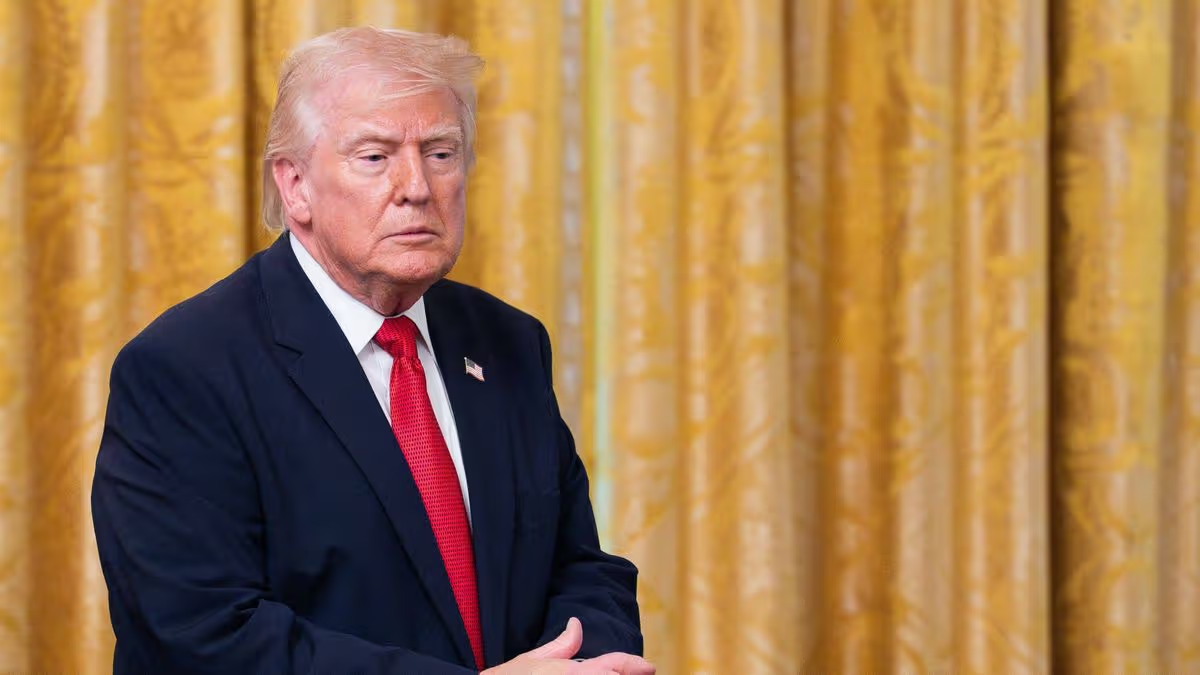
Donald Trump has claimed the CIA told him Iran’s new supreme leader Mojtaba Khamenei ‘is gay’ during a Fox News interview where he also discussed Iran’s treatment of LGBTQ people

US President Donald Trump has alleged that the nation’s foreign intelligence service informed him that Iran’s new leader “is gay.”

In an interview with Fox News, when asked if the CIA had told Mr Trump that Ayatollah Jr. is gay, Mr Trump responded: “They did say that… I think a lot of people are saying that – which puts him off to a bad start in that particular country.”

Mojtaba Khamenei was named Supreme Leader of Iran following the death of his father Ayatollah Ali Khamenei, who was killed by US and Israeli forces at the onset of the conflict in the Middle East. The US and Israel launched joint attacks on Iran on 28 February. In response, Iran has struck key targets throughout the Middle East, causing turmoil in the region.

Advertisement

Ayatollah Jr. was chosen to lead the country by senior clerics in a system where homosexuality is punishable by death.

According to Fair Planet, a global non-profit organisation focused on reporting on human rights and environmental justice: “Homosexuality is illegal in Iran and carries severe punishment under the country’s Islamic penal code.

“Consensual same-sex sexual activity is considered a crime, and those convicted can face imprisonment, flogging, and even the death penalty.

Advertisement

“The Iranian government has justified its stance on homosexuality by citing religious and cultural reasons, claiming that homosexuality is a sin and goes against Islamic values.”

Mr Trump said during the interview, while referring to the “Gays for Palestine” movement, “They kill gays. They kill them instantly. They throw them off buildings.”

He continued by saying that he actually polled “very well” with the LGBTQ community – even highlighting that the song he used for rallies, ‘YMCA’ by the Village People, is a ‘gay national anthem’.

“No Republican’s ever gotten the gay vote like I did and I’m very proud of it,” he said.

Advertisement

Source link

Continue Reading

NewsBeat

Permanent post office to open doors on Monday in Haxby

Published

on

Permanent post office to open doors on Monday in Haxby

Liberal Democrat councillors in Haxby have met with Postmaster Aran Singh to take a look inside the town’s new Post Office ahead of its official opening on Monday, March 30 at 1pm.

The opening comes after a temporary post office was set up at the Oaken Grove Community Centre after the Morrisons Daily branch, which housed the previous post office, closed last May following nationwide cuts by the supermarket. 


RECOMMENDED READING:


The new post office will open its doors in the former Dutch Nurseries store, close to the Haxby Surgery.

Advertisement

Haxby and Wigginton’s ward councillors, who were part of the campaign to reopen a permanent post office in the town, have welcomed the news.

Haxby and Wigginton’s ward councillors (Image: York Liberal Democrats)

Councillor Andrew Hollyer said: “It’s fantastic to see the new post office ready to open its doors on Monday. After months of hard work to secure this vital service, it’s great that residents will once again have a permanent facility on The Village. 

“We would also like to thank Oaken Grove Community Centre for hosting the temporary post office, the staff who kept services running during that time, and Haxby Town Council for helping to fund the temporary provision.” 

Advertisement

Source link

Continue Reading

NewsBeat

UK named less safe than many EU countries for US travellers in official advice

Published

on

UK named less safe than many EU countries for US travellers in official advice

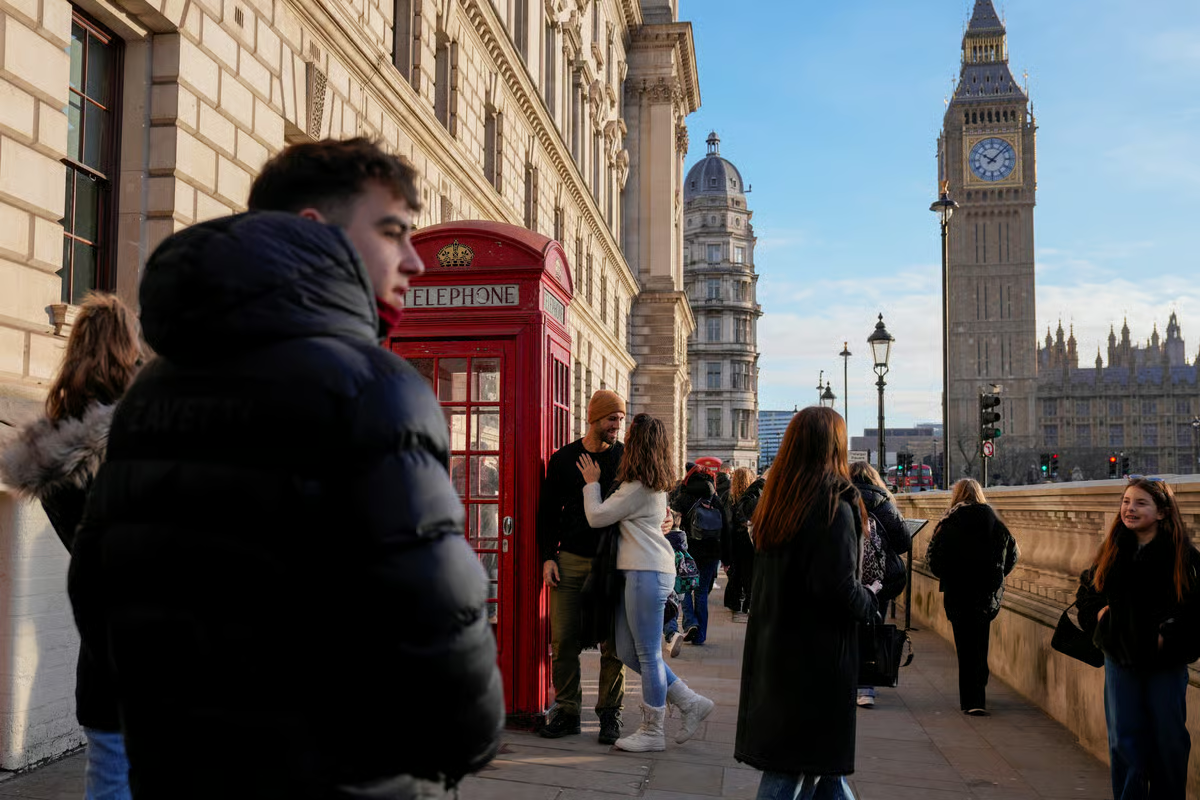
The UK has been categorised as a “Level 2” destination for American travellers in the latest update from the US State Department, placing it behind a number of European countries deemed safer for tourists.

Under the advisory system, Level 2 destinations are those where visitors are urged to “exercise increased caution”, a step above the lowest Level 1 ranking, which advises travellers to take normal precautions.

Source link

Continue Reading

NewsBeat

Liverpool hotel fire: Guests flee as blaze breaks out behind Radisson Blu

Published

on

Manchester Evening News

Four fire engines, ambulances and police rushed to the Radisson Blu Hotel on Old Hall Street after a fire broke out behind the building on March 26

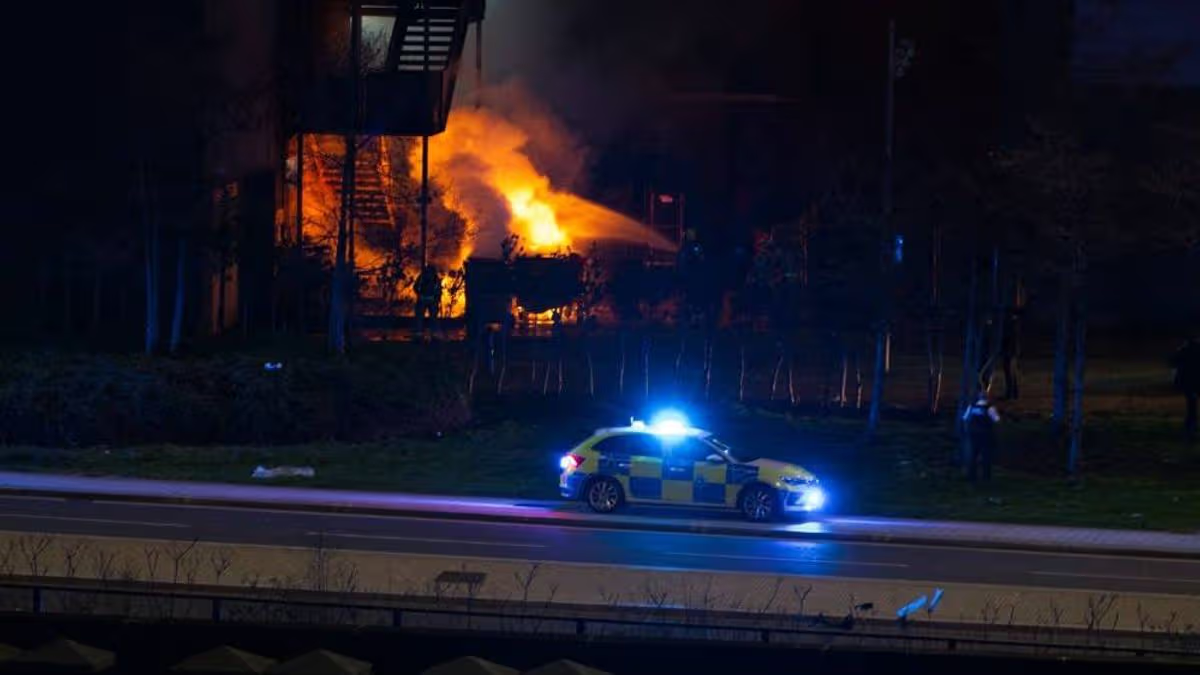
A fire at the rear of a city centre hotel resulted in plumes of smoke billowing into the air. The blaze erupted behind the Radisson Blu Hotel on Old Hall Street this evening, 26 March.

Guests and staff at the Radisson Blu poured onto the street as fire alarms were triggered, congregating outside as emergency services rushed to the scene. Four fire engines, police cars, numerous ambulances and rapid response vehicles, as well as two NHS Incident Response Units, arrived at the street around 8.30pm, reports the Liverpool Echo..

Advertisement

The back of the hotel was cordoned off as firefighters tackled the blaze, which seemed to have ignited in a wheelie bin near a set of stairs.

Ensure our latest headlines always appear at the top of your Google Search by making us a Preferred Source. Click here to activate or add us as Preferred Source.

One female Radisson Blu guest, clad only in a short-sleeved T-shirt and leggings, said: “The smoke somehow got inside and the alarms were all going off. They tried to turn it off but they couldn’t get it off, so everybody’s out here now in the cold.

“I think we’ve been out now more than an hour. I don’t know what they are doing.”

Advertisement

“I was sleeping when I heard the alarm. I didn’t take my phone, my jacket, even my socks. I was just running all the way down.”

Other guests returned to the hotel after spending time in the city centre, only to discover the street swarming with police and paramedics. One man said: “As we came around it was a bit of a shock. We could smell something burning in the air.”

Photographs taken at the scene depicted flames and smoke emanating from the rear of the hotel. Additional images showed firefighters amidst a number of fire-damaged wheelie bins, situated behind the hotel off King Edward Street.

Advertisement

One end of Old Hall Street, at the junction of Leeds Street, King Edward Street and Great Howard Street, was cordoned off by police. Brook Street near HM Passport Office was also obstructed by fire engines responding to the incident.

All ambulances had departed the scene by approximately 9.20pm. Radisson Blu guests and staff were permitted to re-enter the hotel at around 9.30pm, and Old Hall Street was reopened to traffic.

Two police cars and several fire engines remained on site. Merseyside Fire and Rescue Service was contacted for comment.

Source link

Advertisement
Continue Reading

NewsBeat

Iran-US war latest: Trump extends pause on power grid strikes as Pentagon reportedly weighs sending 10,000 more troops to region

Published

on

Iran-US war latest: Trump extends pause on power grid strikes as Pentagon reportedly weighs sending 10,000 more troops to region

UN Security Council to meet about Iran: report

The United Nations’ Security Council will hold a closed-door meeting Friday to discuss US-Israeli attacks on civilian infrastructure in Iran, two UN diplomats told the Associated Press.

Rachel Dobkin27 March 2026 02:17

Advertisement

Trump claimed Biden’s secretary of state supported his attacks on Iran. Antony Blinken says that didn’t happen

“I’ve heard that today Blinken made a statement that he should have done it. Thanks a lot Blinken, I appreciate it”, Trump said. “But he came out with the statement that they should have done it, they made a mistake”.

Blinken took to X Thursday, writing that Trump “cited me as supporting his attack on Iran and expressing regret we didn’t do it during the Biden Administration. Except I didn’t”.

Rachel Dobkin27 March 2026 02:00

Advertisement

No press conference with Pete Hegseth scheduled this week

There will be no press conference with US Defense Secretary Pete Hegseth and General Dan Caine, the chairman of the Joint Chiefs of Staff, this week, the Pentagon said, per The New York Times.

Admiral Brad Cooper, the leader of U.S. Central Command, did give a video update Wednesday, in which he said American forces have hit more than 10,000 military targets since the Iran war began more than three weeks ago.

Rachel Dobkin27 March 2026 01:45

Advertisement

In pictures: A woman holds a portrait of Iran’s late Supreme Leader during a protest outside Iran’s embassy in Beirut, Lebanon

In pictures: A woman holds a portrait of Iran’s late Supreme Leader during a protest outside Iran’s embassy in Beirut, Lebanon

Protesters outside Iran’s embassy in Beirut, Lebanon (AP)

Bryony Gooch27 March 2026 01:30

‘It’s Orwellian’: The information war being waged to keep the ‘Dubai dream’ alive

It was the influencer capital of the world, a photogenic playground for the young, glamorous and wealthy. But as Iranian missiles fall on Dubai, the largest and most ostentatiously luxe city in the United Arab Emirates, the facade seems about to crack.

Advertisement

The city once touted as one of the safest places in the world is no longer a peaceful haven. And the UAE government has rushed to try and control the narrative, prompting a huge crackdown on anyone sharing photos of missile attacks and their aftermath. Instead, content creators have been posting uncannily similar photos and videos full of praise, parroting buzzwords about the city’s strong, stable leaders.

How can influencers continue to portray the “Dubai dream” online, when the whole world knows that the city has been mired in conflict? And what about the ordinary people who are being detained for sharing photos and videos that go against the official line?

Katie Rosseinsky has the story…

Bryony Gooch27 March 2026 01:00

Advertisement

Trump considers sending another 10,000 troops to Middle East: report

US President Donald Trump is considering sending another 10,000 troops to the Middle East amid the Iran war, The Wall Street Journal reported Thursday night local time, citing US defense officials.

The potential deployment would probably include infantry and armored vehicles, according to the publication.

The Independent has reached out to the Pentagon for comment.

Advertisement

The US has already sent thousands of Marines and paratroopers to the region to help with the war effort.

Rachel Dobkin27 March 2026 00:45

JD Vance meeting with Qatar’s prime minister: report

US Vice President JD Vance is currently meeting with Qatar’s Prime Minister Sheikh Mohammed bin Abdulrahman Al Thani, NewsNation White House Correspondent Libbey Dean has reported, citing an unnamed source.

Advertisement

“A range of foreign policy issues are expected to come up, including Iran and Gaza — with talks focused on defense cooperation, protecting energy infrastructure, and collaborating on freedom of navigation, per source”, Dean wrote on X Thursday night.

Rachel Dobkin27 March 2026 00:30

UK faces biggest hit to growth from Iran war of all major economies, OECD warns as inflation set to surge

Bryony Gooch27 March 2026 00:00

Advertisement

Pentagon prepares for massive ‘final blow’ of Iran war

The Pentagon is developing military options for a “final blow” in Iran that could include the use of ground forces and a massive bombing campaign, two US officials and two sources with knowledge told Axios.

The news outlet reported four potential “final blow” options Trump could choose from:

  1. Invading or blockading Kharg Island, Iran’s main oil export hub.
  2. Invading Larak, an island that helps Iran solidify its control of the Strait of Hormuz. The strategic outpost hosts Iranian bunkers, attack craft that can blow up cargo ships and radars that monitor movements in the strait.
  3. Seizing the strategic island of Abu Musa and two smaller islands, which lie near the western entrance to the strait and are controlled by Iran but also claimed by the UAE.
  4. Blocking or seizing ships that are exporting Iranian oil on the eastern side of the Hormuz Strait.

Bryony Gooch26 March 2026 23:01

Advertisement

Trump lashes out at Nato again and claims alliance has done ‘absolutely nothing’ to help in Iran

Bryony Gooch26 March 2026 22:00

Source link

Continue Reading

NewsBeat

Could this energy crisis be worse for the global economy than COVID?

Published

on

Could this energy crisis be worse for the global economy than COVID?

Despite reports of negotiations between the US and the Iranian regime, the Strait of Hormuz remains effectively closed to most oil tankers, with only a small number of vessels being allowed to pass. The result is a loss of roughly 11 million barrels per day (mbd) of oil and petroleum liquids to the global market. This represents just over 10% of global supply.

At first glance, a 10% disruption may not sound catastrophic. But in oil markets, even a 10% imbalance between supply and demand can have very large economic effects.

To understand the scale of the disruption, it is useful to compare it with the height of the COVID pandemic in 2020. During global lockdowns, empty roads, grounded aircraft and deserted bus and railway stations became normal as travel and economic activity collapsed. At that time, global oil demand fell by about 8mbd, the largest demand shock in history.

Today’s situation is the opposite. Instead of a collapse in demand, the world is experiencing a large supply shock. But the impact on everyday life could end up looking similar: reduced travel, higher transport costs, slower economic activity and pressure on household budgets.

Advertisement

The reason is that both oil supply and oil demand are very inflexible in the short term. People still need to drive to work, goods still need to be transported and aircraft still need fuel. When supply falls suddenly, prices must rise significantly to force demand down.

For now, the release of emergency oil stocks is helping to cushion the initial impact, particularly in developed economies. Members of the International Energy Agency (IEA) are required to hold emergency stocks equivalent to at least 90 days of oil consumption, and several countries also maintain strategic petroleum reserves.


À lire aussi :
These are shaky times for oil markets. An expert explains what a prolonged war will mean for prices


Countries such as the US, China and Japan can therefore offset supply disruptions for a limited period. However, these reserves are not a long-term solution. If the conflict continues for months rather than weeks, stockpiles will be depleted.

Advertisement

The situation is much more serious for developing countries. Many countries in Asia, Africa and South America hold very limited commercial reserves and are much more vulnerable to supply disruptions and price spikes. For these economies, elevated oil prices quickly translate into higher food prices, inflation and economic instability.

The first shortages would probably appear not in petrol, but in diesel and jet fuel. Gulf oil producers are major exporters of middle distillates, and their crude oil grades produce large quantities of diesel and jet fuel when refined.

Jet fuel could be one of the first commodities to be hit.
Benjamin_Barbe/Shutterstock

Diesel is particularly important because it fuels trucks, ships, construction equipment and agricultural machinery. So a diesel shortage affects food supply, construction, mining and global trade – not just transport. Petrol shortages would follow as crude oil supply tightens further, and eventually shortages would spread across all petroleum products.

Advertisement

Oil is not just used for transport fuel. It is also a key input into petrochemicals for the production of plastics, fertilisers, chemicals, synthetic materials and many industrial processes. This means the effects of a major oil supply disruption spread across the entire economy.

Shortages or price increases could affect everything from food production and packaging to electronics, construction materials and clothing. The economic effects of an oil shock are therefore much broader than simply higher petrol prices.

Protectionism could make everything worse

One of the biggest risks during a supply crisis is export restrictions and protectionism. Governments often try to protect domestic consumers by freezing prices and banning exports of fuel or crude oil, but this usually makes the global shortage worse.

Government price freezes only discourage production and supply, and encourage consumers to keep burning fuel. Protectionism is even worse. There are already signs of this happening – some countries (China, for example) are restricting exports of petroleum products such as diesel and jet fuel. When countries hoard fuel, global markets become tighter and prices rise even further.

Advertisement

The biggest risk would be if the US restricted oil exports in order to protect domestic consumers. The US is now the world’s largest oil producer, producing more than 20mbd of oil and petroleum liquids. But it is also one of the world’s largest consumers. However, it still exports significant volumes, particularly to Europe.

The US has banned oil exports before. In 1975, following the Arab oil embargo (when in 1973 Arab states refused to supply oil to countries, including the US, that had supported Israel in the Yom Kippur war), the US banned exports of crude oil. The ban was lifted only in 2015. If such a ban were introduced today, it would be likely to cause major supply shortages and price increases, especially in Europe.

If the Strait of Hormuz remains closed for a prolonged period, or if the conflict escalates further, global losses of exports from the Persian Gulf could approach the 20mbd of oil and petroleum products.

Under these circumstances, the economic and social effects could be severe. Transport could become more expensive and less frequent, air travel would be severely curtailed, inflation would rise and economic growth would slow significantly. In extreme scenarios, the disruption to daily economic life could resemble the COVID period (and probably worse). But this time it would be caused by a shortage of energy.

Advertisement

For now, markets are relying on emergency stock releases and hopes of a geopolitical de-escalation. But if not, the world economy could face an unprecedented energy shock, with far-reaching and unpredictable consequences.

Source link

Advertisement
Continue Reading

NewsBeat

Itauma vs Franklin: Date, fight time, undercard, prediction, ring walks and latest odds

Published

on

Itauma vs Franklin: Date, fight time, undercard, prediction, ring walks and latest odds

The British heavyweight phenom steps up for what should be the toughest test of his professional career to date as he continues on his rapid ascent to boxing superstardom.

Now fully recovered from a bicep tear suffered while sparring, the big-hitting southpaw, 21, is ready to deliver another emphatic statement in what he has called the “final piece of the puzzle” before eyeing huge fights and world title opportunities.

He ruthlessly dispatched of Mike Balogun in two rounds in Glasgow before that as part of a nine-fight streak of early stoppages that also included vanquishing the likes of Demsey McKean and Mariusz Wach.

Itauma is expected to face a trickier challenge against Franklin, the tough and durable American heavyweight who has never previously been stopped in his 26-fight career.

Advertisement

The 32-year-old is 24-2 overall, with his only losses to date coming in consecutive outings in London in 2023.

Moses Itauma stopped Dillian Whyte inside the first round in his last fight

Getty Images

Source link

Continue Reading

Trending

Copyright © 2025