Connect with us

NewsBeat

How the well-heeled residents of Sawbridgeworth did what the police couldn’t… and saw off a bank holiday traveller ‘land grab’ fuelled by prosecco and cake

Published

on

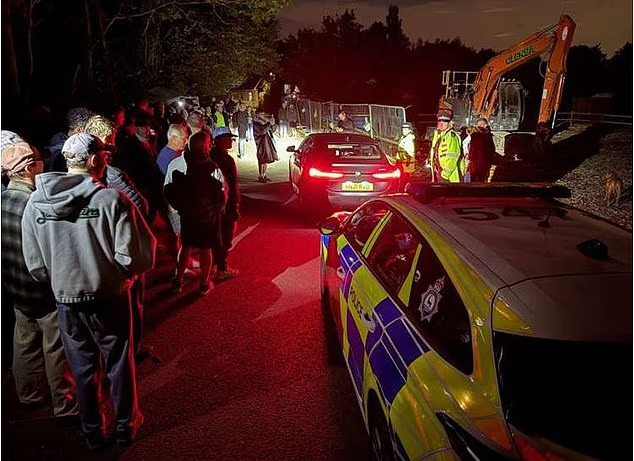
Police cars arrived at the site in Sawbridgeworth at 12.30am on Bank Holiday Monday, where diggers had begun work on the land

In the early hours of Bank Holiday Monday, Nina Johnson-Marshall, a senior planning enforcement officer, was given a ‘blue-light’ police escort through the highways and byways of Hertfordshire.

In her possession was a High Court injunction which had just been issued, out of hours, by a duty judge.

The destination was Sawbridgeworth, a genteel market town near Bishop’s Stortford, which had been invaded by travellers over the weekend. The all-too familiar incursion received extensive media coverage.

Few outside this small corner of Hertfordshire, however, will be aware of the drama – reminiscent of a scene from a film – involving Ms Johnson-Marshall and her race against the clock to serve the injunction.

Advertisement

The travellers had already covered the plot of greenbelt land, a habitat for wildlife, with hardcore and were planning to occupy the site permanently with mobile homes and caravans.

Had this happened they would probably still be there today, having applied for retrospective planning permission and exploiting every loophole in the human rights legislation playbook.

The law is overwhelmingly on their side. Residents in other parts of the country will bear testament to this.

Not this time.

Advertisement

Police cars arrived at the site in Sawbridgeworth at 12.30am on Bank Holiday Monday, where diggers had begun work on the land

A concrete base had been laid on the site alongside fencing over the bank holiday weekend

A concrete base had been laid on the site alongside fencing over the bank holiday weekend

Planning enforcement officer Nina Johnson-Marshall arrived by car at the site at 12.30am with a High Court injunction following a ‘blue-light’ police escort through Hertfordshire

Planning enforcement officer Nina Johnson-Marshall arrived by car at the site at 12.30am with a High Court injunction following a ‘blue-light’ police escort through Hertfordshire

Advertisement

At precisely 12.30am on August 31, when Ms Johnson-Marshall arrived in Sawbridgeworth accompanied by a police patrol car and posted a copy of the injunction on the newly erected wooden perimeter fence of the as-yet-uninhabited encampment, what until then had been a civil case became a matter for the police. 

The order gave officers at the scene the power of arrest if there was further ‘development’ on the grassland next to Sheering Mill Lane, and prohibited ‘the occupation of any caravans, vehicles or mobile homes’.

These were some of the wide-ranging restrictions imposed by the judge following a campaign by residents who blocked the entry to the site.

One of the main reasons for his decision was because he heard that someone on the encampment had used an offensive term to describe a Jewish protester, who was then told menacingly: ‘I am going to follow you home and burn your house down.’

Advertisement

Those who did not comply with the order were warned they could be held in ‘contempt of court’ and be ‘imprisoned, or fined’ or their ‘assets may be seized’.

At 9am, before the unwelcome visitors had time to install their accommodation, the area was cleared, without incident, by the police, to the cheers and applause of locals who watched the convoy of vans and trucks with heavy machinery leave the area.

‘All gone,’ announced Greg Rattey, a local councillor and a former mayor of Sawbridgeworth, on Facebook. ‘What a fantastic united community we are. Well done everyone.’ 

Behind this almost unprecedented victory – it’s hard to remember such a successful legal outcome elsewhere – is the inspiring story of how the good people of Sawbridgeworth, known locally as ‘Sawbo’, mobilised to save their town from the scourge of those travellers who have blighted communities with threatening, intimidatory and anti-social behaviour.

Advertisement

One day they really might make a movie or TV special about it. There is already an obvious title: The Battle of Sheering Mill Lane.

Surely Nina Johnson-Marshall, from East Hertfordshire District Council, would get a leading role. How many provincial planning officials have been ‘blue-lighted’ in the line of duty?

The real stars of the saga, though, are the law-abiding taxpayers of Sawbridgeworth, which has a population of just over 10,000, and was best known, until now at least, for its links with the world of celebrity.

‘Beckingham Palace’, the former country estate of David and Victoria Beckham, is located here and Sir Rod Stewart and his wife Penny Lancaster, who live a little over a mile away, have been spotted walking along the quaint streets of the town with shops such as Christine’s (‘traditional home baking’), The House of Harlequin Boutique (‘ladies fashion & accessories’) and Violets Floral Designs.

Advertisement

In this genteel setting, it was incongruous to see the ‘site manager’ – a bare-chested, tattooed man drinking a can of beer.

He and his ilk underestimated the grit and spirit of the opposition in Sawbridgeworth.

Almost within minutes of lorries arriving with diggers and hardcore at the start of the bank holiday break last Friday, when workmen began excavating, installing fencing, and felling trees on the site, the alarm was sounded on WhatsApp and Facebook and a very middle-class protest swung into action.

Soon hundreds of residents were manning the ‘front line’ in Sheering Mill Lane. Prosecco was served along with teas and coffees and cakes. There was music and even a ‘pub quiz’ at 4am.

Advertisement

Many camped out overnight in five-hour shifts.

Among those who answered the call was a Girl Guides leader, a semi-retired City worker with his ‘Westie’ highland terrier Bianca and 72-year-old retired postmistress Margaret Shields. 

At the same time, a crack team of litigation lawyers, including a barrister lauded by industry bible Legal 500, was assembled by the local authority, which described the operation as a ‘masterclass in effective collaboration’ between the community and the council.

All in the space of 72 hours over the bank holiday when town halls are shut. Hence the reason why so many ‘land grabs’ occur during this period.

Advertisement
The site was previously a wildlife-rich floodplain next to a rare chalk stream

The site was previously a wildlife-rich floodplain next to a rare chalk stream

Police officers at the site, standing near a caravan parked at the wildlife haven

Police officers at the site, standing near a caravan parked at the wildlife haven

‘We cannot let these travellers do what they want,’ was the battle cry from a resolute Ms Shields.

‘If we don’t stand up to them, then who will?’

Advertisement

It has not come without cost, however. The land, a wildlife-rich floodplain next to a rare chalk stream, which attracts muntjac deer, has been all but destroyed and will require a small fortune to restore to its natural state. 

The question residents are now asking is: who ‘sold out’ Sawbridgeworth?

Two men – Leonard Richards and Darren Glover – were named on the injunction, along with ‘persons unknown’, as the registered owners of the two parcels of land at the site, but the legal papers also make it clear that ‘one or both’ may ‘ultimately be removed as defendants’ because the Land Registry hasn’t been updated.

So exactly who owns the land, and who is responsible for selling the grassland to travellers remains unclear.

Advertisement

Mr Richards, 55, who lives in Dunmow, Essex, acquired his plot for £20,000 in 2003 and runs a successful driveway and road surfacing company. 

Town councillors described him as a ‘reputable businessman’ whose firm has been used by the authority itself. 

Mr Richards said that after taking legal advice he was unable to comment.

Mr Glover, for his part, bought his share of the site, where the majority of the hardcore is understood to have been laid, for £150,000 in December 2023, the Daily Mail has established.

Advertisement

He confirmed, when contacted, that he had sold the land ‘a year to 18 months ago… through word of mouth and a little bit of advertising’.

Mr Glover, from Basildon, added: ‘A police officer rang me over the encampment. I said the land was not mine any more and I hadn’t a clue what was going on.’ 

He buys land ‘now and again’, he said, as an investment but would have to check who the buyers were in this case with his solicitor.

Mr Glover didn’t get back to us with an answer.

Advertisement

Will the ‘Battle of Sheering Mill Lane’ set a precedent in the case of future ‘land grabs’?

What makes the Sawbridgeworth campaign so impressive is that it succeeded in the face of the law as it currently stands.

Four heavy-duty diggers and a caravan parked in one of five plots of line created by fencing

Four heavy-duty diggers and a caravan parked in one of five plots of line created by fencing

A JCB digger parked inside wooden fencing used to divide the site into plots of land

A JCB digger parked inside wooden fencing used to divide the site into plots of land

Advertisement

Evidence – including witness statements, site photos, proof of land ownership – has to be collected in an almost impossibly short space of time to satisfy a duty judge that the situation is so serious that enforcement action cannot wait until the next day.

Local Labour MP Josh Dean raised the issue with Andy Burnham on his first day in the Commons as Prime Minister. 

‘Thanks to our community’s exceptional response, East Herts Council was able to move quickly and secure an injunction,’ Mr Dean told the House. ‘But across the country, this is sadly the exception and not the rule.’

He has asked for a meeting with the PM to discuss ‘why we need to change the law to ensure police and local authorities have the right powers’.

Advertisement

Those powers are sadly lacking at the moment.

The Catch-22 at the heart of the ‘land grab’ scandal is that the sites which travellers occupy have invariably been legally purchased so they cannot be removed for trespassing.

And ‘stop notices’, if the recent past is anything to go by, are not worth the paper they are written on. They are routinely ignored without consequence. Police simply have a ‘watching brief’ in these circumstances to ensure there is no disorder.

The bottom line is that councils are effectively powerless to do anything in the vast majority of cases.

Advertisement

A ‘stop notice’ was flagrantly ignored in Sawbridgeworth but the crucial difference here was the size of the protest in Sheering Mill Lane, prompting the police to seal off the single-track 20mph road at one point, which largely prevented anyone from bringing caravans on to the site and bought time for an injunction to be obtained.

That, and the willingness of the community to come together and mobilise quickly.

The first signs of the invasion were spotted last Friday by the aforementioned owner of Bianca the ‘Westie’.

I bumped into him near his home after Sawbridgeworth returned to normality. The 68-year-old asked to remain anonymous because he and his wife, he said, had been ‘threatened and abused’ by travellers (residents spoke of those who made ‘gun fingers’ and throat-slitting gestures) who deliberately parked trucks and cars outside his home and those of fellow protesters.

Advertisement

His suspicions were aroused when he saw a truck heading towards the site. He alerted a councillor who was also a neighbour and they went to investigate. 

A ‘workman’ they encountered at the scene insisted only a small section of the pavement was going to be tarmacked.

‘You’re having a laugh,’ the pensioner told him before becoming a stalwart on the ‘front line’.

The protest was expertly coordinated, with residents performing different roles.

Advertisement

Dominic Connor, 64, a tech journalist, made it his job to lobby companies delivering materials to the site. 

‘My time was best spent disrupting their supply chain,’ he said. One of the firms in question was Harlow Fencing.

‘We were led to believe the site was a legitimate new-build development and supplied materials in good faith,’ the company said on social media.

‘As soon as concerns were brought to our attention, we stopped all further deliveries.’

Advertisement

Meanwhile, business manager Alex Williams, 45, was involved in mobilising support using Facebook and WhatsApp, where the opposition swelled to 700.

‘People power is the only way to stop these developments,’ he said.

He’s right, unfortunately, because councils are unlikely to be given the badly needed new powers they need any time soon.

  • Additional reporting: Isaac Crowson and Tim Stewart

Source link

Advertisement
Continue Reading
Click to comment

You must be logged in to post a comment Login

Leave a Reply

NewsBeat

Hundreds of balaclava-clad protesters blockade Dover ‘in anti-migrant demonstration’ – as P&O warn holiday-makers of delays and police move in

Published

on

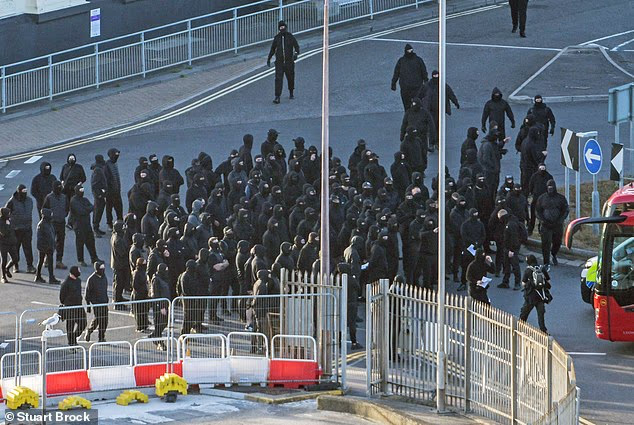
Balaclava-clad protesters have blocked roads leading to the Port of Dover in a suspected anti-migrant demonstration, sparking warnings of delays for holidaymakers

Hundreds of balaclava-clad protesters have blocked roads leading to the Port of Dover in a suspected anti-migrant demonstration, sparking warnings of delays for holidaymakers.

The group, dressed largely in black with their faces obscured, gathered around the ferry terminal on Saturday morning and blocked traffic in and out of the port.

One witness visiting the area said police appeared to be heavily outnumbered as hundreds of protesters descended on the town. 

Kent Police said officers were dealing with an ongoing ‘public order incident’ and were ‘engaging with protesters’.

Advertisement

The protesters are thought to be members of Patriot Platform, a far-right group demonstrating against migrants crossing the Channel in small boats.

P&O Ferries warned passengers of disruption and said those who missed their scheduled crossing would be put on the next available sailing.

Videos and pictures shared online show scores of protesters standing in roads around the port, many wearing black clothing and balaclavas.

A man filming a livestream of the protest declared that ‘something is happening’ as he observed the crowds gathering in Dover.

Advertisement

‘We have hundreds of men, English men, and they seem to be dressed head to toe in black, with black balaclavas, black everything from head to toe,’ he said.

‘There’s going to be waves upon waves. I’m led to believe Dover is going to have a problem today.’ 

Balaclava-clad protesters have blocked roads leading to the Port of Dover in a suspected anti-migrant demonstration, sparking warnings of delays for holidaymakers

Advertisement
A large group dressed in black and with their faces obscured gathered around the ferry terminal on Saturday morning, blocking traffic in and out of the port

A large group dressed in black and with their faces obscured gathered around the ferry terminal on Saturday morning, blocking traffic in and out of the port

Kent Police said officers were dealing with an ongoing 'public order incident' and were 'engaging with protesters'

Kent Police said officers were dealing with an ongoing ‘public order incident’ and were ‘engaging with protesters’

There is speculation online that as many as 300 people are involved, although this has not been confirmed. 

Patriot Platform was launched in June by Danny Thomas, an associate of Tommy Robinson.

Advertisement

Thomas has described the organisation as a ‘resistance’ movement and claimed tens of thousands of people have signed up.

He has also promoted increasingly confrontational rhetoric, calling for supporters to take ‘direct action’ and put ‘boots on the ground’. 

Mike Tapp, the Labour MP for Dover and Deal, criticised what he described as ‘idiots coming to to cause disruption’.

In a post on Facebook, he said: ‘Park run cancelled and port access disrupted.

Advertisement

‘I am fed up with idiots coming to Dover to cause disruption. I bet if you asked any one of those ‘protesters’ they wouldn’t know small boat crossing are down by 40% and we are working hard to fix the mess. 

‘Go home, enjoy your weekend/get a job.’

Commuter Nathan Ditchburn said the group arrived at around 6.45am.

He told KentOnline: ‘I would say there are around 300 men, maybe more.

Advertisement

‘They have blocked off every entrance and exit of the Dover port area, and Jubilee Way is blocked as well.

The protesters are thought to be members of Patriot Platform, a far-right group demonstrating against migrants crossing the Channel in small boats

The protesters are thought to be members of Patriot Platform, a far-right group demonstrating against migrants crossing the Channel in small boats

P&O Ferries warned passengers of disruption and said those who missed their scheduled crossing would be put on the next available sailing

P&O Ferries warned passengers of disruption and said those who missed their scheduled crossing would be put on the next available sailing

The protesters are thought to be members of Patriot Platform, a far-right group launched in June by Danny Thomas (pictured), an associate of Tommy Robinson

The protesters are thought to be members of Patriot Platform, a far-right group launched in June by Danny Thomas (pictured), an associate of Tommy Robinson

Advertisement

‘It will be causing huge delays for the ferries today.’

The Port of Dover confirmed in a statement on X that the disruption is affecting ‘all routes’ in and out, as well as around the town.

It said: ‘The Port of Dover can confirm that there is an ongoing public order incident happening around the town of Dover.

Advertisement

‘This is affecting all routes in and out the port and the town. We are in contact with Kent Police to understand the situation.

‘This situation is impacting our local community and our customers, so of course we are hoping for a swift resolution.’

In a statement on X, Kent Police said: ‘We are aware of a protest currently taking place at the Port of Dover. Officers are in attendance and engaging with protesters.’

Shipping company DFDS said: ‘We are aware of the current traffic disruption affecting access to the port.

Advertisement

‘Rest assured we will accommodate you onto the next departure once you arrive.’

 Reform UK councillor John Baker, for Kent County Council, said he believes it is a ‘stop the boats’ protest.

A man visiting the area said he looked out of the window of the hotel where he was staying at 7 am this morning and saw people walking ‘all covered in black’. 

A clip shared by him shows large groups of people standing in the middle of roads. 

Advertisement

He said: ‘Nothing can get in or out of Dover. The police are vastly outnumbered.

‘They have not made clear why they are doing this protest.

‘People in Dover are saying it’s about immigration, which seems a reasonable conclusion, but it’s not for me to say.’

He added that the protesters are ‘not making threats to anybody’ and that his understanding is that they are keeping silent.

Advertisement

‘People are going to get very frustrated because they are missing their ferries and it’s going to cause a backlog’, he said.

This is a breaking news story, more to follow. 

Source link

Advertisement
Continue Reading

NewsBeat

Tour of Britain fourth stage – road closures and restrictions

Published

on

Tour of Britain fourth stage - road closures and restrictions

The fourth stage of the Tour of Britain will pass through Easingwold, Boroughbridge and Ripon, in a route that extends from Helmsley to Leyburn today (Saturday, September 5).

North Yorkshire Council has scheduled a series of fixed and rolling road closures, as well as parking restrictions, to allow the cyclists safe passage.


RECOMMENDED READING:


Today’s stage presents one of the toughest and most decisive tests of the race – with cyclists reaching elevations of 8,756ft (2.669m).

Advertisement

Starting at 11am in Helmsley, the race will thread down to Coxwold and Easingwold, Boroughbridge and then Ripon Racecourse before entering the Yorkshire Dales National Park.

The map of the Stage Four route from Helmsley to LeyburnThe map of the Stage Four route from Helmsley to Leyburn (Image: Tour of Britain)

Riders are expected to finish the race at 3.20pm today.

Roads will be closed in Easingwold from 11am till 12pm, with the Tour of Britain expected to pass between 11.36 am to 11.41am.

In Boroughbridge, roads will close from 11.30am to 12.30pm for the cyclists arrival scheduled from 11.59am to 12.09pm.

Advertisement

The event will arrive at Ripon Racecourse sometime between 12.09pm to 12.21pm, and Ripon Studley Road from 12.12pm to 12.25pm.

Both areas’ roads will be under road restrictions from 11.40am to 12.40pm.

A spokesperson for North Yorkshire Council said: “Parking restrictions will be in place across the race route to make sure the event is safe – restrictions will be marked with yellow cones and will be in place from 8pm on Friday 4 September until the last race vehicle has passed (about an hour after the estimated time of race arrival).

“Temporary road closures will be in place but these are known as rolling road closures.

Advertisement

“This means the roads are only restricted for when necessary.

“As with previous events, we will be working with emergency service partners to make sure that they are able to deliver services as needed on the race day.”

“Cyclists pass at speed so please stand well back from the road, keep pets on a lead, keep flags, phones and cameras out of the carriageway.”

Advertisement

Source link

Continue Reading

NewsBeat

Manchester city centre incident LIVE as large cordon in place near Piccadilly station

Published

on

Manchester Evening News

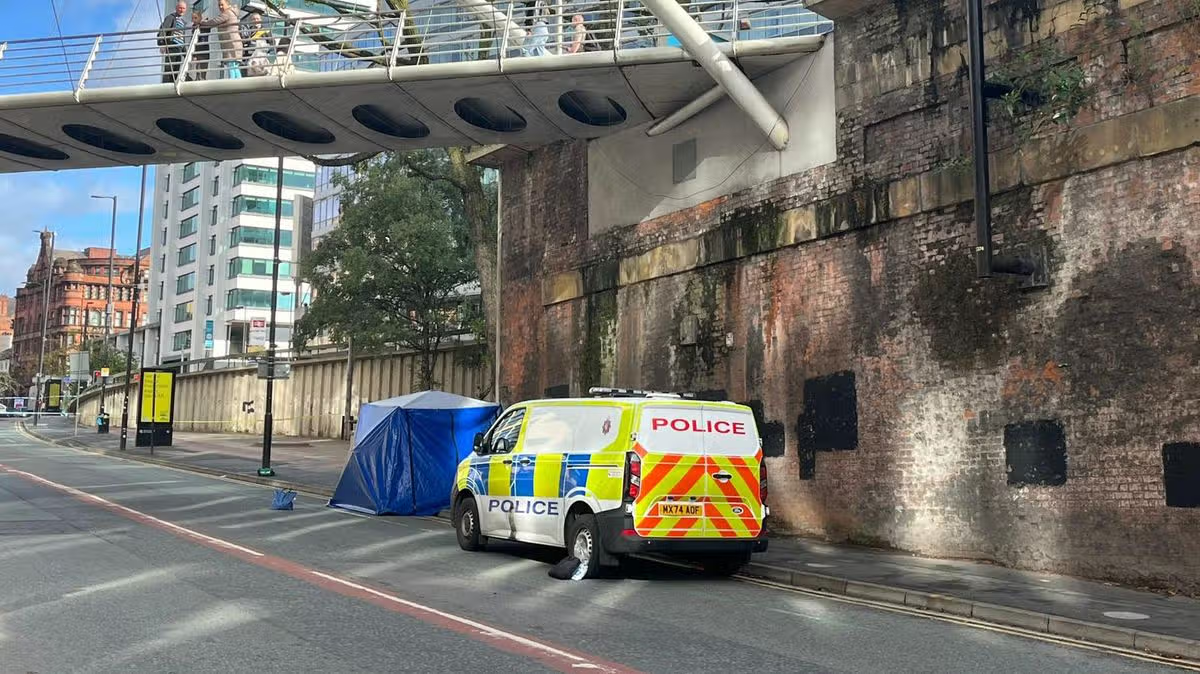
A cordon is in place on a busy Manchester city centre road this morning as officers respond to a serious incident.

London Road is taped off between Aytoun Street and Store Street.

A blue forensic tent has been seen on the road, while police remain in attendance.

Advertisement

Details on the nature of the incident are yet to be confirmed.

The incident had been described as a ‘medical emergency’ by the Inrix traffic monitoring service.

GMP has been approached for information and updates will follow in this blog.

Source link

Advertisement
Continue Reading

NewsBeat

Ukraine’s labour market has been surprisingly resilient during the war with Russia

Published

on

Ukraine’s labour market has been surprisingly resilient during the war with Russia

Russia’s war in Ukraine has generated one of the largest labour supply shocks in recent history. From an estimated pre-war population of 41 million people, close to 6 million have now left Ukraine. This outward migration alone has reduced the country’s worker population by roughly 3 million people.

It has been compounded by the mobilisation of more than 700,000 Ukrainian citizens into the army. At least 55,000 Ukrainian soldiers had been killed in combat by July 2026 (this is likely to be an underestimate as many soldiers are missing in action), with 400,000 more wounded. Most of these people are working-age men.

By conservative estimates, Ukraine’s civilian casualties amount to almost 70,000 people, with the rate increasing over the past few months because of Russia’s extensive use of ballistic missiles. Millions of Ukrainian citizens in the east and south of the country also remain under Russian occupation.

In total, there has been a contraction of about 25% of the initial labour force in areas still under Ukrainian government control. This is a labour supply shock of extraordinary scale.

Advertisement

The shock to labour demand has been similarly severe. A massive, multidimensional reallocation has taken place as a result of the war, with most economic activity shifting to the western part of Ukraine, which is less exposed to air attacks.

In a wartime economy experiencing such massive displacement and reallocation, can workers and firms still find each other? To answer this question, we analysed data from Work.ua, a Ukrainian online platform where companies post jobs and job seekers upload their resumes.

More than 700,000 Ukrainian citizens have been mobilised into the army.
Dmytro Larin / Shutterstock

We estimated the efficiency of matching between workers and firms – in other words, given a certain number of vacancies and job seekers, how often supply and demand actually meet.

Imagine there are ten companies, each with one open position and ten unemployed people. If matching efficiency is maximal, up to ten hires can be generated; if it is minimal, there will be none. The more frictions there are in the market, the more this efficiency decreases.

Advertisement

We traced how matching efficiency has evolved before and after the 2022 full-scale invasion, across Ukraine’s regions and economic sectors.

Labour market resilience

Three facts emerge from the data. First, matching efficiency has declined by about 15% since 2022. It has become more difficult for firms in Ukraine to find workers to hire and for job seekers to find employers willing to hire them.

This decline is significant, but not catastrophic. It is, for example, less than was estimated during the 2008 financial crisis in the US.

Second, the situation is varied. In the regions most exposed to the war, such as Sumy and Kharkiv oblasts in north-eastern Ukraine, the reduction in matching efficiency reaches about 20%.

Advertisement

But in the western regions of Ukraine, the picture is significantly better. In Lviv and Ivano-Frankivsk oblasts, the number of resumes and vacancies both increased compared with before the full-scale invasion – despite the overall decrease in Ukraine’s population and labour force. Matching efficiency in these areas decreased by just 5-7%.

How matching efficiency has changed, by region

A graph showing how declines in matching efficiency since 2022 vary across Ukraine.


Anastasia, Boeri and Zholud (2026) / Economic Policy, Author provided (no reuse)

We found similar variation across sectors. Many blue-collar occupations involving manual labour or skilled trades, from cleaning services to drivers, have experienced relatively modest declines. Non-essential personal services, like travel agencies, have suffered the most.

Finally, direct exposure to conflict – measured using data on air-raid alarms independent of proximity to the frontline – makes it significantly harder to match labour supply and demand. These daily disruptions, which generate fear, uncertainty, damage to infrastructure and blackouts, can severely hamper the labour market.

Advertisement

Overcoming wartime disruption

We also identified mechanisms that may have helped Ukraine compensate for its wartime labour market frictions. Many women have taken on traditionally male job roles, from mining to truck driving. Older people and those with disabilities are also playing a greater role in the labour force.

Many firms have adopted remote working and more flexible schedules. This has been especially important for displaced people and refugees, allowing many to stay connected to their employers in Ukraine and continue to provide services, despite the physical distance.

Ukrainian firms have also benefited from greater contractual flexibility. The minimum wage did not increase between the start of the full-scale invasion and 2026, while inflation eroded its real value. This means firms have been able to hire less-productive workers without experiencing profit losses.

People working on their laptops in a cafe in Kyiv.
People working remotely from a cafe in Kyiv.
Sodel Vladyslav / Shutterstock

Worker shortages are affecting many sectors of Ukraine’s economy – most notably in professions such as construction, transport and engineering. A continuation of the war will require more mobilisation in the labour market of people so far inactive, as well as a bigger contribution from those who left the country.

When the war finally ends, mobilising workers at all levels will be the next hurdle. Veterans will need to be reintegrated into the workforce, while refugee return, immigration and worker retention will all have to be encouraged.

Advertisement

Continuing to nudge higher participation among groups underrepresented in the labour market will also be important. But this all represents a sizeable challenge.

Source link

Advertisement
Continue Reading

NewsBeat

Masked protesters block access at Port of Dover

Published

on

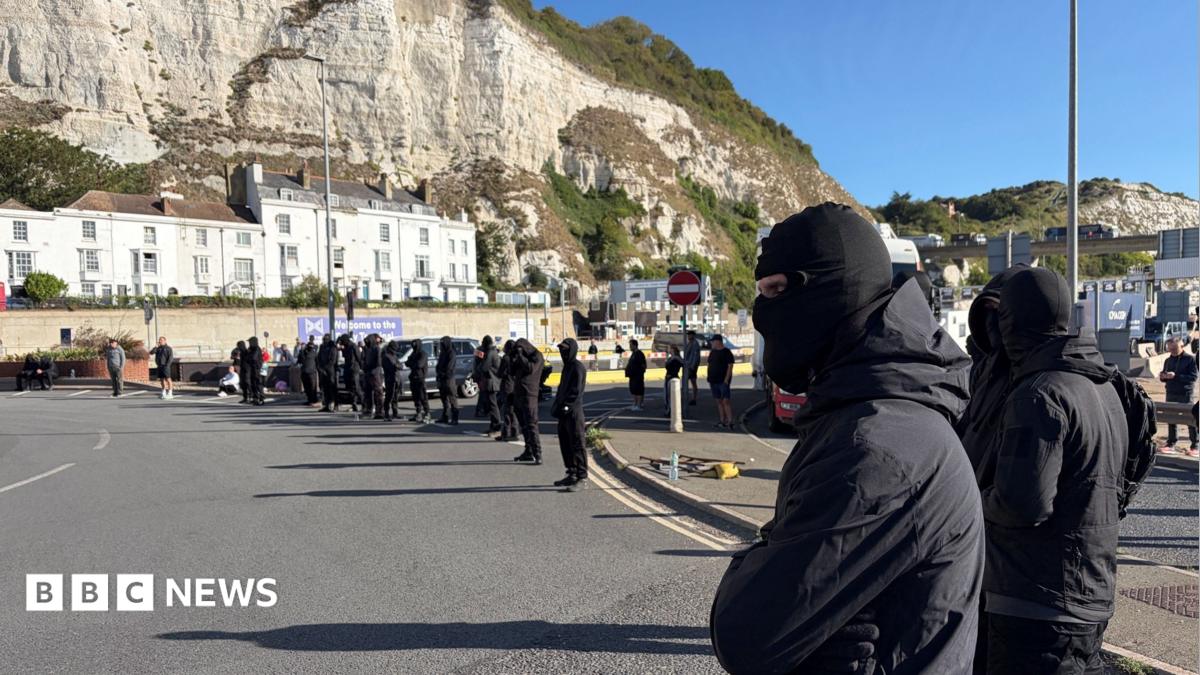
A row of masked men block a road at the entrance to the Port of Dover.

Masked demonstrators are preventing traffic from accessing the Port of Dover.

Kent Police said it was aware of a protest “currently taking place” at the ferry terminal and was “engaging with protesters”.

Traffic has been stopped from going in and out of the port.

Images from the scene appear to show hundreds of protesters, all dressed in black and wearing face coverings.

Advertisement

P&O Ferries said it would get passengers on to the next available sailing if they missed their scheduled crossing.

Traffic is stopped in both directions on the A20, between the A256 York Street and the A2 Jubilee Way in Dover, according to National Highways.

It is reporting four miles (6.4km) of congestion and delays of up to 30 minutes.

Port of Dover said the “ongoing public order incident” was affecting all routes in and out of the port and town.

Advertisement

In a statement, it added: “We are in contact with Kent Police to understand the situation.

“This situation is impacting our local community and our customers, so of course we are hoping for a swift resolution.”

Source link

Advertisement
Continue Reading

NewsBeat

Science uncovers how the brain interprets artistic beauty

Published

on

Science uncovers how the brain interprets artistic beauty

Stand in front of Turner’s Sun Rising Over Water (1825-30) and something odd tends to happen. The painting holds you, even though observers might struggle to say why. Maybe it is the colour, the balance, the composition, or the strange stillness the artwork seems to carry.

Whatever it is, you feel it long before you can explain why. And the stranger next to you, looking at the same canvas with the same awe in their eyes, very likely feels it too.

We often say that beauty is in the eye of the beholder. Yet show almost anyone a
misty Chinese Song-dynasty mountain landscape, or the softly brushed figure of the Mona Lisa, and nearly everyone agrees that something striking is unfolding before them.

Beauty feels intensely private, and, at the same time, we keep discovering that we
collectively share it. That contradiction is one of the longstanding puzzles in
“neuroaesthetics” – the science of how the brain responds to art and beauty. How does our sense of beauty actually take shape in the brain?

Advertisement

In our latest study, published in Nature Communications, we tried to map that shared
experience. We found that instead of representing it as a single entity, the brain
instead splits aesthetic experience into two major strands. One strand handles what
an image shows, whether a landscape, an object or a figure.

Some artworks exert a hold over people, even if they struggle to say why. Pictured is JMW Turner’s The Sun Rising over Water (1825-30).
Album

The other tracks how much pleasure it gives us, drawing on the same circuits that respond to food or money. These two separate neural systems combine to shape every judgment of beauty we make when viewing visual artworks.

Neuroscientists have long argued about this question, from positions that compete
as often as they overlap. One camp focuses largely on perception, on how the brain
takes in composition, contrast and form.

Another emphasises evaluation and reward, placing beauty in the brain’s value circuitry. A third looks to the brain systems behind imagination and self-reflection. Each account captures something real, but they had rarely been tested together in a single study.

Advertisement

Algorithms for art

We asked 34 volunteers to look at 96 traditional Chinese watercolour paintings inside a 7T MRI scanner, powerful enough to pick up the small shifts in blood flow that track the brain’s activity. Once they were out of the scanner, each participant rated how the paintings made them feel.

Instead of working straight from those raw ratings, however, we borrowed a tool from somewhere less obvious: the recommendation engines that power services such as
Netflix and Spotify.

Known as collaborative filtering algorithms, these tools excel at detecting patterns of agreement buried in people’s preferences. When applied to our aesthetic ratings, they pulled out two dimensions running underneath everyone’s responses.

Mona Lisa, Louvre
While there is a subjective element to art, it elicits common reactions too.
Christophe Petit Tesson

The first sorted the paintings from most figure-like to most landscape-like, a measure of what each picture conceptually depicts. The second sorted them from most disliked to most liked across all participants, a measure of emotional value, or hedonic value (the sensory enjoyment someone gets from an experience).

Despite their complementary contribution to the overall aesthetic experience, the
brain kept these two dimensions remarkably separate. Visual content was read out
along the visual pathways, the familiar circuits that let us tell a face from a scene.

Advertisement

Hedonic value, on the other hand, was decoded somewhere else, within deeper
regions that handle reward and pleasure. Put simply, the brain seems to judge a
visual painting with much the same machinery it uses to judge the rest of the world
around us.

Changing the brain

We also found that how strongly the brain encoded this two-dimensional aesthetic
landscape depended on a person’s expertise in visual arts. In particular, the
difference showed up in the default mode network, a system of connections in the brain tied to imagination, consciousness, self-reflection and meaning-making that several leading theories place at the heart of aesthetic experience.

These results suggest that, beyond mere exposure, training in visual arts appears to change how the brain represents beauty in the first place.

This last point carries significant weight. If aesthetic experience has a measurable structure in the brain, and if making and viewing art can reshape it, then arts education starts to look less like enrichment and more like a kind of training that alters how perception, emotion and meaning are wired together. The clinical implications run along the same line.

Advertisement

Art-based therapies for depression, trauma and dementia have long been valued on instinct and anecdote. A clearer neural account gives us a way to test and sharpen them. Finally, as more of the images around us, in advertising, in design and on our screens, are generated by machines, knowing what beauty looks like inside the human brain matters more than ever.

Most often, we tend to treat beauty as something purely personal and assume that
asking scientific questions about it misses the point. Building on pioneering work in the field of neuroaesthetics, our results suggest otherwise.

Beauty has a structure, and that structure says something about the kind of creature we have become over countless years of evolution. We do not simply look at the world, instead we cannot seem to stop judging it for its beauty.

Advertisement

Source link

Continue Reading

NewsBeat

Rescuers in Nepal pull a Chinese national alive from a hydropower tunnel 10 days after floods

Published

on

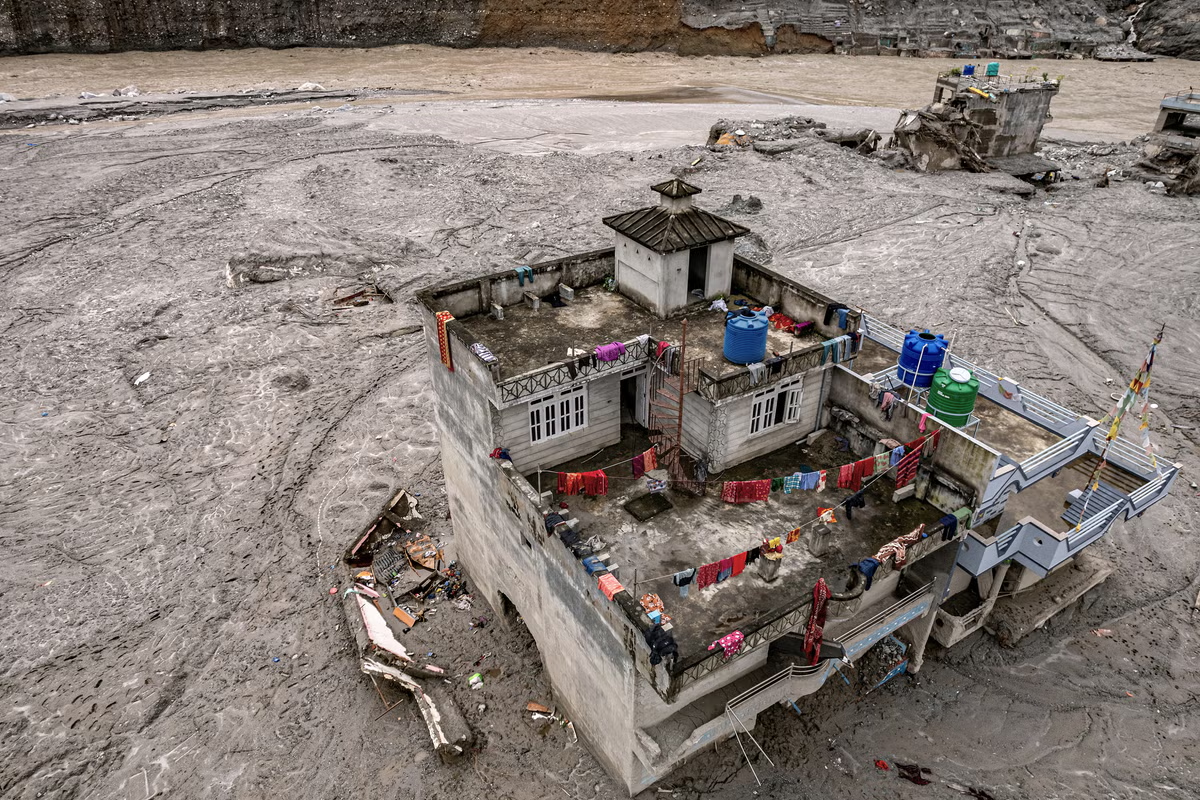
Rescuers in Nepal pull a Chinese national alive from a hydropower tunnel 10 days after floods

Rescuers in Nepal pulled a Chinese national alive from a hydropower tunnel on Saturday, according to a social media post by the country’s prime minister’s office.

The latest rescue brings the total to three workers pulled alive from the Trishuli hydropower project. Two Nepalese workers were rescued from a tunnel at the Trishuli 3A hydropower plant on Friday.

Nepal army said the man was pulled alive from a 225-meter tunnel (about 738 feet) and is undergoing a health assessment. Images showed him being evacuated by helicopter, with an army medic checking on him during the flight.

About 900 workers are missing from 12 hydropower projects across Nepal, with roughly 500 believed to be trapped in various tunnels, according to authorities.

Advertisement

At least 1,300 people were killed in the Aug. 26 floods, which were likely caused by a glacier collapse, and more than 5,000 remain missing, according to Nepal’s disaster management agency.

Source link

Continue Reading

NewsBeat

‘Moon crater’ potholes that villagers claim might as well be fixed with ‘sticky plaster’

Published

on

Cambridgeshire Live

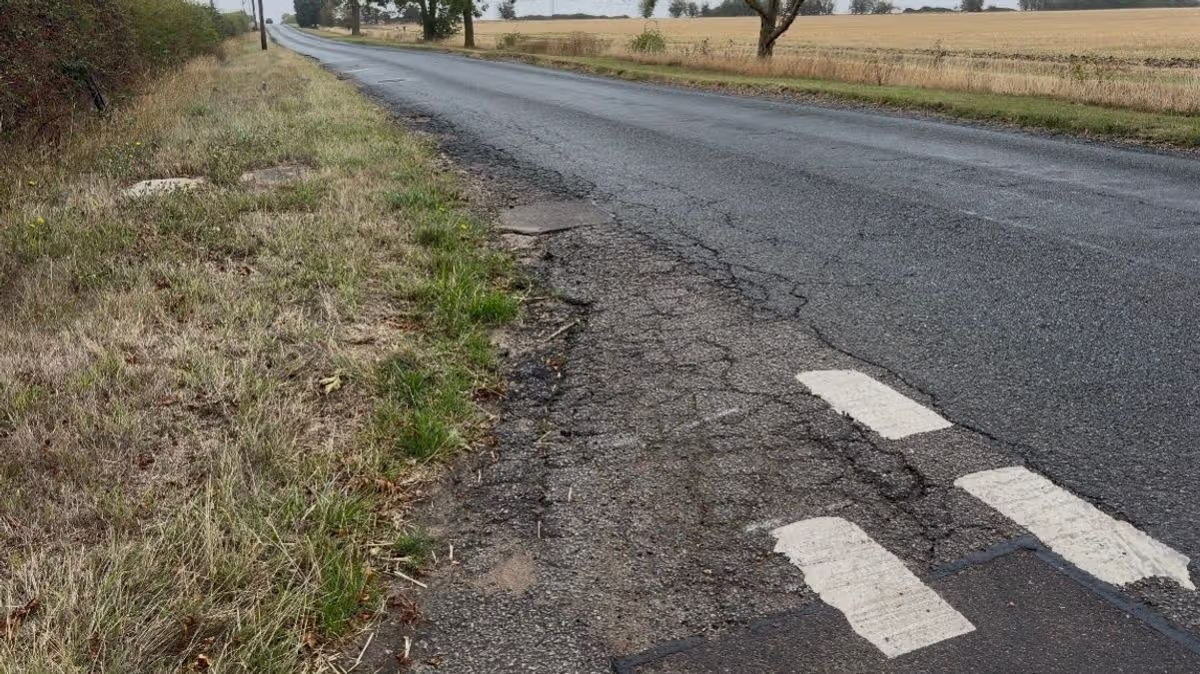
One particular road in the village has been described as ‘slightly dangerous’

Locals say a Cambridgeshire village with “moon crater” potholes only receives short-term fixes that they describe as like “sticky plaster”. Comberton lies around five miles from Cambridge and offers streets filled with pretty houses, shops, a pub and a newly-opened café.

Advertisement

Long Road had been previously named among the worst roads for potholes in the county on CambridgeshireLive’s Traffic and Travel Facebook page by members of the public. CambridgeshireLive asked people whether they think the state of the roads are still an issue, particularly along Long Road.

Samuel Wood, 30, said Long Road can feel “slightly dangerous” and “unsafe” and feels like it’s not quite wide enough. As a cyclist, he said it can be “a little bit scary” and he has to be careful with traffic.

A man in his 50s, who wished to remain anonymous, said that March is the “peak season for potholes”, adding that they are more like “moon craters”. He claimed the council usually plays catch up but then it seems to be “rinse and repeat”.

According to the local, Long Road is less a case of potholes but more that the road is “dangerous because the cambers are gone on either side so it’s actually safer to drive in the middle of the road”.

Advertisement

He said when another car is coming the other way, “you are risking life and limb at that point”. He said driving on Long Road is “like going up Ben Nevis” and you need to drive between 10 and 20mph.

James Waldmeyer, 47, said the roads have got “a lot better” but finds the council are “patching as they go rather than fixing the problems”. He feels like the village roads are having parts repaired but not all of it.

A 49-year-old, who asked to go by Mr Smith, said there has been “large improvement” but that it is likely “short-term fixes”. He questioned what is going to happen in the next six months as winter comes and whether the potholes are just going to emerge again.

Advertisement

He said he just expects the current fixes to be a “sticky plaster” over them and claimed that “every year we do seem to get more holes which suggests it’s just a quick fix just to cover it over”.

He said there was an “awful” pothole along Long Road. He said they were pretty “prevalent” in the area at one point, adding “it seems to take a long time for them to get there”.

A 23-year-old, who wished to not be named, said the road that connects to the Eversdens was “shocking” when she drove along it in recent weeks. Her problem with the potholes is that the council “slap a plaster on a gaping wound” so it’s fixed for “half an hour and then one car drives on it and we’re back to square one”, she said.

Advertisement

The young woman said the council needs that “better full investment” to make it last so that in the “long term it’s going to cost the government less money because they don’t need to fix it as often”.

A 69-year-old woman who lives in the village said Long Road and Green End in Comberton are “pretty bad” for potholes, adding that they are filled with lots of smaller ones. She said there was a “big one that was there for months” along Long Road which has been filled recently.

A Cambridgeshire County Council spokesperson said: “Potholes develop over time, and we prioritise repairs in line with our Highway Asset Management Strategy, identifying potholes through both routine highway safety inspections and from residents’ reports.

“Repairing individual potholes is often the most practical and cost-effective way to address defects as they occur. Resurfacing the entire area may be seen as an option, however it is significantly more expensive and, with limited funding available, resurfacing schemes are prioritised across the county according to need

Advertisement

“The council has recently approved an additional £5 million for its Winter Readiness Programme, which will identify and prioritise areas for repair before potholes occur. However, demand for repairs continues to outstrip available funding, so investment must be targeted where it is needed most.”

They added that residents can report issues with the roads, including potholes, on the county council website.

Source link

Advertisement
Continue Reading

NewsBeat

Martin Lewis says typing one code into your phone will cut your bill

Published

on

Daily Record

The money-saving expert said it could stop people ‘seriously overpaying on their phones’

Martin Lewis says that typing a five-digit number into your phone could cut your bill. The money-saving expert said the free service can help you check if you are still in contract and find out if you owe any early termination fees.

It is a service that is mandated by the communications regulator, Ofcom. Mr Lewis pointed out that it was ‘totally free’. An estimated 14 million Brits are currently out of contract and significantly overpaying for their mobile service.

“There’s a way to find out if you can save on your mobile bill just by typing five digits into your phone. All you’ve got to do is text the word INFO (i-n-f-o) to 85075,” Mr Lewis said.

Advertisement

“This is a service the regulator, Ofcom, mandates mobile phone networks to offer. It’s totally free. They then have to reply with whether you have any early termination or early cancellation charges. If it says you don’t – so £0 early termination – it means you’re one of 14 million people who are out of contract and you’re therefore free to ditch and switch. And the vast majority of people who are out of contract are seriously overpaying on their phones.

“So, what do you then do? Well, just go onto a comparison site like MoneySavingExpert’s Cheap SIM Comparison and see what’s available.”

Content cannot be displayed without consent

Mr Lewis pointed out that:

Advertisement
  • If you are on Three, SMARTY, or ID Mobile, then when you do the text, it will reply back asking you for your date of birth, which is just an ID check.
  • If you are on a multiple phone contract – like a couple of different handsets on the contract – it can’t do this.

“So then, simple rule of thumb: if you’ve been on the same deal for more than two years, you’re almost certainly out of contract. Do check it out, let me know how you do,” Mr Lewis explained.

Does it work?

Interestingly, some of the comments under the post on Instagram suggested that the service did not work as well as it should. One person said: “Tried it with ID Mobile,( provided DOB) they just reply that they have a system issue and can’t provide the service,” while another added: “Would not send to this no , tried to resend but still not sent.”

A third added: “Didn’t work on Sky Mobile, though that’s not a surprise, given they’re the worst mobile network I’ve ever been stuck with,” while another said: “Did this on three and when asks for my dob I send it and no reply.”

“I just text and it said I have to pay charges!!,” said another person, while another added: “I get no response when I message.”

Keeping your number

Advertisement

It is not the only free service on offer. Ofcom says: “To keep your phone number, text ‘PAC’ to 65075.

“If you do not want to keep your phone number, text ‘STAC’ to 75075. This ensures the switch is done for you without paying notice period charges or double-paying for your old and new contracts.

“You can also request your PAC or STAC by calling your provider or on your provider’s website. You will need to use one of these methods if you have more than one number on your account, for example a family mobile package.”

Source link

Advertisement
Continue Reading

NewsBeat

Israel and Hezbollah battle over a strategic hill in Lebanon

Published

on

Israel and Hezbollah battle over a strategic hill in Lebanon

BEIRUT (AP) — Since a ceasefire went into effect between Israel and Hezbollah more than two months ago, fighting has stopped in much of Lebanon, but not on a strategic hill overlooking parts of a main southern city.

In recent weeks, Ali Taher hill has been the scene of daily shelling and airstrikes by Israel’s military. Hezbollah, a militant group backed by Iran, has repeatedly attacked Israeli forces in the area with drones.

The United States, which is mediating talks between Lebanon and Israel, had wanted Hezbollah to hand over the hill to the Lebanese army as part of larger plan to disarm the militant group and dismantle its infrastructure. But Hezbollah has refused.

Lebanon and Israel reached a framework agreement in June stating Israel will withdraw from Lebanon as Hezbollah is disarmed. The militant group was not a party to the negotiations and has rejected calls to disarm in areas north of the Litani river, which is where Ali Taher is located.

Advertisement

A full-on battle over this hill near the city of Nabatiyeh could escalate fighting across the country, and unrest in Lebanon complicates efforts to resolve the war in Iran.

On Thursday night, Israel’s military announced it had taken “operational control” of Ali Taher and a network of tunnels beneath it that Hezbollah uses to shelter its fighters and weapons. It is unclear how far Israel’s control extends. Just before Israel’s announcement, its air force was still targeting the hill, according to Lebanese state media.

There has been no official statement from Hezbollah since Israel’s announcement.

Advertisement

Advertisement

US pushes Lebanon to pressure Hezbollah

Hezbollah firmly rejected a proposal from the Lebanese government to hand over Ali Taher to the country’s army. It fears Israel would then seize control of the hill from the Lebanese army and then demand the handover of more territory.

Israel had occupied Ali Taher for 18 years before it withdrew from Lebanon in 2000.

The hill has a strategic location overlooking several villages as well as main roads leading to Nabatiyeh. Losing full control of it would disrupt Hezbollah’s presence and supply lines in the area.

The Israeli military says the site is also important to Hezbollah because of tunnels it built there, with funding from Iran.

Advertisement

Israel said in its statement Thursday that the hill housed underground command centers, weapons storage rooms, generators, living quarters, showers and a kitchen. Israel said it cleared Ali Taher of Hezbollah fighters and was working to “neutralize underground infrastructure sites.”

Hezbollah legislator Ihab Hamadeh questioned why the Israeli military was still attacking the hill if it was really in control of the area, according to the Arabic-language version of Russia’s state-funded news outlet Sputnik. An Associated Press photographer who visited the nearby village of Kfar Rumman on Friday saw no sign of Israeli military presence on the hill.

Advertisement

The hill, topped with a shrine to a Muslim scholar, sits north of the Litani river, which has become the de facto boundary of the area captured by Israel since its latest war with Hezbollah began in early March.

Fighting in the area has heated up in recent weeks

Israel has been conducting military operations around Ali Taher since July, said Nasser Khdour, a Middle East researcher at the Armed Conflict Location & Event Data Project, or ACLED, a U.S.-based group that tracks conflicts around the world.

Hezbollah official Mahmoud Qamati told a Lebanese podcaster in late August that the group’s fighters were repelling attempts by Israeli troops to take Ali Taher. But he, and others, downplayed the significance of the site should Israel take it.

“Ali Taher is important, but if it is lost it does not mean the end of Hezbollah,” Qamati said.

Advertisement

In mid-August, Israel carried out a series of airstrikes on southern Lebanon that it described as retaliation for a Hezbollah drone attack on Ali Taher that seriously wounded three soldiers. The Israeli strikes, which killed 11 people, including women and children, were the deadliest since the U.S.-brokered ceasefire went into effect in late June.

On Aug. 27, Israel carried out a series of airstrikes, killing one person and wounding six, after the military said Hezbollah fired two explosive drones at Israeli troops in the area. Hezbollah did not claim responsibility for any of the attacks.

Lebanon says Israel is hindering its army

Lebanon’s Deputy Prime Minister Tarek Mitri told an Arab TV station in late August that the Lebanese army was ready to take over Ali Taher.

He accused Israel of blocking the army due to its own political considerations ahead of Israeli national elections on Oct. 27.

Advertisement

“The problem is not in the Lebanese army’s readiness but in Israel’s stance,” he said.

Lebanese and Israeli officials are set to meet for negotiations in Rome later this month. Meanwhile, Hezbollah, which has always refused to speak directly to the U.S., appears to be changing its policy after the major setbacks it has suffered during its wars with Israel since 2024.

A Lebanese official told The Associated Press that indirect contacts are going on between the U.S. and Hezbollah, but refused to give any details. He spoke on condition of anonymity in line with regulations.

The U.S. ambassador to Lebanon, Michel Issa, said recently that Washington is ready to speak with Hezbollah if the group agrees to disarm.

Advertisement

Still, Hezbollah is not likely to take any move forward regarding talks with the U.S. without a green light from its main backer, Iran. While talks with the U.S. over their war have stalled, Iran has sought guarantees that Israel will halt its attacks on Hezbollah as part of any permanent deal.

Capture of Ali Taher could lead Israel to other Hezbollah strongholds

The capture of Ali Taher would open the way to Nabatiyeh and also lead to the nearby Apple Province and Rihan Mountain, where Hezbollah has been building up its presence since the late 1990s.

Israeli leaders have repeatedly pledged to leave troops in Lebanon and threatened to escalate military pressure until Hezbollah disarms.

“Israeli control of the area is an operational and military setback for Hezbollah,” said Khdour of ACLED. He said clearing these sites helps Israel protect towns in the northern part of its country, and increases pressure on Hezbollah.

Advertisement

“This will strengthen Israel’s position in any future negotiations over its withdrawal,” said Khdour.

Source link

Advertisement
Continue Reading

Trending

Copyright © 2025