
When Donald Trump deported a group of Venezuelan nationals to El Salvador in 2025, it was the fulfilment of a long-held wish. Across both of his administrations Trump has pushed officials to find ways to brutalise immigrants, particularly those who are undocumented, believing that doing so will deter others from making the trip.
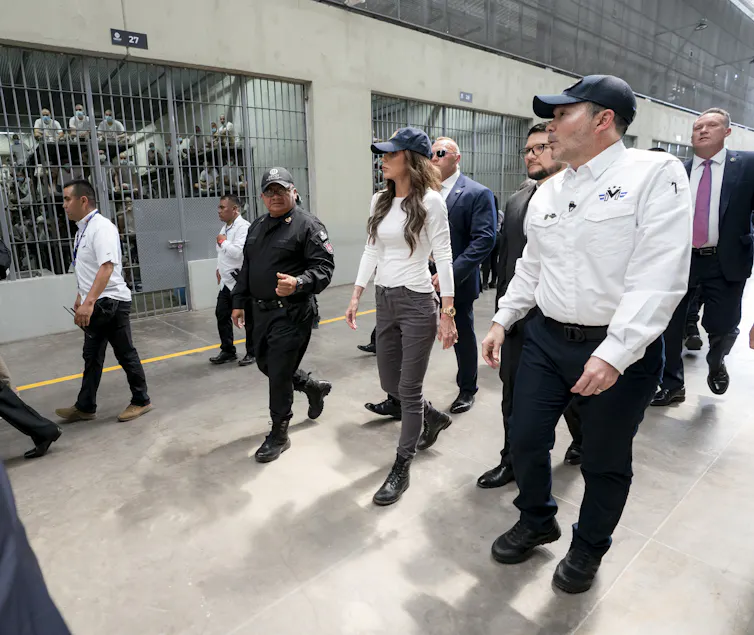
The Venezuelan nationals were destined for El Salvador’s Terrorism Confinement Center, known as Cecot. When they arrived, according to a Human Rights Watch report, they were subjected to systematic beatings, sexual abuse and psychological duress.
The Trump administration amplified reports of conditions in the prison. Trump’s former homeland security secretary, Kristi Noem, for example, filmed a video inside Cecot in 2025 in which she thanked El Salvador for “bringing our terrorists here and incarcerating them”.
Trump’s deportations were a chilling sign of how easy it is for US presidents to sidestep the constitution. If Cecot were in the US, it would be recognised as a site of illegal abuses. The constitution’s protection against “cruel and unusual punishments” would cause judges to order it shut down – and it is likely that political outrage would not cease until that order was followed.
Yet by making an agreement with El Salvador’s president, Nayib Bukele, Trump managed to get around these legal and political obstacles. In a recent paper, I explored how Trump’s deportations are part of a broader pattern of what I call “presidential extra-territorialization” – American presidents acting in or through a foreign jurisdiction to circumvent the US constitution.
There is a long-term pattern of cooperation between presidents from both the Republican and Democratic parties and the leaders of foreign countries. It is a pattern that could have grave implications for the future of US democracy.
Ken Cedeno / EPA
Outsourcing abuses
The ability of US presidents to engage in this outsourcing of abuses is rooted in two things. First, their control over the vast capabilities of the modern executive branch, with its array of spies, soldiers and law enforcement officials. And second, control over US diplomacy, which is enshrined in Supreme Court precedent.
In 1936, the court ruled that the president is “the sole organ of the federal government in the field of international relations”. This has commonly been interpreted as meaning US presidents cannot be constrained by the other branches of government when conducting diplomacy.
Combined, these factors mean presidents face fewer constraints in foreign affairs than in the domestic realm. They are able to avoid oversight from the courts and Congress by keeping agreements with other governments secret and by acting too fast to be stopped. If they can find just one foreign government willing to enable them, then what is not possible at home suddenly becomes possible overseas.
This lack of constraint was evident in Trump’s deportations. The US government sent the men to El Salvador despite a last-minute ruling by a federal court ordering their return.
And once they were in El Salvador, the Trump administation claimed it was no longer responsible for them and could not be expected to bring them back. The Supreme Court stepped in to pause further such deportations, but only weeks after the fact.
United States Department of Homeland Security

Other examples of the power and flexibility of extra-territorialization became apparent during the “war on terror”, when successive US presidents faced the issue of where to send detainees who were suspected terrorists.
If they were brought to the US, they would have had constitutional rights and could not have been tortured or indefinitely imprisoned. So presidents from Bill Clinton in the 1990s onward established a series of agreements with other countries to take and mistreat them instead.
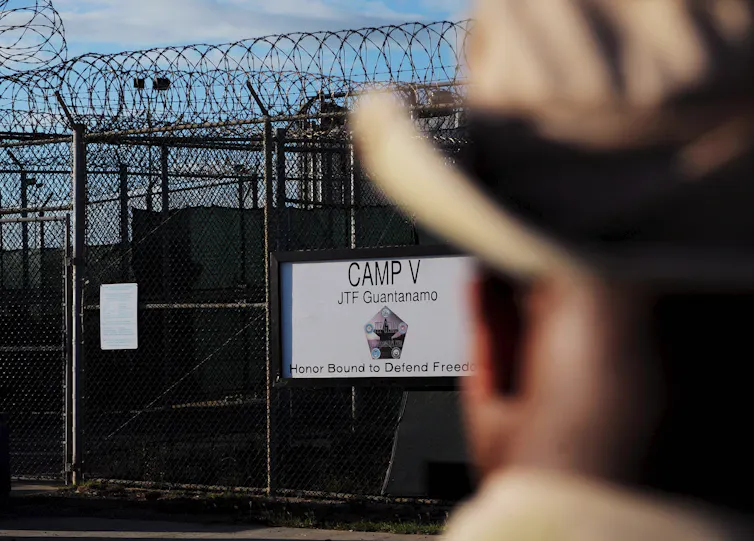
After the 9/11 terrorist attacks in 2001, the Bush administration established a series of “black sites” in countries such as Poland, Thailand and Romania in which to hold detainees in secret. Abuses were committed directly by US agents, but still beyond the reach of US courts. The administration held prisoners at Guantanamo Bay in Cuba too, another place where the constitution’s reach was limited.
Mandel Ngan / EPA

Presidents can also shift territory in response to attempts to constrain their actions. When the US Supreme Court ruled that detainees at Guantanamo Bay had to be afforded certain rights in 2008, the Obama administration transferred some detainees to Bagram Air Base in Afghanistan. Bagram was not covered by the Supreme Court ruling.
As a US court of appeals noted in 2010, the ability to shift territories so easily seemed to allow the administration to “switch the constitution on or off at will”.
Yet another example of extra-territorialization is the “Five Eyes” intelligence agreement between Australia, Canada, New Zealand, the UK and US. As part of this pact, members have been reported to spy on each other’s citizens – an outsourcing of surveillance that allows each to circumvent domestic privacy constraints.
The fact that Trump has engaged in extra-territorialization so openly, in contrast to previous administrations who tried to keep it hidden, is a stark warning.
Even when the president said he was exploring a proposal to send US citizens to Cecot in April 2025, he received little pushback from within his own party. This suggests they have accepted it as a legitimate strategy to achieve policy goals.
In the hyper-polarised atmosphere of contemporary US politics, extra-territorialization is threatening to become a regular tool of governance. To stop that from happening, it is vital to expose and confront it. But first we must understand it.
You must be logged in to post a comment Login