June, 37, who is originally from the Isle of Arran, was found dismembered in her apartment in Los Angeles, California, on September 11 last year. Her husband Jonathan Renteria, 25, was charged with her murder four days later.
Los Angeles County District Attorney’s Office revealed yesterday Renteria has been indicted on one count each of murder and mutilation/disinterment of human remains, along with a new count of misdemeanor child abuse.
Authorities allege Renteria killed June, who had moved to the US to work as a lawyer. She was last seen alive on September 4.
The following day, Renteria was seen on his way to drop off the couple’s one-month-old child at his parents’ house while carrying trash bags filled with unknown contents.
Renteria — who was later found in a nearby hotel room suffering from a bloody arm injury — allegedly confessed to killing his wife during an argument in their Franklin Avenue apartment about her weight.
He was ordered to remain behind bars without bail and will appear at a Los Angeles courthouse on June 2 for a pretrial hearing, according to the District Attorney’s Office.
Advertisement
June set up a paralegal service after she moved to LA – but her ultimate aim was to pass the US bar exam so she could practise law in California. Shortly after she started her relationship with Renteria, June filed a restraining order against him citing domestic violence. That claim was later dropped.
Officers discovered June’s torso with missing limbs. The autopsy says the cause of death was traumatic neck injuries and that June suffered approximately 10 “sharp force injuries.”
Her family have since launched a fundraising bid to cover a legal fight to bring her baby to Scotland.
Advertisement
June’s daughter Regina remains in the US with Renteria’s parents. Her family have launched a custody battle to bring her baby home to Scotland but need £40,000 to foot the legal costs.
June’s mother Jill, who still lives on Arran, previously said she wants the details about what happened to her daughter in the public domain. She visits June’s grave in Arran nearly every day and says she finds comfort speaking to her daughter.
Paying tribute, she said she wants her daughter to be remembered as “very beautiful, very intelligent, very funny, humorous, crazy, kind, loving, passionate”.
Jill added: “I know we’re never going to get her back, ever, but I just need to know what happened to her. June deserved better. Way better.”
Advertisement
Get more Daily Record exclusives by signing up for free to Google’s preferred sources. Click HERE.
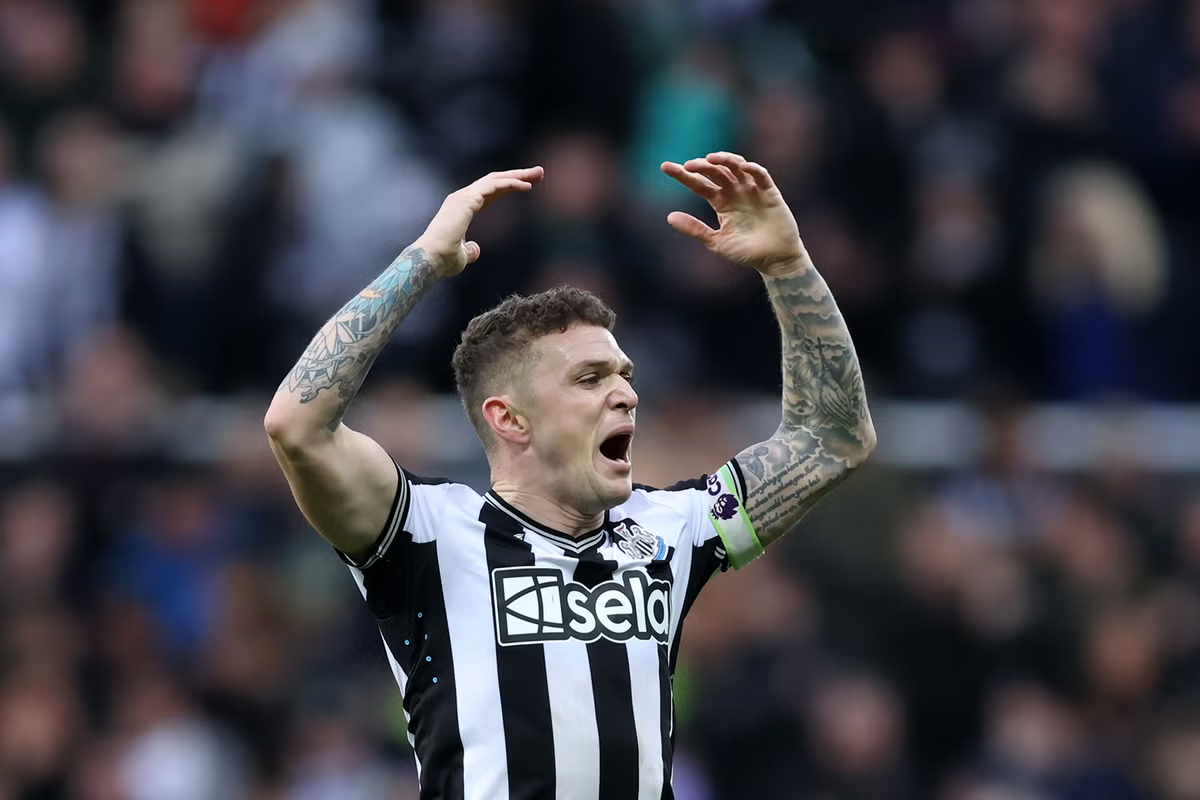
The 35-year-old former England international arrived from Atletico Madrid in January 2022 and went on to play a significant role in the club’s progress under Eddie Howe.
The right back, who has made more the 150 appearances for the Magpies, lifted the Carabao Cup alongside captain Bruno Guimaraes when Newcastle won their first domestic trophy in 70 years last season.
“The time has come to leave this amazing club after four-and-a-half years,” Trippier said in an interview published on Newcastle’s website. “This is where I have felt most at home. It’s emotional, and I’m really going to miss it.
Advertisement
“I want to say a massive thank you to the supporters for all the support through the good and the bad times. You’ve always supported me, always stood by me.
“To my team-mates, it’s going to be emotional. It’s been an amazing journey with you guys. I’m going to miss you all, but to win a trophy with you guys was really, really special – the best of my career.
“And to the manager, Eddie Howe, all the coaching staff and the team behind the scenes, a massive thank you. The gaffer had the trust – twice – to sign me, gave me the opportunity to represent and captain this great club and most importantly, we managed to win a trophy.
“I’m going to miss everyone at the club. Thank you.”
Advertisement
Tripper lifted the trophy with captain Guimaraes when Newcastle beat Liverpool to win the 2025 Carabao Cup final (Getty Images)
Trippier arrived at Newcastle when the club were stuck in a relegation battle but he helped them qualify for the Champions League in two of the next three seasons, as well as lifting the Carabao Cup when they beat Liverpool in the 2025 final.
Tripper, who announced his retirement from England duty in August 2024 having played a part in several major tournaments, has seen his opportunities more limited this season due to injuries and the form of Tino Livramento.
His manager, Howe, said: “Kieran has been magnificent for us on and off the pitch. From the moment he walked through the door, he has helped to drive standards that have changed the club’s trajectory.
“His performances on the pitch have been to the highest level. While we’ll be saying goodbye to Kieran shortly, we also know we have a lot left to play for this season, and I know a player of Kieran’s character will be giving absolutely everything to end his time here on a high.”
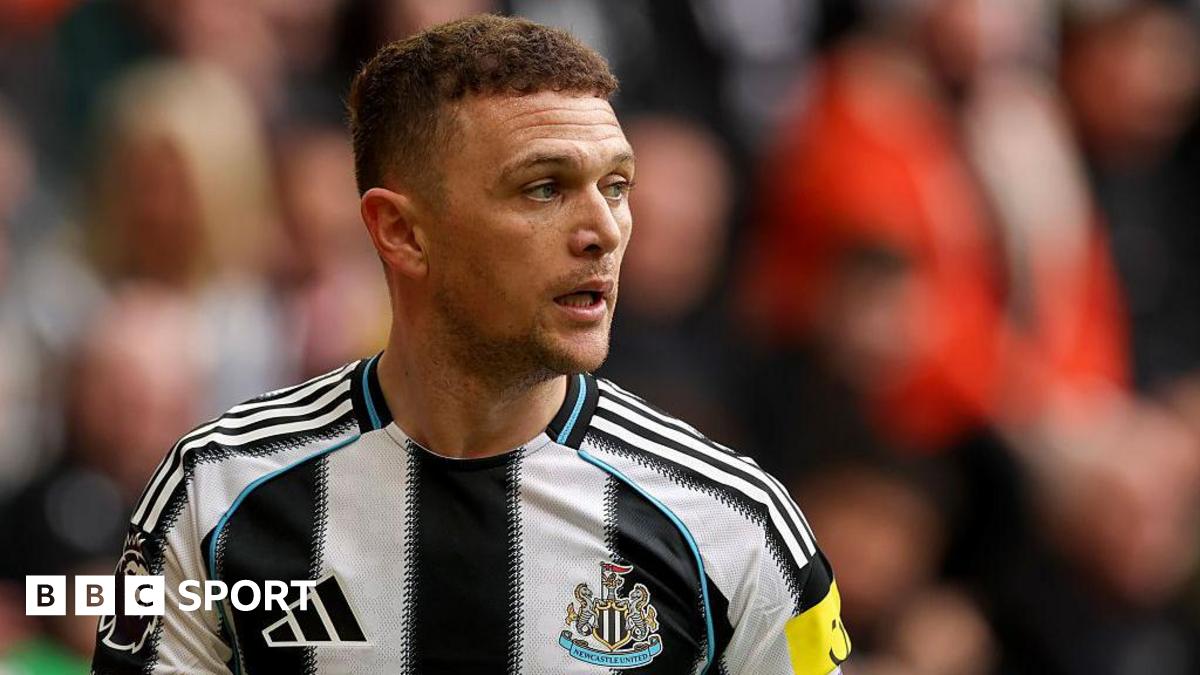
Kieran Trippier is to leave Newcastle United when the defender’s contract expires this summer.
The right-back joined the club from Atletico Madrid in January 2022 as the first signing following the club’s takeover by a Saudi-led consortium.
He has gone on to play a crucial role in Newcastle‘s resurgence and helped Eddie Howe’s side end their seven-decade wait to win a major domestic trophy last season by lifting the EFL Cup, as well as playing his part in the club qualifying for the Champions League in 2023 and 2025.
In a joint statement, the 35-year-old announced he will be departing the club where he has “felt most at home” at the end of the season.
Advertisement
“It’s emotional and I’m really going to miss it,” he said.
“I want to say a massive thank you to the supporters for all the support through the good and the bad times for me personally. You’ve always supported me, always stood by me.
“To my team-mates, it’s going to be emotional. It’s been an amazing journey with you guys. I’m going to miss you all, but to win a trophy with you guys was really, really special – the best of my career.”
Trippier also paid tribute to Howe, who had the “trust” to sign him for Newcastle after the pair previously worked together at Burnley.
Advertisement
Trippier was the first signing Howe made at the club and though the right-back is moving on, the head coach knows he will be “giving absolutely everything to end his time here on a high”.
“Kieran has been magnificent for us on and off the pitch,” Howe added. “From the moment he walked through the door, he has helped to drive standards that have changed the club’s trajectory.
“His performances on the pitch have been to the highest level. Building strong partnerships with the players around him. His outstanding technical ability helped elevate the team and his strong crossing ability helped create many goals and chances for his team-mates.
“His leadership skills have been invaluable. In difficult moments his experience has proved calming and his drive and will to win has inspired the players to keep pushing forward.”
The history-making space mission to the far side of the moon from the US is well underway – here’s what life is like onboard the Orion spacecraft for the four crew members taking part in the historic Artemis mission
11:02, 04 Apr 2026Updated 11:02, 04 Apr 2026
Freeze-dried food, a no privacy toilet and confined living quarters, this is what it’s like to live in a spaceship.
Defying gravity as they launch towards the moon for the first time in 53 years, four astronauts are on a history-making endeavour.
The Artemis II mission are on a planned lunar flyby by the United States, with four space explorers taking on a daring expedition to reach the far side of the moon in their Orion Capsule, launching over 252,000 miles away from the surface of the Earth.
Advertisement
Last night, Nasa said the astronauts have passed the halfway point between Earth and the moon, with the spacecraft more than 136,080 miles from Earth.
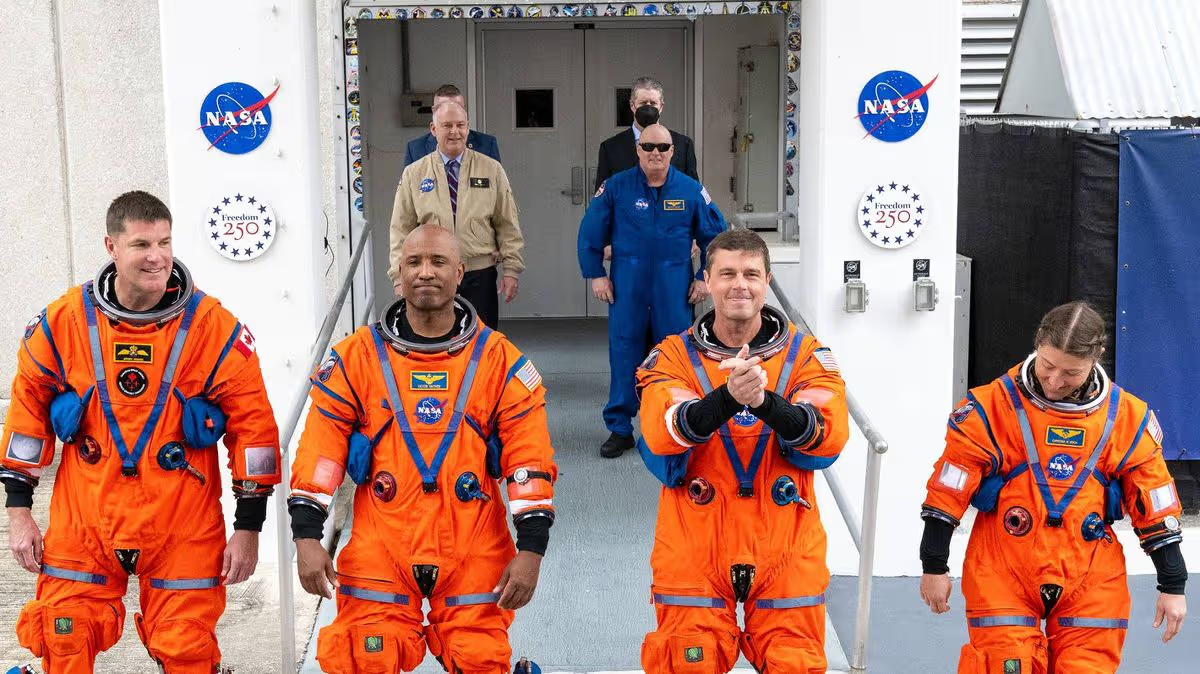
Commander Reid Wiseman, Victor Glover, the first person of colour to travel beyond low Earth orbit, Christina Koch, the first woman on a lunar mission, and Canadian Jeremy Hansen rocketed in to space on the evening of Wednesday April 1.
But this was no April fools – the goal? Stress test Humans, the ‘SLS’ (Space Launch System) rocket, and the life support systems which keep us alive in the daring, harsh reality of deep space.
While it may sound glamorous, the next two weeks will be a gruelling endurance test for the space seekers, sharing a living quarters no bigger than a minivan.
Cosy and compact, the foursome are settling into their new digs. Life inside the Orion Spacecraft, which they have named “Integrity” is a mix of high-tech living and “camping” in their very small floating room.
There are six windows in the Orion capsule, and currently, the astronauts will only be able to see Earth shrinking, while the moon grows towards them.
Advertisement
There are a few amenities for the crew. While there is no fridge or cooker, they have a food warmer and a water dispenser. NASA allows the astronauts a few home comforts, as they could choose some of their favourite meals such as mac and cheese and prawn cocktail.
Their food comes from freeze-dried pouches that they then rehydrate and cook. They also brought five different varieties of hot sauce as tastebuds can dull down in microgravity.
When it comes to the toilet, they have a rather compact but high-tech vacuum system built into the floor. The crew experienced some issues as the toilet broke on day two, but luckily got it back working.
Advertisement
In order to ‘flush’, the compact system uses airflow to ‘pull’ waste away since gravity isn’t on their side – but there is no privacy.
Being in zero gravity means it’s crucial for the astronauts to do physical exercise every day to prevent their muscles and bones from weakening. The human bones will shrink and become fragile as they don’t need to hold the weight of the human body. The crew will use a flywheel device – a cable-based machine that allows them to “row” and do squats against resistance, since weights are pretty useless in space.
While they are they hundreds of thousands of miles away, the Orion crew are still able to communicate with Earth. They aren’t completely isolated as they have direct communication with Mission Control in Houston. Today’s technology means fans of the mission all over the globe can follow along in real time.
Advertisement
However once they get behind the moon, they will experience a “blackout” where contact with the Earth will cut off for up to 50 minutes. As the crew are travelling through the “Van Allen” radiation belt in deep space, it means they could be susceptible to a solar flare. This is a colossal burst of energy and light from the sun.
If this was to happen, the crew have a designated radiation shelter where they will clear out storage lockers and crouch down together under the cabin floor for protection.
It’s a dangerous mission with exceptional risks, these four crew members are making history. The Artemis 2 mission is scheduled to end on Friday, April 10, 2026. It will splash down into the Pacific Ocean, just off the coast of San Diego around 8:05pm EDT.
The end of the mission is actually the most dangerous part as the crew will parachute out of the spacecraft after hitting the atmosphere at 25,000 miles. The friction creates a “superheated plasma” around the capsule which will block all radio signals for seven minutes.
However waiting for them in the ocean will be a US Navy ship ready to pull them out of the water and back to safety.
Rodri won the Ballon d’Or in 2024 but missed almost the entirety of last season after sustaining a knee injury and City failed to win a major trophy for the first time in eight years.
He has missed large chunks of this campaign because of a hamstring issue but has played 28 games in all competitions, helping the side to win the Carabao Cup against Arsenal at Wembley.
During his time at City, Rodri has won four Premier League titles, the Champions League, FA Cup and three League Cups.
Rodri previously said to Spanish media: “There have been many players who’ve gone down that path [playing for Atletico and Real].
Advertisement
“Not immediately, but over time. For me, you can’t turn down the best clubs in the world.”
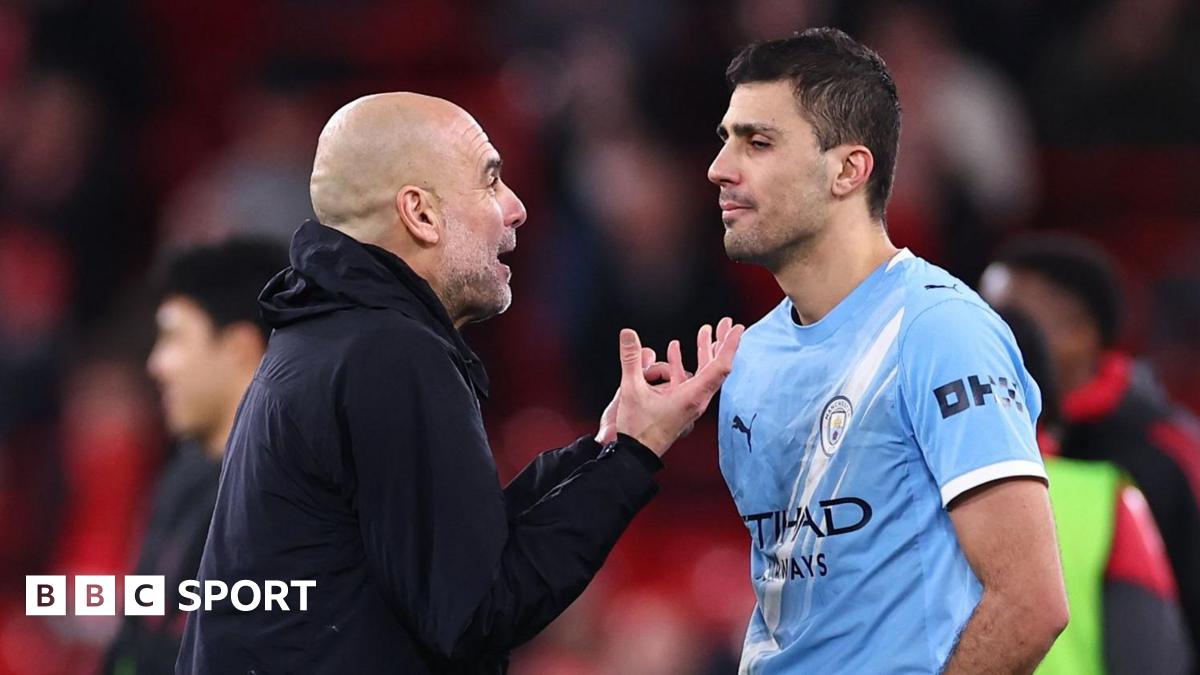
Guardiola said Rodri has shown over time “how attached, how close he is” to City and his “contribution has been massive”.
The manager confirmed he would “absolutely” not stand in the midfielder’s way if he wanted to leave, adding: “The organisation of the club is above all of us – if one player is not happy they have to leave and [we] continue the same always if they are happy – and I think he is happy.
“If he is not happy just knock on the door of the sporting director, accept an offer according to his incredible quality and after that he doesn’t belong to the club – only himself.
Advertisement
“I know what the club wants. They informed me what they want from Rodri – it is to stay, stay, stay. I always had the positive [feeling] with that but at the end I don’t know.”
TSAKANE, South Africa (AP) — Gladys Khoza had missed being able to see her family. Not because they couldn’t visit, but because the 84-year-old had vision problems.
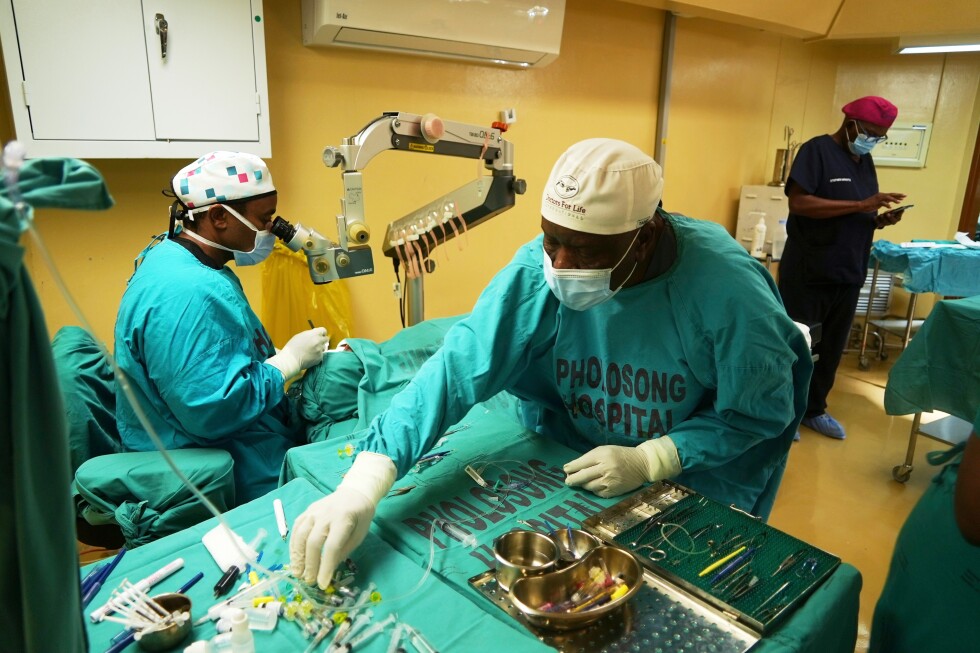
Now that has changed. Khoza is one of 133 people whose sight was restored during a “marathon” of free cataract surgeries conducted by doctors in South Africa at two hospitals over two weekends last month.
“Wow!” a delighted Khoza whispered as a nurse peeled back a bandage a day after her operation, and the world came back into view.
“Can you see me?” the nurse asked. “Very well,” Khoza replied, a big grin on her face.
Advertisement
Patients in South Africa’s public health service can be on waiting lists for years for the simple 15-20-minute cataract operation. Officials said some of those who were selected from hospital waiting lists for the surgeries had been waiting since 2019 to see properly again.
Cataracts are a common, often age-related condition in which the eye’s lens becomes clouded, and they are the leading cause of curable blindness. The surgeries insert a new artificial lens.
For Khoza, who said she couldn’t see anything out of one eye because of a cataract and had long had issues with the other, the simple surgery equates to a major boost for her quality of life.
“I just wanted to be able to see,” she said. Now, after nearly a year of waiting, some of her favorite things — seeing loved ones, reading her Bible and watching late-night soap operas — are all possible again.
Advertisement
Dr. Tebogo Fakude, one of the doctors who volunteered to perform the operations at two regional hospitals near Johannesburg, said his mother was blind and that having sight restored is “beautiful.”
“It’s beautiful because it alleviates depression,” Fakude said adding that the sense of being a burden was also eased.
Globally, more than 2 billion people suffer from some kind of vision impairment, according to the World Health Organization. For half of them, the problem could have been prevented, or they are still waiting for treatment.
Nearly 100 million people are affected by cataracts, and half of them still need access to surgery, according to the WHO. In Africa, that figure rises to 75% of people without surgery, according to a study published in March by the Lancet medical journal.
Advertisement
Surgery backlogs are a significant problem in South Africa, where government-run hospitals serve more than three-quarters of the population of 62 million people. Limited resources mean emergency procedures and more serious operations are prioritized over elective surgery.
The Health Department-led surgical marathons were first staged on Mandela Day in 2023 to commemorate the legacy of the country’s first Black president, Nelson Mandela. They have developed into a public-private partnership that takes place several times a year to increase access to care.
The ministry has vowed to use surgical marathons as a means of eliminating backlogs. Previous ones have addressed prostate, cleft palate and stomach issues.
Cataracts became the latest focus. Around 300,000 new cases are diagnosed every year in South Africa, Fakude said.
Advertisement
Health groups say South Africa faces a backlog of over 240,000 people waiting for cataract operations. Over 35,000 people in the most populous province of Gauteng — where the surgery marathon was performed — have cataract-related blindness.
WHO says eye cataract operations are “one of the most cost-effective medical procedures,” and a powerful tool to restore someone’s independence, dignity and opportunities.
During the three-day surgery marathon at Pholosong Regional Hospital, a new patient was brought into the operating theater about every 30 minutes. Soothing gospel music played on speakers to keep up doctors’ morale.
Looking through a microscope, the eye specialists made tiny incisions for each operation, removed the cloudy lens and replaced it with an artificial one. At one point, two surgeons worked concurrently on separate patients to quicken the pace. They completed 60 surgeries on the last weekend of the marathon.
Advertisement
Molefe Mokoena, 72, said he was looking forward to regaining his independence after suffering from a cataract for four years.
“I want to see my great-grandchildren,” he said. “I want to drive my car, and I’m happy about this.”
The Associated Press receives financial support for global health and development coverage in Africa from the Gates Foundation. The AP is solely responsible for all content. Find AP’s standards for working with philanthropies, a list of supporters and funded coverage areas at AP.org.
Marvel and DC have been captivating the world with their superheroes and supervillains for almost a century. Characters like Spider-Man (Marvel) and Superman (DC) are global household names whose recognition rivals that of world leaders.
For most of their history, Marvel and DC have gone toe-to-toe in comics, cartoons, TV and films. In 2008, Marvel made a breakthrough with its Marvel Cinematic Universe, an ongoing series of interconnected films and TV shows. Overall, it is the highest-grossing film franchise in history, with 2019’s Avengers: Endgame also being the highest-grossing franchise film ever made.
Forced to compete, DC responded with its own cinematic universe (2013-2023) that featured Man of Steel (2013), Batman vs Superman: Dawn of Justice (2015), Justice League (2017) and The Suicide Squad (2021). But it flopped both commercially and critically, forcing an abrupt ending in 2023 with Aquaman: The Lost Kingdom.
Now, in 2026, DC is attempting a revival. The home of Batman and Superman is launching a brand new cinematic universe, with director James Gunn leading the charge. The flagship Superman film was released in 2025, the second film with David Corenswet in the lead role, and Supergirl is dropping this July.
Advertisement
In total, 23 new films and shows have been announced, and DC is on a media blitz promoting its comeback. The timing could not have been better; Marvel is reeling from its own string of disappointments, such as 2021’s Eternals, 2023’s The Marvels, and 2025’s Thunderbolts*, all of which performed rather poorly at the box office given their big budgets.
Can DC pull it off this time around? My ongoing research into mega-franchises such as Marvel, DC and Warhammer, suggests not.
One of the reasons is DC’s failure to understand the psychology of mega-franchise consumers, even after Marvel’s multi-year success from 2008 onwards, and DC’s own failures. Below are four research-backed issues that could start posing serious problems for DC soon.
Advertisement
1. Lack of stylistic diversity
James Gunn is the genius director who gave Marvel the Guardians of the Galaxy franchise, its much praised (and highly successful) comic relief. His 2025 Superman for DC shared the same light-hearted humour and quirky dialogue. And going by the trailer, this year’s Supergirl looks to be similar in tone.
However, a universe cannot be built on quirkiness alone. Dozens of fans I interviewed uniformly praised the impeccable variety of styles that Marvel has managed to deliver since 2008. Some films are darkly funny (Deadpool), and some are dead serious (Eternals). And Marvel is very good at shuffling styles to keep viewers perpetually entertained.
This roller-coaster unpredictability is what drives the success of mega-franchises. If every film was just another spin on Guardians of the Galaxy, consumers could quickly lose interest.
Advertisement
2. Getting the pacing wrong
Last year’s Superman barraged consumers with a cavalcade of characters from DC’s roster, including Superman himself, but also Mister Terrific, Green Lantern, Metamorpho and Hawkgirl, to name a few. Which means DC is doing what it did in 2017, when its Justice League film introduced several major characters all at once.
In contrast, my research shows that fans prefer slower pacing, where characters are introduced first on their own and then aggregated into major spectacles such as Marvel’s Avengers. If the pacing is more measured, consumers cultivate an emotional stake in the characters’ stories. But if dozens of characters are introduced at the same time without proper grounding, who can blame audiences for not caring enough?
3. Over-reliance on obscure characters
Mega-franchises thrive on huge rosters of characters. However, it is important to first focus on just a few popular characters to get that “I know them!” effect. Here, Marvel did an excellent job promoting its biggest heroes first. Its first film featured the iconic Iron Man, quickly followed by mainstays like Captain America, Hulk and Thor. They already existed in the popular consciousness – which is exactly what Marvel counted on.
In this regard, DC’s release schedule leaves much to be desired. A few major characters (Aquaman) are meshed with minor episodic villains (Clay Face) and obscure heroes that have not seen major action in decades (Sergeant Rock).
Advertisement
Meanwhile, one of DC’s biggest characters, Batman, is not even getting his own film (the 2022 film starring Robert Pattinson was not part of this DC universe, but something called DC Elseworlds). If consumers refuse to become comic book nerds to enjoy a two-hour flick, whose problem is it?
4. The missing ‘big picture’
Mega-franchises such as Marvel and DC are famous for their massive life-or-death dramas. This is what drives audience engagement and gives a mega-franchise its purpose.
As my interviewees attest, the fact that such purpose emerged early on in Marvel’s oeuvre is what made it successful. From the start, audiences knew that everything was leading to the Avengers team-up. And, when The Avengers was released, it established Thanos as the archenemy and ensured that all threads led to him. The resulting film, 2019’s Avengers: Endgame, tied everything together in a massive spectacle that also happens to be the highest-grossing franchise film in history.
Advertisement
For now, the new DC universe can’t see the wood for the trees. As such, last year’s flagship film Superman did not seem to establish any major threats, cosmic events, supervillain archenemies, or any meaningful connection to any upcoming characters except Supergirl.
Instead, it opted for a local conflict between Superman and his arch-rival Lex Luthor. And, looking at the upcoming releases, it appears that the Justice League (DC’s version of Marvel’s Avengers) film is not even on the list.
Releasing a bunch of seemingly unrelated superhero offerings harks back to the early 2000s, when both Marvel and DC tried to reinterpret various characters in a series of disconnected standalone films. With audiences accustomed to major interconnected film sagas, this approach will not suddenly work in 2026. If audiences don’t know where the road is going (and, with mega-franchises, it is a long road), who can blame them for not taking it?
While DC’s comeback is sorely needed, the odds are that the current version is just not it. However, DC has always found ways to rebound, and it is still an iconic brand adored by millions (myself included). Like many fans, I await with baited breath to see how this new universe expands – or not.
Advertisement
This article features references to books that have been included for editorial reasons, and may contain links to bookshop.org; if you click on one of the links and go on to buy something, The Conversation UK may earn a commission.
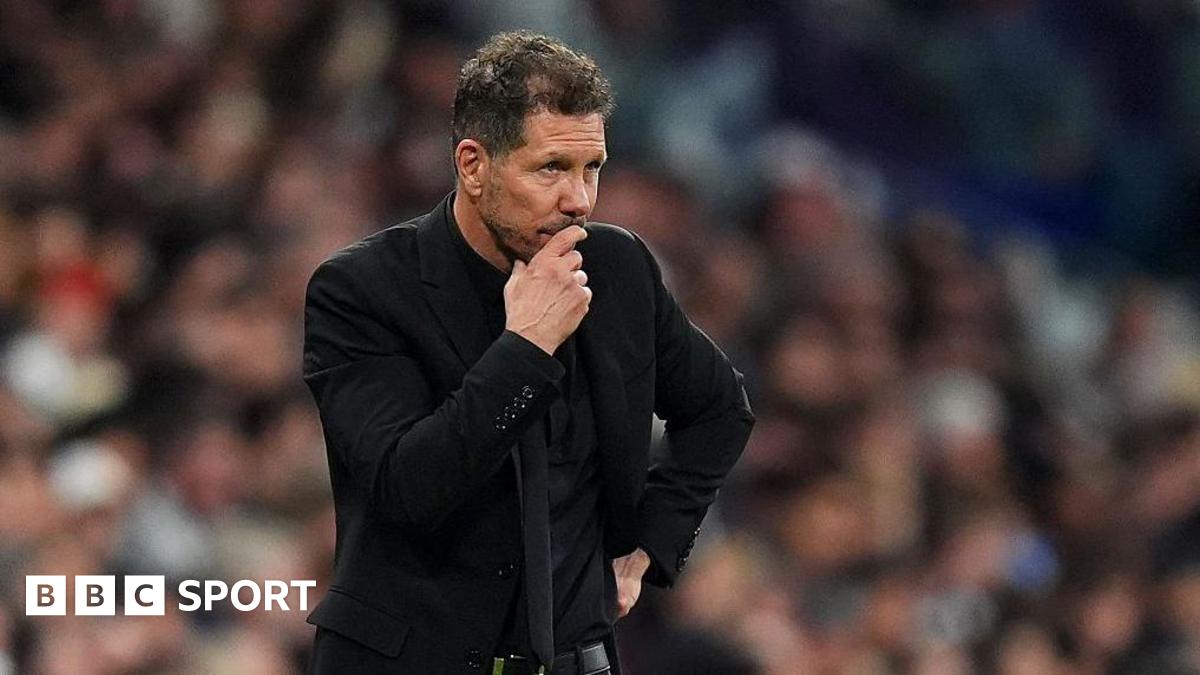
One thing that is indisputable is Simeone’s managerial record at Atletico.
He has taken charge of Atletico Madrid on 786 occasions, recording 465 wins, 170 draws and 151 defeats across more than 14 and a half seasons at the helm. It makes him one of the longest-serving managers in world football.
Atletico offered Simeone his first big managerial job in European football when he was appointed in December 2011, his previous role on the continent having been to save Italian side Catania from Serie A relegation, following success in Argentina with River Plate and Estudiantes.
In that time, the club has been transformed. When Simeone first arrived, Atletico had just been eliminated from the Copa del Rey by third-tier Albacete and were 10th in La Liga, 21 points adrift of the leaders.
Advertisement
Yet under the Argentine coach, Atletico went on to win the Europa League in Simeone’s first season, before adding the Uefa Super Cup and the Copa del Rey in 2012–13.
From 2013-14 onwards, after winning their first title under Simeone, Atletico have qualified for the Champions League every season, twice falling to agonising final defeats at the hands of rivals Real in the space of three years between 2014 and 2016.
Competing on Europe’s biggest stage was no longer an achievement, it was considered the standard.
As Atletico supporter Guillermo Myela describes, Simeone changed the mentality of fans.
Advertisement
“We went from being ‘El Pupas – the jinxed ones’, to a club that can compete against Barcelona and Real Madrid without fear,” Myela says.
“The connection that he has with the club and the fans is something that you rarely see in modern football. He lives for Atletico Madrid.”
He is the most decorated manager of all time at the club and supporter Javier del Amo describes him as “one of the biggest icons in our history”.
“One of his biggest achievements is getting the fans identified again with the team,” del Amo says.
Advertisement
Lifelong supporter Dani Ruiz agrees: “He is the epitome of Atletico and what modern football has become.”
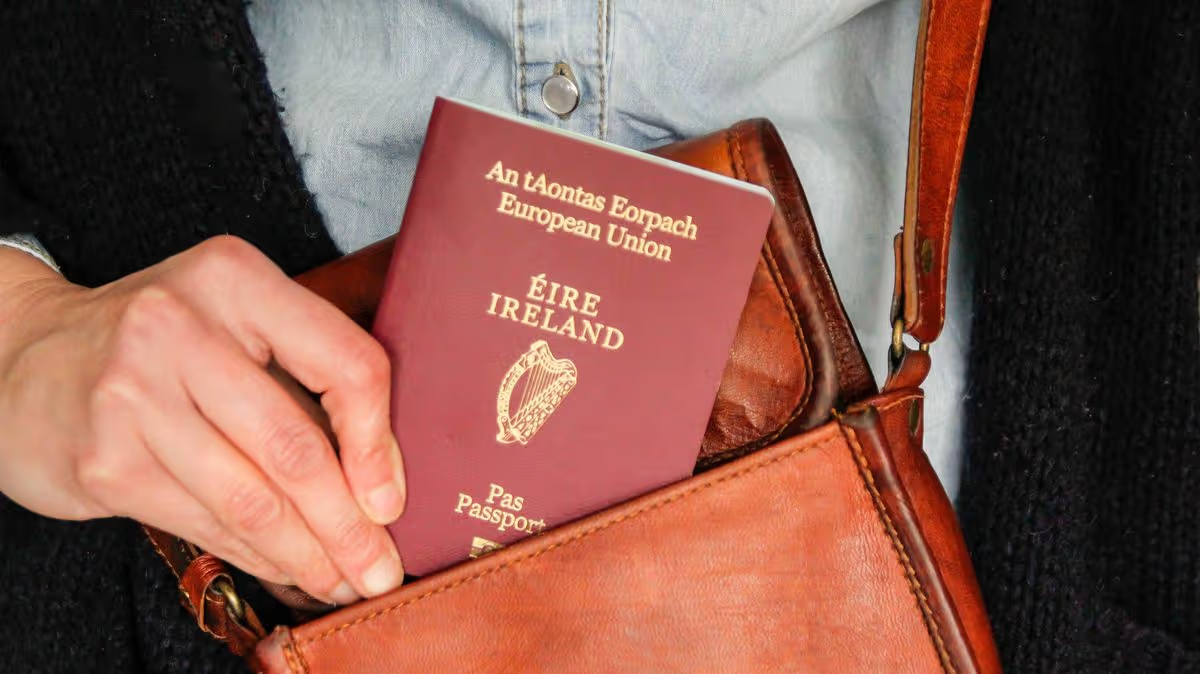
People with Irish passports are being urged to examine their passports ahead of the hectic summer holiday season. The Republic of Ireland’s Passport Service has unveiled its Don’t Be that Person campaign, highlighting situations such as “the groom missing his own stag do”, to prompt people to verify their passport remains valid before heading overseas.
Families with youngsters are being encouraged to submit applications early, given that processing times can be more protracted. Minister for Foreign Affairs Helen McEntee, alongside junior ministers Thomas Byrne and Neale Richmond, has recommended people make preparations well in advance of planned trips, especially those travelling with children.
Advertisement
“As we look forward to our summer holidays, it is vital to check that your passport is valid as soon as possible,” Ms McEntee said.
“As a parent, I understand how much preparation goes into organising travel with children, and ensuring your family’s passports are up to date avoids last-minute stress.
“Many parents may not realise that Passport Online can be used to apply for children of all ages, including newborn babies. Families can ensure a smooth start to their holidays by using Passport Online.”
Mr Byrne stated online applications can be finished in under 10 minutes and can be accessed from any location worldwide. He noted that over 96 per cent of applicants now utilise Passport Online to submit their passport application, whether for a renewal or an initial request.
Mr Richmond stated that child renewals and first-time applications can require longer than typical adult renewals.
“Our advice is to ensure your documentation is prepared in advance,” he said. “When applications are complete, the Passport Service can process and issue passports quickly and efficiently.
“To avoid disruption to your holiday plans, send your supporting documents as soon as you complete your online application. Processing times begin only once the Passport Service has received all required documentation.”
The man died a few hours after being reunited with his wife one final time
The Air Corps and a team of doctors have been lauded for exceptional efforts that allowed a 96-year-old cancer patient to be reunited with his 94-year-old wife before he passed away.
Advertisement
The Co Donegal native had never been outside his home county and had never been away from his wife before he was transferred to Galway University Hospital (GUH) for a lung biopsy that could not be carried out in Letterkenny.
A case report published in the Hospice and Palliative Medicine International Journal noted that the man “started to die” in intensive care at GUH, and was “clearly distressed” by the fact that he was away from home.
He knew that the journey from Donegal to Galway would be too much for his wife, and would likely take too long to ensure that she would be with him before he died, according to the Irish Mirror.
Advertisement
The report, which highlighted a number of cases in which exceptional efforts were made to fulfil patients’ wishes to die at home, said the Defence Forces agreed to airlift the man to Donegal on humanitarian grounds.
The palliative care team also secured a bed for him at Letterkenny University Hospital, where another patient volunteered to move to a trolley to make room for him.
The 96-year-old was accompanied on an Air Corps helicopter by a junior doctor, who kept him alert as he was afraid he would die before reaching his destination. All of the man’s family were waiting at the hospital to greet him, and cheered as he landed.
He passed away peacefully hours after his arrival in Letterkenny, according to the study, which was co-authored by Dr Dympna Waldron, a consultant in palliative medicine and professor at the University of Galway.
Advertisement
Another case concerned a man in his 40s, who was the father of three very young children. He was dying of cancer and it was his wish to die at home surrounded by his family.
However, he had a chest drain inserted to facilitate breathing, and this would have to be removed if he were to travel home. There was concern that he would not survive long enough without it to make the four-hour journey.
The National Ambulance Service was contacted and the Air Corps again agreed to airlift him on humanitarian grounds. “As the helicopter took off, they left the door open so the patient could feel the wind, having [struggled to breathe] for so long,” the authors said.
Advertisement
As they approached his home, “the whole town” had come out to greet him as the helicopter landed in a local football field, according to the report.
His wife contacted the palliative care team some years later to express how “vitally important” this effort had been for their children, who had been made to feel that their dad “mattered”.
The research paper said the case reports demonstrated the value of extra efforts made by healthcare professionals to achieve a wish that “lives on with families” and helps with the process of bereavement.
“In palliative care, end-of-life wishes are paramount and exceptional circumstances tend to live on in all our memories,” the authors wrote.
For Morton, leaving his hometown club was a wrench. He had been at Liverpool since the age of five, rising through the academy to be hailed as one of the club’s brightest prospects after breaking into Jurgen Klopp’s side in 2021-22.
But after promising loan spells at Blackburn and Hull, opportunities dried up under Arne Slot and Morton found himself at a crossroads.
The decision to move abroad was not simply a change of scene, but a pivotal moment – a chance to expand his horizons and add new dimensions to his game.
“As soon as Lyon came in, there was nothing else on my mind,” says Morton, who moved to France after helping England Under-21s win the Euros. “It’s a massive club and the support here is incredible. It was always going to be a big challenge moving away from home but that’s what I wanted, and I felt ready. I wanted to show people I could be a leader and hopefully that’s what I’ve done.”
Advertisement
Morton arrived at Lyon at a time of significant uncertainty. France’s dominant force in the 2000s, they had fallen on hard times and were even provisionally relegated last summer due to their financial situation, only to be reinstated on appeal.
Several senior players, including Alexandre Lacazette, Rayan Cherki and Georges Mikautadze, left as part of a major reset, with younger, more affordable replacements brought in.
Picked up for just 10m euros (£8.7m), Morton wasted little time making his mark. He helped Lyon to victory at Lens on the opening weekend and was named man of the match on his home debut against Metz.
Everything went perfectly that day – except for his half-time interview, which left French broadcasters perplexed. “They couldn’t understand anything I said,” recalls Wallasey-born Morton, who speaks with a strong Liverpool accent. “The translator just laughed. I’m not used to doing interviews at half-time when the adrenaline’s flowing, so I spoke far too quickly.”
Advertisement
It was a light-hearted reminder of the adjustments required off the pitch but Morton has adapted quickly where it matters most. Previously more of a box-to-box midfielder, he has been entrusted with the role of a number six by Fonseca, taking responsibility for organising Lyon’s play from deep.
“The manager has given me the reins to play my football and I’m loving it,” he says. “There’s no better position than number six, getting on the ball constantly, finding passes between the lines and using my brain to dictate games. Paulo Fonseca’s an incredible manager. He’s helped me so much. I’ve discovered things I didn’t even know I had as a footballer.”














































You must be logged in to post a comment Login