Abusers use counter-allegations to deflect blame onto their victims and deter them from seeking help in the future (Picture: Maria Korneeva/Moment/Getty)
When the police arrived, Michelle thought her ordeal was finally over.
She sat shellshocked on the sofa, squinting through a black eye with blood seeping from a cut lip after the latest violent assault at the hands of her abusive partner.
But it was Michelle who ended up in a cell that night after he told officers she hit him first.
Her ex had used the counter-allegation tactic.
Advertisement
It’s one that perpetrators often employ, according to Nadia Hughes, head of criminal justice services at Advance, a charity that helps women who’ve experienced harm through domestic abuse and the criminal justice system.
The ploy is particularly effective when a woman has acted in self-defence or retaliated, so the perpetrator himself has injuries. These are then misunderstood by the police as signs of aggression, rather than the culmination of years of abuse.
Nadia says that besides deflecting the blame from the abuser, the tactic also serves another purpose: ‘It’s a really manipulative way to deter a survivor from calling 999 in the future’.
Once the counter-allegation strategy has been used once, the police have a record that this woman might be violent or abusive. Nadia explains that ‘she’s then less likely to report the abuse she’s been subjected to because there is a distrust of statutory services like the police’.
Advertisement
‘Counter allegations actually become a sort of weaponised way of controlling that survivor. It is something we hear a lot unfortunately.’
Around half of recent referrals to Advance, which works at the intersection of domestic abuse and criminal justice, have stemmed from women being arrested as a result of counter allegations.
Research shows that women are three times more likely to be arrested than their male partners at a domestic abuse incident involving them.
This Is Not Right
On November 25, 2024 Metro launched This Is Not Right, a campaign to address the relentless epidemic of violence against women.
Advertisement
With the help of our partners at Women’s Aid, This Is Not Right aims to shine a light on the sheer scale of this national emergency.
You can find more articles here, and if you want to share your story with us, you can send us an email at vaw@metro.co.uk.
Read more:
Advertisement
Michelle tells Metro she suffered years of abuse prior to her wrongful arrest, beginning when she was pregnant.
‘The second time he hit me was after my son was born and he was in my arms,’ she says. ‘That was horrific.
‘My son had a white baby grow on and there was blood all over him where he broke my nose.’
Advertisement
Michelle suffered appalling injuries, including a broken leg and fractured collarbone, when her ex pushed her from a fourth-floor window.
‘When you’re in it you don’t see how serious it is,’ she says. ‘You just know that you survived it.’
She describes how her homelife hinged on her ex’s moods.
Around half of recent referrals to Advance have stemmed from women being arrested as a result of counter allegations (Picture: Getty Images/Johner RF)
‘He would phone me during the day and let me know how good or bad his day was going,’ she says.
‘That would determine what my evening was going to be like. If it was a bad day, I would be walking on eggshells waiting for him to flip at me.
Advertisement
‘It’s like dying a slow death waiting for that snap to happen.’
Looking back, Michelle can’t even remember what that final argument was about.
When her ex started hitting her again, she instinctively threw her arms up to try and defend herself.
But she caught his face with her elbow while doing so, giving him a bloodied nose.
Advertisement
Despite being the one who called the police, she found herself being arrested alongside him.
She lost her job as a family support worker after missing a key court hearing while in custody.
‘I sent myself to university when I was 30 trying to better my life,’ Michelle says. ‘I got the job of my dreams, and it was taken.’
Research shows that women are three times more likely to be arrested than their male partners at a domestic abuse incident involving them (Picture: Getty)
Beyond the physical and emotional toll, counter allegations can cost women their homes, their children and their jobs.
In the case of Bethany Rae Fields, her killer used counter allegations in the lead up to, and on the day he killed her.
Advertisement
After 21-year-old Bethany reported her ex Paul Crowther to the police following threats he had made against her, her friends and family, Paul turned his finger at her multiple times.
Pauline, Bethany’s mum, calls his actions ‘despicable. She was tiny; 21 to his 35 years.’
Staffing issues meant that Paul’s complaint progressed slowly – as did Bethany’s against him – and a week after filing his ‘case’ with the police, he chased it, and then again four days later.
Despite Paul being reported to the police seven times, despite being known to services after having had two former partners complain about harassment – with one resulting in a conviction, and despite Paul telling mental health services that he wanted to take revenge against Bethany, he was still invited to make a statement after reporting her to the police.
Advertisement
He went into the station on September 12, 2019, to make a statement against her. That same day he killed her.
Pauline now urges police to think of Bethany’s initials – BRF – and to ‘Believe. React. Fast’. That means considering whether the counter-allegation tactic is in play.
For Jessica, the experience of being disbelieved by the police has eroded her faith in the force completely.
‘I don’t believe they have listened to me once, or made me feel safe,’ she tells Metro.
Advertisement
Jessica was abused for years by two of her children and ended up having to leave the family home after being arrested and charged when one of them claimed she was the perpetrator.
She says her son would hold a knife to her throat and her daughter would kick and spit at her.
‘It got to the point where I couldn’t go to the rest of the house really. I was living in a bedroom. It was marked cell number five with my name.’
Jessica adds: ‘I don’t think I could even admit to myself how bad it was until now, when I look at the pictures of the injuries and the pictures of my bedroom door – I thought that was normal.
Advertisement
On the day of her arrest, Jessica says her daughter ‘started on’ her again as she was going into her bedroom.
Like Michelle, she put her hand out to signal she’d had enough – but that was not how it was subsequently reported to the police: ‘Apparently that was attempting to push her down the stairs.’
‘We are finding that women are not speaking up – they are not feeling confident or safe to report.’
Jessica is still haunted by the traumatic experience of being arrested.
Advertisement
‘I was in the bedroom with my other daughter,’ she recalls. ‘We were just laying there. There was a bang on the door.
‘My bedroom door regularly banged from the children anyway, but as I went to open it, I was literally pulled out by force onto the little landing.
‘I didn’t have a clue what was happening – there was no reason for the police to be there. I was put in handcuffs.
‘I was crying, and the two children that did this were sat there filming the whole thing and laughing.
Advertisement
‘It was so daunting, and the way they treat you when you’re going to the cells is just horrendous. I’d never been in one before.’
Jessica adds: ‘Everyone always joked and called me Wonder Woman because I had six children. I was a nursery manager. I was a trusted person.
‘They’ve taken all of that away.’
She spent a year under investigation only for the common assault charge to be dropped at the crown court.
Advertisement
Being made to feel like a criminal has now changed how she views the police.
Learn more about Advance
Advance is a charity that helps women who’ve experienced harm through domestic abuse and the criminal justice system.
They deliver wraparound frontline services across the South and East of England, including Greater London.
You can find out more about the charity here; and if you need help now, you can find the relevant contact details here.
Advertisement
‘They just don’t seem to understand domestic abuse. They definitely don’t understand child-to-parent violence.’
In addition to being less likely to call the police, a woman subject to counter allegations is also less likely to be referred by them on to specialist support because she is seen as a perpetrator.
Advertisement
Nadia says: ‘If you’ve got perpetrators who are recording a woman using resistance – someone who has been subjected to abuse for a long period of time and gets to the point where she retaliates as a response to that – that becomes an isolated incident away from the long-term abuse and can be used as evidence against her.
‘We are finding that women are not speaking up – they are not feeling confident or safe to report.’
Research shows nearly 70% of women in prison or under community supervision are victims of domestic abuse. For many, that is directly linked to their offending and can take the form of counter allegations, coerced offending or criminalisation by association.
‘I’ve seen quite a number of cases where very coercively controlling men – very manipulative men – are able to set these situations up. It can all be quite Machiavellian and horrendous.’
Advertisement
The Centre for Women’s Justice is campaigning for a new defence in criminal law that will recognise coercive control as the driver of the offence.
Currently, victims can only rely on the defence of duress – when you are coerced into acting under the use or threat of violence – which has been found to be ineffective in cases of domestic abuse.
Instead, they often depend on the police or Crown Prosecution Service deciding it is not in the public interest to prosecute them.
Harriet Wistrich, founder and CEO of the Centre for Women’s Justice, tells Metro: ‘In a lot of domestic abuse situations, by the time the police have arrived the victim could be very traumatised or hysterical and he’s appearing very calm.
Advertisement
‘If he’s saying, “she’s just a bit mentally unwell and she’s just thrown something at me”, how do the police deal with that situation?
‘And we have seen a lot of situations where the woman has been arrested and she’s really the victim and the police aren’t necessarily able to make a very careful assessment of what’s going on.
‘I’ve seen quite a number of cases where very coercively controlling men – very manipulative men – are able to set these situations up.
‘It can all be quite Machiavellian and horrendous.’
Advertisement
She adds: ‘Our proposed model is based on what we have for victims of trafficking, where it’s recognised that if you’re forced to commit criminal offences that essentially you have a defence if you can show that it’s directly linked with your exploitation.
‘What we’re arguing is that where somebody is in a coercively controlling relationship where they are under control of somebody and they are essentially forced to handle stolen goods or drugs or commit mortgage fraud or whatever it is, they can show circumstances which lead them to commit those acts.
‘Obviously, it’s not necessarily having a gun held to you, but if it’s in that context of the relationship then they should have a defence and be able to argue they are not culpable rather than potentially argue it as mitigation but still be convicted of a crime.’
A Reform party campaign video starring Farage was also filmed at Ipswich’s stadium.
Farage’s visit sparked an angry response from some Ipswich supporters, while the club claimed that it was apolitical and did not ‘support or endorse any individual party’.
Advertisement
In a statement on Friday night, Aston said he was ‘immensely upset’ for ‘hurting’ Ipswich’s fanbase and admitted ‘mistakes have been made’.
Ashton said: ‘I’m fully aware that this has been a very difficult week for all of us.
Advertisement
Your football fix
Metro‘s Head of Sport James Goldman delivers punchy analysis, transfer talk and his take on the week’s biggest stories direct to your inbox every week.
‘The staff are hurting. Elements of the fanbase are hurting. So are elements of our local community. That upsets me immensely. Unreservedly, I want to apologise and say I’m sorry.
‘I understand that supporters and element of the community are angry. I also understand that there are a number of mistruths out there about what’s actually happened this week. And I also understand that we have lessons to learn. Because mistakes have been made which have caused harm and distress to parts of our local community.
Ipswich Town’s chairman, Mark Ashton, admits ‘mistakes have been made’ after Nigel Farage’s visit to the club
‘And as the chairman of the club I take full responsibility for those mistakes. And full responsibility for making sure that those lessons are learned and learned quickly.
‘The full board of directors are now reviewing the policy regards how we engage with local politicians and political parties. We’ll decide how, if and when we do that moving forward. Because, again, lessons have to be learned.’
Tomodachi Life: Living The Dream – you can try it out right now (Nintendo)
One of the last first party games for the original Switch has a free demo you can download now, as a reader examines the pros and cons of next month’s new game.
When gaming publications started detailing their experiences previewing Tomodachi Life: Living The Dream last week, I assumed it would be a wait to get the same opportunity, if we got one at all. So when this demo shadow-dropped almost immediately afterwards, it caught me off guard in the best way. This has been my most anticipated game of the year, so any opportunity to preview it is a massive privilege.
Essentially a short prologue to the full game, it does a solid job of introducing the core mechanics while letting you actually play around with them without feeling heavy-handed. When you’ve finished the demo, you’ll have a strong understanding of how to manage your residents and interact with them.
The main restriction is the three Mii cap. While that sounds really limited, it’s just enough to complete the basic tutorial and unlock the first two buildings. In the full game you need five residents to unlock the flagship Island Designer, so the demo basically puts you in the perfect position come launch day, as your demo progress transfers to the full game.
Advertisement
Being able to shorten the time it takes to unlock the new feature makes this worth the download alone. I’d recommend making the remaining two Mii in the console’s Mii Maker and then importing them into the full game on release day.
The biggest highlight is simply watching the Mii of my friends interact with each other. The charm of Tomodachi Life is built around wacky interactions and relationships, and seeing this effectively translated to the Switch reminds me of exactly what I loved about the 3DS original, as within minutes I was grinning at the descriptions of what my Mii were talking about.
Expert, exclusive gaming analysis
Sign up to the GameCentral newsletter for a unique take on the week in gaming, alongside the latest reviews and more. Delivered to your inbox every Saturday morning.
Advertisement
The clothing shop also has a surprisingly large amount of clothes to buy for your Mii, and there’s a genuinely cute bonus costume as a reward for completing the demo. LGBT customisability (which was lacking in the 3DS game) is also really strong and is done in a way that’s both detailed for those who want LGBT Mii and simple to ignore for anyone who doesn’t.
The only major objective flaw with the demo game is that you’re only able to use the touchscreen when making the Mii. Also, the frame rate/pacing felt slightly off in my eyes, although your mileage may vary with that.
Advertisement
The biggest flaw is how the demo ends. It takes roughly an hour to complete, which totally makes sense for the type of game this is. However, after giving your Mii an outfit the island essentially freezes. The Mii stay inside their homes and all dialogue becomes focused on what you’ll be able to do in the full game.
While demos are advertisements for games, I can’t remember a recent one quite as blatant about it as this, and the way the Mii talk feels at odds with the tone of the game. It’s frustrating because the bulk of the demo gives you the limited freedom to orchestrate dynamic interactions between three Mii and watch them explore the island. And yet just as it starts to soar, its wings get cut off and it becomes a semi-interactive billboard.
Overall, I’m thrilled that this exists and it does exactly what it needs to do in order to sell you on the full game. However, the unnecessarily restrictive post-demo kills all momentum and makes me think that it should’ve been released on the 9th of April, when you can pre-download the full game.
By reader Connor Lamb
Advertisement
Purposefully peculiar (Nintendo)
The reader’s features do not necessarily represent the views of GameCentral or Metro.
You can submit your own 500 to 600-word reader feature at any time, which if used will be published in the next appropriate weekend slot.
CAPE CANAVERAL, Fla. (AP) — The astronaut who prompted NASA’s first medical evacuation earlier this year said Friday that doctors still don’t know why he suddenly fell sick at the International Space Station.
Four-time space flier Mike Fincke said he was eating dinner on Jan. 7 after prepping for a spacewalk the next day when it happened. He couldn’t talk and remembers no pain, but his anxious crewmates jumped into action after seeing him in distress and requested help from flight surgeons on the ground.
“It was completely out of the blue. It was just amazingly quick,” he said in an interview with The Associated Press from Houston’s Johnson Space Center.
Fincke, 59, a retired Air Force colonel, said the episode lasted roughly 20 minutes and he felt fine afterward. He said he still does. He never experienced anything like that before or since.
Advertisement
Doctors have ruled out a heart attack and Fincke said he wasn’t choking, but everything else is still on the table and could be related to his 549 days of weightlessness. He was 5 ½ months into his latest space station stay when the problem struck like “a very, very fast lightning bolt.”
“My crewmates definitely saw that I was in distress,” he said, with all six gathering around him. “It was all hands on deck within just a matter of seconds.”
Fincke said he can’t provide any more details about his medical episode. The space agency wants to make sure that other astronauts do not feel that their medical privacy will be compromised if something happens to them, he said.
The space station’s ultrasound machine came in handy when the event occurred, he said, and he’s gone through numerous tests since returning to Earth. NASA is poring through other astronauts’ medical records to see if any related instances might have happened in space, he said.
Advertisement
Fincke identified himself late last month as the one who was sick to end the swirling public speculation.
He still feels bad that his illness caused the spacewalk to be canceled — it would have been his 10th spacewalk but first for crewmate Zena Cardman — and resulted in an early return for her and their two other crewmates. SpaceX brought them back on Jan. 15, more than a month early, and they went straight to the hospital.
“I’ve been very lucky to be super healthy. So this was very surprising for everyone,” he said.
Fincke stopped apologizing to everybody after NASA’s new administrator Jared Isaacman ordered him to stop.
Advertisement
“This wasn’t you. This was space, right?” his colleagues assured him. “You didn’t let anybody down.”
Ever the optimist, he’s holding out hope that he can return to space one day.
___
The Associated Press Health and Science Department receives support from the Howard Hughes Medical Institute’s Department of Science Education and the Robert Wood Johnson Foundation. The AP is solely responsible for all content.
Tiger Woods has been arrested and charged with driving under the influence after his car was involved in a crash in Florida, police have said.
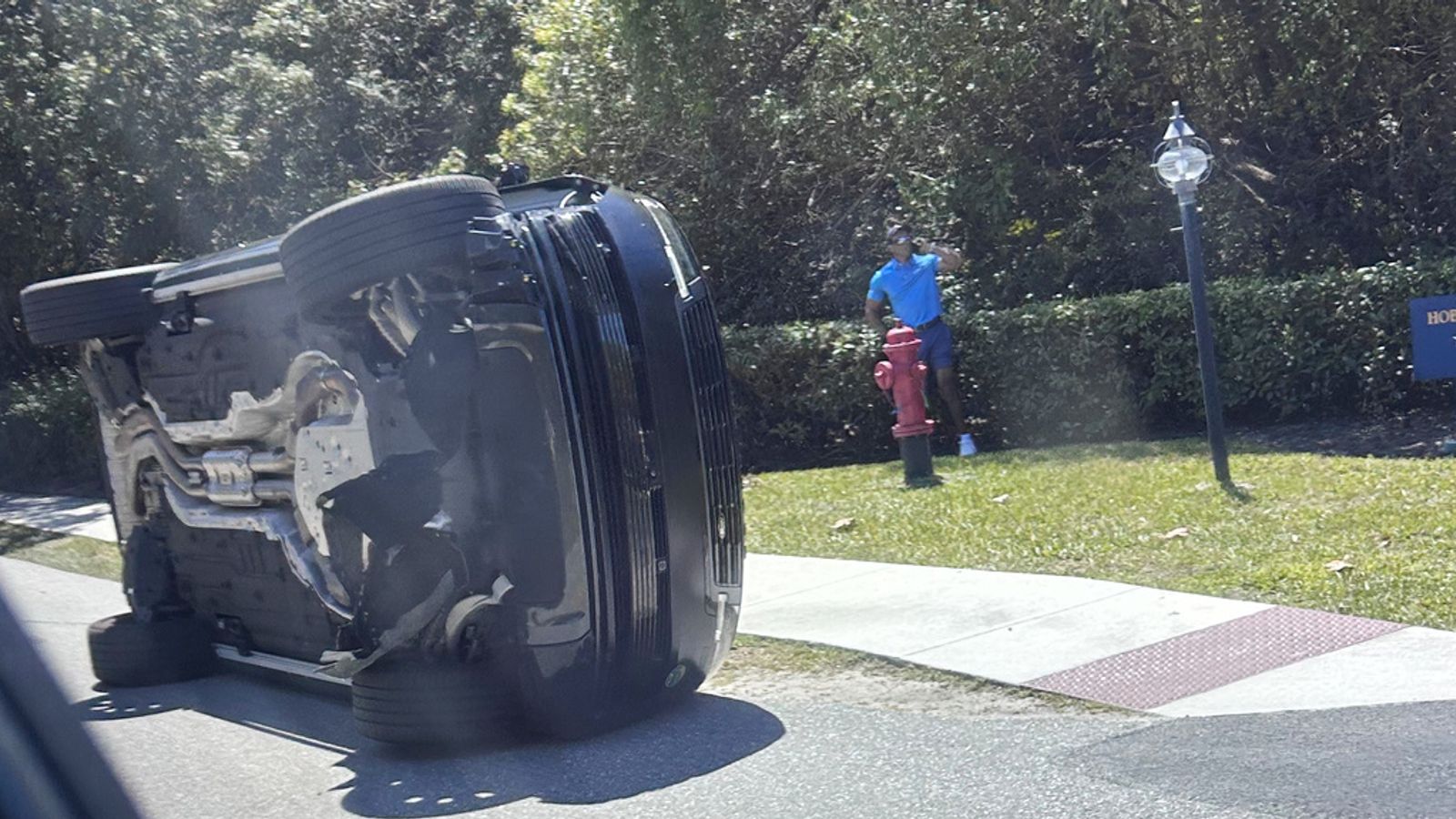
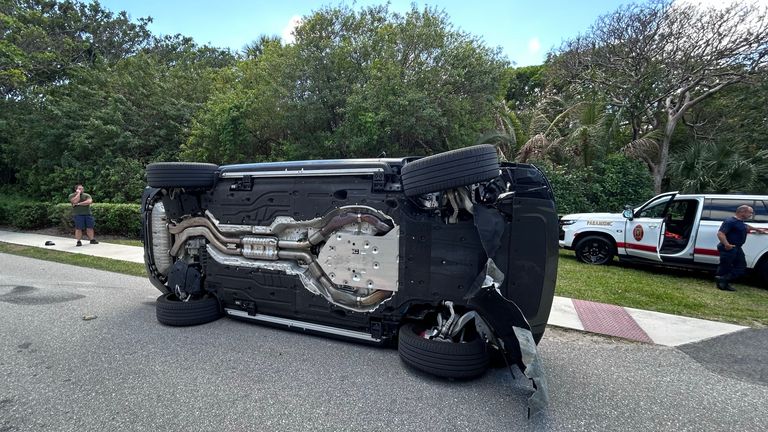
A Land Rover, which the golf legend was driving, tried to overtake a truck “at high speeds” before it swerved and rolled on to its side after clipping a truck towing a trailer, Martin County Sheriff John Budensiek said.
He added Woods showed “signs of impairment” after the incident, which happened shortly after 2pm local time on Friday and not far from where the golfer lives on Jupiter Island.
Woods, 50, took a breathalyser test after his arrest, which came back negative, but the golfer then refused to give a urine sample, police said.
Advertisement
Image: Tiger Woods standing near his overturned vehicle in Jupiter Island, Florida. Pic: AP
Sheriff Budensiek told reporters during a news conference: “When it came time for us to ask for a urinalysis test, he refused, and so he has been charged with DUI, property damage and refusal to submit to a lawful test.”
None of the parties involved in the crash reported injuries.
Pointing to how the smash unfolded on a small, two-lane road, Sheriff Budensiek said it was lucky no one was injured.
Image: Police arriving at the scene of the crash. Pic: WPTV
“Had there been someone moving in the opposite direction, we would not be having a conversation saying there was no injuries. This could’ve been a lot worse,” Sheriff Budensiek said.
“He [Woods] was lethargic on scene but that we believe was because of what he was intoxicated on.”
Advertisement
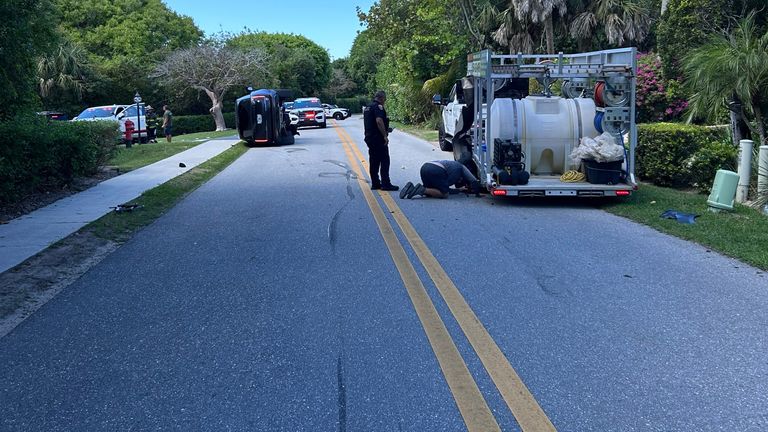
The vehicle Woods hit was a truck towing a pressure cleaner trailer.
Image: Woods was able to escape the vehicle by crawling through the passenger door, police said. Pic: Martin County Sheriff’s Office via AP
The truck driver tried to “edge off” the side of the road to get out of the way but there was not enough room, the sheriff explained during an update on Friday.
It is not known if Woods was wearing a seat belt at the time of the crash, as he “crawled out of the passenger door” prior to police arriving at the scene.
This was at least the third time Woods has been involved in a car crash, most recently in February 2021 when his SUV ran off a coastal road in Los Angeles at a high rate of speed, leading to multiple leg and ankle injuries.
Woods said later his injuries were so bad that doctors considered amputation.
He also was arrested on a DUI charge in 2017 when South Florida police found him asleep behind the wheel of his car that was parked awkwardly with damage to the driver’s side.
Advertisement
He later pleaded guilty to reckless driving after it emerged he had had five prescription drugs in his system at the time.
Image: Tiger Woods with his then wife Elin Nordegren at a basketball game in 2009. Pic: Reuters
In 2009 he crashed his car into a fire hydrant and tree outside his Florida home – an accident which inadvertently led to a spectacular unravelling of his private life.
Woods’ then wife, Elin Nordegren, used a golf club to smash a window of his Cadillac Escalade to get him out.
“This situation is my fault and it’s obviously embarrassing to my family and me,” Woods said on his official website at the time.
“I’m human and I’m not perfect.”
Advertisement
The incident revealed a bitter marital dispute with Nordegren, as a host of women came forward to admit to having had extramarital affairs with Woods.
Woods and Nordegren divorced in August 2010.
Image: Skid marks seen on the road after Woods’ latest accident. Pic: Martin County Sheriff’s Office via AP
The latest crash comes after Woods returned to competitive action for the first time in over a year on the final night of play in the indoor TGL competition on Tuesday.
He had said afterwards that he hoped he would be fit enough to play at the Masters next month.
Woods is widely regarded as one of the greatest golfers of all time. His major titles include five Masters, three US Opens, three British Opens and four PGA Championships.
The villages are within walking distance of one another
People living in two neighbouring Cambridgeshire villages say they “wouldn’t want to live anywhere else” and that living there feels like “being on holiday”. Melbourn and Meldreth are both in the south of Cambridgeshire and are roughly a four minute drive from each other, or around 20-minutes on foot.
Advertisement
Melbourn is the larger of the two, and is home to more than 4,600 people, whilst Meldreth has around 2,000 residents. In Melbourn, there are a variety of amenities including shops, two pubs, barbershops, and even a stunning wedding venue. Meldreth has a train station which is ideal for commuters, a shop, and a village pub called The British Queen.
As part of our Exploring Cambridgeshire series, we visited both villages and spoke to people about what it is like to live here.
Vicky Deville, 73, has lived in Melbourn for 40 years. She said that the village is “a nice place” and she “wouldn’t want to live anywhere else”. She added: “We have got all the amenities we need. There is lots and lots of groups going on for all ages.”
Vicky feels “very lucky” to live here, especially because she enjoys visiting the Melbourn Hub, which has a café with an integrated library, and hosts lots of local events. She added: “There is lots of things that go on in there. There’s all sorts of advice you can get in there and help from people.”
Advertisement
Hannah Trinder, a manager at one of Melbourn’s local pubs, The Dolphin, grew up in a nearby town, but later moved to Melbourn. She said: “It is nice because despite this being a village, you still have that town feel. Plus, what is really nice about living here is that the locals are all really friendly and fun.”
She said that she has made friends with a lot of locals, and that “there is such a community in this village – everyone just wants to help each other”.
Melbourn Greenway, one of 12 Greater Cambridge greenways being constructed in South Cambridgeshire, aims to provide better and safer walking and cycling routes into the city of Cambridge.
Hannah said that this is something she would definitely use because she enjoys a long walk, especially because of “the very nice countryside” that surrounds the village. Hannah sees the neighbouring village, Meldreth, as a similar style village with “nice little houses and cottages”.
A couple, Nicole and Edward, who moved from London to Meldreth, chose the “perfect village” so that they were still able to commute into London. Edward, 49, said: “It has got a pub, corner shop, post office, and butchers.” Nicole, who is 37, said that after living in London, coming to Meldreth feels like “being on holiday”.
The couple love that it is a “lived in village, so it has a sense of community” and the locals “are very friendly”. The couple say Melbourn is useful for its amenities such as the dentist but they consider each village to “have two different personalities”.
David Eldred, 84, said that he has lived in Melbourn for “the longest period of living anywhere” in his life. He added: “I’ve moved 28 times in my life because I was in the army, and now I live by myself so it is a place I should always stay.”
David lives down a remote lane, surrounded by the countryside and he enjoys walking through the fields. He said the Melbourn Greenway “would be ideal” and help to connect the surrounding areas. David moved to Melbourn because of its close proximity to Cambridge, so the village was an “ideal” solution for him.
A lady, who only gave her name as Mirka, has lived in Melbourn for around 10 years. She said that she enjoys the park to walk her dog. She said “a lot of people [from Meldreth] come here” and “my children went to Meldreth Primary School”.
Many of Saturday’s papers lead with the Middle East conflict one month since Israel and the US attacked. The Guardian leads with their latest plans for the conflict. US Secretary of State Marco Rubio says he expects the war to end in “weeks, not months”, the paper writes, while Israel threatens to “‘escalate and expand’ its attack”. The paper also splashes its own investigation into a top model industry executive who allegedly “introduced models to ‘dear friend’ Jeffrey Epstein”. A spokesperson for the executive tells the paper she “never put a model in harm’s way by sending them to inappropriate go-sees or meetings”.
The UK’s second-largest fuel retailer also dismissed claims that forecourts are “profiteering” from recent price increases.
Petrol and diesel costs have climbed sharply since the end of February, after the war between Iran and US-Israeli forces disrupted oil production and supply from the region.
Average unleaded prices have jumped by more than 14p a litre over that period, reaching 147.19p, according to RAC figures published earlier this week.
Advertisement
Allan Leighton, executive chairman of Asda, said the retailer has seen bumper demand from drivers amid price volatility.
The boss stressed that the issue has only affected “the odd pump” at a small number of its petrol forecourts.
He said: “Our fuel volumes are up quite significantly and clearly demand has been outstripping supply.
Advertisement
“Supply is tight and we are all trying hard on that.
“The issue is a temporary one, and some could see issues when we are waiting for delivery, and we can expect to see that continue.
“The spikiness at the moment makes this tricky for us, as spikes can lead to temporary shortages. These are temporary and are addressed very quickly.”
The boss also rejected claims that fuel retailers have boosted their profits through recent price increases.
Advertisement
Earlier this month, Prime Minister Sir Keir Starmer said the Government would step in if retailers try “to rip off customers” through price gouging.
In response, Mr Leighton said “no, we are not” when asked if the business was profiteering.
He said: “Our (profit) margin will be down as a result. It is very clear this is not the case.
Advertisement
“People ask where the money is going and the Government are getting a lot of money of the back of this.”
Why is the Iran war driving up fuel prices?
The war is disrupting both oil supply and its routes, and markets are adding a “risk premium” on top.
Analysis from the RAC and others suggests UK motorists have already paid hundreds of millions extra at the pumps since the Iran conflict intensified, with average petrol and diesel prices climbing sharply in March.
Have you noticed that fuel is more expensive? Let us know in the comments
“And we know that lots of people actually can be in work, and we want to give them the support to make work feasible. The evidence is now very clear. We’re publishing new evidence on this, that those who’ve had this additional help are significantly more likely to be in work, be in a job, and stay in work for an extended period. And we want to give people the chance of fulfilling their ambitions.”
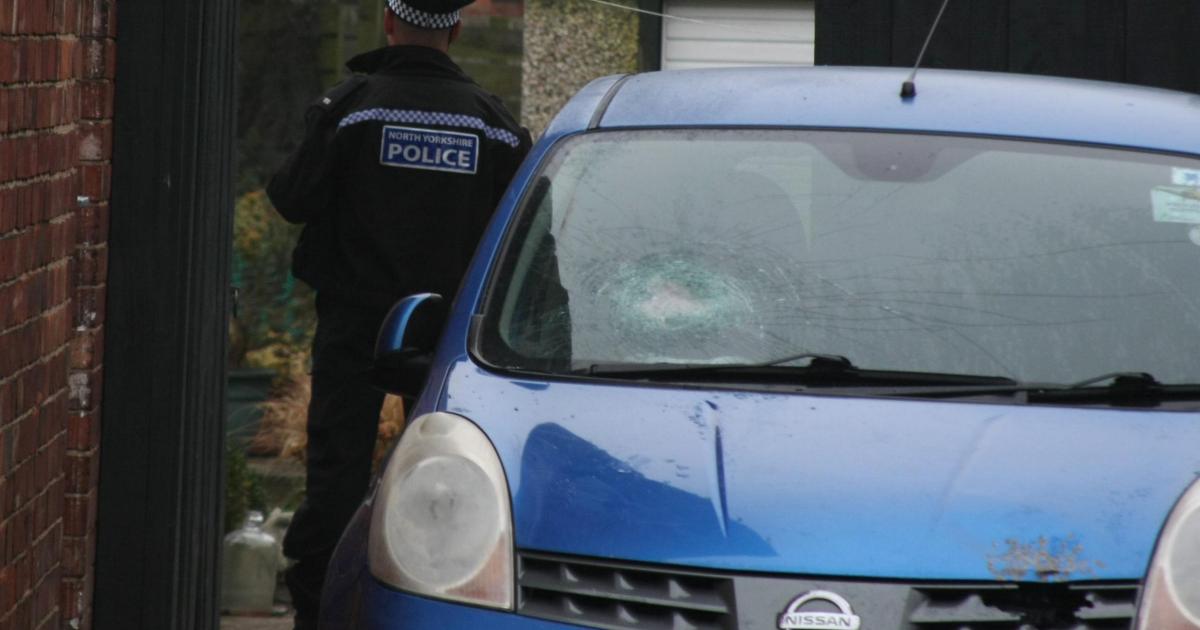
On Saturday, March 7, an unoccupied Nissan car was shot at while it was parked outside a house in Starkey Crescent, at around 9.25pm.
The house and driveway were cordoned off under guard and a heavy police presence remained in the area.
Two days later, police were seen searching the area of a path running parallel to Fifth Avenue from Melrosegate to Tang Hall Lane with sniffer dogs.
Police were combing the area of an active travel path behind Fifth Avenue on consecutive days from March 9 (Image: Kevin Glenton)
Police said no one was harmed in the shooting and it was an isolated incident with no threat to the wider community.
Advertisement
On March 11, three people were arrested in connection with the shooting – a 34‑year‑old man on suspicion of possession of a firearm and criminal damage, a 32‑year‑old man on suspicion of possession of a firearm, and a 29‑year‑old woman on suspicion of assisting an offender.
The following day, the outstanding suspect, a 23-year-old man, was arrested on suspicion of possession of a firearm, possession of a firearm without a certificate and criminal damage.
North Yorkshire Police released an update this afternoon (March 27) saying all four people arrested remain on bail and that its enquiries are ongoing.
Police were combing the area of an active travel path behind Fifth Avenue on consecutive days from March 9 (Image: Kevin Glenton)
A force spokesperson said: “We are continuing to appeal for people in the Tang Hall area of York to come forward, particularly those on Starkey Crescent, Rockingham Avenue, Fifth Avenue, and Melrosegate.
Advertisement
“Do you recall any suspicious people or activity between 8.45pm and 9.45pm on Saturday, March 7?
“Please also get in touch with any relevant information, CCTV, doorbell or dashcam footage.
“This includes residents we have already spoken to during our extensive house-to-house enquiries, but who may now have new information or remembered something not previously mentioned to officers.”
Anyone wishing to come forward with information should quote reference number 12260041722.
Our latest Pompey Q&A returns today for subscribers of The News, with John Mousinho’s future a focus as the Bristol City job becomes available this summer. Summer target Pelle Mattsson, free agents and what happens to contracted misfiring players are all also under the microscope.


























































You must be logged in to post a comment Login