


Connect with us

NewsBeat

‘I had never seen tanks before’ – stories from Ukraine’s children living through war | World News

Published

on

'I had never seen tanks before' - stories from Ukraine's children living through war | World News

“I had never seen tanks before.”

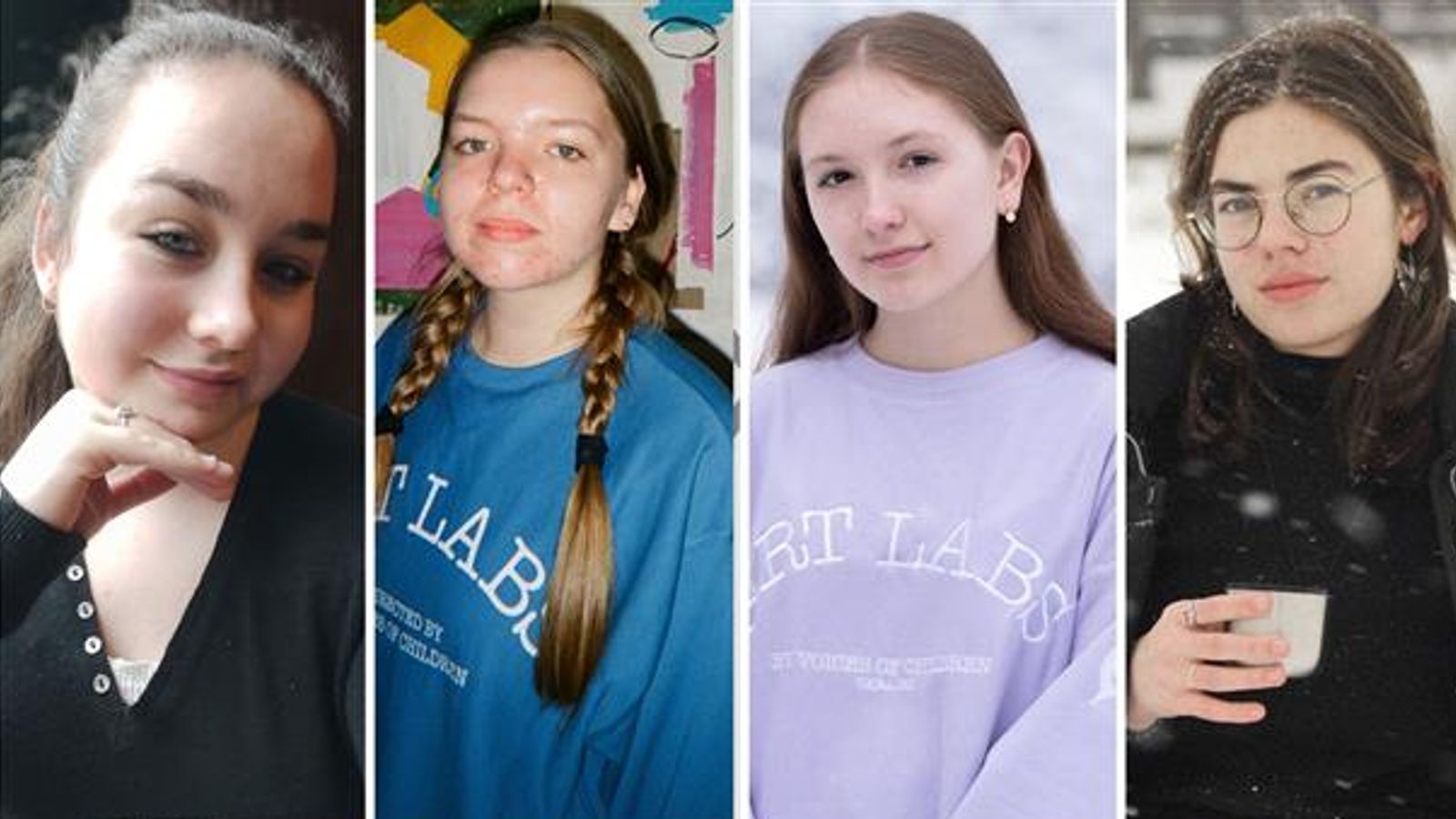
As Ukraine marks the fourth anniversary of the full-scale Russian invasion, Sky News has partnered with Voices of Children, a Ukrainian charity, to tell the stories of teenagers living through war.

They speak of a childhood stolen, and the pain left behind by losses and sacrifices.

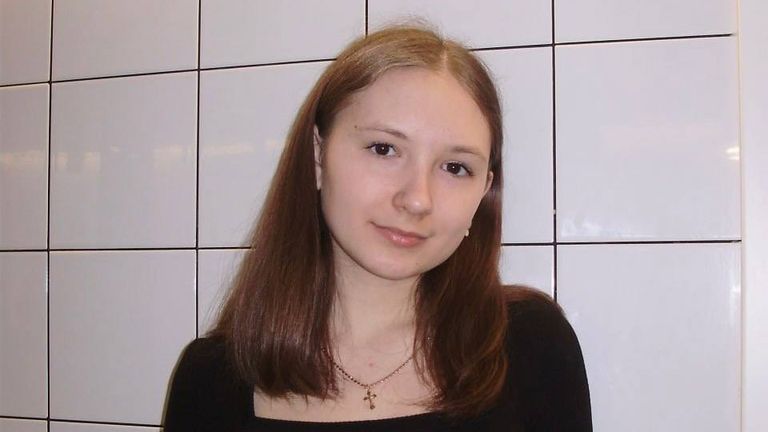
Kateryna

Advertisement
Image:
Kateryna. Pic: Voices of Children

I am 14 and I live in Chernihiv, a city in the north of Ukraine near the border with Belarus. In February 2022, I was 10 and couldn’t imagine what war really meant, yet by 22 February my emergency suitcase was packed.

Within days Ukrainian tanks were driving down our street. I had never seen them before. For the first three nights, we slept in the basement. During the day, we counted explosions, and at night, we tried to sleep.

On 4 March, my birthday, we had to leave the city, because Chernihiv was under constant attack from Russian bombers. We travelled for three days, spending the first night with kind people in Brovary, who had taken in the cats and dogs left behind by fleeing families.

Kateryna. Pic: Voices of Children
Image:
Kateryna. Pic: Voices of Children

The next night was near Khmelnytskyi, where at a checkpoint we were told to stop only in dark places because Russian helicopters might be flying overhead. On the third night, we slept in a kindergarten building on the other side of the country. My family and I stayed there for 40 days before we could go home. It was the hardest time of my life.

Today, the most important thing in my life is creativity, especially writing poetry. I fell in love with literature thanks to my literature teacher, who I can always turn to for help. Writing has become a form of therapy for me.

Advertisement

I do not have many close friends, but I know there are people who help me stay strong, with whom I can talk about everything that worries me. I believe that is important.

Hanna

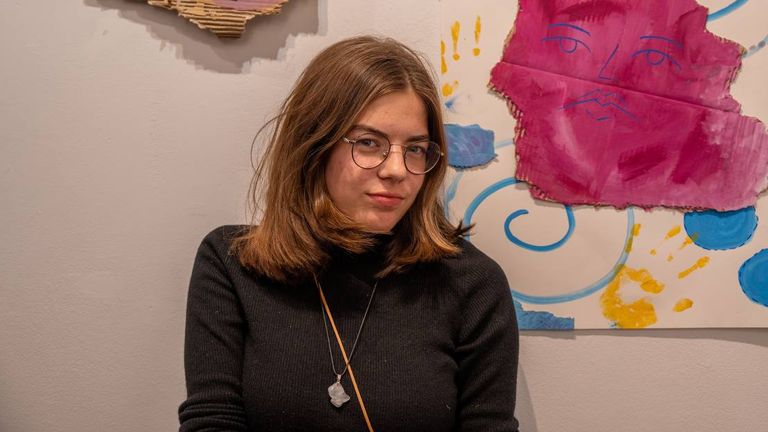
Hanna. Pic: Voices of Children
Image:
Hanna. Pic: Voices of Children

I’m 17 and I’m from Zaporizhzhia.

In September 2022, a missile hit my building. It was deeply traumatic for me. Everyone survived, but coming to terms with it was extremely hard. The experience pushed me to act because the threat should not destroy my sense of purpose.

Over these four years, I discovered volunteering, civic engagement, various projects and the cultural life of our city. Most importantly, I’ve met an incredible number of amazing people who inspire me every day.

Advertisement

Perhaps, without that terrible shock and the acute awareness of my own mortality, my life would have taken a completely different direction. Would I want Russia’s full-scale invasion never to have happened, never to have touched my life? Of course. But I am learning to live in the reality we face and not to let it stand in my way.

Despite all the difficulties, the celebration must go on.

Hanna. Pic: Voices of Children
Image:
Hanna. Pic: Voices of Children

My Valentine’s Day, for example, was bright and eventful. In the morning, I got on a bus and read a message: my friend wouldn’t be coming to the event because her parents wouldn’t let her go due to the security situation. Drones were buzzing in the background, but I hardly reacted. I’m used to it.

At a modern venue that also serves as a bomb shelter, I immersed myself in an educational training session. I was surrounded by young people full of ideas, eager to change the system, launch their own initiatives and move the city forward.

Time flew and soon I had to rush off. I was one of the organisers of an art exhibition, and that day was the opening. I caught up with my friend Yasia, and we hurried towards the gallery. Even in our haste, we noticed the contrasts of Zaporizhzhia’s streets: a clinic destroyed by a strike, buildings nearly reduced to ruins, memorials to the fallen… And right beside them, a cafe was open. Its owners needed only a week to rebuild after a horrific attack.

Advertisement

Read more:
Meet the Ukrainian who swapped Wall Street for the frontline
The ‘hero city’ 30,000 Russians failed to take

Veronika

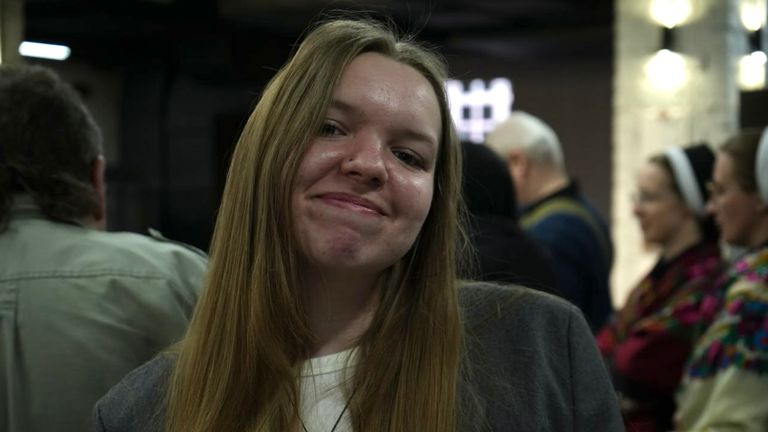
Veronika. Pic: Voices of Children
Image:
Veronika. Pic: Voices of Children

I am 16. I lived under Russian occupation for two years in my hometown of Melitopol after the full-scale invasion before my family managed to escape.

The first month under occupation was especially hard. Food was scarce, and what little there was became extremely expensive. It was impossible to buy even basics like bread. My parents and I decided I would not attend a Russian school. My mother, a teacher, also refused to work for the occupation authorities. Because of that, we had to hide. I secretly continued studying at a Ukrainian school online.

We also had to hide every trace at home of my brother, who had gone to fight for Ukraine on the first day of the war.

Advertisement

I don’t have many memories left from the occupation, but I can picture the Russian soldiers, their military vehicles and the aircraft, so many aircraft. My grandparents’ cottage is near an airfield, and throughout my childhood, I loved watching planes arrive. All the helicopters that landed during the occupation had the letter “Z” painted on the side.

The chance to leave Melitopol came through carriers who gathered people in groups and took them across Russia. Before we left, we erased almost everything from our phones – messages in Ukrainian, any mention of my brother.

Veronika. Pic: Voices of Children
Image:
Veronika. Pic: Voices of Children

Half of our group came from Mariupol, so the vehicle stopped to pick them up. It was 2023. I had never seen anything worse in my life than the destroyed Azovstal plant and the Mariupol Drama Theatre, which the Russians were rebuilding. That was the same theatre they had bombed, killing so many people.

At the border, our phones were taken away. My mother was led in for questioning, and I, a child, was left waiting alone in the middle of the customs hall. Finally, at the Latvian border, I remember hearing my native Ukrainian language and feeling a sense of calm.

We moved to Zaporizhzhia. This is where my brother stays when he is on leave. Before the war, the journey here from my hometown took two hours. Now it takes four days and involves crossing three European countries.

Advertisement

Advertisement

Olena’s harrowing rescue mission – and how it almost killed her

I hate how we’ve got used to war. How I have grown used to explosions and air raid alerts that can last for 10 hours. It has become the background of life, a new reality in which we try to make plans for the future. But at the same time, I have realised that there is one thing I cannot get used to: loss.

Today, I was returning home when I saw yet another convoy carrying fallen soldiers. People who passed by stopped and bowed their heads. In that moment, I felt not only pain, but gratitude. Gratitude that we still care. That we do not just drive past. That even as we adapt to war, we do not become indifferent to human grief.

Liza

Advertisement
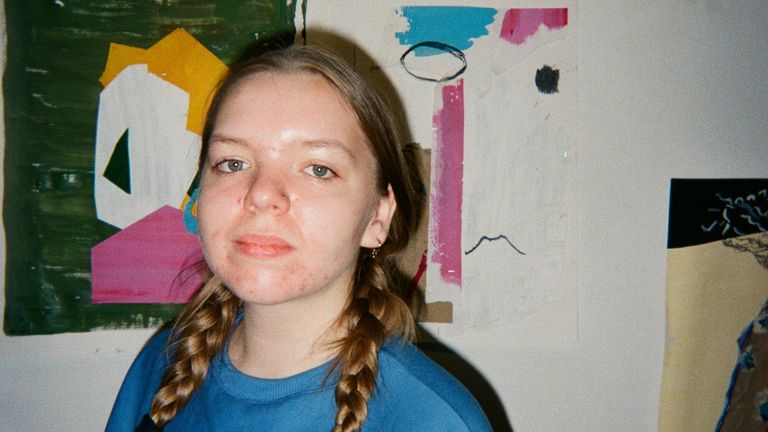
Liza. Pic: Voices of Children
Image:
Liza. Pic: Voices of Children

I’m 18 and I’ve lived in Kyiv for the past two years.

I’m trying to build my life here, but my real home is Oleshky, a small town in the south of Ukraine, in the Kherson region, that is now occupied by Russians. We left to survive. Our neighbours were killed by a shell, and back then, in January 2024, there was no one left in the town to help – no firefighters, no doctors.

We travelled for four days through 20 Russian checkpoints. At a checkpoint in the town of Novoazovsk, my mother and I were taken off the bus for “filtration”. Russians questioned us for four hours.

We started our lives in Kyiv from scratch. We arrived with nothing – just three bags between my sister, my mother and me. But in Kyiv, I met people from my hometown and made new friends. I was able to continue my studies.

Liza. Pic: Voices of Children
Image:
Liza. Pic: Voices of Children

Advertisement

Yet I still can’t quite get used to this big city. The first thing I do when I wake up is open the news to check what happened overnight. Then I wash my face. If I’m lucky, there’s warm water and electricity. I have breakfast and log into my lectures. I’m studying psychology. I pay for my education myself. After classes, I work as a cashier, because I already know that nothing comes easily.

During my first year in Kyiv, I felt a sense of relief. Here, I’m not scared to walk outside. You can wear make-up and dress the way you want without fearing Russians would target you just because you’re a girl. Back home, when we went to the store, we put on old clothes and hats so we wouldn’t appear attractive to them. Here, there’s no need to hide in a closet as we did in Oleshky when we heard strangers approaching our home. We continued studying online at a Ukrainian school at our own risk, knowing that at any moment we could be forced to attend a Russian one.

In Kyiv, I still have to hide from Russians – in bomb shelters during their attacks. I’ve grown used to the explosions, so I try to fall asleep before the air raid sirens go off, just to avoid hearing them and get some rest. What’s harder to get used to is what comes after the strikes. When the electricity and heating are cut off, it feels like deja vu. In the last months of our life under occupation, in the cold winter of 2024, we also had no power, gas or water.

No matter how hard it was there, leaving home was unbearably painful. I cried and kept repeating that I just wanted the war to end. That is still my greatest wish. I just want to go home.

Advertisement

Source link

Continue Reading
Click to comment

Leave a Reply

Your email address will not be published. Required fields are marked *

NewsBeat

Could joining the state sector be an option for private schools?

Published

on

Could joining the state sector be an option for private schools?

Private schools in England are facing new financial realities. Following the UK general election in July 2024, the new government introduced VAT on school fees and removed charitable business rates relief for independent schools. At the same time, staffing costs have continued to rise. Employer national insurance contributions have increased, and the national minimum wage has risen.

For some schools – particularly smaller institutions with limited endowments or declining enrolments – this has raised questions about their sustainability.

Although the full impact of these funding changes remains to be seen, they have intensified concerns about sustainability within parts of the independent sector and raised broader questions about reform.

One viable yet underexplored option is the conversion of private schools to the state sector.

Advertisement

Although still relatively rare, a small number of independent schools have taken this route over the past two decades. In a new report, commissioned by thinktank the Private Education Policy Forum, my colleague Tom Richmond and I have carried out the first comprehensive analysis of what happens when independent schools become state schools in England.

Between 2007 and 2017, 27 independent schools converted into state-funded academies or free schools. Twenty-four are still operating today. While the legal route from independent to state provision technically still exists, it has largely fallen out of use, with no conversions taking place since 2017. Independent to state conversion is therefore often overlooked in debates about the future of private education.

Conversion is often viewed as a last resort taken only by schools in serious financial trouble. However, while financial pressures were relevant to many of the schools that converted between 2007 and 2017, they were not the whole story. Schools have also framed conversion as a way to return to their founding missions, which were often explicitly about inclusion and serving local communities rather than educating a fee-paying intake.

The transition itself was not straightforward. Schools reported significant challenges in adapting to the expectations of the state sector. These included the loss of academic selection, the requirement to deliver the national curriculum, and regular inspections by Ofsted, England’s school inspectorate. Many also highlighted the absence of clear guidance from government on key aspects of the conversion process.

Advertisement

In practical terms, this meant that schools which had previously operated with considerable autonomy had to adjust to a far more regulated environment. In some cases, early Ofsted inspections highlighted weaknesses in data use, governance and oversight as schools adjusted to the demands of state accountability.

However, these difficulties were not permanent. Over time, outcomes improved markedly. All but one of the schools that converted and remained open are now rated “good” or “outstanding” by Ofsted.

Former independent primary schools perform at broadly similar levels than other schools in their local authorities. Former independent secondary schools generally achieve stronger attainment and progress outcomes than nearby state schools, though performance varies. Initial adjustment challenges, in other words, did not prevent long-term success.

The consequences – and the future

One of the most significant changes following conversion is in pupil intake.

Advertisement

Removing academic selection and fees transformed who these schools serve. Since conversion, the proportion of pupils with special educational needs has more than doubled. The share eligible for free school meals has risen sharply.

There are challenges in moving to the state sector.
Monkey Business Images/Shutterstock

Research has shown that while these schools do not perfectly mirror the national state school population, the gap between them and their local communities has narrowed dramatically.

In many cases, they are far more representative of their surrounding areas than they were as independent institutions. Conversion does not simply change how a school is funded. It can reshape who benefits from its facilities and educational offer.

A common concern is that families will withdraw their children once fees are removed. In practice, this rarely appears to have happened at scale.

Advertisement

Consultation evidence and enrolment patterns show that large majorities of parents supported the move, particularly because it eliminated fees and provided financial certainty. Where schools were required to demonstrate parental demand, applications frequently exceeded available places. Widespread collapse in enrolment – a frequently voiced fear – did not materialise.

Conversion to the state sector is not a solution for every school. Local context matters. The availability of places, building condition and leadership capacity all shape whether conversion is viable. But, the experience of the past two decades suggests that, where carefully managed, conversion can preserve provision, widen access and deliver strong outcomes.

As debates about school funding and the future of private education continue, independent to state conversion is likely to resurface.

If the route is to become viable again, greater clarity is necessary. A clear and permanent pathway – assessed case by case and aligned with local need – would reduce uncertainty. Drawing on the more flexible elements of earlier academy reforms and providing practical support during transition could make the process more workable.

Advertisement

Source link

Continue Reading

NewsBeat

Wales play against U20s as ‘class’ youngster impresses senior players

Published

on

Wales Online

Wales U20s went up against their senior counterparts in a full-contact training session on Friday

Wales U20s centre Steffan Emanuel caught the eye of the senior squad as the two teams faced each other in a full-contact session on Friday morning.

Advertisement

This week has seen a host of Wales squad members released back to their clubs for this weekend’s URC action, in a far cry from previous regimes – meaning Steve Tandy is significantly lighter on numbers in the only fallow week of the tournament.

Richard Whiffin’s U20s squad have also seen some players go back to clubs – with Carwyn Leggatt-Jones and Tom Bowen on domestic duty on Friday.

As such, the U20s offered up some stern opposition in training to end the week in a full contact session.

Ensure our latest sport headlines always appear at the top of your Google Search by making us a Preferred Source. Click here to activate or add us as Preferred Source in your Google search settings

Advertisement

“They have got a very good team,” said Wales full-back Blair Murray. “They showed their class against Scotland with the win that they had.

“They’ve been playing really well.

“Steffan Emanuel is a class player isn’t he? He’s probably the standout for me.”

The teenage centre has already impressed for Cardiff’s senior side this season, while he’s made an impression as Wales U20s’ co-captain in this year’s Six Nations.

Advertisement

He’s not the only young Wales player catching the eye, either, with fellow U20s international Bowen earning rave reviews from Irish pundit Ian Madigan on Friday night.

Speaking ahead of Cardiff’s win over Leinster, Madigan said of the 19-year-old on Premier Sports: “He is the real deal.

“I actually watched him in the warm-up game at Cardiff when they played Leinster in Dublin earlier in the season.

“I hadn’t heard of him before then, but he is Shane Williams 2.0. He is nippy, has great footwork and great top-end speed.

Advertisement

“He skinned a couple of the Leinster players in that warm-up game. He offers something different.

“He is a guy you want to get in possession at the line, using his footwork. When you get front-foot ball and you get Tom Bowen on the ball, he is lethal.”

JOIN OUR WALES RUGBY FACEBOOK PAGE! Latest news, analysis and much more

Whiffin’s U20s side beat Scotland last week, having pushed England and France close in their previous two games.

Advertisement

As for Tandy’s men, they’re still looking for their first victory after the narrow defeat to Scotland in Cardiff last Saturday.

Source link

Continue Reading

NewsBeat

Darlington couple’s dog businesses set for expansion

Published

on

Darlington couple's dog businesses set for expansion

Kimberley Burnside, 40, and Paul Burnside, 44, set up Bobbie’s Walkers in January 2024 after finding kennels impersonal when trying to arrange care for their pets during family holidays.

Faced with limited options, the pair decided to create the kind of service they would want for their own dogs.

Paul initially balanced the venture with his job as a hospital porter, but demand has since surged.

Paul with his dog walking business van (Image: KIMBERLEY BURNSIDE)

The dog walking arm of the business is now close to closing its books and he has moved into it full time.

Advertisement

Alongside the success of Bobbie’s Walkers, Kimberley has launched Marley’s Groom Room, expanding the couple’s canine offering.

In August 2025, as she continued her training for a nursing degree, she had the idea of starting a dog grooming business. Now, with only around six months left of her course, her focus is shifting.

She hopes to expand the grooming side and make it her priority, potentially only nursing one or two days a week instead.

The inside of the new grooming facility in the couple’s garden (Image: KIMBERLEY BURNSIDE)

She said: “With only around six months left of university I am hoping to expand and focus on the dog grooming as a priority and maybe nursing one or two days a week because dog grooming really has my heart.”

Advertisement

Marley’s Groom Room operates from a new premises in the couple’s garden, designed to accommodate larger breeds as well as smaller dogs. The studio features a double walk-in shower, removing the need to lift bigger dogs into a bath.

The new grooming facility in the couple’s garden (Image: KIMBERLEY BURNSIDE)

Mrs Burnside completed her training with a woman who once won Crufts and gained her Level 2 certificate.

She grooms no more than four dogs a day but usually limits it to around three to ensure every animal receives individual attention.

A big bernoodle in the new walk in shower (Image: KIMBERLEY BURNSIDE)

She said: “The new studio helps me have bigger dogs as there is now a double walk in shower so I don’t have to lift them to get in the bath so it has been perfect.

Advertisement

“It is really personable and we get to know the dog, play with them, run around the garden if they need and take the time to build report so that they always feel secure and safe.”

Little Maggie having a lay down after her walk with Paul and groom with Kimberley (Image: KIMBERLEY BURNSIDE)

Bobbie, the black lab and Marley the golden lab (Image: KIMBERLEY BURNSIDE)

The couple describe themselves as dog mad and have embraced the lifestyle fully. Their summer house and large garden space allow dogs room to relax and play, and some even enjoy a full day package, heading out on walks with Paul before going straight to grooming with Kimberley.

Both of the business names also carry special meaning to the pair. Marley’s Groom Room is named after their beloved golden Labrador, lost in January 2024. Bobbie’s Walkers honours their black lab, Bobbie, who died in July 2023.

Advertisement

Source link

Continue Reading

NewsBeat

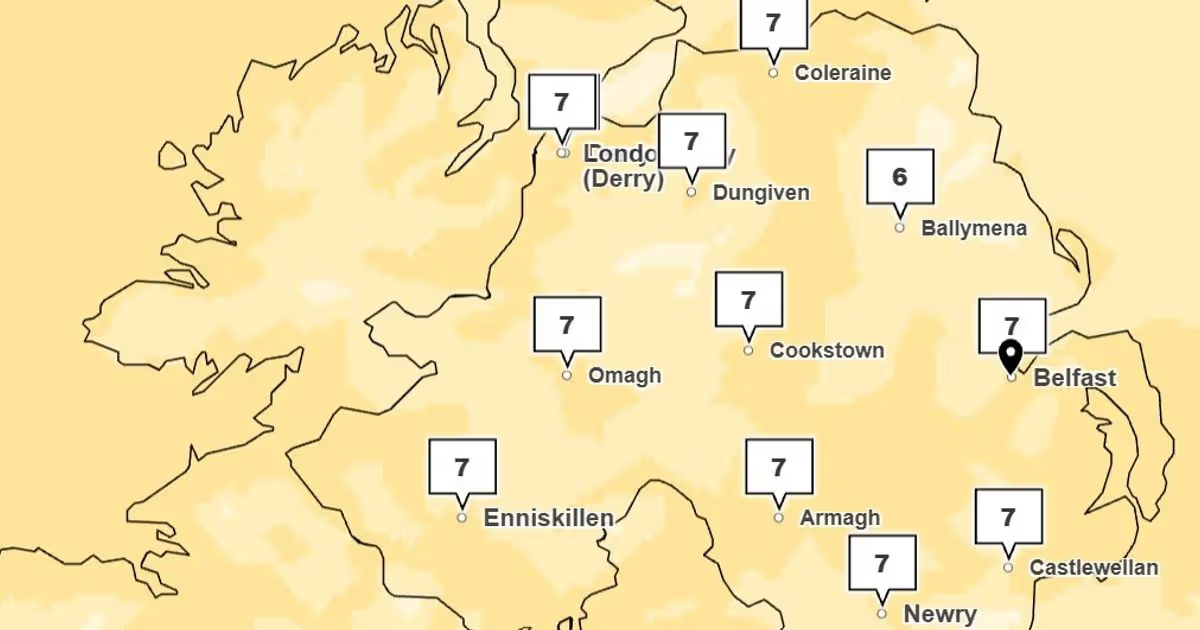
Northern Ireland weekend weather as spring officially begins

Published

on

Belfast Live

It marks the end of a winter that will be remembered for its “relentless rain”

We’ve reached the end of February already and this weekend marks the official start of spring. That’s welcome news after a winter that has felt, for many of us, like a season stuck on repeat.

Advertisement

The UK has experienced a conveyor belt of low-pressure systems, prolonged rainfall, and little sunshine between December and February, according to forecasters.

The Met Office says this winter will be remembered for its “relentless rain”, with provisional figures showing many areas of the UK suffered very wet conditions over the season.

READ MORE: Northern Ireland has been relentlessly miserable this year and there’s no sign of it ending

Early provisional weather statistics show that rainfall so far this winter (up to and including Wednesday 25 February), is tracking 9% above the long-term meteorological average (LTA) for the whole of winter – wet, but nowhere near record-breaking territory.

Advertisement

The figures showed England experienced 35% more rain than the long-term average, Wales saw 14% more and Northern Ireland saw 25% more.

Mike Kendon, a senior scientist at the Met Office, said that while this winter did not break any national records for rainfall, it will be remembered for its “relentless rain as much as its intensity”.

He said: “A near-continuous run of Atlantic systems over the past three months has brought persistent rain, damaging storms and few dry spells.”

In the UK, meteorological spring always begins on March 1 and ends on May 31, with the three‑month season allowing scientists to compare long‑term climate records more easily.

Advertisement

For now, here’s what to expect for the coming days in Northern Ireland:

Saturday:

A dry morning with some long spells of sunshine. Turning cloudier through the afternoon as rain spreads eastwards. Maximum temperature 8°C.

Outlook for Sunday to Tuesday:

Mostly cloudy with outbreaks of rain on Sunday and Monday as winds strengthen, some drier and brighter intervals possible. Drier Tuesday with just the odd shower possible and sunny spells.

UK long range weather forecast: Wednesday 4 March – Friday 13 March

Much of this period looks like being largely dominated by high pressure, especially towards the south or southeast of the UK.

Advertisement

This will mean many places seeing plenty of dry weather with variable cloud amounts and some sunshine, the best of this towards the south or southeast, but perhaps with some fog overnight.

However, frontal systems are still likely to affect the north and west of the UK at times though, maybe also briefly affecting other parts, bringing some rain and strong winds, and perhaps a little snow to the high ground in the north.

Temperatures will be near or above normal, although patchy overnight frost is still likely at times.

Want to see more of the stories you love from Belfast Live? Making us your preferred source on Google means you’ll get more of our exclusives, top stories and must-read content straight away. To add Belfast Live as a preferred source, simply click here.

Advertisement

Source link

Continue Reading

NewsBeat

Woman says anti-ageing eye mask is ‘like something brought by aliens’ now 20% off

Published

on

Wales Online

Shoppers are sharing before and after photos of the red light therapy device now £160 down from £199.99

Customers are posting their before and after images following use of a new LED Eye Mask that addresses the signs of ageing. Shoppers can secure 20% off a Keskine LED Eye Mask on the Keskine website using code EYE20, reducing the price to £160 from £199.99 on the website – a total discount of £39.99.

According to Keskine, the newly-launched eye mask can promote collagen regeneration and diminish dry lines and wrinkles. The brand states it features clinically proven wavelengths of red light and near infrared (633NM + 830NM), with 80 LEDs in total.

Advertisement

According to Harvard, red light therapy is known medically as photobiomodulation and previously called low-level laser light therapy. It involves using devices that emit red or near-infrared light directed at the skin.

READ MORE:

It functions by stimulating mitochondria, which are tiny powerhouses in cells, the article states, to reduce inflammation and enhance the production of collagen, which essentially makes skin firmer and more supple. Research has further indicated that red light therapy can help to diminish fine lines and wrinkles, lighten dark spots, smooth skin texture, reduce redness, accelerate wound healing, boost hair regrowth, minimise scars and ease acne.

To use Keskine’s eye mask, firstly, they advise conducting a sensitivity test 24 hours before the initial use. Then cleanse and dry the skin, switch the device on to begin a five-minute session, remove the gadget and wipe it clean, and then store it away safely, reports the Mirror.

Advertisement

Keskine LED Eye Mask

Content Image

£199.99

£160

Keskine

Buy here

The Keskine LED Eye Mask is currently available with a 20% discount on the Keskine website using code .

Advertisement

Regarding battery life, the eye mask requires approximately six to eight hours to charge and the device is entirely ‘pain free’, according to the site.

A pricier alternative currently available is the Shark CyroGlow Under Eye Cooling LED Face Mask for £299.99 from Argos, which has received positive ratings from customers. This product is the ‘UK’s first LED light therapy mask to offer under-eye cooling technology’, and it works to help soothe, depuff and tighten under eyes in three to 15 minutes, the site states.

Boots also stocks the Lumin Luminator LED Eye Mask for £109, offering a more affordable choice. This model is designed for comfort and convenience, featuring a soft silicone pad and an adjustable strap to ensure a secure fit.

Returning to Keskine, though, the LED Eye Mask has received favourable reviews from users who reported seeing results after four weeks.

One customer said: “It is astonishing to see how technology with beauty devices has improved. It’s almost like a product brought in by aliens. Superb results!” Another added: “The results within a month is amazing considering I only used it six times. I am sure with consistent use my wrinkles will completely disappear.”

Whilst there were no negative reviews for the eye mask specifically, customers did visit Trustpilot to share their opinions on Keskine as a brand. One said about the hair removal kit: “Great product which does exactly what it says. Had a fault after a few months but was replaced with a new machine. Great customer service. Would highly recommend.”

Overall, most individuals were satisfied, as another commented: “I have always had redness under my eyes and constantly having to use makeup it ruined my confidence. Decided to try the Keskine LED eye mask and it has vanished within one month of use.”

Advertisement

Source link

Continue Reading

NewsBeat

Lethal Wales prospect branded the ‘real deal’ as shamed Springbok’s career takes new twist

Published

on

Wales Online

Here are your rugby morning headlines for Saturday, February 28.

‘Lethal Tom Bowen is the real deal’

Wales prospect Tom Bowen is “the real deal” and has been branded “Shane Williams 2.0” by former Ireland international Ian Madigan.

Bowen is the hottest prospect in Welsh rugby and it is understood that La Rochelle have even enquired about the Cardiff Rugby flyer in recent weeks.

Advertisement

It seems to be a case of when – not if – he gets his senior call-up to the Welsh side, having starred for Wales U20s in this Six Nations campaign so far.

Speaking ahead of Cardiff’s win over Leinster on Friday night, Madigan said on Premier Sports of the 19-year-old: “He is the real deal.

“I actually watched him in the warm-up game at Cardiff when they played Leinster in Dublin earlier in the season.

“I hadn’t heard of him before then, but he is Shane Williams 2.0. He is nippy, has great footwork and great top-end speed.

Advertisement

“He skinned a couple of the Leinster players in that warm-up game. He offers something different.

“He is a guy you want to get in possession at the line, using his footwork.

“When you get front-foot ball and you get Tom Bowen on the ball, he is lethal.”

Ensure our latest sport headlines always appear at the top of your Google Search by making us a Preferred Source. Click here to activate or add us as Preferred Source in your Google search settings

Advertisement

Controversial Springbok finds new club

Controversial former South Africa winger Aphiwe Dyantyi has found a new club in Europe.

Having recently had stints with the Bulls and Sharks, the 31-year-old has joined third tier French outfit Narbonne. Dyantyi was previously banned for four years after testing positive for several prohibited substances in an out-of-competition sample in 2019.

The year before, he had been crowned World Rugby breakthrough player of the year. The ban ruled him out of the 2019 World Cup and ended his Test career.

“A powerful and impactful centre or winger, Aphiwe Dyantyi is recognised for his speed, his capacity to penetrate defences and his game intelligence,” said a statement by Narbonne. “He arrives to bolster the Narbonne back lines at a crucial point in the season

Advertisement

“After returning to the field and playing consistently in recent seasons, the player now forms part of a robust sporting trajectory. This acquisition reflects the club’s ambition to equip itself to approach the season’s conclusion with aspiration, high standards, and resolve.

“Racing welcomes Aphiwe Dyantyi and eagerly anticipates seeing him perform soon in the orange and black colours.”

JOIN OUR WALES RUGBY FACEBOOK PAGE! Latest news, analysis and much more

Cardiff coach delighted by discipline in crucial win

Cardiff coach Corniel van Zyl was delighted by his side’s disciplined performance as they edged out Leinster at the Arms Park to give their URC play-off hopes a massive boost.

Advertisement

The 8-7 victory ended Leinster’s 11-match winning run, with the Blue and Blacks coughing up just three penalties over the course of the 80 minutes.

“It’s obviously nice to get on the right side of the result,” said van Zyl afterwards. “We adapted well to the conditions – it wasn’t easy to play.

“Obviously the kicking came into play. Our discipline I think has been the best this season definitely and then also potentially what I can remember in my coaching experience because we only conceded three penalties, which was massive.

“They obviously conceded a few more, but it was frustrating because we had a few opportunities, especially the first half, to apply a little bit more pressure.

Advertisement

“But it’s always going to be tough, with knock-ons and that stuff coming into play. It wasn’t easy.

“It’s almost like a one-off game. You just felt like if you go out and try and put pressure on them, win the territory, win the possession, then we’ve got a good chance to get on top. I’m pleased with the plan and how it unfolded.

“We pride ourselves on performing at home. We want to make this place a fortress and be as good as we can at home, at the Arms Park, in front of our friends and families.”

Scotland happier with Wales win, not England triumph

Scotland prop Pierre Schoeman says that the win over Wales in Cardiff did more for Gregor Townsend’s side than their Calcutta Cup triumph the week before.

Advertisement

The Scots lost their opening match of the Six Nations against Italy in Rome, but have responded well. Having beaten England at Murrayfield, they came back from 20-5 down to beat Wales at the Principality Stadium.

“We spoke about it,” said the prop on Premier Sports. “The Welsh victory did more for us as a team than the England win.

“Just because of the resilience we showed, coming back at half-time. A few unforced errors, not too many big collisions to stop the gainline – Rhys Carre’s try speaks for itself.

“At half-time, we solved it. Some individual brilliant, the experience of individuals and executing things at the right time. That meant the world to us.”

Advertisement

Sitting second in the table, Scotland find themselves in the hunt for the title – while they would also seal a Triple Crown if they beat Ireland at the end of the tournament.

“So much (buzz) and so much confidence,” added Schoeman. “Stacking the small moments is key for the next two weeks.

“Not overthinking about Ireland and the Triple Crown. The first job is France at home here. They’re a quality side.”

Source link

Advertisement
Continue Reading

NewsBeat

Weekend walk to enjoy from Middlesmoor in Nidderdale

Published

on

Weekend walk to enjoy from Middlesmoor in Nidderdale

AT the head of Nidderdale are two remote reservoirs surrounded by bleak moorland. The circuit of both and an exploration of the upper end of Nidderdale make for an enjoyable walk, full of history, cracking views and exploration.

There is parking in the village of Middlesmoor at the road end. From here head north west along a good track, used by farmers and workers on the reservoirs.

The track climbs steadily to Rain Stang (the trig point at nearly 1,500 feet is just off path to the right) before the views open up impressively to the north and back down the valley near How Stean Gorge to the left.

From the high point the track carries on for a few hundred metres before dropping steeply towards the first of the two man-made bodies of water in the Upper Nidd. Scar House Reservoir was completed in 1936 and provides water for Bradford, plenty of it as the dam wall itself is nearly 200 feet high.

Advertisement

The reservoirs have excellent fishing, with brown trout the most common catch and for the walker it is also a fine location for bird watching. On arrival at the reservoir head west (left) alongside the waters till arriving at the second reservoir Angram. Go no further west. Ahead is bleak country, peat hagged moorland. I once visited, never again!

Cross the dam of Angram Reservoir and head north east (right) along a path soon turning in to a good track to the north of Scar House Reservoir. On reaching the track let your imagination take over at what has become known as the ‘Lost Village of Lodge’. Remains exist of a village that almost certainly dated back to the Middle Ages. During the summer of 2016 archaeologists discovered remains that confirmed its ancient beginnings.

Scar House, Upper Nidd

In the 19th century Lodge was a busy community, situated well on a well-travelled pack horse route, with many nearby farms and a bustling community, even before the arrival of the reservoir builders. Now most, but not all, is buried under the reservoirs. Remains (including a narrow gauge railway) of the reservoir works are more visible. A truly fascinating history.


More walks

Advertisement

Country walks: Hebden Bridge reservoirs and moorland


From the lost village follow the excellent track east to the end of Scar House Reservoir and then take the footpath which climbs for 100 m ignoring the main track dropping to the dam. The path (part of the Nidderdale Way) heads over the wonderfully name Woo Gill. It is near here that three tinkers’ bodies were once discovered, headless, in a place known as Dead Man’s Hill!

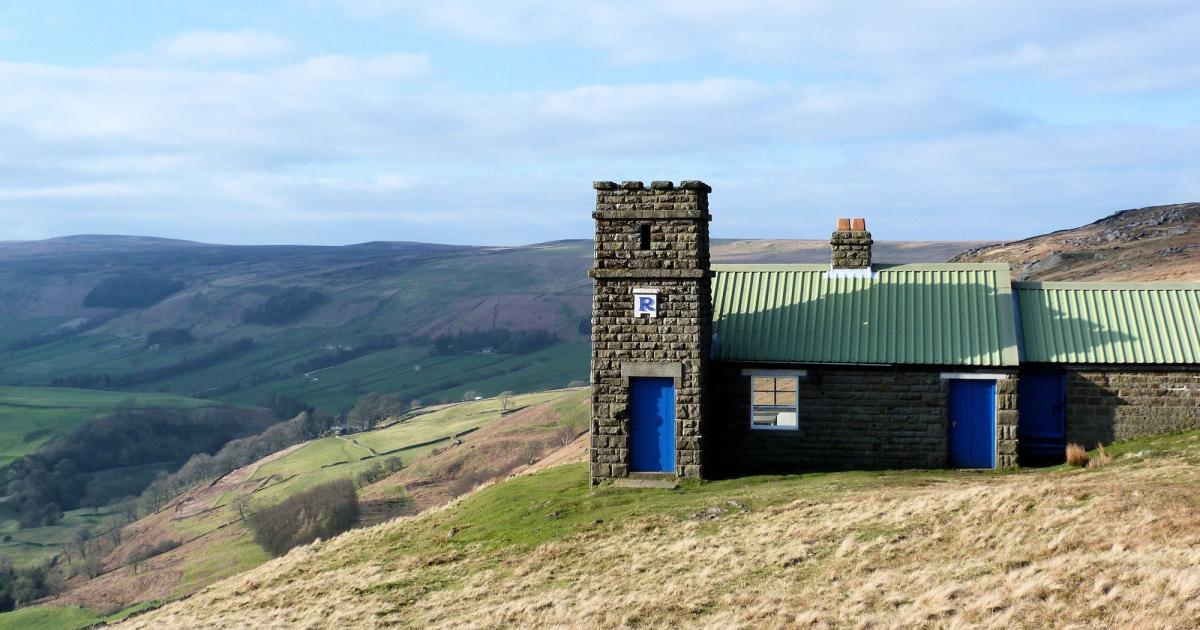
Moors shooting lodge in Upper Nidd. Images: Jonathan Smith

Turn left and climb to the high path on the rim of the dale. I do prefer this high route purely for the views both behind you to the west and ahead to the south but there are alternatives lower in the valley itself.

The path meets a shooters track and carries on its southerly course, sticking close to the rim of the Nidd valley. After a further mile the track arrives at the spectacularly situated Shooters Lodge, from here take the bridleway steeply downhill, into the valley at Thrope Farm.

Advertisement

Cross the River Nidd at the farm and walk for a quarter of a mile alongside the river before taking the footpath to your right, this sting in the tail climbs nearly 200 feet back in to the village of Middlesmoor.


Fact Box:

Distance: Roughly 12 miles

Height to Climb: 450m (1,480 feet)

Advertisement

Start: SE 092743. There is a small car park at the top end of Middlesmoor.

Difficulty: A long day but on good tracks and paths throughout. A couple of steep, short climbs.

Refreshments: The Crown at Middlesmoor is an excellent, traditional Dales pub, great for walkers.

Upper Nidd map. Jonathan Smith

Be Prepared: The route description and sketch map only provide a guide to the walk. You must take out and be able to read a map (O/S Explorer 298) and in cloudy/misty conditions a compass (essential on this walk). You must also wear the correct clothing and footwear for the outdoors. Whilst every effort is made to provide accurate information, walkers head out at their own risk.

Advertisement

* Jonathan runs Where2walk, a walking company based in the Yorkshire Dales:

He has written three books on walking in the Dales; ‘The Yorkshire 3 Peaks’, ‘The Dales 30’ mountains and the long distance path ‘The Bracken Way. Buy them direct from Where2walk

Jonathan runs Navigation Training Courses. The first Beginners Course of 2026 is on Saturday, March 14 from Long Preston, near Settle.

You can now buy Dales 30 T-shirts and caps from the NEW Dales 30 website.

Advertisement

Where2walk.co.uk features hundreds of walks with descriptions across Yorkshire and beyond, from easy strolls to harder climbs. Visit the website for details of all these walks and guiding days.

Source link

Advertisement
Continue Reading

NewsBeat

Why is Lego so expensive? And why is it so popular? A Lego master answers your questions

Published

on

Why is Lego so expensive? And why is it so popular? A Lego master answers your questions

Sales of Lego have increased dramatically over the past few years, with more adults than ever before getting into building with blocks. Recommended’s own tech editor, Nathan Spendelow, spent a gruelling 18 hours putting together Lego’s Star Wars Death Star, callusing his hands and getting a sore back in the process.

One longtime fan who has made Lego his full-time career is Graham E. Hancock. The editor of monthly Lego magazine Blocks, he’s also the author of several books about Lego, including LEGO Heroes: LEGO Builders Changing Our World – One Brick at a Time, Lego Fun Family Challenges and LEGO Star Wars: The Force of Creativity.

As a lifelong Lego fan, there’s nobody better to answer your questions about bricks, including why they’re so expensive, exciting new launches and which sets he would recommend for children and those with dexterity issues.

Advertisement

We caught up with Hancock for our Readers Ask series, where industry specialists answer queries from our Telegraph Recommended Reader Panel. Read his answers below.

How can I determine whether the difficulty level of a Lego set is suitable for my child?

George, London

If you’re thinking of getting a Lego set for your child, go with the age marking on the box that matches their age.

Advertisement

Start with something small and approachable to see how they get on with it. Once you’ve seen them build that first set and get a sense of how natural they find it, you can determine whether you want to get them another set of the same age marking, something simpler or something more complicated.

Why do you think there has been a resurgence in Lego over the last five years?

David, London

It’s been happening over the last 20 years. Sales of Lego sets keep growing and growing. But five years ago, everyone was stuck at home as a result of the pandemic, so people were looking for things to do within the house.

Advertisement

By coincidence, the Lego Group had just introduced a whole new range focusing on adults. These two things coincided and, all of a sudden, people felt comfortable telling others that, as grown-ups, they were sitting at home and building Lego.

I want to encourage my grandson’s creativity rather than the ability to follow instructions – what do you recommend?

Siri, London

You might be surprised to know that there have been instructions in Lego boxes for 70 years. It’s something lots of generations have grown up with. There’s something satisfying about following the steps to build a set and getting a complete model at the end of it.

Advertisement

There’s also something fun about dumping that box of bricks onto the dining room table and getting creative. It doesn’t have to be an either/or thing. You might think that children aren’t being creative when following instructions, but they’re learning how the different pieces and elements interact with one another and different ways they can use them. When they do build things creatively themselves, they’ll use some of these tips and tricks in their own models.

If your child loves building Lego sets, it’s worth getting them a big box of loose bricks, with doors, windows and wheels. Maybe it can be a family activity, to dump them out and build imaginatively around a table. This can be fun, inspiring and joyful.

Source link

Advertisement
Continue Reading

NewsBeat

NHS ibuprofen alert over ‘tummy pain’

Published

on

Daily Record

People have been advised to watch for symptoms indicating potential key side effects

Guidance from the NHS warns that ibuprofen is not suitable for everyone and, in some cases, could make discomfort worse. On its website, the health service explains that ibuprofen is a type of painkiller known as a non-steroidal anti-inflammatory drug (NSAID).

Advertisement

Ibuprofen and other NSAIDs are commonly used to treat a wide range of pain, including headaches and migraines, joint and muscle aches, toothache and period pain. They can also help bring down a high temperature.

However, the NHS notes that ibuprofen may cause more side effects than paracetamol and, in some people, can lead to stomach pain. With this in mind, the NHS advises people to try paracetamol before trying ibuprofen.

What are the side effects of ibuprofen?

The NHS cautions: “Like all medicines, ibuprofen can cause side effects, although not everyone gets them.” Because of this, there are three serious side effects you should watch for.

Advertisement

The NHS says: “Ibuprofen can sometimes cause serious side effects, although most of them are rare. Speak to a pharmacist or doctor if you have any side effects that bother you or do not go away.”

Possible serious side effects of ibuprofen include:

  1. stomach ulcers or bleeding inside your stomach – causing symptoms such as tummy pain, shortness of breath, pale skin, vomiting blood or poo that’s black, sticky and tar-like
  2. an allergic reaction (anaphylaxis) – causing symptoms such as a swollen throat or tongue, a raised, itchy rash or difficulty breathing
  3. a problem with your kidneys – causing symptoms such as shortness of breath, blood in your pee or swelling in your ankles, feet or hands

If you experience any serious side effects call NHS 111 – or 999 in an emergency.

Common side effects of ibuprofen tablets, capsules, liquid and granules include:

  • indigestion and stomach aches
  • feeling sick (nausea) and being sick (vomiting)
  • headaches
  • a rash
  • dizziness
  • diarrhoea or constipation

The NHS further cautions: “These are not all the side effects of ibuprofen. For a full list, see the leaflet that comes with your medicine or search for your medicine leaflet on the electronic medicines compendium website.”

Who can and cannot use ibuprofen?

Most adults can use ibuprofen. But ibuprofen is not suitable for everyone. For example, it may not be suitable if:

  • You’ve had an allergic reaction to ibuprofen, aspirin or another non-steroidal anti-inflammatory drug (NSAID)
  • You have a stomach ulcer, or you’ve had them before
  • You have asthma or allergies (such as hay fever)
  • You have chickenpox
  • You have a heart, liver or kidney condition
  • You have problems with blood clotting
  • You’ve had a stroke
  • You’re pregnant or trying to get pregnant

Can I take ibuprofen?

The NHS advises taking the lowest dose that works for you and using it only for as long as necessary to reduce the risk of side effects.

You should not take ibuprofen tablets or capsules for more than 10 days unless a doctor tells you to. For other types of ibuprofen, you should check the packaging or patient leaflet for guidance on how long they can be used and whether they are suitable for you, as they may not interact well with other medicines you are taking.

The NHS also recommends seeing a GP if your pain worsens or does not improve. Always speak to your GP before starting any new medication or if you have concerns about your health.

Ensure our latest headlines always appear at the top of your Google Search by making us a Preferred Source. Click here to activate or add us as your Preferred Source in your Google search settings.

Advertisement

Source link

Continue Reading

NewsBeat

Countryfile star admits he confided major secret to his wife over cheating fears

Published

on

Daily Mirror

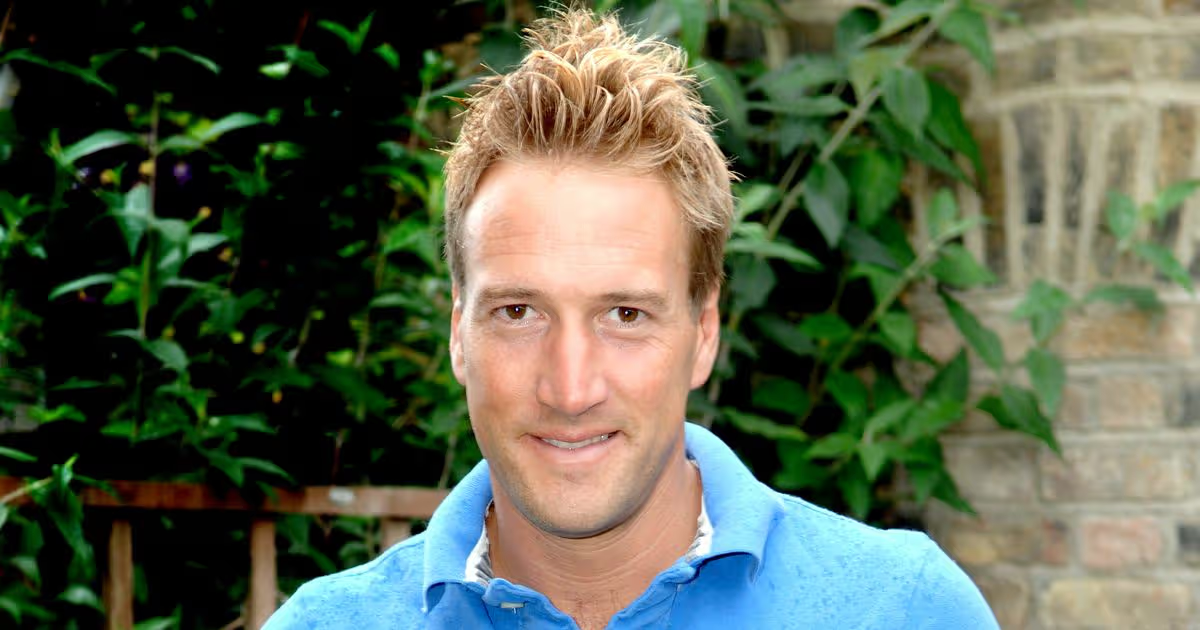
Countryfile’s Ben Fogle has admitted that he worried that his wife Marina thought he might be having an affair as he took on one role

Countryfile presenter Ben Fogle has revealed he was forced to confide a major secret to his wife amid concerns she might suspect him of infidelity. The BBC star recently appeared on The Masked Singer, where his identity remained closely guarded for weeks whilst the celebrity judging panel and viewers at home attempted to guess who was beneath the costume.

The broadcaster reached the semi-finals before being unmasked as Sloth in a dramatic reveal. In an exclusive interview with the Express, the 52-year-old explained: “I decided that I would really go for it. It was very hard keeping it a secret from my family. I did tell my wife, because I was pretty convinced that she would think I was having an affair or something if I didn’t tell her and then disappeared every Saturday night.”

He added: “But I didn’t tell my children so it was a massive shock to them when they watched it on the night. It was so wildly different to anything that I’ve ever done before that they didn’t even have an inkling! They were open-mouthed.”

Advertisement

Discussing whether he’d consider another programme beyond his usual remit, Ben said: “I’m so lucky that I get to travel and do really fun things. I think that if another show came up and I thought it was going to be challenging and looked really fun, and would be so wildly different from what I do on a day-to-day basis then I would certainly explore it.

“I’m in my 50s now, and I think that when I turned 50, I decided that this was the time to just make the most of life. Because, not to sound cliché, but we really do only have one life. And sometimes we can take ourselves too seriously but there’s something really refreshing about shaking it up.”

He added: “If another show came up then I would definitely be all in because if it’s as much fun as I had in those few weeks on The Masked Singer then it would definitely be worth it.”

Advertisement

Ben is presently touring nationwide with his latest theatre production WILD. On stage, he shares narratives and accounts of optimism, potential, and encouragement.

From his remarkable experiences with both humanity and the natural world; the wilderness of Northern Sweden to the jungles of Honduras; the harsh extreme landscapes of Chernobyl to the mountains of Nepal; Ben transports audiences on an adventure with motivating and heartening stories of self-discovery, leaving them captivated, enlightened, and thoroughly entertained.

Discussing his motivation for creating the show, Ben explained: “I get asked by people all the time about how they can live off grid, how other people have done it and how to go on expeditions.

Advertisement

“So I thought it would be a lovely way to take people behind the scenes and peek behind the curtain. There will be illustrations, video, photos, music and plenty of anecdotes.”

Countryfile is on BBC One on Sundays and on BBC iPlayer

For the latest showbiz, TV, movie and streaming news, go to the new **Everything Gossip** website.

Ensure our latest headlines always appear at the top of your Google Search by making us a Preferred Source.** Click here to activate**** or add us as your Preferred Source in your Google search settings.**

Advertisement

Source link

Continue Reading

Trending

Copyright © 2025