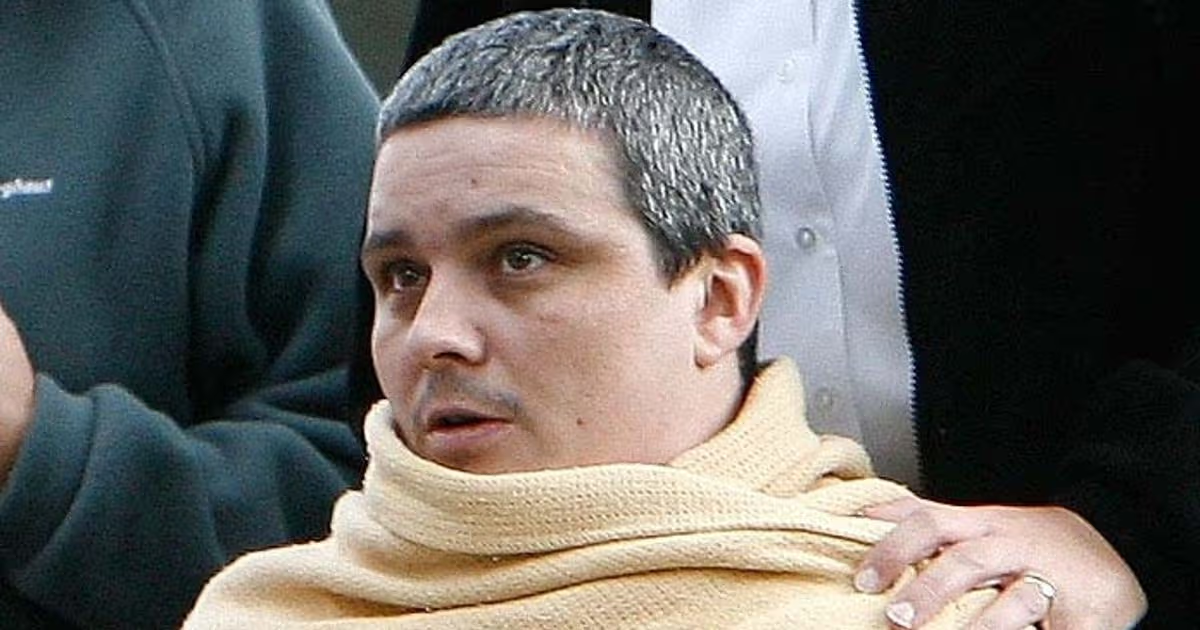
Ian Huntley, serving two life sentences for the murders of Soham schoolgirls Holly Wells and Jessica Chapman, both 10, was said to have been beaten from behind in HMP Frankland
Double child killer Ian Huntley was ‘bludgeoned from behind’ as he bent down in a prison attack that was described as “chaotic” by sources.
Advertisement
Huntley, 52, remains in a critical condition in an induced coma in hospital following the attack just after 9am on Thursday morning. The convicted killer was reportedly bent over tying up string on a recycling crate in a workshop at HMP Frankland in County Durham when his attacker hit him up to 15 times with a three-foot metal pole, according to sources.
Soham murderer Huntley was rushed to hospital, where his mother Lynda, who has visited, described him as “unrecognisable” to friends due to his injuries. He was given just a five per cent chance of survival after the attack which reportedly cut his head open.
Ensure our latest headlines always appear at the top of your Google Search by making us a Preferred Source. Click here to activate or add us as your Preferred Source in your Google search settings.
Huntley suffered a broken jaw, and brain and skull injuries in the attack at the recycling workshop, and is said to be hooked up to a ventilator. The main suspect in the attack has been identified as triple killer Anthony Russell, though police have not officially confirmed this.
A source described the attack as “unbelievably savage”, adding: “It is astonishing that Huntley is still alive. He was bending down tying some string onto a recycling crate when he was first hit – so was in a position like you’d be in when tying your shoelaces. And people who saw it say he was battered around 15 times.”
The source added that inmates were allegedly aware of an impending attack, saying “none of the prisoners there helped.” The source said: “They just watched it happen and it was staff who stepped in – but not before the attacker had inflicted some really severe damage. Everyone thought Huntley was dead and inmates and staff are absolutely stunned he is still alive.”
Advertisement
The source continued: “Afterwards, Russell was handcuffed and led away towards the chapel and was smirking. He has apparently admitted the attack in interviews and said he was proud of it. But he has also said he is ‘gutted’ that Huntley is still alive – because he was sure he’d killed him.”
A prison source told The Mirror the suspect in the attack is likely to be segregated from other inmates for several years. They added: “It’ll be business as usual [in the prison], it’ll be absolutely same as always, just there’ll be one less prisoner to worry about.
“Because it’s a serious assault, he’ll be moved to the segregation unit. He’ll probably just be held there for the foreseeable, certainly, because you can’t go around either trying to kill another prisoner or killing other prisoners, so he’ll probably be in a segregation unit for the next five, 10 years, maybe.”
Durham Constabulary said Huntley continues to be treated in hospital. “He remains in hospital in a serious condition,” their spokesperson said.
Huntley has been serving a life sentence for the brutal killings of Holly Wells and Jessica Chapman, both 10, after they left a family barbecue to buy sweets in Soham, Cambridgeshire, in August, 2002. He later left their bodies in a ditch and attempted to evade suspicion by hiding in plain sight by giving media interviews about the police investigation.
FIFA’s president has told Sky News that footballers who cover their mouths in confrontations with rivals should be sent off on the presumption they are being offensive.
Gianni Infantino has also revealed a desire to reduce the minimum 10-game ban for players who are apologetic for discrimination to encourage a change of attitudes.
But he told football to stop saying “it’s a problem in society” and prioritise dealing with racism within the sport.
Image: FIFA boss Gianni Infantino spoke to Sky News
Advertisement
Mr Infantino – along with rule-making body IFAB – is reacting swiftly to the racism reported by Vinicius Junior while playing for Real Madrid against Benfica in the Champions League on 17 February.
Advertisement
Real Madrid player reports racist abuse in Benfica match
The case could be harder to prove because Benfica’s Gianluca Prestianni covered his mouth with his shirt while allegedly abusing the Brazilian, who is one of football’s most high-profile black players.
“If a player covers his mouth and says something, and this has a racist consequence, then he has to be sent off, obviously,” Mr Infantino, who is the boss of world football, told Sky News.
Advertisement
“There must be a presumption that he has said something he shouldn’t have said, otherwise he wouldn’t have had to cover his mouth.”
While Benfica originally complained about a “defamation” campaign, manager Jose Mourinho now says Prestianni’s career in his team would be over if found guilty of racism.
Should Mourinho have shown more empathy to Vinicius Jr?
Mr Infantino acknowledged a need for European governing body UEFA to still complete its investigation, having provisionally suspended Prestianni for the second leg which Benfica lost.
Advertisement
“There are situations which we did not foresee,” he said. “Of course, when you deal with a disciplinary case, you have to analyse the situation, you have to have evidence, but we cannot just be satisfied with that going forward.”
Image: Benfica’s Gianluca Prestianni and Real Madrid’s Vinicius Junior playing in the Champions League on 17 February. Pic: AP
The plan is for the laws of the game to be strengthened by the International Football Association Board by April, in time to be implemented at the World Cup in June.
Mr Infantino said: “I simply do not understand if you don’t have something to hide, you don´t hide your mouth when you say something. That’s it, as simple as that.
“And these are actions that we can take and we have to take in order to be serious about our fight against racism.”
Mr Infantino has now revealed a change in approach to punishments that could be coming.
“We need to act and to be decisive and it has to have a deterrent effect,” he said. “Maybe we should also think about not just punishing, but also somehow allowing, changing our culture, allowing players or whoever does something to apologise.
“You can do things that you don’t want to do in a moment of anger [and] apologise and then the sanction has to be different, to move one step further and maybe we should think about something like that as well.”
The fight is as much about punishments as how to stop abuse in the stands, on pitches and online in football.
Advertisement
“We have to stop racism,” Mr Infantino said. “We cannot just be satisfied by saying well it’s a problem in society so we cannot do anything about it except what we are already doing.“
A fresh wave of blasts was heard in Dubai and in the Qatari capital of Doha for a second day on Sunday as defence forces intercepted missiles headed their way in response to US and Israeli attacks on Saturday.
The UAE’s ministry of defence said that 165 ballistic missiles, two cruise missiles and 541 drones had been launched from Iran towards the country so far. Three people have been killed and 58 injured, the authorities said.
JS Anand, founder and CEO of Leva Hotels, which has a flagship hotel in Dubai, told The Independent that the attacks had caused panic and uncertainty among residents and guests.
Advertisement
He explained: “I think everybody was caught unawares in the city, because obviously Iran was targeting the bases and missiles were going over us. Sometimes they were intercepted, so there were really loud sounds, and some places got hit. So obviously that resulted in cancellations and a lot of people being uncertain about their flights.”
Mr Anand, who was speaking from Leva Hotel Mazaya Centre, which is near the Burj Khalifa, the tallest skyscraper in the world, added: “It caused a lot of panic, uncertainty, and there was an emergency message that came out in the night.
“It said there was a barrage of missiles coming in, everyone came to the lobby and basement, worried about what was going to happen, so we had to take care of them. Most of them have extended their stay because there are no flights and no certainty on when the airspace is going to open up.”
Advertisement
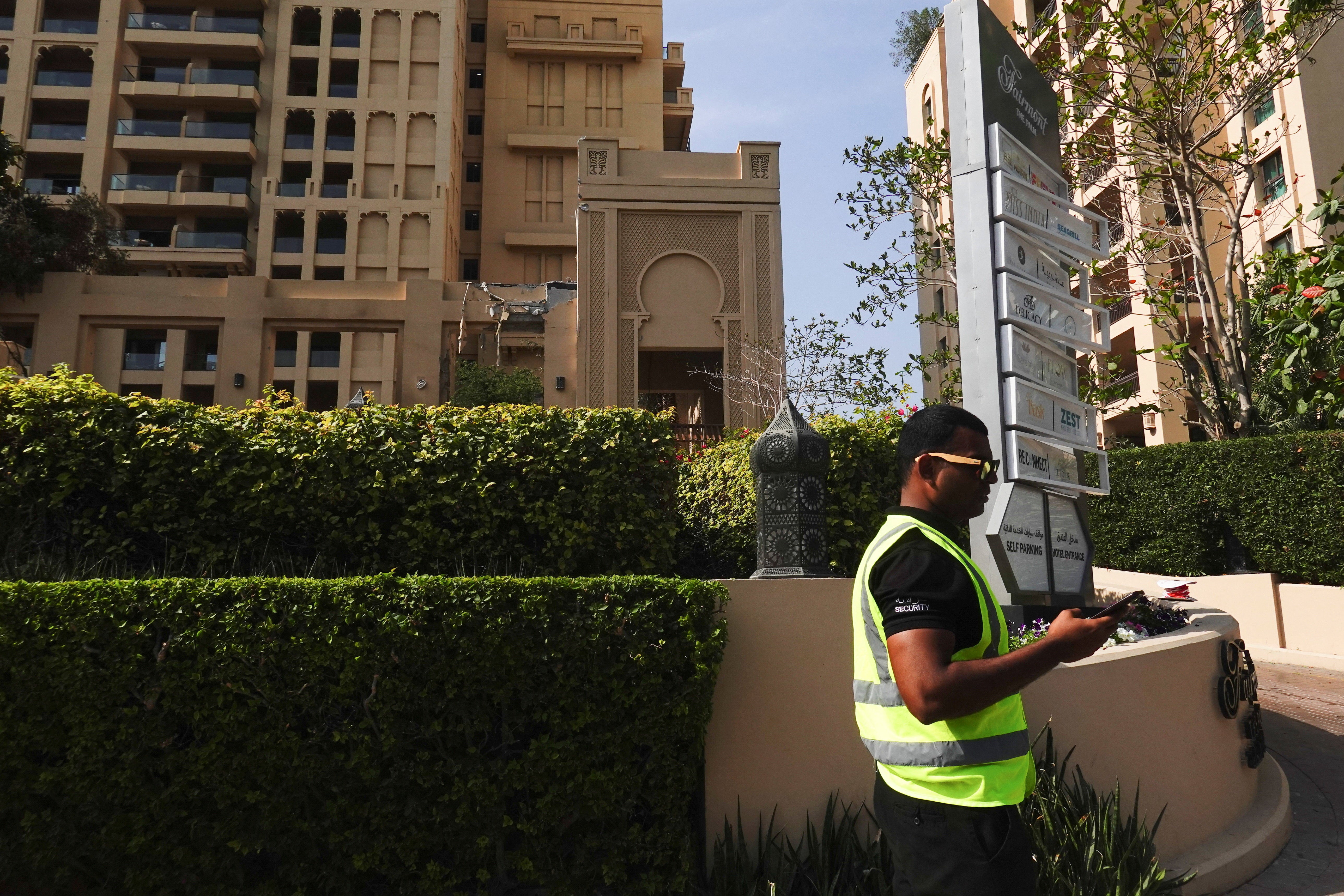
The Fairmont The Palm building in Palm Jumeirah, which was damaged by an Iranian attack (Reuters)
He continued: “Some guests came to the airport from another hotel, and have decided to come to ours. Some were even staying in the Burj Khalifa, and they didn’t want to stay in a higher building. They wanted to come to a low-rise, and we are just three floors.”
He said that around 140-150 rooms at the hotel were occupied with guests and that the UAE’s department for economy and tourism had told hoteliers that the government would cover expenses for guests unable to pay for their extended stays.
He added: “It’s obvious that right now there is no clear indication of what is in store and what is going to happen next.”
Advertisement
Smoke rises from the port of Jebel Ali following a reported Iranian strike in Dubai (AFP via Getty)
Mira Thönnessen, 36, a German national who was staying at the hotel, told The Independent she did not feel safe leaving and planned to stay inside.
Her flight home to Berlin was scheduled for Monday evening, but it is looking unlikely that it will go ahead. She said: “On Saturday morning at breakfast we got the news of the attack. Then my plan was to go straight to the hotel and get my stuff, and go to the airport. By the time we had got to the hotel, they were already closing off the airspace”.
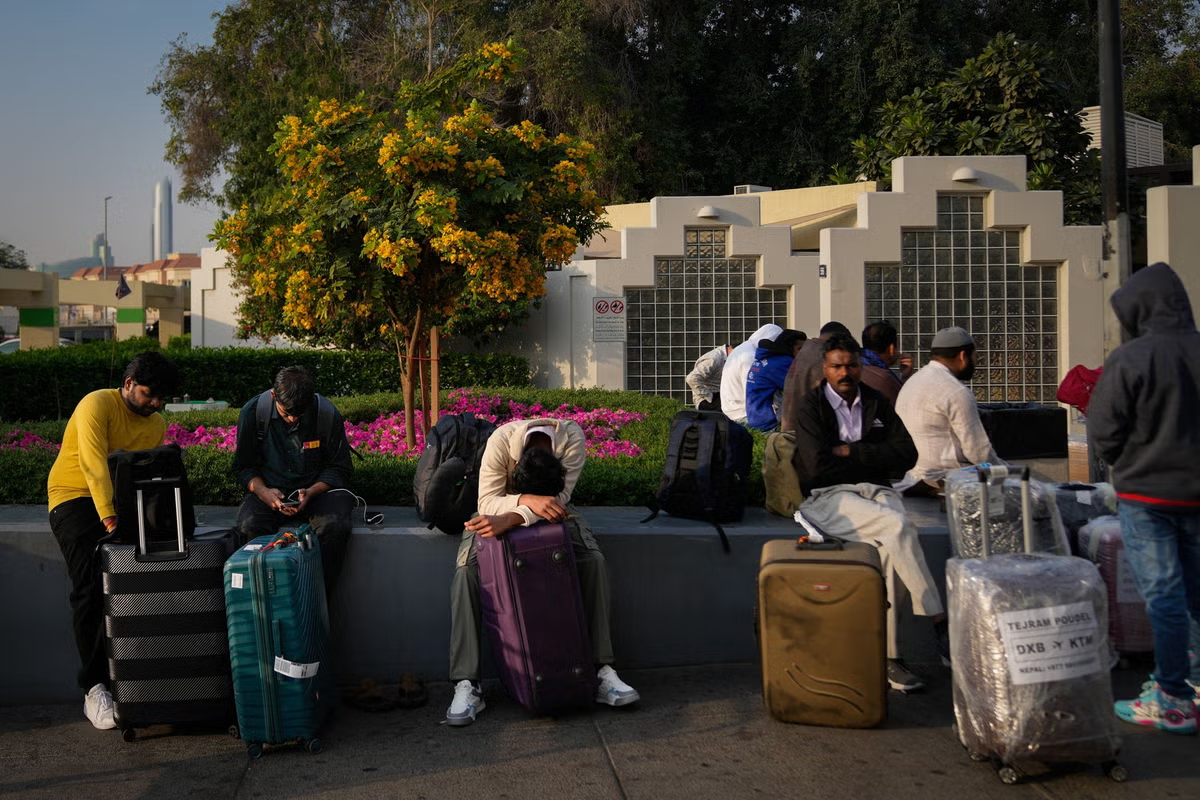
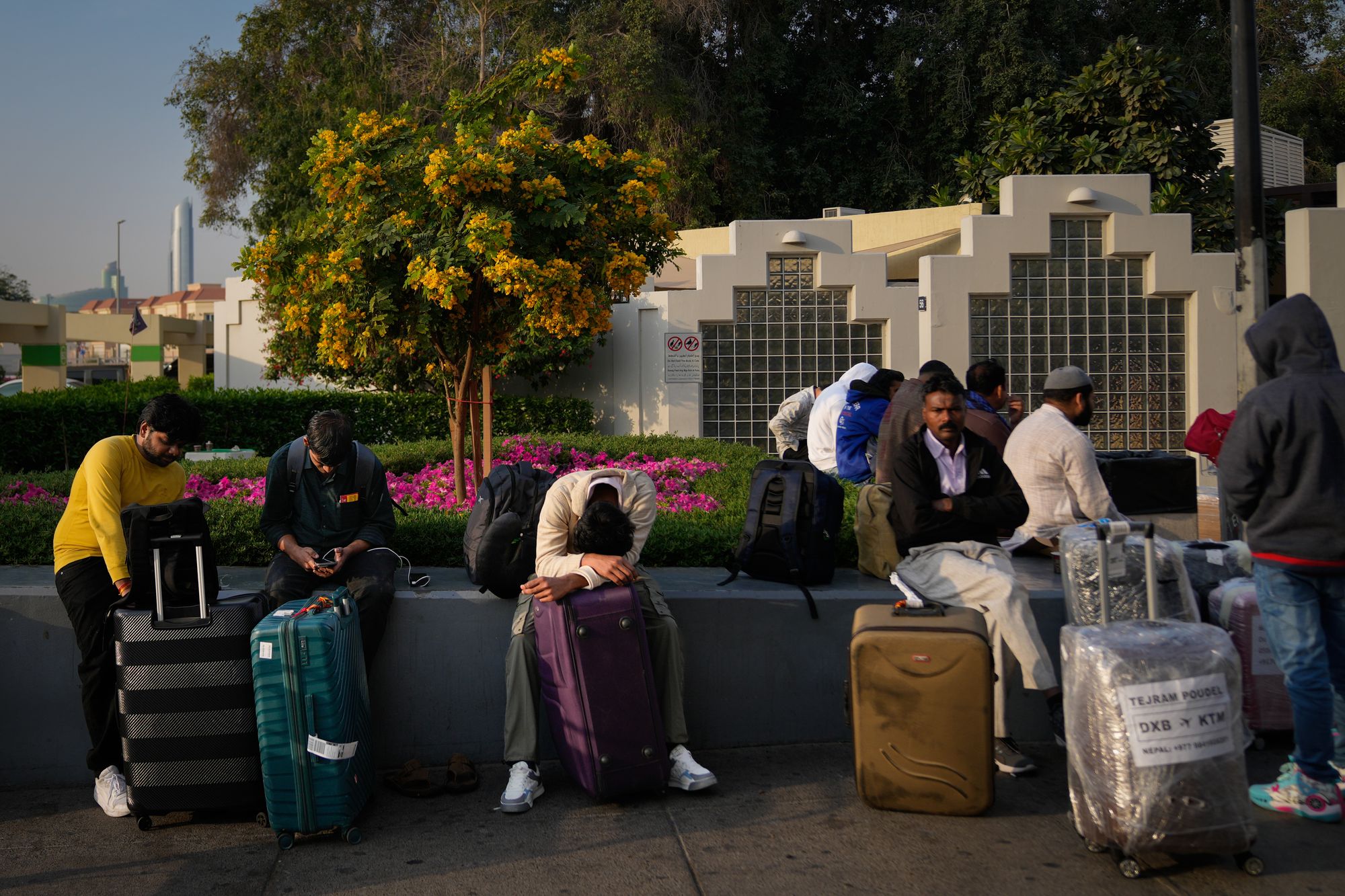
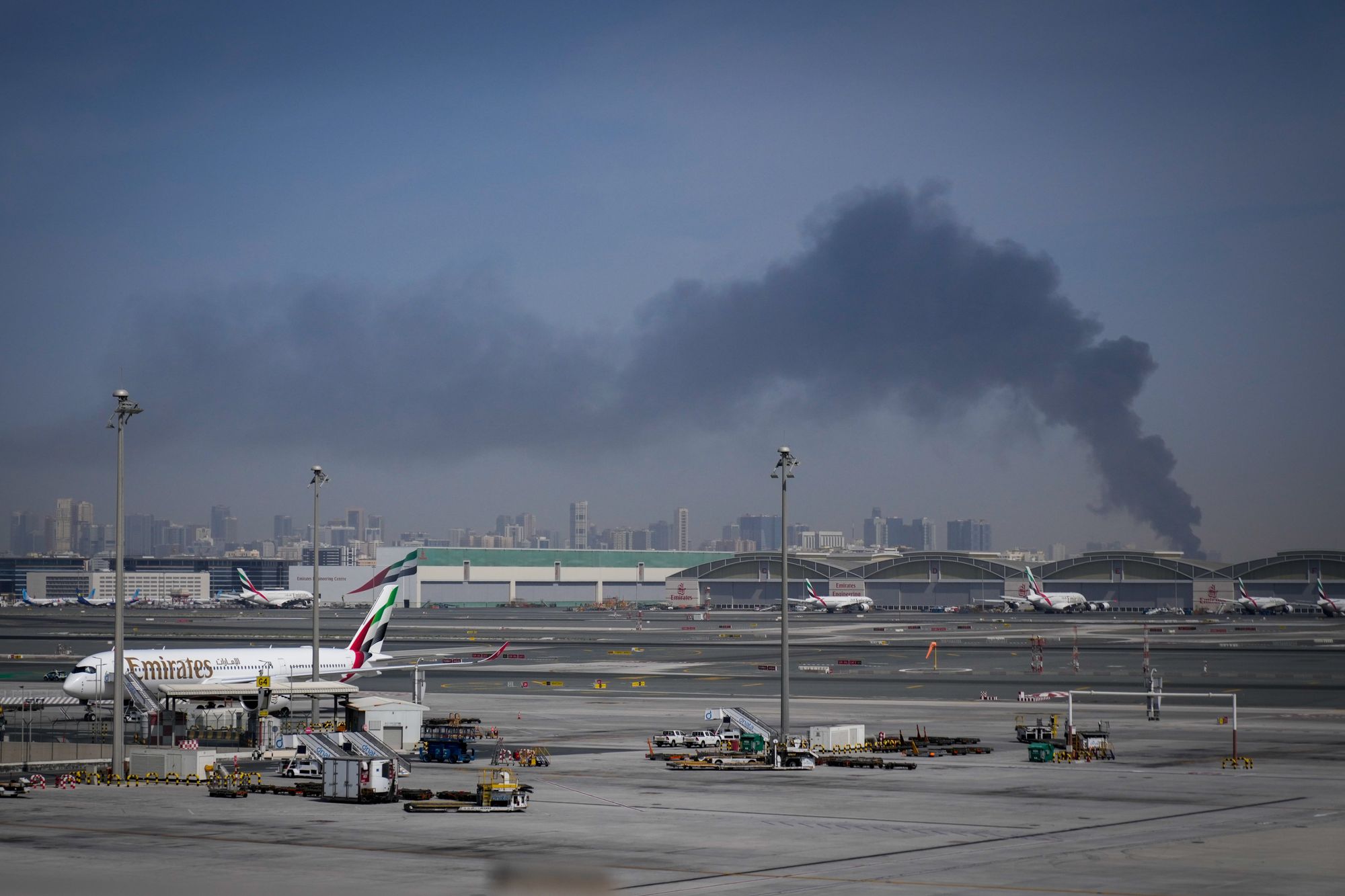
Passengers stranded by the closure of Dubai International airport wait for assistance (AP)
She added: “I came here to visit my best friend, who is going through a divorce, and I came to support her. I’m thinking about going to Oman with friends of friends to go to the airport there. But I think I will probably end up staying here and hoping that it doesn’t escalate further. I’m keen to get out as quickly as possible.”
Advertisement
Ms Thönnessen, who is a midwife, said she has had to cancel the appointments she has due to being stuck in Dubai. “I do home births, and a lot of the women I look after are due around now, so I’ve had to pass them on to colleagues. For the antenatal and postnatal check-ups, I’ve explained to them that I’m currently stuck and I don’t know when I will be back.”
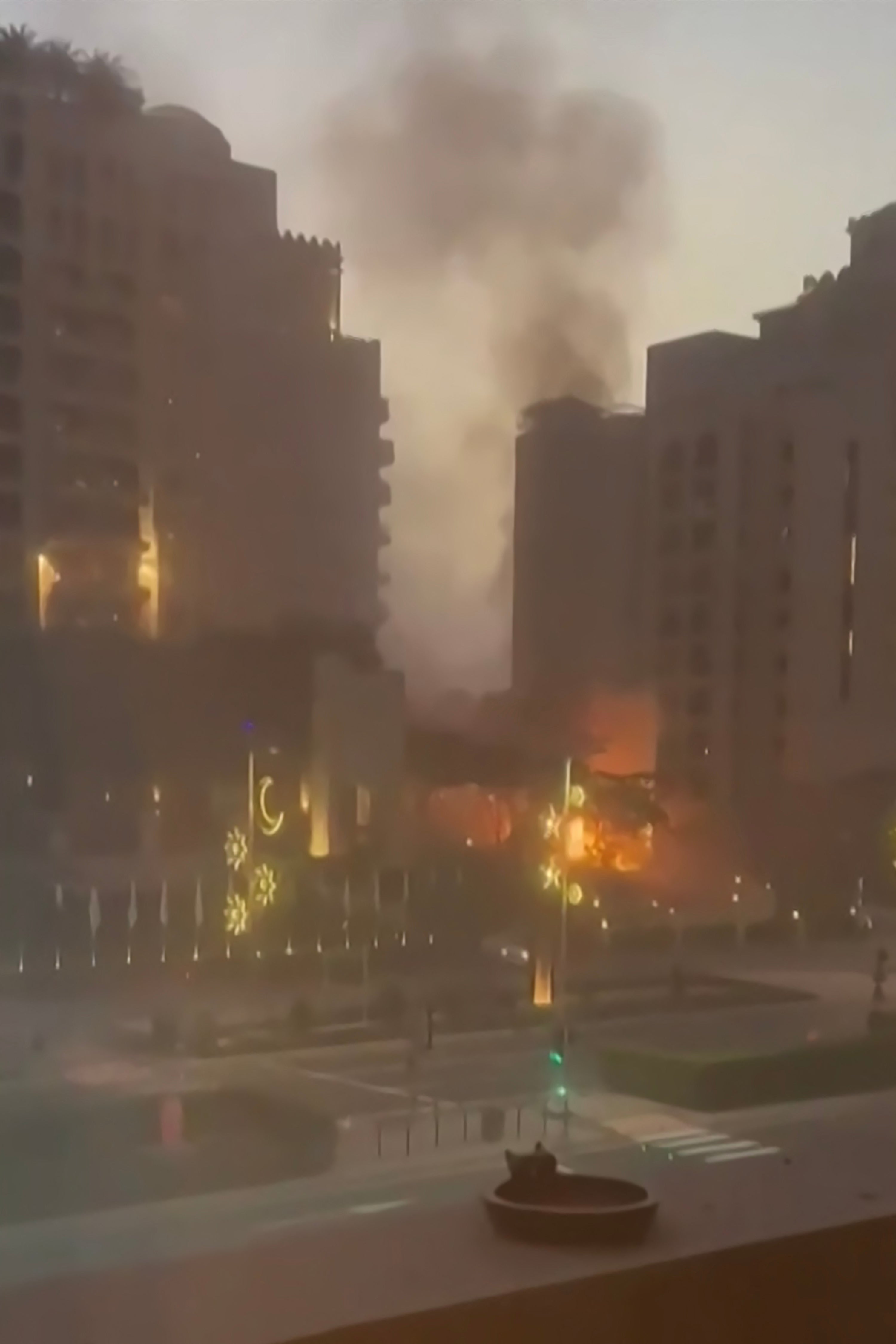
Smoke and flames rise from The Palm in Dubai (AFP via Getty)
Asked if she felt safe to go outside the hotel to walk around, she replied: “No. No, we’re staying very much in the hotel. The hotel is attached to a mall and has a restaurant.
“My financial resources are dwindling because I didn’t expect to have to stay for so long. But I don’t feel like I would want to go outside, no.”
Advertisement
Are you a British national impacted by the escalations between Iran, the US and Israel? Get in touch at holly.bancroft@independent.co.uk
Broadcaster and journalist Isabel Oakeshott, speaking from Dubai Marina, said on Sunday morning: “The authorities have clearly done a very good job indeed of intercepting a lot that is coming our way. This is far from a normal morning here. It is extremely quiet on the streets”.
In a video posted to X, she added that there were “periodic quite regular sounds of munitions”. She said that there was a “very unnerving moment in the early hours of the morning when we all received emergency alerts to take cover”.
Two people were injured in Dubai after shrapnel from drones fell on two houses when they were intercepted, a Dubai Media Office statement said, and state media has reported that shrapnel from an Iranian missile attack on the UAE killed one person.
Advertisement
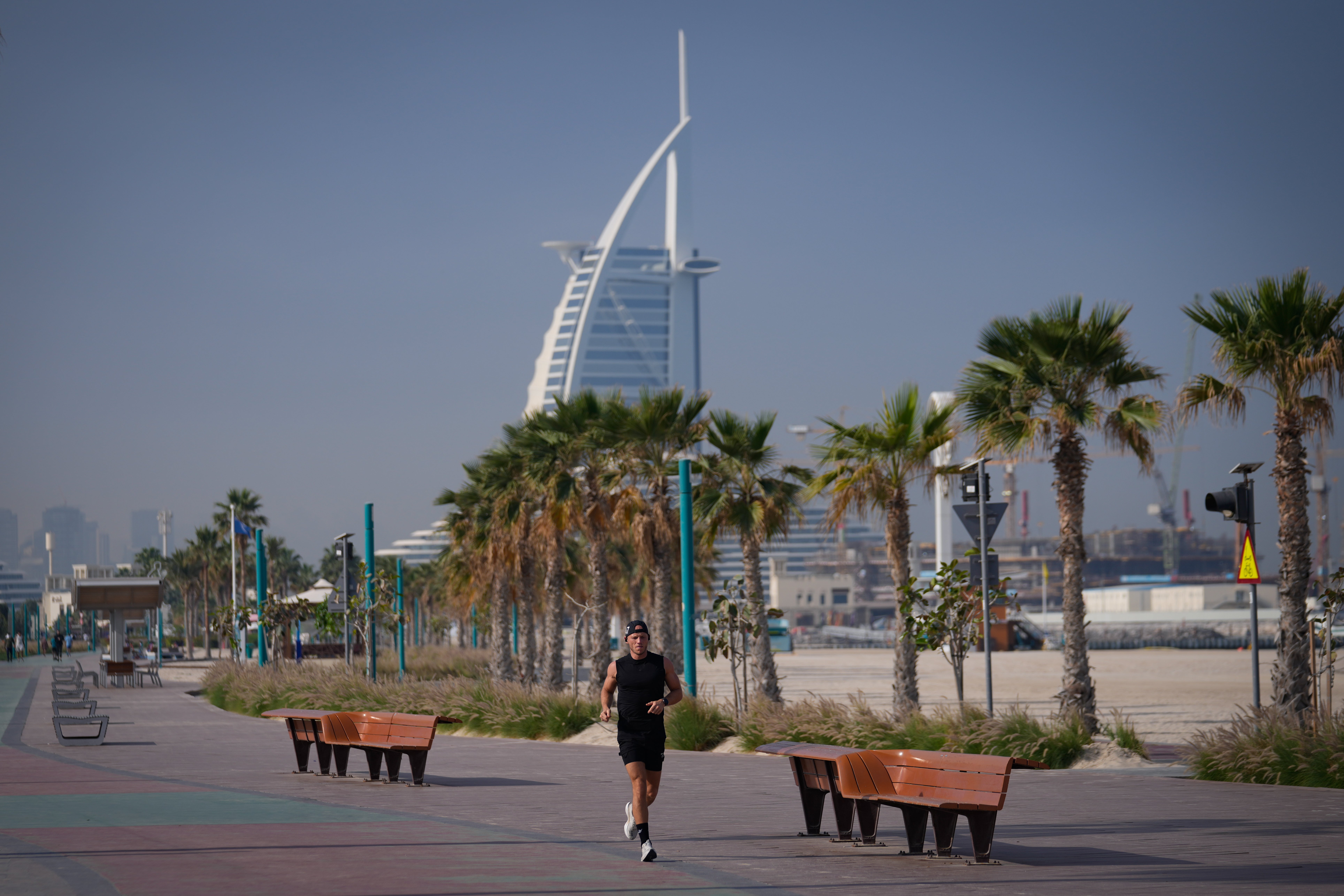
A man jogs on a beach in Dubai, with the Burj Al Arab hotel in the background (AP)
Debris from aerial interceptions caused fires at the city’s main port and on the facade of the iconic Burj Al Arab hotel. Four people were also injured in an incident at Dubai International airport on Saturday.
The former Rangers and Liverpool manager Graeme Souness was also among travellers caught up in flight cancellations on Saturday. He posted two videos on Instagram from Zayed International airport in Abu Dhabi as he attempted to return to the UK.
“I’m hearing some pretty loud bangs go off and that is anti-missiles taking out missiles that have been fired at some American bases,” wrote Souness in the first video.
Advertisement
An update followed, with the 72-year-old writing: “Flight’s been cancelled, still hearing explosions so we’ve given up, we’re just going to check into a hotel for a couple of nights and see where we are.
“Hopefully, things will settle down, and we’ll get back on the flight. You get grumpy when you get delays and stuff at airports but I think we should think of people that maybe this time are dying.”
One person has been killed at Zayed International airport, with others also injured there and at Dubai International airport, while thousands of flights remain grounded.
On Sunday, an adviser to theUAE’spresident said Iran “missed its target” with its attacks on the Arab Gulf states.
Advertisement
“Your war is not with your neighbours,” Anwar Gargash wrote on X, addressing Tehran.
“Return to your senses, to your surroundings, and deal with your neighbours with reason and responsibility before the circle of isolation and escalation widens.”
Multiple people were injured after an incident at Dubai International Airport (AP)
Claire Gleave, who moved to Dubai with her husband and three sons in August, said the situation on Saturday was “quite a strange, surreal feeling and frightening as well”.
Advertisement
She expected attacks overnight, but was surprised to see them continue on Sunday, she said.
“We were woken up along with the rest of Dubai at 1am with one of these phone alerts that came out saying to get shelter.”
Mrs Gleave, who lives 30 minutes from The Palm Hotel, which was struck on Saturday, said: “You do tend to overanalyse everything you hear, if a car door slams, or the air conditioning comes on.”
Her husband and son were due to fly back to the UK on Sunday, but had their flights cancelled after Dubai closed its airspace. They have booked another flight for Monday evening, but she says it is unlikely it won’t be cancelled as well.
Advertisement
Her children have been told not to attend school for the next three days, she said.
Tyrone GAA legend Peter Canavan has accused the GAA of burying its head in the sand over the Allianz sponsorship controversy, after GAA President Jarlath Burns criticised protesters at Croke Park
Peter Canavan has hit out at the GAA for avoiding the issue surrounding its contentious partnership with Allianz, following Jarlath Burns’ remarks about those who participated in Saturday’s demonstration at Croke Park.
Advertisement
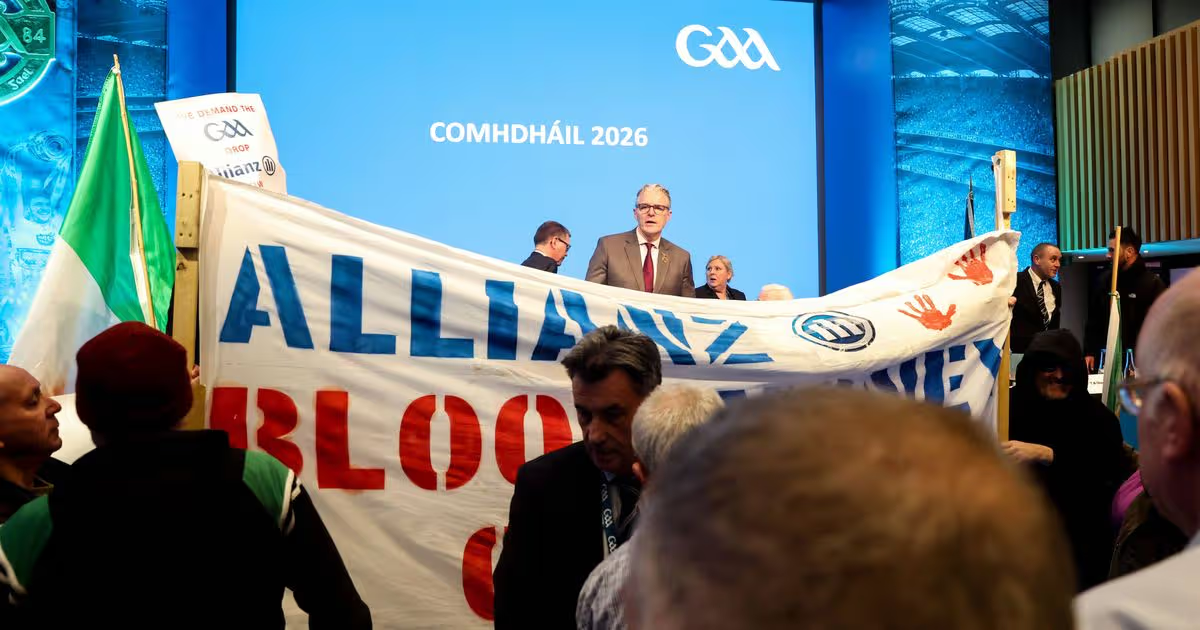
The former Tyrone star joined other GAA legends, including Colm O’Rourke, Pat Gilroy and Brendan Devenney, in protesting against the association’s ongoing ties with Allianz, which sponsors the National Leagues and whose German parent firm has connections to Israel.
However, the demonstration descended into disorder when approximately 50 individuals forced their way into Croke Park’s main hall, where GAA Congress was underway.
Whilst figures such as Canavan, O’Rourke and Devenney remained outside the venue, GAA President Jarlath Burns urged the high-profile personalities to separate themselves from those who stormed the hall, particularly given that Croke Park security personnel sustained injuries whilst attempting to prevent the demonstrators from accessing the chamber where discussions were ongoing.
It’s worth highlighting that Canavan, O’Rourke and Devenney were unaware at that point that a Croke Park security officer had been hurt during the disturbance, reports the Irish Mirror.
Advertisement
Burns remarked: “It’s a bit ironic that people who are protesting against illegal occupation will come in and illegally occupy our building.
“And I just want to say this: on the day that we made the decision based on the Ethics and Integrity Commission, it was on the 19th of December. The 19th of December in my area is a very significant date.
“In 1975, the Glenanne Gang came into Donnelly’s bar, which is our local shop, and murdered three people, one of whom was a good friend of mine, Michael Donnelly. On the 19th of December 2025, I went into my car and drove to the front of Donnelly’s house, shop and pub, which is still there, to make a speech.
Advertisement
“Fifty years on, justice still hasn’t been served for the 120 innocent Catholics who were murdered by the Glenanne Gang in a four-year period in my area, in my community.
“I don’t need any lectures about what it’s like to feel the pressure of illegal occupation. I don’t need any lectures or people shouting in my face about what it’s like to go to bed at night fearful that somebody would barge into your bedroom and riddle you with bullets. That was my lived experience when I was young.
“So when this came onto our table in the GAA, we dealt with it the way the GAA does. We put it through our own processes and reached a conclusion, and Tom Ryan dealt with it very well last night. We have facilitated protests by people who disagree with the decision we took.
“But we have security guards down there who work very, very hard. I know them all from being in here every day. They are injured. Somebody is waiting down there for an ambulance to come.
Advertisement
“I would urge people within our own association who might have aligned themselves with some of the people who came in and illegally occupied our building today, and tried to disrupt Congress by assaulting our staff members and those here to protect us, to examine their own consciences and ask themselves whether they are doing the right thing.
“We went through a process. We have our Congress to go through. I will not be bullied or intimidated by anybody who would come in here and try to do so. As I said last night, we are answerable to the people in this room. You are answerable to the members of the GAA.”
On Saturday evening, Canavan was given the chance to address Burns’ comments whilst providing analysis on RTÉ’s broadcast of the Division Two fixture between Kildare and Meath at Newbridge.
When presenter Joanne Cantwell questioned him about Burns’ comparison between the Troubles and the conflict in Gaza, Canavan maintained his stance against the GAA’s ongoing partnership with Allianz.
Advertisement
Canavan remarked: “Yeah, strange comparison, but a lot of what he said I would echo. It does strike a chord when you go back to when we were younger and what we had to endure. Jarlath spoke about what happened in Donnelly’s bar. There were a lot of atrocities that went on, and what kept us going was the GAA.
“We had something to do, something to be part of, and for a lot of us it was the GAA that saved us. Thousands of children aren’t getting that opportunity.
“Jarlath is still sore from something that happened 50 years ago – and rightly so. He mentioned that there were no convictions for those killings. That was 50 years ago. Why? Because so many people buried their heads in the sand and didn’t want to know what was going on.
“The exact same thing is happening now. We have an opportunity as an association to do the right thing, Joanne.”
Advertisement
Want to see more of the stories you love from Belfast Live?Making us your preferred source on Googlemeans you’ll get more of our exclusives, top stories and must-read content straight away. To add Belfast Live as a preferred source, simplyclick here.
Like a voice from the grave, an important part of Surrey’s cultural heritage has sounded again. It is a short ceremonial brass fanfare by Dame Ethel Smyth (1858–1944).
Rather than commission a new work, I revived a forgotten piece instead: Smyth’s Hot Potatoes fanfare. I chose this composer because she had strong local ties and links to university research.
In 1930, eight of the most prominent British composers of the day were commissioned to write short fanfares for the Musicians’ Benevolent Fund. Each lasted about a minute.
Advertisement
The last of the set was written by Smyth. She based it on a military bugle call, formally titled the Men’s Meal (2nd call). The call signalled that the troops could collect their rations. It is colloquially known as Hot Potatoes. Soldiers added comic words to help remember its meaning: “Oh, pick ’em up, pick ’em up, hot potatoes …”
At the pinnacle of Smyth’s impressive musical output lies her six operas, several of which are available in modern recordings. Her other compositions include a Mass (a musical setting of the Christian liturgy), a concerto for violin and horn and a symphony-cum-oratorio. Smyth is widely known in Britain and internationally as one of the greatest women composers in classical music history. She was also an influential suffragette and a much-published author of autobiographical and other prose writings.
Advertisement
Yet little is known of her Hot Potatoes fanfare, possibly the last piece she ever wrote, other than its original instrumentation: four trumpets, four trombones and percussion. It is rarely even mentioned in literature on Smyth.
Composed when she was in her 70s, experiencing profound hearing difficulties and with the greatest achievements of her career behind her, its manuscript has long been lost and for many years it seems to have been generally assumed that it could never be performed again.
The piece would have held particular significance for Smyth. She was familiar with military fanfares from childhood, since her father had attained the rank of Major-General in the British Army. She quoted such bugle calls in her own music, Hot Potatoes having previously appeared in the overture to her final opera, Entente Cordiale, the centenary of the first performance of which fell last year.
While the use of Hot Potatoes is not explicitly identified in the opera’s published vocal score, an archival copy now held in the Beecham Collection at the University of Sheffield is annotated in Smyth’s own hand to indicate its origin.
Advertisement
Smyth’s fanfare from past to present
Smyth’s Hot Potatoes and the other fanfares in the set were first performed by students from the Royal Military School of Music (Kneller Hall Musicians) under Captain H.E. Adkins. The occasion was the Musicians’ Benevolent Fund Annual Dinner held in London’s Savoy Hotel on May 8 1930 (coincidentally the same date on which Smyth died 14 years later), from where the performance was relayed for broadcast on the BBC National Programme.
The fanfares were reprised at this annual event a couple more times, including on St Cecilia’s Day, November 22 1932. The previous June, they had also been recorded by the same ensemble for release by His Master’s Voice (HMV) toward the end of that year. But thereafter the trail runs cold.
However, the HMV recording of the fanfares yielded sufficient information for me to transcribe and arrange Smyth’s piece for students of the University of Surrey Brass Ensemble. I based this work on my wider knowledge of the composer’s output, which proved invaluable in identifying and replicating her musical idiosyncracies.
The University of Surrey Brass Ensemble at Guildford Cathedral South Gallery before the performance. Author provided (no reuse)
Instead of a faithful transcription, I changed the scoring (though in a nod to the original, I retained four separate trumpet parts) as well as the key of the piece. I even recomposed one bar in its entirety.
Certain details were simply too difficult to make out on the recording, while others naturally lent themselves to being enhanced (and I was convinced that there was at least one wrong note). Nonetheless, this project demonstrates the creative possibilities for bringing back music assumed to be lost to history, and for celebrating diversity by resurrecting works by neglected artists.
Fittingly, since Professor Jarvis’s installation ceremony was an official university event, I conducted the Brass Ensemble from the Cathedral’s South Balcony while wearing my doctoral robes, as had been Smyth’s own practice when wielding the baton. I hope this recovery of Smyth’s Hot Potatoes fanfare will now lead to repeat performances.
Looking for something good? Cut through the noise with a carefully curated selection of the latest releases, live events and exhibitions, straight to your inbox every fortnight, on Fridays. Sign up here.
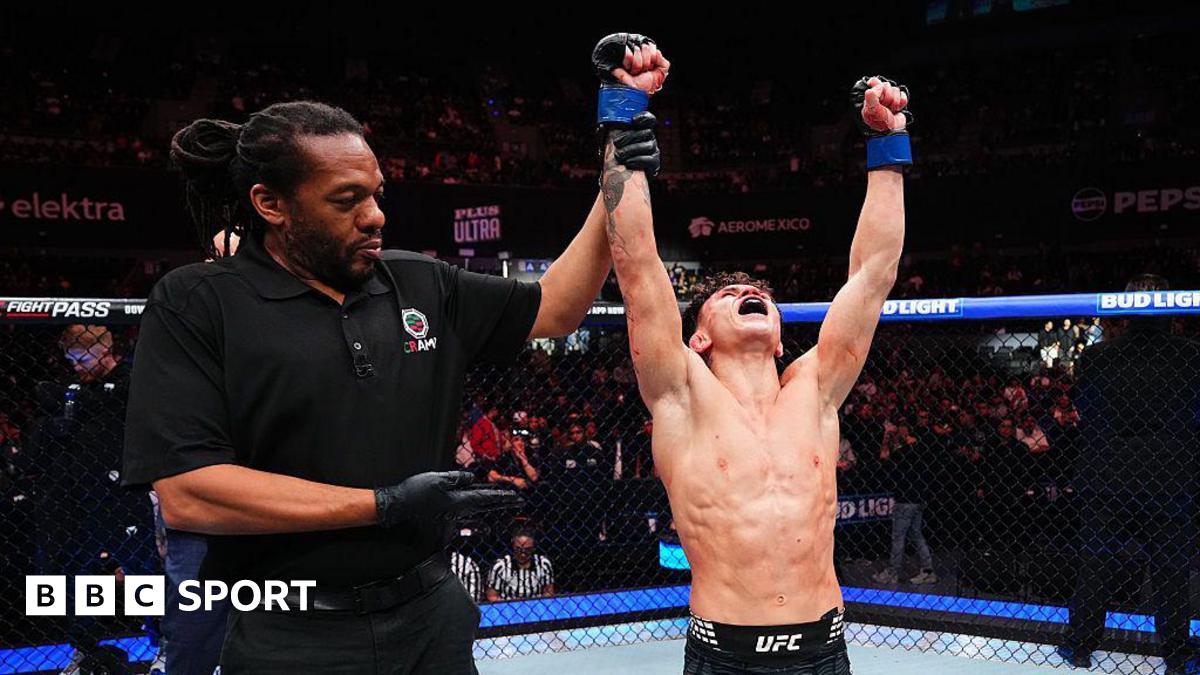
Britain’s Lone’er Kavanagh claimed the biggest win of his career as he upset former UFC flyweight champion Brandon Moreno in Mexico City.
Kavanagh, who took the fight on just three weeks’ notice, delivered a mature display to win by unanimous decision 49-46, 48-47 and 48-47.
Kavanagh, 26, was unranked heading into the contest, but victory over sixth-ranked Moreno – in front of the Mexican’s home fans – will see him him take a big leap towards the top end of the division.
“I said before this fight – I live for legendary moments,” said Kavanagh.
Advertisement
“This is a legendary moment. Brandon is a legend. Two-time world champ. I’m a big fan. I watched him when I was a kid. To get to fight him is amazing.”
Kavanagh took the fight against two-time flyweight champion Moreno when his original opponent Asu Almabayev withdrew because of injury.
The Briton came into the contest after the first defeat of his 11-fight career against Charles Johnson in August, but took control in the early stages against Moreno.
Kavanagh kept Moreno at bay with a series of leg kicks, before hurting him with a flurry of punches midway through the second round.
Advertisement
Moreno had more success in the third round, but Kavanagh regained control with more thudding leg kicks, before seeing out victory by defending a number of takedowns.
The win was the 10th of Kavanagh’s 11-fight career, while Moreno suffered a fourth defeat in his past six fights.
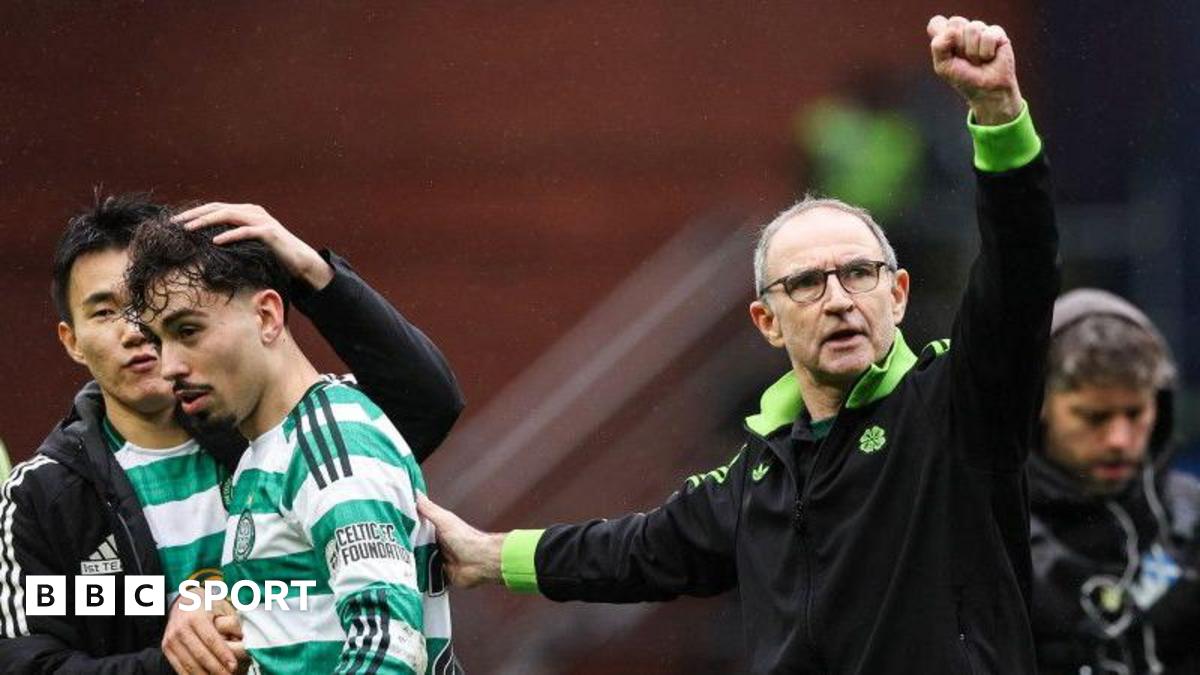
They were serenaded off at the break. O’Neill made changes, as he had to. On came Reo Hatate and Sebastian Tounekti and off went the new men to this fixture, Alex Oxlade-Chamberlain and Junior Adamu. O’Neill could have pulled the trigger on many more, but he left it at two. And it worked. He got his team very badly wrong to begin with, but he righted the wrongs thereafter.
The mentality of sport. You could spend 100 years studying it and still not understand it. Yes, it was about new blood and new tactical thinking, but it was more than that. A team with all the belief suddenly started running out of it. A team with zero belief were suddenly reborn. Confidence is a fickle beast. From nothing, Celtic lorded the second half.
Hatate, a player who has looked a poor version of his best self this season, had a huge impact. He forced the first save out of Jack Butland after 55 minutes. Celtic were now on top. Rangers were in full retreat.
When Kieran Tierney pulled one back with a header it was just reward, Rangers were idling and Celtic were desperate. Where was this urgency earlier on? Daizen Maeda and Luke McCowan could and should have scored.
Advertisement
The thought occurred that after getting out of jail so often in recent times, maybe time was going to catch up with them again. Maybe all of this pressure was too little, too late. There was no act of escapology against Hibernian last week – and with a few minutes to go, you struggled to see one coming here.
It did, of course. The way this season is going – drama at every turn – a late, late penalty was never going to cut it in terms of theatre. No, no. There had to be more.
Hatate’s penalty was saved by Butland, as was his shot on the rebound. Ibrox contorted itself as the goalkeeper performed heroics and then the place let out a guttural groan as Hatate made it third time lucky. The visiting Celtic fans away in the distance went berserk. Sanity plucked from the jaws of madness.
Celtic had their draw. Not what they came for, not what they needed, but it was more than they thought they were getting at the break. And a lot less than what Rangers thought they were getting.
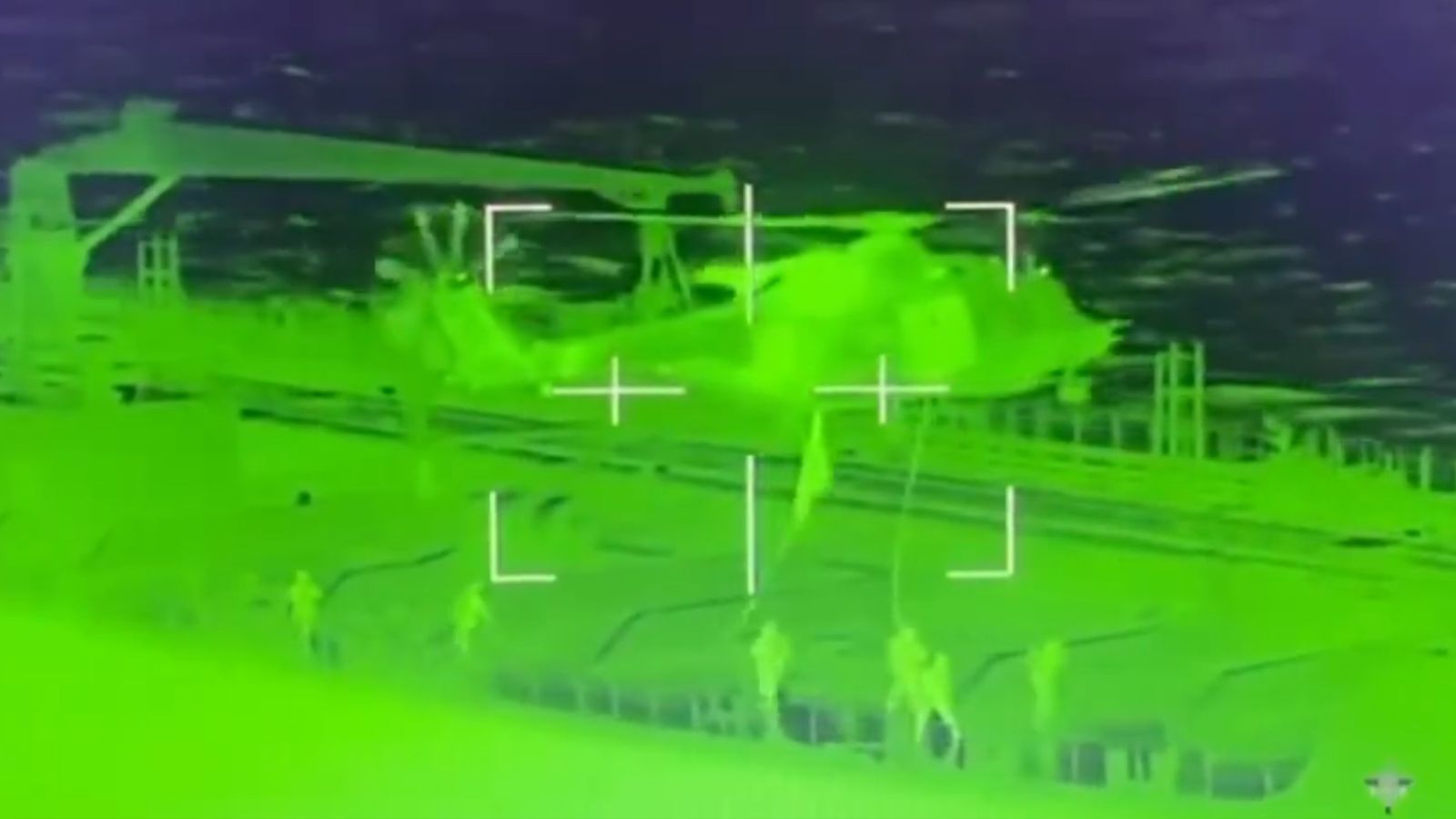
An oil tanker suspected of belonging to the Russian shadow fleet has been seized in the North Sea in a joint Belgian-French operation.
The captured vessel is named Ethera and is on the European Union’s sanctions list, according to Belgian officials.
Announcing the raid, French president Emmanuel Macron called it “a major blow to the shadow fleet“.
Posting on X, he wrote: “In the North Sea, our French Navy helicopters helped last night in the boarding by Belgian forces of an oil tanker under international sanctions.
Advertisement
“Europeans are determined to cut off the sources of funding for Russia’s war of aggression in Ukraine by enforcing sanctions.”
Image: The joint Belgian-French raid on the Russian shadow fleet tanker Ethera. Pic: EmmanuelMacron/X
Moscow is believed to be using a network of poorly-regulated ships with opaque ownership structures to circumvent Western sanctions aimed at cutting its oil revenues.
The ageing tankers are typically prone to spills, mechanical failures, and leaks, and often sail without top-tier insurance or safety certification.
Belgian defence minister Theo Francken said the seized ship was suspected of sailing with a “false flag and false documents”.
Advertisement
He said: “Without his shadow fleet Putin can’t wage war against innocent Ukrainians. So we take these vessels out. One by one. Till his war of aggression stops.”
The ship is now being escorted to the Belgian port of Zeebrugge, Francken said.
Belgium’s federal prosecutor’s office has also opened an investigation.
In a post on X, Ukrainian foreign minister Andrii Sybiha said: “We urge all partners to follow this example, counter Russia’s shadow fleet resolutely through sanctions and concrete action, and advance peace through strength.”
X
This content is provided by X, which may be using cookies and other technologies.
To show you this content, we need your permission to use cookies.
You can use the buttons below to amend your preferences to enable X cookies or to allow those cookies just once.
You can change your settings at any time via the Privacy Options.
Unfortunately we have been unable to verify if you have consented to X cookies.
To view this content you can use the button below to allow X cookies for this session only.
The Russian embassy in Belgium said it was not notified about the basis for the seizure, and added that it was seeking information on whether any Russian nationals were on board.
Advertisement
The French navy intercepted the tanker Grinch in the Mediterranean in January and only released it a month later after the owners paid a penalty worth “several million euros”.
Previous seizures of tankers carrying Russian cargoes have been called “piracy” by the Kremlin.
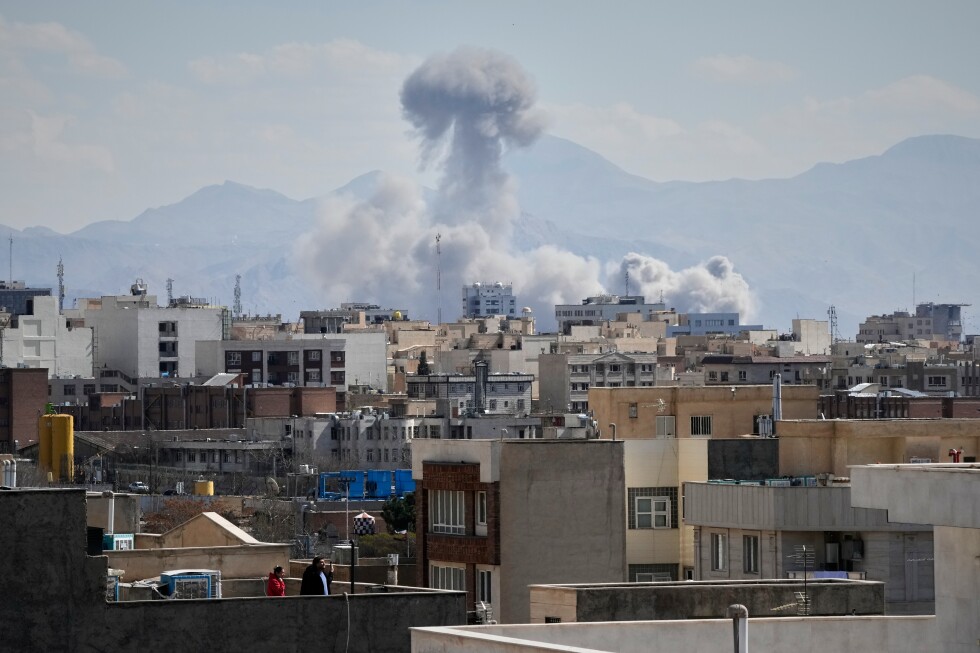
Related violence expanded Sunday to a growing number of places, with a rising death toll. A major Israeli strike targeted Tehran. Iran fired drones and missiles at Israel and U.S. military installations around the Gulf, and also at the global business and tourism hub of Dubai. Several people were killed in clashes after protesters stormed the U.S. consulate in Pakistan.
The joint U.S.-Israeli strikes on Iran, which started on Saturday, carried the potential for a wider war and the fallout could hit the world economy. Global reaction ranged from jubilation to condemnation. President Donald Trump urged Iranians to seize the moment and “take over.”
The latest strikes came two days after the latest U.S.-Iran talks as Trump pressured Tehran for a deal to constrain its nuclear program.
Advertisement
Iran’s provisional governing council started its work Sunday, and is expected to name a new supreme leader. Iran’s theocracy has struggled with growing dissent following nationwide protests that began over the economy but turned into anti-government ones.
Supreme leader was one of the first targets
Israel said it had worked with the U.S. for months to plan the attacks. The U.S. military said targets in Iran included Revolutionary Guard command facilities, air defense capabilities, missile and drone launch sites, and military airfields.
One of the first strikes hit near the offices of the 86-year-old Khamenei, who had ruled since 1989 and held ultimate power. Iranian state television and state-run IRNA news agency reported Khamenei’s death, without details.
Israel said it killed 40 top Iranian military officials, including the commander of Iran’s Revolutionary Guard and the defense minister. Iranian state media said at least 200 people have been killed.
Advertisement
The U.S. and Israel also struck Iran last June during earlier nuclear talks, greatly weakening Iran’s air defenses, military leadership and nuclear program. The Trump administration has asserted that Iran had been rebuilding its nuclear program, which Tehran has insisted is for peaceful purposes.
‘Crossed our red line’
Iran launched missiles and drones targeting Israel and strikes targeting U.S. military installations in Bahrain, Kuwait and Qatar. Three U.S. service members have been killed, according to U.S. Central Command.
“You have crossed our red line and must pay the price,” Iran’s parliamentary speaker, Mohammad Bagher Qalibaf, said in a televised address Sunday.
The authorities said 10 people have been killed in Israel, and loud explosions caused by missile impacts or interceptions could be heard in Tel Aviv.
Advertisement
Air defense fire thudded over Dubai, the United Arab Emirates’ commercial capital, which has long drawn business and expatriates by billing itself as a safe haven in a volatile region. Shrapnel from Iranian attacks on the UAE capital of Abu Dhabi killed two people, state media said.
Attacks also extended into Oman — Iran’s longtime interlocutor with the West.
Saudi Arabia said Iran had targeted its capital and eastern region in an attack that was repelled. Bahrain said a missile attack targeted the U.S. Navy’s 5th Fleet headquarters, and three buildings were damaged in the capital, Manama, and Muharraq city.
Kuwait’s civil aviation authority said a drone targeted the main international airport, injuring several employees. Explosions could be heard in Qatar. Jordan said it “dealt with” 49 drones and ballistic missiles.
Advertisement
Iranian-backed Houthis in Yemen have vowed to resume attacks on Red Sea shipping routes and on Israel, according to two senior Houthi officials who spoke on condition of anonymity because there was no official announcement from leadership.
Trump tells Iranians ‘take over your government’
In announcing the “major combat operations,” Trump indicated the U.S. was striking for reasons beyond Iran’s nuclear program. On Friday, he voiced frustration over lack of progress in negotiations to stop Iran’s ability to develop nuclear weapons.
He listed grievances stretching back to the beginning of the Islamic Republic following a revolution in 1979 that turned Iran from one of America’s closest allies in the Middle East into a foe. Iran’s ballistic missile program and support for armed proxies in the region were other issues.
Trump on Saturday told Iranians to take cover but urged them to later rise up and topple the Islamic leadership.
Advertisement
“When we are finished, take over your government,” Trump said. “It will be yours to take. This will be probably your only chance for generations.”
US military plans to maintain pressure
Trump later said “heavy and pinpoint bombing” in Iran would continue through the week or longer.
The U.S. had assembled a fleet of fighter jets and warships in the region as it negotiated with Iran about a deal over its nuclear program. The fleet has added more than 10,000 U.S. troops to the region.
The aircraft carrier USS Abraham Lincoln and three guided-missile destroyers arrived in January to bolster the number of warships. The world’s largest aircraft carrier, the USS Gerald R. Ford, and four accompanying destroyers were later dispatched from the Caribbean to head to the Middle East and are now in the Mediterranean.
Advertisement
U.S. Democrats are leading efforts to limit Trump’s war powers, notably after he pledged to end with ’’forever wars″ abroad.
Fighting impacts other countries, disrupts air travel
The strikes elicited mixed global reactions, including angry protests, celebrations and calls by world leaders for a return to negotiations and peace.
At least nine people were killed in clashes with police and paramilitary forces Sunday after hundreds of Shiite protesters stormed the U.S. Consulate in the Pakistani port city of Karachi, authorities said.
Shipping companies suspended their vessels’ traffic through the Suez Canal. The strikes could rattle global markets, particularly if Iran makes the Strait of Hormuz unsafe for commercial traffic. A fifth of worldwide traded oil passes through the strait.
Hundreds of thousands of travelers were stranded or diverted to other airports after Israel, Qatar, Syria, Iran, Iraq, Kuwait and Bahrain closed their airspace. There was no flight activity over the United Arab Emirates, flight tracking website FlightRadar24 said.
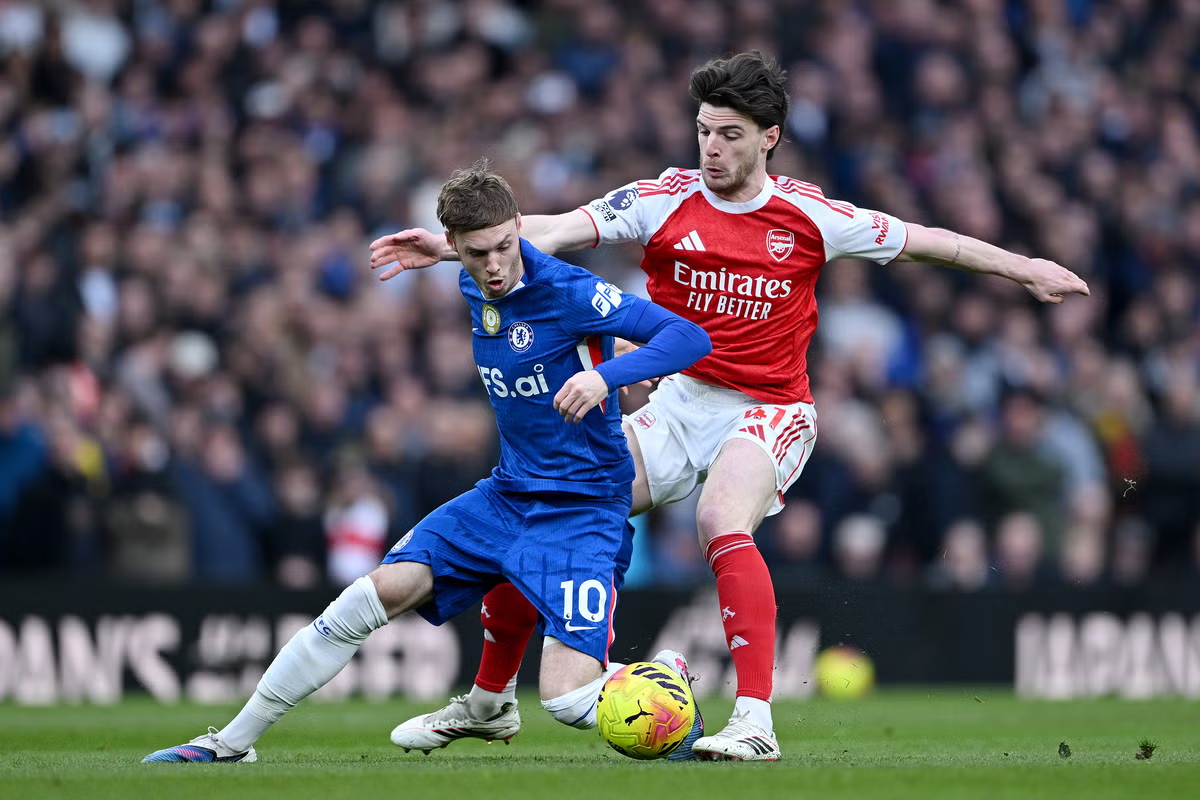
11 mins: Chelsea win themselves a free kick inside the Arsenal final third.
Pedro Neto flicks the ball into the box and a deflection knocks the ball to Mamadou Sarr.
He tries to volley a shot at goal but miscues it and turns it wide instead.
Advertisement
Decent opportunity for Chelsea though.
Mike Jones1 March 2026 16:41
Arsenal 0-0 Chelsea
8 mins: Shots at either end and neither is very good.
Advertisement
Cole Palmer takes the first one having drifted in from the left before firing wide.
At the other end, Martin Zubimendi gets the ball on the edge of the box and lifts his effort too high having lent back during his strike.
Mike Jones1 March 2026 16:38
Advertisement
Arsenal 0-0 Chelsea
5 mins: What has gone on there?
Robert Sanchez pushes up to the edge of his own box and takes a heavy first touch after a back pass.
He almost loses it and has to throw himself on the floor to poke it across to his nearest teammate.
An awkward moment for the Chelsea goalkeeper.
Advertisement
Mike Jones1 March 2026 16:36
Arsenal 0-0 Chelsea
3 mins: A poor pass from Piero Hincapie sees the left-back send the ball out of play and Chelsea recover possession.
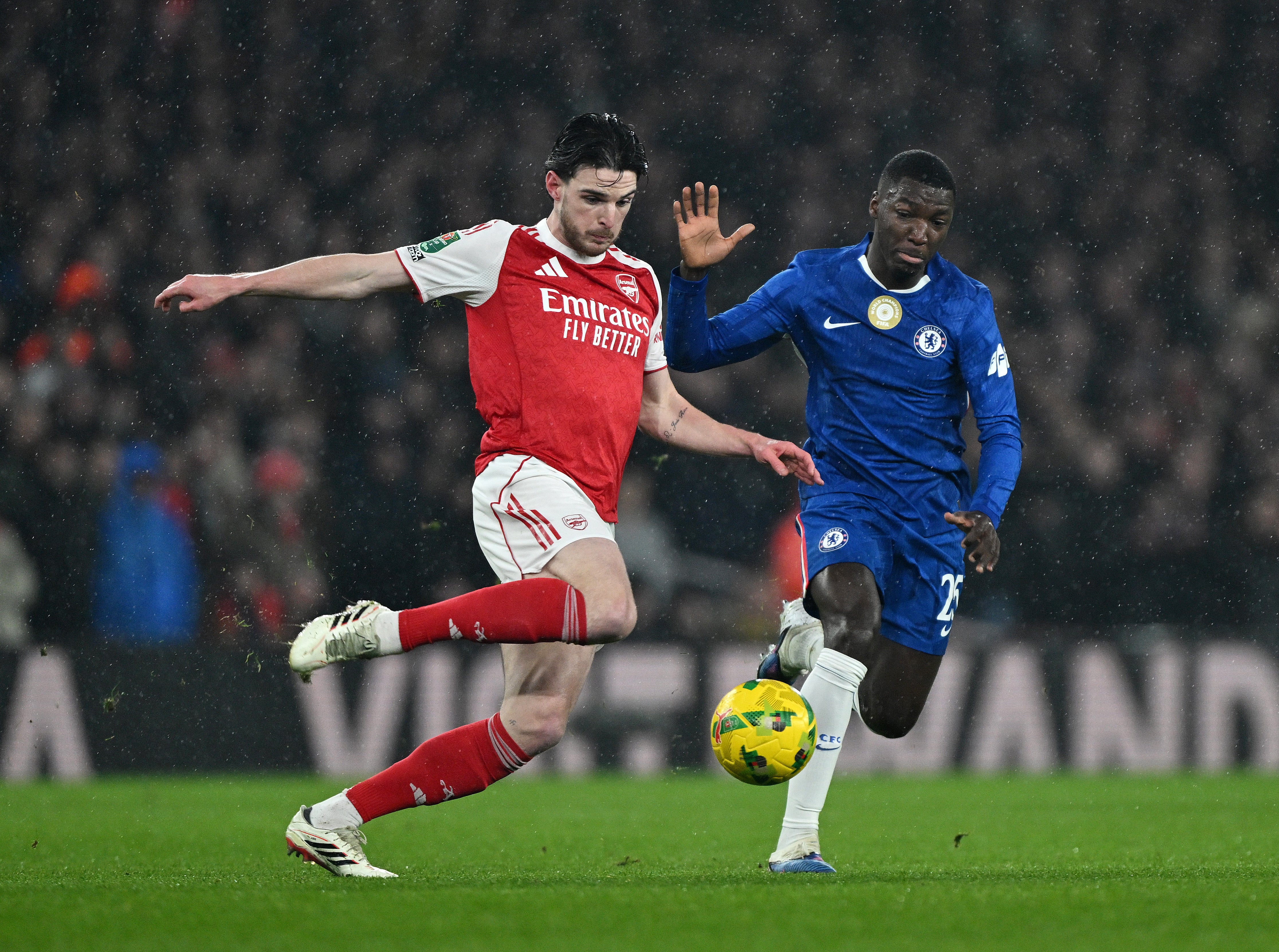
The Gunners have beaten the Blues twice in recent times having won both legs of the Carabao Cup semi-final played between the two teams.
Advertisement
Is today a chance for some redemption?
Mike Jones1 March 2026 16:33
Kick off! Arsenal 0-0 Chelsea
Declan Rice kicks off the game and pings the ball to David Raya who boots it over to the right side of the pitch.
Advertisement
A headed clearance sees the ball come back to Gabriel and he passes it back to Raya for another long ball forward.
Mike Jones1 March 2026 16:31
Arsenal vs Chelsea
The Gunners stride out onto the pitch knowing anything less than a win will be a huge advantage for Manchester City in the title race.
Advertisement
Chelsea though need three points to increase their hopes of winning a Champions League place after victories for Man Utd and Liverpool this weekend.
Which way will this one go? Kick off is up next…
Mike Jones1 March 2026 16:25
Advertisement
Eze to shine today?
Eberechi Eze has scored each of his last 11 Premier League goals in London, with all six of his goals for Arsenal this season coming in London derbies.
That’s the most ever by a player in a season without scoring outside of London derby games.
The last Gunners player with more derby goals in a season was Pierre-Emerick Aubameyang in 2018-19 (7).
(Arsenal FC via Getty Images)
Mike Jones1 March 2026 16:20
Advertisement
An issue of discipline?
Chelsea have received six Premier League red cards this season, more than any other club and their joint-most ever in a single season.
They saw Moisés Caicedo sent off against Arsenal earlier this season and have only received more reds against Liverpool (8) than the Gunners (7).
(Getty Images)
Mike Jones1 March 2026 16:15
Advertisement
Signs aren’t good for Chelsea
Chelsea have lost eight of their last nine away Premier League matches against sides starting the day top of the table, winning the other 2-1 against Man City in May 2021.
They’ve played nine away top-flight games against Arsenal when the Gunners are top and won just once – a 2-0 win in March 1948.
Mike Jones1 March 2026 16:10
Advertisement
Rare errors from Arsenal
Only Tottenham Hotspur players (5) have made more errors leading to goals in the Premier League in 2026 than Arsenal’s (4), with 44% of the goals the Gunners have conceded this year coming from an error (4/9).