Gareth Bale has been a busy man since retiring from football in 2023
Gareth Bale may have retired in 2023, but he will be cheering on his country as they aim to make it to this summer’s World Cup. The iconic forward helped Wales qualify for Euro 2016 and Euro 2020, sending them into the knockout rounds at both tournaments.
Advertisement
Bale’s final act for his country was playing in the 2022 World Cup in Qatar. With impressive stints at Real Madrid and Tottenham during his club career, the 36-year-old retired at Los Angeles FC with plenty of silverware.
These days, Bale focuses his energy on his many business ventures and has his eye on entering football ownership, with his hometown club, Cardiff City, the most attractive option.
Here, Wales Online has all the latest on Bale’s ventures in football, including where he is spending his impressive wealth.
Three years after retiring, Bale is said to be worth an estimated £120million. The former winger was earning a whopping £600,000 a week at the peak of his career at Madrid after he secured a then-world-record £85m transfer from England to Spain.
However, his wealth doesn’t just come from his earnings on the pitch. He began his business portfolio while still playing, opening a bar called Elevens in Cardiff’s city centre in 2017.
In March 2022, Bale then created Par 59, a golfing games bar, which opened on St Mary Street in Wales’ capital. Another bar of the same name opened in Bristol just months later, helping boost Bale’s wealth even further.
Advertisement
The ex-Spurs star became a minority shareholder at Penderyn Distillery and also staked a claim in Tiger Woods and Rory McIlroy’s TGL golf league. Bale continues to hold lucrative endorsement deals with major brands like BMW, Adidas and PlayStation.
Cardiff City takeover plans
Bale first confirmed his desire to take over his hometown club, Cardiff City, in 2025. The Welshman joined an American consortium that was interested in the Bluebirds, which he confirmed at the F1 movie premiere last June.
Speaking to Sky Sports, Bale said: “We are interested in getting Cardiff. It’s my home club, it’s where I grew up, and my uncle used to play for them. To be involved with an ownership group would be a dream come true.”
Advertisement
A month later, the group submitted a bid to owner Vincent Tan and claimed their offer was “serious and fair,” as per The Guardian. While this takeover never materialised at the time, Bale told The Overlap’s Stick to Football podcast that he still wants to own a football team.
He said: “I understand it’s a long time retired, I’ve been planning it since I was about 26 or 27. I always said when I retired that I wanted one, two, three years to decompress and enjoy with the kids, then try to find a few paths I want to go down.
“Obviously, you (Gary Neville) owning a football team, you understand the stresses of it. But we went and looked down that route. It’s something that does interest me. We obviously tried with Cardiff last summer, which didn’t materialise. And they are doing amazing again this season!”
Transfer ambitions for Bluebirds
Had the takeover gone through for Cardiff, Bale revealed that he was planning to take the League One side all the way to the Premier League. He said: “It’s a club close to my heart.
“It’s where I grew up and I would love to be able to be a part of growing Cardiff and taking it to the Premier League where it belongs. I know how amazing the Welsh fans and Cardiff fans are. It would be amazing to try and do something together. We are trying to engage with Cardiff and more news will come out on that in the future but hopefully we can get something done.”
The dream of taking Cardiff to the top flight would see Bale spend some of his wealth to buy quality players for his hometown club.
Get £250 to switch to Virgin Media’s sport packages
Advertisement
This article contains affiliate links, we will receive a commission on any sales we generate from it. Learn more
Virgin Media is paying new customers up to £250 as a bill credit when they switch to one of its TV and broadband packages, several which are packed with hundreds of channels including Sky Sports, Netflix and fibre broadband.
On Tuesday, Trump signalled the US may pursue both strategies at once. In a matter of hours, the Pentagon ordered ground troops to Iran, and US negotiators sent the Iranian regime a new 15-point peace plan. By Wednesday, the White House was urging Iran to accept the deal while threatening to hit the country harder than ever if it didn’t, stoking further confusion about Trump’s intentions.
Train services between Manchester Piccadilly and Manchester Airport are affected due to the incident near Mauldeth Road.
⚠️Services between Manchester Piccadilly and Manchester Airport are being disrupted due to Emergency Services dealing with an incident near Mauldeth Road.
🎫You can travel on the following train operators and routes at no extra cost: -Number 43 Bee Network bus between Manchester…
Northern say passengers can travel oon the following train operators and routes at no extra cost: -Number 43 Bee Network bus between Manchester Airport to Manchester Piccadilly -Manchester Metro between Manchester Airport to Manchester Piccadilly -TransPennine Express between Manchester Airport to Manchester Piccadilly
Northern also announced this morning that yesterday’s disruption caused by trees falling on the lines at Lostock has now ended. Trains were cancelled throughout the day, with passengers being urged to check before travel yesterday.
A spokesman said: “Disruption caused by damage to the overhead electric wires at Bolton has now ended. Services are no longer affected by this problem.”
She was soon put right. In one of Harvard’s lecture theatres, the women’s rugby captain Maya Learned put on a video of a United States’ match.
“They were running at each other, hitting each other, full tackle professional paid athletes,” says Jarrell-Searcy.
“And I was like ‘whoa, that looks awesome’.
“My brother was a wrestler. Growing up, I loved to wrestle, but girls weren’t allowed to do that – it was a very vindicating experience as a little tomboy athlete.
Advertisement
“Our first practice started by just getting the new recruits to run at a tackle pad and seeing how we reacted.
“My team-mates still make fun of me now because I was just grinning, getting a full run up, and sprinting at this stationary girl holding a pad.
“After that, it was it was rugby or bust.”
Which was fine when Jarrell-Searcy was at Harvard.
Advertisement
Harvard had a dedicated rugby pitch, a state-of-the-art weights room, indoor facilities and a slate of fixtures against other college sides.
Title IX – a landmark piece of legislation – stipulates that all educational institutions in the United States spend equal amounts on women’s sports provision as they do on men’s.
However when she graduated, the reality of life outside the college bubble bit hard.
Jarrell-Searcy would go to a public gym before 5am, work a 12-hour ambulance shift transporting non-emergency patients to hospital, before travelling to training at night under shonky floodlights.
Advertisement
On her days off, she would find parks and tracks to do solo speed work. At the weekends, she would gather with the few national-standard players in her state and do some contact work at a mutually inconvenient central location.
“It was almost impossible,” she says. “If I wasn’t obsessed, I would have just been like, ‘alright, time to grow up, let’s get a real job’.
“That is what it is like to be a developing player in the USA, it is total bootstrap stuff.”
It is that reality which has made the PWR – the biggest domestic women’s rugby league anywhere – a magnet for talented players around the world.
Advertisement
As soon as Jarrell-Searcy left Harvard, it was her aim. In January 2024, just before her 25th birthday, she made it, signing for Sale Sharks.
“I remember coming to Carrington [Sale’s training base] and just hearing them say ‘we are on pitch four’ which meant there were four pitches,” she says.
“Just little things like that, people here don’t even think about.”
The change was big, and the curve was steep.
Advertisement
“I was watching these girls smashing each other into the mud on and thinking I’m a United States international but I’m not actually as good as the average person here,” she says.
“In my first season, it was very much like trial by fire. In my first game involvements, I was just getting smoked. I think I lost the ball in contact every other time I carried.
“But just being in a practice squad with Holly Aitchison, Courtney Knight, Morwenna Talling, Amy Cokayne, – I could list the entire team – it is iron-on-iron stuff.”
At the Women’s Rugby World Cup in August, England were cut apart by those sharpened skills.
Advertisement
From just inside the opposition half, Jarrell-Searcy shrugged off Jess Breach and scorched in for the Eagles’ only try of the tournament opener.
The mental health effects of climate change are receiving growing attention, including how children and young people are uniquely affected. Supporting young people to build and sustain good mental health and wellbeing, and to feel prepared for life and work in an uncertain world, has never been more urgent. However, action is still lagging behind need – including in education.
My colleagues and I at the Compass Project, coordinated by the Climate Cares Centre at the University of Oxford and Imperial College London, are exploring how combining climate change education with consideration of mental health and wellbeing can better equip young people for their futures.
We wanted to know how students and educators experience climate change education now, and what they want to see change. Through focus groups and a survey, we heard from over 200 students aged 16-29 and their educators in schools, further education and sixth form colleges and universities in England. They told us why and how emotional resilience – the social and emotional skills to build and sustain good mental health and wellbeing in the face of challenges – should be part of climate change education.
Status quo: disconnected and disempowered
For many young people, climate change education is disconnected from solutions, and from what they see as helpful to everyday life and enjoy learning about. Students report lacking agency, meaning they don’t feel they have the ability to make change. These are not only barriers to meaningful climate change education. Our study highlights this is also driving both distress and disengagement, and missing opportunities to protect and promote mental health and wellbeing.
Advertisement
Students described a wide range of emotions associated with climate change, including worry, fear, guilt, anger and powerlessness. We heard that education can exacerbate these feelings. One university student said:
[My education] increases my worry because despite being a biology course, and many of my modules being based around ecosystems, the environment, animal behaviour, climate change is not a central theme or something brought up regularly in my learning.
What surprised me was just how much students spoke of climate denial and disengagement, mental health stigma, and stigma around engaging with climate action. Students highlighted these as barriers to discussion and community building. One said:
There seems to be a passive feeling amongst my age cohort and, despite most accepting the truth of climate change, they feel removed and disempowered. This is obviously quite demoralising.
Educators spoke of feeling unsupported and lacking time and resources when it came to teaching about climate change and navigating diverse emotional responses. “We want to teach about climate change,” one said, “but there’s anxiety for the educator to say, what if I set some sort of chain reaction of concern amongst these children, how do I deal with that?”
Such experiences have been reflected through a film by the Climate Majority Project, highlighting the emotional reality of climate change education through the eyes of a teacher.
Advertisement
The Hardest Lesson, a film by the Climate Majority Project.
Change is possible, and already underway
Students and educators had clear, aligned, views on action to better prepare young people for a climate-changed future. This included strengthening connection with nature and curriculum reform to include psychologically informed climate change education in every subject.
Students wanted support to cope with their emotions, and opportunities to take part in meaningful and collective climate action. More time, funding, training and support for educators underpins these actions. A school student said:
It gets to a point where it’s like, this statistic, this statistic. These animals are dying. This country’s just had a flood. If you give [young people] concrete ways, more opportunities to do things that genuinely would help a lot of people, and it also does help the environment, but it takes away that powerlessness and frustration and fear.
I was struck by examples students and educators gave of initiatives that did anecdotally support climate change education and build emotional resilience, but hadn’t been designed this way. Inter-school climate action competitions built community, agency and joy. General peer support systems for university assignments led to discussions about climate emotions.
Insufficient attention on the links between climate change education and mental health and wellbeing may mean wider, perhaps unintended, benefits of what schools, colleges and universities are already doing are missed. Particularly given scarce resources and overburdened educators, learning about and investing in how to enable these positive ripple effects – and consistently embed such practices across the education system – is a crucial opportunity.
The transformational societal changes that the climate crisis demands can only take place by considering the emotions, thoughts and beliefs that shape our actions, including support to minimise burnout. Our actions, in turn, shape our emotions and can influence our health and wellbeing. Recognising and resourcing these connections in education systems is critical to truly equip young people for life and work in a changing climate.
Holyrood wrapped up on Wednesday after a dismal five-year session which saw two first ministers resign and little in the way of substantial legislation passed.
04:30, 26 Mar 2026Updated 06:38, 26 Mar 2026
The Scottish Parliament election campaign kicks-off today with party leaders setting out their opening pitches to voters left feeling disillusioned with politics.
Holyrood wrapped up on Wednesday after a dismal five-year session which saw two first ministers resign and little in the way of substantial legislation passed.
MSPs were frequently left scrambling to react to major events like the end of a covid pandemic which hammered businesses, while rampant inflation and soaring fuel prices triggered by the war in Ukraine caused misery for households across the country.
Advertisement
The NHS has continued to struggle since the pandemic and serious questions have been raised about the safety of the £1bn Queen Elizabeth University Hospital in Glasgow.
Roz Foyer, STUC general secretary, said: “This past session of the Scottish Parliament can point to some successes, most notably legislation to pardon striking miners, implement safe access buffer zones and the aim to develop community wealth building across Scotland.
“But this Parliament, like those before it, is still falling short of delivering the change that Scotland’s communities are desperately seeking.
“For too many workers, power remains concentrated in the upper echelons of society, with wealth and resources in the hands of the few.
Advertisement
“As parties formally launch their campaigns, candidates should be cognisant of the demands of Scotland’s workers.
“There is a clear and viable call from our movement to the political class for far greater action on redistributing wealth, delivering a credible industrial strategy for our national infrastructure, and standing with those in Scotland targeted and persecuted by divisive forces in our communities.”
A change of government at Westminster in 2024 has done little to help Scottish Labour which has not won a Holyrood election since 2003.
And despite multiple resignations of senior figures since the last time Scots went to the polls in 2021, it’s the SNP who remain clear out in front in all recent opinion polls – with John Swinney on course to lead the Nationalists into a third decade in power.
Advertisement
The First Minister will make a speech in Glasgow at 10am to officially launch the SNP’s campaign, where he is expected to insist his party offers a “fresh choice” – despite having been in office since 2007.
Anas Sarwar will also make a speech in Scotland’s largest city this morning with Labour left trailing in the polls.
Speaking ahead of his speech in Glasgow, Sarwar said: “After 20 years of SNP government, Scotland needs change, and this is the only party that can deliver it.
Advertisement
“This is the first opportunity in a generation to change the Government in Scotland and it is not one we can afford to miss.
“People are fed up of the old politics of division. They want a more positive and hopeful government and a more positive and hopeful future for Scotland.
“Scotland’s choice is a simple one: a third decade of SNP Government with John Swinney as First Minister, or a Scottish Labour Government with me as First Minister.
“If you agree that Scotland needs change, and that it needs a new government that will fix the mess, get the basics right and build a better future, then on May 7 – cast both your votes for Scottish Labour.”
Advertisement
Russell Findlay, the Scottish Conservatives leader, is also facing a gruelling campaign with his party facing the prospect of losing half of its MSPs, according to recent polls.
He said: “John Swinney has made it clear that he will use an SNP majority on May 7 to push for another independence referendum.
“Recent polling suggests that he is on the brink of achieving that nightmare prospect. He is already boasting about winning a majority.
“But over the next six weeks, if Scots get behind the Scottish Conservatives, we can stop Swinney and his push to break up the United Kingdom.
Advertisement
“That is his lifelong ambition. He says he will use a majority to deploy his ‘secret plan’ to deliver independence.”
To sign up to the Daily Record Politics newsletter, click here
The Government has been told the world is seeing the “worst supply shock there’s ever been”
The Government is “absolutely not” planning for energy blackouts or rationing, MPs have heard. Energy minister Michael Shanks told the Energy Security and Net Zero Committee on Wednesday that the UK has a “strong and diverse range of supplies” that are operating as normal.
Advertisement
It comes amid Iran’s effective blockade of the Strait of Hormuz, a vital shipping route for oil and gas. Asked if ministers are planning for blackouts or rationing, Mr Shanks said: “We’re absolutely not. And look, that’s not from a point of us not taking very seriously the risks that there are at the moment and managing the situation carefully.
“But we are monitoring it, and all the data that we have is that because we’ve got a strong and diverse range of supplies, we’re not concerned about it. It doesn’t mean we don’t take it very seriously.”
The committee was earlier told that Asian markets are seeing a “big drought” of oil and gas on the horizon because of the closure of the Strait of Hormuz. Equinor, which is a major energy supplier to Europe, said a number of its vessels were caught up in the disruption.
Alex Grant, Equinor’s UK country manager, told MPs: “We have a fleet of around 80 vessels at any one point – we have vessels that are caught up in the Gulf situation. I have no better view on anyone else, which is when will the straits reopen.
Advertisement
“There is no shortage even in Asia, yet. Vessels take 25 days or so to sail there so at the moment they’re still just about receiving the same amount of oil that they’ve always received. But they can see on the horizon a big drought. Suddenly nothing coming. And they don’t know when that tunnel ends because they haven’t seen the straits reopen.
“The stress in Asia, a physical shortage problem that they can see coming, is felt much more acutely than it is here.”
Alan Grant, senior vice president of refining, chemicals and oil markets for energy consultancy Wood Mackenzie, told the committee that the war was creating the “worst supply shock there’s ever been” in terms of crude oil. It is a material shock,” he told the MPs.
“What the markets are very much focused on is what is flowing out of the straits – we’re seeing refiners in Asia scrambling to secure supply and countries in Asia try and manage demand. What we don’t know is when the straits reopen, how fast the ships that are currently loaded and waiting there can flow out.”
Advertisement
He added that the world was “slightly split at the moment” with Asian markets in particular facing higher prices as they look for alternative suppliers. At the moment, refiners in Europe are doing quite well because product prices have really lifted compared to crude,” he said.
“Refiners in Asia, not at all – they’re competing so hard for the crude that’s available, they’re kind of destroying their earnings.”
Professor Nick Butler, a former vice president of BP, told Times Radio that there could be oil and gas shortages within two to three weeks. He said: “There will be shortages and I think the Government now should be seriously planning how they’re going to handle that and part of that is maximising supply.”
Prof Butler added: “So developing the North Sea to the extent of the reserves that are there, that’s at least three or four billion barrels of oil and gas and another 10 to 12 of resources that could possibly be developed. I think we are going to need that and the Government should have a sense of urgency in getting the industry going again.”
HERE are some of the long-term benefits of swimming:
1. Help you live longer
According to a 2017 report commissioned by Swim England, swimmers had a 28 percent lower risk of early death and a 41 percent lower risk of death due to heart disease and stroke compared with those who didn’t swim.
2. Help keep you lean
Advertisement
Swimming is a full-body workout, engaging most muscles. According to Harvard Medical School, a person weighing 11 stone will burn about 432 calories with an hour of swimming as opposed to roughly 266 calories walking at a moderate pace. Another study published in 2021 found that 16 weeks of swimming led to significant reductions in body fat and BMI.
3. Boost heart health
Swimming can improve your cardiovascular fitness, allowing the heart to become stronger and the lungs to become more efficient in utilising oxygen. Research shows swimming has been linked to improvements in hypertension, blood pressure, and other markers of cardiovascular health.
4. Strengthen your lungs
Advertisement
If you’ve been diagnosed with a lung condition like asthma or chronic obstructive pulmonary disease (COPD), your lungs will benefit greatly from swimming, according to a Swim England report. Swimming trains the muscles involved with respiration, meaning it can enhance lung volume and aid breathing techniques. For those who have asthma, the pool provides an ideal exercise setting as it’s humid, warm, and usually a low-pollen environment.
Swimming can boost your mood too Photo supplied
5. Boost brain power
When researchers studied the specific benefits of swimming, they found a unique benefit. In one small study, participants who did a 20-minute, moderate-intensity swim processed visual information more quickly and responded faster on cognitive tests conducted immediately before and after their swim.
6. Put you in a better mood
Advertisement
A study published in 2003 found that a single session of swimming improved mood even more than a single session of aerobic dance. This is said to be due to the release of ‘happiness chemicals’ in the brain, specifically endorphins dopamine and serotonin.
7. May help you sleep
According to experts, any exercise routine, including swimming, helps reset the body’s internal clock and restores the natural circadian rhythm. A Brazilian study published in 2021 assessed the sleeping patterns of visually-impaired males aged 16-60 and found that those who swam five times a week enjoyed better sleep quality than those who swam less frequently or not at all.
8. May help with chronic pain
Advertisement
Conditions such as arthritis and fibromyalgia often come with reduced mobility and in many cases, short or long-term pain. Aquatic exercises including swimming have been shown to benefit musculoskeletal conditions and improve physical function and quality of life. This is because the buoyancy of the water adds resistance (making water workouts challenging), but low-impact at the same time.
9. Be calming for people with Additional Needs
People with disabilities – especially those with a neurodiversity such as autism – can find it difficult to process sensory information. For a lot of people who struggle in this way, being in water is a soothing experience which can help develop spatial awareness, balance and coordination, fine and gross motor skills, and learning to feel where your body is in relation to the external world.
10. Can help before and after surgery
Advertisement
According to Swim England, complications after having an operation can be reduced by 30 – 80 per cent if patients are able to exercise before having the procedure. In addition, being active after surgery also speeds up the recovery process. Exercise that improves fitness, strength, balance and deep-breathing is said to be especially helpful in this respect and swimming provides all of these factors. In addition, the pressure of the water decreases swelling, improves circulation and helps flush out the kidneys.
Five fun facts about swimming
• Studies have linked swimming with improved short and long-term memory in mice.
• For anxious people, the weightless environment of a swimming pool soothes agitation and calms the mind.
Advertisement
• The pressure of water on the body in a swimming pool can help reduce the risk of cardiovascular disease.
• An hour of vigorous swimming can burn off 650 calories – that’s more than walking or biking.
• Joining a team of swimmers – either at a pool or for outdoor swimming – increases a sense of community, belonging and wellbeing.
About Better leisure centres
Advertisement
Centres in the city include York Leisure Centre, Burnholme Sports Centre, Energise Leisure Centre and Yearsley Swimming Pool. For more information, please visit www.better.org.uk
Heimir Hallgrimsson’s side kept their qualification hopes alive with a win over Portugal and a dramatic 3-2 defeat of Hungary in November, inspired by Troy Parrott’s hat-trick.
Ireland have not qualified for the World Cup since 2002, and suffered galling defeats in qualifying play-offs ahead of the 2010 and 2018 tournaments. Only two members of the current squad, Everton’s Seamus Coleman and Robbie Brady, have represented their nation at a major tournament – Euro 2016.
Czechia, meanwhile, trounced Gibraltar 6-0 last time out to confirm their place in the play-offs.
Advertisement
The central European nation are also bidding to end an extended World Cup finals hiatus. They have not graced the tournament since 2006, when they were dumped out in the group stage.
Ireland assistant coach John O’Shea said his side are treating the match as a cup final.
“The boys are in a good place,” he said after announcing his squad for the match. “Training today was almost reminding me of that cup final scenario. There’s a quiet confidence in the group growing together, it’s great to see but we know there’s a lot of hard work to come.”
How to watch Czechia vs the Republic of Ireland
Advertisement
Live stream: In the UK, the game will be televised live on Amazon Prime Video, with coverage starting at 7.35pm ahead of a 7.45pm kick-off.
April is around the corner, and with it a new financial year that promises to bring lots of change to households across the UK.
Cost of living concerns have grown as conflict in the Middle East suddenly threatens to hit Britain’s economy. The situation has severely disrupted the global oil trade, bringing knock-on effects to the price of essentials like energy and food.
Economists say that the worst impacts can be avoided should the conflict end soon, but uncertainty remains as the exchange of fire continues.
In positive news for household finances, inflation saw a steep drop in January to 3 per cent, marking a 10 month low. Some analysts now predict the rate could hit the Bank of England’s target of 2 per cent by April, which was last seen briefly in 2024.
Advertisement
The downward trend means prices are rising less quickly, but for many the cost of living still remains too high.
Meanwhile, 55 per cent of households living in poverty now contain at least one working person, according to the Resolution Foundation think tank, which revealed the scale of the issue.
The state pension is expected to rise by 4.8 per cent from next April in line with annual earnings growth (PA)
Against this difficult economic backdrop, households should claim all the support they are entitled to. There are now around 24 million people in the country claiming some combination of Department for Work and Pensions (DWP) administered benefits, which include those drawing a state pension, representing around one in three people.
Get a free fractional share worth up to £100. Capital at risk.
Yet research by Policy in Practice shows that £24bn worth of benefits goes unclaimed every year – you can use its helpful calculator to work out what you might be entitled to.
Are you struggling with the DWP or the cost of living? Share your story: albert.toth@independent.co.uk
Here is an overview of the financial support available to households this April and key dates for benefit and state pension recipients to look out for:
Advertisement
Benefit payment dates in April
Benefit payments will go out as usual in April, except on two key dates. Anyone due a benefit payment on Friday 3 April (Good Friday) or Monday 6 April (Easter Monday), should instead receive this on Thursday 2 April.
The DWP is aiming to complete the migration of all “legacy benefits” to universal credit by the end of March 2026. Those receiving tax credits, income support, jobseeker’s allowance, and housing benefit should have received a notice about moving to universal credit already.
Advertisement
Are you having issues with universal credit, PIP, or any other benefit? Get in touch via email: albert.toth@independent.co.uk
Pension payment dates in April
The basic state pension is paid straight into bank accounts, similar to how benefits are paid. It is usually paid every four weeks, with the exact day you receive it corresponding to the last two digits of your national insurance (NI) number.
Here’s when you should be paid based on those numbers:
Advertisement
00 to 19: Monday
20 to 39: Tuesday
40 to 59: Wednesday
60 to 79: Thursday
80 to 99: Friday
The same bank holiday payment date changes that apply to most benefits will also apply to state pension payments.
When will benefit rates go up?
In April 2026, all universal credit claimants will receive an above-inflation income boost of around 6.2 per cent to the standard allowance. For a single person over 25, this will be a £6 per week increase, rising from £92 to £98.
For couples with one or both partners over 25, it will be an increase of £9 per week, rising from £145 to £154.
Most other benefits should be uprated by September’s inflation rate alone, increasing by 3.8 per cent. This includes PIP, DLA, attendance allowance, carer’s allowance, ESA and more.
Advertisement
However, at the same time, the monthly payment rate for the health-related element of universal credit for new claimants will be cut from £105 to £50. The rate for existing claimants will also be frozen until 2029.
This is a reduction of more than £200 a month, cutting the additional rate by around half. This means it is advisable for anyone who thinks they might be eligible to apply as soon as they can.
The state pension will rise by 4.8 per cent from next April in line with annual earnings growth, the government has confirmed. This will bring the weekly amount to £241.05.
From April, councils will be able to administer Labour’s new ‘Crisis and Resilience Fund’, designed to support low-income households at times when affording the essentials becomes a struggle.
It will replace both the household support fund and discretionary housing payments.
Advertisement
Crisis payment
The first part of the new scheme will be a ‘crisis payment’ to to support low-income households that have experienced a financial shock, or are at risk of entering crisis.
Like the Household Support Fund, councils will continue to have discretion over the exact eligibility criteria. However, the government’s guidance says it should not be limited just to those in receipt of benefits.
The DWP has asked that councils take a ‘cash-first’ approach to the crisis payment, meaning cash payments should be awarded unless there is a fair reason not to do so.
Advertisement
Housing payment
A new ‘housing payment’ will also be introduced across the UK, aimed at providing financial support towards housing costs for those in need.
This will usually be related to rent, such as needing rent in advance, a rental deposit, or shortfall. It could also cover a lump sum associated with housing, like the cost of moving.
Unlike the crisis payment, the housing payment will be restricted to those in receipt of certain benefits. These are either housing benefit, or universal credit with the housing element for rental costs. However, DWP says those who do not qualify but are still in need could be considered for a crisis payment instead.
Advertisement
Budgeting advance loans
The government offers a “budgeting advance loan” for people on universal credit who face an emergency lack of money. The loan has a maximum repayment period of two years.
These loans are interest-free and are automatically deducted from universal credit payments. You can borrow an ‘advance’ of up to:
£348 if you’re single
£464 if you’re part of a couple
£812 if you or your partner claims child benefit
Following Labour’s 2024 Budget, a new cap was introduced on the amount the DWP can deduct from benefit payments to repay loans and debts, including budgeting advance loans.
Beginning in April 2025, deductions from universal credit have been capped at 15 per cent of the standard allowance, down from 25 per cent.
Advertisement
Charitable grants
If you are struggling financially, you may be eligible for certain charitable grants. There is a wide range of grants available depending on your circumstances.
However, these grants will typically require you to meet specific criteria and will only be able to offer limited funds.
Charitable grants are available for people who are disabled or ill, carers, bereaved, unemployed, students, and for many other reasons. The charity Turn2us has an online tool to search for grants which may be available to some.
Advertisement
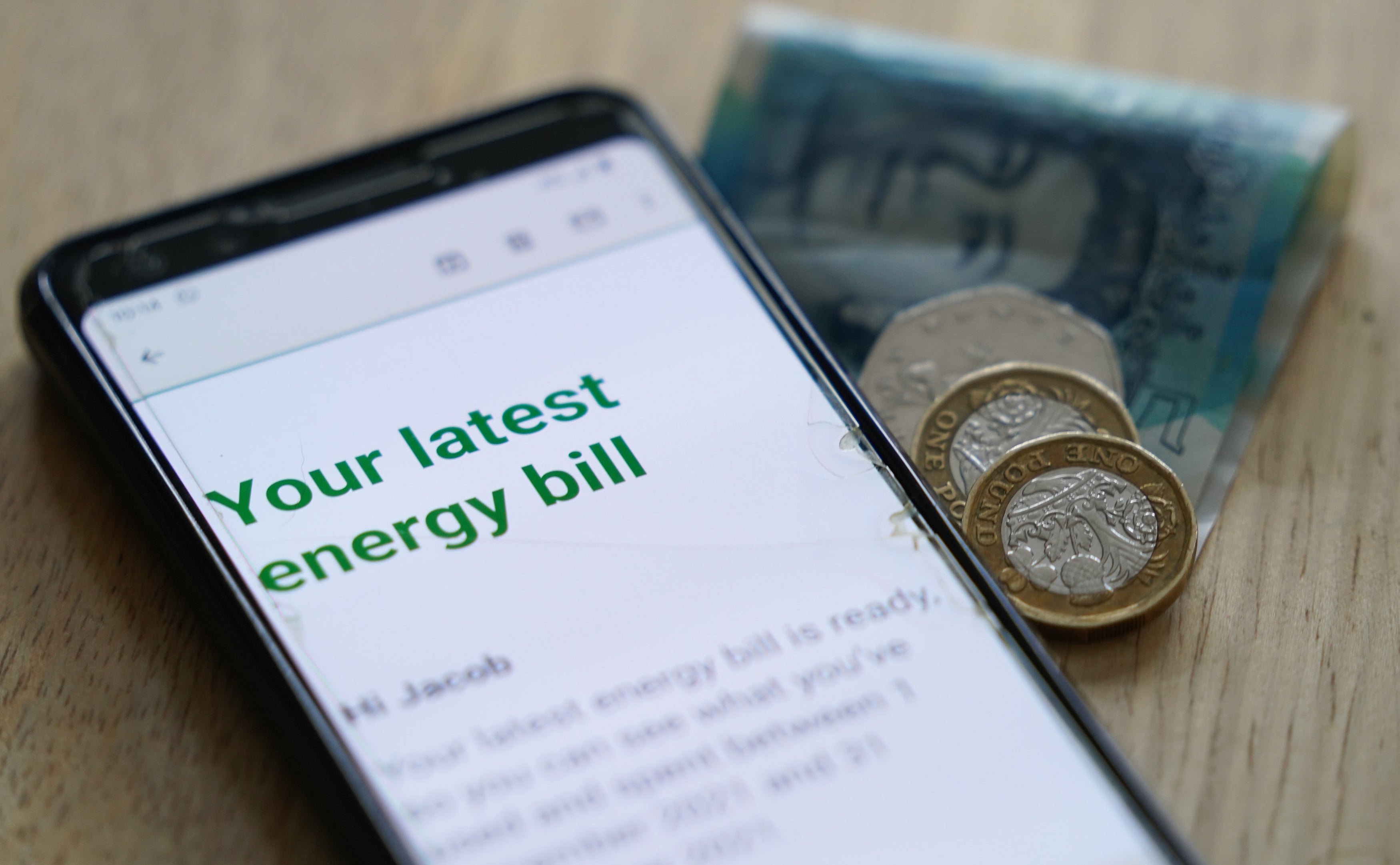
Some energy suppliers offer assistance to those who aren’t able to afford their bills, including Octopus and British Gas (PA)
Energy provider help
A number of energy suppliers offer help for those struggling with their energy bills. These include British Gas, Scottish Power, EDF, E.ON, OVO and Octopus. It is worth contacting your energy provider to find out if you are eligible.
For those struggling with household costs, social tariffs are available for both broadband and water bills. This will mean a reduced rate for certain eligible households.
Advertisement
For water, every company operating in the UK has a social tariff by law. However, the amount on offer can vary between regions and, because water providers can’t be chosen like energy providers, the support has been criticised as a “postcode lottery”.
For instance, some offer as much as 90 per cent off bills, while others cap support at a 20 per cent reduction.
To find out what support your water company offers, it is worth checking on its website or contacting the helpline. In all cases, households will need to be deemed to be on a low income and/or in receipt of certain benefits.
Similarly, many broadband providers offer social tariffs to those on certain benefits like universal credit or pension credit.
Advertisement
Council tax reduction
If you meet certain criteria or are on certain benefits, you may be able to apply for a discount on your council tax of up to 100 per cent (this is sometimes called council tax support).
Your local council may still be able to offer you a discretionary reduction if you can demonstrate you are facing severe hardship and can’t afford to pay your council tax.
To apply for a council tax reduction, contact your local council via the government’s website.
Advertisement
Up to 30 hours of free childcare
From 1 September 2025, all working parents in the UK became entitled to 30 hours of free childcare for children up to the age of four. This concluded a gradual set of expansions that began in April 2024.
Parents must apply online and reconfirm their eligibility every three months, in time for each school term. Working parents can also apply for tax-free childcare, giving back 20p for every 80p you put towards childcare, up to a maximum of £500 a year.
Energy price cap: Is it going up?
Advertisement
Ofgem’s energy price cap will drop to £1,641 for 1 April to 31 June 2026 – decreasing by around seven per cent, or £117. It will remain at £1,758 until 31 March.
The energy price cap is the maximum amount energy suppliers can charge you for each unit of energy if you’re on a standard variable tariff. That includes most households. It is expressed as an annual bill for an average home.
Many experts – including Ofgem itself – are recommending households consider a fixed tariff energy deal, with many on the market offering lower than the price cap rate.
Ofgem will announce its cap for July to September by 27 May. This could be a steep increase of as much as 10 per cent, or £160, increase due to the situation in the Middle East, energy consultancy Cornwall Insight has warned.
Advertisement
Will there be another cost of living payment in 2026?
The DWP has not announced any continuation of the cost of living payment scheme that ran between 2022 and 2024. The final payment should have been made to eligible households between 6 February and 22 February 2024.
Mental health support
In the UK and Ireland, Samaritans can be contacted 24 hours a day, 365 days a year. You can call them for free on 116 123, email them at jo@samaritans.org, or visit samaritans.org to find your nearest branch
Mind runs a support line on 0300 102 1234 which provides a safe and confidential place to talk about how you’re feeling. There is also an information line on 0300 123 3393 for nearby support, and a welfare benefits line on 0300 222 5782 to support the mental health of those navigating the benefits system
Disability charity Scope has a forum where people can have supportive chats with others going through the same experiences
The NHS offers an online mental health triage service
Senators are expected to vote Thursday on a Republican proposal that would fund the Transportation Security Administration and much of the Department of Homeland Security, except the enforcement and removal operations conducted by Immigration and Customs Enforcement. But it’s expected to fail.
Democrats argue the GOP plan does not go far enough at putting guardrails on ICE, Customs and Border Protection and other federal officers who are engaged in the Trump administration’s immigration sweeps, particularly after the deaths of two Americans protesting the actions in Minneapolis.
With Congress set to leave town by week’s end for its own spring break recess, calls are intensifying for an end to the 41-day stalemate that’s put the livelihoods of TSA officers at risk as they provide airport security without pay.
Advertisement
“This is a dire situation,” the acting TSA administrator Ha Nguyen McNeill testified at a House hearing Wednesday.
She described the multiple hardships facing unpaid TSA workers — piling up bills and eviction notices, even plasma donations to make ends meet — and warned of potential airport closures if more employees refuse to come to work. Daily callout rates have increased to 11% nationwide.
“At this point, we have to look at all options on the table,” she said. “And that does require us to, at some point, make very difficult choices as to which airports we might try to keep open and which ones we might have to shut down as our callout rates increase.”
Trump stays out of the fray
The Republican president has largely stayed out of the public debate over the path his party should take to end the standoff. Trump initially signed off on the plan the GOP senators brought to him late Monday, but on Tuesday he said he wouldn’t be happy with any deal.
Advertisement
Trump didn’t directly address the status of negotiations late Wednesday evening during an annual fundraising dinner for the House Republicans’ campaign committee as Speaker Mike Johnson, R-La., works to keep majority control of the chamber in the November midterm elections.
But Trump criticized Democrats for refusing to settle their demands on immigration changes.
The GOP’s big tax cuts bill that Trump signed into law last year funneled billions to the Department of Homeland Security, including $75 billion for ICE operations, ensuring the money is flowing for his immigration and deportation agenda even with the routine department funding shutdown. ICE and other immigration officers are still being paid.
The situation is partly of Trump’s making, a strategy the president put in place last fall, when he cut a deal with Democrats to end a previous federal shutdown. At that time, Trump agreed to fund the federal government, except for Homeland Security, which was then put on temporary funding that has expired.
Advertisement
A stopgap measure
While the Republican offer added one new restraint on immigration officers, funding the use of body cameras that had previously been agreed to, it excluded other policies that Democrats have demanded — such as that federal agents wear identification, remove their face masks and refrain from conducting raids around schools, churches or other sensitive places.
Senate Democratic leader Chuck Schumer of New York said they needed to see real changes. “We’ve been talking about ICE reforms from day one,” he said.
Democrats had been in several days of talks with the White House, including with border czar Tom Homan, that appeared to be making progress toward a deal. The White House presented its own offer with several items Democrats had been demanding, including officer IDs and training.
But those negotiations broke down over the weekend.
Advertisement
Republicans say Democrats are putting the country at risk. They say the Trump administration has already made strides to meet Democrats’ demands and has shown a new approach to its immigration operations, swearing in Markwayne Mullin as the new Homeland Security secretary to replace Kristi Noem.
“They know this is crazy,” Johnson said.
But conservative Republicans also panned the proposal, demanding full funding for immigration operations and skeptical of the promise from GOP leaders that they would address Trump’s proof-of-citizenship voting bill in a subsequent legislative package.
Senate Majority Leader John Thune said late Wednesday that if Democrats put a “more realistic offer on the table, we’ll be back in business.”
Advertisement
Asked if Congress would consider a stopgap measure to temporarily fund the department, Thune said: “We’ll see.”
Airport lines grow
as TSA workers endure hardships
McNeill, the acting TSA administrator, told lawmakers that multiple airports are experiencing greater than 40% callout rates and more than 480 transportation security officers have now quit during the shutdown.
She cited the growing financial strain on the TSA workforce.
“Some are sleeping in their cars, selling their blood and plasma, and taking on second jobs to make ends meet, all while being expected to perform at the highest level when in uniform to protect the traveling public,” she said.
Advertisement
McNeil also said TSA officers working at the nation’s airports have experienced a more than 500% increase in the frequency of assaults since the shutdown began.
“This is unacceptable, and it will not be tolerated,” McNeill said.
___
Associated Press writers Wyatte Grantham-Philips in New York, Rio Yamat in Las Vegas, Russ Bynum in Houston and Gabriela Aoun Angueira in San Diego contributed to this report.





















































You must be logged in to post a comment Login