


They have devoted over 50 years to a sport that this week has been banned
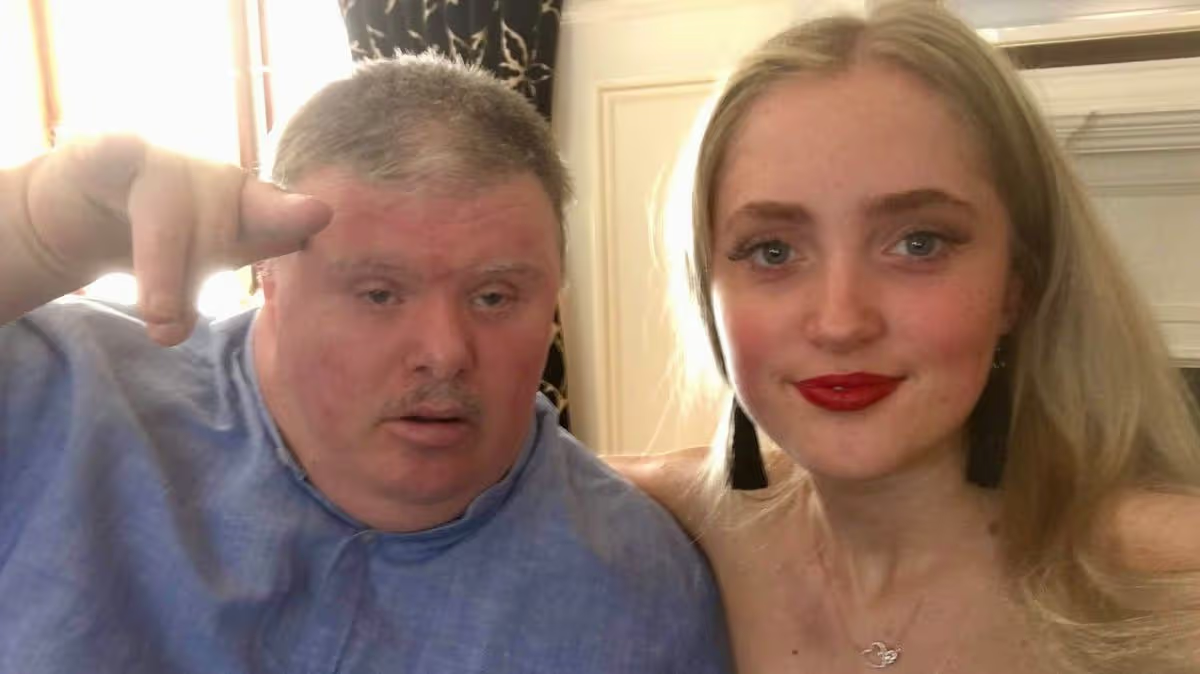
Before he died in December last year, Malcolm Tams dedicated more than 50 years of his life to greyhound racing. The 70-year-old from Blackwood was introduced to the sport at the age of 18 by his uncle, who always kept racing dogs when Malcolm was growing up.
From the very first moments, Malcolm was hooked, and his love for these animals compelled him to make a career in the racing industry. His grandson Joe said he devoted his every waking moment to the sport until the day he took his last breath.
Valleys Greyhounds, in Hengoed, is the last greyhound racing track in Wales. Malcom took over the track in 2008.
Malcolm sold the track in 2021 to Dave Barclay, but continued to manage the track like it was his own until his death. His family hoped to carry on his legacy and to honour Malcom’s love for the sport.
This will no longer be possible. On March 17, the Senedd voted in favour of a ban on the sport. The ban was agreed as part of a deal with sole Liberal Democrat Senedd member Jane Dodds so the Labour government could pass its budget for 2025-26. Ms Dodds, a greyhound owner, has been a vocal advocate of a ban.
Malcom’s grandson Joe Tams, 21, has described this decision as “devastating” for his family and their community, and questioned whether the incentives behind the decision were for the good of Welsh communities and Welsh people, or instead for politicians personal agendas’. Stay in the know by making sure you’re receiving our daily newsletter
Joe said: “The majority of the ministers that voted for the ban, have never even been to the track. They have probably never interacted with a greyhound, to be honest. For me, the ban had already been decided as soon as a proposal was announced, serving Jane Dodd’s personal agenda as opposed to the actual views of Welsh communities.
“We are the only Greyhound racing group in the country yet to this day we still have never been contacted by the Welsh government at any point in their process.
“A lot of the facts they have stated as part of their research behind this decision are questionable, such as the petition from Hope Rescue, where half of the signatures came from outside of the UK, and from other charities that have inflated figures without being challenged.
“I can’t understand how you could ban something without engaging with the very thing you are banning. You should not be able to vote to ban something you do not understand.
“For our family, it is devastating really. Obviously this has been my grandfather’s track for 20 odd years. He brought me up here and everyone at the track helped to bring me up. He spent pretty much every waking moment here until he fell ill at the track.
“We assumed that the Welsh government would contact us to speak to our trainers, and see what exactly they do, and how well our dogs are looked after. My advice for them would be to actually interact with the communities that they’ve targeted.
“As things stand, all of our trainers could be out of a job within a year. We still have absolutely no idea what that means, how that’ll be funded, and how all the racing hounds will be rehomed, as looking after them is a full time job that needs to be paid for. They need to be fed, warm, looked after.
“This will affect 100s of people just in Wales. For our track, we have 10 to 15 staff at the track, 10 trainers, all who will have a couple of staff themselves, and then you’ve got, obviously, the punters and the regulars who’ve been coming to the track their whole lives.”
WalesOnline visited the track previously in March 2025, almost exactly a year ago. While there we spoke to Malcolm Tams before his death.
Malcolm said the Valley, which has been in Ystrad Mynach since 1975, should be compensated sufficiently before anyone walks away. “I sold this for a million in 2022 but I’m still here everyday making sure everything is perfect and making sure future development is going on here.
“We had planning permission to build a community hub here for people to come and have a cup of tea and coffee. But we’ve not been able to build that because of all this hanging over us in terms of the future of the sport.
“In 2010 I went down to the Senedd and had meetings with them and we came out with a paper called The Better Bet for Greyhounds. We all signed it and 100% of what was in that paper has been carried out.”
He said a ban won’t stop greyhound racing in Wales. “It’ll go back to what they used to call flip meetings and they’ll be racing in farmers’ fields. It’d go underground.”
We also spoke to others like Mark Gibson, who has been coming here for 40 years.
“It’s a release,” he says. “To get away from your mundane life. The adrenaline you get from watching the dogs is second to none.
“Once you get into it I suppose it is, to use an old cliche, a bit of a drug. It’s the thrill of the chase isn’t it? I got out of the game for a bit but this track opened on my doorstep and I was hooked again. Now I’ve got three greyhounds. My grandchildren love it too. They’ll tell you everything about the dogs and their form. It’s good for their maths.”
Vet Simon was checking over a young bitch named How’s My Ria who has a problem with her toe when we he told us what he thought.
“I’m not against greyhound racing at all,” he says. “You’ve got an athlete there and it’s what they’re bred to do. They are absolutely fine-tuned to do it.
“Everything about a greyhound is about speed. You’ve got a nice deep chest with big lungs and a big heart. You’ve got a slim-lined body even to the point their ears are folded back against their head. They’re really impressive animals. Without a doubt most of them enjoy it. Those that don’t enjoy it don’t tend to stay racing.
“I think the ban is rather inappropriate. It’s clearly political. I’m not sure it’s actually that much of a contentious or divisive issue in Wales. I don’t see exactly why they want to ban it because I don’t see lots of people rushing to the Senedd calling for this. It’s the sort of thing that weeks later people will have forgotten about so to me it’s an odd one.
“It is difficult to eliminate all injuries but they do get them and there are occasionally freak incidents like if two dogs collide. But the things we can do, like making sure they’re fully fit prior to racing and making sure the track is in perfect condition, are all covered.”
Plumber Marcus May, who is a trainer and has three of his five dogs racing, has been travelling from Neath to Ystrad Mynach to race his dogs since the Swansea track closed in 2009. Prior to that he raced his dogs at Skewen which closed in 1993.
“It’s been in my life since I was six,” he says. “It’s been my family’s life. I don’t know what I’d do without it to be honest. My father who got me into greyhounds died when I was 21 and then my brother died in 2016. After that I’ve suffered from depression and training the dogs has helped me through it massively. Without this I do worry how I’d be.
“The problem is we’ve all been tarred with the same brush. I’ve always looked after my animals – they mean everything to me and they’re part of the family. They’re not just machines. I’ve got a dog who has hurt his wrist – he’s not broken his wrist but he’s been off since September. It’s not about money. I earn enough plumbing. It’s the love of the dogs and a love of the sport.”
Back to the here and now Joe Tams says he wished people could “come and see what we actually do.”
“On a race day, every dog is checked over by a vet before it races. Every dog is weighed, to make sure it’s healthy. Beforehand, they are kept in air conditioned kennels, then they race for maximum of 30 seconds.
“Back off the track, they get washed down by their owners or trainers, checked by the vet again, and then put back into the kennels for a minimum of 15 more minutes to make sure they are all good to go – and they’re always completely healthy after racing.
“There’s no way to force a greyhound to run. You put them in the traps, the traps open, they run. It is completely unlike horse racing, where you’ve got a jockey sat on a horse, whipping it. The dogs are doing it off their own back.
“They’re told to go, but they don’t have to go, obviously. We often have dogs who decide on the day they don’t fancy it. We also have retired racing dogs that return to the track for open days and things with their families that hear the starter and want nothing more than to go onto the track to chase it.
Joe explained that when the dogs are not racing, they are usually with their trainers or families walking and keeping fit.
Joe said that all ministers who had visited the track for themselves before the final phases of the banning process voted against the ban, apart from Lindsay Whittle.
“He reassured us that he found no issues, and reassured the trainers that there was nothing wrong with racing, and then voted for the ban. Which was very disappointing. Just before the Caerphilly by-election.
“He reassured everybody on this side, and then once he won the by election, just stabbed us in the back.”
In a statement, the Welsh Government said: “A transition period to allow the industry to wind down responsibly, strengthen rehoming arrangements for retired greyhounds, and prepare enforcement bodies and local authorities for the change which will see the prohibition brought into effect between 1 April 2027 and 1 April 2030.
“The Bill reflects a clear policy choice: that the injuries, fatalities, and poor post-racing outcomes associated with greyhound racing can no longer be justified. Despite efforts within the industry, harm to greyhounds has remained a consistent reality.”
Opponents of the law pursued a judicial review of it. The Greyhound Board of Great Britain’s (GBGB) case was that appropriate consultation was not undertaken prior to the decision to ban, and that the decision and introduction of the bill was therefore unlawful.
Though on March 20, the High Court dismissed the GBGB’s judicial review challenging the Welsh government’s plan to ban greyhound racing, confirming that the legislative process, passed in the Senedd on March 17, 2026, was lawful. This decision solidifies the upcoming ban, which will gradually wind down the sport by 2030.
The latest available statistics for Greyhound racing in the UK are from 2024. They show that the total greyhound runs amounted to 355,682 and the total deaths following these races were 123, equating to 0.03%.
Joe Tams hopes that further research into the sport will be conducted, and the decision be overturned for the sake of his family, friends and fellow staff.












































You must be logged in to post a comment Login