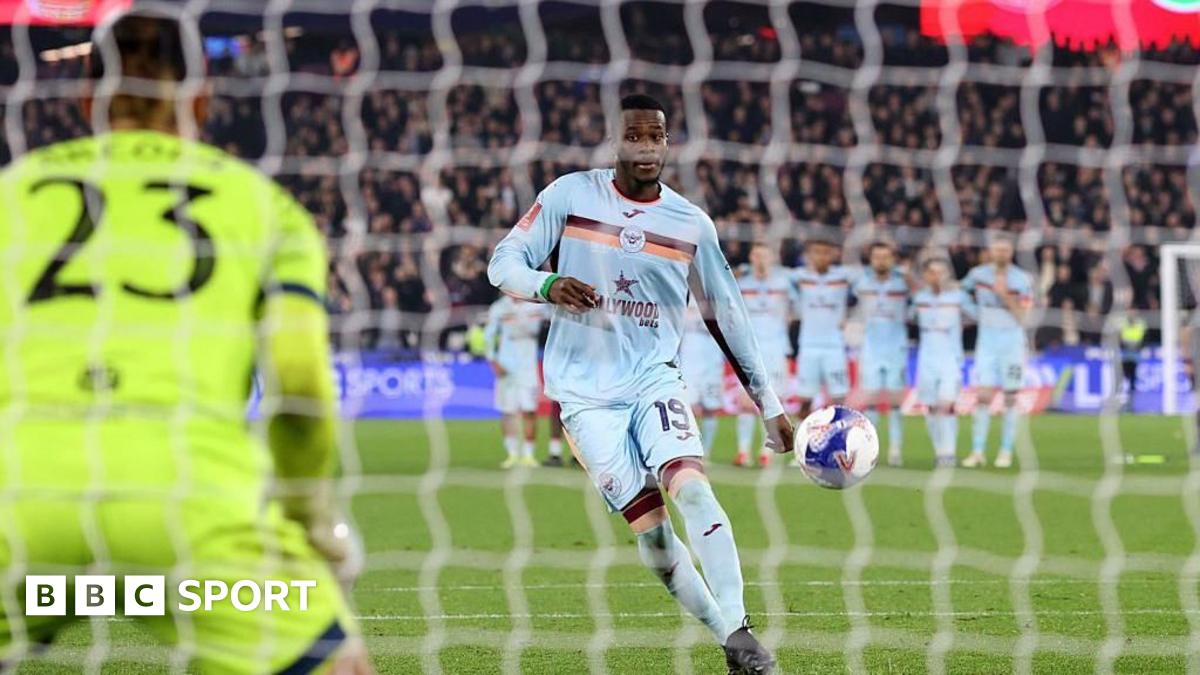


In the 50 years since Panenka brought the dinked penalty to prominence, it has gradually become more common.
A number of top players, including Lionel Messi, Thierry Henry and Francesco Totti, have successfully used the technique from the spot.
France legend Zinedine Zidane has a claim for taking the most high-pressure Panenka, in the 2006 World Cup final with his penalty hitting the underside of the crossbar and just crossing the line.
England have suffered at the hands of the Panenka a couple of times in shootouts, most famously when Italy midfielder Andrea Pirlo nonchalantly beat Joe Hart to change the momentum of the shootout in the Euro 2012 quarter-final.
“For me, Hart seemed to be very confident in himself,” Pirlo said. “I needed to do something to beat him.
“Penalties are a very personal thing but, when I saw him move, I decided to do that. It seemed to be a psychological blow for us.”
Similarly in the 2022 EFL Cup final, with Chelsea keeper Kepa Arrizabalaga making a show of trying to distract the Liverpool players, Fabinho responded by calmly dinking his kick down the middle, much to the delight of the Reds fans behind the goal.
Advertisement
A psychological blow? Well, every Liverpool player proceeded to score as they won 11-10 on penalties.
But for all the notable successes, Ouattara is not the first high-profile miss.
In 1992, Gary Lineker had the chance to match Sir Bobby Charlton’s 49 goals for England in a friendly against Brazil but fluffed his attempted Panenka and ended up one shy of the then-record.
Manchester City striker Sergio Aguero was usually pretty reliable from the spot but was made to look foolish when he attempted a Panenka in May 2021 as Chelsea went on to win 2-1 after the penalty save from Edouard Mendy.
Advertisement
In January, Brahim Diaz attempted a Panenka to win the Africa Cup of Nations in stoppage time for Morocco. His effort was saved and Senegal emerged champions.
The ‘GC’ is back for the show’s spin-off after she quit I’m A Celebrity after 72 hours in 2014
Gemma Collins has already defended herself for crying ‘I’m A Celebrity… Get Me Out of Here‘ as she claimed a ‘dirty prank’ by one of her co-stars forced her into it as she returned to the hit show.
Advertisement
The reality star, who shot to fame on The Only Way is Essex, is among the former campmates who will all return to the jungle for the new series of spin-off, I’m A Celebrity…South Africa.
The ITV programme, which is returning for a second run and will be fronted by Ant McPartlin and Dec Donnelly, sees former jungle stars from the Australian version of the show take on even more challenges in another country and while they have all already proved they can survive the gruelling bushtucker trials of the jungle, in South Africa, the trials are even tougher.
Get MEN Premium now for just £1 HERE – or get involved in our WhatsApp group by clicking HERE. And don’t miss out on our brilliant selection of newsletters HERE.
Gemma, who quit I’m A Celebrity after 72 hours in 2014, will be giving the challenge show, which has been pre-recorded, another go, will be joined by Olympian Sir Mo Farah, former Gogglebox star Scarlett Moffatt, champion boxer David Haye and actor Adam Thomas.
Advertisement
They’ve also recorded the show alongside football manager Harry Redknapp and soap actress Beverley Callard well as former Pussycat Doll Ashley Roberts, comedian Seann Walsh, pop star Sinitta, Red Dwarf star Craig Charles and ex-footballer Jimmy Bullard.
And following her short-lived stint in the Australian jungle, Gemma has already defended herself for shouting the show’s famous title as she almost quit again. “Harry played a dirty prank on me and I actually fell for it,” Gemma said at the show’s launch.
“He’s a fraudster, he’s so funny. I’m not going to say exactly what happened but I did get him back!” Sitting next to him at the event, she added: “This guy deserves an Oscar because I fully believed him… It led me to say, ‘I’m a Celebrity… Get Me Out of Here!’ He scared me so much, I was like, ‘Nah, I’m outta here! I’m out, that’s it!’”
Advertisement
The 45-year-old also revealed that after the show was announced by ITV today, she nearly pulled out of it but was put in her place by her make-up artist. “It didn’t work out for me the first time around in there and ever since it’s been like this black cloud hanging over my head,” she told The Sun.
“Obviously I’m older now and I just thought, I have to do this. It was one regret that I had that I left. I was absolutely bricking it. I was petrified. My makeup artist slapped me at Heathrow Airport because I actually said I don’t think I can actually go through with this.
“But do you know what? I took a deep breath. I went in strong. And to be honest, I think I shut it down. It’s not the GC in there. It’s Gemma Collins as you’ve never seen her before. You’ll see me vulnerable in there. I was so stripped bare going in there. And because I knew it was so disastrous the time before, I had no chance to back out of any of it.”
COVID vaccines saved millions of lives, but months into the rollout, a small number of people began developing dangerous blood clots in unusual parts of the body. These only happened after vaccines that used a modified adenovirus to deliver its payload – such as the AstraZeneca vaccine. Why these blood clots formed was a mystery – until now.
The condition was named vaccine-induced immune thrombocytopenia and thrombosis, or VITT. It happens when the immune system mistakenly attacks one of the body’s own proteins, called platelet factor 4.
Antibodies that recognise platelet factor 4 are actually part of normal immune responses, but in VITT the antibodies that develop are unusually sticky. They cling on to platelet factor 4, pulling together many molecules and forming large clusters of proteins called “immune complexes”, leading to dangerous blood clots.
Over the last few years, we have been working on the biology of VITT, primarily focusing on how these antibodies activate platelets. However, the way that vaccination triggers these antibodies to form was one of the main mysteries in this disease.
Advertisement
Now an international team of scientists in Australia, Canada and Germany has provided an answer. In an elegant set of experiments, they showed that virtually all patients with VITT share a distinctive pattern in their antibodies.
They studied 100 patients with VITT from around the world. By chance, two of these patients had donated blood in the past, meaning samples were taken before vaccination and stored in German blood service freezers. These samples turned out to be the key that unlocked the mystery.
The team were able to show that the antibodies involved in VITT begin as antibodies that recognise an adenoviral protein called protein VII. These antibodies probably came from the immune system’s memory of earlier adenovirus infections – which are common in childhood and cause mild cold-like symptoms.
During normal immune responses to infection and vaccination, tiny random genetic changes occur in cells that produce antibodies. This is normal and these changes help the immune system refine antibodies so they fight infections more effectively.
Advertisement
In all the patients with VITT, the researchers found the same change. By changing just one small part of the antibody, it suddenly gained the ability to bind platelet factor 4 very strongly.
The vaccine saved millions of lives. Giovanni Cancemi/Shutterstock.com
Previous research by the same team had already shown that most patients with VITT carry a particular immune gene variant that shapes the structure of the antibodies they produce.
The new study helps explain why this matters. The mutation identified by the researchers only occurs in antibodies built on this genetic background, allowing them to grab onto platelet factor 4 extremely tightly.
This discovery helps explain why VITT is so rare. Two unlikely events must occur at the same time. First, a person must inherit the particular immune gene variant. Second, a rare mutation must occur in one of the antibody-producing cells responding to the adenovirus. Only when both events happen together does the immune system begin targeting platelet factor 4.
Advertisement
Why do we need to understand VITT?
You might wonder why this is still important. The pandemic is over and surely VITT is no longer seen?
But adenovirus-based vaccines remain an important tool. They are versatile, inexpensive and easy to deploy worldwide. When the next pandemic arrives, vaccines made using this approach could once again save millions of lives.
We also occasionally see patients with syndromes that look exactly like VITT but without any link to vaccination. These cases can sometimes be triggered by viral infections, including adenovirus and cytomegalovirus.
Further major pros are at risk of being dropped from Strictly Come Dancing (Picture: Anthony Devlin/Hogan Media/Shutterstock)
The Strictly Come Dancing bloodbath appears to continue with reports that two more long-standing professional dancers’ futures are in question.

It’s now being claimed that both Katya Jones and Karen Hauer are at risk of being dropped from the show’s line-up ahead of its return in the autumn.
Despite both being long-standing stars of the shows, and a former two-time winner and two-time finalist respectively, it’s being suggested that no-one is safe from murder on the dancefloor.

Karen Hauer, the longest serving female pro, faces an anxious wait to learn her fate (Picture: Ray Burmiston/PA Wire)
Katya Jones is also at risk of being let go (Picture: BBC/Ray Burmiston)
The Sun has suggested that a full list of ‘who’s in and who’s out’ won’t be published until next month but that ‘difficult conversations’ are already happening with pros.
And now Karen, 43, and Katya, 36, are also waiting in anxious limbo to learn their fates.
A show insider told the outlet that while it had been ‘some time’ since there was a ‘churn’ in the pro line-up ‘they do happen every few years and there hasn’t been a big one in some time’.
Advertisement
They added: ‘The way producers look at it is a little like running a football team: even after Man City win the league they still change their team around and bring in fresh blood constantly, to stay at the top of their game.’
(Picture: Alan Chapman/Dave Benett/Getty)
(Picture: BBC)
‘A lot of the people going are now established names and stars in their own right but you have to remember that to be on the show, they also had to replace someone else at one point.’
Metro has contacted the BBC and reps for Karen Hauer and Katya Jones for comment.
More to follow.
Got a story?
Advertisement
If you’ve got a celebrity story, video or pictures get in touch with the Metro.co.uk entertainment team by emailing us celebtips@metro.co.uk, calling 020 3615 2145 or by visiting our Submit Stuff page – we’d love to hear from you.
Kirstin Baker, chairwoman of the independent group appointed by the CMA, said: “We’ve rejected most of the bill increases water companies asked for but allowed limited extra funding where that’s genuinely needed, balancing concerns about affordability with the need to secure our water supplies and cut pollution.
Eberechi Eze was Arsenal’s matchwinner in their FA Cup tie against Mansfield (Picture: Getty)
Eberechi Eze is confident Arsenal have unearthed a ‘special’ talent in Max Dowman and has backed the teenager to thrive in the Gunners’ first team.
The Hale End Academy graduate became the youngest player in Arsenal’s history back in August when he made his Premier League debut against Leeds United when he was still just 15 years old.
An ankle injury had curtailed his progress, but Dowman was promoted to the starting XI on Saturday as Mikel Arteta’s side progressed to the quarter finals of the FA Cup.
While the majority of his senior teammates struggled to cope with the treacherous conditions, Dowman displayed a maturity beyond his tender years and produced a stunning man of the match display.
Advertisement
‘Max Dowman is very different to a lot of players, but he is someone that is confident.
‘He believes in his ability a lot. He is a special player, but also a special person. You can see that he is maturing well and he’s a good guy. It’s fun to be around.
‘To be fair, that is the same with a lot of the players coming through the academy these days.
Your football fix
Metro‘s Head of Sport James Goldman delivers punchy analysis, transfer talk and his take on the week’s biggest stories direct to your inbox every week.
Max Dowman shone in Arsenal’s 2-1 win over Mansfield (Picture: Getty)
‘Once they come to train with the first-team, they believe in themselves. It is a positive energy to be around.’
While it was Dowman who attracted most of the post game plaudits, it was Eze who turned out to be the matchwinner.
Advertisement
With the League One side pressing for an unlikely winner, Arteta summoned the England international from the bench and it didn’t take Eze long to produce the moment of magic that ultimately separated the two sides.
The former Crystal Palace star has a habit of coming alive at the business end of the season and the 27-year-old hopes it is a case of history repeating itself after Eze inspired the Eagles to an unlikely FA Cup triumph last season.
Advertisement
FA Cup Quarter-Final Draw
Southampton vs Arsenal
Chelsea vs Port Vale
Manchester City vs Liverpool
Advertisement
West Ham United vs Leeds United
The ties will be played across the weekend of 4-5 April.
Eze said: ‘I am trying every single game to perform, to score goals and to win.
Advertisement
‘It just seems to fall more so at this time of the year. I hope it is the same this year.
‘This is where it matters. These are the end points that you want to arrive in.
‘For sure, I will be working as hard as I can – like the team – to push for it.
‘I just pray that we continue to build the team, to keep working and winning games.’
Some of the UK’s first homes to meet new energy efficiency standards are proving kinder to the electricity grid than expected. A real-world study of social housing in Birmingham, UK found that peak electricity demand from heat-pump-equipped homes was: “lower than we would expect,” said Dr Monica Mateo-Garcia, academic lead at Birmingham City University’s Centre for Future Homes. The analysis of carbon savings is still being finalised.
Researchers at Birmingham City University tracked seven all-electric homes over the course of a year. The results show that efficient design and smart energy use can avoid spikes in demand that strain infrastructure, easing concerns that widespread electric heating could overwhelm the network. The research compared electricity use across a year and found overall consumption far below typical UK homes.
“We currently seem to be overpredicting how much power we need in new-build housing,” said Professor Richard Fitton of the University of Salford, who was not involved in the study.
Advertisement
Each property was equipped with an air-source heat pump for heating and hot water, as well as high levels of insulation and solar panels. Critics of heat pumps have expressed concern that the extra load would burden the grid, but findings show that electrified homes used less energy at peak times, because peak usage timings varied between properties, and were spread across the homes, helping to reduce pressure on the grid.
In several cases, electricity used for heating and hot water was also lower than Energy Performance Certificate (EPC) estimates, reflecting well-documented concerns about the accuracy of EPC ratings. Total energy consumption over the year was between 40% and 67% lower than the UK average for each property creating “a huge saving over the typical household”.
“We’re finding that all those reasons not to go ahead with a heat pump are slowly but surely falling away,” said Professor Aaron Gillich of London South Bank University.
The results add weight to the upcoming Future Homes Standard, expected in 2027, which will require new properties to be built with heat pumps and solar panels.
Advertisement
Main image: Nancy Pauwels
Be part of the solution
At Positive News, we’re not chasing clicks or profits for media moguls – we’re here to serve you and have a positive social impact. We can’t do this unless enough people like you choose to support our journalism.
Give once from just £1, or join 1,800+ others who contribute an average of £3 or more per month. Together, we can build a healthier form of media – one that focuses on solutions, progress and possibilities, and empowers people to create positive change.
Analyst Cornwall Insight, the leading independent authority on household energy prices, currently predict that the cap will rise by about 10%, adding around £160 a year to typical household bills, bringing the annual total to around £1,801 per year for a dual fuel customer.
Kartal said she will prioritise recovery for her back before she meets Kazakhstan’s Elena Rybakina, the reigning Australian Open champion, in the last 16.
“It [the back] was a pretty big hindrance,” Kartal added.
“I didn’t really practise yesterday so I gave it as much recovery as I could, so I think now it’s about getting recovered and doing the same exact thing to get back on the court in the next couple of days.”
Kartal was not the only player to cause an upset on Monday with a comeback win.
Advertisement
Czech Katerina Siniakova, the world number 44, knocked out defending champion and Russian eighth seed Mirra Andreeva in a gruelling 4-6 7-6 (7-5) 6-3 win that lasted two hours and 48 minutes.
Meanwhile, third seed Rybakina claimed her fourth-round spot with a hard-fought 6-4 6-4 victory over Ukraine’s Marta Kostyuk.
World number two Iga Swiatek, the reigning Wimbledon champion, overcame Greece’s Maria Sakkari, while American fifth seed Jessica Pegula fought back from a set down against Jelena Ostapenko to reach the last 16.
Supporters of the Australian-style ban said parents are in ‘an impossible position’ over the online harms their children are being exposed to (Picture: Getty)
MPs have voted against a proposal to ban social media for under-16s.
The age limit, influenced by the Australian-style ban on sites like Tiktok, Instagram and Snapchat, was supported by people arguing that parents are in ‘an impossible position’ over the online harms their children are being exposed to.
Others, including the NSPCC, warned a prohibition could drive teenagers into unregulated corners of the internet.
MPs voted 307 to 173, majority 134, against the proposed change to the Children’s Wellbeing and Schools Bill, which was brought forward by Conservative former minister Lord Nash.
Advertisement
However, a ban could still come in future after the Commons supported a Government bid to give additional powers to the Secretary of State.
Sign up for all of the latest stories
Start your day informed with Metro’s News Updates newsletter or get Breaking Newsalerts the moment it happens.
Advertisement
Under the amendment in lieu, Science Secretary Liz Kendall could ‘restrict or ban children of certain ages from accessing social media services and chat bots’.
She could also limit children’s VPN use, restrict access to addictive features, and change the age of digital consent in the UK, education minister Olivia Bailey told MPs.
Lord Nash described the Commons’ vote as ‘deeply disappointing’ and pledged to do ‘all that we can’ to revive the amendment in the upper chamber.
MPs voted 307 to 173, majority 134, against the proposed change to the Children’s Wellbeing and Schools Bill (Picture: AFP via Getty)
As MPs considered the changes proposed by the upper chamber, Ms Bailey said: ‘Many parents and campaign groups have called for an outright ban on social media for under-16s.
‘Others, including children’s charities, have warned that a blanket ban could drive children towards less regulated corners of the internet or leave teenagers unprepared when they do come online.
Advertisement
‘That is why, last week, the Government launched a consultation to seek views to help shape our next steps and ensure children can grow up with a safer, healthier and more enriching relationship with the online world.’
The consultation will look at whether social media platforms should come with a minimum age requirement and whether platforms should switch off addictive features such as autoplay.
Education Committee chairwoman Helen Hayes said she supports ‘robust measures to protect children from social media harms, including raising the age of digital consent and a ban on some social media apps for under-16s and I support a statutory ban on schools’.
‘There are important differences of opinion between stakeholders on the best ways to regulate young people’s access to smartphones and social media. So I believe it is right for the Government to consult,’ the Labour MP for Dulwich and West Norwood added.
Advertisement
Labour MP for Hayes and Harlington John McDonnell rebelled against the Government on Monday, voting in favour of the Lords amendment.
Meanwhile, 107 Labour MPs abstained, including North Somerset’s Sadik Al-Hassan.
Mr Al-Hassan had earlier said: ‘Parents like me are locked in a daily battle that they simply cannot win alone, fighting platforms that have been specifically designed to keep children hooked.
‘As a pharmacist, I know if a drug were causing such measurable harm for 78%, it would be withdrawn, reformulated or placed behind a counter with strict controls on who could access it.
Advertisement
‘We would act, because that is what the evidence demanded. The same logic must apply here.
‘We have an identifiable source, we have overwhelming evidence of harm, and we have the power to act.’
Under the amendment in lieu, Science Secretary Liz Kendall could ‘restrict or ban children of certain ages from accessing social media services and chat bots’ (Picture: Parliament TV)
Lord Nash said: ‘It is deeply disappointing that the House of Commons has chosen to gamble on a process which may lead to half-measures – doing little to avert the damage of social media – with no fixed timeline and no opportunity for proper parliamentary scrutiny.
‘There is huge demand across the country to raise the age limit and protect children from the catastrophic harms of social media.
‘Our medical professionals, intelligence community, senior police officers, teachers and parents are all clear: we are not short of evidence, we are just short of action.
Advertisement
‘The Lords passed this amendment overwhelmingly once before.
‘It would raise the age limit for harmful social media within 12 months, written into law by the summer, and I will now work with colleagues across the House to do all that we can to pass it again.’
Liberal Democrat education, children and families spokesperson Munira Wilson said: ‘The Government’s failure to commit to a ban on harmful social media is simply not good enough – families need concrete assurances now.
‘We need the Government to confirm that their consultation will not result in yet more dither and delay.’
Advertisement
During the debate, shadow education secretary Laura Trott pressed the Government to introduce a ban on phones in schools, saying: ‘Polling out today shows 40% of children are shown explicit content during the school day.
‘That’s happening right now. This is an emergency. No more guidance, no more consultations. Legislate, do something about it.’
The Children’s Wellbeing and Schools Bill will now return to the House of Lords to be further considered by peers.
It will only become law if the final draft is agreed by both Houses.
Advertisement
If passed, the legislation will also require councils to ‘assess the child’s home environment within 15 days’ of them being listed on a register of children not in school.
This forms part of the Government’s response to the death of Sara Sharif, 10, who was murdered by her father Urfan Sharif and stepmother Beinash Batool in 2023.
Ms Bailey also confirmed that Benedict’s law, which aims to strengthen allergy safety guidance in schools, would be put on the statute book.
The price of Guinness is among a number of changes made for the 2026 Cheltenham Festival
The price of Guinness at the Cheltenham Festival has been slashed following an outcry from racegoers. A pint of the black stuff is the go-to tipple for many of the tens of thousands who descend on the Cotwolds for the four-day extravaganza, which straddles St Patrick’s Day.
Advertisement
Last year, however, the ‘cheers’ turned to jeers for many punters when they spotted how much a pint of the Irish stout would set them back – a whopping £7.80, while the alcohol-free version was just 40p less.
Lagers and ales were barely cheaper, with a ‘premium larger’ £7.40, with a Doom Bar the same as a regular Guinness. Refreshingly, bosses appear to have listened to the complaints, with the price of a regular Guinness dropping to a slightly more reasonable £7.50 for the 2026 Festival.
Meanwhile, a non-alcoholic Guinness will cost slightly less at £7.30. Premium lager and Doom Bar prices remain unchanged from 2025.
As an added bonus for Guinness drinkers, for the first time, punters will be allowed to consume alcohol in front of the grandstand along the rails, meaning spectators won’t need to gulp down their drinks before watching the action.
Guinness is one of a few things coming down in price at Cheltenham, although accommodation costs remain sky-high. An average five-night stay is now £3,772, according to Booking.com, while renting a three-bed townhouse near the course for the four days costs £8,812.
At the cheaper end of the spectrum, Airbnb prices ranged from a one-bedroom cottage nine miles from the course for £579 to a single-bedroom apartment less than two miles away for £2,500. The cheapest Booking.com option was a guest house four miles from the track for £1,033.
Advertisement
Organisers have introduced measures to make the Festival more fun and affordable to the average punter. Ladies Day is back after being shelved seven years ago.
Bosses expected the move to trigger an invasion of female fans with £10,000 in prizes on offer to the most stylish race-goer. Meanwhile, the daily capacity has also been cut by 2,500 to 66,000 to give the crowd a more comfortable experience, with less-packed stands and smaller queues for food and drink.
Multi-ticket offers were available to reduce the entrance price. The moves are the biggest revamps in Cheltenham’s 166-year history. Though the event may be cheaper to attend, the extra interest has driven up the cost of staying in the area, which is beyond the control of racing chiefs.
Advertisement
The changes have been given the thumbs up by legendary-jockey-turned pundit Ruby Walsh, who said: “I’m very impressed with the changes. I think less is always more, so bringing down the capacity to me is a no-brainer.
“There has to be a customer experience. People have to walk out thinking, ‘I want to go there again’. Ladies’ Day? I’m all in a dither. I have no idea what hat I’m going to wear! I am a man with a girl’s name so I’d better make an effort.”