Connect with us

NewsBeat

Is time a fundamental part of reality? A quiet revolution in physics suggests not

Published

on

Is time a fundamental part of reality? A quiet revolution in physics suggests not

Time feels like the most basic feature of reality. Seconds tick, days pass and everything from planetary motion to human memory seems to unfold along a single, irreversible direction. We are born and we die, in exactly that order. We plan our lives around time, measure it obsessively and experience it as an unbroken flow from past to future. It feels so obvious that time moves forward that questioning it can seem almost pointless.

And yet, for more than a century, physics has struggled to say what time actually is. This struggle is not philosophical nitpicking. It sits at the heart of some of the deepest problems in science.

Modern physics relies on different, but equally important, frameworks. One is Albert Einstein’s theory of general relativity, which describes the gravity and motion of large objects such as planets. Another is quantum mechanics, which rules the microcosmos of atoms and particles. And on an even larger scale, the standard model of cosmology describes the birth and evolution of the universe as a whole. All rely on time, yet they treat it in incompatible ways.

When physicists try to combine these theories into a single framework, time often behaves in unexpected and troubling ways. Sometimes it stretches. Sometimes it slows. Sometimes it disappears entirely.

Advertisement

The Insights section is committed to high-quality longform journalism. Our editors work with academics from many different backgrounds who are tackling a wide range of societal and scientific challenges.


Einstein’s theory of relativity was, in fact, the first major blow to our everyday intuition about time. Time, Einstein showed, is not universal. It runs at different speeds depending on gravity and motion. Two observers moving relative to one another will disagree about which events happened at the same time. Time became something elastic, woven together with space into a four-dimensional fabric called spacetime.

Quantum mechanics made things even stranger. In quantum theory, time is not something the theory explains. It is simply assumed. The equations of quantum mechanics describe how systems evolve with respect to time, but time itself remains an external parameter, a background clock that sits outside the theory.

Advertisement


À lire aussi :
Quantum mechanics: how the future might influence the past


This mismatch becomes acute when physicists try to describe gravity at the quantum level, which is crucial for developing the much coveted theory of everything – which links the main fundamental theories. But in many attempts to create such a theory, time vanishes as a parameter from the fundamental equations altogether. The universe appears frozen, described by equations that make no reference to change.

This puzzle is known as the problem of time, and it remains one of the most persistent obstacles to a unified theory of physics. Despite enormous progress in cosmology and particle physics, we still lack a clear explanation for why time flows at all.

Now a relatively new approach to physics, building on a mathematical framework called information theory, developed by Claude Shannon in the 1940s, has started coming up with surprising answers.

Advertisement

Entropy and the arrow of time

When physicists try to explain the direction of time, they often turn to a concept called entropy. The second law of thermodynamics states that disorder tends to increase. A glass can fall and shatter into a mess, but the shards never spontaneously leap back together. This asymmetry between past and future is often identified with the arrow of time.

This idea has been enormously influential. It explains why many processes are irreversible, including why we remember the past but not the future. If the universe started in a state of low entropy, and is getting messier as it evolves, that appears to explain why time moves forward. But entropy does not fully solve the problem of time.

Spools of coloured embroidery threads. Huge knot is haphazardly braided.

It is hard to undo a mess.
klevo/Shutterstock

For one thing, the fundamental quantum mechanical equations of physics do not distinguish between past and future. The arrow of time emerges only when we consider large numbers of particles and statistical behaviour. This also raises a deeper question: why did the universe start in such a low-entropy state to begin with? Statistically, there are more ways for a universe to have high entropy than low entropy, just as there are more ways for a room to be messy than tidy. So why would it start in a state that is so improbable?

The information revolution

Over the past few decades, a quiet but far-reaching revolution has taken place in physics. Information, once treated as an abstract bookkeeping tool used to track states or probabilities, has increasingly been recognised as a physical quantity in its own right, just like matter or radiation. While entropy measures how many microscopic states are possible, information measures how physical interactions limit and record those possibilities.

Advertisement

This shift did not happen overnight. It emerged gradually, driven by puzzles at the intersection of thermodynamics, quantum mechanics and gravity, where treating information as merely mathematical began to produce contradictions.

One of the earliest cracks appeared in black hole physics. When Stephen Hawking showed that black holes emit thermal radiation, it raised a disturbing possibility: information about whatever falls into a black hole might be permanently lost as heat. That conclusion conflicted with quantum mechanics, which demands that the entirety of information be preserved.

Resolving this tension forced physicists to confront a deeper truth. Information is not optional. If we want a full description of the universe that includes quantum mechanics, information cannot simply disappear without undermining the foundations of physics. This realisation had profound consequences. It became clear that information has thermodynamic cost, that erasing it dissipates energy, and that storing it requires physical resources.

In parallel, surprising connections emerged between gravity and thermodynamics. It was shown that Einstein’s equations can be derived from thermodynamic principles that link spacetime geometry directly to entropy and information. In this view, gravity doesn’t behave exactly like a fundamental force.

Advertisement

Instead, gravity appears to be what physicists call “emergent” – a phenomenon describing something that’s greater than the sum of its parts, arising from more fundamental constituents. Take temperature. We can all feel it, but on a fundamental level, a single particle can’t have temperature. It’s not a fundamental feature. Instead it only emerges as a result of many molecules moving collectively.

Similarly, gravity can be described as an emergent phenomenon, arising from statistical processes. Some physicists have even suggested that gravity itself may emerge from information, reflecting how information is distributed, encoded and processed.

These ideas invite a radical shift in perspective. Instead of treating spacetime as primary, and information as something that lives inside it, information may be the more fundamental ingredient from which spacetime itself emerges. Building on this research, my colleagues and I have explored a framework in which spacetime itself acts as a storage medium for information – and it has important consequences for how we view time.

In this approach, spacetime is not perfectly smooth, as relativity suggests, but composed of discrete elements, each with a finite capacity to record quantum information from passing particles and fields. These elements are not bits in the digital sense, but physical carriers of quantum information, capable of retaining memory of past interactions.

Advertisement

A useful way to picture them is to think of spacetime like a material made of tiny, memory-bearing cells. Just as a crystal lattice can store defects that appeared earlier in time, these microscopic spacetime elements can retain traces of the interactions that have passed through them. They are not particles in the usual sense described by the standard model of particle physics, but a more fundamental layer of physical structure that particle physics operates on rather than explains.

This has an important implication. If spacetime records information, then its present state reflects not only what exists now, but everything that has happened before. Regions that have experienced more interactions carry a different imprint of information than regions that have experienced fewer. The universe, in this view, does not merely evolve according to timeless laws applied to changing states. It remembers.

A recording cosmos

This memory is not metaphorical. Every physical interaction leaves an informational trace. Although the basic equations of quantum mechanics can be run forwards or backwards in time, real interactions never happen in isolation. They inevitably involve surroundings, leak information outward and leave lasting records of what has occurred. Once this information has spread into the wider environment, recovering it would require undoing not just a single event, but every physical change it caused along the way. In practice, that is impossible.

This is why information cannot be erased and broken cups do not reassemble. But the implication runs deeper. Each interaction writes something permanent into the structure of the universe, whether at the scale of atoms colliding or galaxies forming.

Advertisement

Geometry and information turn out to be deeply connected in this view. In our work, we have showed that how spacetime curves depends not only on mass and energy, as Einstein taught us, but also on how quantum information, particularly entanglement, is distributed. Entanglement is a quantum process that mysteriously links particles in distant regions of space – it enables them to share information despite the distance. And these informational links contribute to the effective geometry experienced by matter and radiation.

From this perspective, spacetime geometry is not just a response to what exists at a given moment, but to what has happened. Regions that have recorded many interactions tend, on average, to behave as if they curve more strongly, have stronger gravity, than regions that have recorded fewer.

This reframing subtly changes the role of spacetime. Instead of being a neutral arena in which events unfold, spacetime becomes an active participant. It stores information, constrains future dynamics and shapes how new interactions can occur. This naturally raises a deeper question. If spacetime records information, could time emerge from this recording process rather than being assumed from the start?

Time arising from information

Recently, we extended this informational perspective to time itself. Rather than treating time as a fundamental background parameter, we showed that temporal order emerges from irreversible information imprinting. In this view, time is not something added to physics by hand. It arises because information is written in physical processes and, under the known laws of thermodynamics and quantum physics, cannot be globally unwritten again. The idea is simple but far-reaching.

Advertisement

Every interaction, such as two particles crashing, writes information into the universe. These imprints accumulate. Because they cannot be erased, they define a natural ordering of events. Earlier states are those with fewer informational records. Later states are those with more.

Quantum equations do not prefer a direction of time, but the process of information spreading does. Once information has been spread out, there is no physical path back to a state in which it was localised. Temporal order is therefore anchored in this irreversibility, not in the equations themselves.

Time, in this view, is not something that exists independently of physical processes. It is the cumulative record of what has happened. Each interaction adds a new entry, and the arrow of time reflects the fact that this record only grows.

The future differs from the past because the universe contains more information about the past than it ever can about the future. This explains why time has a direction without relying on special, low-entropy initial conditions or purely statistical arguments. As long as interactions occur and information is irreversibly recorded, time advances.

Advertisement

Interestingly, this accumulated imprint of information may have observable consequences. At galactic scales, the residual information imprint behaves like an additional gravitational component, shaping how galaxies rotate without invoking new particles. Indeed, the unknown substance called dark matter was introduced to explain why galaxies and galaxy clusters rotate faster than their visible mass alone would allow.

In the informational picture, this extra gravitational pull does not come from invisible dark matter, but from the fact that spacetime itself has recorded a long history of interactions. Regions that have accumulated more informational imprints respond more strongly to motion and curvature, effectively boosting their gravity. Stars orbit faster not because more mass is present, but because the spacetime they move through carries a heavier informational memory of past interactions.

Image of the Andromeda Galaxy.

Galaxies rotate faster than they should.
Wirestock Creators/Shutterstock

From this viewpoint, dark matter, dark energy and the arrow of time may all arise from a single underlying process: the irreversible accumulation of information.

Testing time

But could we ever test this theory? Ideas about time are often accused of being philosophical rather than scientific. Because time is so deeply woven into how we describe change, it is easy to assume that any attempt to rethink it must remain abstract. An informational approach, however, makes concrete predictions and connects directly to systems we can observe, model and in some cases experimentally probe.

Advertisement

Black holes provide a natural testing ground, as they seems to suggest information is erased. In the informational framework, this conflict is resolved by recognising that information is not destroyed but imprinted into spacetime before crossing the horizon. The black hole records it.

This has an important implication for time. As matter falls toward a black hole, interactions intensify and information imprinting accelerates. Time continues to advance locally because information continues to be written, even as classical notions of space and time break down near the horizon and appear to slow or freeze for distant observers.

As the black hole evaporates through Hawking radiation, the accumulated informational record does not vanish. Instead, it affects how radiation is emitted. The radiation should carry subtle signs that reflect the black hole’s history. In other words, the outgoing radiation is not perfectly random. Its structure is shaped by the information previously recorded in spacetime. Detecting such signs remains beyond current technology, but they provide a clear target for future theoretical and observational work.

The same principles can be explored in much smaller, controlled systems. In laboratory experiments with quantum computers, qubits (the quantum computer equivalent of bits) can be treated as finite-capacity information cells, just like the spacetime ones. Researchers have shown that even when the underlying quantum equations are reversible, the way information is written, spread and retrieved can generate an effective arrow of time in the lab. These experiments allow physicists to test how information storage limits affect reversibility, without needing cosmological or astrophysical systems.

Advertisement

Extensions of the same framework suggest that informational imprinting is not limited to gravity. It may play a role across all fundamental forces of nature, including electromagnetism and the nuclear forces. If this is correct, then time’s arrow should ultimately be traceable to how all interactions record information, not just gravitational ones. Testing this would involve looking for limits on reversibility or information recovery across different physical processes.

Taken together, these examples show that informational time is not an abstract reinterpretation. It links black holes, quantum experiments and fundamental interactions through a shared physical mechanism, one that can be explored, constrained and potentially falsified as our experimental reach continues to grow.

What time really is

Ideas about information do not replace relativity or quantum mechanics. In everyday conditions, informational time closely tracks the time measured by clocks. For most practical purposes, the familiar picture of time works extremely well. The difference appears in regimes where conventional descriptions struggle.

Near black hole horizons or during the earliest moments of the universe, the usual notion of time as a smooth, external coordinate becomes ambiguous. Informational time, by contrast, remains well defined as long as interactions occur and information is irreversibly recorded.

Advertisement

All this may leave you wondering what time really is. This shift reframes the longstanding debate. The question is no longer whether time must be assumed as a fundamental ingredient of the universe, but whether it reflects a deeper underlying process.

In this view, the arrow of time can emerge naturally from physical interactions that record information and cannot be undone. Time, then, is not a mysterious background parameter standing apart from physics. It is something the universe generates internally through its own dynamics. It is not ultimately a fundamental part of reality, but emerges from more basic constituents such as information.

Whether this framework turns out to be a final answer or a stepping stone remains to be seen. Like many ideas in fundamental physics, it will stand or fall based on how well it connects theory to observation. But it already suggests a striking change in perspective.

The universe does not simply exist in time. Time is something the universe continuously writes into itself.

Advertisement

For you: more from our Insights series:

To hear about new Insights articles, join the hundreds of thousands of people who value The Conversation’s evidence-based news. Subscribe to our newsletter.


Source link

Advertisement
Continue Reading
Click to comment

Leave a Reply

Your email address will not be published. Required fields are marked *

NewsBeat

AFG Law: How families can resolve issues without litigation

Published

on

AFG Law: How families can resolve issues without litigation

While many people assume that disagreements must result in a case going to court, this is far from always the case.

In fact, non-court dispute resolution has become a central part of modern family law, offering separating couples and families more constructive ways to resolve issues.

AFG Law explains what out of court dispute resolution is, how it works, and why it is so often a preferred alternative to litigation.

Advertisement

What is non-court dispute resolution in family law?

Non-court dispute resolution refers to a range of processes that help people resolve family law disputes without asking a judge to impose a decision.

These methods fall under the wider umbrella of alternative dispute resolution (ADR) and are designed to encourage communication, cooperation, and problem-solving.

Rather than focusing on winning or losing, out-of-court approaches aim to help parties reach an agreement that works for their specific circumstances.

Advertisement

This can be particularly valuable in family law, where ongoing relationships, especially where children are involved, often continue long after legal issues are resolved.

Why consider resolving disputes outside court?

There are several reasons why non-court dispute resolution is encouraged in family law cases.

First, it is less adversarial than court proceedings.

Advertisement

This can reduce stress, protect children from conflict, and help preserve a more functional relationship between parties.

Secondly, non-court processes are often quicker and more cost-effective than litigation, allowing families to move forward sooner.

Courts themselves now expect parties to consider alternative dispute resolution before issuing proceedings in most family law matters.

Choosing not to explore these options without good reason can have cost and procedural consequences.

Advertisement

Common forms of alternative dispute resolution

There are several forms of alternative dispute resolution commonly used in family law.

The most appropriate option will depend on the issues involved, the level of communication between parties, and any safeguarding concerns.

Mediation

Advertisement

Family law mediation involves an independent, neutral mediator, who may be a specially trained solicitor, barrister or other family law professional.

The mediator helps parties discuss issues and explore possible solutions.

Mediation is voluntary and focuses on cooperation rather than blame. It can be used for financial matters, arrangements for children, or both.

Hybrid mediation can include the parties’ solicitors, accountants or independent financial advisers to help deal with specific issues.

Advertisement

Shuttle mediation is where the mediator spends time with each party on their own, providing the opportunity to explore issues and settlement proposals in greater detail.

Solicitor-led negotiation

In some cases, parties prefer their solicitors to negotiate on their behalf.

This can be done through correspondence or meetings and may be suitable where direct communication is difficult, but court proceedings are not yet necessary.

Advertisement

Collaborative law

Collaborative law involves both parties and their solicitors committing to resolving matters without going to court.

Meetings take place face to face, and everyone involved agrees to work towards settlement transparently and constructively.

Each of these options aims to avoid the need to take a case to court, while still providing structure and professional guidance.

Advertisement

Are agreements reached out of court legally binding?

A common concern is whether agreements reached outside court are enforceable. On their own, informal agreements are not automatically legally binding.

However, this does not mean they lack value.

In financial cases, an agreement reached through negotiation or mediation can usually be converted into a court-approved order, making it legally binding and enforceable.

Advertisement

In children matters, agreements can be reflected in formal arrangements or, where appropriate, approved by the court.

Taking legal advice before finalising any agreement is essential to ensure it accurately reflects what has been agreed and provides proper protection for the future.

When is non-court dispute resolution not appropriate?

Although non-court dispute resolution works well in most cases, it is not suitable for everyone. Situations involving domestic abuse, coercive control, or significant power imbalance may make negotiation unsafe or unfair.

Advertisement

Where there are safeguarding concerns, urgent issues, or a lack of willingness to engage constructively, court intervention may be necessary.

In such circumstances, taking a case to court may be the most appropriate and protective option.

Importantly, the suitability of alternative dispute resolution should always be assessed carefully, and no one should feel pressured to participate in a process that does not feel safe.

The role of legal advice in non-court resolution

Advertisement

Even when disputes are resolved without court proceedings, legal advice remains crucial. Solicitors can help you understand your rights, assess whether proposals are fair, and advise on likely court outcomes if agreement cannot be reached.

Having separate legal advice alongside negotiation or mediation can also make discussions more effective, as both parties are better informed and more confident in the process. This often increases the chances of reaching a sustainable agreement.

Does non-court dispute resolution really work?

For many families, non-court dispute resolution is highly effective. It allows parties to retain control over decisions, tailor outcomes to their needs, and avoid the uncertainty of a court-imposed order.

Advertisement

When both parties are willing to engage openly, non-court dispute resolution can help them reach an agreement that is practical, forward-looking, and less damaging emotionally and financially. While it is not the right solution in every case, it plays a vital role in modern family law.

How can AFG Law assist with out-of-court dispute resolution?

At AFG Law, we recognise that every family situation is different, and that resolving disputes outside court can often lead to better, more sustainable outcomes.

Our family law solicitors advise clients at every stage of the non-court dispute resolution process, helping them understand their options and choose the most appropriate approach for their circumstances.

Advertisement

We can support you by:

• Advising on whether alternative dispute resolution is suitable for your case
• Preparing you for negotiations or mediation
• Providing clear legal advice alongside out-of-court discussions
• Reviewing proposed agreements to ensure they are fair and workable
• Converting agreements into legally binding court orders where appropriate

Where non-court resolution is not suitable, such as in cases involving domestic abuse or urgent safeguarding concerns, we can advise you on taking a case to court.

Our focus is always on achieving practical, proportionate solutions that minimise conflict and help you move forward with confidence.

Advertisement

To speak to a solicitor for advice on out-of-court dispute resolution, contact us today via email at familysolicitor@afglaw.co.uk or call us on 01204 920105.

Source link

Advertisement
Continue Reading

NewsBeat

Funding boost for families in Almond Valley and across West Lothian

Published

on

Daily Record

West Lothian Council is one of 19 local authorities to receive support through the third round of the Child Poverty Practice Accelerator Fund.

Families in Almond Valley and across West Lothian are set to benefit from new Scottish Government funding aimed at tackling child poverty and helping households with the cost of living.

Advertisement

West Lothian Council is one of 19 local authorities to receive support through the third round of the Child Poverty Practice Accelerator Fund.

Almost £1.9 million will back 21 projects across Scotland between 2025 and 2028, helping councils and local partners strengthen community-based services and improve access to financial support.

The funding is designed to test new approaches, improve benefit take-up and boost household incomes, ensuring families can access the help they are entitled to.

READ MORE: West Lothian Council to impose Council Tax rise of 7.4 percent from April

Advertisement

Angela Constance, MSP for Almond Valley, welcomed the announcement.

She said: “Tackling child poverty and supporting families through the ongoing cost of living challenges remains a clear priority.

“I am pleased that Almond Valley will benefit from this investment, which will strengthen local services and help families across Almond Valley access the advice and financial support they need.

“Community-based projects make a real difference.

Advertisement

“They connect families to practical help, improve wellbeing and ensure support is available close to home.

READ MORE: Woman reunites long-lost West Lothian wedding video with owners 40 years later

“Alongside measures such as the Scottish Child Payment, free prescriptions and free bus travel for under-22s, this funding forms part of a wider package designed to put more money into people’s pockets and give every child the best possible start in life.”

The draft Scottish Budget 2026-27 sets out plans to invest £8 billion through the social justice portfolio to tackle the root causes of child poverty, support vulnerable people and ease cost of living pressures.

Advertisement

The Child Poverty Practice Accelerator Fund is now in its third year and continues to support local innovation and share learning on what works best to reduce poverty in communities across Scotland.

READ MORE: West Lothian shopkeeper attacked in violent robbery as police investigate

Don’t miss the latest news from the West Lothian Courier. Sign up to our free newsletter here.

Source link

Advertisement
Continue Reading

NewsBeat

Ukraine-Russia war latest: Europe says Moscow’s claim it is helping Kyiv build nuclear ‘dirty bomb’ is ‘absurd’

Published

on

Ukraine-Russia war latest: Europe says Moscow’s claim it is helping Kyiv build nuclear ‘dirty bomb’ is ‘absurd’
Trump says he is ‘working very hard to end the slaughter’ in Ukraine

The British government has rubbished Russia’s claim that Ukraine is trying to obtain a nuclear weapon with British and French help.

Russia‘s Foreign Intelligence Service (SVR), without providing evidence, claimed that Ukraine’s nuclear allies in Europe were preparing to provide Ukraine with nuclear parts and technology.

A British government spokesperson shot back on Tuesday, saying: “This is a clear attempt by Vladimir Putin to distract from his heinous actions in Ukraine. There is no truth to this.

“You’ll have seen the PM’s words this morning paying tribute to the incredible resilience of the Ukrainians … We will continue with our efforts to secure a just and lasting peace.”

Advertisement

Ukraine also dismissed Russian claims as “absurd”, as it marked four years since the full-scale Russian invasion.

“Russian officials, known for their impressive record of lies, are once again trying to fabricate the old ‘dirty bomb’ nonsense,” said Heorhii Tykhyi, spokesperson for the Ukrainian foreign ministry.

“For the record: Ukraine has already denied such absurd Russian claims many times before, and we officially deny them again now,” Tykhyi said. “We urge the international community to reject and condemn Russia’s dirty information bombs.”

Advertisement

Four killed in drone attack on Russia’s Smolensk region, says governor

Four people have been killed and 10 injured after a Ukrainian drone attack on a fertiliser factory on the Smolensk region of western Russia, according to the local governor.

Vasily Anokhin said that the people were employees of a fertiliser factory in a statement on Telegram on Wednesday.

Maira Butt25 February 2026 09:19

Advertisement

Musk cutting Starlink to Russia’s drones has delivered ‘enormous’ boost to Ukraine, says army chief

“After the blocking of Starlink for the Russians, the level of their efficiency compared to ours has sharply decreased because Starlink is practically irreplaceable as a combat communication system,” the brigadier general tells The Independent.

The Independent’s world affairs editor Sam Kiley reports:

Maira Butt25 February 2026 08:46

Advertisement

UK has much to learn from Ukraine, says British ambassador

Reflecting on the fourth anniversary of the war, the British Ambassador to Ukraine said the UK has much to learn from Kyiv’s resilience.

Neil Crompton said in a statement on Tuesday that the war is “the issue of our lifetime”, describing it as “existential, in that the outcome will shape the future of Europe”.

“I can’t but marvel at the fortitude Ukrainians have shown,” he added. “Back in 2022, analysts predicted Kyiv would be captured within days.

Ukrainian troops fire towards Russian troops near a front line in Kharkiv region, 9 February
Ukrainian troops fire towards Russian troops near a front line in Kharkiv region, 9 February (Reuters)

“Who can forget President Zelenskyy’s immortal line’“I don’t need a ride. I need ammunition,’ when offered the chance to be evacuated?

“Four years on, the Ukrainians are still fighting, having revolutionised warfare through innovative use of drones and technology to bridge the numerical advantages Russia enjoys. The UK and NATO have much to learn from them.”

Advertisement

James Reynolds25 February 2026 08:15

Recap: Another round of talks expected tomorrow

US and Ukrainian officials are expected to hold another round of talks in Geneva on Thursday, Trump envoy Steve Witkoff announced yesterday.

He said that he and Trump’s son in law, Jared Kushner, would travel to Geneva tomorrow to hold talks with Rustem Umerov, Ukraine’s lead negotiator, and separately with Iran.

Advertisement

Witkoff said he spoke with Umerov over the phone to seek permission for the meeting from Zelensky.

He said he and Umerov talk on an almost daily basis.

Rustem Umerov (L) and Steve Witkoff (R)
Rustem Umerov (L) and Steve Witkoff (R) (UAE Presidential Court)

James Reynolds25 February 2026 07:55

How have the frontlines changed in four years of war?

Ukraine’s front line today is “not like a coherent line, where there’s like a clear control, with two trench lines with a little bit of no man’s land in between,” military analyst Emil Kastehelmi told The Independent as the war entered its fifth year.

Advertisement

“Drones have made it so that front lines are blurry and troops may be intermingled in a certain area of presence.”

This “drone-dominated battlefield” has “demechanised” the front lines, making huge advances difficult. The threat from the sky has made tanks unviable, leading Russia to fall back on trying to overwhelm Ukraine with infantry-heavy tactics.

Even with plans to increase the size of the army to 1.5 million people, this has come at a huge cost for Russia.

On the fourth anniversary of the war, The Independent looked at how technology and tactics have changed the frontlines:

Advertisement

James Reynolds25 February 2026 07:33

Arpan Rai25 February 2026 07:13

Advertisement

Putin’s special envoy calls for Starmer to resign

Vladimir Putin’s special envoy Kirill Dmitriev called for prime minister Keir Starmer to resign in a social media post that claimed the UK is supplying Ukraine with nuclear weapons.

“Starmer needs to resign before trying to cover up his shame by provoking a nuclear war,” Dmitriev said in a post on X.

The prime minister’s spokesperson said there was no truth to the comments.

Advertisement

Arpan Rai25 February 2026 07:05

Zelensky: Only by visiting Ukraine can Trump understand who must be pressured

In his address earlier today to mark the fourth anniversary of Russia’s invasion, Volodymyr Zelensky called for Donald Trump to visit Ukraine.

“Only by coming to Ukraine, and seeing with one’s own eyes our life and our struggle, feeling our people and the enormity of this pain – only then can one understand what this war is really about. And because of whom. Who the aggressor is here and who must be pressured,” the Ukrainian president said in the address, as he stressed the importance of a visit by Trump.

Advertisement

He said Ukraine is defending life, adding that it is “not a street fight” but an “attack by a sick state on a sovereign one”.

Zelensky added: “Putin is this war. He is the cause of its beginning and the obstacle to its end. And it is Russia that must be put in its place. So that there can be real peace.”

Ukraine's president Volodymyr Zelensky attends a joint press conference following his meeting with Nordic and Baltic states leadears in Kyiv
Ukraine’s president Volodymyr Zelensky attends a joint press conference following his meeting with Nordic and Baltic states leadears in Kyiv (AFP via Getty Images)

Arpan Rai25 February 2026 06:48

Trump’s former Ukraine envoy condemns US abstention on UN resolution: ‘Not a business deal’

US president Donald Trump’s former special envoy for Ukraine, Keith Kellogg, who left his role last month has bashed the administration for not backing the UN resolution on peace in Ukraine.

Advertisement

“A UN vote on a lasting peace in Ukraine and we abstained. Go figure. The Russian Federation was against the proclamation. Is not four years of war enough? Is not missing children, shelling of cities and the killing of innocents enough? It is not a business deal-it is war,” he said in a post on X.

Arpan Rai25 February 2026 06:23

US abstains from UN ceasefire resolution on Ukraine, blames China instead

Tammy Bruce, the US deputy UN envoy, explained the US abstention, saying that while Washington welcomed the call for an immediate ceasefire, the resolution included language likely to distract from ongoing negotiations, “rather than support discussion of the full range of diplomatic avenues that may pave the way to that durable peace”.

Advertisement

The 15-member UN Security Council has been deadlocked throughout the war and unable to take action on Ukraine because Russia holds a veto.

The council session saw a clash between the US and China over Washington’s charge that Beijing’s imports of Russian oil and Chinese sales of materials with military uses to Russia have helped sustain Moscow’s operations in Ukraine.

“China remains a decisive enabler of Russia’s war machine,” Bruce told the council.

“If China truly wants peace, it should immediately end exports of dual-use goods and stop purchasing Russian oil.”

Advertisement

Fu Cong, China’s UN ambassador, responded by accusing the US of fabricating “all sorts of excuses and lies” about China intended “to create division and conflict.”

Washington, he said, should “stop shifting blame and creating conflicts and wars around the world”.

(AP)

Arpan Rai25 February 2026 06:13

Source link

Advertisement
Continue Reading

NewsBeat

World Cup fans visiting Mexico face ‘no risk’ after cartel violence, says president | World News

Published

on

Mexican President Claudia Sheinbaum. Pic: Reuters

Mexico’s president has insisted there is “no risk” to fans coming to the country for the 2026 FIFA World Cup, after the killing of a cartel boss sparked days of violence.

Claudia Sheinbaum said on Tuesday that “all the guarantees” for safety were in place for the tournament, which will see Mexico host 13 of 104 World Cup matches.

Nemesio Ruben Oseguera Cervantes, the head and founder of the Jalisco New Generation Cartel, was killed in the state of Jalisco on Sunday by Mexico’s military as they tried to detain him.

His death led to widespread retaliatory violence by Oseguera Cervantes loyalists, especially in Jalisco state, where the group is based and derives its name.

Advertisement
Image:
FIFA President Gianni Infantino

Some 70 people died in the operation and violence that erupted after it, which led to multiple airlines suspending flights to parts of the country.

Guadalajara, the state’s capital, is due to host four of the 2026 World Cup matches, with Mexico City and Monterrey hosting the others.

Jalisco’s governor Pablo Lemus said: “There is absolutely no intention on FIFA’s part to remove any venues from Mexico. The three venues remain completely firm.”

More on Claudia Sheinbaum

Advertisement

FIFA President Gianni Infantino told reporters on Tuesday he was feeling “very calm” about Mexico’s hosting this summer’s tournament.

Advertisement

“Everything is going to be spectacular,” he said.

A spokesperson for FIFA said the organisation was closely monitoring the situation and was in close contact with the authorities.

Mexico’s leader said during her daily morning press conference that the situation was normalising, with security forces working to safeguard the public.


Stuart Ramsay: Mexico’s new generation cartel ‘a nasty bunch’

Advertisement

Read more from Sky News:
Trump’s three options for Iran
Family of Nancy Guthrie offer $1m reward

Ms Sheinbaum, Mexico’s first female president, is widely seen as the political protege of former Mexican President Andres Manuel Lopez Obrador.

Until now, she has largely followed his so-called “hugs not bullets” non-confrontational security strategy, which prioritises alleviating poverty and other root causes of violence.

Asked whether the killing of Oseguera Cervantes marked a break from that policy, Sheinbaum said this would never be the case.

Advertisement

“The detention of a suspected criminal with an arrest warrant can generate this type of circumstance, but we are looking for peace, not war,” she said.

The arrests of other top cartel figures in Sinaloa state have, in recent years, also triggered cartel retaliation, including shootouts and vehicles set on fire.

Source link

Advertisement
Continue Reading

NewsBeat

All jobs lost at 40-year old Scots jewellery firm as it falls into liquidation

Published

on

Daily Record

The Scots-founded business has been trading since 1985.

Another retailer from the Scottish high street has collapsed into administration. All nine employees currently working at the firm’s two sites in Edinburgh and Glasgow are set to be made redundant.

Advertisement

Bespoke jewellery firm The Ringmaker has collapsed into liquidation after 40-years of trading. It has been reported that the move comes after the firm has racked up debts and left creditors our of pocket.

The Scots-founded company, which first opened in 1985, specialised in designing and hand-making engagement and wedding rings. It employed a specialist team of designers across its Ingram Street showroom in Glasgow and the firm’s other base at Dundas Street in Edinburgh.

As reported by the National, suppliers and customers claim they have been met with no response from bosses at the firm for weeks when trying to chase information about bills and invoices.

The company is said to have been inactive on its social media channels, with its last posts being published in January. Based off its final social media posts, it seems the firm was trading over the Christmas period, offering deals of up to 50 percent off.

Advertisement

However, customers and suppliers have since received no communication regarding invoices and bills. On Facebook, some shoppers say they have been contacted directly by liquidators following the news.

There had been reports that the retailer had been struggling for a while, with both suppliers and customers receiving no response to queries. This was before a formal liquidation notice appeared on the Companies House website.

A source told the Glasgow Times: “Rumours had circulated for a while that the business was in trouble. I’d heard suppliers say that when they tried to get in touch, no calls were being returned and no emails were being answered.

Advertisement

“It was just mounting bills by the looks of it. The jewellery business in Glasgow is so competitive, customers just don’t have the money to spend like they did in previous years. It’s really sad to see such a respected firm go bust like this.”

Azets in Renfrew were named as liquidators for the jewellery firm’s parent firm Holkar Ltd and Ninety Four Ltd. It has also been confirmed that all nine staff members were “regrettably” let go following the announcement.

Get more Daily Record exclusives by signing up for free to Google’s preferred sources. Click HERE

Blair Milne, restructuring and insolvency partner at Azets and the joint provisional liquidator, said: “Holkar Ltd and Ninety Four Ltd, which traded in Glasgow and Edinburgh as The Ringmaker, experienced a difficult trading period in recent months and a downturn in trade in the run up to Christmas. This continued into the start of this year and led to the company being unable to pay its debts.

Advertisement

“Having sought professional advice, the directors took the difficult decision to cease trading on 13 January and seek the appointment of a liquidator. We were subsequently appointed as provisional liquidators to both businesses on 21 January.”

He added: “The two companies employed a total of nine people, all of whom have regrettably had to be made redundant, and this process was instigated prior to our appointment. We will help employees with their entitlement claims to the Redundancy Payments Service and shall safeguard the assets of the companies while we arrange their sale in an effort to provide a return to the company’s creditors.

“We have returned the majority of jewellery belonging to customers of both businesses and encourage anyone who has any queries relating to this case to contact the provisional liquidators via the Azets website.”

The Ringmaker is just the latest retailer to collapse into administration recently. The Scottish high street has suffered some major blows since 2025, with many companies closing down several stores or collapsing completely.

Advertisement

Quiz Clothing, another Scots-founded brand, confirmed it had appointed administrators at Interpath in February. The move has made all 109 head office and warehouse staff redundant, while the future of its 40 stores are at risk of closure.

Source link

Continue Reading

NewsBeat

Prince Harry and Meghan kick off surprise ‘royal tour’ to meet Gaza refugees

Published

on

Daily Mirror

The Duke and Duchess of Sussex have started a two-day international trip to focus on their charitable endeavours, while the Royal Family continue with the fallout of Andrew Mountbatten-Windsor’s arrest

Prince Harry and Meghan Markle have kicked off a pseudo royal tour in Jordan, while in Harry’s home country, the Royal Family continue to grapple with the fallout of Andrew Mountbatten-Windsor’s arrest last week.

Advertisement

The Duke and Duchess of Sussex started their whirlwind trip by sitting down with key figures working to support the humanitarian needs of refugees in the country. Meghan and Harry joined a roundtable discussion hosted by the World Health Organisation with individuals from major leading bodies like the United Nations. The couple travelled to Jordan at the invitation of the WHO’s director-general Dr Tedros Adhanom Ghebreyesus.

READ MORE: Duchess Sophie leaves the country amid Prince Edward pulling out of major eventREAD MORE: Royals’ secret Andrew torment – ‘nervous breakdowns, tears and crisis talks’

While their trip is not an official royal visit, given that the Sussexes took a step back from their royal duties in 2020 and relocated to America, they will spend their trip engaging with various charities and philanthropic efforts in the region.

Advertisement

During their two-day visit, Harry and Meghan will meet Jordanian leaders and senior health officials, engage with WHO teams, visit frontline health and mental health programmes and meet World Central Kitchen staff co-ordinating food relief for Gaza from the capital city of Jordan, Amman.

The Duke and Duchess will also visit Questscope at the Za’atari Refugee Camp, home to displaced Syrians, with the aim to further highlight the importance of mental health services, physical rehabilitation, and community-based support for individuals and families affected by war, displacement, and serious illness.

Around the table for the WHO meeting sat senior figures from UN agencies like UNRWA, UNHCR, World Food Programme, Unicef and diplomatic attendees from countries like the Netherlands, Italy, Germany, Canada and the EU.

Philip Hall, British Ambassador to Jordan, thanked the Sussexes for travelling to the Middle East, saying: “So I would simply say thank you very much indeed for coming. Your visit, your support, your appreciation of the efforts that the United Nations, including of course, the World Health Organisation, the government of Jordan and others, are making here is enormously appreciated. So thank you for coming.”

Advertisement

A major element of Harry and Meghan’s trip will focus on efforts to support vulnerable communities affected by conflict and displacement, as they will also visit initiatives they have helped fund to medically evacuate children from the war in Gaza to the Middle East nation.

Jordan has received wave after wave of refugees beginning with Palestinians more than 80 years ago, who now number around 2.5 million people, and Syrians who fled conflict in their country until recently ruled by President Bashar al-Assad.

Advertisement

The visit builds on a long-standing partnership with the WHO and follows a joint engagement in London last September, where Dr Tedros and The Duke of Sussex highlighted pioneering research at Imperial College London’s Centre for Blast Injury Studies.

Harry and Meghan’s pseudo royal tour comes just days after Harry’s uncle, Andrew Mountbatten-Windsor, was arrested at his temporary home of Wood Farm on the Sandringham estate.

Andrew was arrested on Thursday morning, spending 11 hours in custody in a Norfolk police station on his 66th birthday. The former prince was released that evening, with Thames Valley Police confirming he is now under investigation on suspicion of misconduct in public office, after allegations he shared sensitive information with Jeffrey Epstein during his time as the UK’s trade envoy.

On Tuesday evening, Thames Valley Police further confirmed that police searches at Royal Lodge, which had been underway since Andrew’s arrest, have come to an end. Assistant Chief Constable Oliver Wright said: “Officers have now left the location we have been searching in Berkshire. This concludes the search activity that commenced following our arrest of a man in his sixties from Norfolk on Thursday.

“We understand the significant public interest in this case and our investigation remains ongoing. It is important that our investigators are given the time and space to progress their work. We will provide updates when it is appropriate to do so, but this is unlikely to be for some time.” Andrew had vehemently denied any wrongdoing.

Source link

Continue Reading

NewsBeat

22 Kids and Counting star admits ‘it’s unbearable’ amid wait for major news

Published

on

Manchester Evening News

The Radford family faced an anxious wait as 16-year-old Max prepares for a milestone in the upcoming episode of the Channel 5 show

The Radfords face an “unbearable” wait as Max prepares to receive his GCSE results in the upcoming episode of TV favourite 22 Kids and Counting. Mum and dad Noel and Sue share their lives and the lives of their 22 children in the hit Channel 5 show, and the instalment set to air on Sunday (March 1) will document a huge milestone as 16-year-old son Max waits to see if he has passed his exams.

A teaser clip has been posted on Instagram showed the family’s anxious wait. With no idea how it is going to go, the Radfords prepare for a possible celebration, reports the Mirror.

Noel admits: “Maths and science, I think he’ll do OK, it’s just the English. If I’m honest, I’m not convinced he’s going to pass his English. He did put some effort in towards the end, but he’s had a lot of struggles along the way. The odds are properly stacked against him.”

Advertisement

Max is said to be “on tenterhooks” as he waits to hear how he’s done. “You always want the best for your kids, but sometimes some things really tie you in knots,” said Sue.

“And the thing is, if Max doesn’t get his English resƒult that he needs, I don’t know what he’s going to do,” said Noel. “This is unbearable,” Sue added, as Noel agreed: “I don’t know who it’s worse for, Max or us.”

Max is then seen announcing that he has received the email containing his results. He then goes off to read his message privately before sharing the news with his parents and siblings.

Advertisement

As time passes and Max still fails to appear, they start to look worried and Sue grows concerned that it’s “not looking good.” The family even discuss whether they ought to take the decorations down.

Noel says: “If he hasn’t, I think we all need to be there for him. I think there’s a bit of support, because it obviously means a lot.”

However, the teenager then strides into the room and announces: “I passed!” He reveals that he achieved impressive marks, with particularly strong results in science and maths.

Advertisement

“As parents, we are extremely proud of Max,” said mum Sue, who declared it was “absolutely amazing” news. “Now it’s the sky’s the limit,” agreed dad Noel.

22 Kids and Counting airs at 8pm on Channel 5 on Sunday, March 1

For the latest showbiz, TV, movie and streaming news, go to the new **Everything Gossip** website.

Ensure our latest headlines always appear at the top of your Google Search by making us a Preferred Source.** Click here to activate**** or add us as your Preferred Source in your Google search settings.**

Advertisement

Source link

Continue Reading

NewsBeat

Fact checking Donald Trump’s record-breaking State of the Union address | News US

Published

on

Fact checking Donald Trump's record-breaking State of the Union address | News US
For almost two hours, Trump spoke to a room full of Washington’s brightest (Picture: AFP)

Donald Trump delivered the longest-ever State of the Union address to the American public last night, rambling for 108 minutes.

Bragging about the ‘many wars’ he settled, his historic tariffs and heckling Democrats, the US leader made many far-fetched claims in his almost two hours at the podium.

Describing the US as ‘bigger, better, richer than ever before’, he said: ‘This is the golden age of America.’

Metro has fact-checked many of the claims Trump made during his address, from Somali fraud to stopping drug flow into America.

Advertisement

The US has ‘virtually stopped’ sea drug trafficking

This screen grab from a video posted on the X account of US Southern Command (SOUTHCOM) on January 23, 2026 shows a strike at the direction of US Defense Secretary Pete Hegseth on a vessel alleged to be transiting along narco-traficking routes on January 23, 2026 in "international waters.". The US military said it killed two alleged drug traffickers in a strike on a boat in the eastern Pacific January 23, while the Coast Guard was searching for a third person who survived. "Intelligence confirmed the vessel was transiting along known narco-trafficking routes in the Eastern Pacific and was engaged in narco-trafficking operations," the US Southern Command (SOUTHCOM) said in a post on X that included a clip of a multi-engined boat being smashed by an explosion. (Photo by Handout / US Southern Command / AFP via Getty Images) / RESTRICTED TO EDITORIAL USE - MANDATORY CREDIT "AFP PHOTO / US Southern Command's X Account / Handout" - NO MARKETING NO ADVERTISING CAMPAIGNS - DISTRIBUTED AS A SERVICE TO CLIENTS
The US has conducted multiple fatal strikes on alleged ‘narco boats’ (Picture: AFP)

This is false.

Trump claimed that illegal drugs being trafficked into the US by sea have been ‘virtually stopped’ through Operation Southern Spear.

He appears to be referencing the campaign, which saw dozens of boats struck in the Caribbean and Pacific.

Despite this claim, there is no solid evidence that the amount of drugs entering the US has dropped.

Advertisement

Customs and Border Protection stats from July to November 2025 show that there’s been a 98% drop in pounds of drugs seized through marine operations.

One point these statistics don’t include is the amount of drugs still entering the US – with Carnegie Mellon drug policy researcher Jonathan Caulkins telling Politifact: ‘Trump is making a claim about something that is unknowable.’

‘The Somali community has pillaged $19 billion from taxpayers’

WASHINGTON, DC - FEBRUARY 24: Congresswoman Ilhan Omar (D-MN) shouts during US President Donald Trump??s State of the Union address in the chambers of the U.S. House of Representatives in Washington, DC on February 24, 2026. (Photo by Nathan Posner/Anadolu via Getty Images)
Congresswoman Ilhan Omar, of Minnesota, shouted at Trump’s claims (Picture: Getty)

Trump was called a liar by a Congresswoman as he told the country that members of the Somali community have ‘pillaged an estimated $19 billion from the American taxpayer’.

He added: ‘The Somali pirates who ransack Minnesota remind us that there are large parts of the world where bribery, corruption and lawlessness are the norm, not the exception.’

Investigations into alleged money fraud in Somali communities in Minnesota are still underway, but the numbers Trump cited have no basis in fact.

Advertisement

Politifact reports that Assistant U.S. Attorney Joe Thompson said in December that state-run Medicaid programs being audited had billed $18 billion since 2019.

Of these, ‘half or more’ were possibly fraudulent, but not all $18 billion.

‘More people are working today than ever before’

This is not true. Recent statistics from the Bureau of Labour Statistics show that job growth under Trump in the past year was smaller than in any year since 2020.

181,000 jobs were created in the past year, compared to more than 1.5 million each under Joe Biden’s four years as President from 2020 to 2024.

Advertisement

Iryna Zarutska’s killer was an immigrant

(L/R) Erika Kirk, widow of the late conservative activist Charlie Kirk, looks on as Anna Zarutska, the mother of Iryna Zarutska, is recognized by US President Donald Trump during the State of the Union address in the House Chamber of the US Capitol in Washington, DC, on February 24, 2026. (Photo by ANDREW CABALLERO-REYNOLDS / AFP via Getty Images)
Iryna’s mother, Anna, was in the audience last night (Picture: Getty)

The murder of Ukrainian refugee Iryna Zarutska, 23, in August last year has been a major talking point when it comes to crime under Trump’s administration.

Trump falsely claimed that the man who killed her, DeCarlos Brown Jr, was a ‘a hardened criminal set free to kill in America came in through open borders’.

This is false.

Brown was a US citizen, who had an extensive criminal record, but he was not an immigrant.

Gas prices are ‘below $2.30 a gallon in most states’

This is false.

Advertisement

The only state that has gas at $2.30 a gallon is Oklahoma – the latest numbers show that in some states, prices are still above $4.30.

Get in touch with our news team by emailing us at webnews@metro.co.uk.

For more stories like this, check our news page.

Advertisement

Source link

Advertisement
Continue Reading

NewsBeat

SunExpress launches overnight Manchester to Dalaman flights

Published

on

SunExpress launches overnight Manchester to Dalaman flights

SunExpress, a joint venture between Lufthansa and Turkish Airlines, will begin flights on May 19.

The daily overnight departures will leave Manchester at 12.45 am, and land in Dalaman at 7 am local time, allowing passengers to soak up every last drop of sun in Turkey.

Evening return flights depart Dalaman at 9.05 pm, landing back in Manchester at 11.45 pm local time.

Advertisement

Dalaman offers a mix of adrenaline, nature, and relaxation, serving as a gateway to Turkey’s Turquoise Coast.

Activities for holidaymakers include white-water rafting on the Dalaman River, paragliding over Ölüdeniz, and taking boat tours to the Dalyan Delta to see Lycian tombs and Iztuzu Beach.

Both the night and late evening services are available to book now, with fares starting at £84.99 one-way.

SunExpress is also running a packed summer schedule from Manchester, with up to 24 weekly flights to Antalya, 19 to Izmir, 15 to Dalaman, and twice-weekly services to Bodrum.

Advertisement

Source link

Continue Reading

NewsBeat

When John Terry took on Fabio Capello: World Cup untold stories from South Africa 2010

Published

on

Daily Mirror

The third of our Untold World Cup Stories series, looking back at the behind the scenes stories from our journalists covering the 2010 tournament in South Africa

With the countdown on to this summer’s World Cup, we’ve launched a new series going behind the scenes of some of the big moments and untold stories of recent tournaments, from 2002 to 2022.

Advertisement

How Terry news conference exploded England camp

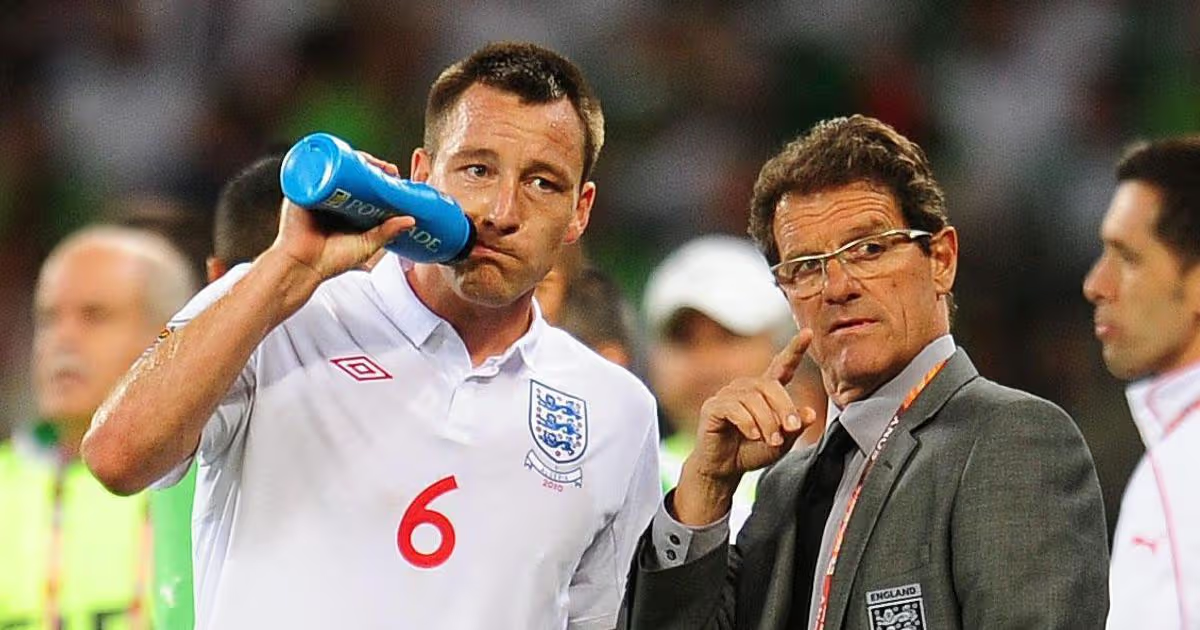
John Cross: It was a glorious sunny day at the Royal Bafokeng training ground in South Africa. No-one expected storm clouds to be gathering an hour later after one of the most memorable and remarkable press conferences in England’s World Cup history.

John Terry started his round of press duties in front of the TV cameras on Sunday, June 20, putting on the tried-and-trusted united front of a senior player backing the under-fire manager after a poor start to the 2010 World Cup.

By the end of the session, Terry had questioned Fabio Capello’s leadership, revealed he had gone to the Italian’s backroom staff to demand the players be allowed a beer and also called for Joe Cole to be put into the starting line-up.

It was as close to a player revolt that you could imagine. And probably as close as England have ever come to a complete meltdown during a tournament.

Advertisement

Terry ended up having to make a public apology, other players were left furious and Capello publicly condemned the former Chelsea player.

It was an amazing episode in England World Cup history. As someone who was there, there was absolutely no sense when Terry started talking that it was going to end so badly.

In fact, Terry started in front of the TV cameras by backing his manager to the hilt despite the fact England had begun their campaign with a 1-1 draw against the United States and then shared a dismal goalless draw with Algeria.

Advertisement

But Terry then went on to reveal there was a players’ meeting that evening with Capello and his staff – and he was ready to lead the call to challenge the manager’s tactics.

Terry also slammed England’s performance against Algeria when they were booed off but it felt pretty clear that he was also challenging Capello’s management and the mood in the camp.

Chelsea legend Terry said they needed Joe Cole’s creativity as he latched on to a question about his teammate – and went too far. Managers do not like players picking their team.

By the end, Terry was insisting that they should be able to relax with a beer which also went against Capello’s whole managerial outlook.

Advertisement

Parts of the TV interview are out there on the internet with Terry, looking a little flushed with the sun beating down outside and making the media tent rather humid, giving what felt like a run-of-the-mill interview.

England had been dull, laboured and short of ideas with Rooney turning on fans at the end of the Algeria game. He ranted into a TV camera after England were booed off.

There was dissent in the air – but it was Terry who misjudged the mood.

Advertisement

When asked about Cole, Terry said: “If he’s called on, Joe will do a great job… I personally think he and Wayne Rooney are the only two in the side who can really open up things.”

It was obvious that Terry had points to make – but scored a spectacular own goal.

Content cannot be displayed without consent

This, do not forget, was the World Cup where the France squad revolted – and forced Raymond Domenech out of a job after a tournament of strikes, rows and recriminations.

Even though Terry had a message, I do not believe that he realised the gravity of what he was saying. He wanted to have his say – but misread the situation.

Advertisement

To be honest, a few of us did not realise just how big this story was until our phones started blowing up on the way back to our media accommodation which was a short coach ride away.

It was quickly evident that Terry was a lone voice. Other players – largely through their agents and contacts – were genuinely staggered at what had been said.

Ensure our latest sport headlines always appear at the top of your Google Search by making us a Preferred Source. Click here to activate or add us as Preferred Source in your Google search settings

The betrayal of a private meeting. Terry painting the picture of him speaking on behalf of the players. It really was not like that.

Advertisement

He was a great Chelsea captain. But Terry was a divisive figure for England at times even though he was unquestionably a world class defender.

Later, Terry even issued a public apology. “I went into yesterday’s press conference with the intention of being honest,” he said.

“I was asked a question about Joe Cole and maybe I went too far. But it was never my intention to upset the manager or the players and, if I did upset anyone, I apologise.

“I have told the manager he has my total support and I would like to stress that I don’t believe I have been a disruptive influence in the camp.

Advertisement

“I would now like to put this episode behind me and concentrate on trying to win what is a massive game for England. All I was trying to do was to say how important it is to me to try to win the World Cup.”

Clearly, Terry still thought his big mistake was about Cole (who was only a substitute in the next game against Slovenia) and it was not quite a full apology… more of an “if I upset anyone” cop out.

The reality was that England players WERE bored in that camp. They definitely underperformed and underachieved under Capello and the players were very divided on him. By the end, most were happy to see him go.

But the real lesson here was that you cannot have a revolt mid-tournament and also they do not like it when a player speaks on behalf of everyone – especially if they did not agree.

It all played out badly. England qualified for the knock-out, got thrashed by Germany 4-1 in the next round and went home.

Capello, meanwhile, was sitting pretty with a new contract signed on the eve of the 2010 World Cup. Stories linking him with a return to club management appeared before the tournament, the FA panicked and regretted it.

And it was another chapter in Terry’s colourful and controversial career because, just four months earlier, he had been stripped of the captaincy after revelations about an affair with former teammate Wayne Bridge’s ex-girlfriend.

Advertisement

Incredibly, 18 months later, Capello – who had reinstated Terry as captain in March 2011 – quit because he was angry that the FA wanted to remove the armband from Terry pending the outcome of a court case over allegations he racially abusing QPR’s Anton Ferdinand.

Terry was later cleared in court but banned and fined by the FA.

Source link

Advertisement
Continue Reading

Trending

Copyright © 2025