Japan joins a long list of countries cracking down on power banks (Picture: Getty Images)
Authorities in Japan have announced a ban on the use of power banks on flights travelling to or from Japan.
Japan’s Ministry of Land, Infrastructure, Transport and Tourism (MLIT) said the rule will apply to all aircraft departing from or arriving to the East Asian country, including those operated by both domestic and internal carriers.
Following the ban, set to come into force in April 2026, you’ll still be able to bring power banks on board, but won’t be permitted to use them until you land.
In 2025, Japan recorded 500,410 visitor arrivals from the UK — meaning this policy has the potential to affect millions of British tourists going forward.
Advertisement
While it’s the first country to crack down on portable chargers, over the past year, the devices have become a major pariah in the aviation space.
Dozens of airlines have adopted stricter regulations regarding their use, with 12 major airline groups having recently introduced bans.
Best of Metro Deals
Get exclusive discounts with Metro Deals – save on getaways and spa days. Powered by Wowcher
Bannatyne Spa: Spa day for two with treatments, lunch & prosecco — save up to 57% off.
The fire on the Air Busan plane triggered an immediate response from airlines across the world (Picture: Getty Images)
Why are power banks a problem on planes?
If a lithium-ion battery is damaged, misused, or stored improperly, it can short circuit — triggering a process called ‘thermal runaway’ where the batteries start to irreversibly overheat.
The result can be a sudden, violent, and explosive fire.
Advertisement
Concerns about allowing passengers to keep power banks in the cabin initially began to grow following an incident in January 2025, when a portable power bank caused a fire that engulfed and destroyed a passenger plane in South Korea.
First discovered by a flight attendant in an overhead luggage bin, the flames quickly spread throughout the entire cabin. Thankfully, everyone onboard was evacuated safely.
But this wasn’t an isolated incident.
According to the National Institute of Technology and Evaluation in Japan, portable battery chargers caused 123 fires in 2024, an increase of more than 150% from the 47 fires reported in 2020.
Advertisement
Different airlines all have their own specific set of rules (Picture: Getty Images)
Moreover, the Japanese fire agency, stated that by product type, power banks accounted for 30% of the 290 incidents in 2024, followed by power tools at 89 and mobile phones at 85.
While flights pose an exaggerated risk, given the intense pressure, faulty lithium-ion batteries can be lethal in all kinds of environments.
So, with all this in mind, it’s not surprising that more and more government bodies are cracking down on these particularly feisty fire hazards.
How will Japan’s power bank ban impact passengers?
The new ban, due to be introduced in April, will mean that all passengers travelling into and out of the country’s airports will be banned from using power banks onboard.
As part of a wider change to guidelines under the country’s Civil Aeronautics Act, travellers will reportedly be limited to a maximum of two portable chargers per person, not exceeding 160Wh, in carry-on luggage.
Advertisement
Fires caused by faulty power banks are on the rise (Picture: Getty Images)
Using power outlets to charge any kind of lithium-ion powered device on board will also be prohibited, as will storing them in overhead cabins.
This marks a rather radical change in Japan’s policies, especially given the fact that in July 2025, the country’s transport ministry explicitly permitted the use of power banks if they remained in sight at all times. However, now that’s all a distant memory.
In 2025, the country welcomed a record 42.7 million international arrivals, and although exact numbers for domestic travel aren’t available, Japan Airlines (JAL) alone operates over 130 routes across 64 regional airports.
Essentially, this move could have a major impact.
Which other airlines have banned power banks?
At the time of publication, the following airlines have banned the usage of power banks onboard its flights:
WASHINGTON (AP) — A federal judge on Thursday rejected a preservationist group’s request to block the Trump administration from continuing construction of a $400 million ballroom where it demolished the East Wing of the White House.
U.S. District Judge Richard Leon ruled that the National Trust for Historic Preservation was unlikely to succeed on the merits of its bid to temporarily halt President Donald Trump’s project. He said the privately funded group based its challenge on a “ragtag group of theories” under the Administrative Procedure Act and the Constitution, and would have a better chance of success if it amended the lawsuit.
“Unfortunately, because both sides initially focused on the President’s constitutional authority to destruct and construct the East Wing of the White House, Plaintiff didn’t bring the necessary cause of action to test the statutory authority the President claims is the basis to do this construction project without the blessing of Congress and with private funds,” the judge wrote.
The preservationists sought an order pausing the ballroom project until it undergoes multiple independent reviews and wins approval from Congress.
Advertisement
Trump used his social media account to hail the ruling as “Great news for America.” The Republican president said the project was ahead of schedule and under budget and “will stand long into the future as a symbol to the Greatness of America.”
The preservationists did not immediately respond to a request for comment.
The White House announced the ballroom project over the summer. By late October, the Republican president had demolished the East Wing to make way for a ballroom that he said will fit 999 people. The White House said private donations, including from Trump himself, would pay for the planned construction of a 90,000-square-foot (8,400-square-meter) ballroom.
Trump proceeded with the project before seeking input from a pair of federal review panels, the National Capital Planning Commission and the Commission of Fine Arts. Trump has stocked both commission with allies.
Advertisement
The arts panel approved the project at a meeting last week. The planning commission is set to discuss it further at a March 5 meeting.
During a preliminary hearing in December, Leon warned the administration to refrain from making decisions on underground work, such as the routing of plumbing and gas lines, that would dictate the scope of future ballroom construction above ground.
The group challenging the project argued that Trump could be emboldened to go further — and possibly demolish the White House’s West Wing or Executive Mansion — if the court did not intervene.
“The losers will be (the) American public, who will be left with a massive ballroom that not only overwhelms what is perhaps the nation’s most historically important building, but will have been built in violation of an astonishingly wide range of laws,” plaintiffs’ attorneys wrote.
Advertisement
The administration said in a court filing that above-ground construction on the ballroom would not begin until April. In the meantime, government lawyers argued, the preservationist group’s challenge was premature because the building plans were not final.
The administration also argued that other presidents did not need congressional approval for previous White House renovation projects, large and small.
“Many of those projects were highly controversial in their time yet have since become accepted—even beloved—parts of the White House,” government lawyers wrote.
Leon, who was nominated to the bench by Republican President George W. Bush, said the White House office behind the project is not an agency covered under the jurisdiction of the Administrative Procedure Act. The judge also said the preservationists, who argued that the ballroom usurped the authority of Congress, did not have the basis to invoke the power of the courts.
Advertisement
As a result, “I cannot reach the merits of the National Trust’s novel and weighty statutory arguments” at this time, Leon said.
___
Associated Press writer Will Weissert contributed to this report.
Leading criminal defence lawyer Marcus Johnstone, managing director of PCD Solicitors who specialises in representing those accused of sexual offences, said: “I am not remotely surprised that Ian Huntley has been attacked in prison, four months since Ian Watkins was murdered by a fellow prisoner at HMP Wakefield.
David Vasey vowed to refund the former owners of the Teesdale Mercury after admitting a single charge of fraud at a plea hearing at Durham Crown Court on Wednesday (February 25).
The 63-year-old defendant committed the offence between June 2012 and September 2016 when he was initially financial manager and then financial director of the Barnard Castle-based weekly.
Vasey, said to be living in Normandy, France, appeared before the court last week, facing several counts of fraud by abuse of position.
Defendant David Vasey will be sentenced at Durham Crown Court in April for defrauding the Teesdale Mercury of £75,000 (Image: The Northern Echo)
His counsel, Chris Knox, said both he and his prosecution counterpart, Martin Towers, hoped to satisfactorily resolve the case prior to a provisional sentencing hearing, then set for March 19.
Advertisement
On the defendant’s return to court, on Wednesday, Mr Knox asked if the charges could be put to the defendant.
Vasey denied six counts of fraud but pleaded guilty to a seventh charge alleging that he made unauthorised payments to himself, of funds belonging to the Teesdale Mercury, between 20212 and 2016.
Mr Knox told the court: “We have been endeavouring to resolve this through discussion.
“He accepts fraudulently taking funds while working for the company and will pay £75,000 by the sentencing hearing.
Advertisement
“We have taken a long time to get to it and the complainant had to be consulted.
“What we are now anxious to do is that there should be acknowledged repayment before he is sentenced.”
Mr Knox also asked if a Probation Service background report could be prepared on the defendant in time for the sentencing hearing.
Judge Jo Kidd asked if the defendant had a fixed address in this country where he could live as a condition of his bail.
Advertisement
The court was given an address in Daisy Fields, Longframlington, Northumberland.
Judge Kidd told Vasey: “The fact I’m adjourning your sentence for a pre-sentence report shouldn’t be taken by you as any indication as to the sentence in this case.
“Paying back what you stole would assist.”
Advertisement
He was bailed to return to the court for the new date for the sentencing hearing which was re-fixed for Thursday April 23.
A prosecuting lawyer told the court there were no booster seats, no child seats and some were “sharing seat belts.”
A man who had four unrestrained children in the back seat when he was doing over 100 mph on the motorway was handed a three-year driving ban today.
Advertisement
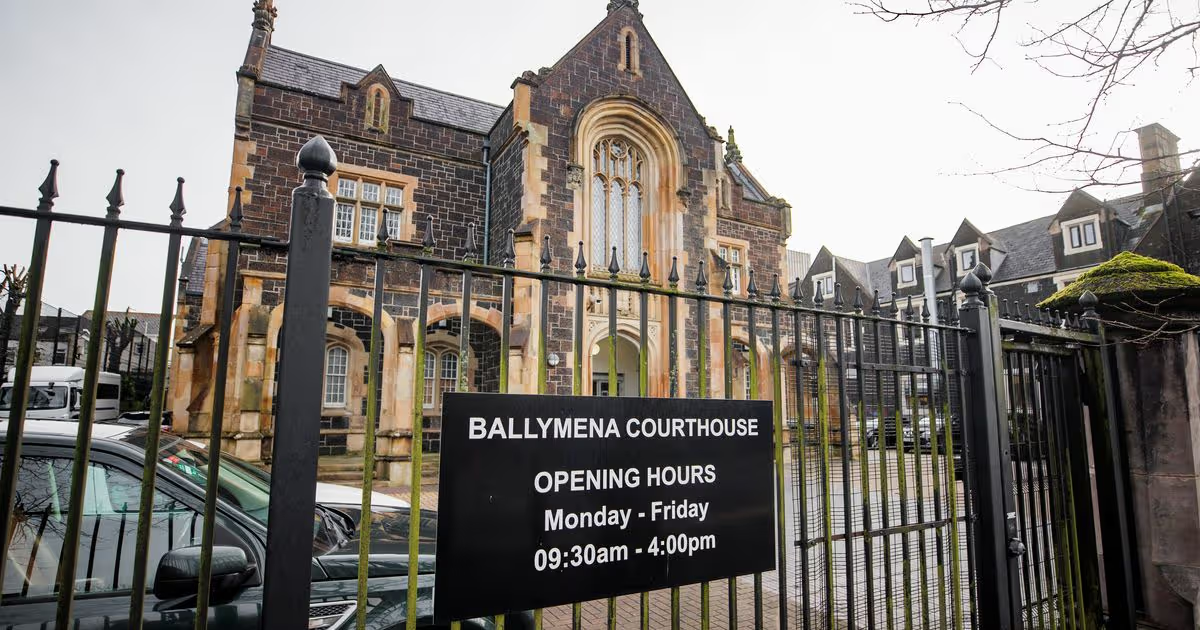
Ballymena Magistrates Court heard that on 27 May last year, police on the Rathbeg roundabout on the M2 spotted a vehicle travelling at 106 mph, 36 over the limit.
When the car was pulled over and officers spoke to 31-year-old Martin Christopher Stokes, they found a total of seven people in the car, including four children in the back seat, none of whom were properly restrained.
A prosecuting lawyer told the court there were no booster seats, no child seats and some were “sharing seat belts.”
“So there were seven people in a car, four of which were children not properly restrained, and he was doing 106 mph,” District Judge Nigel Broderick queried and the lawyer confirmed that was the case.
Advertisement
Stokes, with an address at Harmin Drive in Newtownabbey, entered guilty pleas to each of the five offences, including using a vehicle in a condition causing danger to passengers, excess speed, and three of carrying a child under 12 without proper restraint.
Defence counsel Grant Powles said while it was no excuse, Stokes had received news of a relative who was “very ill” in hospital, so he was on his way there.
Stokes himself was not present in court but Mr Powles conceded that he has previous driving convictions and that having been convicted of driving while unfit, he is subject to a three-year driving ban until 2028.
The barrister further conceded there were aggravating features in the case, but the judge told him “that is an understatement.”
Advertisement
In addition to the three-year driving ban, Judge Broderick imposed fines totalling £500.
Want to see more of the stories you love from Belfast Live? Making us your preferred source on Googlemeans you’ll get more of our exclusives, top stories and must-read content straight away. To add Belfast Live as a preferred source, simply click here.
North in Seaburn, Sunderland, opened in December 2022 in a converted storage shelter at the far end of the promenade, and has since earned national recognition for its food.
The restaurant is now looking for a new owner, though the team has assured customers it will remain open until a suitable new owner has been chosen to takeover.
The restaurant is known for its small plates, brunches and seafood. (Image: North, Seaburn)
The team behind North, also responsible for Mexico 70, Koji, Ship Isis and The Kings Arms in Deptford, said: “We have decided to look for a new owner for North restaurant.
“Most importantly, in the meantime, we are not closing and are in no rush to.
Advertisement
“It’s business as usual and we will remain open until a suitable new owner has been chosen to takeover.”
This Sunday (March 1) will see the return of Sunday lunch with the arrival of a new oven. (Image: North, Seaburn)
North is one of just two restaurants in Sunderland included in the Good Food Guide, alongside Ember in Sheepfolds Stables, and has also been named among the guide’s top 100 local restaurants.
The restaurant is known for its small plates, brunches and seafood, all served with a view.
The team said: “We’ve had a fantastic three years in Seaburn and are so, so proud of the team’s achievements.
Advertisement
“Firstly, being listed in The Good Food Guide but then secondly discovering a month later that we’d also been chosen as the only Sunderland restaurant to have ever made The Good Food Guide’s Top 100 local restaurants was a real honour.”
They added that this Sunday (March 1) will see the return of Sunday lunch with the arrival of a new oven, and that brunch and evening menus will continue as usual.
The team also reassured customers with outstanding gift vouchers that they remain valid, and offered refunds should the restaurant change hands before vouchers are redeemed.
They said: “If you’ve enjoyed dining with us over the past three years it’d be great to see you again before we go, if you’ve not dined with us before, now is your chance.”
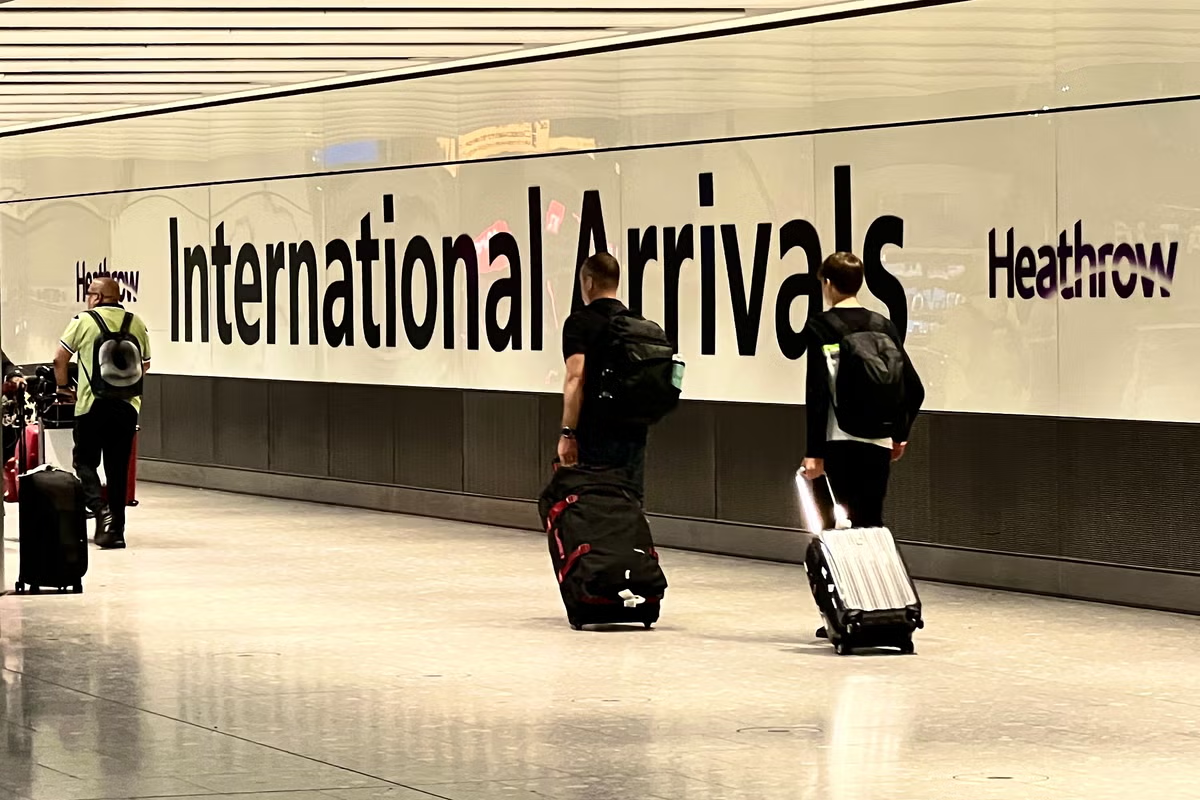
Many travellers who are British citizens and nationals of another country have been thrown into confusion and anxiety over complex new rules for travel to the UK.
Passengers can no longer use their foreign passport with an electronic travel authorisation (ETA) for visits to the UK.
The Home Office says British people who are citizens of a second country must travel to the UK using either a valid British or Irish passport, or a valid passport from any other country that has a “certificate of entitlement” – a digital verification that the holder has the right of abode in the UK.
But many people who are British citizens by birth or descent are concerned that imminent trips may be impossible. Obtaining either official document will take weeks. A passport will cost £94.50 and the certificate of entitlement £589.
Advertisement
At the 11th hour, the Home Office said that airlines could accept, at their discretion, an expired British passport issued at any time since 1989 along with a valid foreign passport.
Crucially, the biographic details – full name, date and place of birth – must match exactly. This will prove a problem for someone whose name has changed since the now-expired UK passport was issued.
Having the expired British-plus-valid foreign passport combination does not guarantee the holder will be allowed to travel
The Home Office stresses: “It is an operational decision whether carriers accept alternative proof, and if so, what alternative proof they will accept.”
Advertisement
In other words, airlines have the discretion to decide whether or not to allow the two-passport combination.
The Independent has been seeking urgent confirmation from leading carriers as to whether they will accept the combo if it meets the requirements: an expired document issued no earlier than 1989, and matching the biographical data on the valid passport.
These airlines have confirmed that they will allow travel:
Qantas is reported in the Australian media to be accepting expired UK passports. Air New Zealand is reportedly not accepting the current/expired passport combo. But since the carrier no longer flies to the UK, partner airlines may accommodate travellers.
Advertisement
Singapore Airlines has responded, enigmatically, by indicating the decision rests with the British authorities. A spokesperson said: “The UK Home Office may accept proof of citizenship if customers have an expired British passport issued 1989 or later and a valid non-visa-national third-country passport, with their personal particulars matching (eg full name, date of birth).”
Passengers flying with other carriers can check directly with the airline. In turn, ground staff can contact the Home Office Carrier Support Hub (CSH).
A Wizz Air spokesperson said: “As directed by the Home Office, we will consider each passenger on a case-by-case basis and if needed would contact Carrier Support Hub to establish the passengers’ circumstances and which combination of documents they are presenting.”
The Independent is waiting to hear from other airlines, but the evidence so far is that a large majority will accept the expired passport.
Advertisement
The government says the new rules constitute “a more streamlined, digital immigration system” that it claims “will be quicker and more secure for the millions of people who pass through the UK border each year”.
The report doesn’t break down the loss into its component parts, but there are clues.
Uefa’s figures show Chelsea’s overall revenue was significantly lower than some of their Premier League rivals.
The Blues brought in £511m, compared to £746m for Manchester City and £744m for Liverpool.
That difference comes from a few key areas.
Advertisement
Chelsea’s income from ticket sales was the ninth-highest in Europe but still £28m less than Liverpool, one place ahead of them.
The average amount Chelsea made per matchday was £1.2m less than Liverpool, who again were one spot ahead.
Chelsea’s matchday revenue is restricted by the capacity of Stamford Bridge, which at 41,798 is only the 11th-biggest ground in the Premier League, 34,000 smaller than Manchester United’s Old Trafford.
The Blues also made far less in commercial revenue than some of their rivals.
Advertisement
They were ranked 11th for commercial revenue in Europe last year, making £207m – £5m down on the previous year.
That puts their commercial revenue £66m lower than Tottenham – the next-highest English club – and £165m lower than Manchester City, who brought in more than anyone else in the Premier League.
Chelsea also made far less from merchandising and kit sales than the five other wealthiest Premier League clubs.
They generated £83m from that revenue stream – no improvement on the previous year. That is £46m less than Spurs and £82m less than top-ranked Manchester United.
Advertisement
The only area in which Chelsea performed impressively in comparison to their rivals was broadcast revenue, with participation and victory in the Fifa Club World Cup boosting income to £192m, putting them second-highest on the list in Europe, behind Manchester City.
There are other actors, such as Lewis Pullman as Lee’s ever-faithful brother William, but this is Seyfried’s show. With her huge doe eyes, she’s perfect for Lee’s enraptured, possessed fervour. With her body swirling and contorting, it’s a ferociously physical performance.
There has been quite the to-do about the latest adaptation of Wuthering Heights by director Emerald Fennel but one thing I am not seeing as much discussion on is the accents delivered by Margot Robbie and Jacob Elordi.
Jacob has a somewhat questionable (though I liked it…) Yorkshire accent and Margot has a lovely-if-misplaced Received Pronunciation (RP) accent which is traditionally associated with English upper classes. Think ‘BBC accent’.
Now, research from language learning app Babbel which polled 2,000 adults and found that the sexiest accents did in fact include Yorkshire accents as well as Northern Irish which took the top spot, Welsh and Scouse (Liverpool).
With this in mind, HuffPost UK spoke exclusively with Babbel’s cultural and linguistic expert Noel Wolf about why accents are crucial to our perceptions of characters in film and TV.
Advertisement
The role of accents in Wuthering Heights
According to Wolf, we can learn a lot about Cathy’s background just from her voice. He says: “Accents are more powerful than how someone sounds, they’re emotional signposts that tell us who a character is before they’ve even spoken a full line. In Wuthering Heights, Emerald Fennell uses accents as a form of character development.”
This is contrasted with Jacob Elordi’s Yorkshire accent, which Wolf says grounds Heathcliff in the wildness and isolation of the moors. He says: “It carries grit, passion and a defiant edge that feels inseparable from the landscape itself.
“Margot Robbie’s polished Received Pronunciation (RP) by contrast embodies Cathy’s gentility and control, reflecting how she’s shaped by class expectations and her yearning to belong to a more refined world.”
Advertisement
Why Cathy’s accent changes in Wuthering Heights
One thing I did notice and admittedly didn’t really understand was why Cathy’s voice changed as the film goes on. However, Wolf explains that this is actually clever storytelling: “What’s particularly striking is how Cathy’s accent evolves over the course of the film. As she grows older her accent subtly shifts towards RP, as elements of her earlier, earthier tones fade.
“That change is far from incidental; it’s a perfect example of how an accent can illustrate internal conflict. The refinement of her speech signals her attempt to rise above her roots but also her loss of spontaneity and the growing distance from the passion she once shared with Heathcliff. Accent becomes a kind of emotional barometer, showing us her transformation before her choices do.”
The emotional impact of Healthcliff’s Yorkshire accent
Advertisement
If you came away from Wuthering Heights with a new-found crush on Jacob Elordi, his accent as Heathcliff may have had something to do with it. Wolf says: “For modern audiences, that awareness of linguistic nuance deepens the emotional realism. We’re subconsciously attuned to the cues accents provide. For example, a Yorkshire accent feels unguarded and direct while RP often conveys education and social aspiration.
“When those qualities collide between two lovers it amplifies the sense of longing and impossibility. The result is a story in which language itself becomes part of the tension, reminding us that desire, class and belonging are all expressed not just through what we say, but how we say it.”
A suspect in his 40s has been identified but not arrested
Laura Hill and George Lithgow and Tom Wilkinson Press Association
17:30, 26 Feb 2026Updated 17:32, 26 Feb 2026
A fellow prisoner has been identified as a suspect in the attack on Soham murderer Ian Huntley on Thursday morning. The man in his mid-40s has not been arrested and remains in detention within HMP Frankland, County Durham, police said in an update.
A spokesman for Durham Constabulary said that Huntley remains in a serious condition after he was attacked with a metal bar. They said: “The 52-year-old prisoner who was injured during this morning’s assault in the workshop at HMP Frankland remains in a serious condition in hospital following treatment for head injuries.
Advertisement
“Police forensic teams have examined the scene of the attack throughout the day to gather evidence.
“A suspect, a male prisoner in his mid-40s, has been identified by officers investigating the incident. He has not been arrested at this stage but remains in detention within the prison.”
Former caretaker Huntley murdered 10-year-olds Holly Wells and Jessica Chapman after they left a family barbecue to buy sweets in Soham, Cambridgeshire, on August 4 2002, then discarded their bodies in a ditch. He is serving a life sentence, with a recommendation that he must serve at least 40 years, for the murders.
Durham Constabulary confirmed that a prisoner, believed to be Huntley, was attacked on Thursday morning at HMP Frankland in County Durham before being urgently transported to hospital. A representative for the force stated: “Police were alerted to an assault which had taken place within HMP Frankland in Durham this morning.
“A male prisoner suffered serious injuries during the incident and was transported to hospital. A police investigation is now under way into the circumstances of the incident and detectives are liaising with staff at the prison.”
The Sun, which initially reported the attack, claimed he was knocked unconscious with a metal pole and quoted a source saying his condition was “touch and go”.
A Prison Service spokesperson said: “A prisoner is receiving treatment after an incident at HMP Frankland on Thursday morning. It would be inappropriate to comment further whilst police investigate.”
Advertisement
This isn’t the first time Huntley, 52, has been assaulted at Frankland prison. In 2010, robber Damien Fowkes attacked him with a makeshift weapon, inflicting a “severe gaping cut to the left side of his neck”.
The injury was 7in (18cm) long and required 21 stitches. Fowkes asked a prison officer: “Is he dead? I hope so.”
He referred to Huntley as a “notorious child killer, both inside prison and in society in general”.
Manchester Arena bomb plotter Hashem Abedi is accused of launching “terrorist” attacks on prison officers at the same maximum security jail using hot cooking oil and improvised weapons. He denies three counts of attempted murder after four prison officers were injured on April 12.