Good sex on the screen seems to be having a moment. Steamy gay ice hockey romance Heated Rivalry made stars of its unknown leads Hudson Williams and Connor Storrie. The most recent season of Bridgerton – in which the titular family’s son and their lady’s maid fall passionately in love (and into bed) – garnered 39.7 million views in four days.
The final season of Outlander is currently airing, enduringly popular more than a decade after its episode The Wedding was heralded as a game-changer for representations of explicit, woman-centred sex on television.
These three shows have something in common: they are all adapted from romantic fiction written by women – Rachel Reid, Julia Quinn and Diana Gabaldon, respectively.
They have also all been credited as examples of shows that, like the romance novels they are inspired by, prioritise the female gaze in their depictions of sex. The Guardian has described this as “storytelling that highlights the meandering, textured, sublimely messy inner worlds and wants of women” (even when, as in the case of Heated Rivalry, women are not actually partaking in the on-screen sex).
Cooper was particularly famous for writing “bonkbusters”: a form commonly associated with the 1980s, described pithily by comedy writer and author Sue Limb as “a big, thick book with lots of bonking in it”.
Sex is central to the bonkbuster, which glories in wild, over-the-top sex scenes. More than half of Rivals’ 52 chapters describe sex between characters – and many of these sex scenes have made it onto the screen.
Advertisement
These range from the tender – such as the first time between Freddie Jones (Danny Dyer) and Lizzie Vereker (Katherine Parkinson), in which he declares her body “an area of outstanding natural beauty” – to the ridiculous. One of our earliest encounters with protagonist and Conservative MP Rupert Campbell-Black (Alex Hassell) is via him playing a naked tennis match with fellow MP’s wife Sarah Stratton (Emily Atack).
Notably, not all – not even most – of the sex scenes in Rivals occur in the service of a romantic plot, which sets it apart from shows like Heated Rivalry and Bridgerton. This reflects the difference in genre between the source texts: while bonkbusters have a lot in common with romance novels – including, but not limited to, their predominantly female readership – they are not quite the same thing.
However, for many readers, the depictions of sex in bonkbusters felt as groundbreaking in the 1980s as the sex depicted in these lauded screen adaptations of romantic novels.
Sex education and female pleasure
In 2022-24, we spoke to dozens of people who read books like Rivals in the 1980s, while conducting research for our recent book The Bonkbuster.
Advertisement
A key takeaway for many was bonkbusters’ role as supplementary sex education. For example, one of our participants appreciated the comparative sexual progressiveness of Rivals, which contrasted with her memory of a 1986 biology textbook “which showed the female reproductive organs but did not point out the clitoris”.
By representing sex on the page, books like Rivals filled a silence about sex in these readers’ lives. One of the most remarked-upon aspects of bonkbusters by those we spoke to was not just the explicit sex, but that the sex depicted was overwhelmingly positive for the women involved – and it was men who had to work at it.
Cameron is a woman who prioritises her own sexual pleasure. Disney / Getty
For example, when Rupert and Cameron (Nafessa Williams) have sex for the first time, she “ordered him around like a sergeant-major”. This is reflected in the TV adaptation, where, when Cameron demands more clitoral stimulation, Rupert’s reply – taken directly from the book – is to say “I am, after all, a member of the Cli-Tory Party,” and obliges.
While Rupert is sleeping with Cameron under sinister pretences (corporate espionage), she still benefits in short-term sexual pleasure. Good sex in the bonkbuster tends to happen because men are willing to put in an effort to make it good for women.
Advertisement
Sex adaptation – nostalgia v discomfort
However, bonkbuster sex is not always pleasurable, and Cooper has an eye for the unsexy, darker side of the 1980s. Many such details have been included in the TV adaptation. For example, several female characters in Rivals are assaulted, but in the first season, none of the male perpetrators are held accountable – something which many of our readers also found disquieting in the book.
The TV adaptation, though, has taken the opportunity to redress some of the imbalances from the original text.
In the novel, Cameron requires stitches after being badly beaten by Tony (David Tennant). But in the TV adaptation finale of season one, it is Cameron who strikes Tony. The first season ends unclear as to whether Tony is alive or dead (although Tennant’s presence in the trailer for season two is a bit of a giveaway).
And while Cooper’s novel mentions HIV/AIDS in passing, the TV adaptation places more emphasis on the discrimination against gay men at the time, and introduces a new relationship between two gay characters – Charles (Gary Lamont) and Gerald (Hubert Burton).
Advertisement
The second season has taken this even further. Even Rupert – who got away with everything short of murder in Cooper’s books – has to face the consequences of his past bad behaviour.
These changes are indicative of the different climate of 2026. While some aspects of the 1980s bonkbuster are clearly still important and pleasurable for readers and viewers – the nostalgia, the sex positivity – some things are best left in the 1980s.
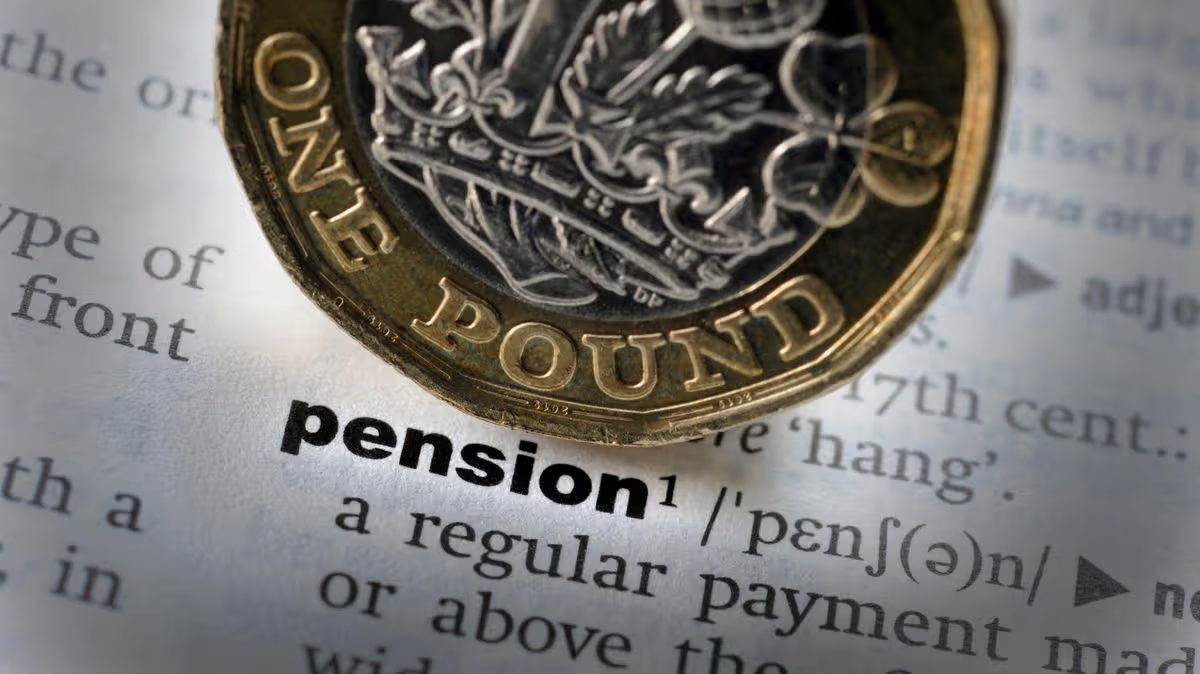
People with terminal illnesses could get earlier and easier access to their pensions
The Government has said one of its ‘clearly outdated’ pension rules could be overhauled as a review is set to take place.
Advertisement
People with terminal illnesses could get earlier access to their private pensions more easily, as the Government said it would revise the rules around how pension schemes work.
Treasury minister Lord Livermore acknowledged there were issues as he said the current definition of terminal illness was ‘clearly outdated’ as he acknowledged the difficulties for people trying to claim their pensions early.
Click here to get the biggest stories straight to your inbox in our Daily Newsletter
Lord Livermore had been asked by Labour peer Baroness Martin of Brockley whether current practices would be updated.
Advertisement
At present people with a life expectancy of less than a year may take a Serious Ill Health Lump Sum, but Lady Martin, who was previously Rachel Reeves’ chief of staff, said some people with terminal diagnoses may live up to 10 years or more.
The current scheme allows the sum to be taken tax-free for those below age 75, up to a sum of £1.073 million. Any amounts above that is taxed as income.
Responding to a question in the House of Lords, Lord Livermore said: “While the current rules are intended to provide flexibility, the Government recognises that the permissive nature of these rules means individuals may experience varying hurdles to access depending on their scheme.
Advertisement
“The Government wishes to ensure a fair and compassionate approach to allowing access to pension savings in cases of terminal illness, and will therefore now consider this issue in further detail.”
Lady Martin said: “It’s encouraging to hear the Government will look again at this important issue. The rules on access to private pensions for terminally ill people were designed for an era when terminal diagnoses often meant death within months, but medicine has moved on.
“For cancer alone, around half of patients now survive 10 years or more compared to just one in four in the 1970s.
“Can the minister confirm that when the Government looks at this issue, they will ensure that the access rules will reflect modern, clinical reality, rather than leaving people who may live for many years with a terminal diagnosis, unable to access funds that are rightfully theirs?”
Advertisement
Lord Livermore responded: “I agree with her that the current definition for when someone with a terminal illness can access their pension savings is clearly outdated and does not align with wider legislation, including the (Department for Work and Pensions) standard definition, so I can confirm the Government will now review this.
“Individual private pension schemes also have their own requirements for terminally ill people to access their pensions savings.
“The Government will therefore also examine the access options across these schemes and will consider what changes may be needed to ensure people have appropriate access while safeguarding against the risk of financial hardship later in life.”
He also told Labour peer Lord Pitt-Watson that the Government would consider ensuring the definition of terminal illness in pensions regulations is the same as that for the DWP.
Advertisement
“Although I can’t prejudge it, it would be ideal if there was now one standard definition,” Lord Livermore said.
NEW YORK (AP) — A self-exiled billionaire Chinese business tycoon once believed to be among China’s wealthiest men was sentenced Monday to 30 years in a U.S. prison for a massive financial fraud that a federal judge said cost over 1,000 people worldwide hundreds of millions of dollars.
Guo Wengui, who fled China a decade ago and reinvented himself as a U.S.-based Communist Party critic, was sentenced in a Manhattan courtroom packed with his supporters by Judge Analisa Torres. She said he “preyed on those seeking to bring Democracy to China,” taking their money so he could live lavishly.
Before he was sentenced, Guo protested his treatment in jail, saying he was taken to the hospital early Monday. He disputed a prosecutor’s portrayal of him as a malingerer faking illness, saying he repeatedly vomited as he was returned to jail before being brought to court.
“When I came here, I said: ‘I have a tummy ache, I need to go to the bathroom, I don’t feel well,’” Guo said through an interpreter of his courthouse arrival. Later, Guo wiped his mouth repeatedly with a tissue.
Advertisement
He only briefly addressed the criminal case, defending his intentions by saying in reference to the Chinese Communist Party: “The reason I came to the U.S. was to destroy the CCP.”
The judge, in sentencing him, read snippets of letters she received from victims who described losing their life savings and feeling severely anxious and shamed and having family members turn on them for their poor investment choice.
Torres said Guo “takes no responsibility for his actions and instead insists incredibly his conduct caused no loss and harmed no one.” She said he “has called upon supporters to harass and intimidate those who dare to speak out against him.”
The judge ordered Guo to forfeit $889 million in restitution.
Advertisement
Wei Chen, a victim who testified at trial, told Torres that Guo’s fraud “destroyed my life” and that of her family.
As Guo left the courtroom after the sentencing, supporters applauded and shouted toward him.
Before his arrest and detention without bail three years ago, Guo grew so close to conservative political strategist Steve Bannon that they announced a joint initiative to overthrow the Chinese government in 2020. He lived in a luxury apartment overlooking Central Park and had joined President Donald Trump’s Mar-a-Lago Florida golf club.
Advertisement
Sign up for Morning Wire:
Our flagship newsletter breaks down the biggest headlines of the day.
Advertisement
Prosecutors had requested he serve at least 30 years in prison, saying his “astonishing” fraud from 2018 to 2023 “destroyed hundreds of lives” and left “a wreckage of victims and families who have been devastated financially, emotionally, and psychologically.”
Prosecutors said in court papers that his ill-gotten riches fueled “a lifestyle of extraordinary excess and indulgence, a gilded life of mansions, yachts, race cars, designer clothes and luxury furnishings.”
Guo was convicted of nine of 12 criminal charges during a seven-week trial that prosecutors said showcased his deception of thousands of investors in bogus deals that enabled Guo’s lavish lifestyle.
Advertisement
In a court filing, Guo’s lawyers wrote that he was the victim of the Chinese Communist Party’s “grand, pervasive, and life threatening” pursuit of him. They alleged that the party recruited elites in U.S. business, entertainment and politics to conspire against him.
They said in presentence court papers that a lengthy prison term would only validate China’s smear campaign and “embolden further efforts to eliminate Chinese dissidents from public life” while defendants in similar cases received prison terms of two-to-four years.
The lawyers noted that a court probation officer wrote to the sentencing judge that Guo, also known as Miles Guo and Ho Wan Kwok, had scars and disfigurements from physical torture he endured in China and subsequent surgeries he underwent from 1993 to 2022 to repair the injuries.
Defense lawyers said Guo’s wealth grew as his family became the largest shareholder of China’s largest publicly traded securities company, but he became a target of Chinese government officials as he exposed them as corrupt. Eventually, the lawyers wrote, Guo moved to Hong Kong, London and then New York in 2017.
Advertisement
Chinese authorities accused him of rape, kidnapping, bribery and other crimes, but Guo said those allegations were false.
On Monday, China’s Ministry of Foreign Affairs said they had noted the sentencing, and that Guo is wanted by the Chinese government and has an Interpol “Red Notice” on him. The notice is a request to police forces around the world to arrest a suspect, pending extradition.
Prosecutors say Guo convinced hundreds of thousands of people to invest more than $1 billion total in entities he controlled, including his media company, GTV Media Group Inc., and his so-called Himalaya Farm Alliance and the Himalaya Exchange.
Guo, the government alleged in presentence court papers, was “entirely unrepentant” for his crimes after he took advantage of lax U.S. asylum laws to flourish in America.
In February 2025 Sir Keir committed to raising Nato-qualifying defence spending to 2.5% of GDP by 2027.
The prime minister also announced that the activities of the UK’s security and intelligence agencies would – by 2027 – be classified as Nato-qualifying defence spending. As a result spending would hit 2.6% of GDP by 2027.
The prime minister also stated a “clear ambition” to increase spending to 3% of GDP “in the next parliament”.
At a Nato summit in the Hague in June 2025 the UK and other members committed to spend 5% of GDP on defence and security with 3.5% going to Nato-qualifying “core defence” by 2035.
Advertisement
The alliance’s members agreed that the rest of the 5% (1.5% of GDP) could be made up of spending to “protect critical infrastructure, defend networks, ensure civil preparedness and resilience, innovate, and strengthen the defence industrial base.”
Sir Keir said on Tuesday that the measures in the DIP “takes us to 4.2% under that commitment”.
WASHINGTON (AP) — Students pursuing graduate degrees in nursing, physical therapy and several other fields will be eligible to take out higher federal student loan amounts — at least for now — after a federal judge blocked part of a Trump administration rule that held them to lower limits.
The U.S. Education Department issued a revised rule on Monday designed to follow the judge’s order from last week, officials told The Associated Press. Agency officials called it a temporary change while they fight in court to keep the original rule, which defined medicine, law and other fields as “professional programs” but excluded fields such as nursing.
The department disagrees with the judge’s order but will comply, even as officials plan to prevail in the case over which degrees are defined as “professional,” Undersecretary Nicholas Kent said in a statement. “We will continue to make the case that the definition is both lawful and appropriate,” he said.
The change represents a short-term win for groups that sued to stop the rule. Eight groups challenged the department’s definition in court, representing nurse practitioners, therapists, speech language pathologists and more.
Advertisement
But in strictly applying the judge’s order, the department is now striking some degrees from the list of professional programs, meaning those students will face lower loan limits. Theology studies programs are among the biggest to shift from professional to non-professional degrees in the shuffle, subjecting theology students to a lower student loan limit. The master of divinity degree — a common degree for pastors and ministers — remains on the professional list, with a more generous student loan limit.
The new rule, which takes effect Wednesday, comes from a student loan overhaul passed in President Donald Trump’s tax bill last year. Programs designated as professional degrees face federal loan caps of $200,000, while other graduate programs are capped at $100,000.
Previously, graduate students had been able to take out federal loans up to the full cost of their degree. Trump officials pushed for new loan caps to rein in student debt and lower tuition prices that they said had grown out of control.
The groups that brought the lawsuit said the rule would require students to forgo their studies or take out riskier private loans. Although many graduate nursing degrees fall within the lower loan limits, some can cost more than $100,000, including in high-demand fields like nurse anesthesia.
Advertisement
In a notification to universities on Monday, the Education Department said it’s confident the Trump administration’s initial rule will ultimately be upheld in court. The amended rule is expected to remain in effect during the judge’s preliminary stay, but the department warned that it “may change as litigation in the case proceeds.”
The original rule included about a dozen programs that were deemed professional, which Trump officials had said was not a judgment on their importance but part of a technical definition dating to the 1960s. Along with law and medicine, that list also included theology, pharmacy, veterinary medicine, clinical psychology and more.
The temporary rule expands that list to 29 specific degree programs, including master of science in nursing, doctor of nursing practice, and doctor of nurse anesthesia practice. Others newly added to the professional list include degrees for physical therapy, athletic training, speech-language pathology, physician associates and anesthesiologist assistants.
The department’s communication listed about 25 programs that are now considered non-professional degrees. Along with theology, that list now includes applied psychology, pharmaceutical sciences and others. (The doctor of pharmacy degree remains professional.)
Advertisement
Last week’s court ruling blocked parts of the Education Department’s definition that were added in a federal rulemaking process. U.S. District Judge Beryl Howell in Washington called it a “misguided” interpretation that strayed from a longstanding definition created by Congress.
The department’s definition laid out several criteria used to weigh if degrees count as professional programs. It said those degrees generally take six years to complete and require licenses to begin practicing, among other requirements.
It also said professional degrees cannot lead to employment that must be “be supervised by another professional” with “more education, training, and qualifications.”
Associated Press Writer Heather Hollingsworth contributed to this report from Kansas City.
___
The Associated Press’ education coverage receives financial support from multiple private foundations. AP is solely responsible for all content. Find AP’s standards for working with philanthropies, a list of supporters and funded coverage areas at AP.org.
Share or comment on this article:
Ivory Coast vs Norway – World Cup last 32 LIVE: Erling Haaland set to return as Emerse Fae’s side take part in knockout stages for first time ever
The UK is not usually thought of as the kind of country that’s prone to a coup d’état. Yet in the UK too, power can change hands without a general election. Boris Johnson, Rishi Sunak, Theresa May, Liz Truss – in each case, internal party dynamics determined who occupied 10 Downing Street.
In the current situation, all eyes are on the former mayor of Greater Manchester, Andy Burnham. It’s widely expected that Burnham will become prime minister through an internal Labour party manoeuvre rather than a general election. But this would reinforce the same uncomfortable point. The UK accepts major political transitions without the electorate ever casting a vote. Once again, the public may simply be expected to accommodate the outcome.
Keir Starmer won a landslide in the 2024 general election. But dissatisfaction within the party and across the country soon led to grumblings, cabinet resignations and a collapse in the PM’s public approval. In such a trigger-happy system, any political misstep (or series of missteps) becomes potentially fatal.
Advertisement
Normalising hierarchy
So why do voters accept pressure from within a PM’s own party as legitimate grounds for removal? The answer may lie in psychology, namely the human tendency to justify existing systems, defer to authority and treat hierarchy as normal. Understanding that process is the first step towards challenging it.
“Social dominance orientation” describes a preference for social hierarchy, in which some groups are seen as more deserving of power than others. People higher in this tendency are more comfortable with unequal relations and more likely to support policies, institutions or leaders that preserve hierarchy rather than reduce it. In social psychology, this matters because hierarchy survives when many people come to see it as normal.
One reason for this is that hierarchical settings themselves can make inequality feel natural. Military organisations, policing, workplaces that are structured around hierarchies and elite educational systems all expose people to repeated signals that some voices matter more than others. Over time, this can make hierarchy seem less like a political choice and more like common sense.
That helps explain why internal party decision-making can sometimes be accepted by the wider electorate. When groups such as the 1922 Committee of backbench Conservative MPs (which sets out the rules for Tory leadership contests) or a party’s national executive use internal rules to shape leadership outcomes, their language and formality can create an air of authority. This may make many voters more inclined to accept it.
Advertisement
During the tumultous Conservative years, the UK public got very used to hearing from Graham Brady of the 1922 Committee. EPA/ANDY RAIN
But this raises a deeper democratic question: if people simply absorb the outcome of these elite processes, how representative is that democracy really? One way of thinking about this is through voter apathy and disengagement, which can leave surrogate decision-making unchallenged.
There are ways to push back against this. Meaningful interactions between people from differing social groups (known in psychology terms as “high-quality inter-group contact”) can reduce support for hierarchies. This is especially true when it takes the form of genuine one-to-one contact, rather than just symbolic interaction.
And so can “cultural humility”: the willingness to recognise that we do not fully know other people’s experiences and should approach difference with respect, curiosity and awareness of inequality. These are practical ways of loosening the hold of hierarchy on politics.
Advertisement
Internalised classism adds another layer. This is the process by which people absorb negative beliefs about their own social group and begin to see themselves, or those like them, as less entitled to lead. That can make the acceptance of unelected elites easier, especially when those elites come from the upper classes. The privileged upbringing of Eton-educated Johnson, for example, did not prevent him from appealing to some working-class voters to win a general election in 2019 and lead the UK through Brexit.
Of course, the easiest way to alleviate internalised classism is for the governing party to change its rules to ensure that any new prime minister must be elected via a public vote, rather than leadership challenge. However, this small change would have a seismic effect and is unlikely to happen.
Ultimately, the strongest defence against unelected leaders is democratic accountability. That means questioning backroom power, reducing political apathy and encouraging citizens to care about who governs them and how. If democracies fail in this, they risk normalising elite rule and weakening the foundations of democratic life.
You know that feeling when you walk into a room and immediately forget why you came in? Maybe you were there to fetch your keys. On your way to the room, you were thinking about grabbing your keys. But once you arrive, your keys have completely disappeared from your mind.
This is sometimes known as the doorway effect, since it often strikes when you walk into a new room. Why does it happen? The answer has a lot to do with a faculty called working memory. Information gets stored in working memory when we need it for the tasks that we are engaged in right now (like remembering to grab your keys).
What makes working memory so intriguing is its close link to consciousness. The doorway effect suggests that when information is removed from working memory, it immediately seems to leave consciousness. It also suggests that it is easy for information in working memory to be forgotten.
The link between working memory and consciousness is getting increasing attention in psychology, philosophy and neuroscience. Could working memory somehow give rise to consciousness? In my new book, I explore the complex relationship between the two.
Advertisement
Working memory: both rich and poor
To understand the doorway effect, we’ll need to know a bit about working memory. One thing that makes working memory so special is that it’s so rich, both in terms of the information it has access to, and its processing power. According to recent models of working memory, it can draw information from sensory channels (vision, touch, smell etc), as well as from other memory systems such as long-term memory and also the brain’s system for processing language. In other words, working memory is where a lot of the information in your brain comes together.
Wait, why am I carrying boxes? Prostock-studio/Shutterstock
Once working memory has that information, there’s a lot it can do with it. Inside working memory are a host of different smaller systems for specific tasks, including visual and spatial reasoning (like solving a Rubik’s cube) and storing chunks of information (like a phone number). There’s even a “central executive” system (my favourite). The executive is like a merciless boss, assigning tasks to the different systems within working memory and keeping everything under control.
In other ways, what makes working memory so special is that it’s simultaneously very poor. Despite the riches of information available to it, working memory can only actually store a tiny amount of information at any one time.
Advertisement
In one classic experiment reported in 1997 people were asked to view a screen with several coloured shapes on it, which they were told to remember. The shapes then disappeared for about a second, and a new set of coloured shapes appeared. One of the new shapes might have changed colour. Participants were asked to spot whether there had been any changes between the two sets of shapes. This is called “change-detection”.
People were almost perfect at this when there were only 1-3 shapes involved in each set, but got steadily worse as the number of shapes was increased from 4-12. The experimenters argued that this is because it gets harder to store information as the number of shapes increases. This is because the capacity of working memory isn’t big enough to store lots of shapes. The experimenters concluded that the capacity of working memory is only about four “slots”. Once those slots are taken, working memory is full up: there’s simply no more room for any new information.
The idea that working memory has “slots” is closely related to something called “chunking”. Here are two strings of letters (nine in each). Try to memorise them both:
BBC FBI WWF
Advertisement
ZQK EWP WLJ
I bet you find the first string of letters easier to memorise. This is because they’re familiar, and so naturally your brain sorts them into three chunks. They can then be stored as three different chunks in working memory. For this reason, the first set only takes up three slots in working memory. The second string of letters is unfamiliar, and so requires us to store all nine letters as individual chunks. This is difficult because working memory quickly runs out of slots.
But like many features of working memory, its capacity is a hotly debated issue. A growing number of scientists have rejected the idea that it has “slots”, arguing instead that its capacity is more of a flexible resource that can be differently distributed across different pieces of information. According to this view, working memory’s capacity – far from being four rigid slots – might be more like a tank of water to be used in watering your garden: you can give a little bit of water to lots of different areas, or lots of water to just one or two areas.
In the same way, working memory might be able to store a little bit of information about lots of objects, or very detailed information about just one or two of them.
Advertisement
One study from 2004 supports this flexible resource view over the slots view. This experiment also used change-detection with shapes.
Crucially, the experimenters tried this with different kinds of shapes. Sometimes they used only very simple shapes, sometimes very complicated ones. They found that people seem able to store information about more of the simpler shapes in working memory. They were much worse at storing information about the complicated shapes. In fact, the experimenters suggest that the capacity of working memory for a very complicated object (like a cube with many different coloured sides) might only be between 1 and 2.
This seems to show that the capacity of working memory is “soaked up” much more when it tries to remember very complicated objects. This suggests that working memory doesn’t have a fixed number of slots, but that its capacity depends on how complicated the information you’re trying to store is.
To me, there’s something romantic about how rich working memory is in terms of how much information is available to it, and how poor it is in terms of its small capacity. It’s like it can always see the vast riches available to it, but can only ever sample a tiny portion at a time.
Advertisement
The low capacity of working memory can help us understand why the information it stores is so easily forgotten, like in the doorway effect. There’s not much room in working memory, so when new information comes in, old information needs to go.
As I mentioned at the beginning, research suggests that the very action of walking through a doorway might trigger forgetting. One experiment showed that people find it harder to remember things when they walk through a doorway, compared to people who walk the same distance but don’t cross a threshold. When we enter a new room, its like the brain flushes away the old facts from working memory, to get ready for the fresh information that we might need in our new setting.
From an evolutionary perspective, the doorway effect makes sense: forgetting old information is important in helping us to stay open and alert to novel information in the new environment.
Thinking about the capacity of working memory can help shed light on why it’s so easy to forget things, even when we were just this second thinking about them. But there’s an even more tantalising possibility here. When we forget things like our keys, they seem to drop away from our consciousness entirely. This raises the suggestion that working memory and consciousness might go hand in hand.
Advertisement
Working memory and consciousness
Consciousness is perhaps the biggest mystery facing both science and philosophy today. By “consciousness”, I mean the subjective experiences that we have of the world. Consciousness includes the visual image of a beautiful sunset, or the taste of chocolate, as well as emotions like love and anger.
The close link between consciousness and working memory is clear from some of the major theories of consciousness in psychology and neuroscience today. Personally, I’m a huge fan of the global neuronal workspace theory, which suggests that consciousness arises as a result of information being “broadcast” in a “global workspace” in the brain. This workspace is like a central information store, which can process information and distribute it globally to many different systems in the brain.
Does that sound like working memory to you? If it does, that’s no coincidence: the global workspace and working memory are similar notions. Their similarity can even be seen in the brain. There are still lots of open questions about where working memory is located in the brain but one important area is the prefrontal cortex. This is at the front of your brain, just above your eyes and behind your forehead. The same area also seems to be important for the sort of global broadcasting that global workspace theorists think is responsible for consciousness.
Advertisement
Scientists friendly to the global neuronal workspace theory have suggested that when we pay attention to information that is stored in working memory, that information gets boosted in volume and is broadcast across the brain – and that is what makes it conscious. According to this view, consciousness arises when working memory and attention work together.
The idea that attention and working memory might both be important for consciousness seems to fit with our own experience. When you’re trying to remember a phone number in your head, your attention stays on the phone number and you’re conscious of it. If someone distracts you by asking you a question, your attention is pulled away from the phone number and it immediately gets deleted from your consciousness. According to this picture, no attention = no consciousness.
The importance of both working memory and attention also fits with experimental data. One of my favourite experiments studied people walking across a courtyard on a spring afternoon. It was found that 75% of people who were on their mobile phones completely failed to spot a purple and yellow clown unicycling around the courtyard. This is even though the clown could have crossed their path, potentially causing a dangerous collision. They were on their phones, their attention was elsewhere, so the clown didn’t get into their consciousness. Again, this suggests that no attention = no consciousness.
I have a lifelong fear of clowns. The idea that there might be a clown nearby that I just haven’t spotted fills me with dread. (I mean come on, they’re clearly terrifying).
But like everything to do with consciousness, the link between consciousness and working memory is controversial. Some think that there’s just too much consciousness to fit into working memory. Others say that some bits of working memory aren’t conscious at all. Let’s have a look at these arguments.
Is working memory too small for consciousness?
We’ve seen that working memory has a small capacity. This raises an obvious question: if working memory is responsible for consciousness, doesn’t that mean that consciousness must have a small capacity as well?
This can be a difficult idea to swallow. Imagine you’re looking out at a countryside scene. You see rolling hills, the vibrant sunshine and a herd of cows. You hear the birds, smell the fresh cut grass and feel the wind on your skin. Surely you are conscious of this whole scene all at once. But we know that working memory has a capacity that is far too tiny to fit all of this information in at one time. If consciousness arises from working memory, then how can I be conscious of all this stuff at once?
Indeed, some philosophers and scientists have argued in just this way, saying that consciousness overflows the capacity of working memory. If this is true, it would be a problem for those who think that consciousness arises from working memory.
Advertisement
In response to this problem, supporters of the link between working memory and consciousness have argued that consciousness isn’t as big as you might think. With the countryside scene, you might think that you’re conscious of all those sights, sounds and smells together. However, according to this view, really you’re only ever conscious of a few scraps at any one time. The reason it feels like you’re conscious of more is because, whenever you pay attention to something, that attention boosts the information into consciousness.
This is known as the refrigerator light illusion. Imagine someone who thought the light in their fridge was always turned on, because whenever they open the door to check, the light is on. Obviously, the problem is that the very act of opening the door causes the light to come on.
In the same way, the very act of checking to see if you’re conscious of birdsong causes you to direct attention to it, which brings the birdsong to consciousness. According to this view, we are only ever conscious of a few little bits at a time, but the ease with which attention can make things conscious fosters the illusion that we’re conscious of a lot more.
As if it weren’t bad enough that doorways make us forget, or that phones make us ignore unicycling clowns, now we have to deal with our fridges hoodwinking us about our own consciousness.
Advertisement
Working memory without consciousness?
Another area where consciousness and working memory might come apart concerns unconscious information. We know that lots of processing in our brains occurs unconsciously. When it comes to information in the brain, we only get to be conscious of the very tip of a large iceberg. Some psychologists have suggested that some of the information in working memory is completely unconscious. If this is true, this would mark an important difference between consciousness and working memory (since by definition, unconsciousness can’t be part of consciousness).
One key experiment from 2011 involves showing participants an image of a rippled patch, tilted at a specific angle. In the psychology world, this is called a Gabor patch. This patch was only shown to the participants for the tiniest flash of time. It’s there on the screen for only 16.67 milliseconds, about 17 thousandths of a second. This is about as long as a bee takes to flap its wings three times.
Gabor patch. wikipedia
Flashing the patch on the screen so briefly prevents the patch from being consciously seen. Because of the brevity with which the patch appears, information about the patch enters the participants’ eyes, and participants see the patch but are not consciously aware of it. They see it, but unconsciously.
Still, we know that information about things we’re not conscious of must be processed at quite a high level in the brain. After the first patch disappeared, they were shown another different patch. This one was shown for longer, so it could be seen consciously. Participants were asked to indicate (by clicking a button) whether this second patch was tilted to the left or the right of the first patch that they had not consciously seen. Amazingly, they were able to do this at a level above chance. Even though the first patch was unconscious, people could still use information about it to make comparison judgements.
Advertisement
This is crucial for working memory and consciousness. The experimenters claimed that information about the briefly flashed patch must be stored in working memory, even though participants were completely unaware of it. From this, the experimenters concluded that some information in working memory is not conscious. If so, the link between consciousness and working memory is weaker than we might hope.
My idea: not all-or-nothing thing
When it comes to the experiment just discussed, I want to close with some of the ideas that I’ve been exploring in my book. I think that working memory might not be an all-or-nothing thing, that information might not have to be either “in” or “out” of working memory.
Sometimes, we can slip into the trap of thinking that everything in the human mind must be either one thing or another. This mindset is very natural, but in my book I argue that it must be rejected.
I suggest that there could be some information that is not “in” or “out” of working memory, but somewhere in between. I argue that working memory comes on a spectrum. Some information is definitely in working memory, and some is definitely not. But in between (I argue) is a large grey area where there is some information in our minds that falls in between being fully stored in working memory and not being stored.
This is certainly an unusual suggestion. But I argue that thinking about working memory as a spectrum sheds new light on the experiments I talked about above. Remember the patch that was flashed up in three beats of a bee’s wing – so fast you couldn’t consciously see it and preventing it from being fully encoded in working memory? I argue that this information sits in the grey area between being fully in and fully out of working memory.
This raises an interesting possibility with respect to consciousness. If we think that working memory is closely linked to consciousness, an obvious question is whether there can be a grey area between something being conscious and not being conscious. Indeed, some philosophers have suggested that there might be such a grey area.
At first sight, the experiments I’ve talked about might look a bit strange and obscure. When I tell people about these experiments at parties, they sometimes ask me how I can spend so much time thinking about doorways, unicycling clowns, or how we remember random shapes. I get visibly excited talking to people about all this, and I can almost see them making a mental note not to invite me back.
But these experiments are exciting. To see this, we need to step away from the technical details of these experiments and take a broader view. These experiments and others continue to unearth the mechanics of working memory. There is still much more to find out, such as where and how it is brought about in the brain, and the ways in which injury to the brain can impact on working memory. As these mysteries are slowly explained, perhaps we will be in a better place to tackle the arguably biggest conundrum in science: consciousness itself.
Within the current rules ministers have the option to use emergency powers to remove control from the health board as a last resort.
The health minister has not gone that far today.
In fact, his statement explicitly states that the existing board members and executive team “must take ownership of the long-standing issues”.
Today’s move “strengthens expectations” of the health board bosses he said, rather than absolving them of responsibility.
Advertisement
NHS Wales Performance and Improvement has been asked to support the health board with reducing long waits for cancer treatment, tackling ambulance handover delays and two-year waits for planned care.
A team will also be set up to make improvements in urgent and emergency care.
We have previously seen resignations and replacements within the leadership of the health board, however the minister will also be aware that wholesale changes at the top risk further delay and confusion.
But he will also be keen to show action on an issue that has plagued successive governments and caused long-term concern for patients, even if a tangible difference is unlikely to be felt by staff or patients for some time.
Advertisement
He said there were still plans to review the effectiveness of the current escalation and intervention framework for health boards, which have “clearly shown to be wanting by the chronic issues at Betsi”.
In a statement, Edwards said: “We welcome the opportunity to work collaboratively with the Welsh government and NHS Performance and Improvement to ensure we continue making improvements for the people of North Wales.”
He added the board remained “committed to delivering safe, high-quality care” and would use independent expertise to help “strengthen” the organisation.
ATLANTA (AP) — President Donald Trump has tried many ways to tighten his grip on U.S. elections, from signing executive orders to pushing restrictive legislation in Congress. Monday’s Supreme Court ruling siding with states that accept late-arriving mail ballots was the latest example showing the limits of his reach.
It followed back-to-back rulings last week that barred his two sweeping executive orders seeking to change national election rules, more court rulings preventing his Department of Justice from obtaining detailed state voter data and his stalled attempts to get the Senate to pass the SAVE Act. That measure would eliminate nearly all absentee voting, require citizenship documents to register to vote and impose photo identification requirements nationwide right before the midterm elections.
“It’s been a mixed bag for Republicans,” said University of Notre Dame law professor Derek Muller. But the president, he added, “has come up mostly empty-handed.”
Trump’s efforts have not been entirely fruitless. Republican-run states have satisfied his demands to redraw congressional district lines, efforts buoyed by the Supreme Court striking down a key section of the Voting Rights Act, and he has been directing his Department of Justice to investigate voting and election operations, which Democrats see as a possible prelude to their involvement in November.
Advertisement
All the activity around how the nation votes and runs its elections is a reflection of the Republican president’s long fixation on his false claim that his 2020 election defeat was rigged. He has been so frustrated by the inability of the Senate to pass the SAVE Act that he has refused to sign a bipartisan housing bill.
He weighed in again Monday after the Supreme Court’s decision in the mail ballot deadline case, saying on his social media account that he is trying to “save America from crooked elections.” Voting rights groups and Democrats see him abusing power and attempting to suppress legal voters to gain an advantage in the midterms, when control of Congress is at stake.
Regardless, Muller said Trump faces legal and political realities: The Constitution gives the states and Congress authority over elections while providing no such role for the president.
“That’s how federalism works,” Muller said.
Advertisement
Here’s a look at Trump’s efforts to reshape election rules and what options he might have left for the November midterms.
Focus on noncitizens and voter data has met roadblocks
The president has repeatedly said U.S. elections are riddled with fraud in part because of noncitizen voting. Research shows the problem to be rare, accounting for a minuscule percentage of fraud cases. Convictions are measured in the hundreds over periods in which tens of millions of ballots are cast.
Advertisement
A person holds a sign about protecting voting rights during a protest near the White House, May 11, 2026, in Washington. (AP Photo/Jacquelyn Martin, File)
Advertisement
A person holds a sign about protecting voting rights during a protest near the White House, May 11, 2026, in Washington. (AP Photo/Jacquelyn Martin, File)
Advertisement
Advertisement
Trump’s view resulted in a multiagency push to nationalize voter data and use federal resources to help states remove voters from the rolls. The Department of Justice has sought detailed voter files from multiple states, data that would include dates of birth and partial Social Security numbers. Democratic and some Republican secretaries of state balked, and federal lawsuits followed. The administration has lost every case so far.
Homeland Security citizenship check rejected in court
Trump’s Department of Homeland Security, with help from the DOGE effort led by Elon Musk, revamped a government tool called SAVE (Systematic Alien Verification for Entitlements). The program has been a key pillar of his efforts to cull potentially ineligible voters from state rolls.
Advertisement
Last week, a federal judge blocked its use as a mass citizenship check.
The administration, according to its own news releases, had allowed local election administrators to search users by the thousands, using a wider range of metrics rather than DHS-issued identification numbers. At least 67 million registrations, primarily in Republican-controlled states, were analyzed. Tens of thousands were flagged as potential noncitizens or people who have died, but some voters were wrongly identified as ineligible.
U.S. District Court Judge Sparkle L. Sooknanan ruled that Trump’s changes aggregated Americans’ sensitive personal data in a way that could result in voters being wrongly purged from the rolls.
“All in all, the federal government has knowingly trampled on the privacy rights of American citizens in a manner that threatens the sacred right to vote,” Sooknanan said in her order.
Advertisement
Executive orders used in place of legislation
As presidents before him, Trump signed executive orders when Congress would not enact his policy preferences.
Trump’s first order reflected his emphasis on noncitizens. Like the SAVE Act pending on Capitol Hill, it sought to require would-be voters to document their citizenship to be able to register to vote.
U.S. District Court Judge Denise Casper put a temporary block on the order last year as she considered the case and last week made her decision permanent. The Constitution, Casper wrote, “does not grant the President any specific powers over elections.”
Trump issued a second order in March, as the SAVE Act’s rough path in Congress became obvious. He called for a national voter list using data from U.S. Citizenship and Immigration Services and the Social Security Administration. Further, the order would have empowered the U.S. Postal Service to determine who gets an absentee ballot and threatened local elections officials with prosecution.
Advertisement
Absentee voting is a staple of U.S. elections, but Trump describes the practice, incorrectly, as allowing fraud — even as he has used it himself. A 2025 report by the Brookings Institution found that mail voting fraud occurred in only 0.000043% of total mail ballots cast.
Democratic secretaries of state sued, and U.S. District Court Judge Indira Talwani made the same legal assessment as Casper. The provisions, she wrote last week, “unconstitutionally violate the separation of powers.”
The White House has indicated it will appeal.
Even Trump says the SAVE Act has long odds
Trump on Monday called the Senate logjam “crazy” and one of the holdouts, Republican Alaska Sen. Lisa Murkowski, “Trump-deranged.”
Advertisement
It’s the latest legislative tussle that prompted Trump to demand Republicans scrap the filibuster, which requires most major legislation to get support from 60 of the 100 senators. But that likely wouldn’t matter in this case, with four of the Senate’s 53 Republicans declaring their opposition to the bill itself: Murkowski, Susan Collins of Maine, Mitch McConnell of Kentucky and Thom Tillis of North Carolina.
The president acknowledged Monday that the SAVE Act is “probably not going to happen.”
Trump still has options for the November elections
Both major parties have national operations to monitor elections, including legal teams ready to file challenges.
Despite the Republican National Committee losing the mail ballot case, Chairman Joe Gruters on Monday alluded to those efforts: “We are not going to be deterred by this decision, and the RNC will keep fighting to have elections end on Election Day,” he said.
Advertisement
Meanwhile, Trump has been developing a possible roadmap for more aggressive actions.
His U.S. attorney in Los Angeles said in June that he had opened multiple election fraud investigations, and he sent a prosecutor to the county’s vote-tabulation center after California’s June primary. Six months earlier, FBI agents executed a warrant and seized ballots and other records from the 2020 election in Georgia’s Fulton County, which includes Atlanta.
Advertisement
Supporters of President Donald Trump carry flags and signs as they parade past the Capitol in Washington, after news that President-elect Joe Biden had defeated the incumbent in the race for the White House, in Washington, Nov. 7, 2020. (AP Photo/J. Scott Applewhite, File)
Supporters of President Donald Trump carry flags and signs as they parade past the Capitol in Washington, after news that President-elect Joe Biden had defeated the incumbent in the race for the White House, in Washington, Nov. 7, 2020. (AP Photo/J. Scott Applewhite, File)
Advertisement
Advertisement
Advertisement
Muller, the law professor, said local elections officials “already are having conversations about chain of custody disputes” for ballots as they are cast, collected, counted and stored.
He and UCLA law professor Rick Hasen noted that judicial warrants are required for the kinds of actions that happened in Fulton County. Muller predicted “the bar would be even higher” for any warrant the administration requests during a live election.
Hasen added that he’s working to educate judges around the country on the importance of chain of custody for ballots.
Advertisement
“Republicans believe him when he says the election is rigged. And then when Republicans try to change voting rules to tighten things up, that causes Democrats to also think that the election system is being rigged,” Hasen said. “So, if what he’s trying to achieve is undermine voters’ confidence in the election process, he seems to have succeeded spectacularly.”
___
Associated Press writer Ali Swenson in New York contributed to this report.
‘I heard my spine and body split’: Pedestrian hospitalised for month with serious injuries after smash with child e-bike rider calls on London Mayor to clamp down on Lime bikes
A woman who suffered spinal fractures after a child crashed into her on a Lime bike has called on the mayor of London to clamp down on the ‘Wild West’ E-bike industry.
Jane Ouartsi was walking through a pedestrianised square in central London in August 2023 when she was hit by a young boy, understood to be around ten years old.
She was left like ‘a broken china doll’, with a fractured collarbone, two spinal fractures and a broken femur.
Since then, Ms Ouartsi has spent 36 days in hospital, had three operations and been forced to learn to walk again.
Advertisement
Police took statements from witnesses at the time but pursued no further action. Ms Ouartsi said no compensation has been offered by Lime, which has around 40,000 bikes in London.
‘If an elderly person had got my injuries, they wouldn’t have survived,’ she said. ‘I heard my spine and my body split… I was just a broken china doll.’
Recalling the incident, she told BBC London: ‘We’d had a lovely lunch and seen a light exhibition and next minute, [there was] the impact. I thought, “Oh my God what’s gone into me?”
After the crash, she was ‘terrified’ of going on the pavement. ‘I still am,’ she added. ‘It’s like the Wild West with the Lime bikes. They’re still zooming… how are under-age kids getting them?’
Advertisement
CCTV captured the moment Jane Ouartsi was walking in central London in August 2023 when she was hit by a boy, understood to be around ten years old
Since then, she has spent 36 days in hospital, had three operations and been forced to learn to walk again
Ms Ouartsi has called for the mayor of London Sir Sadiq Khan to clamp down on dockless E-bikes using the English Devolution Bill, which recently received royal assent.
Advertisement
This could create a tighter set of parking and licensing rules across the capital to replace the different regulations that exist across individual boroughs.
Sir Sadiq previously said the sector was ‘like the Wild West’ and that ‘we desperately need regulation’. The Bill, he added, shows that ‘lobbying [the Government] has paid off’.
Ms Ouartsi’s partner Dave Mathias said new legislation could not come quickly enough.
‘If you ride any other motorised vehicle, you have to have a licence and cannot ride them on the pavement. It should be no different for Lime bikes,’ he said.
Advertisement
‘[The rider] was going as fast as they can go. I turned round and Jane was falling to the ground in slow motion. It was a real shock. She was screaming.
‘I know they have the technology to slow down these Lime bikes in certain areas so why not do that so this doesn’t happen?’
Riders pay to use the bikes by the minute, and Lime says it provides users with free third-party liability insurance, though Ms Ouartsi has not received any compensation
Lime is one of a number of dockless hire E-bike operators, which pay councils to operate in their borough.
Advertisement
Riders pay to use the bikes by the minute, and Lime says it provides users with free third-party liability insurance, though Ms Ouartsi has not received any compensation.
A spokesman for the company said: ‘Our thoughts are with Jane and her family, and we are sorry for the distress this incident has caused. We take incidents like this extremely seriously. This situation has been carefully reviewed and handled in line with our policies.
‘Safety informs everything we do at Lime — from how we design and maintain our vehicles, to our rider education, and how we work with cities.’
The rise of E-bikes has been controversial, with concerns over inconsiderate parking and dangerous riding.
Advertisement
Last year, it was reported that trauma surgeons had even coined the term ‘Lime bike leg’ as they were seeing so many severe lower-leg injuries in patients who were crushed under the weight of heavy electric bikes that had tipped over.
Ms Ouartsi is not the first victim to have gained attention.
Sandy Peters – a single mother in her 50s – was walking to her son’s 21st birthday celebrations in Carshalton, Sutton, when a teenager riding a Forest bike smashed into her last October.
She was sent flying into a brick wall – suffering a broken nose, upper jaw, cheek bones, and a misaligned lower jaw.
Advertisement
There was so much blood gushing from her nose and mouth her son feared she would die.
























































You must be logged in to post a comment Login