




The new BBC boss has said he is pushing for a mandatory ‘household levy’ to replace the optional TV licence, as numbers paying the fee have plummeted.
Director-general Matt Brittin said he was ‘open to all options’ to fund the broadcasting giant after it was revealed that licence fee income has dropped by more than £1billion in real terms in the last decade.
Half a million people stopped paying their licence in the 2025/26 financial year, so the broadcaster is looking to recoup its finances, which Mr Brittin said are in ‘an unpredictable but downward spiral.’
‘We need universality, we need sufficiency,’ he added.
A household levy would mean everyone pays a mandatory fee to the BBC regardless of whether people watch or listen to its programmes. The charge could be levied alongside utility bills, proponents of the idea say.
Germany funds its equivalent of the BBC in this way – households pay a compulsory €18.36 per month (£15.70) to fund the nation’s TV and radio.
Mr Brittin, 57, argued for a possible introduction of a household levy at the House of Lords Communications and Digital Committee as part of the BBC charter review.
He said: ‘It’s very, very hard to run an organisation that can attract the best creative, journalistic and technical people if you’re going to have to cut costs every year’.
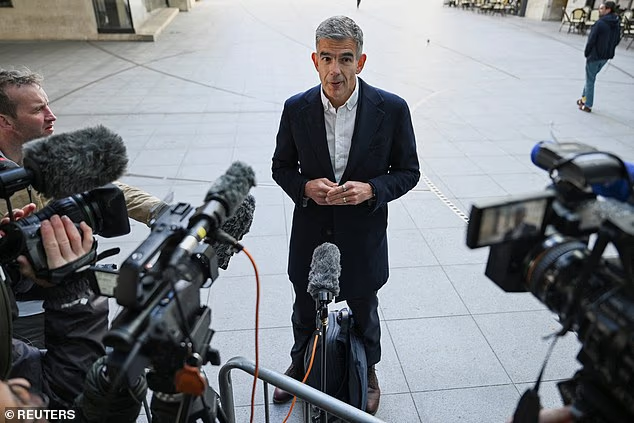
New director-general Matt Brittin, 57, has been in the job just six weeks but is already potentially bringing in a major shake-up with a mandatory household levy to replace the ‘busted flush’ optional TV licence model

It comes as it was revealed that licence fee income has dropped by more than £1billion in real terms in the last decade. Half a million licencees stopped paying the fee in the last financial year and the price has now been bumped up to £180 a year

Culture Secretary Lisa Nandy said ‘no decisions’ had been made on introducing the levy earlier this month
The new director-general has previously described the licence fee model as a ‘busted flush’ which is ‘no longer fit for purpose’.
The licence fee price has gone up to £180 a year from April 1, up from £174.50.
But the hike in price appears not to be sufficient, as Mr Brittin floated the idea of introducing a ‘streaming levy’, which would expand the scope of the licence fee to include anyone who watches content on Netflix, YouTube, TikTok or other types of internet video streaming.
But he did tell MPs last week about the ‘appealing’ possibility of concessions for young people and low-income households in paying the fee.
However, Culture Secretary Lisa Nandy said ‘no decisions’ had been made on introducing the levy earlier this month.
She told BBC Radio 4’s Today programme: ‘I think there are different ways of doing a household levy. But every time I have a discussion about the BBC licence fee, if an option is put to me, people assume if I don’t rule it out that the Government has some kind of secret plot to introduce it.
‘I can tell you, hand on heart, that we have made no decisions about this.
‘We’re talking to the BBC about it. We’re also about to go out, as part of the charter process, and consult with the public. We’re determined to get this right.
‘What is not negotiable is that we will fund the BBC properly. That is a commitment that we have made.
‘What is up for negotiation is how we do that, because it has to be sustainable and it has to command public support.’
Mr Brittin stressed the need for the BBC to reinvent itself.
The former Google executive told the committee: ‘I think the onus on us is to reinvent the BBC for the world we’re now in, and that requires us to focus on the audience value, the public service value, of the BBC, what does that mean today?
‘The economic impact, and I think last week we published a sort of an updated report that shows the scale of that impact.
‘And in this moment of geopolitical and international disruption by the scale of technology and innovation to come, the sovereignty impact, British values and how they’re portrayed in the world and how the world sees us.
‘And I think on that third one, we also published last week a report that shows that the BBC is reaching over half a billion people around the world, something we should be really proud of.
‘So the opportunity, I think, for us is to reinterpret the BBC’s mission with today’s technology and today’s setting – that will imply quite a lot of change, and as we discussed last week, also a rethink of the funding mechanism, if we’re to have a BBC that has sufficient universality, scale and sustainability.’
If a household levy was introduced and 100 per cent of households are made to pay – as currently around only 80 per cent pay for a licence – the price could be reduced for users and it would save the BBC hundreds of millions in collection and enforcement costs.
Though critics have raised questions over being made to pay for a service they might not actually be using.
As it stands, the annual report said the BBC’s financial outlook ‘deteriorated’ in the second half of 2025.
Mr Brittin replaced former BBC head Tim Davie, who resigned in November 2025 over the controversial BBC Panorama edit of Donald Trump’s speech on January 6, 2021, which made it sound like he encouraged the attack on the US Capitol.








































You must be logged in to post a comment Login