Connect with us

NewsBeat

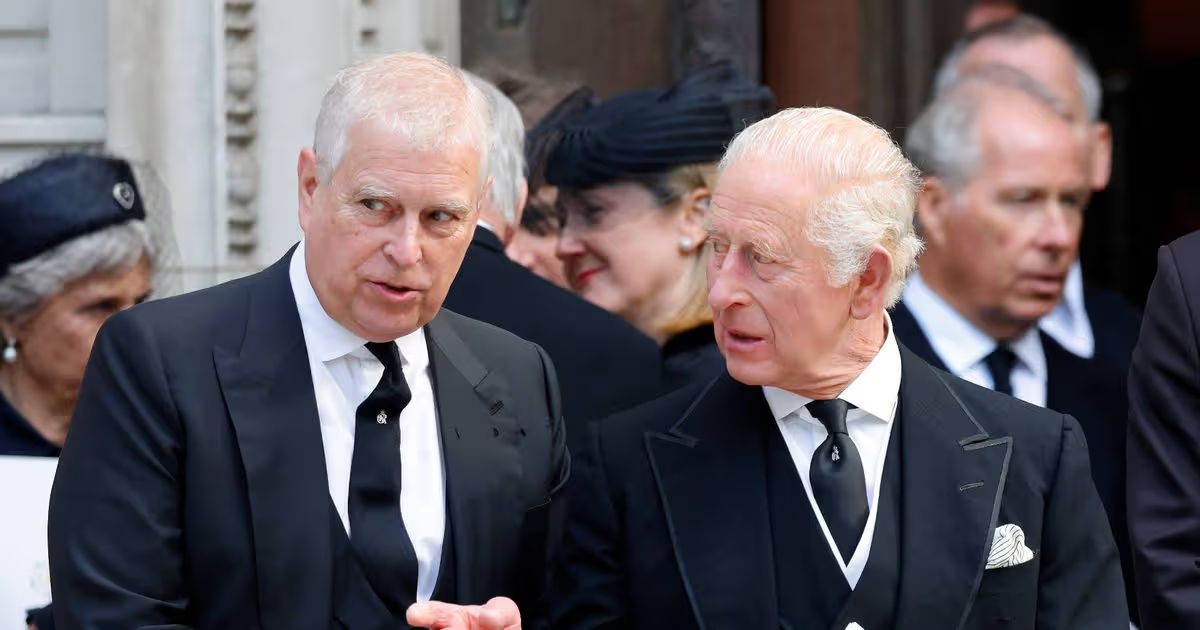
King Charles breaks Andrew silence and ‘ready to support’ police if approached over Epstein claims

Published

on

Daily Record

Buckingham Palace released a statement on Monday evening expressing the King’s ‘profound concern.’

The King has made clear his “profound concern” at allegations over Andrew Mountbatten-Windsor’s conduct and will “stand ready to support” the police if approached over the claims.

Andrew, 65, is accused of sexually assaulting women who were allegedly trafficked by Epstein, claims he has always denied. The former Duke of York’s name has appeared numerous times in the latest batch of documents released last month by US investigators looking into Epstein’s crimes, reports the Mirror.

Among them are claims that a second woman was sent to the UK by Epstein for a sexual encounter with Andrew, and that Andrew and Epstein had asked an exotic dancer for a threesome in Epstein’s Florida home.

Advertisement

United States authorities have repeatedly urged Andrew to speak to them, while Prime Minster Keir Starmer has also called on Andrew to give any evidence he knows of Epstein’s crimes Today Thames Valley Police confirmed it is assessing a complaint that Andrew passed on reports gathered during his role as a trade envoy on trips to Singapore, Hong Kong and Vietnam.

An email from November 2010, was forwarded by Andrew just five minutes after being sent by his then-special advisor, Amir Patel. Andrew Mountbatten-Windsor made the visits in his capacity as trade envoy in late 2010, conducting meetings and trade talks.

Additionally, on Christmas Eve 2010, Andrew discussed a confidential brief on investment opportunities in the reconstruction of Helmand Province, Afghanistan with Epstein.

A Buckingham Palace spokesman said tonight: “The King has made clear, in words and through unprecedented actions, his profound concern at allegations which continue to come to light in respect of Mr Mountbatten-Windsor’s conduct.

Advertisement

“While the specific claims in question are for Mr Mountbatten-Windsor to address, if we are approached by Thames Valley Police we stand ready to support them as you would expect.

“As was previously stated, Their Majesties’ thoughts and sympathies have been, and remain with, the victims of any and all forms of abuse.”

The Palace has not so far been approached by Thames Valley Police over claims that Andrew shared confidential reports from his role as the UK’s trade envoy with sex offender Jeffrey Epstein.

The Palace has not so far been approached by Thames Valley Police over the claims which relate to Andrew’s time as the UK’s special representative for international trade and investment.

Advertisement

The Prince and Princess of Wales meanwhile publicly addressed the Epstein scandal for the first time on Monday, with Kensington Palace saying they were “deeply concerned” at the “continued revelations” and that their thoughts “remain focused on the victims”.

Source link

Continue Reading
Click to comment

Leave a Reply

Your email address will not be published. Required fields are marked *

NewsBeat

Winter Olympics latest: Live updates from Milan-Cortina

Published

on

Mia Brookes competes at the Winter Olmypics. Pic: Cal Sport Media via AP Images

<a href='https://www.skysports.com/live-blog/15234/13502613/winter-olympics-2026-live-milan-cortina-news-schedule-updates-latest-results-todays-events-as-team-gb-aim-for-record-breaking-medal-haul'>Winter Olympics live: See how British hopes are faring</a>

Source link

Continue Reading

NewsBeat

No new Michelin Stars for Manchester as city leaves prestigious awards empty handed

Published

on

Manchester Evening News

Greater Manchester’s restaurant scene may have been hoping for some more Michelin Stars but were left disappointed

The Michelin Guide Great Britain & Ireland has unveiled its new stars for 2026. At its official ceremony held in Dublin this evening a total of 22 Michelin Stars and seven Green Michelin Stars were handed out to a variety of venues.

Advertisement

The ceremony, which marked the first time the awards were held in Ireland, saw all the new star ratings announced for the guide, which is considered to be the most prestigious of all the culinary honours.

Sadly for Greater Manchester there were no new stars awarded to the region. Despite picking up a new star for Skof last year, the 2026 edition saw the city and surrounding area leave the awards empty handed.

Try MEN Premium NOW for just £1

Mana and Skof, Manchester’s only Michelin-starred restaurants, may have been hoping for a second star but were also left disappointed – however both have retained their Michelin Star. Restaurants that achieved two Michelin stars were Row on 5 in London and Bonheur by Matt Abé.

Advertisement

Mana was the first Manchester restaurant to receive a new star in 40 years when it landed its first in 2019. The last Greater Manchester restaurant to have a star before this was Juniper in Altrincham, which held it for 11 years until chef Paul Kitching left in 2009.

In 2025, Skof was awarded a Michelin Star – less than a year after opening in Manchester city centre. Presided over by former L’Enclume chef Tom Barnes, it first opened in May 2024 and quickly became one of the hottest tables in town with reservations booked out for months.

Despite no new stars, Greater Manchester is firmly on Michelin’s radar, as last week two venues in Greater Manchester received a Bib Gourmand. The Michelin Guide introduced the Bib Gourmand back in 1997, to acknowledge the restaurants and venues that serve high-quality food at great value across the country.

Advertisement

Erst in Ancoats and Cantaloupe in Stockport were both bestowed the honour. They joined The Sparrows in Cheetham Hill, Higher Ground on the edge of Chinatown and El Gato Negro who all have a Bib Gourmand too.

Elsewhere in proceedings for the night, Northern restaurants that shone out included Fifty Two at Rudding Park, Harrogate, and Joro in Oughtibridge, Sheffield, which both took home a Michelin Star. Beyond this, the majority of new stars were handed to restaurants in capital.

Tom Earnshaw took home Young Chef of the Year. The Executive Chef presides over Bohemia, the only Michelin-starred restaurant in Jersey. He cooked at Michelin-starred restaurants including Lancashire’s Moor Hall and Northcote in Lancashire, as well as the Sampling in Cumbria before first joining Bohemia as a sous chef in 2023.

Advertisement

The full list of Michelin Stars for Great Britain & Ireland 2026:

One Star:

  • Legado, Shoreditch, London
  • The Pullman, Galway
  • The Boat, Lichfield
  • Fifty Two at Rudding Park, Harrogate
  • 1887, Torridon, Scotland
  • Tom Brown at The Capital, London
  • Ugly Butterfly, Newquay
  • Ambassadors Clubhouse, London
  • Joro, Oughtibridge
  • Restaurant Gordon Ramsay High, London
  • Vraic, Vale, Guernsey
  • Somssi by Jihun Kim, London
  • The WIlderness, Birmingham
  • Labombe by Trivet, London
  • The Kerfield Arms, London
  • Michael Caines at the Stafford, London
  • Corenucopia, Chelsea
  • Killiecrankie House, Pitlochry
  • Mare, Brighton and Hove
  • Forest Avenue, Dublin

Two Star:

  • Row on 5, London
  • Bonheur by Matt Abe, London

Three Star:No new awards for 2026

Source link

Continue Reading

NewsBeat

The Scottish landmark 500 years older than Stonehenge on a tiny remote isle

Published

on

Daily Record

The little known Scottish landmark older than Stonehenge sits on a remote island reached by the world’s shortest commercial flight

An incredible Scottish landmark older than Stonehenge is one many Britons have never heard of. Stonehenge in Wiltshire is estimated to be between 4000 and 5000 years old and remains one of the country’s most visited historic attractions.

It is often considered Britain’s most famous ancient monument, yet it is only one of many prehistoric sites scattered across the country. According to historians, it is not even the oldest. One lesser known landmark that predates Stonehenge sits on a remote island that can be reached by taking the world’s shortest commercial flight, Express reports.

Many of the UK’s most isolated islands lie off the rugged coast of Scotland. One of these islands is home to what is believed to be the oldest preserved stone house in northern Europe. Despite its remote location, the site attracts visitors with a strong interest in Neolithic Britain. Local experts say it is at least 500 years older than Stonehenge.

Advertisement

The site is known as the Knap of Howar and is located on the island of Papa Westray in Orkney. Historians describe it as a Neolithic farmstead, with evidence showing it was occupied between 3800 BC and 2800 BC. This places it at almost 6000 years old.

Reaching the Knap of Howar involves travelling on the flight from Westray to Papa Westray, recognised as the world’s shortest scheduled commercial journey. While most air passengers are used to flights lasting hours, this trip takes just over a minute.

At the site, visitors can see rectangular stone buildings with thick walls and short doorways facing the sea. The larger structure is believed to have served as a workshop, while the smaller building is thought to have been used as a home.

Advertisement

Historians believe the roofs once had openings to allow smoke from indoor fires to escape, as there were no windows. Although the buildings would originally have stood further inland, thousands of years of coastal erosion have brought them close to the shoreline.

Much of the stone furniture inside the buildings remains intact, offering a rare insight into daily life during the Neolithic period. Archaeologists have uncovered a range of objects that shed light on the lives of the site’s early inhabitants.

These include distinctive stone tools such as grinders and borers, an antler and whalebone macehead, and animal remains that provide information about the diet of Scotland’s earliest farmers.

Advertisement

Historic Environment Scotland says the wider area has not yet been fully explored. This suggests the two visible buildings may once have formed part of a larger settlement yet to be uncovered.

Visitors frequently praise the site for its preservation and atmosphere. One TripAdvisor reviewer, who called it a “magical place”, said: “In addition to the wonderful Neolithic remains, which are enough reason to visit Papay, this is a beautiful place for a picnic, looking across to Westray.”

Another shared: “A day trip here (from Westray) is a must. To visit northern Europe’s oldest building and have it all to yourself. We got the boat from Westray and walked up and down the small island for the day. Hardly saw anyone else at all.”

A third wrote: “The dresser, fireplace, quernstone, sleeping areas and storeroom areas are all clearly visible. It is a short walk down from the farm. It is astonishing!

Advertisement

“You can feel the difference when you enter the rooms The ever present wind suddenly is no longer roaring in your ears, and you understand: The neolithic people who built this settlement, perhaps 500 years before Skara Brae on Mainland Orkney, probably were not much different from yourself.

“They would have wanted shelter, warmth, and places to store and organise their belongings and foodstuffs.”

Orkney is home to several other notable ancient sites, including the Ring of Brodgar, the Stones of Stenness and the Maeshowe tomb.

Source link

Advertisement
Continue Reading

NewsBeat

Curling pair Jen Dodds and Bruce Mouat ‘gutted’ after Team GB Winter Olympics shock

Published

on

Wales Online

Team GB’s mixed doubles curling duo Jen Dodds and Bruce Mouat suffered semi-final heartbreak at the Winter Olympics

Team GB’s mixed doubles curling pair Jen Dodds and Bruce Mouat saw their medal dreams dashed in a devastating semi-final defeat at the Winter Olympics.

Advertisement

The British duo entered their semi-final clash with Sweden as strong contenders, having topped their round-robin group.

Their sole group stage defeat had come at the hands of the very same Swedish opposition.

However, Sweden proved to be their Achilles heel once more, as Great Britain succumbed to a comprehensive 9-3 defeat, extinguishing their hopes of securing gold or silver.

They now face either Italy in the bronze medal match as they aim for a consolation.

Advertisement

READ MORE: Lindsey Vonn breaks silence from hospital bed ‘in intensive care’ after sickening ski crashREAD MORE: Winter Olympics investigation launched as fuming athletes share video evidence

This marks the second consecutive Winter Olympics where the pair have fallen short of reaching the gold medal match.

Four years ago in Beijing, they also missed out on a podium finish in the bronze medal contest – a result they’ll be desperate to overturn this time.

The pivotal moment came in the fifth end, when errors from both British curlers handed Sweden’s sibling duo Rasmus Wrana and Isabella Wrana a devastating five-point haul on their power play.

Advertisement

That swing pushed the Swedes into a commanding 8-3 advantage.

BBC Sport commentator Steve Cram observed at the time: “The Swedes are trying not to get ahead of themselves but this could be a match-winning moment.”

Sweden added another point in the seventh end to seal an insurmountable lead, prompting the customary handshakes with one end still to play.

Advertisement

BBC Sport’s Richard Winton, reporting from Cortina, added: “Bruce Mouat and Jen Dodds leave the arena looking disconsolate, and no wonder.

“They’ve been in this movie before, in Beijing four years ago, and had their heart broken in the bronze-medal match.”

Responding to the loss, Mouat told BBC Sport: “We’re really gutted.

“We’ve had such a good week and it was quite exciting for us to go into this game feeling the way we were feeling but to come out and not even play close to the way we wanted to is hard to put into words really. They were the better team today.”

Advertisement

Dodds has also revealed how they will look to bounce back for the bronze medal match, which will take place at 1.05pm on Tuesday. “We’ll probably speak to our coaches and speak things through and regroup for tomorrow,” she said.

“We don’t want this to affect our chances of a medal tomorrow so we’ll speak about the things that need to be spoken about and corrected and we’ll come out firing tomorrow.”

Source link

Advertisement
Continue Reading

NewsBeat

BBC Death in Paradise fans fume over ‘unfair’ schedule change

Published

on

Wales Online

BBC’s Death in Paradise has been moved from its usual slot and fans are not happy

Fans of Death in Paradise expressed their frustration over the weekend after the BBC announced the popular crime drama would be bumped from its scheduled slot, with football coverage taking priority. The new season of the Caribbean crime drama kicked off on January 30, and ever since there has been a new episode every Friday.

Advertisement

The show has announced that this weekend there will be a major schedule change for the series, as it’s been bumped to make way for the FA Cup.

A statement on the show’s Instagram account informed followers: “Quick heads up: due to football, this week’s #DeathInParadise will be on BBC iPlayer this Friday, but it won’t be on BBC One until Monday night!”

The accompanying graphic confirmed that the third instalment of the current series would now broadcast on BBC One on Monday, February 16 at 9pm, whilst becoming available on iPlayer from 8.45pm on Friday, February 13. For the latest TV and showbiz gossip sign up to our newsletter

Viewers were far from pleased with the schedule shake-up, questioning why the beloved programme should be sidelined for sport.

Advertisement

One disappointed fan commented: “Not fair to move DiP for the football – Mervin can’t watch football as he wasn’t allowed to install a satellite dish outside the shack!”.

Another protested: “No! Why can’t the football be moved?”

A third queried: “Does that mean we will get two episodes that week?”

However, not all responses were negative, with some praising the current series.

One viewer remarked: “Just watched episode two, really enjoyed it. The team are pulling together nicely.”

Another commented: “It is very good,” whilst someone else declared: “Loving the new series.”

The 15th series launched with fresh episodes and exciting guest stars. The series continues on a weekly basis, with DI Mervin Wilson tackling fresh perplexing murder cases whilst navigating his complicated relationship with his estranged half-brother, Solomon, and integrating new team member Sergeant Mattie Fletcher.

Advertisement

However, the conclusion of series 14 left viewers worried about the fate of one particular character who seemed to be departing the programme.

Don Warrington, widely recognised for his portrayal of Commissioner Selwyn Patterson in the BBC detective drama since its launch in 2011, has now addressed speculation surrounding his future on the show.

In an exclusive conversation with Express.co.uk at the TV Choice Awards in London, the 74 year old actor was asked about his plans for remaining with Death in Paradise. He responded: “Well, that is the question, who can answer? Who really knows? Life is just always a surprise. I’ll just have to keep you guessing.”

Yet he became slightly more forthcoming, revealing that whilst the programme remains on air, he intends to continue in his role: “As long as the show is going, then I am happy to keep going.”

Advertisement

You can watch Death in Paradise on BBC iPlayer and BBC One.

Source link

Continue Reading

NewsBeat

What's going on if your hips always feel tight no matter how much you stretch?

Published

on

What's going on if your hips always feel tight no matter how much you stretch?

!function(n){if(!window.cnx){window.cnx={},window.cnx.cmd=[];var t=n.createElement(‘iframe’);t.display=’none’,t.onload=function(){var n=t.contentWindow.document,c=n.createElement(‘script’);c.src=”//cd.connatix.com/connatix.player.js”,c.setAttribute(‘async’,’1′),c.setAttribute(‘type’,’text/javascript’),n.body.appendChild(c)},n.head.appendChild(t)}}(document);(new Image()).src=”https://capi.connatix.com/tr/si?token=19654b65-409c-4b38-90db-80cbdea02cf4″;cnx.cmd.push(function(){cnx({“playerId”:”19654b65-409c-4b38-90db-80cbdea02cf4″,”mediaId”:”83926584-688b-4dc5-855a-80afd4103076″}).render(“6989ead6e4b02d49a7797b8a”);});

Source link

Continue Reading

NewsBeat

Two men tried to throw drugs and phone into Frankland Prison

Published

on

Two men tried to throw drugs and phone into Frankland Prison

Stephen Jones and Gary Muldoon were arrested after an incident outside Frankland Prison in Durham.

They entered their guilty pleas during a short hearing at Teesside Crown Court on Monday (February 9) morning.

Judge Francis Laird KC, the Recorder of Middlesbrough, said: “You have both pleaded guilty to serious offences and the overwhelming likelihood is that you will receive a prison sentence.

Advertisement

“However, I have been persuaded that there are matters that a pre-sentence report would assist in determining what that sentence is.”

Jones, 57, of St Marks Road, Liverpool, and 42-year-old Muldoon, of Helmsley Road, Liverpool, both pleaded guilty to trying to two charges of trying to convey prohibited items into Frankland Prison in Durham on November 27, 2024.

They were released on conditional bail until they are sentenced on Friday, March 20.

Advertisement

Source link

Continue Reading

NewsBeat

Teen arrested after alleged knife incident in school canteen where staff ‘restrained’ him

Published

on

Wales Online

Staff reportedly had to restrain the boy, 14, until police arrived at the school.

Police descended on a school today following reports a teenage pupil injured another in an incident involving a knife.

A pupil, 14, from Haute Vallée secondary school in Jersey was arrested from the premises today after reports of a knife incident.

Advertisement

The headteacher confirmed in a statement that a “very serious incident” occurred in the school canteen which left a pupil with a “very minor injury to the hand”, reports the Mirror.

The message to parents from headteacher Stuart Hughes on Facebook reads: “I am writing to inform you about a very serious incident that took place at Haute Vallée School at the end of lunchtime today.

“A 14-year-old male was involved in an incident involving a knife in the canteen. Members of staff acted swiftly and decisively to restrain the teenager, and the police arrived imminently. The 14-year-old has been arrested. I want to reassure you that everyone is safe. One student has sustained a very minor injury to their hand. There are no other reported injuries.”

Mr Hughes said police were examining CCTV footage and that Year 7 students have been provided with “reassurance and support”.

“Officers from the States of Jersey Police are currently on site and working closely with us to support students and staff and reviewing CCTV of the incident,” continued the headteacher. “As part of our response, I spoke to all students in an assembly this afternoon, alongside the Police. Year 7 students were addressed separately in the Theatre to ensure they received appropriate reassurance and support.

“All staff were briefed at the end of the school day and wellbeing support for both students and staff is already in place and will continue over the coming days. I apologise that I was unable to communicate with you sooner; I hope that you understand that our initial priority had to be to ensure the safety and wellbeing of students and staff as we managed the situation.

“I would like to say how proud I am of our school community. Staff responded swiftly with exceptional professionalism, and students were calm, respectful, and supportive of one another throughout. As this is a live police investigation, I am unable to comment further at this stage, but I would like to stress that this is an extremely rare incident.

Advertisement

“If your child is worried or upset over the coming days, please encourage them to speak with their tutor, Head of Year, or a member of our pastoral team tomorrow. We will continue to ensure that every young person feels safe and supported. School will be open as normal tomorrow, please do not hesitate to get in touch if there is anything that we can do to support.

“Thank you for your understanding. I sincerely appreciate parental response and support in this matter. I wish to stress once again that this is an extremely rare incident in which we are working closely with the States of Jersey Police and Education Department colleagues to further understand the events that occurred and ensure that the safety and wellbeing of students and staff is paramount.”

Jersey Police has been contacted for comment.

Source link

Advertisement
Continue Reading

NewsBeat

Face of a ‘vampire’ revealed: Science rebuilds likeness of man decapitated after death to stop him coming back | Science, Climate & Tech News

Published

on

Face of a 'vampire' revealed: Science rebuilds likeness of man decapitated after death to stop him coming back | Science, Climate & Tech News

The face of a “vampire” whose remains were posthumously mutilated to prevent them rising from the dead can be seen for the first time in more than 400 years.

Discovered in a grave at Racesa, a fortress in eastern Croatia, the body had been exhumed, beheaded and reburied face down beneath heavy stones.

And since the desecration cannot be explained by environmental factors, experts believe it was done to stop the dead man returning as a vampire.

Now the face of the deceased can be seen for the first time in centuries, after scientists rebuilt his likeness from his skull.

Advertisement
Image:
The reconstructed face starts to take shape. Pic: Cicero Moraes

Archaeologist Natasa Sarkic, part of the excavation team, said the fear inspired by the man in death may stem from the fear he inspired in life.

She said: “Bioarchaeological analysis showed that this man often participated in violent conflicts, and died a violent death.

“He experienced at least three episodes of serious interpersonal violence during his lifetime.

“One of those attacks left his face disfigured, which could cause fear and repulsion, leading to social exclusion.

Advertisement

“Before even recovering from the penultimate trauma, he sustained a final fatal attack.”

Photo shows the skull of the 'vampire' in situ. Pic: Natasa Sarkic
Image:
Photo shows the skull of the ‘vampire’ in situ. Pic: Natasa Sarkic

The deadly head wound that killed the Racesa 'vampire'. Pic: Natasa Sarkic
Image:
The deadly head wound that killed the Racesa ‘vampire’. Pic: Natasa Sarkic

She continued: “Individuals who died violently, behaved violently in life, or were considered sinful or socially deviant, were believed to be at risk of becoming vampires.

“He may have been regarded as a ‘vampire’, or a supernatural threat due to his facial disfigurement and his marginal lifestyle, characterised by repeated interpersonal violence.

“Such beings were thought to be restless, vengeful, and capable of harming the living, spreading disease and killing people or livestock.”

Dr Sarkic said that, in the Slavic tradition, the soul remains attached to the body for about 40 days after death.

Advertisement
The exacavation at Racesa fortress. Pic: Muzej Nova Gradiska
Image:
The exacavation at Racesa fortress. Pic: Muzej Nova Gradiska

In this time, various preventative measures could be used to prevent the dead from returning as vampires.

These included staking, burning or beheading the corpse, burying it face down, weighing it down with stones and binding the limbs.

This burial therefore showed “practices commonly associated with ‘anti-vampire’ rituals at the time”, Dr Sarkic said.

To complete the reconstruction, graphics expert Cicero Moraes started by virtually rebuilding the man’s skull using data from a CT scan.

The reconstruction of the skull in progress. Pic: Cicero Moraes
Image:
The reconstruction of the skull in progress. Pic: Cicero Moraes

Pic: Cicero Moraes
Image:
Pic: Cicero Moraes

“Although the skull was somewhat fragmented at the time of its discovery, it was possible to reconstruct and digitise it,” Dr Sarkic said.

More data from living donors was then used to plot the likely placement of facial features, and the thickness of soft tissue in different places across the skull.

Advertisement

A technique called anatomical deformation was also used, whereby a donor’s head is virtually adjusted until it matches the subject’s skull, revealing a potential face.

Combining these approaches revealed an objective face, based solely on the shape of the skull, without subjective features like hair or skin tone.

The objective version of the reconstructed face. Pic: Cicero Moraes
Image:
The objective version of the reconstructed face. Pic: Cicero Moraes

Pic: Cicero Moraes
Image:
Pic: Cicero Moraes

A second version of the face is more artistic, introducing some of these speculative elements for a more life-like recreation.

Mr Moraes said it was a “hostile, threatening” likeness.

“The facial scar and other injuries obtained during his life are quite a significant sign that his life may have been rather turbulent,” he said.

Advertisement
The final version of the reconstructed face. Pic: Cicero Moraes
Image:
The final version of the reconstructed face. Pic: Cicero Moraes

The Racesa “vampire” lived in the 15th or 16th century, was roughly 5ft 4in tall, and is believed to have died between the ages of 40 and 50.

Given his injuries, he may have been a soldier, or simply a person accustomed to violent encounters.

He was buried inside what seems to have been a church, though his grave was in the “the most disfavoured spot” along the wall.

The grave of the Racesa 'vampire'. Pic: Natasa Sarkic
Image:
The grave of the Racesa ‘vampire’. Pic: Natasa Sarkic

And it seems his head was literally pulled from his body, since there are no cut marks consistent with decapitation on his neck, skull and shoulders.

His grave was discovered in 2023 and is one of more than 180 burials found in the fortress, which stood 70 miles southeast of Zagreb.

Further examples of vampire belief can be found elsewhere in Europe, including more desecrated graves in Poland.

Advertisement
Pic: Natasa Sarkic
Image:
Pic: Natasa Sarkic

Pic: Cicero Moraes
Image:
Pic: Cicero Moraes

In Serbia, meanwhile, the body of Petar Blagojevic was staked through the heart, and burnt as a suspected vampire after his death in 1725.

While Jure Grando Alilovic, a Croatian villager who died in 1656, is described as a vampire in historical records.

Read more:
Face of ‘most important’ 8,500-year-old American revealed
Face of 75,000-year-old Neanderthal woman reconstructed

Racesa itself is believed to have been occupied first by the Templars, then the Knights Hospitaller, and finally by the local nobility.

Mr Moraes, Dr Sarkic and their co-authors published their study in the journal OrtogOnLineMag.

Advertisement

Source link

Continue Reading

NewsBeat

Which countries are best-placed to see off state-supported cyber-attacks? A government advisor explains

Published

on

Which countries are best-placed to see off state-supported cyber-attacks? A government advisor explains

In April 2007, the Baltic nation of Estonia woke up to one of the world’s first major cyber-attacks on civil society carried out by a state. A series of massive “distributed denial of service” assaults – floods of fake traffic from networked computers – targeted government websites, banks, media outlets and online services for weeks, slowing or shutting them down.

These cyber-attacks followed Estonia’s decision to relocate a Soviet-era war memorial and war graves from the centre of the capital city, Tallinn, to a military cemetery.

Amplified by false reports in Russian media, this sparked nights of protest and rioting among Russian-speakers in Tallinn – and cyber chaos throughout the country. Though the cyber-attack was never officially sanctioned by the Kremlin, the “faceless perpetrators” were later shown to have Russian connections.

Estonia has since transformed itself, in part through voluntary initiatives such as the Cyber Defence Unit (a network of private-sector IT experts), into a leader in this field. It is home to Nato’s Cyber Defence Centre of Excellence, and ranks fifth in the International Telecommunication Union’s global cybersecurity index – alongside the UK.

Advertisement

The massive 2007 cyber-attack on Estonia explained. Video: Cybernews.

But in many ways, Estonia is far ahead of Britain in its cybersecurity planning. A 2025 government review found that nearly one-third of the UK’s public sector IT systems were “critically vulnerable” due to historical underinvestment – with some aspects of the police and NHS at particular risk.

International cyber-attacks on the UK increased by 50% last year. “Nationally significant” incidents rose from 89 to 204 – including, in September 2025, a major ransomware attack on Jaguar Land Rover that halted production for a month, causing losses of around £1.9 billion.

Amid these threats, the UK government recently launched its Cyber Action Plan and held the first ever cross-party international security briefing – co-chaired by the National Cyber Security Centre’s CEO, Richard Horne.

Advertisement

So can this more preemptive approach staunch the flow of cyber-attacks on the UK? In my experience of advising European and Asian governments on cybersecurity matters, the problem is that nothing is ever urgent – until everything is.

Cyber-attacks could shatter public trust

A key worry for British ministers is that an attack on government systems could shatter public trust. Imagine welfare benefits going unpaid, tax returns being ignored and health records frozen amid a major ransomware crisis.

The new plan prioritises central government digital services including tax, benefits, health records and identity verification. Pledging £210 million in additional funding, it promises to address the difficulty of attracting highly paid private-sector engineers, analysts and penetration (“pen”) testers to the public sector. Defence companies, specialist security firms and big tech typically pay 30-50% higher salaries.

While establishing a Government Cyber Unit is welcome, its phased rollout to 2029 feels too leisurely amid the level of threats the UK (and other countries) now face. Groups linked to Russia and China in particular are dramatically increasing the volume and sophistication of cyber-attacks. They combine state resources with criminal ecosystems to exploit the vulnerabilities of years of IT under-investment much faster than most cyber-defences can adapt.

Advertisement

Rapid developments in AI technology are also making the threat more severe – for example, through highly personalised phishing attacks and use of deepfakes. Defenders are struggling to keep up with the scale and constantly changing nature of these threats.

Interview with the UK’s National Cyber Security Centre CEO, Richard Horne. Video: McCrary Institute for Cyber and Critical Infrastructure Security, Auburn University.

Who leads the way on cyber-defence?

The US is in a league of its own when it comes to cyber-defence. The federal government alone spends an annual US$25 billion (£18 billion) on defending its IT systems, compared with the UK’s £2-2.6 billion.

Australia’s budget – A$6.2 billion (£3.2 billion) – also exceeds the UK’s, despite its much smaller population. It enforces strict rules such as 12-hour critical incident reporting and, most importantly, has prioritised investing in new technologies.

Advertisement

Countries that are ahead of the cybersecurity curve show the same ingredients work: mandatory rapid reporting of incidents, serious investment in AI-powered monitoring, real-time sharing of information between government and private sectors, and strong international partnerships.

What came as a shock to Estonia in 2007 has been hitting European institutions and infrastructure for years now. Since Russia launched its full-scale invasion of Ukraine four years ago, it has woven cyber operations much more closely into its hybrid warfare playbook. In 2022, there were more than 650 documented attacks by pro-Russian groups, of which only 5% targeted Ukraine – the rest focused on Nato and other EU countries.

In contrast, China has tended to prioritise stealthy, long-term espionage, including the UK Ministry of Defence payroll breach in 2024. Iran has focused on aggressive disruption, and North Korea on seizing funds through cyber heists – the most successful of which stole US$1.5 billion in cryptocurrency by hacking into the Bybit crypto exchange.

To keep pace, the UK needs to lean harder into its alliances, including with Nato and the EU. It should insist on compulsory AI-threat training across government and key industries, and show more willingness to expose attackers publicly. A timely but measured response should at least raise the risk (and cost) of the next cyber-attack for its state-sponsored perpetrators.

Advertisement

Source link

Continue Reading

Trending

Copyright © 2025