Connect with us
DAPA Banner

NewsBeat

Labour has 45 days to pull-off an electoral miracle in Wales

Published

on

Wales Online

At around 1.20pm today, Eluned Morgan will take the lift from the fifth floor of Ty Hywel, the office block in Cardiff Bay, pass through the Senedd canteen, and head along the glass corridor towards the newly-reopened Senedd Siambr.

Placing her red ringbinder on the lectern in front of her, as she has done since she took over as First Minister on August 6, 2024, she will then face up to an hour of questions, some from her own party, but the trickier ones likely to come from Senedd members in opposing parties.

She is not alone in dreading this session. When you speak to most leaders, they say this is the bit they hate most. The chance to be caught off guard in a gotcha moment with the cameras pointing at you adds a huge level of jeopardy.

She’s previously told WalesOnline how she goes to a tranquil cove, overlooking the sea near her home in St David’s, Pembrokeshire, to sit and prepare on a Sunday for what is seen in the political world at least, as the big door prize.

Advertisement

But there is every chance this could be the last time she will carry that red folder.

As is ever the way, some of the questions she will know, the schedule shows she will be asked about higher education, nuclear regulation, Hywel Dda health board and the ongoing battle to resolve penson inequalities of Allied Steel and Wire workers.

But the follow-ups to those, or the questions she faces from the opposition leaders are not. Plaid Cymru leader Rhun ap Iorwerth and Conservative Darren Millar will both take their shots at getting a question to her they can use in the following press releases and social media clips.

In recent months, Rhun ap Iorwerth has tended to focus on why he thinks Labour in the UK administration has done little to help her party here, while the Tories tend to go for a national issue they know will sit well with right of centre voters.

This will be the last First Minister’s Questions of this, the Sixth Senedd. Anyone who has tuned into proceedings in the last few weeks will have heard the platitudes between colleagues as they thank each other for their work, and prepare – in some cases – to say goodbye.

But for her, personally, there is a lot at stake. Not only is her Welsh Labour Party facing an epic electoral battle to be re-elected, but she is too.

Advertisement

Mrs Morgan is standing in the new constituency of Ceredigion Penfro, and the projections based on current polling show she could herself find herself losing her job in the most public way possible – on a stage with cameras pointed at her when the votes have been counted on May 8.

It means that if the polls are right, and she fails to keep her seat, today isn’t just her last First Minister’s Questions, it may well be her final visit to the Siambr.

Even her rivals have questioned why she didn’t try to contest a safer seat – she does also have a home in Cardiff.

From her point of view, she’s been bullish: “I have to be able to be true to myself. So whatever happens, I’ve got to live with myself. In the future, whether I win or whether I don’t win, I have to be able to be true to myself,” she told me last August.

Advertisement

She has known for some time it is a battle of epic proportions.

Some of the reasons for that are totally outwiith her control. The tide started turning, the polls show, when Vaughan Gething had to quit as First Minister. Sir Keir Starmer’s unpopularity is something Labour activists will tell you comes up again and again, and world events impacting any chance of Labour’s cost of living promises giving any respite have all played their part.

Those sympathetic to her would say those are all issues she has no control over. The flip side is that she has been part of Labour, and the government in Wales for long enough to have made a difference long before she put her name forward to be leader. For our free daily briefing on the biggest issues facing the nation, sign up to the Wales Matters newsletter here

Advertisement

Yet as she takes to her feet, she will know that few, if any, within Labour realistically think they can perform a miracle and retain the role they have held at the top of Welsh politics for the 27 years of devolution so far, but they are banking on a bounce.

Those in and around the First Minister believe that when Labour, with all its experience and resources, gets out in earnest in the next few weeks, thjat the party faithful will be able to convince people to mark their X in the box next to the Labour rose.

But they know Plaid Cymru and Reform UK have topped polls consistently now for months. They know their local and national records are counting against them, as is the performance of the UK Government.

Advertisement

While Friday is officially the last day of Senedd business, with dissolution following Easter on April 8, it’s fair to say that the action is easing off. Attention is being diverted to campaigns, manifesto launches, and door knocking sessions.

And there will be little respite, once she leaves the chamber because just after she finishes First Minister’s Questions, we expect the latest voting intention poll by YouGov and ITV Cymru Wales to be published.

In recent months they have been nothing to cheer about, the First Minister will be one of those hoping for better news this time.


Source link

Advertisement
Continue Reading
Click to comment

You must be logged in to post a comment Login

Leave a Reply

NewsBeat

Why ‘deaths of despair’ are higher in former coal mining communities

Published

on

Why ‘deaths of despair’ are higher in former coal mining communities

Life expectancy in the UK has risen dramatically since the Industrial Revolution. For more than a century, people lived increasingly long and healthy lives. But around the turn of the millennium, that progress began to slow.

In 2015, economists Anne Case and Angus Deaton published a landmark study showing something unexpected. From the late 1990s onwards, death rates among middle-aged white Americans without university degrees had started to rise. Three causes of death were driving the trend: suicide, drug overdoses and alcohol-related disease. Case and Deaton called these “deaths of despair” and they have been a topic of research in public health ever since.

Although deaths of despair were originally thought to be a specifically American problem, researchers have been concerned that similar patterns exist elsewhere. New research from my colleague Eurwen Williams and myself suggests they do. And in England and Wales, they are particularly common in one type of place: former coal mining communities.

Coal once powered the UK’s economy. At its peak in 1920, the industry employed more than 5% of the entire UK workforce. Mining shaped towns and villages across England, Wales and Scotland. Work was hard, but it provided stable employment and strong communities. That began to change in the late 20th century.

Advertisement

Competition from imported coal, the shift to oil and gas, and political conflict between miners and government accelerated the industry’s decline. The confrontation reached its peak during the 1984 to 1985 miners’ strike against the government of Margaret Thatcher.

Within a generation, most mines had closed. For many coalfield communities, the economic shock was profound. Jobs disappeared. Local economies struggled to recover. And many areas have never fully recovered. We wanted to understand whether this long economic transition has left a lasting mark on public health.

For our study we examined whether deaths of despair are more common in former coal mining areas than elsewhere. To do this, we linked death registration data from the Office for National Statistics with historical records of coal mines and the dates they closed. This allowed us to compare mortality rates between areas with a history of coal mining and those without.

We analysed deaths between 2015 and 2023 and looked specifically at three causes – suicide, alcohol-related deaths and drug poisoning. What we found was striking.

Advertisement

Across England and Wales, deaths of despair were consistently higher in communities that once relied on coal mining. Alcohol-related deaths were particularly elevated. In some coalfield areas, they were between 27% and 52% higher than in places without a mining history.

Drug poisoning deaths were also much more common, running 23% to 53% higher than elsewhere. While suicide rates were higher too, the difference was smaller, roughly 7% to 19% higher. Perhaps most striking was the fact that these patterns appeared even in places where coal mining ended more than 50 years ago.

More than just poverty

At first glance, it may seem obvious why this happens. Former coalfield areas tend to be poorer than other parts of the country. Poverty is closely linked to poorer health.

But when we adjusted our analysis to account for differences in deprivation, something interesting happened. The gaps became smaller but they didn’t disappear.

Advertisement

Former coal mining communities still had significantly higher rates of alcohol-related deaths and drug poisoning. Suicide rates also remained elevated in areas where mines closed more recently. In other words, poverty alone cannot explain the pattern. Something deeper appears to be at work.

The legacy of industrial decline can shape communities in ways that standard economic measures struggle to capture. The loss of stable employment, the weakening of social institutions and long-term uncertainty about the future can all leave lasting effects. These pressures may contribute to the kinds of distress that lead to deaths of despair.

The legacy of coal mining persists in its former communities.
Angela Hampton Picture Library/Alamy

A wider pattern of health inquality

Our findings fit with a growing body of research on health in former coalfield communities. Previous studies have found higher rates of mental health problems in these areas. Others have identified other public health issues, including greater use of anabolic steroids and lower uptake of COVID-19 vaccines.

Taken together, these studies suggest the effects of deindustrialisation can persist for decades. Coal may be gone, but the consequences remain.

Advertisement

The decline of coal is one of the clearest examples in modern Britain of how economic transitions can reshape communities. It shows how the effects of industrial change can outlive the industries themselves.

Many economists believe the world may be entering another major economic shift. Advances in artificial intelligence are already beginning to reshape parts of the labour market.

History suggests these transitions need to be managed carefully. For decades, the UK has often relied on markets to absorb economic shocks, with limited industrial strategy to support the places most affected. But our findings highlight what can happen when communities face large economic changes without timely support.

The story of Britain’s coalfields is not just about the past. It is a reminder that economic transitions leave deep marks on people and places. And if we want to avoid repeating those mistakes, we need to learn from them.

Advertisement

Source link

Continue Reading

NewsBeat

Military aircraft crashes in Colombia killing 66 soldiers with four still missing

Published

on

Manchester Evening News

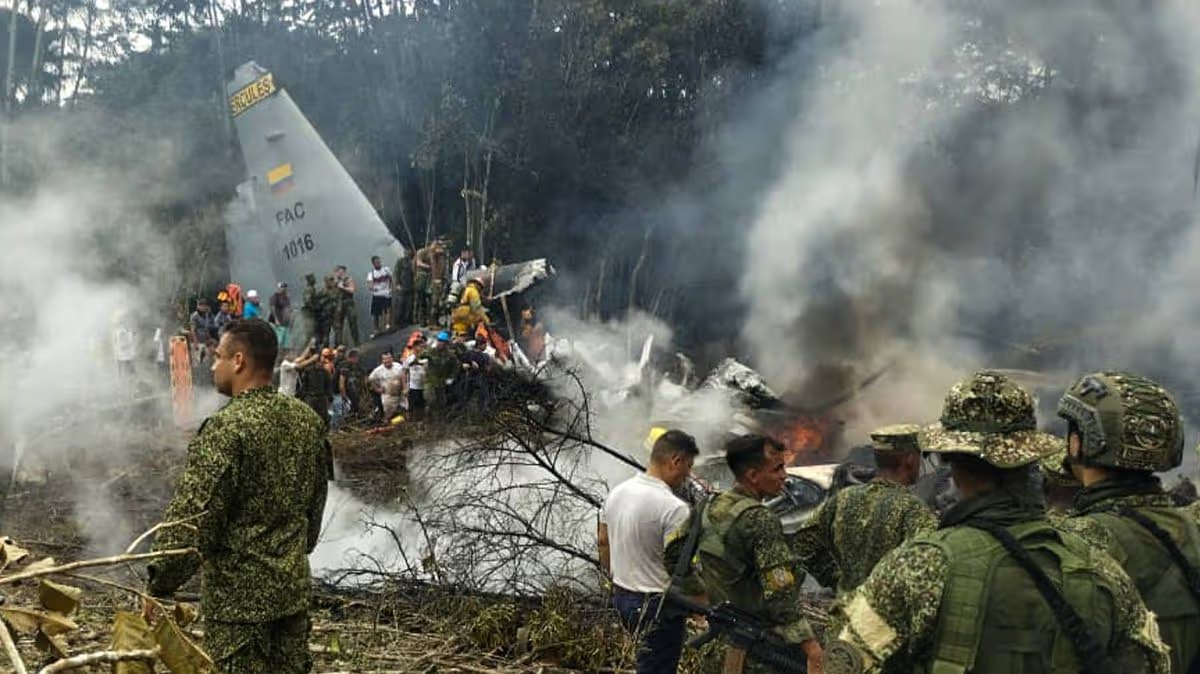
At least 66 people have died after a military transport plane carrying 128 people, mostly soldiers, crashed shortly after take-off

At least 66 people have lost their lives following a military transport aircraft crash shortly after departure in Colombia.

It is understood that 128 people were aboard, predominantly soldiers, when the aircraft went down on Monday, 23 March in Puerto Leguizamo, Colombia. Dozens have sustained injuries, the head of Colombia’s armed forces confirmed. Four military personnel remained unaccounted for.

Advertisement

Defence minister Pedro Sanchez stated on X that the aircraft was transporting troops to another city in Putumayo.

“Sadly, as a consequence of this tragic accident, 66 of our military elements died,” said General Hugo Alejandro Lopez Barreto.

“At the moment, we have no information, or indications, that it was an attack by an illegal armed group,” Mr Barreto added.

The remains of the victims have been transported to the small town’s morgue. Just two clinics in the town treated the wounded before they were airlifted to larger cities. Puerto Leguizamo is situated in Putumayo, an Amazonian province bordering Ecuador and Peru.

Footage circulated online by Colombian media outlets showed a dense black plume of smoke billowing from a field where the aircraft came down. A lorry carrying soldiers is seen racing to the scene.

Carlos Fernando Silva, the commander of Colombia’s air force, said specifics of the incident were not yet available, “except that the plane had a problem and went down about two kilometres from the airport”.

Source link

Advertisement
Continue Reading

NewsBeat

Stories of survival emerge as officials investigate cause of New York airport collision

Published

on

Stories of survival emerge as officials investigate cause of New York airport collision

NEW YORK (AP) — Moments after an Air Canada jet collided at high speed with a fire truck at New York’s LaGuardia Airport, killing the pilots and hurling a flight attendant from the aircraft, the passengers took their escape into their own hands.

With the smell of fuel in the air and debris dangling from the obliterated cockpit, passengers tore open emergency exit doors, jumped off the plane’s wings and then turned around to catch others coming up behind them, some bleeding or with head wounds.

“Strangely enough, I wasn’t scared or panicked. On the contrary, I think most of us were pretty aware of what happened,” said passenger Clément Lelièvre. “So we all went outside; we got other people out.”

About 40 passengers and crew members on the regional jet from Montreal, and two people from the fire truck, were taken to hospitals. Some suffered serious injuries, but by Monday morning, most had been released, and others walked away without needing treatment.

Advertisement

As investigators continued delving Tuesday into what caused the catastrophic wreck, stories of survival also emerged — including that of the flight attendant, found injured but alive outside the aircraft.

Lelièvre credited the pilots’ “incredible reflexes” with saving lives. The pilots braked extremely hard just as the plane touched down, he said.

The collision late Sunday came after the fire truck was given permission to check on another plane that had aborted its takeoff after reporting an odor on board and started crossing the tarmac. An air traffic controller can be heard on airport communications frantically telling the fire truck to stop.

Roughly 20 minutes later, the controller appears to blame himself. “We were dealing with an emergency earlier,” the controller said. “I messed up.”

Advertisement

A key for investigators will be examining coordination of the airport’s air traffic and ground traffic at the time of the crash, said Mary Schiavo, a former Department of Transportation Inspector General.

Transportation Secretary Sean Duffy said LaGuardia is “well-staffed” but faces a shortage of controllers.

The runway where the crash happened is likely to be closed for “days” during the investigation, Jennifer Homendy, chair of the National Transportation Safety Board, which is leading the investigation, said at a news conference Monday. Investigators need to sift through a lot of debris, she said.

Authorities recovered the plane’s cockpit and flight data recorders by cutting a hole in the aircraft’s roof and then drove them to the NTSB lab in Washington for analysis, Homendy said.

Advertisement

It was too early in the investigation to answer many questions about the accident, but more information was expected to be released Tuesday, she said.

The crash shut down LaGuardia — the New York region’s third busiest hub — during what was already a messy time at U.S. airports because of a partial government shutdown.

Flights resumed Monday afternoon on one runway and with lengthy delays. The shutdown caused some disruptions at other airports, too, especially for Delta, which has a major presence at LaGuardia.

There were 72 passengers and four crew members aboard the Jazz Aviation flight operating on behalf of Air Canada, according to the airline. The flight originated at Montreal-Pierre Elliott Trudeau International Airport. Canada has also sent a team of investigators.

Advertisement

The pilot and copilot who died in the first fatal crash at LaGuardia in 34 years were both based out of Canada, said Kathryn Garcia, executive director of the Port Authority of New York and New Jersey, which operates the airport.

Jeannette Gagnier, the great aunt of one of the pilots, identified him as Antoine Forest, and said he always wanted to be a pilot.

Air traffic controllers are not impacted by the partial government shutdown that has caused long delays at airport security checkpoints in recent days. They have been affected by past shutdowns.

The FAA has been chronically short on air traffic controllers for years.

Advertisement

LaGuardia is one of 35 major U.S. airports with an advanced surface surveillance system designed to help keep track of planes and vehicles crossing the airport.

An alarm heard in the background of the air traffic control audio was likely from the system and would have alerted the tower to the potential collision, Former FAA air traffic control chief Mike McCormick said.

FAA statistics show there were 1,636 runway incursions last year.

___

Advertisement

Associated Press reporters Michael R. Sisak, Anthony Izaguirre and Mae Anderson in New York; Rob Gillies in Toronto; Josh Funk in Omaha, Nebraska; Kathy McCormack in Concord, New Hampshire; and Hallie Golden in Seattle contributed.

Source link

Advertisement
Continue Reading

NewsBeat

Sexism at football – a problem that isn’t going away

Published

on

Marcus Rashford showing his support for campaign group Her Game Too by wearing a T-shirt showing their logo

In the lead-up to the recent men’s Manchester derby, officers from Greater Manchester Police (GMP) and partner organisations were deployed across the city to raise awareness of Violence Against Women and Girls (VAWG) and protect vulnerable people.

The United Nations defines VAWG as acts of gender-based violence that cause physical, sexual or psychological harm. While that includes serious crimes such as domestic abuse and sexual violence, experts say casual misogyny and sexist comments can also contribute by reinforcing gender inequality.

Fans in Manchester were encouraged to recognise abuse and challenge it.

Ch Supt Colette Rose – head of specialist operations at GMP – said: “I think VAWG is a societal problem. It’s high on the national agenda. It leaks into every aspect of our society, and that includes sports and football.

Advertisement

“What we tend to see at football is predominantly a male-dominated fanbase. If we can work with males around behaviours that may make women feel unsafe or intimidated and educate people, that will have an impact on wider society.”

Figures released by GMP show the number of reported incidents of VAWG at football matches increased from 18 in the 2023-24 season to 28 last season – and that is expected to rise again.

Her Game Too, meanwhile, told us they receive at least one report every matchday.

But Rose does not think that necessarily shows the issue is getting worse.

Advertisement

“I think what is actually happening is we’re calling it out,” she said. “And I think society is starting to see that these behaviours are unacceptable and our partners are really engaged in working with us on this.

“People are reporting it more because they can see that it’s wrong and we shouldn’t just accept it.”

Rose recalls one incident at a match in Germany when she was targeted.

“I had reason to speak to a couple of lads who were exiting the game and were very jubilant, but were singing songs that could have caused real offence in Germany,” she says.

Advertisement

“The barrage of abuse that I got on the back of that was very much about my sex, the way I looked… I was followed around the stadium for a bit and I couldn’t locate a police officer in uniform to support me.

“It shook me to the core. I didn’t realise I could ever feel that vulnerable in a crowd as a police officer, and in fear of that immediate violence towards me, purely because I was a female.


“The language used was very misogynistic and the person perpetrating it was using my vulnerabilities to make me feel the way I did. It’s a horrible feeling.”

Source link

Advertisement
Continue Reading

NewsBeat

Noel Gallagher reveals ‘celebrating hard’ with Liam during boozy Oasis reunion

Published

on

Daily Mirror

Noel Gallagher has revealed an insight into his boozy reunion with little brother Liam as the two Oasis legends celebrated a victory for their beloved Manchester City on Sunday

Noel Gallagher revealed he and brother Liam partied for nine hours this weekend. It was a reunion we could have only dreamed about a few years ago, but any tension between the brothers is firmly in the past.

Just a few months ago, Noel, 58, and Liam, 53, hugged one another on stage in Brazil after their final concert on the mammoth Oasis Live ’25 Tour, a tour nobody ever expected to happen. But after playing 41 shows together and having put their differences aside, the brotherly love is as strong as ever.

This weekend, the Mirror revealed that the two siblings celebrated in style in a fancy box at Wembley Stadium, watching their beloved Manchester City beat Arsenal 2-0 to win the Carabao Cup Final. A source close to the band told us that it had been “many years” since the brothers attended a match together, and while it was “noisy and lively,” they were “both delighted with the result”.

Advertisement

Ensure our latest headlines always appear at the top of your Google Search by making us a Preferred Source. Click here to activate or add us as your Preferred Source in your Google search settings.

Now, Noel has shared an insight into their boozy antics, which saw the Gallaghers come out in force. They were joined by Noel’s two sons from a previous marriage, Liam’s sons Gene and Lennon, and Gene’s girlfriend, Nevey Maya, as well as Liam’s fiancée Debbie Gwyther, 41, who is said to be from a family of Arsenal fans.

“Liam invited me in his box. He was on spectacular form,” Noel said. He added: “We celebrated hard, we were in a boozy box. On either side of us were Arsenal boxes, and let’s put it this way — he [Liam] was letting them know that he was there. All the kids were there, we had a great time.”

Advertisement

Prior to hitting the road last year, Liam had turned his back on booze but found it fitting to have a drink as he soaked in the atmosphere at Wembley Stadium. Meanwhile, Noel joked: “I was out Tuesday, Wednesday, Thursday, Friday, Saturday and Sunday. I am looking my age this morning.”

Liam, however, was said to be in a boozer close to his home with fiancée Debbie and his two sons at 2pm before they made their way to the stadium. Speaking to The Sun about the reunion over the weekend, a source said: “The lure of reuniting Oasis brought Noel and Liam back together, and now football has done it again.

“Remember, it was only a couple of years ago that Noel and Liam couldn’t bear to be in a room with one another. Then on November 23, they were hugging on stage in Brazil after playing their last of 41 sold-out shows around the world.

Advertisement

Being on tour together reminded Noel and Liam of the love they have for each other, even if they do still wind each other up now and then.”

While many were emotional after seeing Noel and Liam hug for the first time in decades during the opening night, Noel previously said that the band are not the emotional type. “We’re not those kinds of guys, really,” he said. He added: “It’s great to be back with Bonehead and Liam, just be doing it again.

“I guess when it’s all said and done, you sit and reflect on it. But it’s great being back in the band with Liam. I forgot how funny he was.” And while Liam was widely praised for his voice being on top form, Noel joked it was “AI”. Rocker Noel went on to say that he’s the “songwriter” before praising his little brother for “smashing it” on the tour, knowing how “difficult” it is to be the frontman of a band.

Like this story? For more of the latest showbiz news and gossip, follow Mirror Celebs on TikTok, Snapchat, Instagram, Twitter, Facebook, YouTube and Threads.

Advertisement

Source link

Continue Reading

NewsBeat

EastEnders favourite left ‘broken’ over ’emotional’ baby twist in labour plot

Published

on

Daily Mirror

EastEnders’ Nicola Mitchell actress Laura Doddington has revealed emotional scenes ahead on the BBC soap next week as her character goes into labour prematurely

Emotional scenes will take their toll on one EastEnders favourite next week.

Pregnant Nicola Mitchell is left distressed as she goes into premature labour. The character initially experiences pains and tries to keep them to herself.

After a visit to the hospital she heads back to Walford, but soon after a row with Penny Branning, the character is rushed to hospital where she gives birth to a baby girl.

Advertisement

Sadly Nicola is not allowed to see her baby daughter due to an infection, while the baby’s father, George Knight, is on hand to support her. Actress Laura Doddington has said we will see a more vulnerable side to her character as the episodes air, with Nicola left “broken”.

READ MORE: Coronation Street blaze to destroy iconic set as much-loved character ‘fights for life’READ MORE: EastEnders fans ‘work out who Jasmine killed before Anthony’

Laura said: “It takes a significant toll on her, and we see a real vulnerability in her, compared to her usually combative and protective parenting style. This week, the emotional strain and the inability to see her baby leave her broken, and the situation becomes heartbreaking for her, especially knowing that everyone else can see the baby while she cannot.”

Advertisement

It all begins at the start of the week, when Nicola hides the concerns about her unborn child that she’s facing. Laura explained: “She is incredibly distracted because she hasn’t felt the baby move, something that she initially keeps to herself.

“With the Knight Fusion launch being an important moment for George, she wants to support him and avoids raising his worries while trying to manage her own.” After admitting her fears she gets checked over before being allowed to leave.

Back in Walford there’s a moment where Nicola supports pregnant Penny after a run-in with Suki Panesar. Laura said: “From Nicola’s perspective, she was simply trying to speak with Penny when Suki interrupted, which infuriates her!

Advertisement

“Her opinion of Suki is already low given the recent issues involving Ravi and Harry. With Penny in the early stages of pregnancy, Nicola understands the anxieties that come with that experience.

“She also has a soft spot for Penny, who has supported Harry throughout his recent rehabilitation.” But soon Nicola realises Penny’s baby could be her son Harry’s, and not Vinny Panesar’s.

Laura revealed: “Nicola wants clarity as soon as possible on whether the baby is Harry’s. She’s incredibly protective over him and carries guilt about what he has been through.

“She also feels she has fallen short as a mother, so if the baby is his, she wants to support him from the outset. Harry has hinted that he does want children and is beginning to think seriously about his future. With Harry and Gina still early in their relationship, she feels it’s important to establish the truth now rather than risk a more painful revelation later, once they have invested more in their future together.”

It’s during a confrontation about this with Penny that Nicola is overcome with pains, and eventually learns she is in labour. Laura shared: “Nicola is used to dealing with things on her own and doesn’t want to burden George with any additional worries.

“She is already dealing with loads of concerns that she wants to keep to herself, convincing herself they may not be serious. Having experienced false labour with both Harry and Barney, part of her also believes the pains could simply be another false alarm.”

Teasing what will happen for George and Nicola now that their daughter has arrived, Laura added: “I think they will make an excellent team, as they bring different energies and moral standings that complement each other. They have open and honestly conversations with each other, addressing things head on rather than avoiding them and they have learned from their previous parenting experiences.”

Advertisement

EastEnders airs Mondays to Thursdays at 7:30pm on BBC One and BBC iPlayer. * Follow Mirror Celebs and TV on TikTok , Snapchat , Instagram , Twitter , Facebook , YouTube and Threads .

Source link

Advertisement
Continue Reading

NewsBeat

Bedlington care home worker celebrates 15 years of dedicated work

Published

on

Bedlington care home worker celebrates 15 years of dedicated work

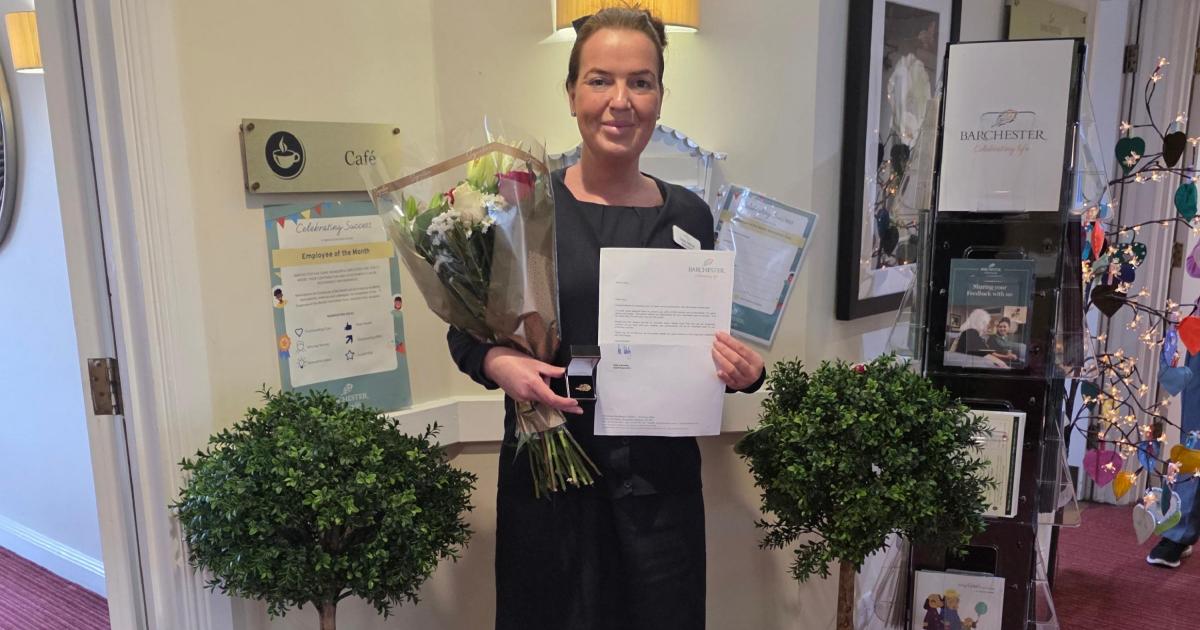
Lacey Milner from Meadow Park Care Home in Bedlington has received a Long Service Award for her commitment to Barchester Healthcare.

She began working for Barchester in March 2011 and has held a variety of roles over the years.

Adele Keenan, employee services director at Barchester, said: “I’m always pleased to hear stories about the long service of Barchester staff and am delighted Lacey has achieved this milestone.

Advertisement

“It is dedication like this that ensures our residents are provided with the best possible care.”

Colleagues have praised her work ethic and dedication.

Julie Bond, general manager at Meadow Park, said: “We’re delighted to be celebrating 15 years of loyal service with Lacey.

“She has demonstrated her dedication and commitment to this home and its residents year after year.

Advertisement

“I speak for all of us here at Meadow Park when I say that I’m looking forward to many more years of working with Lacey.”

Meadow Park Care Home is part of Barchester Healthcare and provides residential and dementia care for 61 residents from respite breaks to long term stays.

Source link

Advertisement
Continue Reading

NewsBeat

Will ending short prison sentences fix prison overcrowding? What an expert thinks

Published

on

Will ending short prison sentences fix prison overcrowding? What an expert thinks

The UK’s latest law on sentencing came into force on March 22. Among other changes, the new law means that, in England and Wales, people who would previously have been sent to prison for short sentences will instead serve those sentences in the community.

This means they will need to attend appointments with probation, do certain rehabilitative activities and may also be restricted from doing certain things or going to certain areas. They might also be required to do a set number of hours of community service.

The new law requires courts to avoid imposing custodial sentences of less than 12 months, except in exceptional circumstances. It also extends the maximum sentence that can be suspended from two years to three. This gives judges discretion to suspend sentences for more serious offences that would previously have required immediate custody.

Possession with intent to supply class A drugs (where a guilty plea can reduce a starting-point sentence to three years); street robbery; the most serious forms of controlling and coercive behaviour; and a third conviction for domestic burglary could now all, in theory, be suspended.

Advertisement

At the end of 2025, there were around 3,500 people serving a prison sentence of less than 12 months in England and Wales. Around 44% of all prison sentences are shorter than 12 months. They tend to be imposed for offences such as shoplifting, common assault or breaches of restraining orders.

People given short sentences have the highest reoffending rates when compared to other sentences. Evidence from Scotland, where a similar legal approach has been in place since 2019, has found that people released from a short sentence are reconvicted nearly twice as often as those sentenced to serve a community sentence.

Short sentences mean that people lose access to families, employment and housing, but they do not allow prisons enough time to provide the support that people need prior to release. As such, they account for more than half of all recalls to prison following release, and have contributed to increases in the prison population in recent years.

People serving short sentences typically have acute and unaddressed needs, such as housing instability, substance misuse and mental health concerns. And evidence shows that people sentenced for similar offences are more likely to offend after a short prison sentence than if they had been given a community sanction.

Advertisement

The changes are intended to alleviate pressure on the prison estate by reducing the number of people given immediate custody. Prisons in England and Wales have been working at capacity for years.

These new powers should also prevent the need for emergency early release schemes, which have failed in the past. Both Conservative and Labour governments have introduced emergency early release schemes in recent years. Under a scheme run by the previous Conservative government from 2023-24, 42% of people released were recalled to custody. This was partly due to an inability to plan for their release, and a shortage of support services such as accommodation.

We do not yet have recall data for the scheme introduced by the Labour government in 2024, which allows people to be released 40% of the way through their sentence. But overall recall rates have remained high.

Recent governments have trialled early release schemes to cope with overcrowding in prisons.
Tolga Akmen/Shutterstock

With the new law in force, we should see a relatively quick decline in the number of people sentenced to custody. A steady reduction in the prison population should follow.

Advertisement

It is also worth highlighting that expanding the use of community sanctions can backfire, resulting instead in unintended net-widening: more people drawn into the penal system overall, rather than just reducing the number of people in prison. This could happen if judges begin to give more suspended sentences to those who would otherwise have been given a fine or community order. They may also sentence people to longer in prison to avoid the requirement to suspend the sentence – what criminologists call up-tariffing.


À lire aussi :
How a doubling of sentence lengths helped pack England’s prisons to the rafters


Although broadly positive, these changes are not necessarily a silver bullet for the well-documented prisons crisis. For one thing, the reforms will result in more work for the probation service, which is already under pressure. In recent inspection reports, the probation inspectorate has described the service as having “too few staff, with too little experience and training, managing too many cases”.

Introducing more people with higher risk profiles into probation narrows the margin for error considerably. The service has been planning for these changes – by reducing the extent to which people at the end of their sentences are supervised – but how well it copes with these increased numbers remains to be seen.

Advertisement

If probation fails to cope, we may see more people breaching their orders. When this happens, their custodial sanction is activated, and they are swiftly put in custody to serve their sentence.

The effect on crime

There is also the question of whether the act will affect crime levels, which have been decreasing in recent decades. Criminological evidence has repeatedly shown that changing the seriousness of a punishment does not deter people from offending. What is much more important is the perception of whether one is likely to be caught, and the speed with which one might be punished.

In reality, most people who are about to commit an offence – especially those for which shorter custodial sentences are imposed – are not thinking about what sentence they may or may not receive at some undetermined point in the future.

Sentencing severity is a blunt tool for dealing with crime, especially given the complex reasons behind why people offend. The impact on crime will depend on other parts of the criminal justice system. Police performance, court backlogs and the nature of high-volume offending such as shoplifting and online fraud will all have much more immediate effects on crime levels than tinkering around the edges of sentencing.

Advertisement

Short sentences achieve very little beyond disrupting peoples’ lives and relationships and making it more difficult to find housing and employment, both of which are strongly correlated with re-offending rates. If probation copes with the additional workload, if recall rates do not skyrocket, and judges and magistrates stick to the ask, then the reforms could result in a more sustainable prison system that causes less harm than it currently does – that should be better for everyone.

Source link

Advertisement
Continue Reading

NewsBeat

Senators consider deal to fund Homeland Security but not ICE enforcement

Published

on

Senators consider deal to fund Homeland Security but not ICE enforcement

WASHINGTON (AP) — Senators are discussing a proposal to end the Homeland Security budget stalemate by funding much of the department, including the Transportation Security Administration airport workers going without pay, but excluding ICE’s enforcement and removal operations that have been core to the dispute.

The potential breakthrough came after a group of Republican senators headed to the White House late Monday to meet with President Donald Trump. Senators said they expected the negotiators to work through the night hammering out the details and present written proposals for both parties to discuss Tuesday at their weekly caucus lunches.

“All I can say is that the discussions have been very positive and productive, and hopefully headed in the right direction,” said Senate Majority Leader John Thune, R-S.D.

Senate Democratic Leader Chuck Schumer told reporters late in the evening: “Both sides are working in a serious way.”

Advertisement

The sudden shift in the monthlong standoff comes as U.S. airports are jammed with long lines after routine Homeland Security funding was halted, leaving TSA understaffed during the spring travel season. Democrats are refusing to fund Homeland Security without restraints on Trump’s immigration enforcement and mass deportation operations after the deaths of two U.S. citizens during ICE protests in Minneapolis.

Trump took the extraordinary step over the weekend of ordering Immigration and Customs Enforcement officers to provide airport security, drawing alarm from some lawmakers that it could escalate tensions.

The contours of the deal under consideration would fund most of Homeland Security, but exclude funding for one main part of ICE — the enforcement and removal operations that are core to Trump’s deportation agenda.

Under the package being floated, ICE’s Homeland Security Investigations would be funded as well as Customs and Border Protection, but with new guardrails to position officers from those divisions in their traditional roles, rather than as they have been used more recently in immigration roundups in cities. It would also include a number of changes in immigration operations that Democrats have demanded, including mandating that officers wear body cameras and identification.

Advertisement

Since so much of ICE is already funded through Trump’s big tax breaks bill, and immigration officers are still receiving paychecks during the partial government shutdown, senators said the new restraints would also be imposed on operations that rely on that funding source, as well.

“I’m going to be working through the night,” said Republican Sen. Katie Britt of Alabama, a chief negotiator who returned from the White House meeting hopeful they had a solution to “land this plane.”

“We’re going to be working diligently,” she said.

Sen. Chris Coons, D-Del., who was not part of the group at the White House, said his understanding was that there was a “sense of urgency” coming from the talks.

Advertisement

Coons described various choices before the senators at this point — from no money at all for ICE but also no restraints on the agency operations, to fully funding ICE but with more of the restraints Democrats have demanded, to a middle option of funding most of DHS excluding ICE’s enforcement and removal operations. That middle option is what he and other senators understood was broadly on the table after the White House talks.

“First step is to get the proposal in writing,” said Sen. Angus King, the Independent from Maine. “I want to see exactly what that means.”

Senators late Monday also confirmed Markwayne Mullin as Homeland Security secretary. He takes over for Kristi Noem, who led the department’s immigration enforcement operations that erupted with the public outcry and the funding standoff.

Mullin provides a potentially new face for the immigration operation. During his confirmation hearing last week, Mullin touched on another key demand Democrats want — ensuring a judge has signed off on warrants that immigration officers use to search people’s homes, rather than simply relying on administrative warrants issued by the department.

Advertisement

“This is significant,” Sen. Peter Welch, D-Vt., said about the progress toward changes. “Noem is gone. That’s a big deal.”

Sen. John Hoeven, R-N.D., said he was hopeful senators could work things out. “Look, there’s a lot of different variables in the equations,” he said. “I’m hopeful we’ll get there.”

___

Associated Press writer Seung Min Kim contributed to this report.

Advertisement

Source link

Advertisement
Continue Reading

NewsBeat

Cars and homes burnt as Israeli settlers rampage through occupied West Bank | World News

Published

on

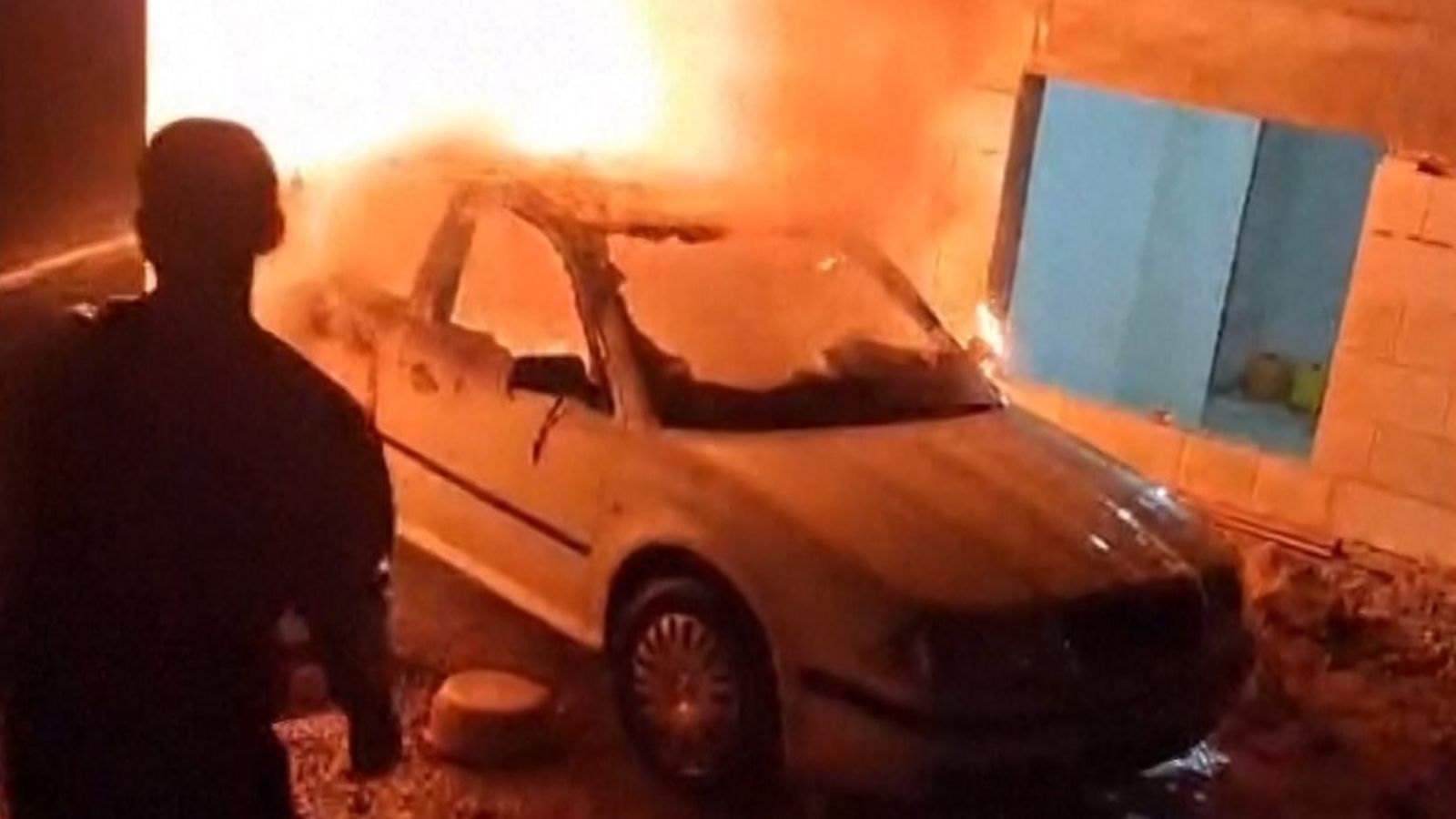
A man tries to put out a car fire in Deir al-Hatab, in the West Bank. Pic: AP

Israeli settlers have injured at least 10 Palestinians, as well as smashing cars and setting fires, as they rampaged through villages in the West Bank.

The violence on Sunday night came after the funeral of Yehuda Sherman, an 18-year-old Israeli settler, who was killed in a collision with a Palestinian vehicle in the area.

Among those wounded in the unrest was a 45-year-old man shot in the foot and a woman suffering from smoke inhalation, according to The Palestinian Red Crescent Society.

Videos from the scene showed cars and homes were set ablaze as army flares lit up the sky above the village of Deir al-Hatab.

Advertisement
Image:
A man tries to put out a car fire in Deir al-Hatab, in the West Bank. Pic: AP

Smoke rising in Deir al-Hatab with what appears to be a military flare overhead as seen from Salem village. Pic: AP
Image:
Smoke rising in Deir al-Hatab with what appears to be a military flare overhead as seen from Salem village. Pic: AP

A day earlier, simultaneous attacks were reported in at least six West Bank communities overnight by the official Palestinian news agency, WAFA.

The settlers claim that the crash which killed Sherman was deliberate. Police say they are investigating.

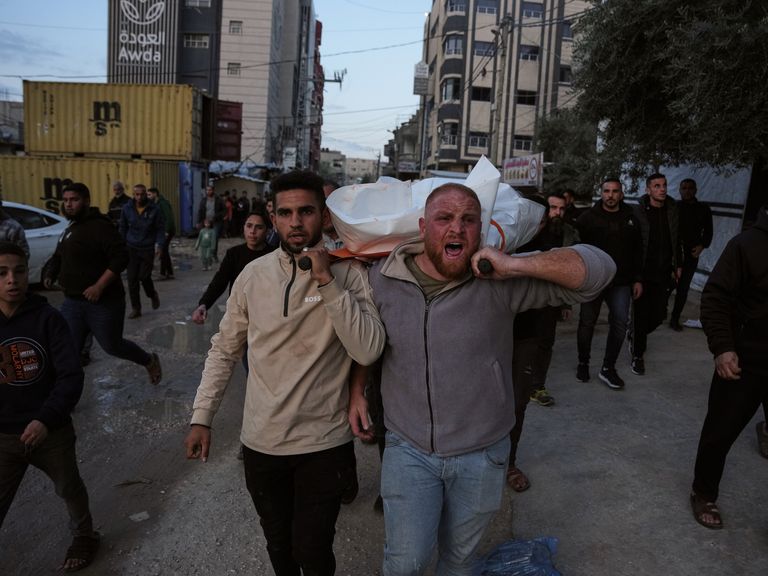
Three Palestinians were also killed and 10 people injured after an Israeli strike hit the central Nuseirat refugee camp in the Gaza Strip, officials at Awda Hospital said.

Mourners carry the body of a Palestinian policeman killed in an Israeli military strike on Gaza. Pic: AP
Image:
Mourners carry the body of a Palestinian policeman killed in an Israeli military strike on Gaza. Pic: AP

Hours earlier, another Palestinian had been killed in a strike in northern Gaza.

Israeli strikes on Gaza declined in the days after the Iran war began on 28 February, but locals say they have started to rise again.

At least 680 people have been killed by Israeli attacks in Gaza since the October ceasefire, including dozens in recent weeks, according to the territory’s Hamas-run health ministry.

Advertisement

Read more:
Wave of emotion as first Gazans return to their loved ones
Inside a US-backed ‘illegal’ West Bank Israeli settlement

Israel, meanwhile, claims four of its ​soldiers in Gaza have been killed in the ​same period. Both sides accused each other of violating the truce.

The uneasy ceasefire brought a close to a war lasting more than two years, which reportedly claimed over 70,000 lives.

It was sparked by Hamas attacks on southern Israel on 7 October, 2023.

Advertisement

On Sunday, Israel’s foreign minister, Gideon Saar, criticised a social media post by Steffen Seibert, the outgoing German ambassador, for mentioning the death of the teenager alongside a condemnation of the violence.

Mr Saar welcomed the imminent departure of Mr Seibert, claiming that his “obsession” with settlers in the West Bank had stopped him from condemning the death of the Israeli.

“Seibert finds it very difficult to condemn attacks against Israelis without bringing up the Palestinians,” wrote Mr Saar.

A spokesperson for Germany’s Foreign Ministry stated on Monday that the ministry stands behind its outgoing ambassador.

Advertisement

Source link

Continue Reading

Trending

Copyright © 2025