

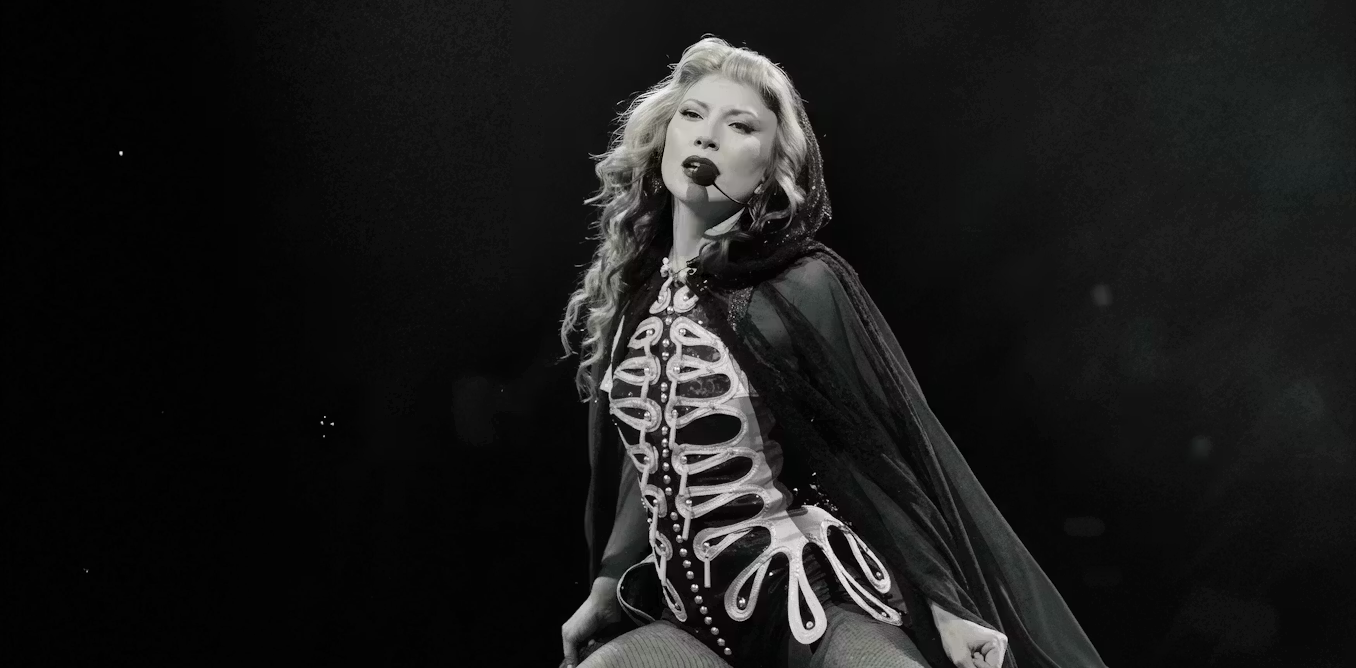
The Mayhem Ball – the concert tour for Lady Gaga’s 2025 album Mayhem – is set to conclude in April after a global run. The tour delivered everything fans have come to expect from the artist: spectacle, innovation and, above all, immersion in a gothic world.
The production is bursting with macabre theatricality, including concepts and images associated with the gothic tradition. Skeletons, doppelgängers, zombies, candelabra, cloaks, veils, dreams and nightmares are incorporated into intricate set designs and showstopping costumes. Themes of pain, death and rebirth frame the whole narrative of the show.
Gaga has often made interesting use of gothic motifs, so much so that she was a key source of inspiration for my new book Gothic Celebrity: Fame and Immortality from Lord Byron to Lady Gaga. In it, I examine the intersection of celebrity culture and the gothic across literature, visual media and popular culture.
I started writing the book in 2016, inspired by a significant wave of celebrity deaths and the public’s reactions to these losses – including David Bowie, Prince and George Michael. These deaths unsettled many people because modern celebrity culture has established an expectation of the celebrity’s immortality.
Fame, immortality and the gothic
Described by some as the first celebrity, the Romantic poet Lord Byron’s posthumous fame was maintained in the years following his death by various cultural artefacts. These included a statue in Cambridge University’s Trinity College and two illustrated books published by William and Edward Finden in the 1830s.
In the 21st century, digital technology now serves this purpose. Three years after her death, actor Carrie Fisher was digitally resurrected for her role as Princess Leia in the 2019 Star Wars film The Rise of Skywalker with the help of CGI. Holograms of deceased celebrities have also been used for music performances, such as in 2020 for An Evening with Whitney: The Whitney Houston Hologram Tour.
In western culture, our relationship with celebrities revolves around a tension between renewal and decay. We want celebrities to be immortalised; we do not want them to age or die. Technological preservation or the reinvention of a celebrity’s image in a new context reinforces immortality, ageing or dying disrupts it. Gothic can be found in these moments of disruption.
My research has found that celebrities have continually been represented in gothic ways. Mortality and immortality are central themes in these gothic representations, whereby the celebrity is often portrayed as decaying, dead or undead.
The notoriously hideous portrait in Oscar Wilde’s 1890 Gothic novel The Picture of Dorian Gray establishes a useful motif for exploring the deterioration of a celebrity’s flawless image. In the novel’s context of Victorian fashionable society, Dorian Gray is celebrated for his remarkable beauty. However, his decaying portrait embodies the horror of this beauty not being preserved, reflecting both the inevitability of ageing and the precarity of visual media.
This motif is later reimagined in the celebrity portraits of the pop artist Andy Warhol. Warhol’s Marilyn Diptych, created in the months following Marilyn Monroe’s death in 1962, mimics the appearance of a decaying portrait to symbolise Monroe’s death and question the perceived immortality of celebrities in the late 20th century.
In gothic novels, a celebrity’s immortality is often symbolised by the eternally youthful vampire. John Polidori’s 1819 short story The Vampyre established this archetype. In the story, the enchanting Regency gentleman Lord Ruthven – modelled after Lord Byron, who was friends with Polidori – returns from the dead in vampiric form.
Polidori’s tale inaugurates a tradition of eternally youthful vampires modelling celebrity that extends all the way to the post-millennium. In fact, Lady Gaga has played one such character in the anthology television series American Horror Story (2011-). In an episode titled Hotel, she plays a vampire called The Countess who adapts to the modern world by reinventing her image.
Lady Gaga’s gothic celebrity
What makes this phenomenon particularly compelling is the degree to which celebrities can choose to manage or even initiate their affiliation with the gothic. My research has found that there are many celebrities who form dialogues with gothic texts. This is done by producing, starring in or inspiring them. These celebrities also self-consciously construct images that can be described as gothic. Lady Gaga is the perfect example.
A recurring theme in her music performances is her interest in the undead. In the music video for her song Bad Romance (2009), she emerges from a coffin-like container inscribed with the word “Monster”. Later in the same video, she is seen lounging on a bed and smoking a cigarette next to a charred carcass.
Uncanny echoes of this gothic iconography appear in Gaga’s recent Mayhem Ball performances. During her song Perfect Celebrity (2025), she is laying in a sandpit caressing a skeleton, surrounded by skeleton backing dancers. The show’s climax sees Gaga dramatically resurrected after the set is engulfed in flames. She is wheeled back on stage by dancers in plague doctor costumes, who operate on her lifeless body before she is spectacularly reanimated for a show-stopping rendition of Bad Romance.
These performances, in which Gaga is frequently depicted as undead or resurrected, represent more than just an aesthetic interest in the macabre. They are reflections of our enduring fixation with death. In this way, celebrities can play a crucial role in interrogating such profound concerns. Both gothic and celebrity culture are vehicles for exploring how modern western society processes its deepest anxieties.
This article features references to books that have been included for editorial reasons, and may contain links to bookshop.org. If you click on one of the links and go on to buy something from bookshop.org The Conversation UK may earn a commission.















































You must be logged in to post a comment Login