Connect with us

NewsBeat

Lewis Hamilton smashes into barriers in Madring practice

Published

on

Lewis Hamilton smashes into barriers in Madring practice

It remains to be seen how bad the crash damage is, but at the very least missing a large chunk of practice time on a new track is likely to compromise Hamilton’s performance in qualifying, which takes place at 4pm local time (3pm UK time) today.

Hamilton dropped 76 points behind Mercedes’ championship leader Kimi Antonelli following his sixth-place finish at Monza last weekend, where he collided with team-mate Charles Leclerc on the opening lap.

After lengthy repairs to the barriers, the session finally got back underway only for Haas’ Bearman to lose control at Turn 10 and career backwards into the wall, sustaining major damage to the car. Fortunately, Bearman was unhurt. The incident brought an early end to proceedings.

Advertisement

The Madring has been described as a “car killer”. At the recent Formula 3 test, there were 19 red flags, three broken chassis, and various broken suspensions.

“It’s a crazy circuit,” said Mercedes driver George Russell. “I would [call] it, arguably, the most risky circuit of the whole calendar, because you have real high-speed corners, sort of Jeddah-esque, the walls are very close, so there’s no margin for error… but then you have other corners that are quite like Baku, where you’re coming from a high speed into a slow braking zone. You’re braking and turning at the same time. So locking the tyres is going to be easy. And if you lock up, you’re straight into the wall.”

On Friday there was a spectacular crash in F2 practice, Thai driver Tasanapol Inthraphuvasak losing control at the right-hander at Turn 19, and spinning backwards into the barriers, his car bursting into flames.

Source link

Advertisement
Continue Reading
Click to comment

You must be logged in to post a comment Login

Leave a Reply

NewsBeat

Anti-migrant protesters march in Portsmouth as police warn them not to cover their faces after vowing to make more arrests

Published

on

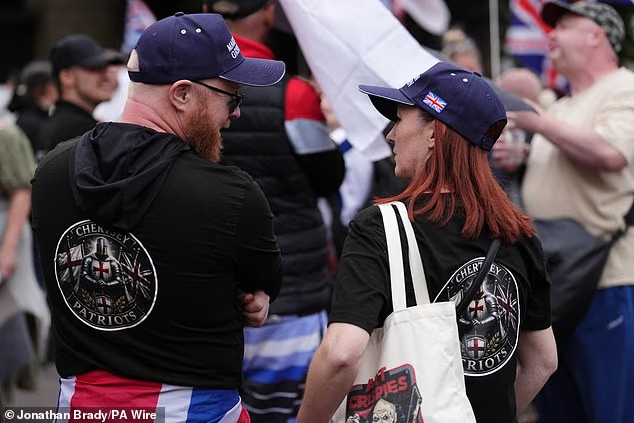
Anti-migrant protesters in Portsmouth on Saturday. The demonstration follows several protests by Right-wing groups since last weekend, after several hundred men dressed in black and wearing balaclavas blocked access to the port of Dover

Anti-migrant protesters are marching in Portsmouth today, as police warned attendees not to cover their faces and vowed to make more arrests. 

The demonstration follows several protests by Right-wing groups since last weekend, after several hundred men dressed in black and wearing balaclavas blocked access to the port of Dover.

The organiser of that protest, Danny Thomas, took to social media on Friday to admit he will not be at today’s event – but said ‘as many people as possible’ should turn out in the coastal town.

Hampshire Police have warned those attending today of powers in place that make it illegal to wear a face covering to conceal identity while attending protest activity.

Advertisement

It means officers can arrest anyone in a designated area for hiding their face during the demonstration using powers under the Crime and Policing Act.

Hundreds of people gathered in the city centre at All Saints Church in Commercial Road at 12.30pm, before setting out to Guildhall Square.

A man with a megaphone addressing the anti-migration protest began chants including ‘stop the boats’. He said the protest was against ‘illegal men invading the shores’ and said it was not about giving ‘f*** the police’.

Earlier on Saturday, Hampshire Police said: ‘We will support those who want to express their views peacefully and lawfully, but we will not tolerate those whose only aim is to create fear and incite violence.’ 

Advertisement

They must follow a designated route, and organisers Portsmouth Patriots and other aligned groups have been allocated a specific location to gather near All Saints Church.

Anti-migrant protesters in Portsmouth on Saturday. The demonstration follows several protests by Right-wing groups since last weekend, after several hundred men dressed in black and wearing balaclavas blocked access to the port of Dover

The protesters in Portsmouth are expected to march from All Saints Church in Commercial Road at 12.30pm to Guildhall Square

The protesters in Portsmouth are expected to march from All Saints Church in Commercial Road at 12.30pm to Guildhall Square 

Advertisement
Riot police were deployed to the scene, in Portsmouth on Sunday night after hundreds of protesters gathered

Riot police were deployed to the scene, in Portsmouth on Sunday night after hundreds of protesters gathered

A counter demonstration planned by Stand Up To Racism must gather in a specified area adjacent to the protest.

Failure to comply with conditions could lead to arrest, the force said.

Home Secretary Shabana Mahmood met police on Thursday for reassurance they are ready to move quickly in dealing with ‘far-right groups’ seeking to intimidate communities after the events in Dover and Portsmouth last weekend.

Advertisement

Overnight last Sunday, several hundred people gathered at Eastney Marina after a dinghy’s arrival across the English Channel in a bid to prevent the 120 migrants leaving the area on coaches.

Official vehicles were damaged and a small number of police officers were injured, Hampshire Police said.

About 200 people were dispersed early on Monday.

In Dover, crowds of masked men blocked road access to the port last Saturday, in scenes which were condemned by politicians of all parties.

Advertisement

Yesterday the force announced that a man has been charged with violent disorder and assaulting a police constable in the execution of their duty in relation to Sunday’s protest in Portsmouth.

Attendees at today's protest in Hampshire who have been warned not to wear face masks

Attendees at today’s protest in Hampshire who have been warned not to wear face masks 

A counter demonstration planned by Stand Up To Racism have gathered in a specified area adjacent to the protest

A counter demonstration planned by Stand Up To Racism have gathered in a specified area adjacent to the protest

At least 200 anti-migrant activists amassed at the Eastney Marina on Sunday night in a bid to prevent coachloads of some 120 migrants leaving the area

At least 200 anti-migrant activists amassed at the Eastney Marina on Sunday night in a bid to prevent coachloads of some 120 migrants leaving the area

Advertisement

They said the arrest of Del Leon Somerville, 42, of Paulsgrove, Portsmouth, was the first of what they anticipated to be ‘a number of’ detentions regarding the ‘violent public disorder’ and hit back at claims online that the event was a peaceful protest.

Somerville appeared at Portsmouth Magistrates’ Court, sitting at the crown court, this morning.

He did not enter any pleas at the short hearing to charges of violent disorder between September 5 and 8 in Portsmouth, and assaulting a constable on September 11 in Waterlooville.

Prosecutor Lucy Paddick told the court he was accused of throwing a bottle towards a police line and was allegedly heard telling officers to ‘f*** off’ as the bottle was thrown.

Advertisement

Somerville is also alleged to have kicked out at Pc Peskett, making contact with the officer’s right thigh, when he was arrested, the court heard.

He was remanded into custody at the hearing, supported by members of his family in the courtroom, ahead of his next appearance at Portsmouth Crown Court on September 16.

Ms Mahmood said: ‘These scenes have caused disruption for people and, given that people are dressed in black wearing balaclavas, there is a fear factor and obvious malign intent being communicated to our residents.

‘This makes it different from other protests, so we need to make sure we are learning lessons.’

Advertisement

Source link

Continue Reading

NewsBeat

Saudi Arabia shuts key oil pipeline after drone attack launched from Iraq

Published

on

Satellite images show images of the area where the East-West pipeline was hit before (left) and after

The Gulf Co-operation Council – made up of representatives from Saudi Arabaia, the United Arab Emirates, Bahrain, Oman, Qatar and Kuwait – also issued a missive condemning the attack.

“This attack represents a dangerous escalation and an unacceptable threat to the security of the Kingdom of Saudi Arabia, its territorial integrity, and its vital installations, as well as a flagrant violation of the principles of international law,” secretary general Jasem Mohamed Albudaiwi.

This week, a lightning advance in Yemen has also seen Houthi militants seize control of much of the country’s coastline, sources say.

The group claims it has control of the Bab al-Mandab Strait, the gateway to the Red Sea and the Suez Canal, though it says maritime navigation is “safe for all companies except for Saudi vessels”.

Advertisement

The developments have squeezed both sides of the Arabian Peninsula, pushing crude oil prices to over $100 a barrel for the first time since July.

Fears over inflation have risen with the spike in energy prices, further pushing up government borrowing costs.

Source link

Advertisement
Continue Reading

NewsBeat

I spent a rainy afternoon at Turton Tower in Bolton

Published

on

I spent a rainy afternoon at Turton Tower in Bolton

On a rainy September afternoon, I found one practically on my doorstep.

I had gone to Turton Tower expecting a coffee, a slice of cake and a wander around one of the area’s most historic buildings.

I left feeling like I had discovered somewhere genuinely special.

My afternoon started at the Woodland Café, tucked within the grounds of the tower, where Rachel and Katie were behind the counter, greeting everyone who came through the door with a smile.

Advertisement

Turton TowerRachel at the Woodland Cafe

It immediately felt warm and welcoming – the sort of little café where you don’t feel hurried to order and disappear, but somewhere you actually want to stay for a while.

And even the café comes with its own piece of history.

It sits in what was once the kitchen of Turton Tower – a kitchen which remained in the same location for more than 500 years.

Then came the important decision – what to have.

Advertisement

Anyone who knows me knows that I take a sweet treat very seriously, and the counter certainly gave me plenty to think about.

The café sources its cakes from a number of different bakers and there was a tempting selection staring back at me.

Eventually, I settled on a slice of Victoria sponge and an Italian hot chocolate.

And what a combination.

Advertisement

The hot chocolate was rich, creamy and indulgent without being too sickly, while the Victoria sponge was exactly the kind of comforting cake that seems made for a rainy day.

But instead of staying inside, I carried them out to the kitchen garden,

That was when I really fell in love with the place.

September had arrived, the skies were grey and there was rain in the air, but somehow it didn’t matter.

Advertisement

I sat surrounded by flowers, herbs and plants, many lovingly grown and looked after by volunteers, with Turton Tower just beyond them.

And it was beautiful.

Not in a grand or showy way.

It was the kind of beautiful that makes you notice the little things.

Advertisement

The plants moving in the breeze, the quiet of the garden, the warmth of a hot chocolate between your hands and the fact that, for once, there was absolutely no need to rush.

I sat, ate my cake and just looked around.

No agenda.

No next stop.

Advertisement

No feeling that I should be doing something else.

I was simply there.

It sounds like such a small thing, but life doesn’t always leave much room for moments like that.

We are constantly moving on to whatever comes next, and sometimes it takes sitting in a centuries-old garden with a slice of Victoria sponge to realise how nice it is to stop.

Advertisement

Perhaps that sense of stepping away from modern life feels particularly fitting at Turton Tower.

Because everywhere you look, there is a reminder that this place was here long before any of us.

Turton Tower has been evolving for around 600 years, beginning as a medieval stone tower house in the 1400s before generations of owners added to it and made it their own.

The Orrell family called it home for generations, and later industrialist James Kay bought the tower in 1835 and set about transforming the ageing building.

Advertisement

I am a complete history nerd, so naturally I found all of this fascinating.

There is something almost surreal about wandering around a building with six centuries of stories behind its walls and then remembering that you haven’t travelled miles to find it.

It is right here.

Visitors can pay to explore inside the tower, and I think that is where its history becomes most captivating.

Advertisement

Rather than dates and names written on a page, you can stand inside the rooms, look at the architecture and imagine all the ordinary lives that have unfolded there before yours.

People ate here, slept here, laughed here and looked out of the same windows that visitors do today.

As you wander through, there are little reminders of just how many different lives the tower has lived.

The dining room is lined with historic wooden panelling brought from Middleton Hall in Manchester when it was being demolished, while an elaborate Elizabethan plasterwork ceiling survives in the drawing room.

Advertisement

You don’t need to know every date or every name to appreciate it.

For me, the joy was simply being curious – peering into rooms, noticing details and wondering about the people who had stood there centuries before.

Then you step back outside and the tower becomes something completely different again.

People are walking their dogs through the grounds, friends are chatting over coffee and Rachel and Katie are welcoming the next person into the café.

Advertisement

You could easily come just for that.

The café is hoping to introduce more paninis, sandwiches and savoury choices alongside its cakes and drinks, making it somewhere you could stop for lunch as well as coffee and a sweet treat.

Or you could do exactly what I did and make an afternoon of it.

By the time I left, the rain hadn’t really stopped.

Advertisement

But I didn’t mind.

What I thought would be a simple afternoon of coffee, cake and local history had turned into a few hours somewhere I genuinely didn’t want to leave.

And for somewhere that had been sitting practically on my doorstep all along, that felt pretty special.

Advertisement

Source link

Continue Reading

NewsBeat

Police seek information after Tyldesley brick attack on car

Published

on

Police seek information after Tyldesley brick attack on car

The incident occurred on June 26 at around 5:26pm, when a brick was thrown at a car in what is thought to be a targeted attack.

Police have now released images of a man they would like to speak to in connection with the incident.

Greater Manchester Police said: “Officers are appealing for information as they investigate a report of criminal damage in the Tyldesley area.

Advertisement

“At around 5.20pm on 26 June, a car was damaged by a brick in a suspected targeted attack.

“Officers have now released an image of a man they would like to speak to, as it is believed he could help with their enquiries.

“Anyone with any information is asked to contact police via 101 or our Live Chat at https://orlo.uk/41e8Y, quoting CRI/06LL/0015794/26.

“Alternatively, you can contact the independent charity Crimestoppers, anonymously, on 0800 555 111.”

Advertisement

Police seek information after a car was damaged by a brick in a suspected targeted attack in Tyldesley.

The incident occurred on June 26, at about 5.20pm.

Source link

Advertisement
Continue Reading

NewsBeat

Executed with a bullet to head for ‘adultery’: The Taliban execution that horrified Afghanistan… and terrifying signs such brutality is set to return

Published

on

Kneeling next to a ditch, deep in the rugged mountains of Afghanistan , a 22–year–old woman draws her last breath in a 'desert court' before she is shot in the back with an AK47

Kneeling next to a ditch, deep in the rugged mountains of Afghanistan, a 22-year-old woman draws her last breath in a ‘desert court’ before she is shot in the back with an AK-47.

Her executioner? Likely her hardline militant husband, in what the Taliban consider an ‘honour killing’. 

It took less than an hour to decide Najiba had been adulterous – although it has been suggested this accusation was fabricated to protect her husband’s reputation. Adultery is a crime that deserves corporal punishment under the Taliban’s strict interpretation of Sharia law.

Fourteen years on from her death, little is known about her story, like many women slowly being erased from the fabric of Afghan society. 

Advertisement

But the horror of Najiba’s undignified death, met with the cheers of rural militants, feels eerily prophetic to the conditions of women today, who are once again being tortured and revoked to the status of a slave.

In January this year, the Taliban reintroduced a decree that invoked the death penalty for blasphemers and undefined ‘immoral’ or ‘corrupt’ offences after it had been banned following US intervention.

Following this latest sign that horrific brutality is set to return, Michelle Shahid from Equality Now told the Daily Mail that ‘the death penalty, stoning sentences and public floggings are likely to fall hardest on Afghan women’, while Medica Mondiale likened the current conditions as a ‘gender apartheid’.

Dishearteningly, in July 2012, Shajan Yazdanparast, the head of women’s affairs for Parwan Province, said in response to Najiba’s execution: ‘we have had a very bad experience of Taliban in the past several years. Everyone is in shock and scared that, God forbid, if the Taliban return, what will happen.’

Advertisement

Kneeling next to a ditch, deep in the rugged mountains of Afghanistan , a 22–year–old woman draws her last breath in a ‘desert court’ before she is shot in the back with an AK47

They added that women ‘suffered socially, psychologically, and they could not study’ while the Taliban ruled. 

Indeed, today, the situation for women is much the same as it was under the Taliban in the 90s despite America’s near two decades of intervention, with the recent legalisation of domestic abuse and the banning of girls from secondary education.

Advertisement

Or, arguably, even in 2012, when a US-backed government was still trying to negotiate with the Taliban, who held control in pockets of the country, as was the case for Najiba.  

The grainy video that captured Najiba’s execution caused uproar both across the world but also within Afghanistan, as authorities had been trying to improve women’s rights through reinstating their vote and access to schooling.

But in Qōl-e Hir, the village where Najiba was from in the Shinwari district of the Parwan province, the Taliban still ruled.

Najiba had been found in the house of a local Taliban commander, Mullah Qader-e ‘Lang’ (Qader the Lame), who was reportedly involved in internal clashes. 

Advertisement

It is unclear whether she was being held there voluntarily or against her will, however Parwan province governor at the time, Abdul Basir Salangi, claimed she had some kind of sexual relationship with the man – either romantic or abusive.

According to local MP Zakia Sangin, who spoke contemporaneously to Afghanistan Analysts’ Network, Najiba had fled her husband’s house, situated two-and-a-half hours north from the capital, Kabul, some three months before she was found.

At Najiba's execution, verses from the Qur'an regarding adultery are read to her in front of a crowd of men, some so desperate for a view of the execution they sit atop roofs

At Najiba’s execution, verses from the Qur’an regarding adultery are read to her in front of a crowd of men, some so desperate for a view of the execution they sit atop roofs

Qader-e Lang was killed in June 2012 and comrades of an opposing Taliban member then supposedly stormed his house where they found both Najiba and Qader-e Lang’s pregnant wife.

Advertisement

Najiba was handed back to her family but it was her own husband, Juma Khan, who reportedly took her to the Taliban’s shadow district governor of the time, Mirza Muhammad, to settle the ‘dispute’ of her alleged running away.

Najiba was said to be tortured and then charged with fleeing from her husband, while Qadar-e Lang’s wife was accused of sheltering her – offences that both deserved execution.

As is typical in honour killings, it is usually the affected or the family of the affected, who take the role of executioner.

At Najiba’s execution, verses from the Qur’an regarding adultery are read to her in front of a crowd of men, some so desperate for a view of the execution they sit atop roofs in the village.

Advertisement

‘We cannot forgive her, God tells us to finish her. Juma Khan, her husband, has the right to kill her,’ the man is reported to have said.

Another man – likely her husband – then approached with an AK-47 rifle, shooting twice from a few metres away but missed.

With his third shot, he hit Najiba in the back and she crumpled forward, before firing ten more times to the screams of the jubilant crowd behind him. 

‘Within one hour they decided that she was guilty and sentenced her to death. They shot her in front of villagers in her village, Qōl,’ Parwan provincial spokesman Roshna Khalid said after Najiba’s death.

Advertisement
Very little detail is recorded on the story, as is the case with 'desert courts' administered by the Taliban where justice is taken into their own hands and Sharia law is often applied

Very little detail is recorded on the story, as is the case with ‘desert courts’ administered by the Taliban where justice is taken into their own hands and Sharia law is often applied

Mr Salangi similarly said they ‘faked a court to decide about the fate of this woman and in one hour, they executed the woman’ – before going on to suggest she was condemned in order for Mr Khan to save face.

Thankfully, Qader-e Lang’s wife was spared an equally barbaric fate owing to her pregnancy and reports suggested she managed to escape to security forces in Parwan centre and was later housed in a women’s shelter.

Very little detail is recorded regarding the story, as is the case with ‘desert courts’ administered by the Taliban where justice is taken into their own hands and Sharia law is often applied.

Advertisement

The Taliban at the time denied involvement in the execution – despite having control of the region at the time – criticising media reports blaming them as ‘incorrect and cursed’. 

Their ‘Islamic justice’ was different to the ‘tribal justice’ being administered here, they further claimed. 

Afghanistan’s government condemned the ‘un-Islamic and inhuman action by those professional killers’. President Hamid Karzai launched a manhunt, however there are no further reports about the case. 

The rest of the world was similarly horrified: the then-foreign secretary William Hague said he was ‘shocked and disgusted’, while Nato’s top commander in Afghanistan, US General John Allen said the execution was ‘an atrocity of unspeakable cruelty’.

Advertisement

The execution triggered protests in Afghanistan, with hundreds taking to the streets in Kabul holding white sheets with the words ‘International community: Where is the protection and justice for Afghan women?’ written across it.

Wazhma Frogh, executive director of the Research Institute for Women, Peace and Security, said at the time the execution ‘was nothing new for us’.

She told Al Jazeera: ‘When we first saw the reports, we flashed back to the stoning of a couple in Kunduz last year and the stoning of a woman in 1998.’

‘The truth is though, every day we are under threat. If we stay at home we are under threat. If we go to school we are under threat.’

Advertisement

Some 52 girls were murdered in the months leading up to Najiba’s execution, 42 of which were honour killings. 

The same week that Najiba was killed, a woman and her two children were beheaded, an execution similarly carried out by the alleged husband. 

Hanifa Safi, a prominent female official specialising in Women Affairs, was also targeted with a car bomb a few days after Najiba’s death, with the explosion killing Ms Safi and her husband, and injuring 11 others.

Another girl, 15-year-old Tamana, was found dead in Parwan days later, who had allegedly been beaten and killed by her cousin she was forcibly married to for being ‘disobedient’.

Advertisement

With the few institutions set up to protect women now obliterated, the unrestrained violence against women has come full circle.

After the departure of American forces in 2021, Afghanistan descended to a shell of its former self, with the de facto authorities issuing nearly 100 edicts that stripped women of their rights, like prohibiting employment and abolishing a minimum age for marriage. 

Ms Shahid said: ‘In five years, the Taliban have dismantled practically every legal protection Afghan women had; the ministries and justice systems that enforced their rights have been abolished, girls are barred from school beyond primary level, women’s voices have been banned in public, and there is no minimum age for marriage. 

‘Decree No12, issued this January, makes the death penalty available for blasphemy and for undefined ‘immoral’ or ‘corrupt’ offences; such categories are vague enough for the Taliban’s all-male courts to apply arbitrarily. 

Advertisement

‘Women are already disproportionately prosecuted for sexual relations outside marriage and other so-called moral crimes, including when they are fleeing forced marriage or domestic violence, or have been raped, so the death penalty, stoning sentences and public floggings are likely to fall hardest on Afghan women.’

A spokesperson from Medica Mondiale similarly told the Mail: ‘Five years after the Taliban’s return to power, Afghan women and girls continue to face systematic violations of their fundamental rights and increasing exclusion from public life.

‘These are not isolated measures, but part of an increasingly entrenched system of control and oppression. A system that can be described as gender apartheid. The broader justice system has also become more repressive, marked by the return of corporal punishment and public executions.

‘The international community must not normalise this erosion of human rights. Sustained political pressure on the Taliban, alongside support for Afghan women, girls and civil society, remains essential. Solidarity with Afghan women and girls must not waver. Women’s rights are human rights.’

Advertisement

And although public executions like Najiba’s may be happening once again, they are likely being done in private and under strict censorship – and with any chance of public backlash a mere fantasy for many oppressed Afghans.

Shaharzad Akbar, from Rawadari, an Afghan human rights organisation, told the Daily Mail last week ‘the Taliban have in the past two years moved most of the floggings away from the public eye and they severely restrict any filming and photography of these punishments’. 

Ms Akbar, whose organisation has already received reports of one woman who was stoned, added: ‘Considering the pattern we have documented and the increasing limitations on access to information, there may be severe and inhumane punishments of women and men away from the eyes of the world.’ 

Once more, women are living in fear that one day they could be cruelly punished for stepping out of the narrow lines of the Taliban’s governance.

Advertisement

‘God forbid, if the Taliban return, what will happen,’ they asked 14 years ago.

Sadly, they may already have found out – and the rest of the world was none the wiser.

Source link

Advertisement
Continue Reading

NewsBeat

Britain must rejoin EU customs union, George Osborne says | News

Published

on

Video Player Placeholder

Britain must rejoin the EU‘s customs union if it is to recover the economic losses caused by Brexit, George Osborne has said.

The former Tory chancellor who was forced to resign a decade ago after being on the losing side with then-prime minister David Cameron in the Brexit referendum said a “conspiracy of silence” by politicians and business and union leaders is hindering vital moves to rebuild links to the EU.

He says it “will be hard to rejoin the EU anytime soon” but said rejoining the customs union would be a relatively easy short-term remedy.

Advertisement

He spoke to The Independent’s editor-in-chief Geordie Greig in a In a wide ranging and candid interview covering everything from his role in bringing the Bayeux Tapestry to London to the challenges facing Kemi Badenoch.

Source link

Continue Reading

NewsBeat

Mystery remains over woman found dead in bin bag after police rule out 70 possible names | News UK

Published

on

Mystery remains over woman found dead in bin bag after police rule out 70 possible names | News UK
A murder investigation was launched into the death of the woman, aged around 70, following the grim discovery in Stanley Park (Picture: Liverpool Echo)

Detectives have still not been able to identify a woman whose body was found in a bin bag in a Liverpool park two weeks ago.

A murder investigation was launched into the death of the woman, aged around 70, following the grim discovery in Stanley Park, Anfield, on August 28.

Merseyside Police said more than 70 people have been ruled out after concerned locals had called in with names matching the woman’s description.

Officers have also knocked on more than 600 doors speaking to residents and retrieved CCTV from 30 cameras but have yet to make a breakthrough.

Advertisement

The woman’s body could have been in the park for weeks, detectives believe.

Sign up for all of the latest stories

Start your day informed with Metro’s News Updates newsletter or get Breaking News alerts the moment it happens.

Forensic tests yielded a DNA profile but there was no match in the national database.

The woman is white and around 5ft 2ins, of small build, and with strawberry blonde hair.

Advertisement

She was found wearing a pink Nike T-shirt. Police have released photos of a similar top in the hope somebody would recognise it.

An image of a similar t-shirt to the one worn by the victim, Officers where notified by a member of the public that had sadly discovered the body of a woman in a black bin bag in the area of the walled garden in in Stanley Park Liverpool
The woman was found wearing a pink Nike T-shirt (Picture Merseyside Police)

Detective Chief Inspector John Fitzgerald, the senior investigating officer, said: ‘Our investigation remains ongoing and we remain determined to identify the woman and find the person or persons responsible for her murder.

‘We are actively pursuing every call we receive to ensure that people are seen to be safe and well and can be eliminated from our enquiries.

‘We are continuing to appeal for anyone who has been in the area of Stanley Park over recent weeks who has seen anything suspicious to contact us and also ask anyone who may have flown a drone over the park over the past couple of months to check their footage for anything significant.’

During the initial appeal, Detective Superintendent Rachel Wilson, head of the major incident team at Merseyside Police, said: ‘This is a shocking crime.

Advertisement

‘If you live in the area of Stanley Park in Anfield and have seen or heard anything suspicious in recent weeks, regardless of whether you have reported it or not, or whether you dismissed it as something trivial at the time, please come forward.’

Get in touch with our news team by emailing us at webnews@metro.co.uk.

For more stories like this, check our news page.

Source link

Advertisement
Continue Reading

NewsBeat

BORIS JOHNSON: The story of Gaza’s Crazy Water Park reveals why Miliband’s sanctions are a shameful waste of time

Published

on

Foreign Secretary Ed Miliband speaking in the House of Commons this week as he announced UK sanctions on Israeli settlements in the occupied West Bank

Ok, so we all want a two‑state solution for Israel and Palestine. I do, you do, and so does Ed Miliband.

Let’s suppose for a moment that the Israelis are so appalled by his ridiculous and disgraceful sanctions announced this week that they decide to oblige the UK Foreign Secretary.

Let’s imagine that the Labour Government gets its way and somehow persuades Israel to begin dismantling all the recent settlements in the West Bank. It’s never going to happen, not in the real world; but I want us to think it through.

Let’s suppose the Israelis get out the bulldozers, evict the settlers (using violence if necessary) and then pass responsibility entirely to the Palestinians.

Advertisement

That’s what Miliband claims to want; that’s the objective of his sanctions, isn’t it? A new self-run Palestinian state. And what do you think would happen then?

Well, as it happens, we know exactly what will unfold, because this experiment has been tried before.

In 2005, the government of Israel bowed to international pressure and pulled all Jewish settlers out of Gaza – and when I say pulled, I mean in some cases literally pulled them out by the hair.

They uprooted about 8,500 Israelis and demolished their homes, and then they handed the entire management of the Gaza Strip to the Palestinians – or, more particularly, to Hamas.

Advertisement

Foreign Secretary Ed Miliband speaking in the House of Commons this week as he announced UK sanctions on Israeli settlements in the occupied West Bank

Hamas brigades hold a Palestinian flag as they destroy an Israeli tank in Gaza City

Hamas brigades hold a Palestinian flag as they destroy an Israeli tank in Gaza City

You would have thought that Gaza offered in many ways a fantastic prospect for urban development. It has a young and dynamic population; it has beautiful beaches in a stunning Mediterranean location; and it has enough offshore gas to deliver billions in revenues for decades to come.

Advertisement

When Hamas took control of Gaza, they could have been sensible and pragmatic. They could have focused on the needs of their electorate, on keeping the streets clean and crime-free, and putting in good public transport.

And did they? Did they emulate most decent municipal politicians and go for jobs and growth? Did they hell.

If you want to know why Israelis will never agree, as things are, to a two-state solution and why Miliband’s sanctions are a tragic waste of time, look at what happened to Gaza.

The whole tragedy is summed up, for me, by the story of Crazy Water Aqua Fun Park. It was only a few years after the Israelis left that one enterprising Gazan – actually a former Hamas minister – decided to make use of some of the stupendous sums of development assistance that was flooding into the enclave.

Advertisement

In 2010, he built a water park, one of those delightful places full of giant tubular slides through which the human body is propelled like a bolus in the alimentary system until you plop screaming into some splash pool.

We all know and love them, and we have all taken our families to use them. They are universal scenes of joy and fun, in which the sexes mix in suitable bathing attire.

Crazy Water Aqua Fun Park was no exception. It was a hit. Soon the establishment was employing more than 100 people, and it might be there to this day – except for the hatred and jealousy of Hamas.

The zealots objected to the semi-nudity. They shuddered at the proximity of the sexes. They thought the whole thing was un-Islamic and ungodly, and one day they closed it down – shortly before 40 masked men appeared in the dead of night and torched it.

Advertisement

That is a perfect metaphor for the way that Hamas have run the Gazan economy. Instead of unleashing potential, they have incinerated it. They have squandered billions in foreign aid, from the EU, from Britain, from all over the world.

They have either trousered the money themselves or used it to buy weapons; and instead of using the cash to dig proper sanitation or mass transit systems, they have spent the entire time digging tunnels – from which to attack Israel.

On October 7, 2023, as we all know, they swarmed out from their places of hiding, on motorbikes or microlights, and committed the biggest and most horrific atrocity against the Jewish people since the Holocaust.

That is what happened to Gaza when the Israelis pulled out, and destroyed the settlements, and put the Palestinians in charge of their own security. And that is why no one in Israel is remotely interested – right now – in doing the same in the West Bank.

Advertisement

No one with any chance of forming a government in the forthcoming Israeli elections, neither Benjamin Netanyahu nor the opposition, is contemplating a two-state solution – if by a state you mean an armed Palestinian political entity in charge of its own security.

Of course, those Israeli attitudes might change if they thought that there was no risk of attack. If Hamas genuinely decided to renounce violence and get rid of its weapons, then we would be at the beginning of a conversation that could indeed lead to a lasting peace.

I am not completely pessimistic about this; I think it could happen. But where is the UK pressure on Hamas? Why do we keep hammering Israel? This is the seventh package of sanctions imposed by Labour since the October 7 attack, all of them on Israel. And we all know the reason why – because whatever Ed Miliband may say, Labour is now a Corbynista party pursuing radical and sectarian policies designed to shore up the hard-Left vote.

They are bringing forward hopeless and unenforceable laws on so-called Islamophobia – and since the term literally means fear of Islam, we can only conclude that the biggest Islamophobes are in the Labour Party.

Advertisement

They fear Islam, in the sense that they fear being seen – like Keir Starmer – to be too soft on Israel. Andy Burnham fears the finger-wagging reaction in the mosques and among the 57 Labour constituencies where there is a more than 15 per cent Muslim minority.

These pathetic and derisible sanctions are nothing to do with promoting a two-state solution; they are nothing to do with peace. They are all about appeasing a growing and fundamentally anti-Semitic Left-wing feeling against Israel and fending off the challenge from the egregious Zack Polanski and the Greens.

It will not work. Like all acts of appeasement, Miliband’s gesture will only encourage the demand for more concessions from a growing movement that will not be satisfied until the homeland for the Jewish people has been removed, as they put it, from the ‘River to the Sea’.

You watch. The next step will be an announcement, not just by the Labour Party but by the Labour Government, that Israel is guilty of ‘genocide’. That is an abuse of the term and an insult to those who died in the Holocaust.

Advertisement

These sanctions will not help a single Palestinian farmer; they will not support a single Palestinian business – quite the reverse. If they have any effect at all in the Occupied Territories, they will cost jobs among those who need them most.

The only impact they will have on Israeli politics is to boost the extreme Right and strengthen the impression even among moderates that the UK is no longer to be trusted.

The hapless and incoherent Burnham has moved Britain to the outer fringes of the debate – and for what? To feed the Corbynista crocodile.

The whole thing is shameful.

Advertisement

Source link

Continue Reading

NewsBeat

Daily Mail’s pioneering visual journalism awarded top honours for groundbreaking Deep Dive format and incredible Mo Farah investigation

Published

on

Daily Mail's pioneering visual journalism awarded top honours for groundbreaking Deep Dive format and incredible Mo Farah investigation

Advertisement

The Daily Mail was last night lauded for revolutionising visual journalism, pushing the boundaries to the extreme by combining in-depth investigative reporting with stunning presentation.

Judges at the Future of Media Awards crowned Harry Lewis-Irlam the Media Innovator of the Year for his work on the Daily Mail’s groundbreaking Deep Dive format.

Deep Dive’s unique marriage of exclusive revelations, premium storytelling, footage and graphics has proved a smash hit with readers on their desktops, tablets and phones, driving unprecedented engagement with our audiences.

One recent success was a damning exposé of the Epstein files, which laid bare the full extent of the paedophile’s depravity in graphic detail to more than a million readers. 

Advertisement
Crowning Harry Lewis-Irlam the Innovator of the Year, judges at the Future of Media Awards heaped praise on his contribution, saying: 'Interesting, well-conceived, well-sourced and well-designed graphics are fundamental to modern journalistic storytelling'

Crowning Harry Lewis-Irlam the Innovator of the Year, judges at the Future of Media Awards heaped praise on his contribution, saying: ‘Interesting, well-conceived, well-sourced and well-designed graphics are fundamental to modern journalistic storytelling’

And it broke new ground by partnering with Alzheimer’s Society to educate readers on the early warning signs of dementia

Advertisement

Deep Dive has also tackled lighter subjects – such as the popularity of baby names – with similarly stellar results.

Awarding the prize to Lewis-Irlam, the Mail’s director of visual storytelling, judges heaped praise on his contribution, saying: ‘Interesting, well-conceived, well-sourced and well-designed graphics are fundamental to modern journalistic storytelling. 

‘This year’s winner is recognised for helping transform the look of a UK journalism megabrand and helping to prove that quality popular journalism can pay its way online.’

Lewis-Irlam said: ‘I feel really honoured to win this award, reflecting the incredible team efforts of the peerless Deep Dive unit.  

Advertisement

‘Even bigger and better visual storytelling is planned for the weeks, months and years ahead. This really is just the beginning.’

Marking the 25th anniversary of the 9/11 terror attacks, Deep Dive today published a forensically researched minute by minute reconstruction – using 3D models of the Twin Towers and the Pentagon – of how the day unfolded. 

The Daily Mail also took the prestigious Best Online Video award for a groundbreaking piece about the ‘real Mo Farah’.

The video – which was the result of months of painstaking investigative work by Andy Jehring and Kamal Sultan in the UK and Africa, combined with camerawork from Jamie Wiseman and excellent production and editing skills by Charlie Craven, Luke Blackall and Adam Dokhan – told the story of the man in Somalia whose identity and visa were used to bring the Olympic athlete to the UK. 

Advertisement

Our reporters told his heartbreaking story for the first time, with exclusive interviews with him and his family, detailing his life since that fateful moment so many years ago when he was left alone in Africa in place of the boy who went on to enjoy dizzying Olympic success and become Sir Mo. 

Judges said: ‘This was gripping reporting told brilliantly across multiple formats investigating the origin story of a national treasure.’

Advertisement

Source link

Continue Reading

NewsBeat

York MP still backs assisted dying bill – despite not voting

Published

on

York MP still backs assisted dying bill - despite not voting

The Terminally Ill Adults (End of Life) Bill was voted down by a majority of 16, after 286 voted against while 270 voted in favour on Friday (September 11).

Luke Charters said he had a “personal family matter” on Friday so did not vote on the bill.

The Labour MP for York Outer said he paired with an MP who was against the bill and was also not voting due to a “personal family matter”, adding: “In these circumstances, pairing allows both of us to deal with those matters without affecting the outcome of the vote.”

Mr Charters insisted that him not voting on the bill “should not be interpreted as a change in my position”.

Advertisement

“I remain in favour of assisted dying and supportive of the principles underpinning this bill as it progresses,” he said.

“Pairing is a normal parliamentary practice whereby two MPs who would otherwise vote on opposite sides agree that neither will vote, meaning the overall balance of the vote remains unchanged.

“I know some people will disagree with my beliefs, just as others will support it. Votes of conscience are deeply personal matters, and I believe it is important that we are able to disagree respectfully while recognising the sincerity of one another’s views.

“Because I know this issue matters deeply to many people across our constituency, though, I want to make very clear that I intend to continue engaging with residents from all perspectives.”

Advertisement

Keir Mather, MP for Selby (Image: Supplied)

Keir Mather, Labour MP for Selby, voted for the bill on Friday, saying: “On the core principle of this issue, I believe terminally ill adults should have the option to end their life safely and without unbearable suffering.”

Meanwhile, York Central MP Rachael Maskell voted against the Terminally Ill Adults (End of Life) Bill.

The Labour MP previously said she was concerned that legalising assisted dying “could lead to coercion, rather than protecting people from it”.

Rachael Maskell, MP for York Central (Image: UK Parliament/PA Wire)

“I do not believe it [the bill] will work safely for everyone and that there is a real danger of putting marginalised communities at risk should it go through Parliament,” Ms Maskell said.

Advertisement

“Sadly, we know that people do experience coercion in relationships, and while cases may be few, malign coercion is real.

“Prior to entering Parliament, I worked as a clinician in the NHS and would frequently hear a patient say, ‘I don’t want to be a burden’ and against the cost of social care, their small savings ‘should go to the grandchildren rather than on my care’ or ‘someone else is more deserving’ not least when the NHS is struggling to find beds.

“I am extremely concerned that, when looking at countries with assisted dying, this is verbalised as a ‘duty’ to die.”

Advertisement

Source link

Continue Reading

Trending

Copyright © 2025