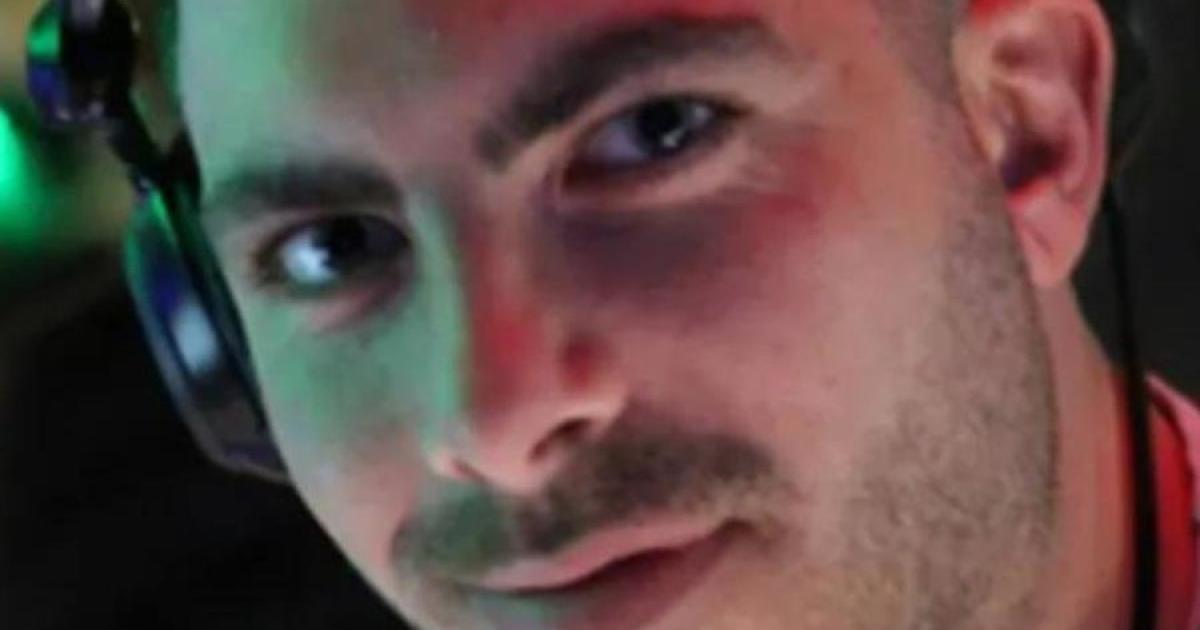
Ashley Crowder, 36, denied murdering 37-year-old Graham Cox after repeatedly stealing his money to buy drugs and keeping his trapped in his flat.
But this week a jury convicted him of the crime with a string of other offences, leaving Crowder facing a life sentence.
Opening the case at the start of the trial, Mukul Chawla KC, prosecuting, said: “The murder occurred in the days before Graham Cox’s body was discovered on the evening of March 5.
“He had been beaten and there were fractures of the laryngeal cartilages in the neck.”
Advertisement
The trial took place at Bolton Crown Court (Image: Phil Taylor)
Mr Chawla said it had not been possible to establish the exact time of Mr Cox’s death but that it had happened at some point before March 5, 2024.
Mr Chawla told the jury that Mr Cox had been “extremely vulnerable”, because of his long-term drug use and from strokes he suffered in 2023.
He told jurors that Crowder had access to Mr Cox’s bank cards and phone and so was able to take money from him in the period leading up to the 37-year-old’s death.
Mr Chawla said: “The thefts alleged are that this defendant stole money from Mr Cox.
Advertisement
Officers on Barton Walk (Image: Newsquest)
“Not in the usual way perhaps by picking his pocket or by taking his wallet but, by forcing Mr Cox to pass all the money that he received as benefits from the Department of Work and Pensions to the defendant when Mr Cox was, as you will see, in desperate need of it.”
Crowder, of Barton Walk, Farnworth, had denied all the charges put to him.
Richard Pratt KC, defending, told the jury that far from being his killer, Crowder had been the “only person” to put a roof over Mr Cox’s head.
Police on the scene on Barton Walk (Image: Newsquest)
Mr Pratt told the court the prosecution had failed to “shut down” the chance that someone else could have killed Mr Cox.
Advertisement
He reminded the jury of Mr Crowder’s police interview where he claimed that around 50 people had made use of his flat.
Mr Pratt said: “Could some person unknown or unidentified have caused the death of Graham Cox?”
But on Wednesday June 17 the jury convicted Crowder of murder, assault and four counts of theft.
The Honorary Recorder of Bolton Judge Nicholas Clarke KC remanded Crowder into custody and ordered that he be brought back to court to be sentenced on Wednesday July 29.
By the early 2000s, British Asian culture was breaking into the mainstream.
In the middle of that shift was Bobby Friction, who now presents on BBC Asian Network.
“The revolutions of the 1990s paved the way for the riches of the early noughties,” he remembers.
” ‘Goodness Gracious Me’, for us, was monumental – that specific British Desi humour was on national TV.”
Advertisement
Seeing members of the cast who were from the same parts of London as he was felt, he says, “like the revolution wasn’t just in my head, it was happening across the country”.
“In 2002, Radio 1 decided to do a South Asian music show, and Nihal Arthanayake and I were chosen to present it.
“My ambition since the age of 15 was to be on Radio 1 playing South Asian music.”
That same year, Asian Network went national, and Desi DNA launched soon after.
Advertisement
“Suddenly you’re in this new era which has already started when the other era hasn’t even finished yet.
“At that time, if you were young and South Asian just coming of age, it was very, very different compared to even 10 years before.”
Andy Burnham has acknowledged a plea from a bride not to ‘ruin’ her wedding which is happening in the shadow of the new Number 10 North.
Advertisement
The government’s new northern headquarters, currently based in Heron House facing Albert Square in Manchester city centre, was officially opened by the new Prime Minister who made his first visit on Friday (July 24).
He is expected to work from the new hub at least once a week whilst other cabinet ministers are expected to work there on a regular basis.
Click here to get the biggest stories straight to your inbox in our Daily Newsletter
There was a police presence outside the building, which also houses GCHQ’s North West base, throughout the week. This then ramped up on Friday with a large police presence including armed officers patrolling the area around it.
Advertisement
Mr Burnham’s security convoy was driven straight into the building in the morning and metal fencing was also erected around the front entrance. He did however come out to greet crowds who had gathered hoping to catch a glimpse of him, telling them: “I love you Manchester.”
The registry office is based in the same building, with the entrance being around the corner on Lloyd Street.
A number of bridal parties could be seen making their way into the building as police stood guard nearby.
Advertisement
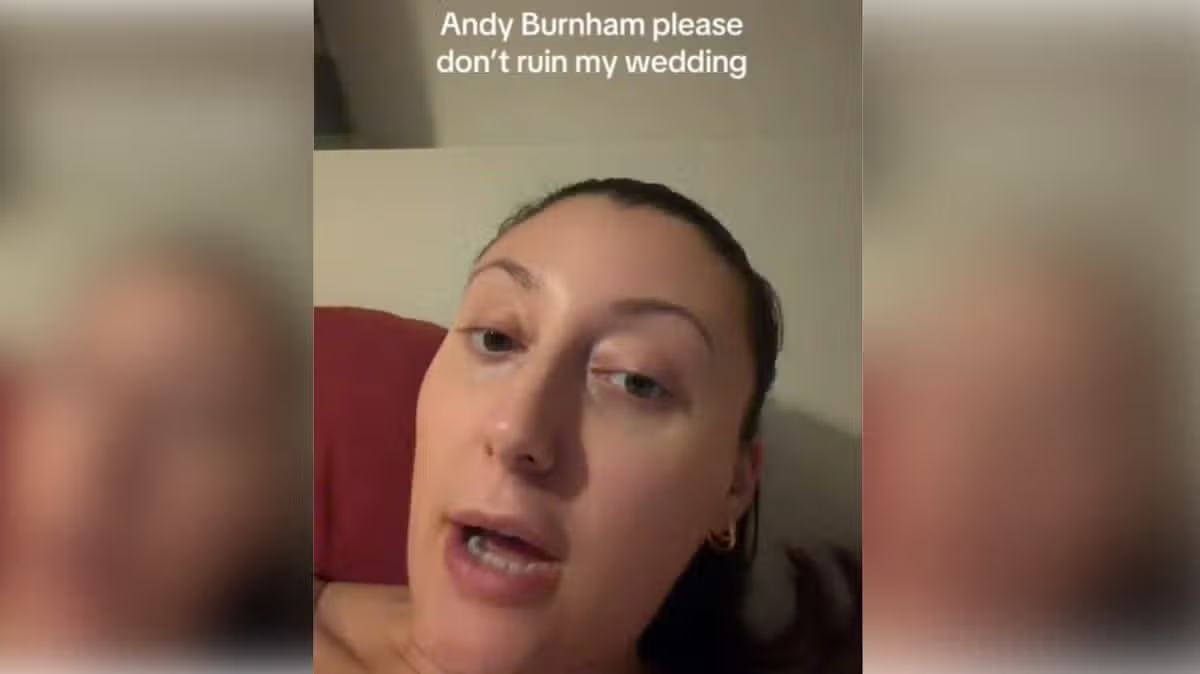
And one bride-to-be has issued an emotional appeal to Mr Burnham ahead of her nuptials. In a video posted on TikTok, titled ‘Andy Burnham please don’t ruin my wedding’, Saz Burwin said: “I saw you set up your new gaff, Number 10 North, at Heron House. I saw it on the news, gorgeous, love what you’ve done with the place.
“But I’m actually getting married there on the 21st of August and on the news today, the place was surrounded with police, bollards, all sorts. A lot of stuff that wasn’t there before.
“My trouble is, I was planning to get nice photos like after, the registry office, outside, and I’m just a bit worried that all of this is kind of ruining the vibe.”
Advertisement
Saz, who has been documenting her wedding preparations on the social media site, continued: “So I would really appreciate it if you were maybe not there that day. I mean, you’re welcome, you’re invited. But maybe without the escorts, the police escorts. The guys with the rifles and s**t, because I’ve got a content creator coming.
“So I don’t really know what we’re gonna do if it’s surrounded by the military and police, you know. Just something to think on. No pressure. But if you could, you know, give them an hour off. I am just a little bit concerned about that, if you could let me know.”
Mr Burnham responded to her post saying: “Noted Saz.”
A 39-year old man was arrested after calling for help after the two-year-old began struggling to breathe, with paramedics administering a NARCAN nasal spray which the boy responded to
Rachel Vickers-Price UK and World News Reporter
01:48, 27 Jul 2026
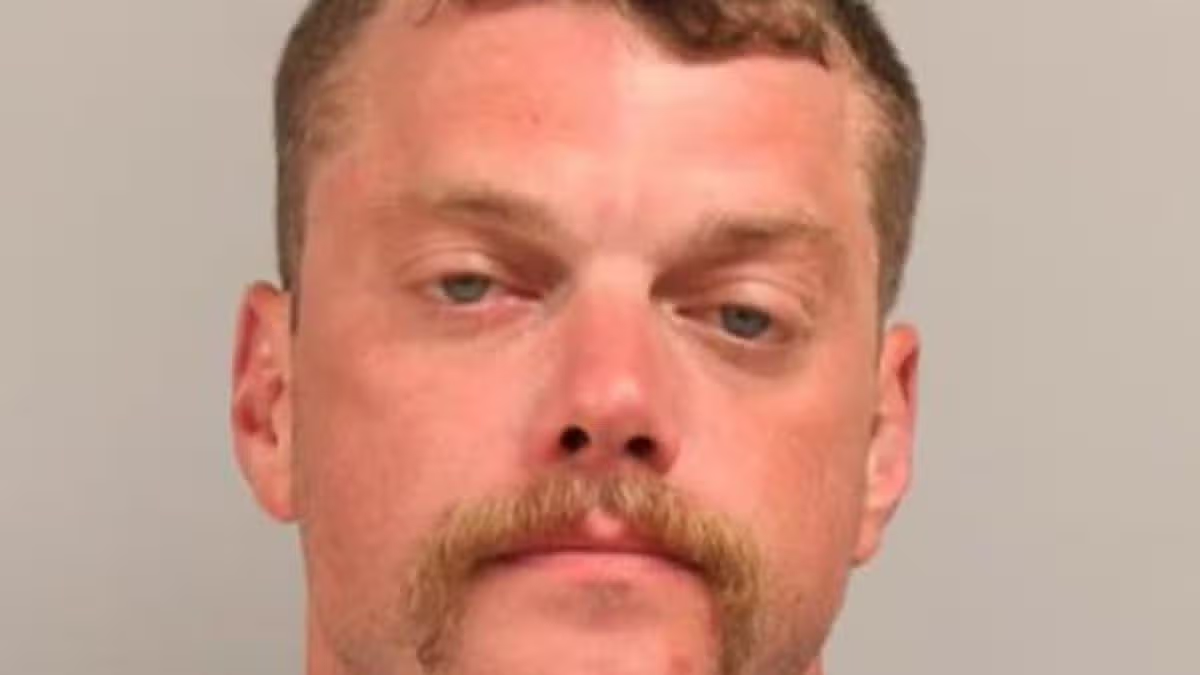
A toddler has nearly died after overdosing on cocaine, with first responders forced into action after the two-year-old was found struggling to breathe. Police on the Jersey Shore in the United States confirmed they have arrested a man, 39-year-old Alexander T. Moles, on charges of child endangerment after a July 20 callout in relation to a sick toddler. When first responders arrived, it was discovered that had been on his way to hospital, driving the two-year-old to A&E as he was having difficulty breathing. Paramedics administered two doses of Naloxone nasal spray – also known as NARCAN – to the boy, to which he responded. NARCAN is an anti-opioid drug which has no effect on a patient if there are no opioids in their system.
The two-year-old boy was then transportedto Cooper University Hospital Cape Regional for further medical attention, with blood tests later confirming the tot had tested positive for cocaine.
Police officers later found a pill, tinfoil packets labelled “tapentadol hydrochloride,” a clear plastic bag containing a white, powdery substance, and several short plastic straws following a judge-ordered search of Moles’s Airbnb, according to an affidavit.
As per a statement released by prosecutors in New Jersey, a joint investigation was then initiated by the Wildwood Police Department and the Cape May County Prosecutor’s Office Special Victims Unit. A spokesperson said: “Through the investigation it was determined that Alexander T. Moles was vacationing at a residence in Wildwood, New Jersey when the two-year-old male became ill.
“As a result of the initial investigation, on July 21, 2026, Alexander T. Moles was arrested and charged with one count of Endangering the Welfare of a Child, a crime of the second degree; one count of Possession of Cocaine, a crime of the third degree; one count of Possession of Drug Paraphernalia, a Disorderly Persons Offence; and one count of Possession of Prescription Legend Drugs, a crime of the fourth degree.
Advertisement
The Cape May County Prosecutor’s Office added: “Prosecutor Sutherland advises persons convicted of a second degree crime are subject to a term of imprisonment of five to 10 years in New Jersey State Prison. A person convicted of a third degree crime are subject to a term of imprisonment of three to 5 years in New Jersey State Prison.” The 39-year-old was arrested and placed in the Cape May County Correctional Facility, but was released three days later on bail with conditions.
The footage shows Louise Harris screaming: ‘I hope you die in your sleep’
02:00, 27 Jul 2026
Carer caught on camera abusing 81-year-old dementia patient
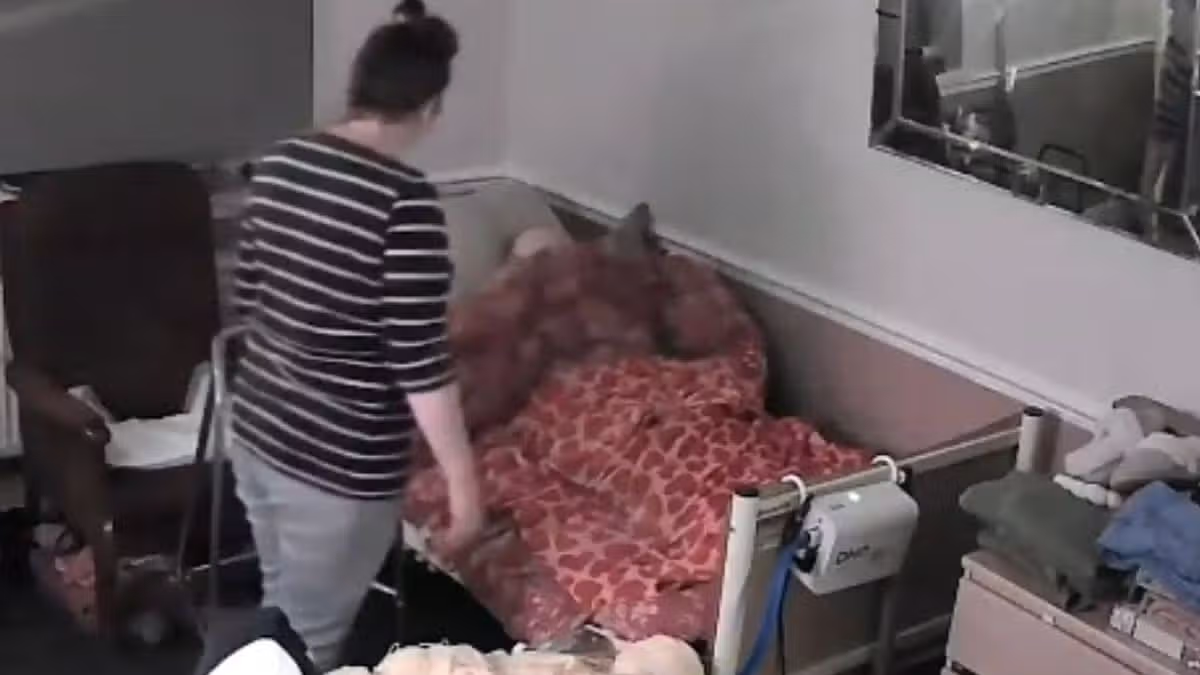
A carer was caught on camera abusing an 81-year-old woman with dementia. The family of the victim, Elizabeth Anne Shipton, have shared with WalesOnline their footage of the disturbing meltdown by carer Louise Harris, who drunkenly screamed at the pensioner: “I hope you die in your sleep you f***ing horrible cow.”
As Elizabeth lay in the bed of her Pontardawe home, Harris knelt down and put her arm on the elderly woman’s chest, demanding to know where her money was. Elizabeth complained the arm was hurting her but the carer yelled: “I don’t care, where’s your money?”
Advertisement
Last week at Swansea crown court the 42-year-old was jailed for three months, a sentence that the victim’s family believe should be significantly longer. Elizabeth is “horrifically traumatised” following her two-hour ordeal and her mental scars “will never go”, her daughter Tracy Faram told us.
Tracy has filed an appeal arguing the sentence was unduly lenient. She had known Harris, a former neighbour, for many years and had trusted her, never imagining she was capable of such cruelty.
“She’d been a carer since she was 18. I checked everything with her – she was trained on dementia, manual handling, incontinence. I’ll never get my head around how she could do this.”
Tracy had made the carer aware her mother was already in a fragile state having recently been in Morriston hospital for seven weeks with sepsis. She was also grieving the death of her husband whom she had been with since the age of 16.
“My mother had come out of hospital in December, my dad’s funeral was in January, and then this happened in February. Louise knew everything my mother was going through.
“I’d explained to her that knitting was the only thing helping my mother through the grief – it was giving her something to live for – and after I left the house Louise got drunk and ripped up my mother’s knitting. It was just cruel.”
While waiting for a care package to be put in place by social services, the family had advertised on Facebook for a sitter, which was answered by Harris. The abuse happened on the first and only occasion she cared for Elizabeth, whose family were treating it as a trial shift.
Advertisement
Tracy said: “She was meant to stay for four hours. I was there for the first hour and Louise seemed amazing. Almost as soon as I left she turned.”
After Tracy’s departure, Harris found a bottle of vodka in the fridge and downed it. The court later heard she was a recovering alcoholic who had “succumbed to temptation”.
Harris’ rage appeared to be sparked by Elizabeth accidentally pressing her Lifeline button, which triggered a phone call to a crisis response helpline.
Advertisement
This happens often, said Tracy, and the helpline operator quickly ended the call after Harris said everything was fine. But this innocuous moment seemed to infuriate Harris to the point she began screaming in the victim’s face.
The carer shouted that Elizabeth was “a horrible cow” and repeatedly hurled obscenities in a guttural scream at the top of her lungs.
At one point Harris went into the kitchen and waved a large kitchen knife around while trashing the property, the court heard.
Tracy was horrified when she accessed the security system’s camera to check how things were going, and witnessed Harris abusing her mum.
“The police had to break the door down because she’d been waving a knife,” said Tracy.
The court heard the inebriated carer was “slumped on the floor” when police entered the property.
Prosecutor Abud Hussain said the victim lay helpless in her bed thinking she was going to die. All she had wanted was to be left alone to sleep but instead Harris’ relentless aggression ruined her memories of her family home of some 60 years.
Advertisement
Harris, of Cwrt y Waun, Rhydyfro, Pontardawe, had no previous convictions. She pleaded guilty to being a care worker who ill-treated the victim and to criminal damage.
She had originally been charged with attempted robbery because of her demands about Elizabeth’s money, but the Crown Prosecution Service (CPS) dropped that charge.
WalesOnline has seen a letter from the CPS explaining this decision was made because the CCTV did not show there had been “an application of force” when Harris put her arm on the victim and asked where her money was.
Tracy, who was outraged by this decision, said: “Louise’s arm was on my mum’s chest and she could be heard saying, ‘You are hurting me.’ It beggars belief that they couldn’t see any physical assault there.”
Advertisement
During the sentencing, Harris’ lawyer Andrew Evans said his client was genuinely remorseful for her “wholly unacceptable behaviour”, which he said was the result of her finding the vodka in the fridge.
Judge Huw Rees imposed a three-month jail term, of which 40% will be served in custody, a sentence that felt wholly inadequate to Tracy, although she said: “The judge’s hands were tied by the sentencing guidelines. You could see he was raging.
“For her to be serving just over a month is unbelievable when you think what we’ve had since February. We’ve been living this day in, day out, with my mother getting worse.
“Louise told my mum she lived up the road and would be coming back. My mum can’t be left on her own at all now. She keeps thinking Louise is going to come back and she has such vivid flashbacks that she’s been put on sedatives.
Advertisement
“The effect is my mum will not wear the Lifeline device because she thinks if she presses it the same thing will happen. We’ve had to fit a new front door with glass in the middle so she can see if someone is on the other side.
“I want to advocate for cameras in homes where there are carers, because what if we didn’t have this camera?”
Judge Rees said elderly people were entitled to be treated with “respect, dignity, and humanity” but that the defendant had been “heartless and cruel”, showing a “callous disregard” for her welfare.
Get daily breaking news updates on your phone by joining our WhatsApp community here. We occasionally treat members to special offers, promotions and ads from us and our partners. See our Privacy Notice.
Israeli Prime Minister Benjamin Netanyahu said he planned to attend the UN General Assembly in New York City this autumn, despite the city’s mayor, Zohran Mamdani, making threats to arrest him.
Mamdani walked back that threat last week, acknowledging he lacked the legal power to arrest Netanyahu on a warrant issued by the International Criminal Court, the world’s top war-crimes court.
The Israeli leader told Fox News on Sunday that he was “not concerned” about Mamdani’s previous pledge and accused the mayor of “fomenting hate”.
“He’s supposed to be the mayor of all New Yorkers, Jews, Christians, Muslims, everyone, but he’s trying to turn one group against the other,” Netanyahu said.
Advertisement
Netanyahu referenced a pair of stabbings in New York on Thursday, in which a suspect stabbed a Jewish man and an Asian man just blocks apart.
The suspect allegedly shouted the phrase “Allahu akbar” while committing the stabbings, according to police. He has been charged with hate crimes relating to each victim.
Both men survived the attacks, which drew condemnations from the city’s Jewish and Asian American leaders.
In the aftermath, Netanyahu said Jewish New Yorkers were “afraid right now.”
Advertisement
The mayor’s office did not immediately respond to a request for comment.
Mamdani, a staunch supporter of Palestinian rights, made his opposition to the Israeli military operation in Gaza a central plank of his campaign last year. In an address last week, he called Netanyahu a “war criminal.”
As part of that platform while campaigning, Mamdani promised to enforce a 2024 arrest warrant for Netanyahu from the International Criminal Court (ICC), which accused the prime minister of committing war crimes in Gaza.
Israel has denied charges that it has committed war crimes in Gaza, and Netanyahu called the charges “bogus”.
Advertisement
The Israeli military entered Gaza after the Hamas-led attack in Israel on 7 October 2023. About 1,200 people were killed and 251 were taken hostage.
Over 73,000 people have been killed in Israeli attacks in Gaza since then, including more than 21,000 children, according to the territory’s Hamas-run health ministry, whose figures are considered reliable by the UN.
Last week, after the New York Times pressed Mamdani on his pledge to arrest Netanyahu, Mamdani said his administration had reviewed the law and found: “We do not have the independent legal authority to enforce this warrant”.
Mamdani urged the federal government to arrest the prime minister, and said: “Benjamin Netanyahu is not welcome in New York City.”
The 44th US president has visited Belfast and Ireland before
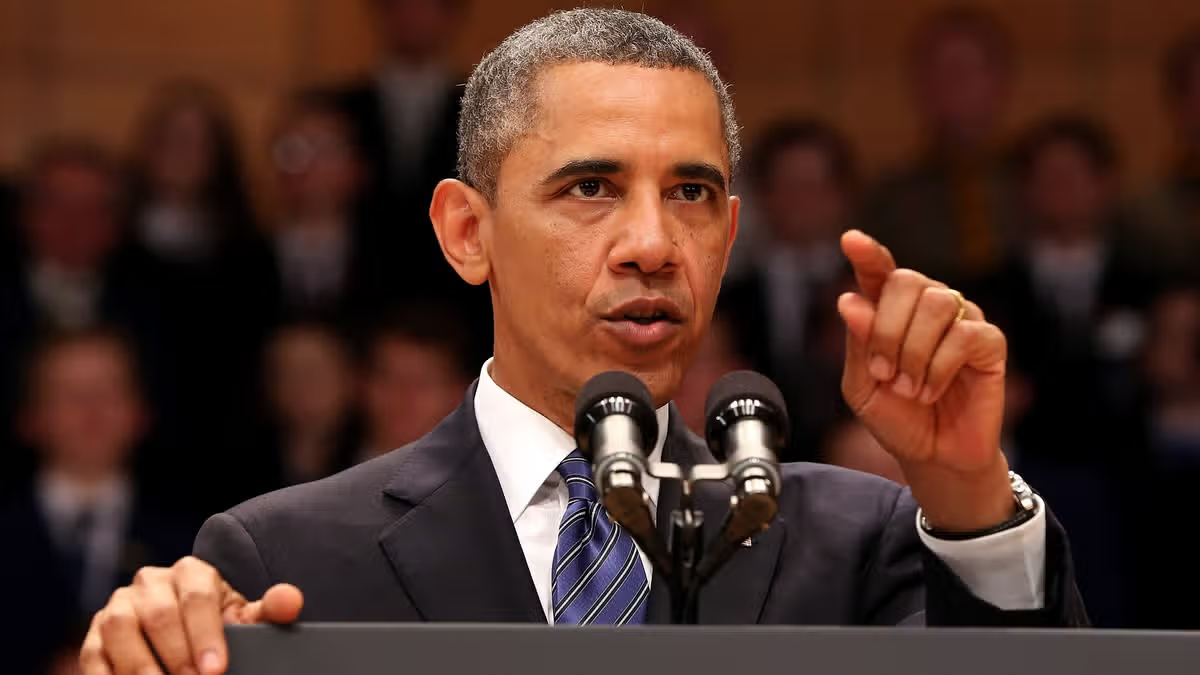
Former US president Barack Obama is to tour the UK in a series of on-stage interviews.
Advertisement
The 64-year-old, who became the first black president of the United States in 2009, will take An Evening With President Barack Obama to Belfast, Glasgow and Manchester, following shows at The O2 in London and the 3Arena in Dublin last year.
The 44th US president will appear at The O2 in Belfast on October 13, Glasgow’s Ovo Hydro on October 14 and Manchester’s Co-op Live on October 15, with guest moderators to be announced.
Organisers said Mr Obama will speak about “what comes next for America, and for all of us” in the live interview format.
Robin Sherry, founder and chief executive of organiser Seat Unique, said: “Following the phenomenal response to last year’s events, we are delighted to bring three new opportunities for fans to experience An Evening With President Barack Obama.”
Advertisement
Mr Obama was interviewed by British TV historian David Olusoga at The O2 in London in September.
After his two-term presidency ended in 2017, Mr Obama and his wife, Michelle, signed a deal with Netflix to produce documentaries, series and features for the streaming platform under their Higher Ground Productions company.
In 2022, Mr Obama won the Emmy for best narrator for his work on Netflix documentary series Our Great National Parks, and he has won Grammy Awards for his audiobook readings of two of his memoirs: The Audacity Of Hope and Dreams From My Father.
The Hawaii-born former president has also hosted a 2021 podcast called Renegades: Born In The USA, alongside rock singer Bruce Springsteen, which also resulted in a book.
Advertisement
Tickets for the UK shows will go on sale on Friday July 31 at 10am from Myticket.co.uk and SeatUnique.com, with 100 tickets set aside for charitable organisations.
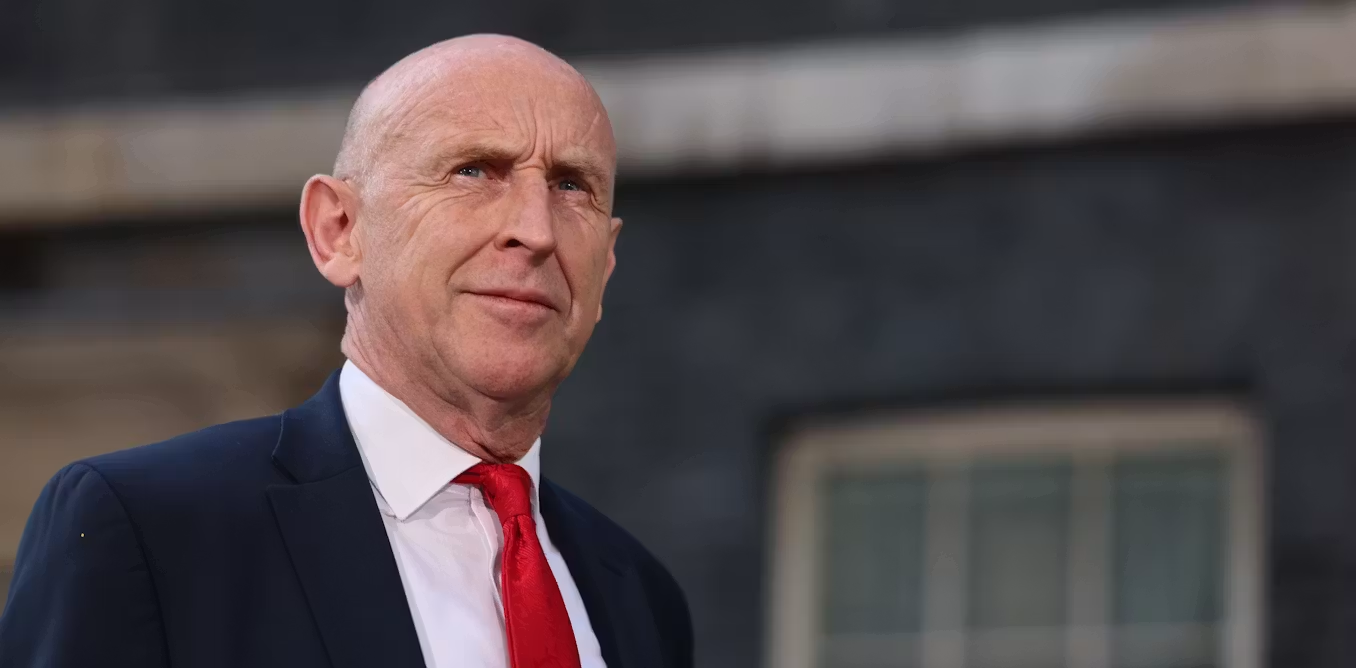
The UK’s new prime minister, Andy Burnham, laid out a radical agenda in his short speech upon taking office. He called for a long-term strategy to reverse 40 years of Thatcherism, and the privatisation and centralisation that resulted. Wisely, he put a ten-year horizon on these objectives and it is now up to his new chancellor, John Healey, to realise his ambitions.
Sensibly, Burnham has also announced less costly but limited measures to deal with the cost of living and the housing crisis – intended to convince the public that he understands their concerns. So far these include a pledge to cap single bus fares in England at £2, cut VAT on electricity bills from October, and end rough sleeping (with no time frame specified).
The government said that the cut in energy bills is fully funded by scrapping plans for digital IDs. But spending watchdog the Office for Budget Responsibility (OBR) has pointed out that the funding for this was set to be covered by further, albeit modest, cuts to other government departments.
By appointing Healey, Burnham has reassured the bond markets, which feared the more leftwing Ed Miliband would become chancellor. Healey resigned as defence secretary in June, which played a major role in Keir Starmer’s resignation. His exit was caused by the Treasury refusing to find the funds to allow the UK to reach Nato’s defence spending target of 3% of GDP. Now it will be Healey’s job to find this money.
Other long-term goals will be just as expensive. Building council housing, fixing social care and acquiring privatised companies will all make a considerable dent in the government’s finances. These have already been weakened by the effects of the Iran war, with growth this year projected to be just 1%.
Like all chancellors, Healey’s central aim must be to boost long-term growth and productivity. This is the only way to ensure prosperity for voters and enough funds to improve public services without increasing government debt.
Although Burnham has pledged to abide by the fiscal rules and Labour’s promise not to raise income tax, VAT or national insurance, the chancellor will be able to find a number of tweaks that give him room for manoeuvre – just as chancellor, Rachel Reeves revised the fiscal rules in a way that eased restrictions on borrowing money in order to invest.
Advertisement
Many new policies, from building council housing to funding social care and training for young people, have long-term benefits to the economy. There could be an argument for reclassifying these as investment spending. In the case of council housing, it is actually providing the government with a valuable physical asset.
Time for a wealth tax?
Meanwhile, there are also many ways to increase revenue without breaking Labour’s taxes pledge. Burnham’s main focus is likely to be further taxation of wealth, which might aim to equalise rates with taxation on earned income. Tax relief on private pensions, which mainly benefit the better-off, could also be a target. And changes to the top rate of income tax, if it was balanced by an increase in the personal allowance to ensure people on the basic state pension do not pay income tax, could be popular.
The most contentious issue will be the taxation of property. Broadly, the reform of council tax – the system introduced by the Thatcher government and still based on property valuations made more than 30 years ago – would sharply increase costs in rich areas like London and the south east, while easing burdens further north. But that would have to be accompanied by a redistribution of funds to northern councils, which would otherwise see their revenues fall sharply.
This points to the broader question facing the Treasury – and the government – on how to carry out a meaningful devolution to the regions. It is likely to mean giving some of central government’s revenues – such as income tax – to regional authorities. They could also be given powers, like in Scotland, to raise income tax in their region.
Advertisement
There are also some fixes that could reduce the government’s deficit – the difference between what it brings in and what it spends. Firstly, key policies such as social care could be funded by a special tax on housing, as Burnham himself proposed in 2010 when he was health secretary. And some of the huge increase in defence spending might be funded jointly by a number of Nato countries issuing a common defence bond, which might lower borrowing costs and may not be counted as part of UK government debt. Finally, the government could gain effective control of failing private utilities, such as Thames Water, without fully nationalising them.
Rates relief for small businesses, including pubs, could be popular. EPA/ANDY RAIN
Like all chancellors, Healey will have to balance the need for more spending with voters’ desire for lower taxes. It will take a clever politician to square this circle, given the weakness of the UK economy and that of its key trading partners.
One route to achieving these objectives without upsetting the markets is to put forward measures that show it is on the side of the people, while announcing revenue-raising measures aimed at more unpopular targets. For example, a cut in rates for small businesses (especially pubs) in northern cities could be popular, and might be funded by higher taxation of warehouses owned by retail giants.
Advertisement
Devolution could also help by pushing responsibility to the local level. Voters would then be able to see the benefits in their own communities. And giving councils a bigger role in welfare reform may pay off if investment in training and mental health support led to a national reduction in the welfare bill. This will be one of Healey’s key objectives, as well as being a major concern for the markets and the OBR.
So far the markets have adopted a “wait and see” approach to the Burnham government. The autumn budget could be crucial in determining whether the new administration has a credible long-term economic strategy that can win both public support and market acceptance.
Bosses at Britain’s second busiest airport issued the update late on Sunday, after most passengers had a disrupted start to their holidays when restaurants, cafes, and toilets closed
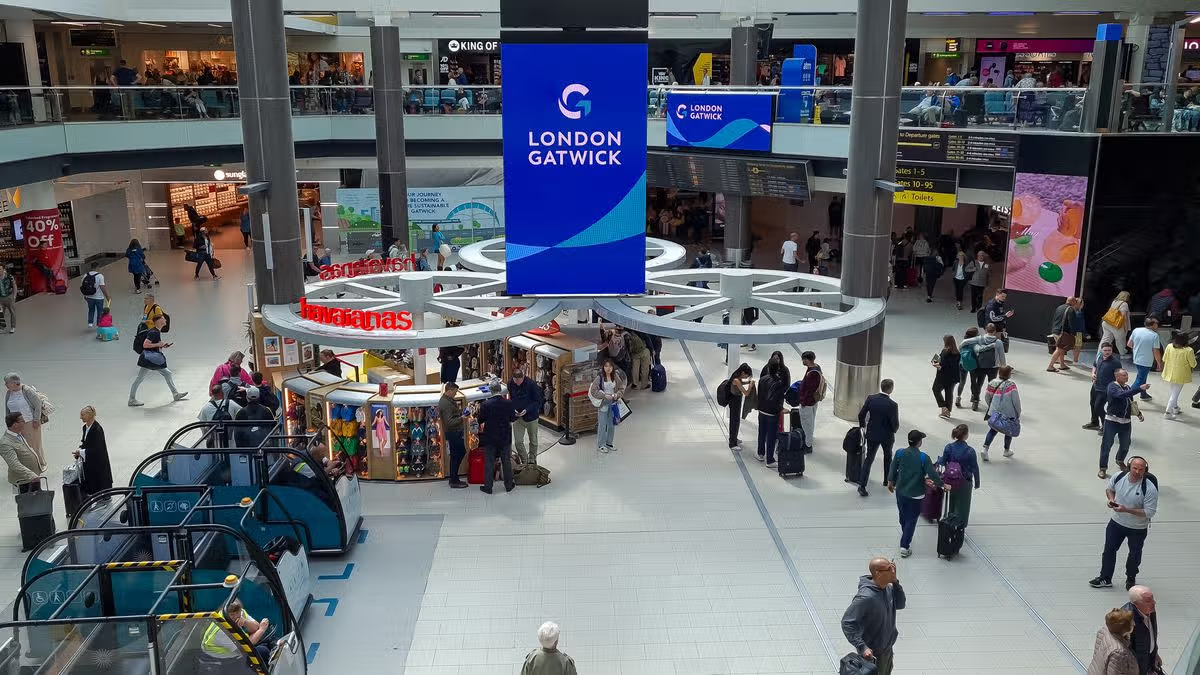
Gatwick Airport has issued an update to passengers over its Monday opening plans following major water supply issues.
Advertisement
Britain’s second-busiest airport lost its water supply for much of Sunday (July 26), prompting restaurants, cafes, and even toilets to close in both terminals. Passengers were given complimentary bottles of water by staff.
Roger Wood, from Tunbridge Wells in Kent, was one. He arrived at Gatwick South Terminal at around 11am on Sunday to fly to New York.
He told PA: “There was no communication. We arrived at 11ish and it had only started recently.
“We met friends at the bar but they couldn’t serve us as they were unable to wash their hands.
“I’ve never seen Wetherspoons empty. No idea when it’ll be resolved, the toilets also lacked water to wash hands.”
The issue plagued the airport for most of Sunday, but shortly before 10pm yesterday evening, management said water supply has been restored for ‘most’ of its buildings. They hope to reopen the terminals as normal on Monday.
Advertisement
“Following an issue at the Bough Beech Water Treatment Works which impacted the local area today, we are pleased to report that the water supply has now returned to the vast majority of the London Gatwick campus,” the statement said.
“Most toilet facilities are now open and we expect all toilets – as well as food and beverage outlets – to be open for tomorrow’s first flights.
“Since becoming aware of the issue, we have been working closely with SES Water and our airport partners to help minimise the impact, and ensure all today’s flights departed as scheduled. Additional staff remain on hand across both terminals to support passengers and maintain operations as we return to normal operations.
Advertisement
“We recognise the inconvenience caused by today’s water shortage and thank passengers for their patience and understanding. We’d also like to thank airport staff and our partners, who have gone above and beyond to support passengers and keep disruption to a minimum.”
The first flights out of Gatwick leave at 5:20am on Monday. The North terminal’s first departure is easyJet’s service to Athens, while the south terminal’s first take-off will be Wizz Air’s jet to Podgorica, the capital of Montenegro.
On top of this, life satisfaction among young people is on the decline. New analysis by the Institute for Public Policy Research (IPPR) found the number of young people who are satisfied with their lives has fallen from 62% in 2010 to 44% today among 16- to 24-year-olds living in England.
Yet research has demonstrated a strong link between mental health and confidence levels. High levels of symptoms such as anxiety and depression have been associated with low confidence, for example.
So, how can parents best help encourage confidence in children and teens? I reached out to Dr Patapia Tzotzoli, clinical psychologist and founder of My Triage Network, to discuss the best techniques.
Advertisement
1. Praise effort, strategy and persistence
The psychologist said when parents comment on the effort and approach their children make, rather than fixed traits, it helps them develop a growth mindset. They then believe their abilities can improve with practice.
Instead of saying “You’re so clever”, Dr Tzotzoli advises parents to say, “You worked really hard on that,” or “I noticed you tried a different strategy.”
Dr Lucie Hemmen, a clinical psychologist and author of multiple books on parenting teens, previously noted that compliments “do not create true confidence for teens”.
Advertisement
Klaus Vedfelt via Getty Images
2. Let children do age-appropriate things for themselves
“Confidence grows from lived experience, therefore it is very important that children need chances to try, struggle, make mistakes and recover,” said Dr Tzotzoli.
“Parents can build this by giving manageable responsibilities, such as ordering their own food, packing their school bag, choosing clothes, or solving a problem before they step in. The aim is to support your child, without stepping in too quickly.”
Advertisement
As they grow older, Dr Hemmen suggested in a TikTok video that teens need the “opportunity to interact with challenges that are a little outside their comfort zone”.
She added that summer is “a great time to work with your teen to find developmentally appropriate stretches that give them the opportunity to build true confidence”.
This could look like volunteering, learning an instrument or even setting up their own side hustle (the kids in my street have been doing everything from car and bin-washing to babysitting over the holidays – they even made fliers!).
3. Use specific encouragement
Advertisement
Dr Tzotzoli said another helpful strategy is to describe what you observe when your child does something difficult. For example, you could say: “You were nervous, but you still walked into the room,” or “You asked for help instead of giving up.”
“This helps children see themselves as capable, brave and resourceful,” she said, adding that general reassurance such as “You’ll be fine” is “often less helpful than highlighting what the child has already managed”.
4. Give children limited choices to build autonomy
For younger children, offering two or three realistic choices helps them feel some control over a situation without becoming overwhelmed, noted the psychologist.
Advertisement
“For example, you can ask ‘Would you like to try homework before or after snack?’ or ‘Do you want to practise for five minutes or 10?’,” said the expert.
“ Giving children age-appropriate choices helps them feel capable and involved, rather than simply being told what to do.”
5. Model confidence by showing healthy self-talk after mistakes
Your children can also learn a lot from how you handle setbacks. If you did something incorrectly, you could highlight that and say: “I got that wrong, but I can try again.”
Advertisement
This can teach more than a lecture about resilience, said Dr Tzotzoli. “It normalises mistakes as part of learning and helps children see failure as part of the process, not the end of the story.”
In her own home, when she gets something wrong, she’ll celebrate it in front of her children and show genuine excitement, “because I tell them I am now one step closer to getting it right”.
She ended: “There are also some lovely children’s books that reinforce this message, such as The Most Magnificent Thing by Ashley Spires, which shows how frustration, mistakes and persistence are all part of the creative process.”
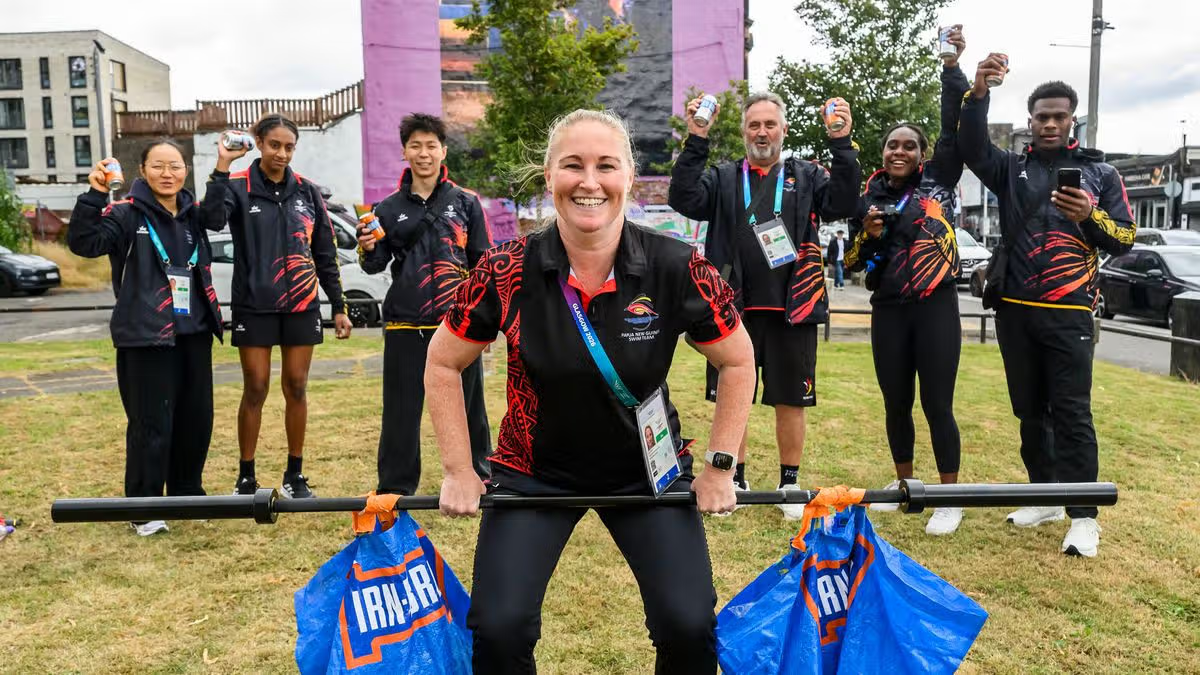
The Papua New Guinea swimming team were spotted at Glasgow’s Barras Market for Irn-Bru themed activities.
The Commonwealth Games’ Papua New Guinea swimming team have joined thousands at Glasgow’s iconic Barras Market for the official IRN-BRU games.
Advertisement
The aquatic sports stars visited the popular east end market just hours after competing in the qualifying heats at Tollcross International Swimming Centre on Sunday, July 26. They competed in a host of urban challenges set up by Irn-Bru despite falling short of booking a spot in any of this evening’s medal competitions.
The challenges included a 10 metre Bus Sprint along an orange running track, aiming to beat the number 61 service in less than 1.7 seconds and Bin Ball, where visitors scored empty cans of IRN-BRU into an orange and blue bin through a 3-metre high hoop. The other test was the 20kg bar bell Bag Lifting challenge, weighted entirely by cans of IRN-BRU.
Over 2,000 people of all ages turned up over the weekend to show off their girders as part of the celebrations of the sporting prowess that’s taken over the city.
Advertisement
The challenge caught the attention of keen competitors and famous faces alike, with Scots singer Josef and ex-England rugby international and sports pundit David Flatman also turning up.
To celebrate their wins, each competitor walked away with an ice-cold can of BRU, with some even lucky enough to win an iconic ‘Made in Scotland From Girders’ t-shirt.
Kenny Nicholson, Director of Brand at IRN-BRU, said: “Glasgow is welcoming some of the best sporting talent in the world this summer, but we wanted to champion athletes closer to home too; those people who show up with feats of endurance, strength and a whole lot of girders in the everyday.”
Get more Daily Record exclusives by signing up for free to Google’s preferred sources. Click HERE.

















































You must be logged in to post a comment Login