She will, forever, be known as the last woman in England to be hanged for murder. But this week, some 70 years on, there has been redemption of sorts for former nightclub hostess Ruth Ellis.
Ellis was executed at the age of 28 at north London‘s Holloway Prison in July 1955, having shot dead her lover David Blakely, 25, outside the Magdala pub in nearby Hampstead.
Amid public fury over her execution, the former glamour model appeared serene about her fate, as revealed in unseen letters that came to light when her family called for her to be posthumously given a reprieve last October.
In one letter, written on prison paper with her name and prisoner number, Ellis said, ‘I am quite well’ the day before she was hanged by Albert Pierrepoint, Britain’s most prolific executioner.
A single mother of two at the time of her death, Ellis was portrayed as a ‘cold-blooded killer’. But her family have long denied this depiction, arguing she was physically and emotionally abused by her partner before killing him.
She shot Blakely dead following a tumultuous relationship involving infidelity on both sides, an aborted pregnancy, and violence including a punch in the stomach during an argument that led to a miscarriage.
Fighting for a posthumous pardon, four of her grandchildren said Ellis would today be able to plead the defence of diminished responsibility due to his treatment of her.
Now, 71 years later that wish has now been granted by the King, announced in the House of Commons on Wednesday by Justice Secretary David Lammy.
Ruth Ellis (pictured) was the last woman to be hanged for murder in the United Kingdom
Ruth Ellis shot David Blakely dead outside the Magdala pub in South Hill Park, Hampstead
Ruth Ellis featured at Madame Tussauds’ ‘Chamber of Horrors’ alongside serial killers
Today, in an exclusive interview with the Daily Mail, Ellis’s granddaughter Laura Enston, 47, lays bare the family’s fight for justice and their everlasting grief.
‘Her trial was a disgrace,’ she said. ‘She was made an example of.’
Ms Enston hailed the pardon as ‘significant’, adding: ‘Changing her sentence doesn’t bring her back, but it sends out a very clear message that they got things wrong.
‘She wasn’t just on a trial for murder – she was on trial for morality.’
Ellis, a single mother from a modest background, showed no emotion during her Old Bailey trial in June 1955.
The judge told the jury to disregard the fact she had been ‘badly treated by her lover’ as a defence.
Under cross-examination, Ellis admitted she intended to kill Blakely and the jury took just 20 minutes to convict her of murder, a charge that carried a mandatory death sentence.
Ms Enston also acknowledged how her grandmother had come across as ‘cold’ when giving evidence in court.
She said: ‘She inadvertently played up to that sort of cold-blooded killer persona that she’d been portrayed to be, but knowing what we know now about trauma and slow-burn provocation, Ruth was traumatised and typical of domestic abuse victims.
‘I don’t think many people at the time understood what women suffered.’
Sitting in the House of Commons yesterday, Ms Enston said she suddenly realised just how important the family’s campaign has been.
That said, she is not done fighting just yet.
She has now urged the Madame Tussauds museum in central London to remove a figure of her grandmother from its ‘Chamber of Horrors’ exhibition.
To her dismay, Ellis is featured alongside serial killer ‘Jack The Ripper’, necrophile Nilsen, Acid Bath Murderer John Haigh and the notorious Kray Twins.
‘I recognise why she’s in there, but she shouldn’t be next to serial killers and sex offenders,’ she said, adding that she has contacted Madame Tussauds but has not received a response. Madame Tussauds has been approached for comment.
Ellis’s execution came just after Styllou Christofi, 54, was sentenced to death for murdering her daughter-in-law.
By chilling coincidence, both Christofi and Ellis carried out their killings in the very same street in the 1950s – South Hill Park in Hampstead.
They were both buried in unmarked graves at Holloway, then exhumed in 1971 along with three other female murderers of the 20th century.
These included Edith Thompson, 29, who was executed in 1923 for the murder of her husband Percy.
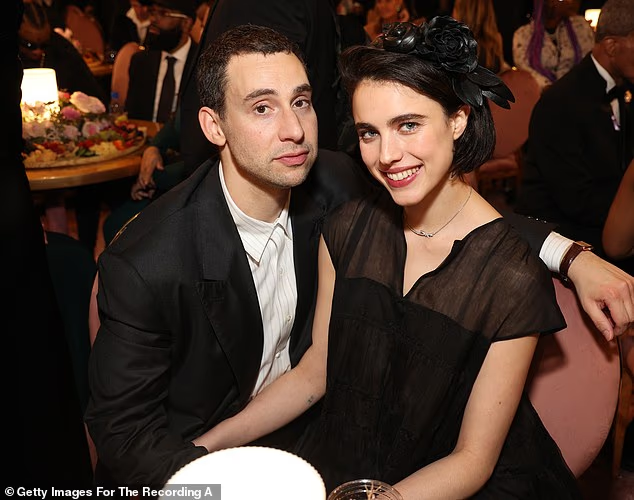
David Blakley and Ruth Ellis are pictured together at a social event
The Daily Mail’s report of Ruth Ellis’s execution in July 1955
A stoic letter by Ruth Ellis saying, ‘I am quite well’ the day before she became the last woman to be executed in Britain
Also disinterred at the same time were ‘baby farmers’ Amelia Sach, 29, and Annie Walters, 54, who had been hanged at the jail in February 1903 after being found guilty of murdering infants in East Finchley, north London.
All were transferred to Brookwood Cemetery in Surrey in 1971 except for Ellis, whose remains were returned to her family.
Thompson was exhumed in 2018 and buried in her family plot beside her mother.
It has been Ruth Ellis’s case that has drawn the most attention, not only in headlines at the time but in subsequent film and TV recreations.
These have included the 1985 movie Dance With A Stranger, starring Miranda Richardson and Rupert Everett, and last year’s ITV docudrama series A Cruel Love with Bohemian Rhapsody star Lucy Boynton in the leading role.
Ellis’s granddaughter Ms Enston said she first learned about the case when her mother showed her the 1985 film when she was just seven years old.
‘[It was] completely unsuitable for children’s eyes. That was my first experience of Ruth Ellis. That was the start of me wanting to discover for myself the story, though at first I didn’t want to be part of it.’
She prefers last year’s series as it was more sympathetic towards her late grandmother.
Mr Lammy told MPs on Wednesday that the King had granted a conditional pardon on the advice of the Government.
Ms Enston said justice had ‘finally been done’ for Ellis and the family she left behind.
She said: ‘Ruth was a victim of sustained and brutal abuse. Her children – our mother and uncle – never recovered. The shadow of Ruth’s execution has fallen across two generations.
‘This pardon does not undo what happened 71 years ago. It does not restore the lives that were broken – the children left behind, the years lost.
‘But it says, formally and finally, that Ruth should not have been executed; that the justice system failed her.’
Ms Enston admits that despite what her grandmother went through, she should never have killed Mr Blakely.
The Magdala in north London closed in 2016 but reopened in 2021 as a pub and restaurant
Ruth Ellis was the last woman in the UK executed for murder
The shooting of David Blakely happened near a pub in Hampstead, north London
‘Did he deserve to die? I don’t think he did. But he was obviously a troubled individual.’
Ms Enston said domestic abuse was poorly understood at the time and that her grandmother would now have been considered a victim of battered woman syndrome and treated differently by the justice system.
James Libson, of law firm Mishcon de Reya which represented Ellis’s family, said Ellis ‘suffered considerably’ at the hands of her ‘abusive, violent partner’.
Following a number of other controversial executions and a series of miscarriages of justice, the death penalty was permanently abolished for murder in 1969.
Two years after Ellis’s execution, the law was also changed to introduce diminished responsibility as a defence for murder.
Police lined nearby streets ahead of Ruth Ellis’ execution at Holloway prison in north London
Ruth Ellis was hanged by executioner Albert Pierrepoint on July 15, 1955
Ruth Ellis is thought here to be posing at a club over her flat on Brompton Road in 1955
Miranda Richardson portrayed Ruth Ellis in the 1985 movie Dance With A Stranger
The convicted killer was also played by Lucy Boynton in a drama series last year
Ruth Ellis’s grandchildren applied to the Department for Justice last year, seeking a conditional pardon.
Unlike court appeals, pardons can consider broader factors such as social developments which could render a conviction or its resulting punishment inappropriate or unfair.
Speaking in the Commons, the Justice Secretary said: ‘I have the honour to say that His Majesty the King has accepted our advice to grant Ruth Ellis a conditional pardon, the last woman to be hanged in the United Kingdom.
‘While the pardon does not claim she was innocent of killing David Blakely, it replaces the death penalty with a sentence of life imprisonment to recognise a profound injustice in this exceptional case.’
The Ministry of Justice said the move reflected ‘evidence of domestic abuse and coercive and controlling behaviour that may have been understood differently today’.















































You must be logged in to post a comment Login