Connect with us
DAPA Banner

NewsBeat

Man who photographed criminal underworld names four scariest Scottish gangsters

Published

on

Daily Record

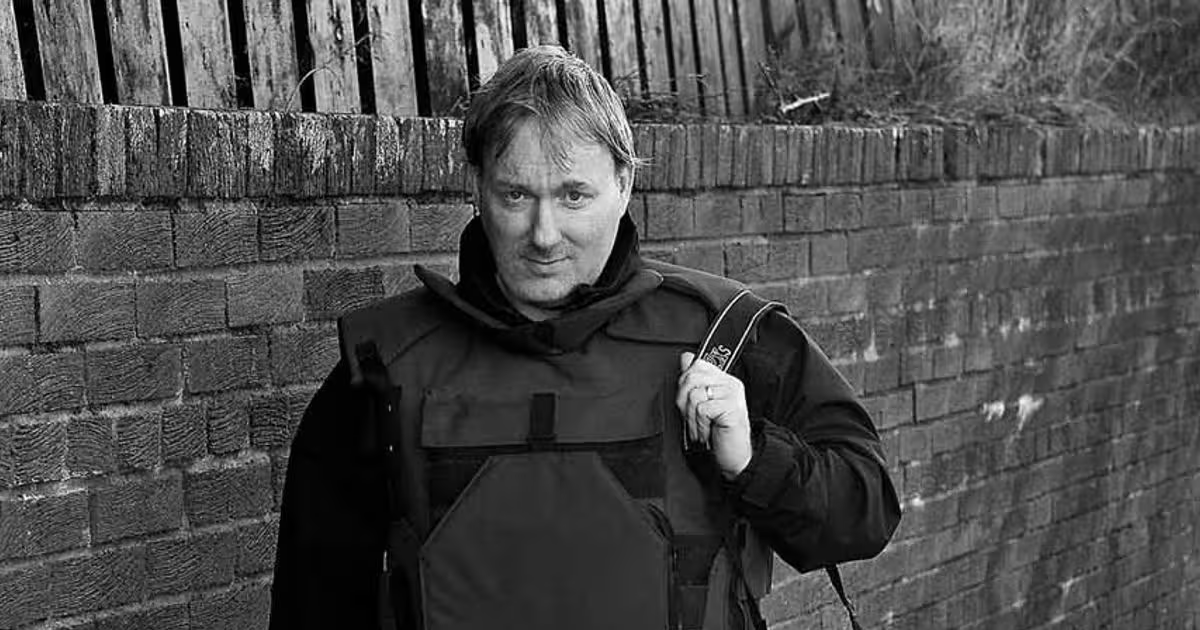
Veteran crime photographer Brian Anderson names the four Scots underworld figures that scared him more than most.

Advertisement

He has been photographing Britain’s most notorious and violent criminals for more than 25 years.

In that time Brian Anderson has come face to face with underworld figures who have stood trial for murder and in some cases been accused of multiple killings.

From Glasgow’s tough Blackhill district Brian grew up in the same mean streets that produced many of the people he would later photograph.

Today the 55 year old Glaswegian recalls four crime figures – all Scots – who scared him more than most.

Advertisement

One terrifying assignment was gangland enforcer Gary Moore who was at one time linked to the deaths of eight people..

In 2004 he snapped Moore for the front cover of an article on the criminal underworld.

Brian said:”It was probably the most terrifying three or four days ever.

“The guy was seriously unhinged. When I first met him he was sleeping on the couch in his flat in Govanhill on the southside of Glasgow.

Advertisement

“You ought to have seen the mess there were vodka bottles and cigarette stubs everywhere. It was absolute chaos.

“I used to have to wake him up every day and take him to the various locations.”

Brian was so worried about his personal safety that he had his brother-in-law accompany him every day as back up.

When Moore arrived on the second day of the shoot in Glasgow’s George Square, he was carrying a fish supper and a bottle of irn bru and to Brian’s astonishment then whipped out a loaded Magnum revolver Brian had no idea he was bringing along a firearm.

Advertisement

After his death in 2010 Brian learned that Moore was feared by other criminals and also disliked because of his violence towards women.

Brian added:”He was one of the scariest men I ever met, there were a few.

“Gary Moore was the type of guy that if you went for him you had to finish him as he would come back at you.”

Moore, who was once an enforcer for Glasgow godfather Arthur Thompson snr, was sentenced in 1994 to eight years for killing James Boyle – son of convicted murderer turned sculptor and author Jimmy Boyle.

Advertisement

Moore was also charged with the murder of sex worker Diane McInally in 1991 but the charges were later dropped.

He also stood trial at the High Court in Glasgow in 1984 over the deaths of six members of the Doyle family in a fatal fire at their home – during the city’s notorious ice cream wars – but was cleared.

Another fearsome confrontation was with crime boss Jamie Daniel in 2010.

He was then head of the Daniel crime family and would die six years later from cancer.

Brian and a colleague had been trying to photograph him outside his home in the city’s upmarket Jordanhill – without his knowledge.

Advertisement

Brian said:”He suddenly came flying round the corner in his car and gave chase and at one point we were bumper to bumper.

“The chase lasted about two miles and we ended up in Glasgow’s Great Western Road where I drove into a police station and he then drove away.

“I think he had a lot of spies in the street who would have let him know if there was a car outside.

“At the time it was terrifying incident. We were just panicking and thinking lets get out of here.”

Advertisement

Another terrifying underworld figure was Mark Clinton who once told Brian that he wanted to cut off the head of crime boss Tam McGraw and put it in his wife’s bed.

Brian said: “I was taking photographs at Clinton’s home in Airdrie when he told me he was going to decapitate McGraw.

“He then pulled out a sword and started waving it around his living room. I photographed Clinton various times. He lived a dangerous life.

“While I was in his flat he assembled a contraption at his door.

Advertisement

“It was rope attached to a sword set up like a guillotine. The rope was tied to the handle so that if any intruders came in it would decapitate them. It was a booby trap.”

In 2003, Clinton became a prime suspect in the murder of Billy McPhee – an enforcer for McGraw.

McPhee had been watching a rugby match when a man entered the Springcroft Tavern in Baillieston, Glasgow and stabbed him multiple times before walking out.

Advertisement

Clinton was cleared of the murder at the High Court in Glasgow the following year when witnesses failed to identify him. He died in 2019 at his flat in Paisley at the age of 48.

Brian added:”You can tell when you are in the company of somebody who has become really unhinged.

“With someone like Mark Clinton there is no filter.

“You can sense the danger right away.

Advertisement

“I found that with him. Another guy who was off the chart.”

Clinton once told Brian that his local Job Centre was trying to find him work on a building site.

Brian added:”He said that if he was ever asked to dig a hole he was going to dig the hole but the person who asked him was going in it.”

Brian also photographed Tam McGraw in his luxury home in Mount Vernon in Glasgow’s east end for a book about his life.

Advertisement

Brian says McGraw was less terrifying but exuded a natural air of menace.

He added:”He definitely gave the impression of someone that shouldn’t be crossed.

“I had photographed him at the funeral of an associate Gordon Ross who had been murdered outside a pub in the east end of Glasgow.

“It was the first time he had been seen in public for years. Tam was not happy that the photograph had been taken and asked me how much I had been paid.

Advertisement

“When I said £100 he said he said he would have given me £2,000 for it not to appear.

“When I turned up at his door with my equipment he asked what was inside my bag.

“I jokingly said a bazooka and he said okay come in.”

McGraw died aged 55 in July 2007, after collapsing at home from a heart attack.

He was estimated to have made around £30 million from organised crime including drugs which in turn was said to have been laundered through legitimate enterprises such as ice cream vans, taxis, pubs, security firms and property both at home and abroad.

Brian began taking photographs of criminals in the late 90s for newspapers.

His first subjects were Thomas TC Campbell and Joe Steele, who were serving life sentences for the six Doyle family murders in Ruchazie, Glasgow.

Advertisement

In 2004, both men were eventually cleared after spending more than 20 years behind bars. Campbell died in 2019.

Brian has also photographed 1960s London underworld figures such as Ronnie Biggs, former Kray Twins driver Billy Frost, Freddie Foreman and Mad Frankie Fraser.

One of his earliest subjects was former underworld figure turned author Paul Ferris after he got out of prison in 2001 on firearms offences.

Ferris first came to public attention in 1992 when he was cleared unanimously of the murder of Arthur Thompson jnr, son of crime boss Arthur Thompson snr, at the High Court in Glasgow.

Advertisement

Brian was speaking to the Daily Record following the launch of his new blog Naked City about Glasgow’s underworld.

The blog has photographs and profiles of the underworld figures he has met over the years as well as his own take on the Glasgow crime scene.

Last month we reported how a book about the infamous figures that Brian has snapped may be turned into a Hollywood movie Shooting the Mob was a Christmas bestseller and has already sparked interest from investors.


Advertisement

Source link

Continue Reading
Click to comment

You must be logged in to post a comment Login

Leave a Reply

NewsBeat

‘Not good enough’: Sonia Bompastor fumes over VAR controversy in Chelsea FC loss as Veerle Buurman goal ruled out

Published

on

'Not good enough': Sonia Bompastor fumes over VAR controversy in Chelsea FC loss as Veerle Buurman goal ruled out

Asked what the fourth official told her after Buurman’s header was chalked off, she replied: “Nothing! Nothing, it is always the same. You go to them and ask them to check the situation and make sure they made the right decision, they just always say ‘we are checking’, but they make the wrong decision.

Source link

Continue Reading

NewsBeat

here are three ways the UK government could shield vulnerable households

Published

on

here are three ways the UK government could shield vulnerable households

Even before the US-Israel war on Iran, people in the UK were unusually vulnerable to sudden swings in the cost of energy. Depending how you count it, either 11% or 30% of households are officially energy poor, and already struggled to afford basic needs in times of relative peace.

The government’s fuel poverty strategy for England, published in January 2026, focuses on long-term measures such as home insulation upgrades. But it says little about how to protect vulnerable households quickly in this crisis or in future price shocks.

To reduce the immediate harm, ministers need tools that can be deployed now, not just reforms that may take years to deliver.

Here are three measures that could be deployed right now.

Advertisement

A social tariff

The most effective step would be to discount energy bills for lower-income or vulnerable households – a so-called “social tariff”.

This is often seen as difficult or politically risky. But energy remains one of the few essential services without targeted affordability support. Water and telecoms already enjoy it, and energy should be no different.

In a policy brief we published late last year, we showed that the UK electricity system hits lower-income households hardest and produces “uneven bills”. This means that two households using the same amount of electricity can face differences in bills of up to 15% depending on where they live, and another 22% depending on payment method or contract type.

Advertisement

Laundry costs more – or less – depending on where you live.
Carlos G. Lopez / shutterstock

A social tariff would be fairer. Through a lower unit rate or a bill discount it would protect households with the least room to cut energy use – such as older people, low-income households, those with medical-related electricity needs and renters in inefficient homes.

These policies can also encourage energy efficiency. For instance, in California, the state’s Care programme discounts electricity and gas bills for low-income households up to a set level of use. Beyond that point, rates revert to normal.

This is not unrealistic administratively. Portugal introduced automatic eligibility for its social energy tariff in 2016. This used existing tax and social security data to expand the number of households receiving support by 400%.

The UK already has the data infrastructure to do something similar through its benefits and tax system – energy companies wouldn’t have to find out household incomes themselves; they could just ask the government. The near-term step here is straightforward – ministers could ask the industry regulator Ofgem and energy companies to design an automatic, income-linked tariff for winter 2026, instead of waiting for another crisis response.

Advertisement

Emergency support

The second priority is to reduce immediate exposure to the most volatile and expensive fuels.

Government has traditionally responded to shocks like the Ukraine war with emergency bill support. However, these ill-targeted policies are impractical and do not reduce reliance on volatile fossil fuels. Unlike a social tariff, which is a continuous means-tested support payment, emergency support is often a one-off payment. Traditionally, emergency support is a flat payment to all households, meaning those on lower incomes benefit less in relative terms, though it can also be targeted at vulnerable households.

Transport is one immediate opportunity. Rather than (yet again) freezing fuel duty, the government could redirect this money into cheaper public transport for low-income and car-dependent households.

Germany’s €9 (£8) public transport ticket, introduced in 2022 during the energy and cost-of-living crisis, shows that governments really can act quickly when necessary.

Advertisement
People chatting on a bus

Subsidised public transport could help out people struggling with expensive energy.
PintoArt / shutterstock

Households that are off the gas grid and reliant on heating oil are especially exposed when global prices rise. Alongside short-term support, like the welcome £50 million announced last week, the government should consider targeted support to switch from oil to heat pumps. The economic case for heat pumps is especially strong for households relying on heating oil. This switch would immediately reduce their exposure to oil prices.

Help households access existing savings

The third priority is to ensure vulnerable households can benefit from money-saving features that are already available in the electricity system.

Smart meters, time-of-use tariffs and shifting electricity use to cheaper times of day can cut bills, but the savings are not automatic. Those who could benefit most are often least likely to be able to access them.

The near-term priority is not new schemes, but making existing ones usable. The government could require suppliers, local authorities and landlords to prioritise smart meters and other low-carbon technologies in social housing and private rentals, where people face the greatest barriers to accessing these savings. It could also fund trusted community organisations to help households choose suitable tariffs, avoid poor deals and access support if they fall into arrears.

Advertisement

This may sound less dramatic than a new subsidy scheme, but clarity matters in a price shock. Households cannot benefit from cheaper tariffs or smart systems they do not know about or cannot use, so financial support often flows most to those already best placed to respond.

The UK cannot prevent global energy price shocks, but it can choose who bears its greatest burden. What is missing is political will. If the government is serious about protecting vulnerable households, it needs a strategic short-term response that matches the scale of urgency.

Source link

Advertisement
Continue Reading

NewsBeat

how this part of London became a home for Jews

Published

on

how this part of London became a home for Jews

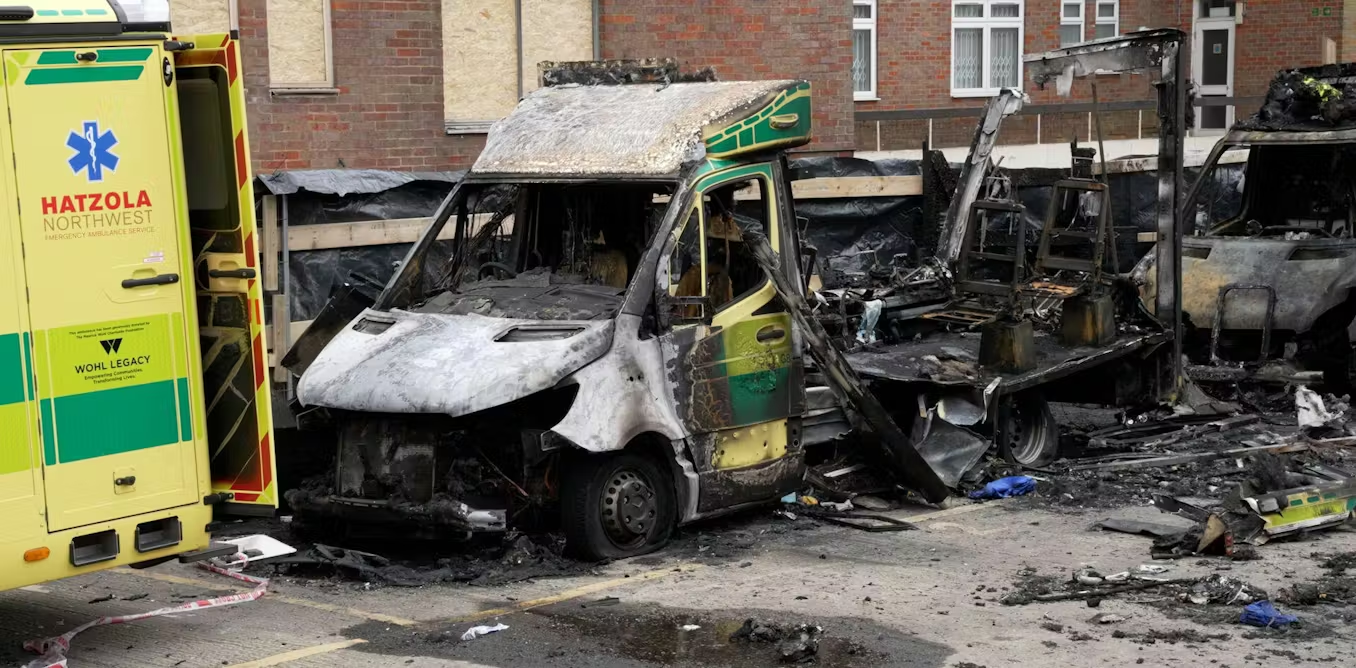
The arson attack on four ambulances in Golders Green early on March 23 has been called “a horrific antisemitic attack” by the prime minister, Keir Starmer.

These ambulances were run for the benefit of both the local Jewish and non-Jewish communities in this district of north London by a charity called Hatzola – meaning “rescue” in Hebrew. As these ambulances played a key supportive role in enabling access to health provisions for the good of all, it is especially shocking – and has further heightened the anxieties of British Jews.

This is a community still reeling after the attack on the Heaton Park Synagogue in Manchester in October 2025 on Yom Kippur, the holiest day of the Jewish religious calendar, which killed two people. And the arson attack is part of a wider international wave of antisemitism, which has included Norway, the US and the Netherlands in the past few weeks. This is not an easy time to be a diaspora Jew.

Those who have carried out the attacks have come from different backgrounds. Many have been influenced by online hate emanating from Isis, and potentially individuals or groups supportive of the hardline Iranian regime. Counter-terror police are investigating whether an Iran-linked group is responsible for the arson. The terror group Harakat Ashab al-Yamin al-Islamiya (The Islamic Movement of the People of the Right Hand) has claimed responsibility for the attack, as well as others in Europe.

Advertisement

These attacks reflect the complex pattern of hostility towards Jews in the UK, which has been through a mixture of domestic and foreign-inspired hatred. In terms of the latter, there are several examples going back a century which can be highlighted.

The most well-known is the Jew hatred spread by Oswald Mosley and his British Union of Fascists (BUF), formed in 1932, which was at least partly stimulated by German Nazism.

Overall, however, there are deep domestic roots of antisemitism since the readmission of the Jews in the 17th century after a 300-year expulsion. But it has rarely resulted in violent attacks – even if it has made life uncomfortable for the Jewish minority in moments of crisis.

Golders Green’s rich history

These roots can be seen in relation to Golders Green which started to develop as a place of Jewish settlement from the first world war onward. While there were some Jews in this then small suburb in the 19th century, there was not much in the way of a formal community.

Advertisement

Pam Fox, the social historian of Golders Green’s Jewish community, states that “Before 1910 there was just a handful of Jews living in the community, but by 1915 … there were 300 households”. Growth continued after the first world war, and in 1922 the first synagogue, Dunstan Road, was opened. Today, the Jewish population is around 8,000 and represents some 40% of the suburb’s population.

The first synagogue in Golders Green opened on Dunstan Road in 1922.
Erfurth/Wikimedia Commons

Such crude statistics do not reflect the diversity of the Jewish population both past and present. As early as the 1930s, more orthodox Jews, some of them refugees from Nazism, were establishing different forms of worship from Dunstan Road, which was more in the form of mainstream orthodox religiosity. By the second world war, there were at least 14,000 Jewish refugees in north-west London (including Golders Green), who varied from the totally secular, to reform, to the very orthodox.

After the war, there were more influxes of Jewish refugees, including from Egypt, Hungary and later South Africa, as well as second- and third-generation Jews whose origins were from eastern Europe and then the East End of London. While the very orthodox are currently the growing group in Golders Green, it still has an incredibly heterogeneous Jewish population.

For most Jews, the vibrant cultural, social and religious life of Golders Green has made it a very comfortable place to call home. Even so, there has been antisemitism – organised in the form of the BUF and more commonly in the form of more casual prejudice.

Advertisement

In late 1945, the Hampstead Petition Movement aimed to remove all foreign Jews from the wider area, and it had some local support. In the Nazi era, local newspapers, including the Golders Green Times, objected to the alleged bad behaviour of the Jewish refugees who were falsely accused of being unpatriotic and selfish.

Today, the idea of Golders Green being a Jewish suburb ignores the reality that most of its population is not of that background. It also forgets the many types of Jewishness that are articulated there. Such nuances are lost on those carrying out the attack on the ambulances, with their universal usage.

It says much about the times that such distinctions are not made – many people hold all Jews responsible for the actions of a particular Israeli government. Yet in Golders Green as elsewhere, Jews for both political, cultural and religious reasons hold a range of attitudes towards the problems of the Middle East. Ultimately, such attacks are, as local Jewish resident Sam Adler put it, “cynical and cowardly”. If nothing else, as with Manchester, they have also brought communities together in solidarity and resistance to the ugliness of antisemitism.

Advertisement

Source link

Continue Reading

NewsBeat

Lovell boosted by performance in Newcastle and Morpeth

Published

on

Lovell boosted by performance in Newcastle and Morpeth

Lovell, part of the Morgan Sindall Group, has credited its success in 2025 to regeneration schemes across the region, including projects in Newcastle, Whitburn and Morpeth.

Don Anderson, regional managing director at Lovell, said: “The record results achieved by the Group demonstrate the strength and resilience of the business in what remains a challenging market.

“Continued investment in long-term partnerships has been key to the Group’s performance, exemplified in the North East by our collaboration with Placefirst at Benwell Dene.”

Advertisement

One of the company’s developments is Benwell Dene in the west end of Newcastle, a partnership with Placefirst to deliver 146 energy-efficient homes for long-term rent on a six-acre brownfield site.

In Whitburn, construction began on the Laurel Gate scheme, which will bring 32 new homes to the site of a former pub.

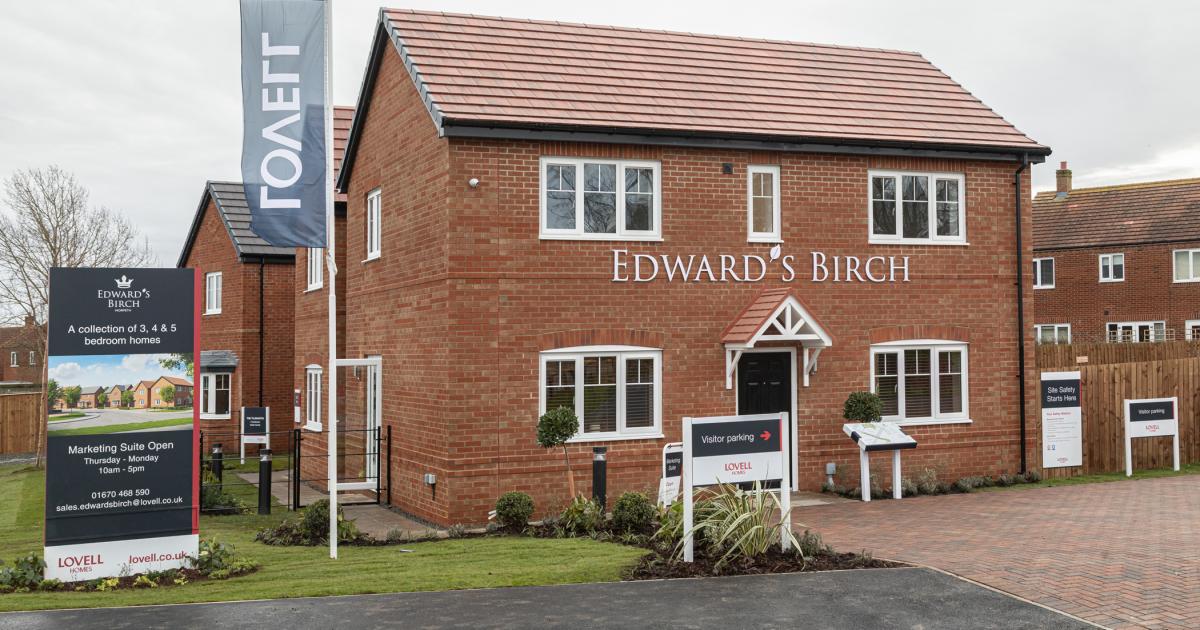
Further north in Morpeth, Lovell launched Edward’s Birch, a 141-home development on land that was once part of the Northgate Hospital estate.

Mr Anderson said: “Our track record of developing brownfield sites in the North East also reflects the wider Group’s commitment to long-term regeneration and placemaking.

Advertisement

“We’re proud of the contribution we are making to local communities and to the success of the business and look forward to building on those achievements in 2026.”

The developments contributed to Morgan Sindall Group’s overall growth, with group revenue up 10 per cent to more than £5 billion and adjusted operating profit rising 39 per cent to £232.6 million.

Lovell alone recorded a five per cent increase in revenue to £903 million, with operating profit up 16 per cent at £42 million.

Last year, the company delivered more than 5,000 new homes, 85 per cent of which were classed as affordable—matching its performance from previous years’ performance.

Advertisement

Source link

Continue Reading

NewsBeat

Bridgerton’s Rege-Jean Page says he ‘whited out’ during ‘terrifying moment’ on set

Published

on

Manchester Evening News

The Bridgerton actor opened up about the moment during an interview on a BBC programme.

Rege-Jean Page has revealed he experienced “one of the most terrifying moments” of his life whilst filming his latest project. The Bridgerton star shares the screen with singer-songwriter Halle Bailey in romantic comedy You, Me and Tuscany.

In one scene he was required to sing in front of her, and speaking during an interview on The One Show, he confessed that he felt “vulnerable” showcasing his own vocals in front of the Grammy-nominated artist.

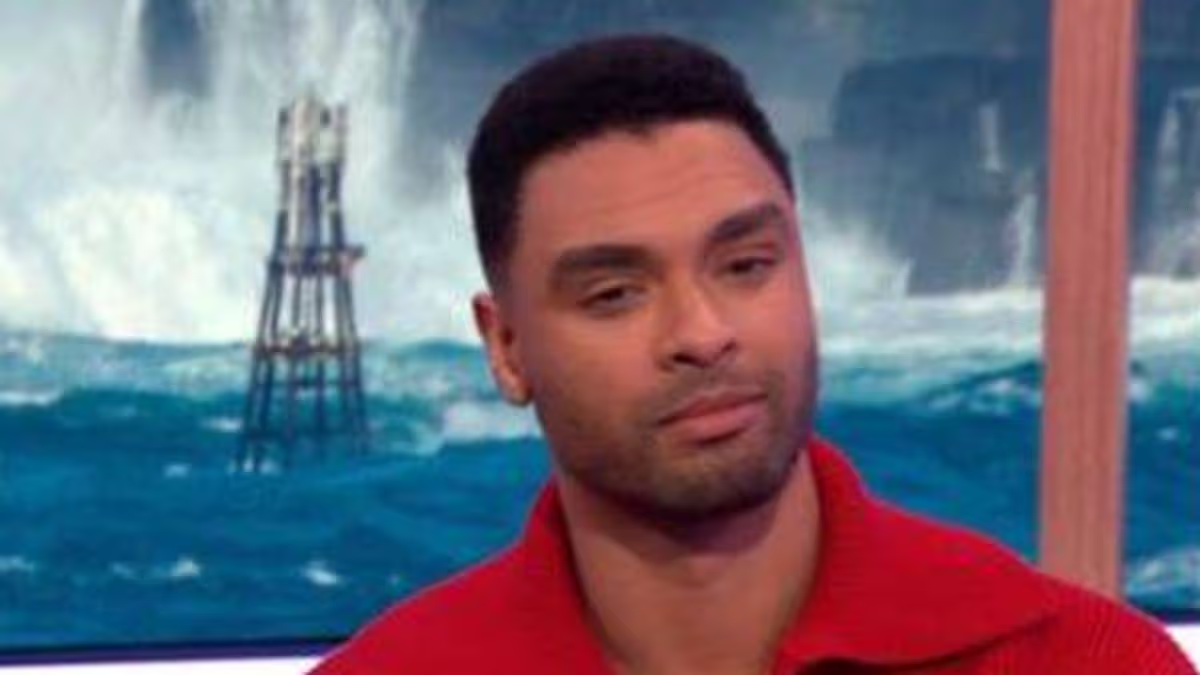
The actor appeared on the BBC programme with Halle to discuss the film.When presenter JB Gill asked about the singing scene, he admitted: “It was genuinely one of the most terrifying moments of my life.”

Advertisement

He explained: “There is this moment in the script that calls, ‘OK, you are going to sing in front of one of the world’s greatest singers’… No accompaniment, no support, no one to even put a note out. ‘Just go charm Halle Bailey with nothing but the power of your voice.’

“And so I think I just kind of whited out,” continued the star. “I went to a happy place in the back of my head and saw what came out.”

Rege-Jean added that he was in a “vulnerable place” during the scene but his co-star Halle made it clear she thought he had pulled it off, as she exclaimed: “He killed it! He killed it! It’s great, it’s one of the best parts of the movie, seriously.”

Advertisement

The new film is set in Italy and Halle portrays young cook Anna, who relocates to a Tuscan villa owned by a man who she barely knows, reports the Mirror. Rege-Jean – who portrayed Simon Basset in the first series of Netflix’s period sensation Bridgerton – plays Michael, the cousin of the man who owns the property and Anna’s romantic interest.

Halle informed presenter JB and his co-host Alex Jones that she relished the opportunity to work with the Netflix star. “I mean I love Bridgerton, I love the other projects he was in,” she stated.

“I’m excited to get to work with him.” Addressing the actor, she continued: “And also get to know you. He’s a really genuine person, it’s been fun.”

A synopsis for the film says: “Halle Bailey stars as Anna, a young woman who has abandoned her dreams of becoming a chef and is now drifting through her twenties with a series of bad choices. When Anna loses her house-sitting job (and housing) in one fell swoop, a chance encounter with Matteo — a handsome Italian who happens to have a villa sitting empty in Tuscany — will inspire her to jet off for Italy, against the advice of her always-honest bestie, Claire.

“But Anna’s plan to crash at Matteo’s villa, without permission, just for one night, falls apart when Matteo’s mother, Gabriella shows up at the house unexpectedly. In a panic, Anna allows Gabriella to believe that she is Matteo’s fiancée. That little lie becomes a big problem, though, when Matteo’s cousin, Michael shows up, and Anna discovers that the heat between them may ignite a fire that will transform her life.”

The One Show airs on BBC One on weekdays from 7pm.

Advertisement

Source link

Continue Reading

NewsBeat

Two Cambridge businesses targeted by attempted break-ins on same night

Published

on

Cambridgeshire Live

The front door of both businesses were damaged in the incident

Two masked people attempt to break into property in Cambridge

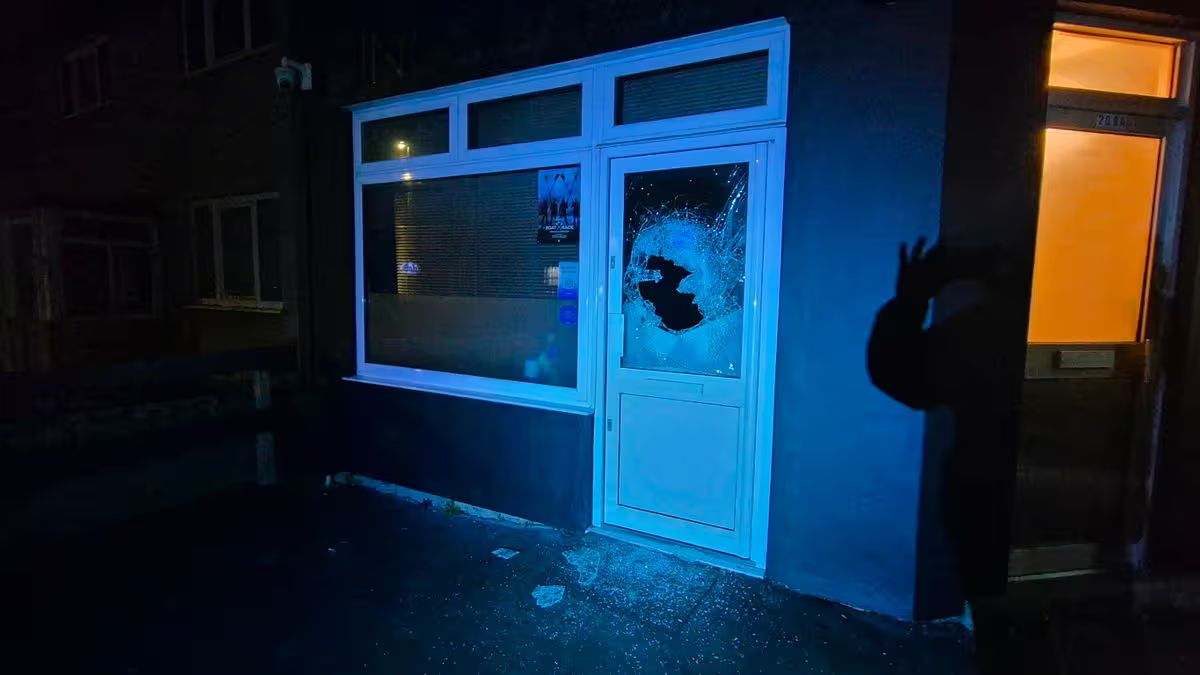
Two Cambridge businesses were targeted by attempted break ins in the same night. Cambridgeshire Police were called at around 3.10am on Sunday, March 22 to a barber’s shop in Green End Lane, Chesterton.

The front door was smashed in the incident, but no entry was gained to the premises. In another incident, a nearby Chinese takeaway also had its front door damaged.

Advertisement

A spokesperson for Cambridgeshire Police said: “Police were called at around 3.10am yesterday (Sunday 22 March) to a report of an attempted break-in at a Barber’s Shop in Green End Lane, Chesterton.

“The front door was damaged in the incident, but no entry was gained to the premises. A nearby Chinese takeaway also had its front door damaged.”

Advertisement

Anyone with information about these incidents have been asked to contact the police quoting incident 58 of 22 March.

Source link

Continue Reading

NewsBeat

Update on casualties after building crumbles to ground in Oldham

Published

on

Manchester Evening News

A number of people sustained injuries in the incident

Scene in Oldham after building collapses leaving three injured

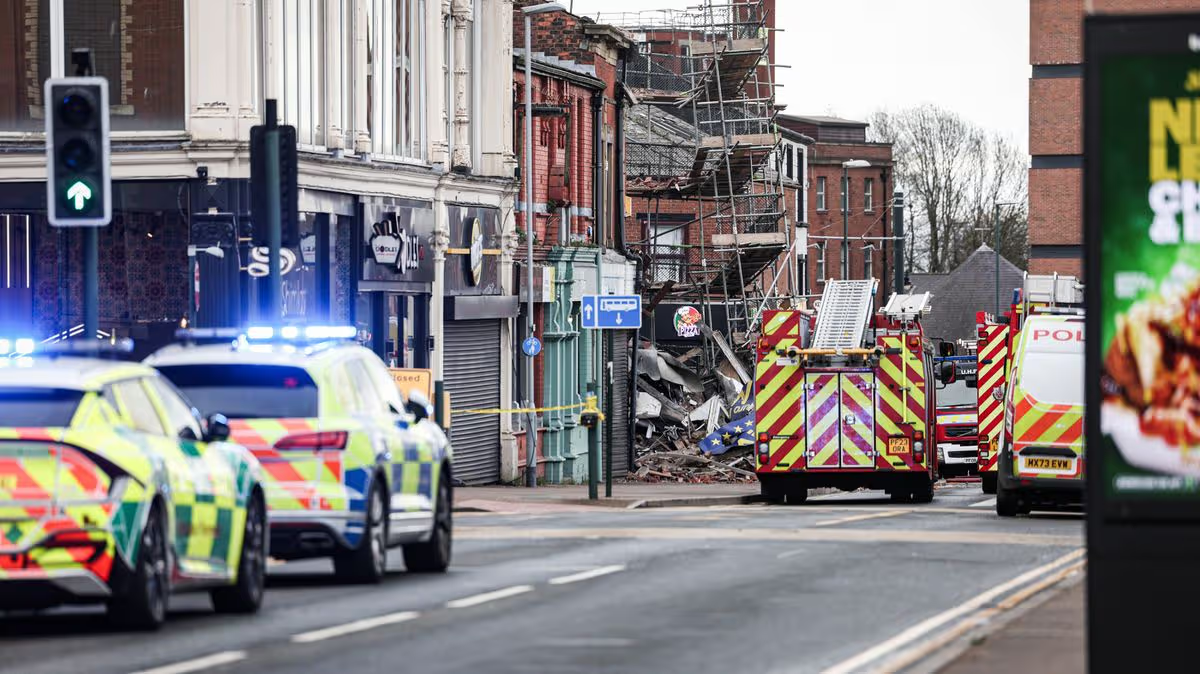
An update has been issued on causalities after a building collapsed in Oldham on Tuesday (March 24). Emergency services raced to the scene when part of the building on King Street crumbled shortly after midday.

Photos from the scene showed the building on the corner of King Street and Jackson Street, believed to be the site of Euro King Mini Mart, which had fallen down along with scaffolding.

Police and fire teams descended on the street with multiple fire engines and cordoned off the area. Three people were hurt but none have life-threatening injuries after the incident, GMP said. A total of five people were said to have ‘self-evacuated’ the building before emergency services arrived.

Get MEN Premium now for just £1 HERE – or get involved in our WhatsApp group by clicking HERE. And don’t miss out on our brilliant selection of newsletters HERE.

Advertisement

Pictures shared with the Manchester Evening News in the days before the collapse appeared to show gaps in part of the brickwork. They can also be seen on Google Maps images online. It is not yet known what caused the incident, but investigations are ongoing.

One man has since claimed he called 999 to alert authorities about the structure appearing dangerous just over three weeks before the collapse, adding: “It was visually obvious the building wasn’t stable. Now, 23 days later, it’s collapsed.”

Advertisement

The Manchester Evening News also understands that authorities are also probing the possibility of a gas leak being the cause, but that investigations are currently ongoing into the incident.

The North West Ambulance Service (NWAS) has since issued an update on causalities affected by the collapse. Two people required hospital treatment following the incident.

“We can confirm that NWAS has now left the scene, in agreement with our multiagency partners,” a statement read on Tuesday night. “Two of the five casualties have required hospital treatment, and we wish them a full and quick recovery.

“We would like to offer our thanks to our emergency services and local authority colleagues who have supported and continue to support the ongoing operation, as the building remains unsafe.”

Advertisement

Source link

Continue Reading

NewsBeat

‘Loving’ girl, 12, found dead by her mum after ‘bullying on Snapchat’

Published

on

Daily Mirror

Amelia Bath died on March 6 at her home in Yapton Lane, Walberton, West Sussex – the 12-year-old is believed to have been targeted by bullies on Snapchat in the weeks before her tragic death

A “bright” and “loving” girl was found dead at her home, a coroner’s court heard.

Amelia Bath, aged 12, sadly died on March 6 at her home in Yapton Lane, Walberton, West Sussex.

Coroner Joseph Turner described the facts and circumstances of Amelia’s death as “unnatural” during an inquest opening at West Sussex Coroner’s Court in Horsham. A statement from a coroner’s officer said: “She was sadly found deceased at her home address by hanging.”

Advertisement

Amelia’s uncle, Kris Marsh, said her death “was an absolute massive shock to everybody” and “totally out of the blue”. He added: “I don’t think you ever recover from something like this. Marie her mum had gotten up that morning as usual, gone to wake her up for school and then found Amelia in her bedroom. Her world had just been completely turned upside down.”

Her aunt Lisa Marsh has set up an online fundraiser on GoFundMe to support the family with funeral costs. Funds will also be donated in Amelia’s memory to children’s hospice Chestnut Tree House.

Ms Marsh told the Daily Mail that Amelia had spent the evening before her death laughing and joking, eating fish and chips at her grandparents’ house. Friends later told her parents that Amelia had been targeted by bullies on Snapchat in the weeks before her death.

Advertisement

In the fundraiser, Ms Marsh paid tribute to her “beautiful niece”, describing her as a “bright, funny, kind-hearted and loving girl who filled every room with warmth and laughter”.

She said: “She had the most beautiful soul and so much life ahead of her. She was deeply loved, and she loved deeply in return. The silence she has left behind is unbearable, and the hole in our hearts will never truly heal.”

Ms Marsh added: “If you are able to donate or share this page, we would be forever grateful. Every penny, every kind word, and every act of support means more than we can ever express.”

A spokesperson for Sussex Police said officers were “reviewing the wider circumstances” and her death was not being treated as suspicious. They said: “We are working alongside schools and partner agencies to support the girl’s family and others who have been impacted.” The inquest was adjourned until a pre-inquest review on June 17.

Advertisement

For emotional support you can call the Samaritans 24-hour helpline on 116 123, email jo@samaritans.org, visit a Samaritans branch in person or go to the Samaritans website.

Source link

Continue Reading

NewsBeat

Everton star James Garner reveals career turning point after landing dream England call

Published

on

Daily Mirror

Everton’s brilliant midfielder James Garner has opened up on the difficult times he went through before his stellar run of form earned a call-up from England manager Thomas Tuchel

James Garner admits he treated this season with a make-or-break attitude that has seen him rewarded with an England call-up. The Everton midfielder, 25, has been one of the Premier League’s most consistent performers over the past seven months and is now widely tipped to make the cut for Thomas Tuchel’s World Cup squad.

But after signing from Manchester United in September, 2022, Garner endured a frustrating time with injury and form before establishing himself as a key figure in Everton’s revival under David Moyes. His emergence as one of the country’s most versatile talents – Garner has proved to be an effective right-back on occasions – earned the 25-year-old a new deal at Everton that keeps him at Hill Dickinson Stadium until the summer of 2030.

But Garner had started Everton’s 2025/26 campaign, believing he had an awful lot to prove. A place at World Cup 2026 certainly seemed a long way off.

Advertisement

READ MORE: England fans react to replica kit price – and threaten to take actionREAD MORE: FIFA respond over accusation of breaking European Union laws as World Cup complaint filed

Garner, who was part of the England Euro-winning under-21 squad in 2023, said: “I told myself at the start of the season that this season has to be the season that I can show everyone what I can do. Since I signed for Everton, I’ve had quite unlucky spells with two serious back injuries so that obviously put me out for a long time.

“Then, the first three years we’ve been fighting near the relegation zone. So, it’s been quite tough for me to really showcase what I can do.

“I just thought to myself this season is a fresh season, with a new manager, a new stadium. And with a year left on my contract as well, I knew I had to show everybody what I’m really about and showcase all my talents.

Advertisement

“I’m glad this season is going as well as it is. I set really high standards for myself and I know for those first three years I was not up to the levels that I know I can be at.

“I knew there were levels to go and I think there are still even more. I’m trying every single day to get better and try to reach those levels.”

And Garner believes his vote of approval from Tuchel reflects the positivity around Everton in their first season in their new state-of-the-art riverside home. He went on: “Since David Moyes came in, with his staff, the club has come in leaps and bounds.

Advertisement

“I’m very thankful for all the help he has given me since he came in. The manager has put the belief in the players.

“We all bond well – going forward, there’s no reason why we can’t be in the top half of the table and competing for the European spots. I’m hoping for my first cap and if Everton can finish in a European spot, it would be one special season.”

For his part in that triumph at the under-21 Euros, Lee Carsley was due to give Garner a special golden cap during this senior camp. And Garner has a dream of following that honour with something even more special.

Advertisement

He said: “For me, that was probably one of the best feelings I’ve had in football. So I just want to go one step further now and hopefully win a trophy for the first team as well.”

Join our new WhatsApp community and receive your daily dose of Mirror Football content. We also treat our community members to special offers, promotions, and adverts from us – and our partners. If you don’t like our community, you can check out any time you like. If you’re curious, you can read our Privacy Notice.

England’s 2026 World Cup kits

This article contains affiliate links, we will receive a commission on any sales we generate from it. Learn more
Content Image

Various Prices

England Official Store

Advertisement

Buy Now on England Official Store

England and Nike have launched the new home, away and goalkeeper kits to be worn at this summer’s FIFA World Cup. You can get free delivery on all orders with the code: ENGFREEDEL

Source link

Continue Reading

NewsBeat

Texas man who knocked on doors begging for help in critical condition after being shot by homeowner, police say

Published

on

Texas man who knocked on doors begging for help in critical condition after being shot by homeowner, police say

A blood-covered Texas man who knocked on doors in a neighborhood begging for help was then shot by a homeowner after forcing his way into a property, according to police.

The Houston Police Department says the man is in critical condition at a hospital in the city following the confrontation, ABC13 Houston reported.

The incident began shortly after midnight on Monday when witnesses reported seeing two men running near Campden Hill. One man was reportedly wearing a mask, while the other was bleeding from the head.

According to investigators, the bloodied man began a frantic circuit of the neighborhood, knocking on the doors of several homes. Video footage obtained by ABC13 captured the man shouting for help and banging on a door before he eventually reached a property in the 4800 block.

Advertisement

Authorities say the man kicked in the front door and forced his way inside the house, where he was subsequently shot by the homeowner.

According to KHOU 11, a CBS affiliate in Houston, Lt. J.P. Horelica stated that investigators believe both suspects are in their early 20s.

The masked man was described as wearing a black hoodie and a jumpsuit. He fled the scene on foot in an unknown direction and remains unidentified.

Police have not yet determined the cause of the man’s initial injuries or whether he had been assaulted before the break-in.

Advertisement

Residents of the quiet suburb expressed shock at the violence.

Gerald Conkrite, a neighbor, told reporters that such events are a rarity for the area.

“We don’t have that over here,” Conkrite told ABC13. “It don’t work like that over here no more.”

KHOU 11 reported that investigators are also asking residents to review home-surveillance footage from the neighborhood to track the suspects’ movements before the shooting.

Advertisement

Source link

Continue Reading

Trending

Copyright © 2025