


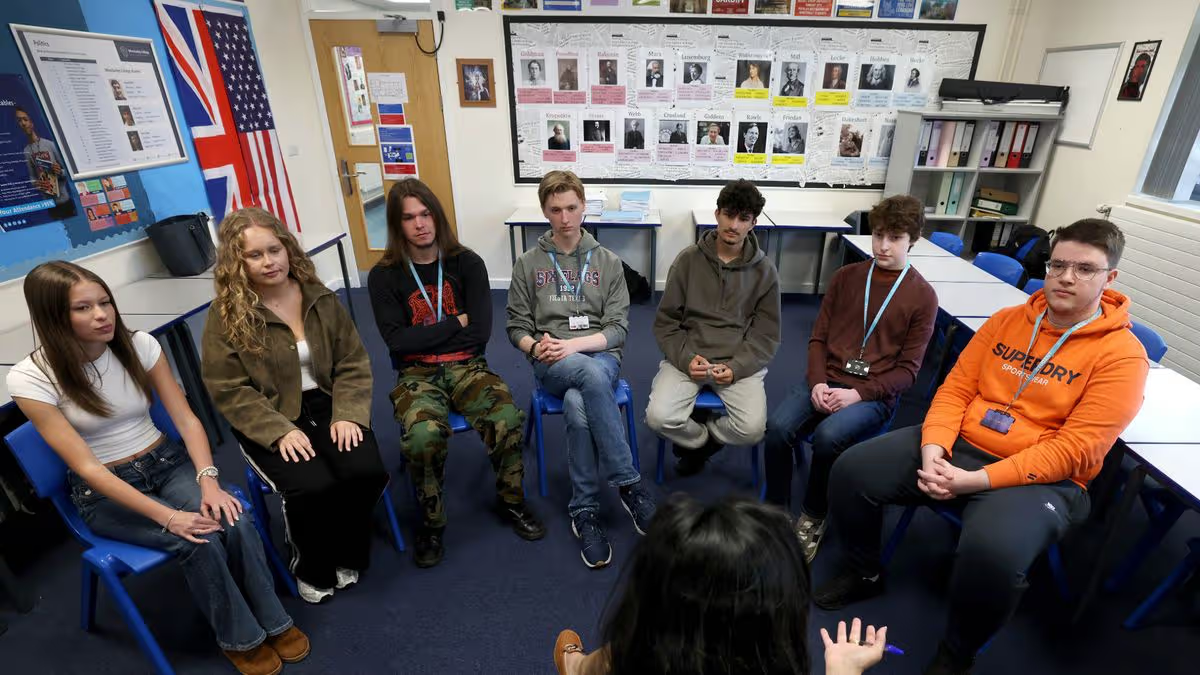
While they disagree on plenty, they share one thing in common – a frustration with the state of modern politics
People often assume young people are apathetic about politics.
That they get their views from TikTok clips or follow whatever political tribe their friends belong to.
However, my hour with seven students from Winstanley College suggests otherwise.
When they take their seats at the MEN’s hustings on Wednesday, the candidates hoping to become Makerfield’s next MP should not expect an easy ride.
Far from it.
Click here for our dedicated Makerfield by-election newsletter with exclusive interviews and analysis
The group – six 18-year-olds and one 17-year-old – are studying subjects ranging from politics and international relations to history, PPE and law. Between them they span much of the political spectrum, from centre-left Labour supporters to One Nation Conservatives.
And while they disagree on plenty, they share one thing in common – a frustration with the state of modern politics.
Several tell me politics in the area feels more alive than it has for years. They point to campaign placards appearing on streets across the constituency and the unusually intense conversations taking place both inside and outside college.
For Emiliano Dina, whose family migrated from Albania, politics feels more personal. Debates around immigration and identity are not abstract policy discussions but issues that affect real people.
The students recently watched the BBC’s Question Time special featuring the Makerfield candidates. None of them thought Reform UK’s Rob Kenyon performed particularly well, though they differed on who came out strongest.
“I thought the Conservative candidate did really well,” says Ryan Cain, a self-described One Nation Conservative who admires both Abraham Lincoln and Margaret Thatcher.
“There’s so much polarisation in politics but you did see Andy Burnham and [Conservative candidate] Michael Winstanley agreeing with some points and having that dialogue. Politics should be a conversation and not an argument.”
Ryan admits being one of the few Conservatives in his peer group can, unsurprisingly, lead to “heated discussions”, Yet he says college provides a safe space where disagreements remain respectful.
That theme comes up repeatedly.
- Join our new Makerfield by-election WhatsApp community by clicking this link for the latest news. We also treat our community members to special offers, promotions, and adverts from us and our partners. If you don’t like our community, you can check out any time you like. If you’re curious, you can read our Privacy Notice.
Shaun Simmons – a Che Guevara fan who hopes to study history at university – says debates among students are often healthier than those taking place in wider society.
“We have heated, but respectful debates,” he says. “When we’re not in this environment I feel like people are more black and white in their political views.
“People become more emotional, more ideological and less open to being pragmatic.”
Iris Fearon, who is considering studying politics and international relations at Newcastle, adds: “Here you’re encouraged to analyse everything.”
That habit of questioning assumptions appears to shape many of their views.
Annie Lloyd, the youngest member of the group at 17, describes herself as left-wing but politically undecided. She is unconvinced that Sir Keir Starmer is currently representing voters effectively and says she likes politicians who appear genuinely connected to ordinary people.
Darius Ghorbani, who leans Conservative because of the party’s record on law and order, throws a curveball when he admits he actually admires Starmer, even though he disagrees with Labour on many issues. Remi Naylor, a centre-left voter praises Andy Burnham for building consensus across party lines.
Then there is Emiliano, who describes himself as economically left-wing and broadly Labour-minded but says he could imagine voting Conservative if the right candidate came along. He liked Tony Blair’s record before the Iraq War.
It is difficult to fit any of them neatly into a political box.
That may explain why several are frustrated by social media, which they believe rewards outrage and tribalism.
“People will share a lot of figures and it’s all about trying to get a reaction out of you,” says Emiliano. Nodding along, Iris adds: “A lot of people get stuck in their echo chambers.”
They say political literacy is declining despite information being more accessible than ever.
“Being in this classroom, you’re probably more politically literate than 90 per cent of the population, which is a bit sad,” he says. “I think political education is something everyone should have. You should know who you’re voting for.”
The discussion turns to family politics and again the stereotype of permanently angry political disagreement fails to materialise.
Annie says she often debates politics with her father, who sits further to the right politically than she does, adding: “But we’re normally on the same page.”
Remy, whose father is a committed socialist, says political discussions at home are rarely arguments.
“In politics you see a lot of divisive rhetoric, but when you can talk to a family member about politics it’s never an argument, it’s more of a conversation,” he says. “There’s a model there that could be applied to politics on a national level.”
Even Darius, who jokes that his father is impossible to persuade because of what appears in his social media feeds, sees echo chambers as a growing problem.
The students are equally willing to challenge the political system itself.
Most believe the UK’s voting system should change, arguing that First Past The Post (FPTP) no longer reflects a “fragmented” political landscape.
Annie argues the current system can produce distorted results, while Shaun believes a Single Transferable Vote (STV) system would allow people to vote for parties they genuinely support rather than settling for the least-worst option.
“It’s not just Labour versus Conservative anymore,” he says. “For the by-election, people are either Labour or Reform but that’s because those are the only viable options. If we had the options under STV, people could actually vote for the policies they want without having to pick a compromise.”
Ryan disagrees. For him, FPTP remains the best way to produce strong and stable governments.
It is one of many issues on which they sharply disagree without falling out.
There is similar diversity when discussing the by-election itself.
Five of the seven believe it was right for Josh Simons to resign, although they differ on what should happen next. Some, like Annie, see the contest as a healthy democratic exercise.
“A lot of people at the moment aren’t happy with the way the Labour government was going,” says Annie, who admires Burnham.
Others worry it risks creating instability.
Remy reminds them all about the scandal that forced Simons to resign earlier this year – he commissioned a report that falsely linked Sunday Times journalists to pro-Russian propaganda.
On Wednesday, when the MEN will host a hustings at the college, they will want detailed answers on housing, transport, the environment, immigration, student finance, Palestine and the future of the northern economy.
Ryan wants Burnham in particular to explain what “reindustrialisation of the north” actually means in practice. “I fear we’re looking backwards rather than actually creating a realistic economic plan for the future,” he says, citing the recent Milburn report on record youth employment.
The report, published last month, said job and career opportunities for young people are “not growing, they’re shrinking”, with former minister Alan Milburn warning of a “lost generation” unless action was taken.
Iris wants greater clarity on environmental policies.
Shaun wants to know whether Greater Manchester’s Bee Network can be replicated nationally.
Emiliano is interested in housing policy and whether Andy Burnham sees Makerfield as a destination or merely a stepping stone.
Voters in Wigan have expressed concerns that the mayor of Greater Manchester is only interested in becoming MP so that he can eventually run for the Labour leadership. They fear he will then forget about the constituency if he becomes PM.
“I’m optimistic but come on bro, you know how big your responsibilities are!” Shaun quips.
Naturally, with them all off to university in September, student finance is another major concern. Several feel young people are being asked to shoulder costs previous generations never faced when they went to university.
“The interest rates should be cut, maybe they rise as inflation does,” says Emiliano. “But it’s a punitive tax that’s simply unfair on young people. None of the parties running right now are addressing it, they’re not even acknowledging it.”
Remy believes a graduate tax might be the solution. The conversation briefly turns to immigration and the housing crisis.
Some, like Emiliano, believe certain parties are conveniently looking for “villains” to blame. He conceded that placing asylum seekers in hotels is “objectively not the best way to be accommodating people,” adding: “A bigger problem is the housing crisis. Not only do you not have somewhere to put these asylum seekers, you have the single mother of four waiting six months for a council house.”
Remy, a Clement Attllee admirer, believes there are problems in the rhetoric of both the left and right.
“On the right they’re attacking immigrants and blaming them for taking away jobs. But also I think on the left, their defence is purely, think about what immigrants bring to this country,” he says. “It’s also commercialising people. But people are people.”
And despite their disagreements on policy, there is broad consensus on one point – politicians should be held to higher standards.
Predictably, the discussion turns to Rob Kenyon’s old social media posts. The anti-racism campaign group Hope Not Hate published details of social media posts from his X account, which has now been deleted, that showed sexist, violent and homophobic messages.
The comments about women were of particular concern to Iris and Annie.
Kenyon denied being sexist on Question Time, adding: “I’ve got nothing but respect for women”.
The group is critical of both Reform and the Green Party for failing to properly vet candidates or take swift action when allegations of racism or sexism have emerged.
Shaun brings up the case of a newly elected Reform UK councillor who was suspended from the party following allegations of racism.
Glenn Gibbins, who was elected to Sunderland City Council in May, reportedly posted that Nigerians should be used to “fill in pot holes”.
“How on earth did that get past?” says Shaun. “There’s just a line and they’ve spat on the line and run a full sprint over it. What on earth is going on?”
They say if Kenyon had apologised for his comments, that would have made some difference. “He would have gained some respect. At least that shows some regret,” says Emiliano. “But trying to excuse it with the word ‘allegedly’, that’s not going to get you respect from anyone”.
Ryan believes the party’s response to allegations can often be more telling. “Reform has consistently shown itself unwilling to take action”, he says. “It’s systemic within the party, it’s not just the odd candidate”.
He also believes the Greens are “equally concerning”, adding: “The deputy leader [Mothin Ali] was at pro-Iranian regime rallies”, as well as mentioning Chris Kennedy, who was forced to resign just hours after being announced as the party candidate in Makerfield when it emerged he had shared antisemitic posts.
“I think perhaps the Greens escape criticism,” he says .
Nodding along, Emiliano says politicians “go on about British values, but they conveniently forget that respect is one of them.”
Criticism is directed across the political spectrum rather than at one party alone.
Perhaps that is what makes this group stand out.
They are not activists chanting slogans, or ideological purists demanding perfect agreement. Instead, they are exactly what our politics needs more of – curious and informed participants who are willing to listen and challenge where it needs to be.
That does not mean these students will be complacent at Wednesday’s hustings.
The candidates can expect tough questions and for their claims to be scrutinised.
Most of all, they can expect a room full of young voters who have already shown they are prepared to challenge even their own assumptions.
And if the candidates think they will get an easy ride simply because they’re students, they may be in for a surprise.



















































You must be logged in to post a comment Login