Women who don’t want or can’t take hormone replacement therapy (HRT) might now have another option
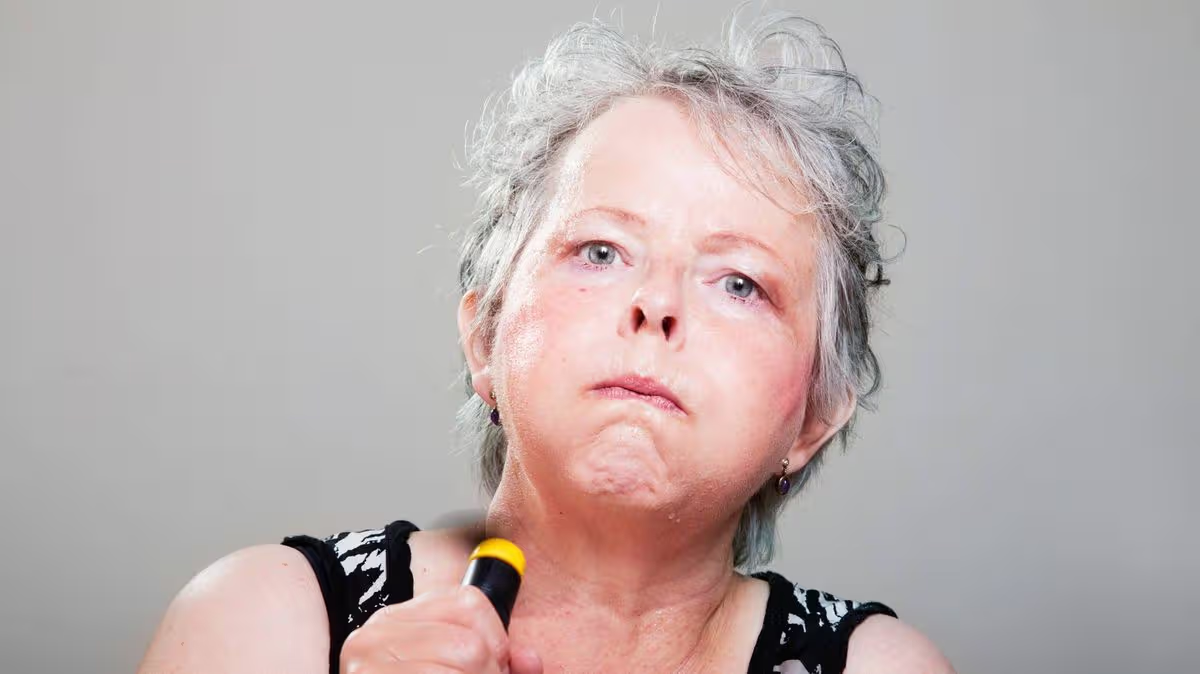
Half a million menopausal women could be eligible for a new daily tablet to alleviate hot flushes and night sweats. The pill can now be prescribed on the NHS for women who either don’t want or can’t take hormone replacement therapy (HRT).
Advertisement
The National Institute for Health and Care Excellence (NICE) stated that fezolinetant is a non-hormonal treatment which operates by blocking the nerve pathways in the brain that trigger hot flushes and night sweats.
Dr Sue Mann, national clinical director in women’s health for NHS England, commented: “Symptoms of menopause including hot flushes and night sweats can affect every part of a women’s life, so this is very welcome news especially for women who are unable to or don’t wish to take hormone replacement therapy.
“It’s another vital treatment option which could help hundreds of thousands of women experiencing menopause to better manage their symptoms and feel more in control of their health.”
The treatment, also known as Veoza, is produced by Astellas Pharma, and NICE has indicated that it can significantly reduce symptoms. Women may not be able to take HRT if they have other medical conditions such as blood clots, reports the Mirror.
Advertisement
Some also opt not to use HRT, which is the first-line treatment for symptoms of the menopause. The health spending watchdog added that women will need regular liver function monitoring whilst taking the treatment as it is rolled out in England.
Helen Knight, director of medicines evaluation at NICE, said: “We know that menopausal hot flushes and night sweats can have a profound impact on quality of life and significantly affect overall wellbeing. For those who are unable to take HRT for varying reasons, options have historically been limited, and we have heard clearly from patients how difficult that can be. This decision will give much-needed relief to those for whom HRT is unsuitable.”
The menopause occurs when periods cease due to reduced hormone levels. According to the NHS, it typically affects women aged between 45 and 55, though it can occur earlier.
The NHS recommends the following lifestyle adjustments women can make to help manage symptoms:
Advertisement
get plenty of rest, including keeping to regular sleep routines
eat a healthy diet
have calcium-rich food like milk, yoghurt and kale to keep bones healthy
exercise regularly, try including weight-bearing activities where your feet and legs support your weight like walking, running or dancing
do relaxing things like yoga, tai chi or meditation
talk to other people going through the same thing, like family, friends or colleagues
talk to a doctor before taking herbal supplements or complementary medicines
The use of three locks in England’s pack improved their maul significantly, while Chessum had a huge impact in the loose; scoring from close-range, assisting Alex Coles with an inside pass, before intercepting Matthieu Jalibert at a pivotal moment, with England trailing by 11 points, and racing clear to score from 60 metres out.
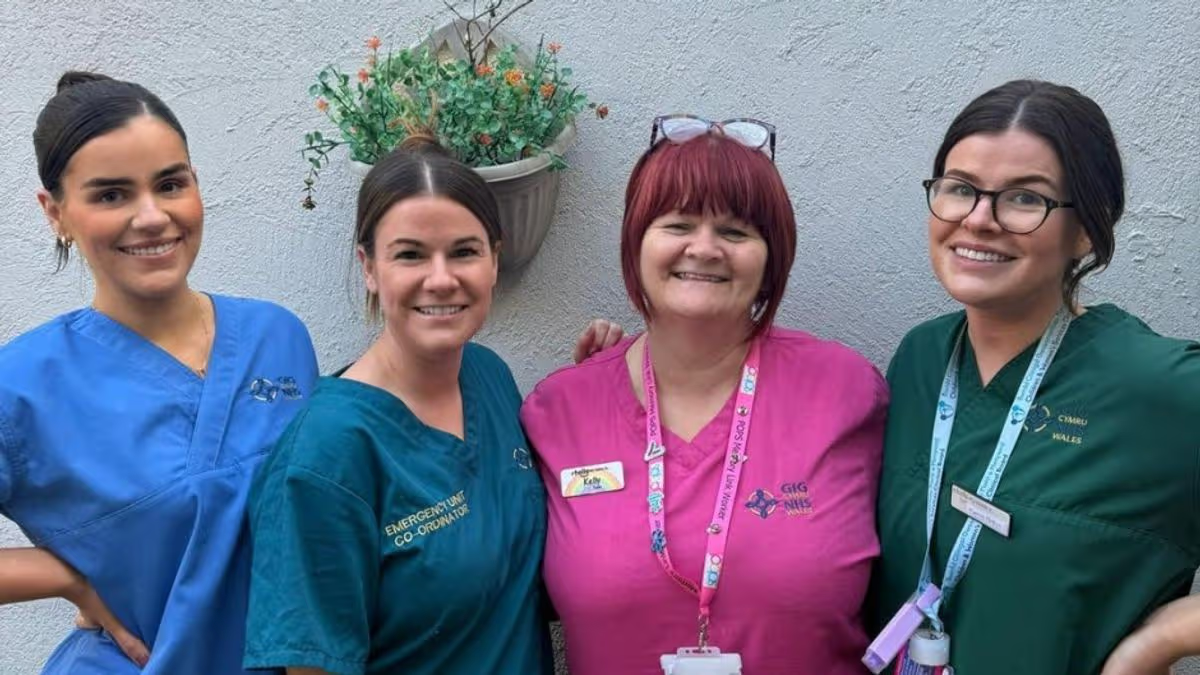
The four women all work alongside each other and have done for many years
LIke most mums, Kelly Brown is proud of her kids, but she says she is “incredibly proud” to work alongside her three daughters – and all have incredibly valuable roles in the health sector. Hannah, 31, Laura, 37, and Lucy, 28, have followed in their mother’s footsteps all working at University Hospital of Wales in Cardiff.
Advertisement
And it didn’t start with Kelly, her mum, Gloria worked as a staff nurse at the former miner’s hospital in Caerphilly.
For over 20 years Kelly has worked in healthcare, supporting patients and families in Wales. For 16 years she was a health care support worker but for the last four years she has been helping those affected by cognitive impairment and dementia as a memory link worker,
Hannah has worked in the gynaecology department at UHW for 12 years as a health care support worker, winning a health hero award for supporting women through difficult experiences.
She said: “My role is all about providing compassionate, hands-on care and being there for patients when they need reassurance and kindness the most.”
Advertisement
Her elder sister Laura has also been working at the same hospital for 12 years, starting as a health care support worker but since progressed into the role of patient flow co‑ordinator in the Emergency Unit. Never miss a Cardiff story by signing up to our daily newsletter here
A big inspiration for Laura is her mum who she watched work hard as a health worker when she was growing up. Laura said: ““I’m so proud of the incredible women in my family.
“My mum inspires me every day with her passion for supporting patients with cognitive impairment and her dedication to going above and beyond for her patients.”
Kelly felt a similar inspiration when she was young as her mother, Gloria, worked as a staff nurse at the former miner’s hospital in Caerphilly. Sharing Gloria’s story with her daughters has “played a big part in encouraging” the family to pursue careers in healthcare.
Advertisement
“I think it’s fair to say nursing runs in our blood,” Kelly said.
Lucy, the youngest of the three sisters, began her career with the seven years ago as a health care support worker in the neonatal intensive care unit and has now qualified as a registered nurse after completing a flexi nursing degree. She now cares for some of the most vulnerable babies while supporting the families.
She said: “As the youngest in the family, I grew up watching my mother and sisters be advocates for their patients and always going above and beyond for them. Seeing their compassion and dedication inspired me to follow the same path.
“We share the same commitment to caring for patients, and I’m proud to represent the health board alongside my mam and sisters.”
Advertisement
Kelly said: “Working in the same organisation as my daughters makes me incredibly proud. We each play different roles within the Cardiff and Vale Health Board, but we share the same commitment to caring for others.
“Working here isn’t just a job – it’s something that means a great deal to our family. Caring for others has always been at the heart of what we do, and I feel privileged to continue doing that every day.”
At least five people have been killed in Russian attacks on Ukraine, with a further 18 wounded, officials have said.
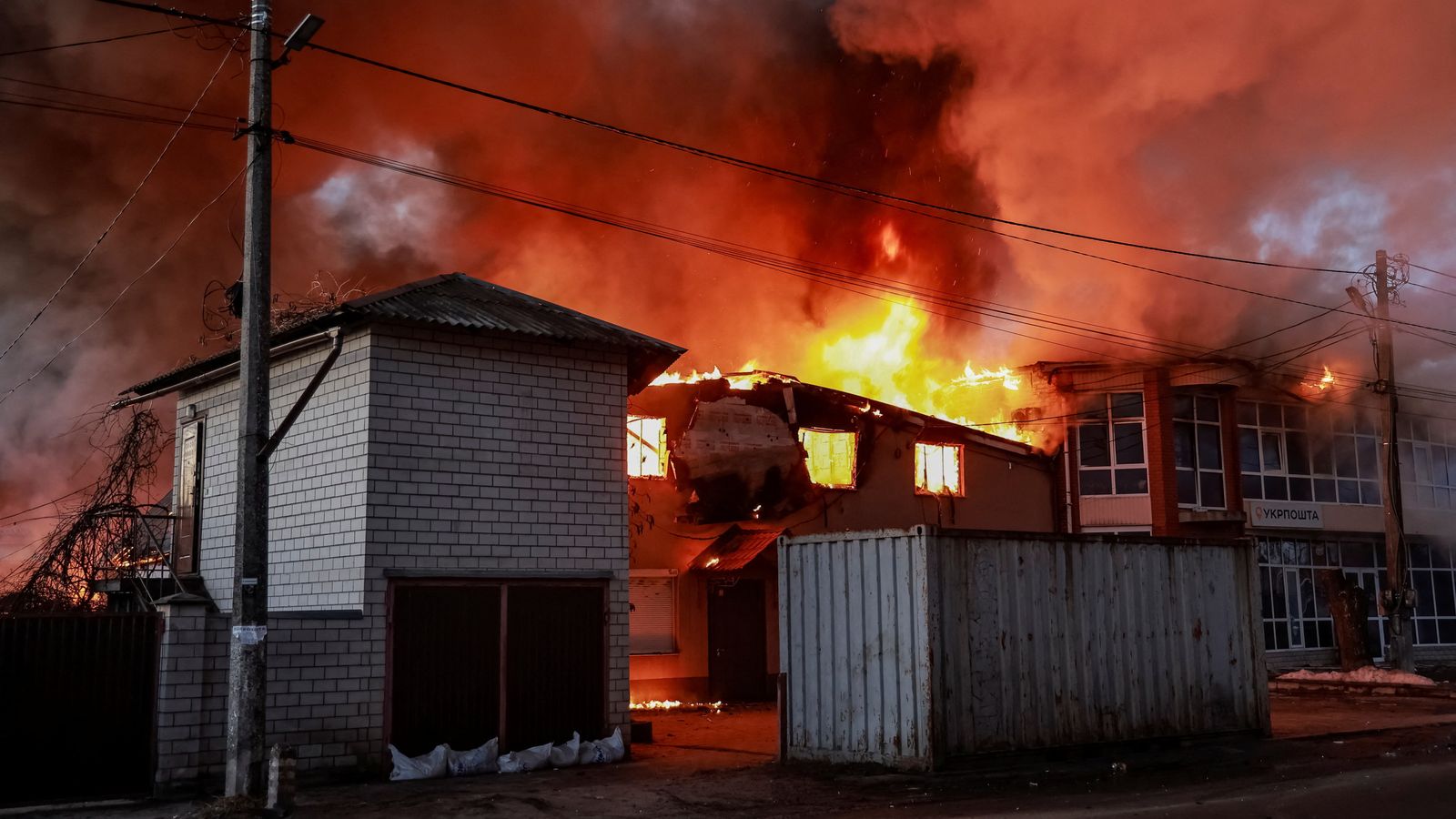
Four of the deaths were in the Kyiv region, where President Volodymyr Zelenskyy said Russia targeted energy infrastructure with around 430 drones and 68 missiles.
Mykola Kalashnyk, the head of the area’s regional administration, said 15 people were injured, with three of those in a critical condition.
Image: Smoke rises in Brovary. Pic: Reuters
Russia’s defence ministry said the nighttime attacks targeted energy and industrial facilities serving Ukraine’s armed forces, as well as military airfields.
Advertisement
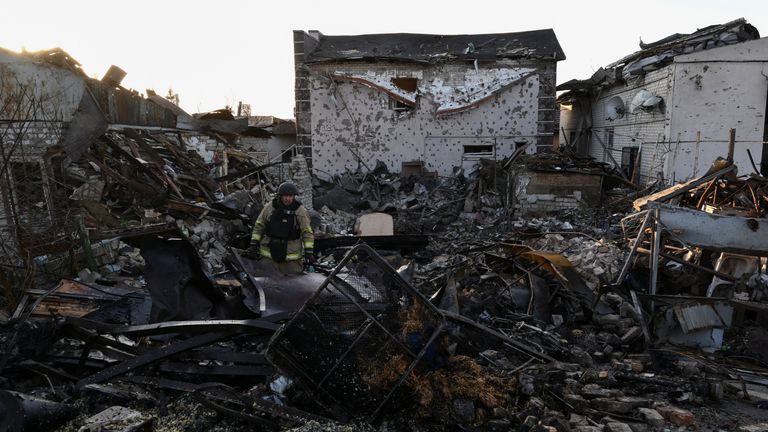
Another person was killed, and a further three wounded, when Russian-guided bombs hit a residential area in the city of Zaporizhzhia, authorities said.
Image: A firefighter inspects debris in Zaporizhzhia. Pic: Reuters
Image: An injured resident receives first aid. Pic: Reuters
It comes as US-brokered peace talks between Russia and Ukraine are on hold, as Washington focuses on its military action in Iran.
While Moscow has condemned the US-Israeli strikes on Iran, it has stopped short of offering military support to its longstanding ally – and stands to benefit from the conflict.
Russia is already profiting from the surge in global energy prices and may hope that the war in the Middle East will detract attention from Ukraine and force NATO allies to reduce military support for Kyiv.
Mr Zelenskyy said in a social media post on Saturday that “Russia will try to exploit the war in the Middle East to cause even greater destruction here in Europe, in Ukraine”.
“We must be fully aware of the real level of the threat and prepare accordingly, namely: in Europe, we need to develop the production of air defense missiles – especially those capable of countering ballistic threats – as well as all other systems necessary to truly protect lives,” he wrote.
The road into Tyre is lined with the yellow and green flags of Hezbollah. Billboards are filled with the faces of fighters who lost their lives in the many battles with Israel over the years.
We’re in the evacuation zone, the area of south Lebanon that Israel has told everyone to leave. And it’s not long before we see the mounting human cost of the latest conflict this community is engulfed in.
A group of mourners is gathered by the side of the road at a temporary cemetery. Huddled around makeshift memorials, some weep, some hug, others stare blankly ahead. They’re here to bury four men that they say were medics and social workers. They were not, they say, fighters.
Advertisement
Ehsan Dbouk, a cleric for the group, says they’ve had to use this site because the men’s hometowns are no longer safe.
“We can’t bury our martyrs in their villages on the frontline,” he says. “We are dealing with an enemy that doesn’t distinguish between killing fighters and killing civilians.”
That enemy, they claim, represents an existential threat. Israel frames the Iran-backed group, proscribed as a terrorist organisation in the UK, in exactly the same way. Neither side is showing any sign of backing down.
The Israel Defence Forces (IDF) has rapidly expanded the evacuation zone here. Until three days ago, it stretched from the border in the south with Israel to the Latani River. That has now been extended further north to the Zahrani River, about 25 miles from the border, raising fears of a ground invasion.
Advertisement
More than 800 people have been killed so far in the country and hundreds of thousands of people have been displaced.
But Ehsan dismisses allegations that Hezbollah is dragging the rest of the country into a war it doesn’t want and cannot win.
“The displaced are part of the resistance,” he says. “Hezbollah was born from their homes. They are the fathers and mothers of those fighting on the frontlines.”
Iran war day 15: Videos from the ground
You can see how battle-hardened those who stayed behind are. The IDF is fighting more than a force in Hezbollah – it’s battling a mindset. And after months of Israeli strikes in the middle of a ceasefire, supporters of Hezbollah believe they are fighting a just war now more than ever.
Advertisement
Nada Harb, a mother and Hezbollah supporter, tells me: “I won’t leave, I didn’t in the previous wars. I was born in war. But there was no resistance then like Hezbollah. The Israelis used to come at night, break down the door, they kidnapped my brother, my father, my sister, my uncle, and no one was allowed to say anything.”
At her home, she takes us to her balcony to show us three buildings hit by airstrikes. She is exposed, vulnerable, but determined. The IDF insists it’s targeting Hezbollah’s infrastructure and leadership here.
But the civilian impact is already huge. The bridges, they say, that Hezbollah is using are also critical to civilians. And hundreds of thousands have been forced to flee this war already – many with no power, no shelter and no say in what happens next.
It was a busy Friday night for officers as they made several arrests while on patrol
Rob Currell Live news reporter
21:29, 14 Mar 2026Updated 21:30, 14 Mar 2026
PSNI’s auto crime team made several arrests across Belfast last night, (Friday) for a number of offences.
Police announced they attempted to pull over one vehicle which failed to stop when signalled.
Advertisement
A spokesman for PSNI said: “The driver was wanted to be recalled to prison and when signalled to stop by the team he made off creating a pursuit in which he drove dangerously from the vicinity of the Grosvenor Road to the Whiterock area.
“The Auto Crime Team were assisted in containing the vehicle by Roads Policing Interceptor officers all whilst he was driving at the officers in a bid to escape. They arrested the driver for his return to prison, and various motoring offences. Searches of the male recovered a quantity of Class A drugs and Class C drugs for which he has been further arrested.
“While the team were conveying the first driver to custody, other members stopped and arrested a drink driver in the Lower Falls Area who provided a breath sample over double the drink driving limit.
Advertisement
“Shortly after returning to patrol, another vehicle was reported as having been stolen in the Ballysillan area. The car made it’s way to the Castlereagh Road area where the team located it and the suspect.
“This male has been arrested for the theft of the vehicle which has been recovered to be returned to it’s rightful owner.
“The actions taken by the team this evening have assisted in bringing offenders to justice to prevent further offending and most importantly have prevented harm being caused to the public.”
Get ready for a new week (Picture: Getty/Metro.co.uk)
The New Moon in Pisces this week is an eye-opener; specifically a third eye opener.
Expect to experience psychic phenomena, messages and events. It’s a week of woo!
Tune into your intuition, expand your mind, write down your dreams, scry, moon bathe, read your cards, ask for spirit messages and guidance, gaze into flame or incense smoke and see what feelings and ideas emerge from your heartspace.
Let’s use the tarot cards to see what message is ready for you to receive from beyond the veil. What will this New Moon awaken for you?
Advertisement
Aries
March 21 to April 20
Your spirit message this week comes from The Empress (Picture: Getty/Metro.co.uk)
Tarot card for Aries for this week: The Empress
Meaning: This is a loving, maternal, feminine and nurturing energy who is surrounding you with love from beyond, from the other side, from your ancestors and passed over loved ones. Can you feel them?
Their message is to say how loved you are, on this side of the veil as well as the other. Don’t doubt yourself, be hard on yourself, or second guess yourself. Act like a person who is supported, cheered on, encouraged and admired. Lean on the support of others, they are all here to help.
Your spirit message this week comes from the King of Swords (Picture: Getty/Metro.co.uk)
Tarot card for Taurus for this week: King of Swords
Meaning: This is a masculine, older, sharp-minded, clever and worldly energy who is surrounding you with much-needed lessons, wisdom, insights and cunning ideas of how to overcome your issues. Do you feel super clear-eyed and minded right now? This is your King of Swords guide helping you to see what needs doing, and why, and how.
Their message is to ask you to plan ahead, lay down a strategy that gets you where you want to go, and walk the walk single-mindedly, even ruthlessly. Make this about you. Do what needs to be done.
Your spirit message this week comes from the Eight of Wands (Picture: Getty/Metro.co.uk)
Tarot card for Gemini for this week: Eight of Wands
Meaning: This is a chorus of voices, maybe a collective of spirits or ancestors or a tribal kind of force or energy which is sending you many, many omens and signs right now. Maybe you keep on seeing angel numbers or repeat words or symbols?
Their message is to remind you that your Gemini superpower is communication. No one can weave words like you, and this is a gift. Use it. Make moves that no one can because no one else can manipulate a message or network in the skilful and persuasive way that you can. Talk yourself in or out of something. The power of words is yours.
Your spirit message this week comes from the Ace of Wands (Picture: Getty/Metro.co.uk)
Tarot card for Cancer for this week: Ace of Wands
Meaning: This is a single-minded force or energy that is fiery, sparkling, exciting and motivating, and it serves to provoke a new beginning for you.
The message is to make a bold leap into the unknown this week, one inspired by excitement and optimism, that might not feel sensible or even feasible. But you must do it anyway. You may not land where you think, but you will land someplace new and interesting.
Travel, education, lifestyle change, new purpose, creative skill and career change are all on the table – see where your attention is drawn…
Your spirit message this week comes from The Moon (Picture: Getty/Metro.co.uk)
Tarot card for Leo for this week: The Moon
Meaning: This is a mysterious, feminine and lunar energy surrounding you with intrigue and illusion, challenging you to see and find your way through the mist to the truth you are seeking. You may feel there is more to something that what is shown. It’s a quest. A quest for truth and transparency.
Let the New Moon be a time to reflect, question, and validate the facts as they stand, and then ask for the answers they beg. The message for you now is to probe, dig, investigate and establish the whole truth. Powerful change will come from this mission.
Your spirit message this week comes from The Star (Picture: Getty/Metro.co.uk)
Tarot card for Virgo for this week: The Star
Meaning: This is a pure-hearted, truthful, authentic and stirring energy who is surrounding you with good fortune, luck, opportunity and possibility to help you manifest a dream come true. What do you wish for? Imagine this week you meet a genie with a lamp and are granted a wish. What would it be?
All the genie asks of you is to make your own overt, bold steps in your dream’s direction, and it will activate the help you need. Is that a good deal? If so, then take it, act on it, and manifest your most heartfelt desire – this kind of help doesn’t come around that often.
Your spirit message this week comes from the Knight of Wands (Picture: Getty/Metro.co.uk)
Tarot card for Libra for this week: Knight of Wands
Meaning: This is a swashbuckling, fun-loving, adventurous energy who is surrounding you with the urge and desire to head out into the world on a fresh adventure or quest. Can you feel the call of the wild?
Their message is to say it’s time to explore, experiment, expand and escape your comfort zones and patterns and routines. Throw caution to the wind and do something bold and fresh this week, then follow it up with something else. The spirit of adventure is visiting with you and won’t leave until you’ve had a good time!
Your spirit message this week comes from the Eight of Coins (Picture: Getty/Metro.co.uk)
Tarot card for Scorpio for this week: Eight of Coins
Meaning: This is from someone who was incredibly hardworking, never had it easy, but kept going. Their resilience, courage and humble strength was an inspiration and example. This might be a passed loved one or an ancestor, or just a spirit guide drawn to you.
Their message is to say you are doing great, doing your best, and it’s working! It might not always feel that way but you mustn’t give up or quit. Keep putting one foot in front of the other this week because a piece of good fortune, a breakthrough, lies ahead for you — even though you might doubt it. Keep going. You’ve got this, Scorpio. Your guide is backing you.
Your spirit message this week comes from the Six of Swords (Picture: Getty/Metro.co.uk)
Tarot card for Sagittarius for this week: Six of Swords
Meaning: This is a masculine, sharp-minded and clear-eyed spirit or energy who is reasoning with you to make the bold leap, exit or departure you’ve been mulling over for at least the last six months.
Their message is to say it’s time to make that move now. This is the window of opportunity. And it’s been such a long time coming that it won’t feel sad or hard, the grieving has already been done, the penny dropped long ago that your heart wasn’t in this. Just bring clarity to the situation now and follow through on what your heart is telling you.
Your spirit message this week comes from the Eight of Cups (Picture: Getty/Metro.co.uk)
Tarot card for Capricorn for this week: Eight of Cups
Meaning: This is a nagging feeling in your heart that you’ve not fulfilled something, made a mistake, let an opportunity slip through your fingers. And you need to turn face and acknowledge whatever it is. Some unseen force keeps bringing it up for your attention.
Their message is to you should just say how it is, what you regret, let that be a part of your past story, and turn to the future feeling unburdened. You’re going to get a second chance, but you need to purge this old regret first. Once you do, the new shining glowing sparkling opportunity will show itself, and all will be forgotten!
Your spirit message this week comes from the Nine of Wands (Picture: Getty/Metro.co.uk)
Tarot card for Aquarius for this week: Nine of Wands
Meaning: This is a masculine, strong, reassuring energy, a parental or nurturing force in your life or realm who would always encourage you — their spirit is walking with you now.
Their message is to tell you they are standing shoulder to shoulder with you, giving you all of their power and wisdom and resilience, so that you can tackle whatever it is that you’re dreading or worrying about. Now is the time to face it and unpick it and address it. You will be given all you need, good fortune will speed things along, the results will be positive, and it will be easier than you think. They’ve got your back, so stride forth with confidence.
Your spirit message this week comes from The Tower (Picture: Getty/Metro.co.uk)
Tarot card for Pisces for this week: The Tower
Meaning: This is a powerful unseen force that will move in and out of your life abruptly this week, likely taking away something painful, fading or false with it. This energy moves fast and with precision and force, almost like ripping off a plaster, provoking a moment of ouch! And then lasting relief and healing.
Their message is to say get ready for an unexpected event or revelation that collapses something you knew, deep down, was wrong. Your intuition is correct. Forces are at work to prove that to you, so don’t deny or suppress it. This is a good thing!
Kerry King has been reading, teaching and creating tarot for 30 years. Join her magical, exclusive Tarot Club for forecasts, predictions, lessons and readings straight to your inbox. Enjoy one month free for all Metro readers (no lock-in or commitment) over on Patreon.
Your daily Metro.co.uk horoscope is here every morning, seven days a week (yes, including weekends!). To check your forecast, head to our dedicated horoscopes page.
Over 100,000 requests have been made to the DWP’s digital Proof of Benefit service which allows people to download or request a letter confirming their benefits to access discounts on broadband and council tax
The Department for Work and Pensions (DWP) has released a fresh update regarding an online service designed to assist individuals in saving money.
Advertisement
Since its inception in September 2025, the digital Proof of Benefit service has received over 100,000 requests.
This service enables users to download or request a letter confirming their benefits without the need to make a phone call or visit a Jobcentre.
Such a letter can facilitate savings from social tariffs on broadband to council tax reductions, as many organisations require proof of benefits before discounts can be accessed.
The service encompasses eight benefits: Employment and Support Allowance (ESA), Jobseeker’s Allowance (JSA), Personal Independence Payment (PIP), Disability Living Allowance (DLA), State Pension, Pension Credit, and Attendance Allowance, reports the Mirror.
Advertisement
Minister for Transformation, Andrew Western stated: “We are modernising DWP services, so they work better for everyone.
“This new 24/7 digital service is a great example of this, putting people firmly at the centre, giving them instant access to vital support when they need it.
“This is just the start of how we’re transforming DWP for the better – modernising DWP services to work around people’s lives – not the other way round.”
Future enhancements will enable customers to view payment information, report certain changes online and receive tailored support.
Advertisement
This comes as the DWP is transitioning from some older legacy benefits to Universal Credit.
Universal Credit has taken the place of most Tax Credits, Income Support, income-based Jobseeker’s Allowance and Housing Benefit claims. However, you can still claim Housing Benefit if you reside in supported or temporary accommodation.
Income-related Employment and Support Allowance (ESA) is also being phased out in favour of Universal Credit, with the DWP aiming to have all claimants transferred by March 31, 2026.
If you’re an income-related ESA claimant, you should have received your “migration notice” detailing the transition process in the final months of last year.
Advertisement
This “migration notice” provides a three-month deadline for transitioning to Universal Credit – beyond this point, your existing benefits will cease.
According to the DWP, 55 percent of individuals will be financially better off on Universal Credit, whilst 35 percent will be worse off. The remaining claimants will see no change.
If you’re set to be worse off under Universal Credit, you’ll receive monthly transition payments to cover any shortfall.
This transitional protection remains in place until there’s no difference between your new Universal Credit award and what you previously received under legacy benefits.
Advertisement
However, these transitional payments are only available if you wait to be transferred through the “managed migration” process.
From gastropubs with national acclaim to welcoming village locals, here are five of the best across the county, according to reviews online:
The Star Inn, Harome
Main Street, Harome, near Helmsley, YO62 5JE
One of the most celebrated pubs in the region, The Star Inn in Harome has built a national reputation for its ingredient-led cooking served in a 14th-century thatched inn.
Regularly featuring in major food guides, the pub is known for combining “rustic charm” with “refined dishes” that showcase Yorkshire produce.
Advertisement
Diners frequently praise the quality of the seasonal menus, “attentive service” and the “cosy yet elegant atmosphere”.
The Malt Shovel at Brearton (Image: TRIPADVISOR)
Online reviewers often describe it as a “destination for special occasions”, with many highlighting the consistency of both food and hospitality.
Its gardens and traditional interiors only add to its appeal, according to diners.
The Alice Hawthorn
The Green, Nun Monkton, York, YO26 8EW
Advertisement
Overlooking the village green in Nun Monkton, The Alice Hawthorn offers “classic country-pub charm with a modern focus on food”, according to reviews.
Housed in a historic 18th-century building, it has been carefully restored to retain exposed beams and period features while delivering a contemporary dining experience.
Reviewers regularly commend the “warm welcome”, “well-executed British dishes” and “relaxed setting”.
Its combination of “quality food”, local ales and “stylish rooms” has made it a firm favourite with both York residents and visitors exploring the surrounding countryside.
Advertisement
The Wensleydale Heifer, West Witton
Main Street, West Witton, Leyburn DL8 4LS
Set in the heart of the Yorkshire Dales, The Wensleydale Heifer has become one of the area’s most talked-about inns.
Holding an impressive 4.8-star rating on TripAdvisor from more than 1,400 reviews, it is particularly well known for its seafood dishes alongside traditional pub favourites.
Advertisement
Visitors frequently highlight the “generous portions”, “friendly service” and “relaxed yet polished atmosphere”.
A traditional coaching inn with boutique-style rooms, it attracts walkers, food lovers and weekend break visitors alike, with many reviewers describing it as a “must-visit” when in the Dales.
The Angel at Hetton, Hetton
Back Lane, Hetton, Skipton, BD23 6LT
Tucked away in a small Dales village near Skipton, The Angel at Hetton blends historic character with ambitious, modern British cooking, according to people online,
Advertisement
The pub has earned widespread praise for its tasting menus and carefully sourced ingredients.
Online reviews often reference the “quality of presentation” and “depth of flavour”, alongside the “attentive service”.
Despite its fine-dining credentials, the setting remains rooted in traditional village pub surroundings, making it popular for celebratory meals as well as relaxed countryside dining.
The Malt Shovel, Brearton
Main Street, Brearton, Knaresborough HG3 3BX
Advertisement
A Yorkshire village pub just outside Knaresborough, The Malt Shovel offers a more traditional take on the county’s pub scene, per reviews online.
With a strong reputation for “hearty British classics”, “well-kept ales” and “welcoming staff”, it consistently earns positive reviews from locals and visitors alike.
Diners often comment on the “friendly atmosphere” and “reliable, well-portioned dishes”.
Its location in the quiet village of Brearton makes it a popular stop for walkers and those seeking a relaxed meal away from busier places.
Earlier this month, former English National Opera artistic director John Berry said opera in the UK needed to “attract good writers and tell better stories” that could tap into the zeitgeist, making the art form more contemporary and accessible. But is this kind of approach enough to capture the attention of new and younger audiences? In the same week, actor Timothée Chalamet caused a furore when he dismissed ballet and opera as art forms that younger people “did not care about”.
Often regarded as an “elite” art form, opera undoubtedly has an image problem in that it is seen as the preserve of rich older white people, which risks alienating those who feel it excludes and is not for them. At the same time – like much of the arts – opera is under attack from funding cuts and needs to attract new and more diverse audiences if it is to survive long term. So what is the position of opera in the UK and what does it need to do to secure its future? We asked four experts in the field.
Embrace a greater range of influences
Jen Harvie, Professor of Contemporary Theatre and Performance, Queen Mary University of London
John Berry’s comment raises crucial questions: more generally, what should the arts do? And for opera: what should a traditionally “elitist” art form do? My answer: publicly subsidised arts have an ethical duty to reach as wide an audience as possible.
Advertisement
This doesn’t mean the arts should dumb down – a horrible, patronising phrase. It means traditionally elite arts like opera must adapt to broaden their appeal. I am not alone in my view. Research commissioned by Arts Council England on opera in 2024 says the same thing: that opera’s audiences are usually white, older and richer than England’s general population.
To expand audiences, opera must embrace a greater range of influences, from musicals to concept albums and music videos. It should commission new English-language librettos and mixed spoken/sung operettas. It should commission stories that resonate with audiences across all ages, classes and ethnicities. At the same time, opera’s funders must support both formal innovation and arts education, to facilitate access to opera.
Opera is full of extraordinary performance, music, song, storytelling, stagecraft, costume and design. It faces an ethical responsibility – and an opportunity – to share these riches with more of us.
Advertisement
Popular Spanish singer-songwriter Rosalia’s latest album embraces all kinds of musical forms.
Transform the operatic ecosystem
Edward Venn, Professor of Music at the University of Leeds
Beneath its attention-grabbing provocations, Berry’s call for the evolution of opera contains a deceptively simple question: how are we going to
encourage writers? Clearly, opera benefits from showcasing authentic creative
voices that speak to a wide audience.
But the answer does not lie in enticing the latest Netflix sensation to pen a libretto. Rather, evolution requires the whole operatic ecosystem to transform so that those performing, directing and creating operatic stories better reflect our society.
Advertisement
This article is part of our State of the Arts series. These articles tackle the challenges of the arts and heritage industry – and celebrate the wins, too.
The industry tends towards creative reworkings of canonic repertoire rather than financially more risky new commissions. This means opportunities for composers and writers to produce new work that speaks to contemporary issues become vanishingly rare.
Sustainable evolution comes from nurturing a diverse, rich talent pool; such diversity can in turn result in a wealth of authentic, compelling operatic stories. But this requires creative risk-taking at a time when opera companies can ill afford to do so.
Advertisement
Itch by Alasdair Middleton and Jonathan Dove.
Develop new writers, composers and audiences
Jennifer Daniel, Senior Lecturer in Musical Theatre at Edge Hill University
To “own the zeitgeist in the performing arts”, as Berry suggests, opera does need to develop its form, its artists – and crucially, its audiences. Is that really about drawing big names into the writing process? Opera librettists are distinctive – they create musically, often in established partnerships with composers (such as Alasdair Middleton with Jonathan Dove).
They take on dramaturgical responsibility for musical storytelling, often finding ways to write less. Writing an opera can take years, is seldom profitable, and skills most often developed for the love of it rather than acclaim or financial reward. Opera writers really want to write opera. And companies such as Opera North have made the case that the publicly funded opera company has the public responsibility to develop those distinct artists in developing the form.
Advertisement
Just as important, audiences also have to be developed in readiness to receive. In the best cases, companies’ outreach and education work extends our understanding and enhances our reception of opera, including the challenging and the new.
Such initiatives are applied across an incredibly broad social and age spectrum by companies such as Opera North, ENO, Royal Opera and the rest. The balance of cost and popularity means that relatively few full-scale new operas are produced. Small, agile productions can be hugely innovative and accessible if we can tear ourselves away from the grandeur of the mainstage auditorium.
But concurrent and equally important to the development of new work is the development of a wide audience. There must be a commitment to ensuring that each generation anew is culturally primed and able to access an art form – from the 1700s right up to the present moment – that is live, spectacular, unmediated and essentially human. If “opera if wants to own the zeitgeist” in an age of AI, technology and unprecedented mediation, this is, perhaps, where we should place our attention.
Advertisement
Invest in well-conceived outreach programmes
Kiera Vaclavik, Professor of Children’s Literature & Childhood Culture and Director of the Centre for Childhood Cultures at Queen Mary University of London
When I was a teenager my class got on a coach to London to take part in a workshop with Glyndebourne Opera, where I sang and found out about Dvořák and his gripping mermaid story, Rusalka (1901). In the evening, we went to see that story performed. I was not much of a singer and there was no way I would have seen an opera otherwise. Nor would I have been able to make much sense of it without the workshop. The entire trip cost £5 and I’ve never forgotten it.
Opera companies don’t need TV writers as much as they need well-funded and well-conceived outreach programmes. They need to be operating within a culture where, from birth, children have opportunities to experience the sheer wonder of sound that a voice can produce. Fortunately, companies like HurlyBurly in shows like You Are The Sun are already offering this with great skill and care. We need children to be regularly singing, shouting and using their voices.
Young audiences can’t tell what they like or don’t like unless they get to experience it for themselves. Invest in outreach. And as the massive success of an artist like Rosalía suggests, don’t underestimate their eclecticism and openness.
Everything you need to know about the hero firefighter who saved Glasgow Central – Daily Record
Need to know
John Banach tackled the flames on the building in Union Street from the top of a 115 height ladder.
John at Johnstone Community Fire Station(Image: Daily Record)
A hero firefighter spend six hours battling flames to save Glasgow Central. Here’s everything you need to know about John Banach and his actions last Sunday.
Incident Overview: A massive fire broke out at 3:45 pm on a Sunday afternoon within a ground-floor vape shop on Glasgow’s Union Street. The blaze quickly escalated, eventually destroying a historic building that had been a part of the city for 175 years.
Heroic Individual Effort: Crew commander John Banach spent six exhausting hours at the top of a 115-foot high-reach ladder to battle the flames. He was later pictured covered in soot and resting on the pavement, a photo that has since become a symbol of the emergency response.
Strategic Fire Break: Banach’s primary mission was to create a fire break to prevent the inferno from spreading to Glasgow Central Station and the Grand Central Hotel. His success in holding this position saved these iconic landmarks from suffering catastrophic damage.
Extreme Working Conditions: Firefighters endured punishing heat that was so intense Banach reported losing significant body weight from sweat during his shift. Despite being physically and mentally drained, the crews maintained their focus to ensure the fire did not jump across the street.
Significant Structural Loss: The fire resulted in the near-total destruction of the B-listed “Union Corner” building, including the collapse of its famous domed roof. Only the Gordon Street facade remains standing after the internal structure and a large digital advertising board gave way.
Scale of Emergency Response: The operation involved 18 fire engines and a massive team that eventually grew to include nearly 200 firefighters. This extensive resource mobilisation was necessary to manage the inferno and protect the surrounding city centre.
Innovative Water Supply: To provide enough water for the high-reach appliances, crews utilised a high-volume pump to draw water directly from the River Clyde. This tactic ensured a steady supply was available to combat the fire from multiple elevated angles simultaneously.
Government and Policy Reaction: First Minister John Swinney has pledged to look into financial support for the businesses affected by the devastating incident. Additionally, the Scottish Government is now considering tighter regulations for vape shops to minimise the risk of similar fires in the future.