Connect with us
DAPA Banner

NewsBeat

Mexico and US look for new deal in long-running battle over 80-year old water treaty

Published

on

Mexico and US look for new deal in long-running battle over 80-year old water treaty

Mexico City has experiencing years of low rainfall, leaving it often unable to supply its citizens with water.

The city, originally built on lakes and wetlands, is now covered in concrete and asphalt. Another factor is that Mexico City loses about 40% of its water through leaks.

The shortages have sent the price of water shooting up. One resident told ABC News that he now spends about 25% of his income on buying water. And in 2024 water was rationed in 284 of the city’s neighbourhoods.

But the problem extends well beyond Mexico City. Water shortages are projected to affect 30 of its 32 states by the year 2050, which is forecast to affect 40-80% of its population.

Advertisement

Despite all of these water shortages, Mexico is being forced to send part of its water supply to the US because of a just over 80-year-old agreement that was negotiated when water was less scarce. The 1944 treaty governs the allocation of water from the Rio Grande and Colorado River. Under the agreement, Mexico must send 430 million cubic metres of water per year from the Rio Grande to the US, and the US agreed to send 1.85 billion cubic metres a year of water from the Colorado River to supply the Mexican border cities of Tijuana and Mexicali.

US president Donald Trump recently threatened additional 5% tariffs on Mexican exports to the US, claiming that Mexico was 986.8 million cubic metres short of delivering water targets set out in the treaty.

While Mexico is facing its worst water crisis in decades, with reservoirs that serve over 23 million people drying up, it continues to be struggle with this water debt to the US.

Now Mexico has agreed to send 65 billion gallons of water (246 million cubic meters) north by the end of January 2026, about a quarter of the debt, in an updated deal that was finalised on December 15, with distribution to Texas starting in January 2026.

Advertisement

Trump and Mexico’s president Claudia Sheinbaum are expected to discuss further steps for Mexico to resolve its water debt by the end of January 2026. Sheinbaum has argued that there has to be recognition that Mexico has experienced years of drought.

Mexico has been suffering from a drought for years.

How is Mexico coping?

This isn’t a new problem. Mexico City is sinking at a rate of 20 inches a year, with the aquifer that provides 60% of the city’s water over pumped. Back in February 2024, there were concerns that Mexico City might even run out of water in months.

In the town of San Cristóbal, in the southern state of Chiapas, residents have had to travel at least 30 minutes to access water as the taps often run dry, while other residents claim they only have access to water for a few hours a day.

Advertisement

In March 2025 for the first time ever the US refused a request by Mexico to provide water to the border city of Tijuana, which was running out of water. Tijuana is a manufacturing hub just 27 miles south of San Diego, California, which depends on the Colorado River for 90% of its water.

About 97% of the Colorado River basin lies within the US, while about 60% of the Rio Grande runs through the Mexico-Texas border, with the rest running through Colorado and New Mexico.


À lire aussi :
The world is in water bankruptcy, UN scientists report – here’s what that means


Mexico has not consistently adhered to the water agreement since the early 1990s, and the agricultural sector in Texas has struggled to cope without the water being supplied. Texas lawmakers have made this a priority, calling on Trump to apply pressure on Mexico for not complying with the agreement.

Advertisement

And the pressure on Mexico is likely to continue as it must start to renegotiate the US-Mexico-Canada Trade Agreement this year.

It’s not just Mexico that is running out of water, according to a new report by the United Nations.

The report reveals that more than 50% of the world’s large lakes have lost water while 70% of the major aquifers are experiencing long term decline. This is likely to ramp up tension between neighbouring countries over water access, with the Mexico/US conflict being just part of the bigger picture.

Mexico and the US’s growing dispute over water rights further complicates an already strained relationship that must tackle existing challenges related to drug trafficking, security, migration and trade wars. Water is just the latest issue to rise to the top of the tension table.

Advertisement

Source link

Continue Reading
Click to comment

You must be logged in to post a comment Login

Leave a Reply

NewsBeat

Drivers find relief from high gas prices on tribal lands from Seattle to New York

Published

on

Drivers find relief from high gas prices on tribal lands from Seattle to New York

FORT COLLINS, Colo. (AP) — Junelle Lewis was on the hunt for a reprieve from Seattle-area gas prices driven high by the Iran war when an app on her phone gave her the answer: the Tulalip Reservation north of the city, almost half an hour from her home.

She didn’t hesitate.

“I purposely drove here just for the gas,” Lewis said while filling up her Chevrolet Suburban at the Tulalip Market this week for $4.84 a gallon (3.8 liters) — about 75 cents less than prices near home. “Gas is ridiculous. But I have found, honestly, over the years, this gas station specifically is cheaper than a lot around here. Probably the cheapest.”

Lewis isn’t the only driver who has discovered that some of cheapest fuel can be found on Native American reservations.

Advertisement

Especially in California, New Mexico, New York, Oklahoma and Washington state — places with dozens of tribally owned stations, including some in busy travel corridors — tribes exempt from state fuel taxes can sell for much less than competing stations nearby.

Gas prices push the drive to find bargains

Apps such as Gas Buddy make finding the cheapest gas easier than ever.

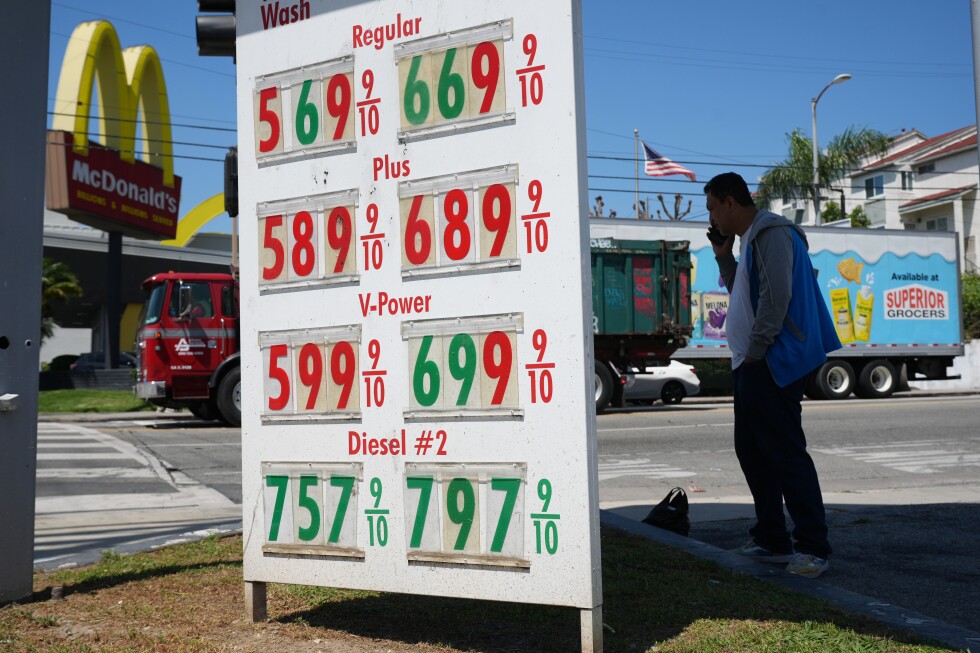
Nationwide, gasoline prices have risen by well over $1 since the Iran war began Feb. 28, reaching an average of $4.15 a gallon, according to AAA.

Prices have been higher, topping $5 during the summer of 2022, but economists believe they will continue heading up and contribute to inflation in the weeks of ahead as geopolitical tension persists.

Advertisement

Deals are to be found, though, at many of the almost 500 tribally owned convenience stores with gas stations across the U.S.

Fifty-five are in California. At the Chukchansi Crossing Fuel Station & Travel Center between Fresno and Yosemite National Park, the $5.09 gas was 60 cents less than nearby stations.

New Mexico resident Jamie Cross usually finds savings on the Mescalero Apache Reservation, where gas was as low as $3.79 this week.

“I hope we don’t go any higher,” Cross said Thursday.

Advertisement

In eastern New York state, on Cattauragus Indian Territory between Buffalo and Erie, Pennsylvania, the cheapest gas was about $3.65 at more than half a dozen stations — 50 cents less than in towns nearby.

Tribal lands find a fuel tax escape

So how do tribes do it? Two words: Tax exemptions.

Generally tribes must pay the federal fuel tax of 18.4 cents per gallon for gasoline and 24.3 cents per gallon for diesel, and pass that cost along to drivers. State fuel taxes are a different matter.

For well over a century, U.S. courts have found that states don’t have authority to collect taxes from Native Americans on their land, said Dan Lewerenz, a University of North Dakota assistant law professor who specializes in Native American law.

Advertisement

“The Supreme Court consistently held to this view and it’s one of the most enduring principles in federal Indian law,” Lewerenz said.

Federally recognized Native American tribes are in 35 states with state gasoline taxes ranging from 9 cents per gallon in Alaska to 71 cents in California.

From there, things get complicated based on where the fuel is taxed — at fuel terminals, say, or when distributors buy or sell fuel — and depending on various agreements between states and tribes.

Court rulings come into play. In 2005, the U.S. Supreme Court ruled that off-reservation distributors in Kansas may charge state tax on sales to tribes for on-reservation fuel sales. But in 2019, the Supreme Court held that an 1855 treaty between the U.S. and the Yakama Nation that ensured the free travel of tribal members on roads with their goods prohibited state fuel taxes on tribal lands in Washington state.

Advertisement

“This is a little bit different than the principle that Indians aren’t taxed within Indian Country because this particular treaty reserved certain off-reservation rights for the Indians as well,” Lewerenz said.

Gas is just one way stores make money

Convenience store gas sales are not as profitable as bringing people inside from the pumps.

Selling snacks adds profit. But tribal businesses are increasingly offering groceries in what otherwise would be “food deserts” far from grocery stores.

“Sometimes these gas stations and convenience stores are the nearest, best place to purchase affordable food or household supplies,” said Matthew Klas, with the Minneapolis-based consultant Klas Robinson Q.E.D.

Advertisement

Klas does market research and consults for tribal businesses and tracks the 245 tribes nationwide that, as of 2025, operated 496 convenience stores with gas stations.

Oklahoma, California, Washington, Arizona, New Mexico, Wisconsin, Michigan and New York have the most. Some tribes, including the Choctaw Nation in Oklahoma and Oneida Indian Nation in New York, have their own store chains.

Drive-through smoke shops, car washes and truck stop amenities also bring in revenue. Then there are the casinos: 205 tribally owned gas stations are located at or near casinos.

Some tribal casinos are resorts with gas stations. Some tribal gas stations are casinos of a sort called “gasinos,” which only have a small number of gambling machines.

Advertisement

Tribally owned businesses are a major revenue generator for Native American reservations. On the Seattle area’s Tulalip Reservation, rising gas sales were being reinvested in the community, helping to cover the cost of roads, police, health care, education, housing and other needs, Tulalip Tribes Federal Corporation CEO Tanya Burns said in a statement.

“Like any government, we provide critical services to our people,” Burns said.

It’s not just about savings

“It’s terrible,” Todd Hall of Paden, Oklahoma, said of diesel prices as he spent about $90 to fill up his tow truck at the Citizen Potawatomi Nation gas station about 30 miles (48 kilometers) west of Oklahoma City.

But, he added: “They’re cheaper here than anywhere else.”

Advertisement

Hall paid $4.57 per gallon for diesel, and said the price is over $5 at many locations in the area.

Mark Foster said he saves about $5 a week buying fuel at the tribally owned gas station. But he’s a faithful customer because the tribe is a good community partner, he said.

“I like the way the tribe operates,” he said. “And the price is good too.”

At the Tulalip Market north of Seattle, Jared Blankenship was griping not about prices but that he was having to pay for gas at all.

Advertisement

“Yeah, well, my electric car just got totaled,” Blankenship said. “So this sucks. This is new. It’s either Costco or looking wherever’s cheap, like the rez. So here we are.”

___

Lindsey Wasson in Seattle; Sean Murphy in Oklahoma City; Susan Montoya Bryan in Albuquerque, New Mexico; and Savannah Peters in Edgewood, New Mexico, contributed.

Advertisement

Source link

Continue Reading

NewsBeat

Bolton awards recognise inspiring women in business

Published

on

Bolton awards recognise inspiring women in business

The fourth annual Women in Business Awards took place on March 28 at the BWFC Premier Suite.

The sold-out event, founded by Anita McKay, celebrated the achievements of women in enterprise, leadership, and community impact.

350 guests attended the ceremony (Image: Creative Camera)

Ms McKay said: “I am blown away by the event this year, we have over 2,000 nominations for tonight’s awards, so to be a finalist and a winner is a huge achievement. I love everything the event represents, amazing businesses, women and impact.”

The event was hosted by Maura Jackson, and 350 guests attended the ceremony.

Advertisement

Guests included the Mayor and Mayoress of Bolton, Councillor David Chadwick and Mrs Valerie Chadwick.

The Mayor and Mayoress of Bolton, Councillor David Chadwick and Mrs Valerie Chadwick, presented the evening’s highest honour, the Lifetime Achievement Award, to Sital Arjan Raja MBE for her outstanding contribution to Bolton’s business community.

Among the more than 30 winners were Sarah Hulme of Covem, Carrie Flitcroft of Shiny and New Cleaning Services, Ruth Wilkinson of Ruth Wilkinson Fitness, Hasina Reshamwalla of VEDA, and Helen Smith of Althams Travel.

The evening featured live music from Tommy Price and karaoke sponsored by Mercedes-Benz of Bolton.

Advertisement

A charity raffle raised more than £1,000 for BACKUP North West.

Sital Arjan Raja MBE took home the Lifetime Achievement (Image: Creative Camera)

The event was sponsored by Jacksons Accountants and Mercedes-Benz of Bolton.

Future events include the Men in Business Awards in May and the Health and Wellbeing Awards later this year.

A newly launched event, the Proper Northern Wedding Awards, will debut in 2026.

Advertisement

Applications and involvement opportunities for the 2027 awards are now open.

Source link

Advertisement
Continue Reading

NewsBeat

Bike stolen outside York Home Bargains in Foss Islands Road

Published

on

Bike stolen outside York Home Bargains in Foss Islands Road

North Yorkshire Police said the black Giant bicycle was stolen from a cycle rack near Home Bargains in Foss Islands Road between 8.30pm and 10pm on Tuesday, March 31.

The force said the lock was removed before the bike was stolen.

Officers are urging anyone with information about the theft to contact North Yorkshire Police.

Advertisement

Those with information are asked to email mark.burrows@northyorkshire.police.uk or phone 101.

Crimestoppers can be contacted anonymously on 0800 555 111 or via its website.

Quote reference 12260058403 when passing on information to police or to Crimestoppers.

Advertisement

Source link

Continue Reading

NewsBeat

For some Americans, rising costs put a new car out of reach

Published

on

For some Americans, rising costs put a new car out of reach

DETROIT (AP) — After a few years of sharing a 2019 Chevrolet Trax, Dana Eble and Tyler Marcus are finally looking for a second car. But as they jump into the market, the young married couple isn’t sure what they can afford.

“I just keep seeing a lot of different aspects of life getting more expensive, and it’s harder,” said Eble, an account manager for a public relations agency.

Car ownership has long been integral to the American dream. But as automakers slash the production of inexpensive models to cater to customers who can afford oversized pickups and sport utility vehicles, buyers find themselves facing sticker shock at the same time they are already frustrated by the lingering effects of high inflation.

Consumer prices rose 3.3% in March, the biggest yearly increase since May 2024, while new car prices were up 12.6% from a year ago, the Labor Department reported Friday.

Advertisement

New vehicles now sell for an average of nearly $50,000, up 30% in six years, and average monthly payments — based on 10% down and a 6-year note — recently hit $775. Looking for something on the cheap end? The share of vehicles listing for less than $30,000 is about 13% — down from 40% five years ago, per the car review site CarGurus.

To cope, buyers are spreading their payments out longer. Consumers choosing 7-year loans make up more than 12% of all sales, up from nearly 8% a year ago, according to auto buying resource J.D. Power. Such contracts wind up costing more in the long run because of interest payments.

“The ability to buy transportation is still out there. The question is just, what do you get for your money?” Charlie Chesbrough, a senior economist at Cox Automotive, said.

The rising cost of cars is contributing to increased concerns about affordability throughout American life. Consumers, especially young people, say they feel like everyday needs like housing, food, utilities and child care are getting costlier and wages aren’t keeping up.

Advertisement

It is a vulnerable position for Republicans ahead of this year’s midterm elections, especially as the Iran war has pumped up gas prices that makes getting behind the wheel even more expensive.

Size, technology and ‘must-have’ features add to costs

Sticker prices have been rising since automakers discovered Americans are willing to pay more for bigger, more expensive SUVs and pickup trucks that bring the companies more profit from each sale. They have largely phased out smaller, cheaper sedans.

That is especially true for domestic carmakers; the average selling prices for many vehicles from Ford Motor Co., General Motors and Jeep-maker Stellantis have generally trended higher than those for Asian companies Honda, Hyundai, Mazda and Subaru.

Car companies are also savvy about placing desired options in more expensive trim levels that can lure consumers into a vehicle that costs more than they planned, said David Undercoffler, the head of consumer insights at CarGurus.

Advertisement

Advanced safety technology — lane-keep assist, automatic emergency braking, blind-spot monitoring, collision warnings and more — all add to the cost of a vehicle. Automakers are required by federal industry rules to add some features, such as rear-view cameras.

The COVID-19 pandemic pushed up auto prices because production fell, affecting both the new and used markets. Though production recovered, other supply chain disruptions and tariffs have affected prices. Meanwhile, government data shows that car insurance prices have soared 55% compared with six years ago, or just before the pandemic, driving up the number of Americans going without. Car repairs, on average, are 48% more expensive.

Advertisement

The share of new car buyers earning below $100,000 fell to 37% last year, down from 50% in 2020, according to Cox Automotive.

Some carmakers have acknowledged affordability concerns. In February, Ford said it would have several vehicles prices under $40,000 by the end of the decade. GM has pointed to vehicles from Buick and Chevrolet, including the Trax, as cheaper options.

Looking to used market for relief

Chesbrough thinks consumers are sometimes unrealistic in their wants.

“There are vehicles out there for less than $30,000. What everybody wants is the mid-sized SUV with leather seats and the sunroof for $25,000, and that’s not available,” Chesbrough said.

Advertisement

Those buyers, he said, are being pushed into the used market.

But as those buyers shift to used, they are finding fewer affordable options there, too. The share of used vehicles priced less than $30,000 fell from 78% in 2021 to 69% in February, according to CarGurus. The average used vehicle sold for about $25,000 in February, and the average used monthly payments hit $560.

The inventory of used cars is being hit by a couple of trends. One is that consumers keen to avoid a big expense are hanging on to their cars longer — nearly 13 years on average now, 18 months longer than a decade ago, according to the Bureau of Transportation Statistics. And a downturn in the popularity of leasing means fewer two- and three-year-old cars hitting the market after leases expire.

J.D. Power estimates that consumers might spend up to $140 less on a lease payment than the average finance commitment, a good option especially for drivers whose annual mileage is predictable. But experts say there is still an affordability challenge.

Advertisement

What buyers can do

Sam Dykhuis, 27, of Chicago, needed to buy her first car recently when she started a new job as a scheduler for United Airlines. She searched for something used under $20,000, and eventually paid a little more than that for a 2021 Mazda CX-5. To hold down the cost, she tapped savings to buy the car outright. She pays insurance six months at a time to save a few bucks, too.

Still, “My paycheck went down and my expenses went up,” Dykhuis said. “Certainly, I have to be more just on top of it than I was previously.”

Eble, 30, and Marcus, 31, say they appreciate cool vehicles but don’t consider themselves “car people” and are hoping their search is easier as a result. Still, finding something in their $20,000 to $30,000 budget might not be as easy as it once was.

They are considering cars such as a newer Trax, a Mazda or maybe an electric vehicle. New EVs generally cost more upfront, but consumers can save in the long run. The used EV market will also soon be flooded with two- or three-year-old EVs that were leased at the time federal credits were generous.

Advertisement

Like Dykhuis, they say they also might buy their new ride outright to avoid a new monthly payment.

“It feels like if anything happens out of our control … it just seems so much more difficult to figure out how to orient our finances,” Eble said.

___

Alexa St. John is an Associated Press climate reporter. Follow her on X: @alexa_stjohn. Reach her at [email protected].

Advertisement

Source link

Advertisement
Continue Reading

NewsBeat

Man charged after ‘stabbing’ near Edinburgh Central Mosque

Published

on

Daily Record

The man’s current condition is unknown.

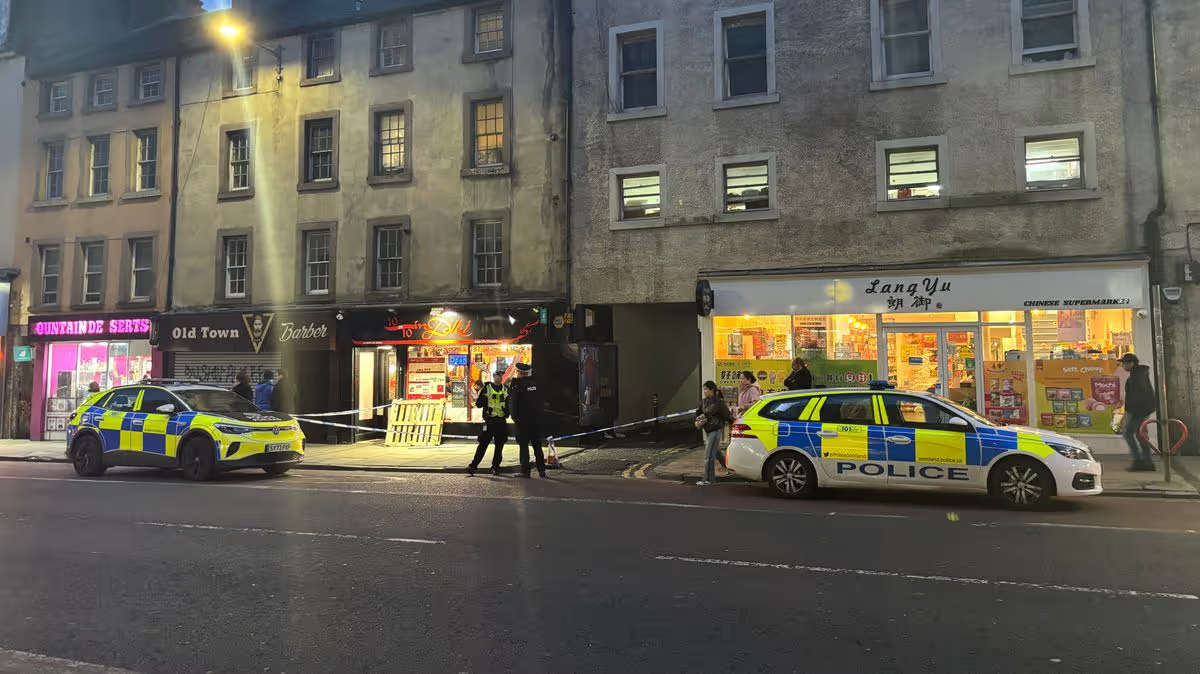
A man has been arrested and charged after an alleged stabbing near Edinburgh’s Central Mosque.

Officers from Police Scotland were called to Nicolson Street in the city centre at around 7pm on Friday night, April 10, after reports of a serious assault. One man was rushed to the Royal Infirmary of Edinburgh.

The man’s current condition is unknown. A cordon was erected at the scene and guarded by uniformed officers while detectives carried out an investigation.

Advertisement

The car park outside the Central Mosque was surrounded by several police vans. A 23-year-old was arrested and charged at the scene.

It is understood the incident is not being treated as a hate crime. He will appear at Edinburgh Sheriff Court on Monday.

A Police Scotland spokesperson said: “Around 7.20pm on Friday, 10 April, 2026, officers received a report of a serious assault on Nicolson Street, Edinburgh. A man was taken to hospital for treatment.

“A 23-year-old man was arrested and charged in connection and is due to appear at Edinburgh Sheriff Court on Monday, 13 April, 2026.”

Advertisement

Get more Daily Record exclusives by signing up for free to Google’s preferred sources. Click HERE.

Source link

Continue Reading

NewsBeat

Pathologist who drew criticism over Katie Simpson postmortem has left post

Published

on

Belfast Live

The pathologist who drew criticism from a High Court judge over his initial conclusions on Katie Simpson’s death has left his post and is currently not licensed to practice.

While there is no suggestion that this played any role in his decision to leave, it is unclear if he will now attend the pending inquest.

Ms Simpson, 21, from Tynan, Co Armagh, died in Altnagelvin Area Hospital almost a week after an incident in Gortnessy Meadows, Lettershandoney, on August 3 2020.

The postmortem was carried after Katie passed away six days after being presented unresponsive to Altnagelvin Hospital.

Advertisement

Death was deemed ‘probable hanging’; however, it later emerged that this was largely based on the account provided by Katie’s killer, Jonathan Creswell.

READ MORE: Katie Simpson’s family expresses ‘significant concern’ over Ombudsman findingsREAD MORE: Katie Simpson: Ombudsman finds no evidence of criminal wrongdoing by officer during investigation

He claimed to have rescued her from hanging, but the truth was much more sinister. Katie had been subjected to sustained and savage assault after Creswell discovered she had spent the night with a new boyfriend.

Having first driven her across the border, during which it is believed she was ‘interrogated’ and while in possession of her phone, Creswell returned to the house in Gortnessy Meadows, Derry, in the early hours of August 3 2020.

Advertisement

At some point after that, Creswell strangled Katie, then staged a hanging scenario. Despite his obvious inconsistencies and frantic reports to PSNI of Creswell’s propensity for strangulation, no action was taken.

Forensic photographs were not taken of Katie’s battered body on the day she was admitted to hospital.

Incomprehensibility, throughout the week Katie fought for her life, police were providing updates to Creswell.

However, a detective did attend the postmortem, leading the pathologist to enquire why this was necessary.

Advertisement

He was advised there was a “level of suspension’ and the detective was thereafter asked to contact Creswell for further information, which police sources have confirmed was done and recorded in the case log.

While images were taken of Katie’s injuries at postmortem, these did not appear to cause alarm, having been explained away by Creswell’s claims she was trampled by a horse.

The later descriptions of these injuries were clearly inconsistent with trampling. With the postmortem signed off as ‘probable hanging’ police closed the case as non-suspicious. This was entirely rejected by some who simply refused to accept the narrative.

After significant agitation, a second PSNI team took over, and a murder enquiry was launched.

The postmortem images were reviewed by a Home Office pathologist who noted linear marks on Katie’s limbs indicative of ‘tramline injuries’ having been inflicted with a rod-type implement. These present as twin red or bruised lines side-by-side, caused by the implement bearing down and the skin on either side being pulled inward.

Injuries on Katie’s hands suggested defensive wounds, and bruising to her inner thigh pointed to ‘grip marks’ often seen in violent sexual assault.

Advertisement

Presented with the alternative opinion, the original pathologist changed the cause of death to ‘possible hanging’.

During a High Court bail application, prosecution counsel said, “The pathologist described (death) as possible hanging. That’s mainly on the face of information given to him by the Applicant (Creswell).”

Mr Justice O’Hara responded, “But if that’s right, the pathologist should not – with all due respect – be signing off the cause of death on the basis of what somebody has told them. The pathologist should only be signing off on the basis of a medical examination, and then say either ‘I can’t say what the cause of death was’ or ‘The cause of death was consistent with A, B or C.’”

Creswell’s senior counsel added, “There must assuredly have been communication with investigating police and the pathologist. It’s perhaps somewhat trite to suggest the pathologist findings are from what he was told by the accused. That simply wouldn’t happen, and it’s nonsense to suggest that would happen.”

Advertisement

The judge replied, “It certainly shouldn’t happen.”

The remarks were put to the Department of Justice, and a spokesperson replied, “The pathologist has confirmed that they did not contact or speak with anyone other than the police and colleagues about this case, as would be normal practice.”

Challenged on this, the department was asked if the pathologist asked police to speak to Creswell.

The reply was, “We have nothing to add.”

Advertisement

All further attempts for clarification since have been met with a response that the pathologist would wait until the inquest.

However, the pathologist has now left and when asked about the circumstances, the Department said, “Personal information about current and former members of staff cannot be released.”

A Freedom of Information response showed the post became vacant on April 1 2025, and was advertised the following June.

There were two applications, and the post was filled on January 19 this year.

Advertisement

The pathologist remains registered with the General Medical Council but has not had a licence to practice since January 2025.

However, this does not necessarily mean there are concerns as a doctor may relinquish their licence, for a range of reasons including retirement, moving abroad or deciding to pursue other work.

The Department of Justice, which encompasses the State Pathologist’s Office, was asked to contact the former pathologist or clarify on his behalf that he will attend to give evidence at Katie’s inquest, having since left his post.

A spokesperson replied: “This case is subject to an ongoing coronial investigation. Decisions regarding witnesses are a matter for the Coroner and, as such it would not be appropriate for the Department to comment.”

Advertisement

However, a follow-up enquiry confirmed that a coroner can require people to attend an inquest and consider any request not to attend.

Source link

Continue Reading

NewsBeat

Man charged after car crashes into house in Bolton

Published

on

Man charged after car crashes into house in Bolton

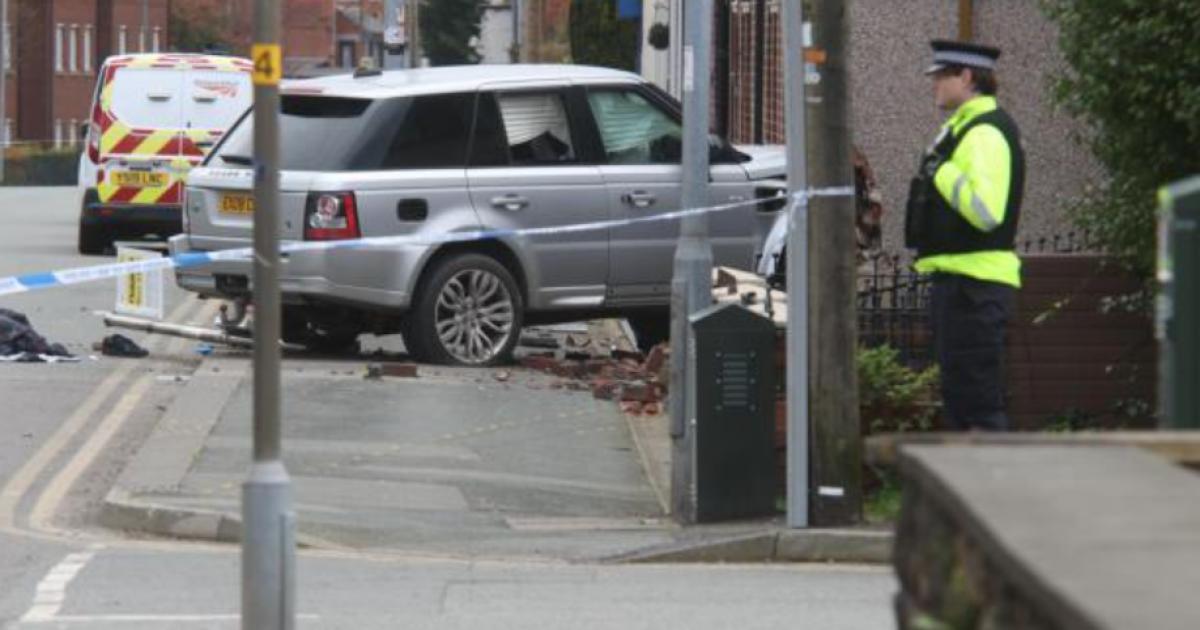
Yesterday, Nicholas Partington, 42, from Bury, appeared at Manchester and Salford Magistrates Court, where he was charged with causing serious injury by dangerous driving and driving whilst disqualified.

He has been remanded in custody and is due to appear later this year.

The incident took place on Saturday, March 28 on Market Street, at around 4.50am.

(Image: Phil Taylor)

A 47-year-old man, who was walking on the street at the time, was seriously injured in the crash and remains in hospital in critical condition.

Advertisement

The owner of the home damaged by the crash, Tony Walters, told the Bolton News that he was asleep at the time and “thought a bomb had gone off“.

Mr Walters, 72, said his house had suffered “significant structural damage”, but neither he nor his son, who were both in the house at the time, was injured.

The crash also caused damage to another nearby property and street infrastructure.

Advertisement

Source link

Continue Reading

NewsBeat

Sadness as ITV shuts down CITV for good after 42 years

Published

on

Sadness as ITV shuts down CITV for good after 42 years

The channel first launched in 1980 under the name Watch IT before being rebranded as Children’s ITV and later shortened to CITV.

Known for hit shows Art Attack, Fraggle Rock, and Tots TV, the channel once brought in millions of viewers.

But on the morning of Friday, April 10, CITV officially ended its time on TV.

Advertisement

ITV shuts down CITV

In 2006, its late-afternoon slot on ITV1 was axed as it got its own channel on Freeview, but was still available on weekend mornings on ITV channels.

CITV Freeview was later shut down and replaced by the streaming service ITVX Kids Hub on ITVX in 2023, with the weekend showings moving to ITV2.

However, on April 10, the CITV block on ITV2 ended for good, cementing the closure of the channel.

The last moments were marked with the credits of the show, Be Cool, Scooby-Doo! followed by several adverts before the final logo clip of CITV was shown.

Advertisement

Those who grew up watching CITV reacted to the channel’s closure on X, as one viewer wrote: “Can’t believe CITV has ended… I remember watching a lot of children’s TV on CITV.

Another person said, “After 42 years #CITV has officially ended, marking the end of an era for Children’s TV as we know it.”

A third viewer wrote: “I absolutely loved CITV back in the day. Thank you for many years of fun, laughter and entertainment.”

Advertisement

Recommeded Reading


It was previously claimed by X account, Media Central UK, that CITV would be ending its time on TV for good, sharing: “In TV news, the CITV block on ITV2 is officially ending on 10th April.

“This really means the end of the iconic CITV brand that has been around for 42 years.

“Farewell CITV, this time for real.”

Advertisement

What was your favourite show on CITV? Let us know in the comments below.

Source link

Advertisement
Continue Reading

NewsBeat

Further Irish motorway closures as fuel protests continue into fifth day

Published

on

Belfast Live

It comes after a crunch meeting on Friday failed to end with concrete proposals

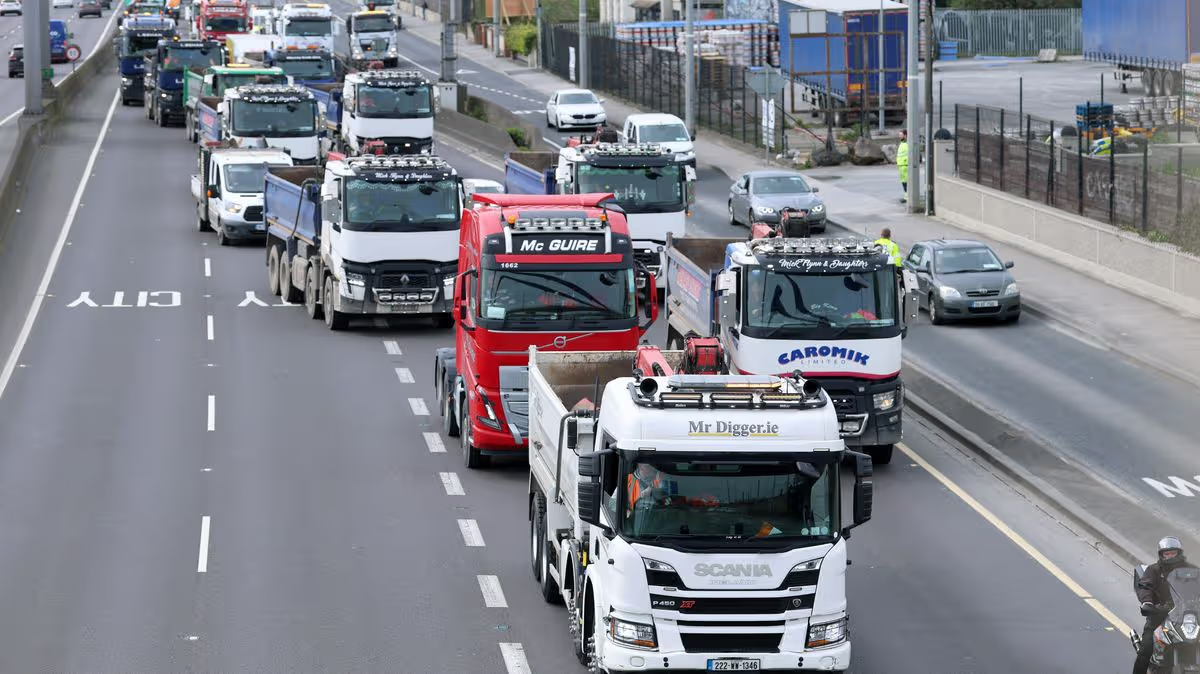
Ireland’s police service introduced “exceptional” measures as fuel protests which have strangled the distribution of fuel around the country rumbled into a fifth consecutive day.

Advertisement

The Irish Government is to re-enter talks on Saturday aimed at defusing the protests, which have involved blockades at key fuel distribution sites, as the prospect of most filling stations running out of fuel by Monday was raised by an industry representative.

It comes after a crunch meeting on Friday failed to end with concrete proposals.

READ MORE: Ambulance service warns protesters not to ‘impede’ emergency vehicles during NI fuel demonstrationsREAD MORE: Dublin airport travel warning as fuel protests lead to ‘five-hour’ trip from Belfast

An Garda Siochana internally declared an “exceptional event”, allowing it to designate every member available for duty over the weekend.

Advertisement

About 600 of the 1,500 filling stations around the Republic of Ireland have run dry, according to Fuels for Ireland chief executive Kevin McPartlan.

He said he expected the number “will grow quite dramatically” if ongoing blockades of fuel depots remain in place.

Asked on RTE Radio One’s The Business how that number may grow, he said: “If everything remains as it is, that is to say that the three facilities remain blockaded, then I don’t think we could guarantee fuel at any forecourt by very early next week, Monday morning or Monday perhaps.”

Despite this, Health Minister Jennifer Carroll MacNeill told the Irish Medical Organisation AGM in Co Kerry on Saturday that “all of our ambulances have been refuelled successfully”.

Advertisement

Elsewhere, Rosslare Europort is expected to hit capacity by Sunday evening or Monday morning.

Operations at the port, run by Irish Rail, have been affected by a blockade of fuel protesters in the nearby town of Kilrane, Co Wexford.

A spokesperson for Irish Rail said the port will soon be at capacity and will not be able to take in any more freight – resulting in ships having to wait on anchor or be diverted to another port if possible.

Meanwhile, ministers said the Irish Defence Forces are “on standby” to help gardai remove blockades at critical infrastructure.

Advertisement

Blockades have resulted in full closures of parts of the M50 ring road around Dublin, as well as the M4, M6, M7, M8, M9 and M20.

Transport Infrastructure Ireland, which is responsible for motorways, said there is “significant disruption” to its network impacting counties Clare, Limerick, Tipperary, Laois, Offaly, Kildare, Galway, Cork, and Dublin.

It said it was working closely with gardai in managing traffic distribution.

The protests have caused disruption to some bus routes across Ireland and within the capital, where Luas Green Line tram services are also affected.

Advertisement

Participants say the Government needs to take urgent action on fuel prices or they will go out of business.

Protesters have blockaded the country’s only oil refinery, in Whitegate, Co Cork, as well as key depots in Galway and Foynes, Co Limerick.

There have also been concerns about fuel shortages leading to curtailments on the provision of emergency services and the delivery of vital goods, while the National Emergency Coordination Group urged the public to only buy the fuel they need.

Taoiseach Micheal Martin warned that Ireland is on the “precipice of turning oil away from the country”, describing the situation as “unconscionable”, “illogical”, and “difficult to comprehend”.

Advertisement

The protests, which have also seen slow-moving convoys and outright stoppages on major motorways as well as a blockade on Dublin city’s main thoroughfare, began on Tuesday over the cost of fuel.

Participants include professional drivers, farmers and hauliers as well as taxi and bus operators.

Many official representative groups recognised by Government have expressed sympathy with the cause but have said they have not been involved in organising the protests.

Government ministers engaged with some of these groups on Friday but a spokesman for the protesters expressed “devastation” that they were excluded from the meeting.

Advertisement

A commitment from the coalition on Friday night to deliver a “substantial” package of measures on fuel costs was not enough to dissuade protesters from continuing blockades.

Christopher Duffy, a spokesman for the grouping in Dublin city centre, said the protest would continue until there was a “serious reduction in our costs”.

Talks between Government departments and representative bodies are set to continue at lunchtime on Saturday, with a view to finalising what deputy premier Simon Harris said would be “substantial and significant” measures for affected industries.

Police in Northern Ireland said they were “maintaining an ongoing assessment” in relation to social media posts calling for similar planned protests there.

Advertisement

A PSNI spokeswoman said: “A policing response has been prepared, if needed, to ensure public safety and to help minimise any potential disruption to the wider community.”

For all the latest news, visit the Belfast Live homepage here and sign up to our daily newsletter here.

Source link

Advertisement
Continue Reading

NewsBeat

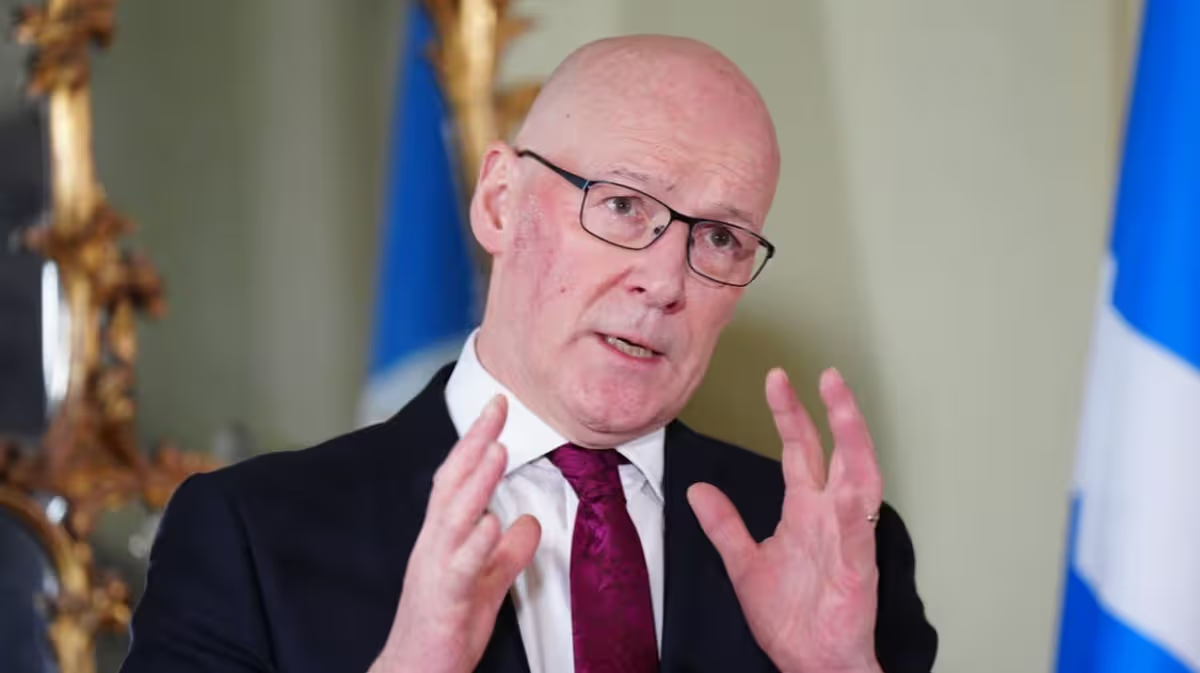
John Swinney warns UK may not be able to deal with Russian ‘threat’ to Scotland

Published

on

Daily Record

The First Minister said he was concerned about revelations of a Russian attack submarine and two spy submarines loitering over critical undersea cables.

The UK may not have the capability to deal with the “threat” of Russia’s military off the coast of Scotland, John Swinney has said.

The First Minister said he was concerned about revelations of a Russian attack submarine and two spy submarines loitering over critical undersea cables in the North Atlantic. He also expressed concerns about the ability of the UK’s armed forces to deal with any potential threats from Moscow.

Defence Secretary John Healey revealed on Thursday that the UK and its allies tracked three Russian vessels off the UK’s northern coast. A British warship and aircraft were deployed to deter “malign” activity by Vladimir Putin’s regime in waters off the UK’s northern coast, John Healey said.

Advertisement

He said Vladimir Putin had sought to capitalise on the world being “distracted” by the Iran war and that he poses “the primary threat to UK security”. Speaking in Inverness, the UK’s northernmost city, Scotland’s First Minister said it was “vital” Scotland’s infrastructure was protected.

He told MFR (Moray Firth Radio): “I am very concerned by the presence of Russian vessels in the North Atlantic, and there’s obviously significant infrastructure that is in the water that involves the communications infrastructure and the energy infrastructure of our country and many other countries. So it is vital that our interests are protected from any threats that might be levelled by the actions of Russian naval vessels and submarines who could damage the infrastructure.”

Speaking on the Holyrood campaign trail, Mr Swinney said it was “exclusively the responsibility” of the UK Government to protect the UK’s national security. I want to make sure we’ve got the capability to do that,” the SNP leader added. “I’m very concerned that the UK does not have sufficient capability to deal with the Russian threat in the North Atlantic.

Advertisement

“It’s an issue which I think has got to affect our defence choices, because I think we should be investing in the security of the country, protecting that infrastructure, and not investing in nuclear weapons that we can’t use and are prohibitively expensive.”

Mr Swinney said he had not had any briefings from the UK Government “over this particular threat” but said he had urged ministers in London to ensure infrastructure in the north of Scotland is protected. The SNP leader, speaking on the Holyrood campaign trail, said he had “made clear” his “frustration” over the level of dialogue between the Scottish and UK Governments over national security concerns “that affect the domestic security of Scotland and the domestic powers of the Scottish Government”.

He added: “I’ve benefited from individual, national security briefings, which I’m grateful for, but I think we need to have more partnership, more dialogue, more engagement, because, as we saw with the Bella 1 tanker, it didn’t take long for something that happened on the high seas to come right into the Moray Firth and be an issue that we had to wrestle with.”

In January, the Russian-flagged oil tanker, previously known as Bella 1 and now named Marinera, was seized by the US south of Iceland before sailing it to the coast of Moray, east of Inverness. The captain and first officer of the tanker were later taken out of UK territory by the US Coastguard. Mr Swinney said at the time the Scottish Government was told about their removal only after the US had done so.

Advertisement

Angela Constance, Scotland’s Justice Secretary, said the situation had shown a lack of respect for “Scottish jurisdiction and Scots law”.

An MoD spokesperson said: “The UK is stepping up to protect the Arctic and High North – doubling the number of Marines we have in Norway, deploying HMS Prince of Wales to the high north and scaling up joint exercises with Nato allies. As the Defence Secretary said yesterday we’re providing an extra £100 million for our vital P8 submarine hunting aircraft and we’ve launched the Atlantic Bastion programme, to combine the latest autonomous technologies with the very best warships and aircraft to create a British-built hybrid naval force.

“The exceptional military personnel serving in Scotland and the 11,800 skilled people across the Scottish defence industry are a credit to this country. Their dedication keeps us secure at home and strong abroad.”

Get more Daily Record exclusives by signing up for free to Google’s preferred sources. Click HERE.

Advertisement

Source link

Continue Reading

Trending

Copyright © 2025