Connect with us
DAPA Banner

NewsBeat

Ministers told British public must be better protected after UK Biobank breach

Published

on

Ministers told British public must be better protected after UK Biobank breach

Ministers have been urged to do more to protect the public after data from 500,000 people who volunteered their health information to the UK Biobank was breached and offered for sale online in China.

Information of all half a million members had been listed for sale on the website Alibaba, said science minister Ian Murray, as he called the incident an “unacceptable abuse” of data.

Mr Muarry told the Commons on Thursday that the charity had informed the government about the data breach on Monday, and said the information did not include names, addresses or contact details.

But Dame Chi Onwurah, the Labour chair of the science, innovation and technology committee, said it was “another blow to public confidence”, adding that it showed “little progress had been made” in protecting public data after she said she was given assurance by Mr Murray in February that standards of public sector information security and data hygiene would improve.

Advertisement

She said: “[The] statement, however, demonstrates just how little progress has been made. It raises serious questions about whether lessons have been learned from repeated data breaches and leaks, and whether robust data management practices are being enforced at publicly funded bodies.

“Public trust in the handling of sensitive data is handled is key to the government’s digital transformation ambitions. This is another blow to public confidence.”

The Biobank is the world’s most comprehensive dataset of biological, health and lifestyle information. It has been used to achieve improvements in the detection and treatment of dementia, cancers and Parkinson’s.

The data was offered for sale on Alibaba's ecommerce platforms
The data was offered for sale on Alibaba’s ecommerce platforms (AFP/Getty)

Mr Murray told MPs: “Biobank told us that three listings that appear to sell … Biobank participation data had been identified. At least one of these three datasets appeared to contain data from all 500,000 UK Biobank volunteers.

“Additional listings offer support for applying for legitimate access to UK Biobank or analytical support for researchers who already have access to the data.”

Advertisement

“The government has spoken to the vendor today, and they did not believe that there were any purchases from the three listings before they were taken down,” Mr Murray added.

The UK Biobank was established to advance medical research and scientists from across the world can use its data – with the personal information removed – for studies that are deemed in the public interest.

All of the participants were aged between 40 and 69 years old when they joined the study between 2006 and 2010. Their data is used to track their long-term health and help researchers to understand, prevent and treat serious illnesses.

UK Biobank has referred itself to the Information Commissioner’s Office following the breach, said Mr Murray, who said the data involved in the breach could include gender, age, month and year of birth, socioeconomic status, lifestyle habits, and measures from biological samples.

Advertisement

He said he could not give a complete guarantee that nobody could be identified, but said it would likely only be done so through a “very advanced way”.

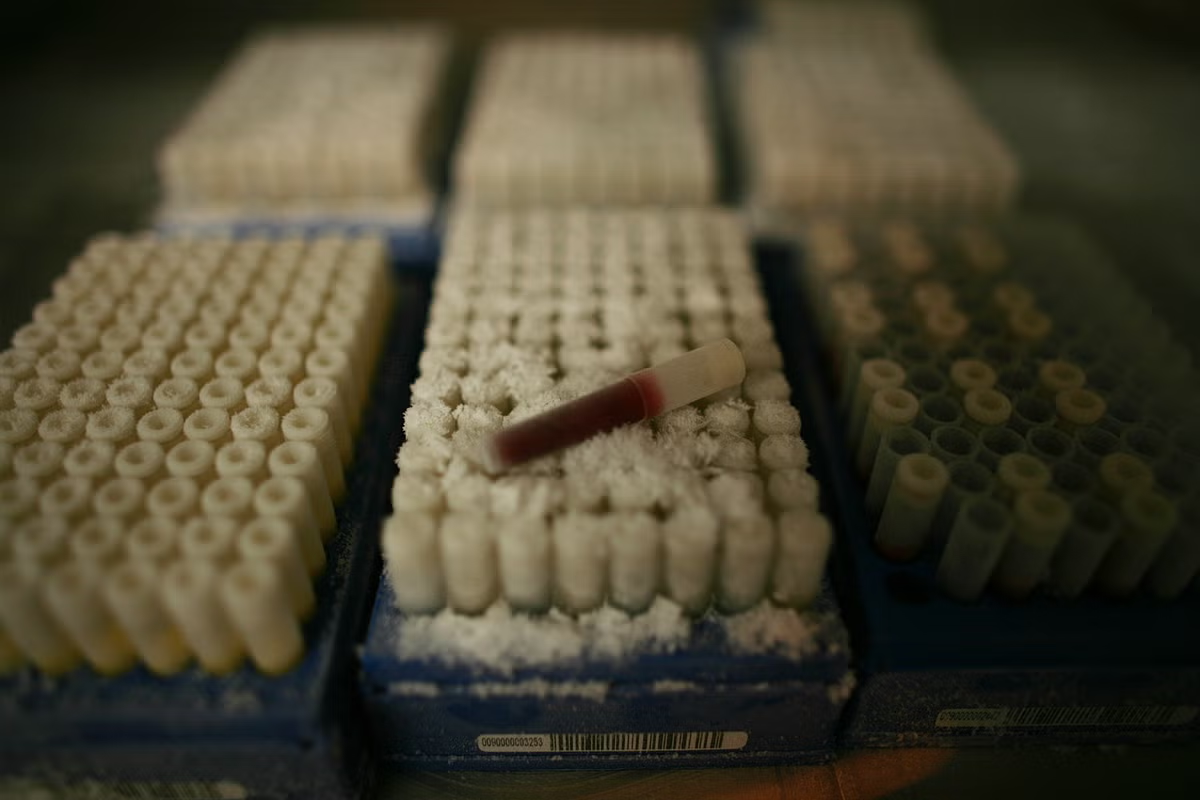
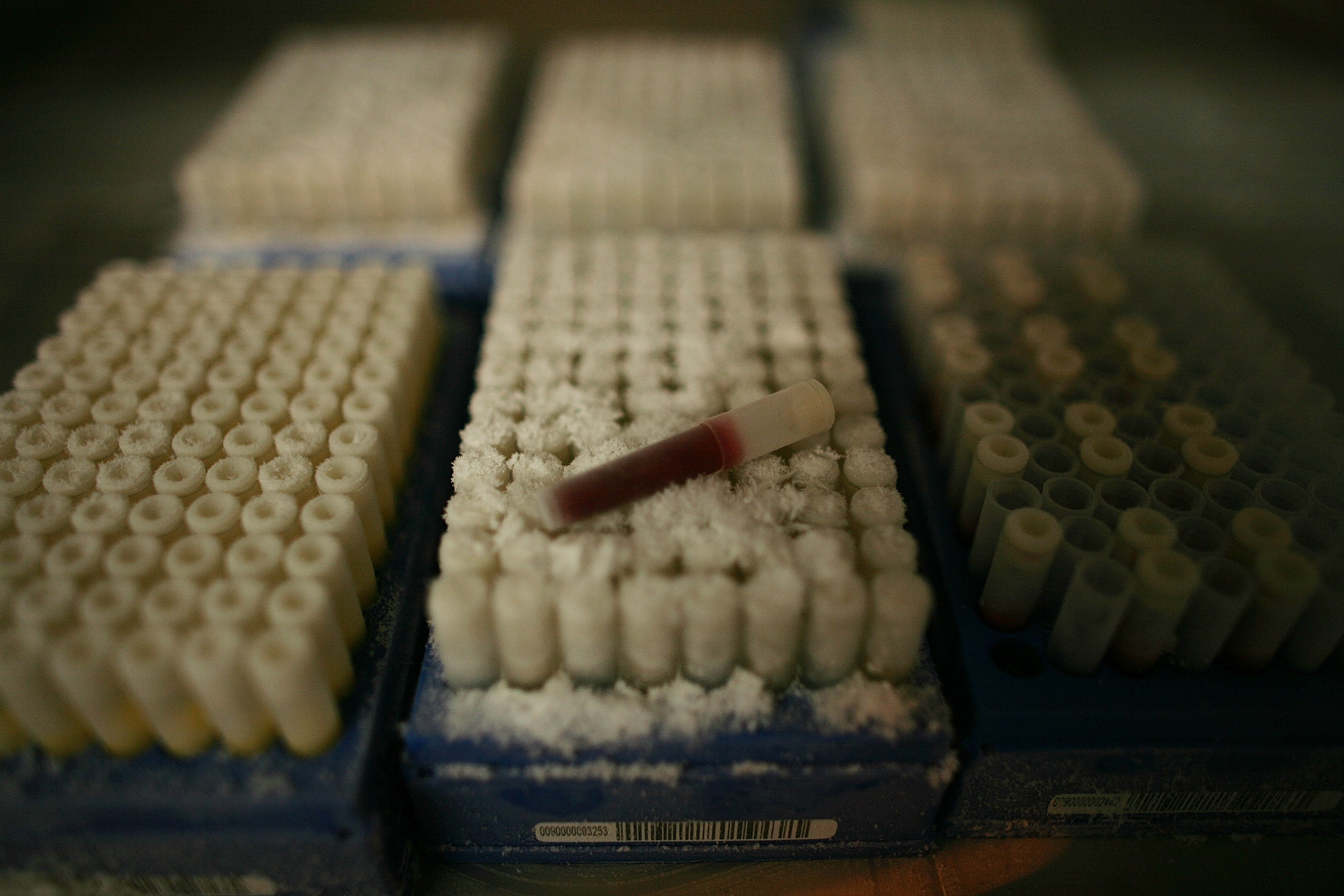
Blood samples taken from volunteers, ready to be stored in the UK Biobank
Blood samples taken from volunteers, ready to be stored in the UK Biobank (Getty)

In a statement, he told the Commons: “Once the government was made aware of the situation, we took immediate action to protect participants’ data. Firstly, we worked with Biobank, the Chinese government and the vendor, to ensure that those three listings – that UK Biobank informed us (of), including participant data – had been removed.

“I want to thank the Chinese government for the seriousness with which they work with us to help remove these listings.

“Secondly, we ensured that the Biobank charity revoked access to three research institutions identified as the source of that information.

“And thirdly, we have asked that the Biobank charity pause further access to its data until they put in place a technical solution to prevent data from its current platform from being downloaded in this way again. I can confirm to the House that this pause is now in place.”

Advertisement

In a statement published on Thursday, Professor Sir Rory Collins, chief executive and principal investigator of UK Biobank, told those in the study: “We would like to inform you about an incident involving UK Biobank data.

“We apologise to our participants for the concern this will cause, and we hope to provide reassurance by outlining the serious actions we are taking in response.

“Your personally identifying information in UK Biobank is safe and secure.

“Listings offering access to UK Biobank data (which did not contain any personally identifying information) were found on a Chinese consumer website. These listings were swiftly removed before any purchases were made.

Advertisement

“We are putting in place additional security measures to prevent this happening again. We will conduct a comprehensive investigation into this incident.

“Since UK Biobank started to make your de-identified data available for research in 2012, it has led to thousands of discoveries that are already leading to improvements in the prevention and treatment of many different diseases.”

Professor Elena Simperl, Department of Informatics at King’s College London, said: “The recent UK Biobank data exposure is not a moment to point fingers, but to take seriously what it tells us about national data infrastructure. Initiatives like UK Biobank are absolutely essential to driving innovation across the health and life sciences ecosystem.

“With longitudinal data on half a million volunteers and more than 18,000 peer-reviewed papers to its name, the UK is world-leading in this space, and rightly proud of it.

Advertisement

“What happened here was an infrastructure problem, not the result of a complex cyber attack. Too often, the costs of maintaining infrastructure for flagship data stewardship projects like this are treated as an afterthought. The UK has built something remarkable, but we need to keep investing in keeping it safe.”

Source link

Continue Reading
Click to comment

You must be logged in to post a comment Login

Leave a Reply

NewsBeat

NTSB: Firefighter heard warning but unsure who it was for in deadly LaGuardia crash

Published

on

NTSB: Firefighter heard warning but unsure who it was for in deadly LaGuardia crash

NEW YORK (AP) — A firefighter whose truck collided with an Air Canada Express jet last month on a runway at New York’s LaGuardia Airport, killing both pilots, heard an air traffic controller warn “stop, stop, stop” but didn’t know who it was for, federal investigators said Thursday.

Just seconds earlier, the controller had cleared the fire truck to cross the runway, but the truck started moving while warning lights that act as a stop sign for crossing traffic were still lit, the National Transportation Safety Board said in a preliminary report on the March 22 crash.

Because the truck lacked a transponder, a surface monitoring system in the control tower was unable to reliably determine its position, “did not predict a potential conflict” with the landing plane and did not generate an audio or visual alert, the report said, pointing to a series of failures that contributed to the crash.

“There were so many opportunities where this accident could have been prevented,” aviation safety expert Jeff Guzzetti said after reviewing the report.

Advertisement

In addition to the control tower and truck driver, he said the report suggests the pilots had a chance to recognize the danger and pull up. But, he said, they may have been too dialed into landing.

After the air traffic controller’s initial stop warning, the fire truck’s turret operator heard the controller say, “Truck 1, stop, stop, stop,” and realized he was telling the truck to halt, the report said. By then, the truck was already on the runway as Air Canada Express Flight 8646 was landing and speeding toward it.

Aviation safety consultant John Cox, CEO of Safety Operating Systems, said it might be understandable that the truck driver didn’t recognize the first “stop” call was meant for him because the controller had just been directing a plane on a taxiway and didn’t say Truck 1 at the start of the command.

The turret operator, one of two crew members in the fire truck, told investigators that as the vehicle turned left, he saw the airplane’s lights on the runway, the report said. The plane registered a speed of 104 mph (167 kph) just before the collision. The truck was going about 30 mph (48 kph).

Advertisement

The fire truck was leading a convoy of vehicles, including four fire trucks, a police car and a stair truck, responding to an emergency involving a strong odor that was making flight attendants feel ill aboard a departing United Airlines jet.

The air traffic controller cleared the truck to cross the runway just 12 seconds before the plane touched down, investigators said. About eight seconds later, the controller frantically began calling for the truck to stop.

Pilots killed, 39 people hurt, including fire crew members

The plane, a CRJ900 regional jet from Montreal, was carrying 76 people. Pilots Antoine Forest, 30, and Mackenzie Gunther, 24, were killed. It was the first deadly crash at LaGuardia in 34 years.

In addition, 39 people were taken to hospitals, including six described as seriously injured. The two fire truck crew members are recovering at home after being released from the hospital, according to the Port Authority of New York and New Jersey, which operates LaGuardia.

Advertisement

A flight attendant still strapped in her seat survived after being thrown onto the tarmac.

Another flight attendant reported taking his seat in the rear of the plane for landing and described the flight as normal until he felt an impact, the report said. He didn’t know what had happened and attempted to call the pilots but received no response, the report said.

The Port Authority said it is conducting a comprehensive review of the NTSB’s initial findings. “Our focus is straightforward: ensure our safety procedures and protocols are as strong as they can be and take action to strengthen them as needed,” the agency said.

LaGuardia was busier than usual the night of the crash because flight delays pushed the number of arrivals and departures after 10 p.m. to more than double what was scheduled, according to aviation analytics firm Cirium. Two air traffic controllers were on duty, consistent with normal scheduling, the report said.

Advertisement

Planes were landing every few minutes, with a dozen flights arriving between 11 p.m. and when the crash happened less than 40 minutes later. At the same time, the controllers had to shuffle their duties because of the odor issue on the United plane.

While the more senior controller coordinated the United emergency response, the other controller took over directing vehicles on the ground while continuing to authorize takeoffs and landings.

“These controllers were just way busy, just too busy,” Guzzetti said.

Airport had technology designed to prevent crashes

The warning lights — known as runway entrance lights — were lit until the fire truck reached the edge of the runway, about three seconds before the collision, the report said. By design, they turn off two or three seconds before a plane reaches a runway intersection, the report said.

Advertisement

The runway warning lights in place at 20 of the nation’s busiest airports are one of the backup systems designed to help prevent a crash. Cox said the truck should have never entered the runway while the warning lights were illuminated.

“That’s an automated system so even though the controller says you’re cleared to cross, the lights mean that there’s an airplane that is either on the runway or about to be,” Cox said. “So the truck driver is going to have some questions to answer there.”

LaGuardia is one of 35 major U.S. airports with an advanced surface surveillance system that combines radar data with information from transponders inside planes and ground vehicles to help prevent runway incursions. Controllers have a display in the tower that’s supposed to show the location of every plane and vehicle.

The system, known as ASDE-X, didn’t sound an alarm partly because the radar had trouble distinguishing the closely spaced trucks and the radar targets intermittently merged on the display. Only two targets were displayed just before the crash, even though there were seven vehicles. None were equipped with transponders that would have helped the system to precisely track their movements.

Advertisement

According to air traffic control transmissions, Flight 8646 was cleared to land on Runway 4 at 11:35 p.m.

About two minutes later — and 25 seconds before the crash — the fire crew asked to cross the same runway, which was between the airport’s fire station and where the United Airlines jet had parked.

Five seconds later, with Flight 8646 approaching the runway a little more than 100 feet (30 meters) above the ground, an air traffic controller cleared the fire truck to cross.

Then, just nine seconds before the crash, the controller frantically told the fire crew: “Stop, stop, stop, stop. Truck 1. Stop, stop, stop, stop.” A second later, the plane’s landing gear touched down.

Advertisement

___

Funk reported from Omaha, Nebraska. ___

This story has been corrected to show that pilot Antoine Forest was 30, not 24; and pilot Mackenzie Gunther was 24, not 30.

Advertisement

Source link

Continue Reading

NewsBeat

Frustration grows among Pakistanis with capital under indefinite lockdown for stalled US-Iran talks: ‘Like living in a cage’

Published

on

Frustration grows among Pakistanis with capital under indefinite lockdown for stalled US-Iran talks: ‘Like living in a cage’

Bilal Mazhar Khawaja, 44, runs three restaurants in Islamabad. For the past few days his business has been severely hit, with food supply chains disrupted and movement of staff restricted as the Pakistani capital remains in an indefinite lockdown in anticipation of the stalled US-Iran talks.

Pakistan has mediated the first round of peace talks to end the seven-week-old war between US and Iran. It appeared confident to get both sides talking again as US president Donald Trump indefinitely ​extended the ceasefire withTehran this week, hours before it was set to expire, to allow the two countries to continue the the peace negotiations.

No date for the talks has been set, but the city remains under sweeping security restrictions, forcing locals to grapple with uncertainty.

Khawaja tells The Independent over the phone: “They (the administration) have blocked all main roads leading to Islamabad. Trucks full of bread and cooking oil, which have been denied entry to the city, have not been able to deliver supplies.”

Advertisement
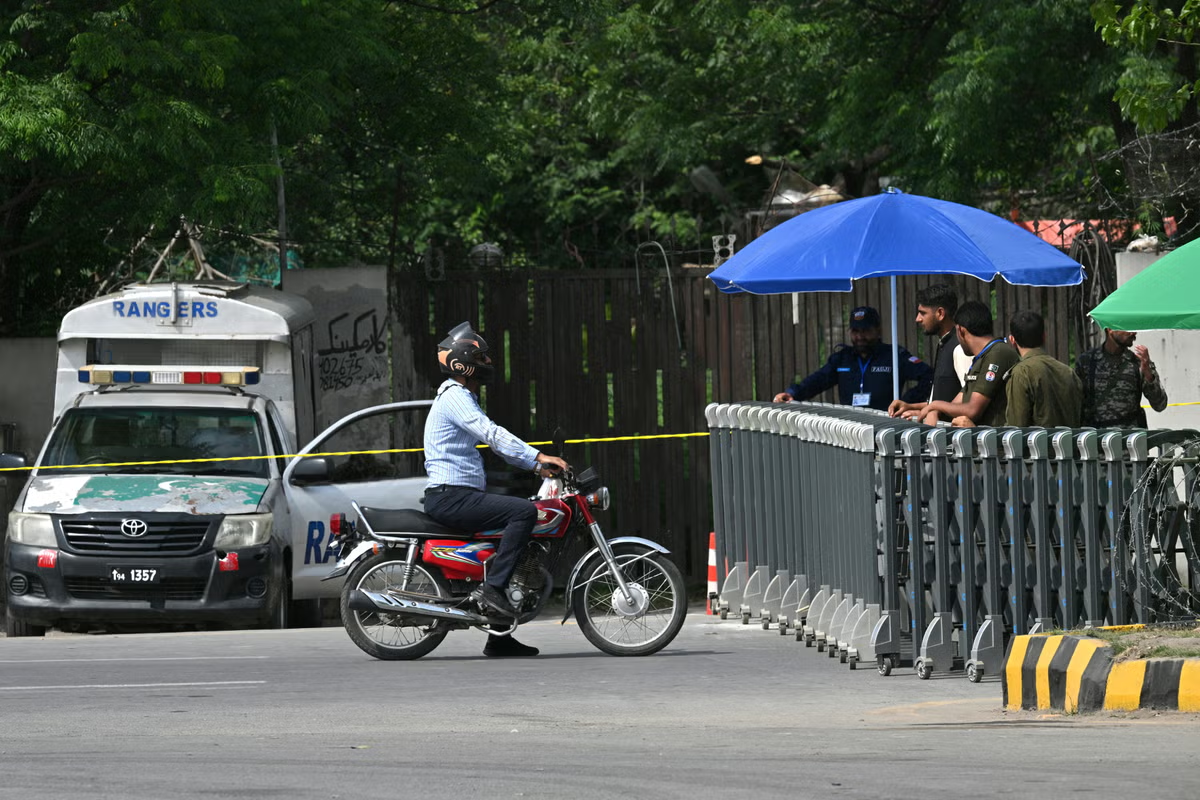
Security personnel stand guard at a closed road leading to the Serena Hotel in the Red Zone area of Islamabad on 23 April 2026. - Pakistan's capital was still locked in gear on 22 April to host high-stakes US-Iran talks that were pushed back at the last minute overnight, but many residents began to tire of the heavy personal and economic toll of tight security restrictions
Security personnel stand guard at a closed road leading to the Serena Hotel in the Red Zone area of Islamabad on 23 April 2026. – Pakistan’s capital was still locked in gear on 22 April to host high-stakes US-Iran talks that were pushed back at the last minute overnight, but many residents began to tire of the heavy personal and economic toll of tight security restrictions (AFP/Getty)

His staff have not been able to travel to the restaurants because movement of public transport has been restricted. “Earlier, they would spend, say, 50 to 60 (Pakistani) rupees to reach their work using the public transport. Now, if they hire a taxi, for example, it will cost them 300. Most of them prefer to stay home.”

Khawaja, whose businesses have been impacted severely, says if in the next few days the administration doesn’t ease out the restrictions, he would be forced to let some of his staff go. “It is impacting everyone.”

“Near the (Islamabad) airport, there are no shops open. Not even chemists. Fuel stations have no fuel.”

It was previously reported that US vice president JD Vance would lead the US delegation to Pakistan. The visit got delayed even though there were reports that Iran was reconsidering its initial refusal to engage in further talks.

Islamabad remains hopeful that the talks will take place soon. On Wednesday, Pakistan’s prime minister, Shehbaz Sharif, met with Iran’s ambassador, and according to one official who was briefed on the talks, the second round of negotiations could take place within the next few days.

Advertisement

However, Iran’s capture of two cargo ships in the Strait of Hormuz on Wednesday has led to fresh uncertainty in Islamabad over the plans for the second round of peace negotiations to end the war in the Middle East.

Residents who have had to deal with high security, road closures, and scarce public transport for days now, say their daily lives are badly impacted by the stringent measures.

The government has asked offices to close and urged employees to work from home. Schools have been moved online. Streets which were once crowded are mostly empty.

Several areas, especially “red zone”, which houses critical government institutions, including the parliament, Supreme Court, the prime minister’s secretariat, and foreign embassies.

Advertisement

Al Jazeera said that for ordinary Islamabad residents, the impact has been “devastating”.

An X user wrote: “Islamabad was turned into a lockdown zone for days leaving ordinary people stuck in traffic missing flights work and daily routines. Security is important but when an entire city suffers before talks even begin it raises serious questions about priorities and planning.”

Another person wrote: “Islamabad & Rawalpindi are in lockdown with public transport & electric buses suspended in anticipation of US & Iran delegations’ arrival…The public is going through hell!”

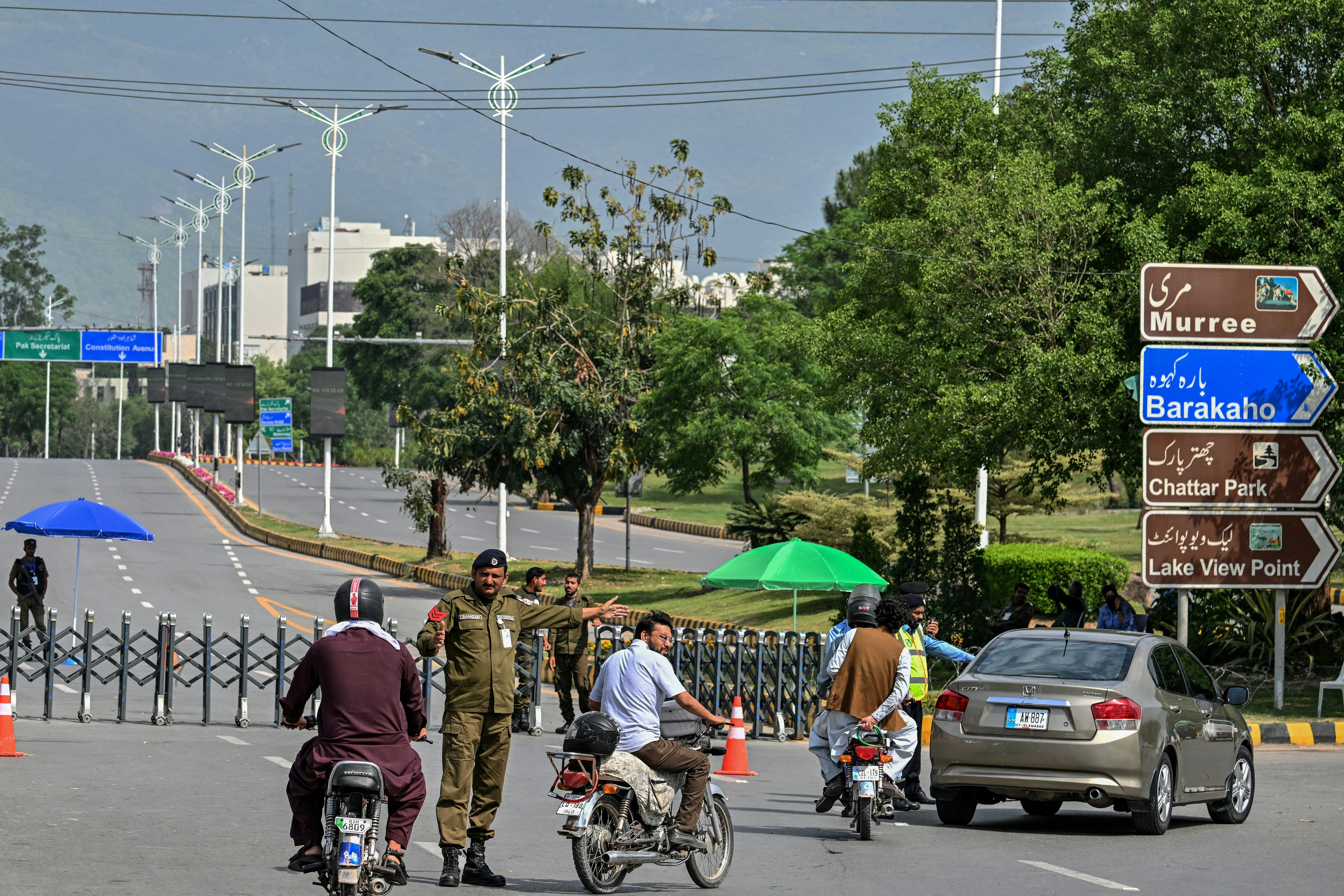
A security personnel manages traffic at a closed road leading to the Serena Hotel in the Red Zone area of Islamabad on 23 April 2026
A security personnel manages traffic at a closed road leading to the Serena Hotel in the Red Zone area of Islamabad on 23 April 2026 (AFP/Getty)

“Take the red zone out of Islamabad and move it outside, and kindly let the people of Islamabad and Pindi live a normal life,” wrote another social media user.

Daily wage earners have been among the worst affected. Muhammad Zubair, 45, a labourer, told The Guardian: “A lockdown means no work and no work means no food. The government does not care about the poor. We need work to feed our children.”

Advertisement

He has not been able to find work for the past six days. Small business owners are struggling too. Earnings have dropped sharply.

Muhammad Ahsan, 35, the owner of a small jewellery kiosk, told AFP: “The impact of the lockdown is that we are not seeing any customers here in the market… the government does not know what one day of their lockdown does to our households.”

“Our stoves do not run, we do not find food (in the markets).”

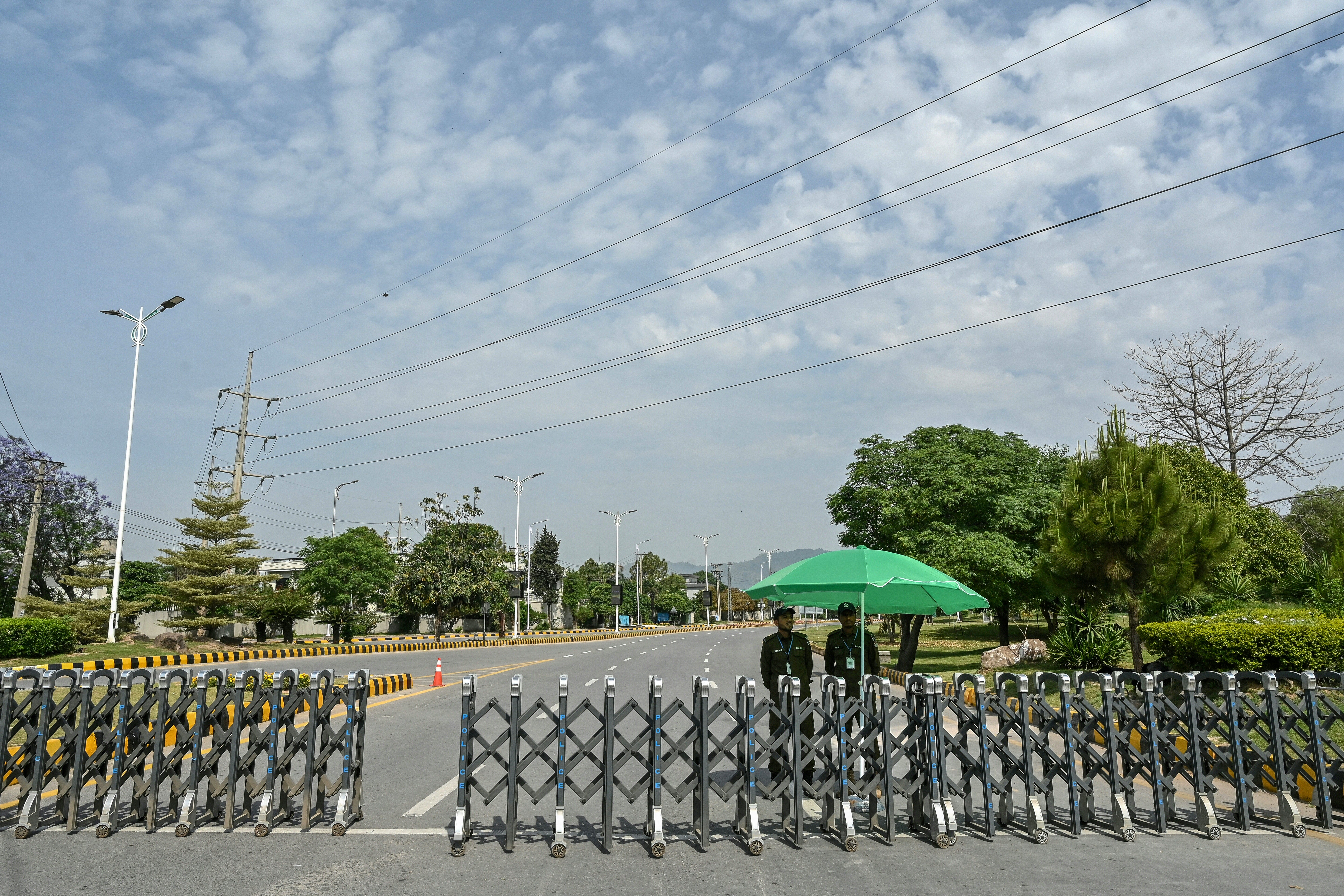
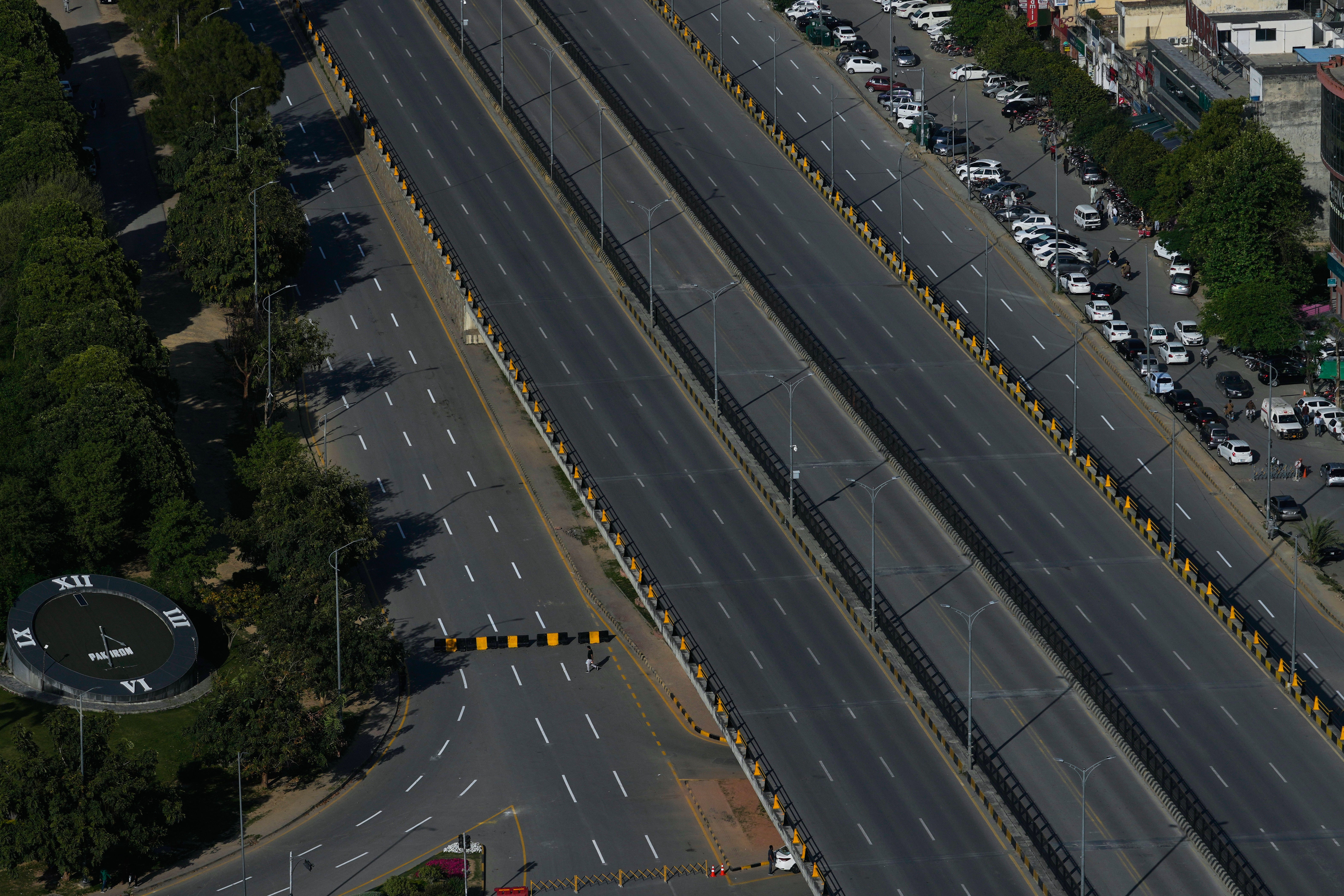
A man crosses a deserted road barricaded by authorities due to security arrangements for the US and Iran talks, in Islamabad, Pakistan, Wednesday, 22 April 2026
A man crosses a deserted road barricaded by authorities due to security arrangements for the US and Iran talks, in Islamabad, Pakistan, Wednesday, 22 April 2026 (AP)

Areej Akthar, a health officer at Pakistan Institute of Medical Sciences, told The Guardian: “Saturday was chaotic. I am lucky enough that my village is a three-hour drive away. But many people [who] were from distant cities and province[s] had to beg their colleagues, friends and relatives to allow them to stay until the US-Iran negotiations took place.”

With transport services suspended, commuting has become difficult or impossible.

Advertisement

Akhtar added: “It is like we are living in a cage.”

Students are also feeling the strain. Some exams have been moved to another city, forcing candidates to travel long distances.

The ongoing conflict in the Middle East has already disrupted global energy supplies. Pakistan has also been hit hard. Fuel shortages have led to long power cuts. Gas shortages have forced restaurants to close. The latest lockdown has only deepened these problems for the citizens.

However, despite the difficulties, there are locals who back the administration’s decision to put the city in an indefinite shutdown. “We are giving a small sacrifice to reduce the size of the larger sacrifice. So we will continue to sacrifice,” a local was quoted as saying by AFP.

Advertisement

Pakistani officials are hopeful that the diplomatic channels will reopen.

Maleeha Lodhi, a former Pakistani ambassador to the US and UK who was also briefed on the continuing diplomatic efforts, told The New York Times: “The cease-fire has opened a space that Pakistan thinks is enough for the diplomatic path to resume. Neither side has rejected the talks.”

Source link

Advertisement
Continue Reading

NewsBeat

Zack Polanski’s wishful thinking is really Green on major issues

Published

on

Daily Record

English Green leader Zack Polanski’s head is in the clouds on so many issues, says Record View.

Green leader Zack Polanski is in Scotland today campaigning ahead of the Holyrood election.

Advertisement

While the charismatic politician is in town, at least that means Scottish Green candidates aren’t the dumbest people in the country – for a wee while at least.

His solutions for the serious problems we face as a society may appeal to the naive and those who like to indulge in wishful thinking.

But on so many issues – like defence jobs, the need for clean nuclear energy, the oil industry – his head is in the clouds.

With Polanski in charge, thousands of well-paid oil and energy jobs would disappear almost overnight – to be replaced by what?

Advertisement

Wind farms and solar energy jobs? That’s just fantasy. Scotland needs a “just transition” from fossil fuels to clean renewable energy.

Not a short, sharp shock that would destroy jobs and send bills soaring.

On defence, he wants to scale back spending on the armed forces.

Thousands of well-paid civilian jobs on the Clyde and at Rosyth in Fife are dependent on defence contracts.

Advertisement

With the Scottish election round the corner, many might be tempted to give the Greens a try because it sounds like a nice thing to do. But voting Green isn’t a vote to save the planet.

In a previous life, Polanski worked as a hypnotist who claimed he could increase the size of women’s breasts through the power of thought.

If you believe him on that corker, you might well fall for his other ludicrous claims. Otherwise, give this chancer a wide berth.

Heed the warning

The roll-call of young men killed by violence in Scotland last year is heartbreaking.

Advertisement

The deaths of Dylan Geddes, 24, Kayden Moy, 16, and Amen Teklay, 14, rightly sparked calls for change.

The Record’s Our Kids… Our Future campaign has reflected the concerns of our readers – highlighting growing concerns over youth violence.

Our campaign led to anti-violence summits and sincere promises from First Minister John Swinney to tackle the issue.

One of our main campaign aims is to make sure every community in the country has a place for kids to go to keep them out of trouble. But with another summer now here, warnings have been made council cuts are leading to the closure of these vital venues.

Advertisement

Kevin Martin, from Easterhouse Sports Centre in Glasgow, claims in the Record today a lack of facilities could lead to more violence this summer.

We call on politicians fighting for votes in the upcoming Holyrood elections to heed Kevin’s warning.

Get more Daily Record exclusives by signing up for free to Google’s preferred sources. Click HERE.

Source link

Advertisement
Continue Reading

NewsBeat

Toddler diagnosed with brain tumour after mum spotted change in her colouring in

Published

on

Daily Record

Jessica Macrae spent weeks in intensive rehab after life-saving surgery left her unable to move or speak — but the determined four-year-old is now back on her feet and enjoying life again with her family.

A mother has said she is “so incredibly grateful” to medics who saved her daughter’s life and helped her learn to move and speak again after she suffered a brain tumour.

Four-year-old Jessica Macrae, from Bearsden in East Dunbartonshire, underwent surgery at the Royal Hospital for Children (RHC) in Glasgow last year after a tumour was discovered on the back of her brain.

This was followed by 12 weeks of intensive neuro rehabilitation, which saw her go from being unable to speak, eat or move, to getting her life back and enjoying every minute with her family.

Advertisement

Her parents Jude Pender, 40, and Andrew Macrae, 43, first noticed “worrying changes” in Jessica’s health in the summer of 2025.

“What started as headaches and feeling sick in the mornings gradually progressed to problems with balance and coordination,” Ms Pender said.

“It was very incremental, but there were lots of things that didn’t feel right.

“Her colouring in went from being fine for her age to very messy, she disengaged from gymnastics because she said it made her dizzy, and I noticed her walk had changed.”

Advertisement

After an initial visit to Accident and Emergency in August and several GP appointments, Jessica’s parents returned to the RHC in October when her symptoms worsened.

A CT scan revealed a mass at the back of Jessica’s brain, along with a build‑up of fluid.

“When the neurosurgeon came to speak to us, we knew it was serious,” Ms Pender said. “We were told Jessica would need surgery immediately.”

Advertisement

Jessica underwent surgery on October 17, and following a short stay in intensive care she was transferred to a ward.

Her recovery was initially extremely challenging, with little movement or responsiveness, and severe sickness, so medics took the decision to fit a “shunt” to drain excess fluid.

Although Jessica began to stabilise, she was unable to move or speak and required a feeding tube.

She also needed full assistance from two staff members for any movement.

Advertisement

Ms Pender continued: “The neurosurgeons did a great job with Jessica to get her to that point, and we are so grateful to them for saving her life.

“We also knew that it would take a team following the surgery to progress her movement, but we were never sure what the outcome would be.”

Ms Pender credited the intensive neuro‑rehabilitation Jessica then received with the RHC physiotherapy team for progressing her recovery to where she is today.

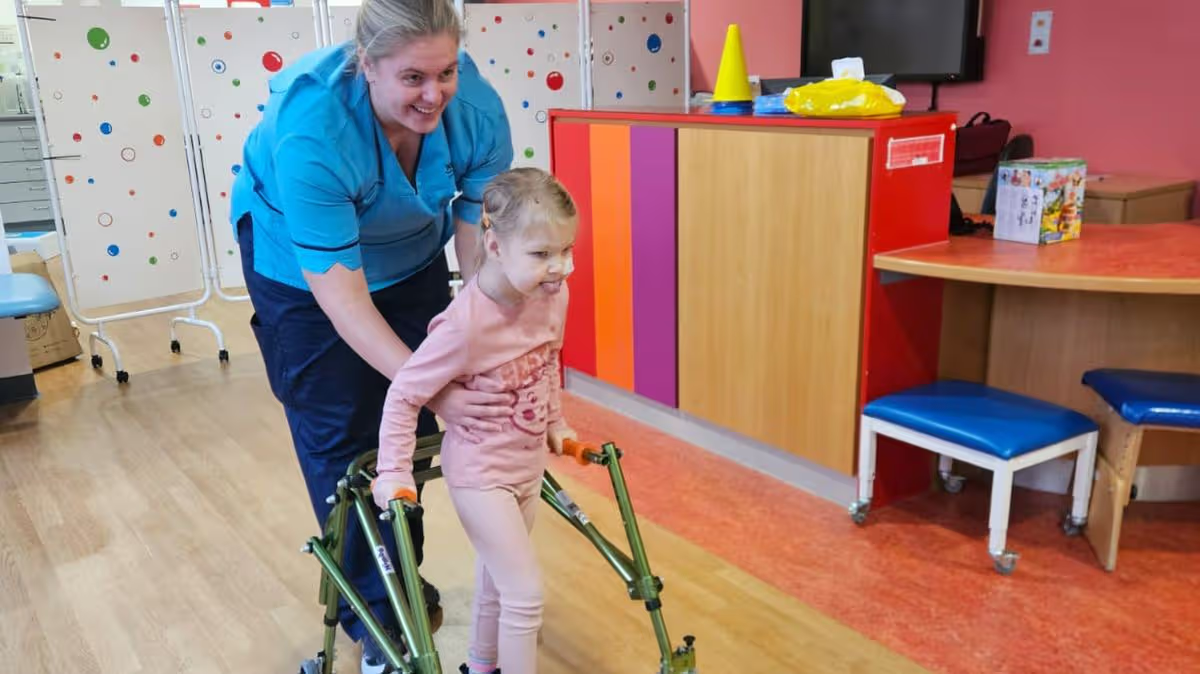
Jessica remained in hospital for 13 weeks, with daily physiotherapy sessions taking place at her bedside, in the sensory room, gym and hydrotherapy pool.

“At the beginning, her rehabilitation was like fast‑tracking a baby’s development, learning to hold her head up, sit, crawl, eat and walk again,” Ms Pender said.

“Her main physio, Fiona (Norval), tailored every session to what Jessica enjoyed.

“They played games, set up obstacle courses and made everything feel fun. Jessica looked forward to her physio, and that made such a difference.”

Advertisement

Jessica was discharged in January and is continuing her recovery.

Her speech has returned, she is eating independently, her motor skills have “significantly improved”, and she is now able to walk with more stability and confidence.

She is now looking forward to celebrating her fifth birthday in April, with a fun-filled trip to a farm park with her cousins.

This is something her parents feared might not be possible just six months earlier.

“Jessica is such a happy little girl and has shown incredible resilience and determination,” Ms Pender said.

Advertisement

“She knows she has been unwell, but I don’t think she realises just how far she has come. We are so incredibly grateful to the teams who cared for her.”

Fiona Norval, a paediatric physiotherapist with NHS Greater Glasgow and Clyde, said Jessica’s determination throughout her recovery had been “incredible to see”.

“Her rehabilitation was intensive and challenging, but she approached every session with curiosity and enthusiasm,” she said.

“Our aim in paediatric physiotherapy is always to make therapy engaging and meaningful for the child, and Jessica’s progress is a testament to her hard work, her family’s support and the dedication of the wider multidisciplinary team involved in her care.”

Advertisement

Get more Daily Record exclusives by signing up for free to Google’s preferred sources. Click HERE

Source link

Continue Reading

NewsBeat

Tees Valley’s five bike hubs to stay open until July 31

Published

on

Tees Valley's five bike hubs to stay open until July 31

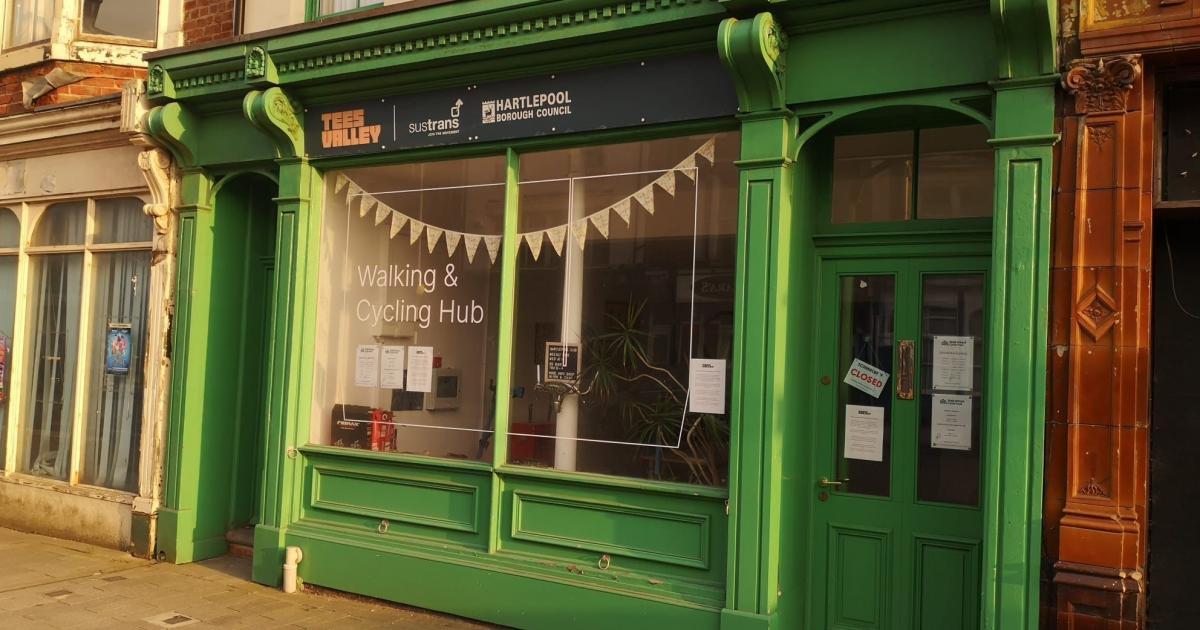
Confirmation has come from the Tees Valley Combined Authority (TVCA) that the five hubs across the region will remain open throughout the next three months, while procurement for the longer-term running of the hubs is “ongoing”.

The active travel hubs, located in Stockton, Hartlepool, Redcar and Darlington were all set to close temporarily at the end of March, while Middlesbrough’s hub was due to be axed for good.

Members of TVCA’s cabinet were blindsided by the cycling hub developments, but were pleased that a U-turn was undertaken before the end of March, meaning that all hubs would stay open in the upcoming months.

Advertisement

This immediate timeline has now been clarified, and while the future beyond July 31 is still not certain, a TVCA spokesperson said that the procurement process is ongoing and next steps will be confirmed once it has “progressed further”.

When the initial closures were announced, a TVCA spokesperson said they were “fully committed” to improving active travel options across the region. It was confirmed at March’s TVCA cabinet meeting that the combined authority’s active travel capability rating had been “downgraded” in the latest assessment, in response to a question about why there had been a reduction in funding.

Jonathan Spruce, director of infrastructure at the combined authority, explained to TVCA Cabinet on Friday, March 20 that approving the submission of the “local transport delivery plan” would allow TVCA to start using active travel funding to “enable the continuation” of hubs while looking at a longer term, “sustainable” arrangement. 

TVCA chief executive Tom Bryant apologised at the same meeting that active travel hub proposals hadn’t been brought to cabinet earlier, adding: “This short term intervention now buys us the time so that the hubs can stay in place while we work up with Cabinet what the future looks like.”

Advertisement

Mr Spruce spoke of the possibility of relocating some of the hubs if it were found to be beneficial.

Source link

Advertisement
Continue Reading

NewsBeat

Tory politician sacked as magistrate after accusing judge of ‘two-tier justice’

Published

on

Tory politician sacked as magistrate after accusing judge of ‘two-tier justice’

When asked about a suggestion that the judge may have been biased because of an alleged personal link to an event involving Sir Sadiq, Mr Fawthrop replied: “He should have taken the opportunity – and I can say this as a JP – that if there’s any doubt whatsoever that you might actually have an interest, or be not seen to be doing justice at all, you recuse yourself automatically and on this occasion this didn’t happen, and it should have happened in my view.”

Source link

Continue Reading

NewsBeat

DeepSeek releases new AI model and claims it beats all open-source competitors

Published

on

Boy, 15, arrested for attempted murder after armed attack on school teacher

China’s DeepSeek has released its long-awaited new artificial intelligence model V4, saying it offers world-beating capabilities and that a preview version is now available to use.

More follows

Source link

Advertisement
Continue Reading

NewsBeat

Moss Bank Way incident was not a cause for alarm

Published

on

Moss Bank Way incident was not a cause for alarm

But after arriving on the scene, firefighters discovered the blaze – first feared to be something bigger – was only a bin fire.

A Greater Manchester Fire and Rescue Service spokesperson said initially the fire was expected to be bigger than it was, but happened to be a bin fire,

The engines were spotted on Moss Bank Way near the Thornleigh Salesian School.

Advertisement

There were also fire engines in Little Lever this morning, after blaze in a flat living room on Dukes Avenue.

Two people have since been arrested on suspicion of arson in connection with the Dukes Avenue fire.

Four engines attended the blaze, from Farnworth, Bolton Central, Bolton North and Whitefield fire stations.

They worked in tandem with police officers to ensure people were kept safe.

Advertisement

There were no injuries as a result of the fire.

Source link

Advertisement
Continue Reading

NewsBeat

Speeding business boss Tristan Hulbert escapes driving ban

Published

on

Speeding business boss Tristan Hulbert escapes driving ban

Tristan Hulbert, 34, of York Road, Flaxby, runs a small company that supplies specialist chairs to the care sector, Harrogate magistrates heard.

He was convicted of speeding in a Tesla car on the A1(M) northbound near Kirk Deighton on May 25 last year and because of the penalty points already on his driving licence should have been banned for at least six months, the court was told.

They decided he would suffer exceptional hardship if he were banned and allowed him to keep his licence. They put three penalty points on his licence, fined him £333 and ordered him to pay a £133 statutory surcharge.

Advertisement

Harrogate magistrates heard that if he was banned, the company, which had been going through difficult times, would lose a third of its income.  Hulbert was one of three people who could do bespoke measurements and meet with occupational therapists on site and would be unable to do so if he couldn’t drive.

The company employed 16 staff in West Yorkshire, Lincolnshire and the Scottish borders and Hulbert drove between 35,000 and 40,000 miles a year..

They also heard he had family reasons for needing to drive.

Advertisement

Source link

Continue Reading

NewsBeat

Turner prize 2026 shortlist points to sculpture as a way of thinking about power, ecology and belief

Published

on

Turner prize 2026 shortlist points to sculpture as a way of thinking about power, ecology and belief

The shortlist for the Turner prize 2026 brings together four artists whose practices are firmly rooted in sculpture and installation. Their work, in diverse ways, tests how material form can carry political, ecological and symbolic meaning.

This year’s Turner prize jury (chaired by Alex Farquharson, director of Tate Britain) is composed of Sarah Allen (South London Gallery), Joe Hill (Yorkshire Sculpture Park), Sook-Kyung Lee (The Whitworth) and Alona Pardo (Arts Council Collection). They praised the shortlisted artists for their material intelligence and their capacity to link sculptural language to wider systems of power, memory and belief. Here is a round up of this year’s shortlisted artists.

Simeon Barclay: performance, place and British ruin

Simeon Barclay performs The Ruin at The Hepworth Wakefield.
Peter Rupschl/he Artist Workplace

Simeon Barclay is nominated for The Ruin, shown at the Institute of Contemporary Arts (ICA), London in January 2025 and later at the Hepworth Wakefield in Yorkshire. His work combines performance, sculptural installation, spoken word and live brass music. This combination nods obliquely to the industrial and musical traditions of his Yorkshire upbringing.

Barclay’s practice frequently returns to British national identity as something shaped by labour, landscape and decay. In The Ruin, industrial materials become resonant rather than merely symbolic: scaffolding, sound and breath are choreographed to produce an atmosphere that feels both ceremonial and unstable. The presence of brass instruments (historically tied to civic pride and working-class culture) introduces a solemnity that is repeatedly undermined by fragmentation and collapse.

Advertisement

Barclay’s work stages Britishness as something assembled and disassembled in real time. Spoken language slips between declaration and hesitation, while the sculptural setting refuses to settle into monumentality. It is a practice less concerned with nostalgia than with the ways national identity is continually rehearsed, strained and repaired.

Marguerite Humeau: sculpting belief systems

Marguerite Humeau is nominated for Orisons (2023), originally produced for the Black Cube Nomadic Art Museum, and for her subsequent exhibition Torches at ARKEN Museum in Denmark. Her contribution to the shortlist brings an overtly speculative dimension into dialogue with sculpture.

Humeau’s work often begins with research into non-human intelligence and biological communication systems. In Orisons, a large-scale sculptural elephant emerges as a central figure. However, it is not as an image of wildlife, but a stand-in for matriarchal knowledge and collective memory. Elsewhere in her practice, attention shifts dramatically in scale, from insects and wasps to ecosystems that exceed human comprehension.

Advertisement

The jury highlighted Humeau’s “cinematic” approach, and this is apt. Her installations are immersive, carefully lit and choreographed, producing a sense of narrative without storyline. Yet the work resists being pinned down. Instead, sculpture becomes a speculative tool for imagining belief systems that sit outside rationality: an attempt to materialise what cannot be directly known, only inferred.

Kira Freije: softness, armour and the human figure

Kira Freije is nominated for Unspeak the Chorus, her exhibition at the Hepworth Wakefield in Yorkshire. Her sculptures take the form of life-size hybrid beings – part animal, part human, part automaton – constructed from fabric, metal and aluminium casts taken from her body and the faces of people close to her.

Freije’s work consistently plays hardness against softness. Industrial materials such as aluminium are used not for rigidity, but for their capacity to receive impressions through casting. The results are surfaces that appear armoured yet vulnerable. Faces emerge as partial traces, embedded within bodies that refuse stable identity categories.

Advertisement

These figures don’t dominate space so much as inhabit it uneasily. Suspended between animation and stillness, they suggest forms of collectivity that are fragile, negotiated and embodied. The jury noted her transformation of everyday and industrial materials, but it is the emotional economy of the work – its careful calibration of exposure and defence – that gives it weight.

Tanoa Sasraku: sculpture and petro-politics

Tanoa Sasraku completes the shortlist with Morale Patch, exhibited at the ICA in 2025. Her work looks at oil as a system of power, examining how petro-politics shapes corporate identity, military culture and national symbolism.

In Morale Patch, Sasraku disrupts minimalist sculptural grids by inserting objects laden with meaning: paperweights awarded to mark milestones in oil extraction, flags mounted on crates that evoke pallets or coffins, and repeated references to military terminology. The title points to the symbolic language used to maintain cohesion within structures of extraction and violence.

Advertisement

Sasraku juxtaposes American and Scottish flags, drawing attention to unexpected national entanglements within global energy systems. Sculpture here operates as a critical inventory, cataloguing how abstract economic forces find expression in objects designed to reassure, reward or commemorate.

Sculpture and the institutions that shape it

This year’s prize arrives at a moment when sculpture, funding structures and art education are becoming unusually entangled. For the first time, the prize will be hosted within a university setting, Middlesbrough Institute of Modern Art (known as MIMA, part of Teesside University). The Turner prize is run by Tate, an Arts Council England (ACE) National Portfolio Organisation (NPO) – as is MIMA. This means that ACE funds a national prize presented in an ACE-funded space, which also functions as a teaching and research environment.

In recent years, there have been clear connections between funding and nomination with some shortlisted artists holding NPO status. This is a pattern that my research has identified as part of the wider instrumentalisation of British art funding.

Then there are the concerns raised by the Independent Review of Arts Council England’s critical assessment of ACE’s increasing institutionalisation and its sidelining of artistic quality.

Advertisement

Together, these issues raise questions about how closely programming, funding frameworks and art education may begin to mirror one another. Universities, some of which are NPOs or host NPO-adjacent arts centres (as we do at the University of Lincoln), risk reproducing rather than challenging dominant artistic norms.

Yet this year’s shortlist complicates that concern. It’s notably strong on artistic grounds, driven less by identity-led rationales than by a renewed commitment to sculpture as a way of thinking about power, ecology and belief.

Marguerite Humeau stands out as a possible winner. Her work exemplifies a post-postmodern sensibility shaped by new materialist thought: sculpture no longer represents the world so much as participates in it, modelling forms of non-human intelligence and agency through matter itself.

Humeau’s ability to combine speculative research with rigorous fabrication gives her work both intellectual ambition and genuine aesthetic appeal. These are qualities that suggest the Turner Prize, for all its institutional entanglements, still has the capacity to reward artistic excellence.

Advertisement

An exhibition of the shortlisted work will open at Middlesbrough Institute of Modern Art (MIMA) on September 26 2026.

Source link

Advertisement
Continue Reading

Trending

Copyright © 2025