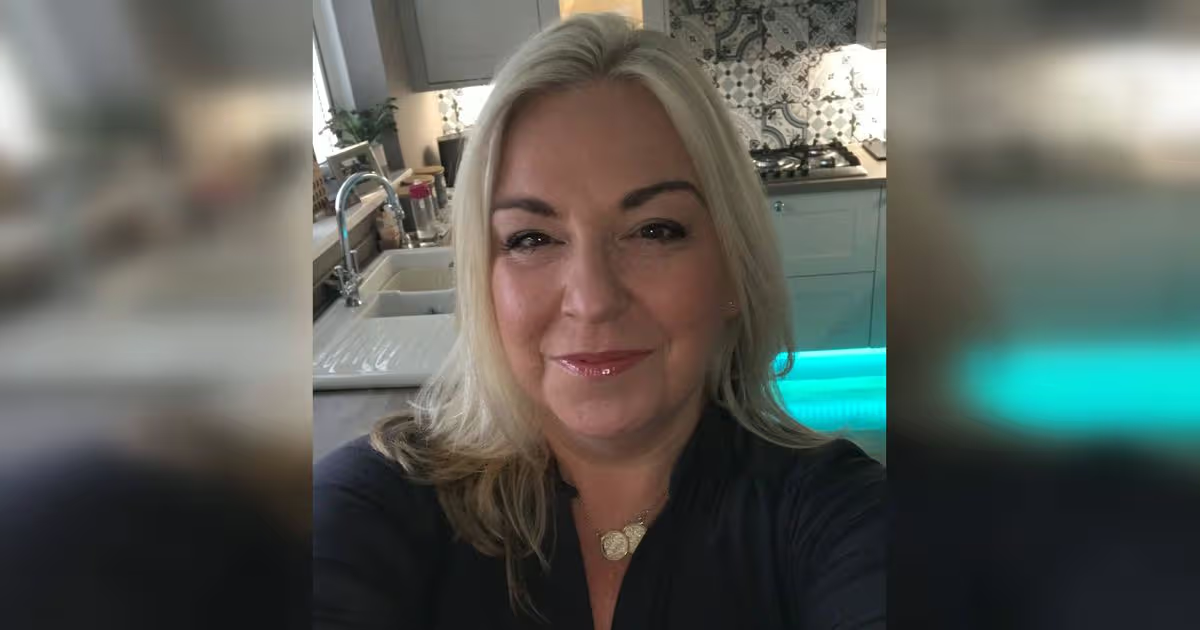
Julie Hatton, 51, was diagnosed with Motor Neurone Disease just weeks after her mum died from the same illness, and died seven months later. Her husband John has written a book about their journey
A woman tragically lost her life just months after her mother succumbed to the same cruel disease.
Julie Hatton, 51, received a Motor Neurone Disease (MND) diagnosis mere weeks following her mum’s death from the condition, and passed away seven months later as the illness took hold rapidly.
Her husband, John Hatton, from St Helens, described how their world was shattered when Julie started displaying alarming symptoms. In November 2023, whilst preparing one of her go-to dishes, she knew something was amiss when she abruptly lost power in her left arm and couldn’t manage to lift a pan off the cooker.
Before long, Julie’s left leg also weakened, and after undergoing examinations, the pair received the heartbreaking MND diagnosis. The condition advanced swiftly, forcing the family to confront the harsh truth about how precious little time remained.
READ MORE: Rihanna’s Beverly Hills home ‘targeted in shooting’ as police make arrestREAD MORE: Meghan shares sweet message for daughter Lilibet when she’s older on International Women’s Day
Ensure our latest headlines always appear at the top of your Google Search by making us a Preferred Source. Click here to activate or add us as your Preferred Source in your Google search settings.
Following her passing, John, who teaches A-level maths, has penned a book called ‘No Plan B’ chronicling their final months as a couple, drawing on diary entries he started keeping throughout Julie’s battle with the disease to honour her memory and shine a light on the condition.
Speaking to the ECHO, John shared: “When Julie’s mum was diagnosed, the words MND came as a massive shock. Julie’s mum died in July, and it was only in November when Julie noticed her own symptoms.”, reports the Liverpool Echo.
“She was concerned and I told her that her mum was in her 70s and Julie was only 51. I said, ‘let’s not think the worst just yet’. But she was convinced. From that day she always said she could feel it and knew what it was.”
Julie initially attempted to regain strength in her arms through gym sessions, but the weakness persisted and deteriorated further. Whilst on a weekend break to Leeds, her condition took a deeply concerning turn when her left leg abruptly collapsed beneath her.
John recalled: “She described it as being like a cardboard tube from a kitchen roll, as if it had kinked and bent in the middle. She cried the whole way home.”
Faced with neurology waiting lists extending for months, the pair opted to go private. Julie underwent examinations at Spire Hospital in Warrington before having an MRI scan at the Liverpool branch.
Subsequent nerve conduction tests ultimately confirmed the diagnosis after detecting widespread muscle fasciculations, especially in the muscles around Julie’s neck, and medics delivered the crushing blow that Julie had MND.
John remembered: “For Julie, it was kind of just confirming her suspicions. For me, it was one of those moments where you see it on adverts, in films but you never believe it will be you. But it was, and we just stood in the reception and hugged. It was like one of those time lapse videos; people were coming and going, and we were just stood stationary. It’s heartbreaking. It’s the worst news you can ever have.”
Julie passed away merely 212 days following her diagnosis, dying on August 17 after receiving the news on January 17. John said: “Watching your wife deteriorate before your eyes, slowly taking her bit by bit is just devastating. Every day, something gets worse. You sleep a little bit longer, your arms and legs are a little bit weaker.
“Eventually, you need a wheelchair to get from the living room to the kitchen, and the bedroom moves downstairs. Eventually you have to go to the hospice because it’s unbelievably difficult to look after somebody at home. I suppose the hardest part is that you want to enjoy what little time you have left together. There’s no cure; there’s never a moment where you think you’ll beat it. You know your fate from the minute you’re diagnosed.”
Through everything, John said Julie remained remarkably resilient: “Even in the toughest of circumstances, Julie was an absolute warrior who fought the disease head-on. She didn’t ever play the victim; she was always so strong and she was absolutely incredible. I still get strength from her, and she’s been gone two-and-a-half years.”
Whilst Julie was ill, John started keeping diary entries, chiefly to document their journey and keep mates informed, but also to make sense of his own feelings. He expressed: “I just wanted to capture as much of Julie as I could. She was so popular and had so many friends, and as time went on, it became a way of keeping everyone involved. She wasn’t hiding away from anything; Julie wanted people to know and understand about MND, because a lot of people don’t. And the longer she slept, the more I wrote.”
Following Julie’s passing, John dedicated half a year to transforming those diary entries into a book. He further stated: “The book is not about me; it’s a love story. It’s about celebrating what Julie had, our life together, and trying to promote the plight of those with MND.”
For those intrigued by John’s book, ‘No Plan B’, you can discover more here.