

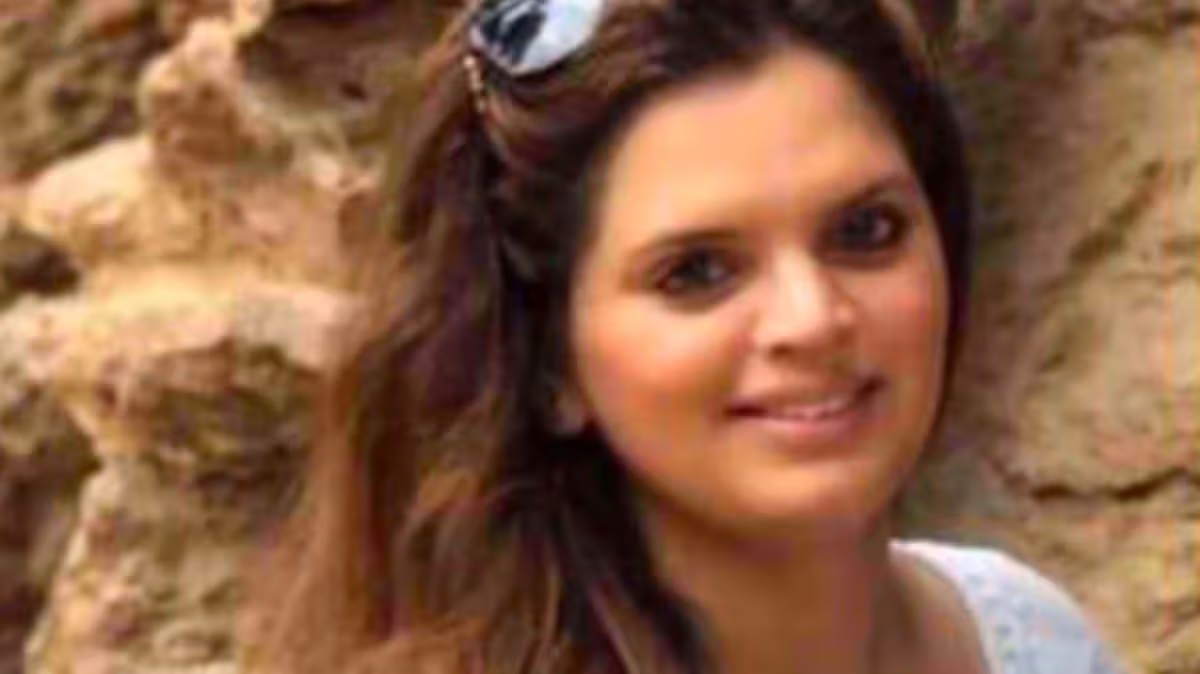
The mum of Fawziyah Javed, who was murdered by her husband in 2021, spoke after a Scottish Government bid to better identify victims of ‘honour-based’ abuse.
The mum of a pregnant wife pushed over a cliff to her death by her husband says it must be Scotland’s last “honour killing”.
Fawziyah Javed was murdered by Kashif Anwar at Edinburgh’s Arthur’s Seat landmark in September 2021 after he learned she planned to leave him.
The 31-year-old mum-to-be managed to identify her husband as her attacker as she lay dying, having suffered multiple blunt force injuries plunging from the hill.
The tragic case sparked widespread concern over crimes committed to defend the “honour” of a family.
Now the Scottish government has drafted a “long-overdue” definition of the crime which involves physical, emotional, sexual abuse and killings.
It is hoped the move will ensure authorities and support services can better identify victims.
Fawziyah’s mum Yasmin yesterday told the Record her daughter’s harrowing death must be the last of its kind as her “legacy” continues to save lives.
She said: “This must never ever happen again. Another family can not go thorough this.
“He’s (Anwar) got a prison sentence, but we’ve got a life sentence until our last breath on this earth.
“For your only child to be brutally murdered alongside her unborn baby, time is definitely not a healer. It gets more difficult as time goes by.
“Every day is a battle to get through. There are no ways to express something as horrific as this for a family. It can’t happen again. It just can’t.
“It does bring me comfort that this progress is Fawziyah’s legacy and I’m optimistic that lives are going to be saved because authorities will better recognise the signs and be able to better protect women and girls.”
Anwar, from Leeds in Yorkshire, denied killing Fawziyah but was found guilty after a week-long trial at the High Court in Edinburgh in 2023 and was jailed for 20 years.
Chilling CCTV images revealed the pair’s movements as Anwar led his employment lawyer wife to her death, just nine months on from their wedding.
The trial heard how the tragic mum-to-be told a police officer as she lay dying that her husband had pushed her because she “told him I wanted to end (the marriage)”.
Fawziyah had planned not to return to Anwar’s home but to go to her parents’ house and contact police to retrieve her belongings after earlier logging, in secret, abuse she had suffered.
There were several thousand reported cases of honour based abuse (HBA) across the UK last year, but the crime is known to be hugely under reported and often hidden within domestic abuse statistics.
In Scotland, there is not yet a statutory definition of HBA and it has not been a specific crime within Scots’ law.
Scottish Government strategy incorporates the crime within the wider definition of domestic abuse, along with female genital mutilation, forced and child marriages.
Now, as part of the strategy to tackle violence and abuse against women and girls, officials have developed a “clear and robust draft policy definition” to ensure those responding to survivors understand what HBA is.
A progress report published this week said: “This is crucial because stakeholders have raised that when the complexity and nuances of HBA are not fully understood, minority ethnic women can be overlooked by the Police and other services.”
The policy definition has now been tested with mainstream services, including police, social work, the NHS and councils and work is underway to see it applied across services.
The move follows a tabling of an amendment by the UK Government last month to introduce a statutory definition of honour-based abuse following campaign work by Yasmin and HBA charity Karma Nirvana.
Yasmin said her daughter’s case, which featured in two-part Channel 4 documentary The Push, which re-aired this month, is helping educate the public.
She said: “I get messages from women from all walks of life who have said to me ‘Fawziyah saved our life’. They’ve watched the documentary and realised they’re in that position and taken steps to get out. I’ve also had messages from victims’ families contacting me asking what they can do to help them.
“This definition is a step in the right direction for Scotland but there is still a lot of work to be done. This definition has got to be crystal clear and it has to go deeper into this type of abuse so that people in authority can recognise it and do something about it.
“Not every incident is violent. In Fawziyah’s case in the start it was subtle. There was coercive control and gaslighting. That played a massive part in what happened to her.
“Irrespective of what community you come from, people have this stereotypical type of person in their mind this can happen to. But I know this has happens to highly articulate, confident professional women. Sometimes people may not even realise that they’re being abused in that way. This can happen to some men as well.”
Executive Director at Karma Nirvana, Natasha Rattu, welcomed the Scottish government’s work on HBA but said emotional HBA must be understood as much as physical.
She said: “It’s always really difficult to get to a point of consensus on what we understand about honour-based abuse.
“This definition is a starting point, which is really welcome. It’s just about making sure that we are absolutely landing it in the experience of victims and survivors.”
Equalities Minister Kaukab Stewart said: “Our Equally Safe delivery plan progress report reflects that real and meaningful progress is being made to realise our shared ambitions of a Scotland free from violence against women and girls.
“We are now confident that we have a strong draft policy definition of Honour-Based Abuse that reflects the realities of women in Scotland.
“We look forward to continuing to work with partners to explore how the definition can be applied in practice across services, and how it can support better responses for survivors.”
What is honour-based abuse?
Honour-based abuse, according to the Scottish government’s definition, describes “a range of violent incidents or patterns of abuse” committed against a person, mainly women and girls, due to the perception that they have brought, or may bring, “dishonour or shame to their family or community”.
They say it includes physical, emotional, sexual abuse and killings and perpetrators can include partners, family
members and members of the community.
They say the abuse “is not exclusive to any specific racial or religious group” but perpetrated by a “minority of individuals within diverse communities”.
The extent of HBA in Scotland is unknown but several thousands of cases are reported across the UK every year.
Fawziyah’s tragic case is not considered the first honour killing north of the border.
In 2011, police in Pakistan confirmed they were treating the murder of a couple from Glasgow as an honour killing.
Saif Rehman, 31, and his wife Uzma Naurin, 30, were shot after their car was ambushed in Gujrat.
It is understood Mr Rehman was shot dead by a group of men at the scene and his wife was driven away and killed.
The perpetrators remain unknown.
In 2013, a man was found guilty of burning his “westernised” ex-wife to death, after setting fire to her following a bitter divorce in another suspected honour killing.
Ahdeih Khayatzadeh, 46, suffered 95% burns in an attack by Ahmad Yazdanparast at the Venus Hair & Beauty salon in Stirling.
Get more Daily Record exclusives by signing up for free to Google’s preferred sources. Click HERE.













































You must be logged in to post a comment Login