

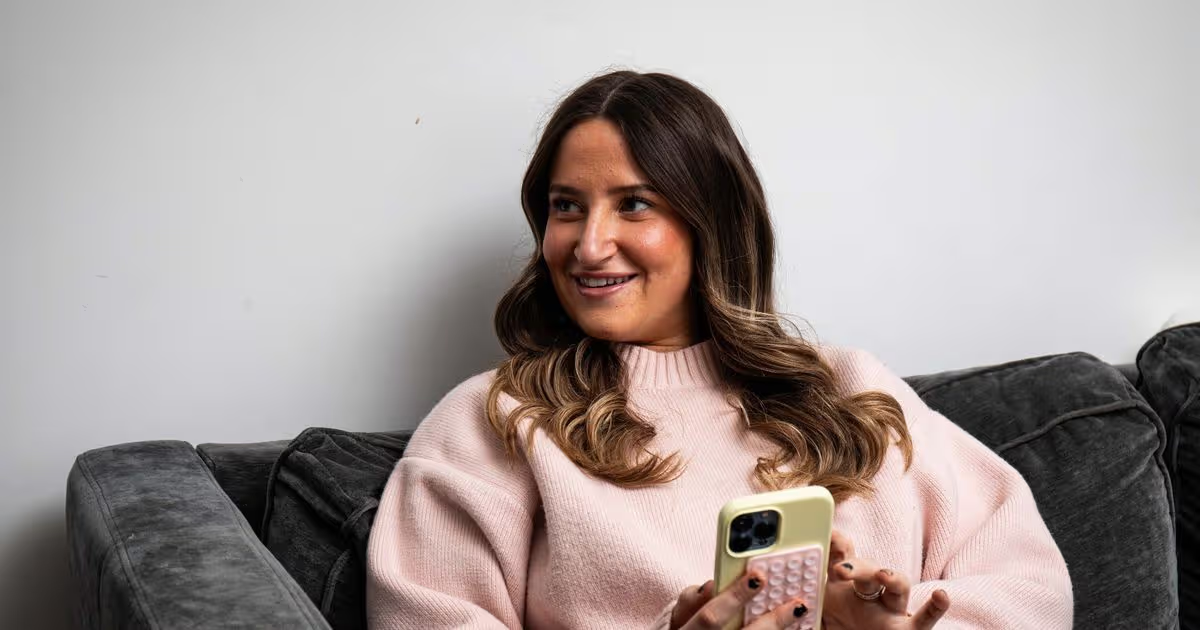
What began as childhood anxiety and graphic fears about death soon escalated into relentless, unwanted thoughts that she says ‘changed my life forever’
A young woman says she spent four years believing she was a paedophile before making a discovery that transformed her future.
Molly Lambert, 22, developed intrusive sexual and violent thoughts as a teenager. It left her convinced she was a danger to others.
What began as childhood anxiety and graphic fears about death soon escalated into relentless, unwanted thoughts.
At 15, while revising for exams, Molly, from Manchester, became consumed by the belief that a single intrusive thought meant she was a ‘monster’.
Click here to prioritise Manchester news in Google from the MEN
For six months, she lived in constant fight‑or‑flight mode – barely eating, not sleeping and terrified of being alone. But after seeing a video of a woman talking about paedophile OCD (P-OCD) – a type of OCD in which an individual has unwanted sexual thoughts or images about children – on TikTok, Molly was able to get diagnosed in July 2025.
P-OCD is not paedophilia, and Molly is now speaking out to help others who may be silently suffering with intrusive thoughts. The digital PR worker and mental health advocate, living in Deansgate, said: “I genuinely thought I was a paedophile.
“No matter what you’re worrying about, it’s the same brain process each time, but when it’s that deep, and such a horrid thought, the shame is unbearable.”
Looking back, Molly believes the signs she was actually suffering from a type of obsessive compulsive disorder (OCD) were there from childhood. She said: “I always had OCD traits. I had graphic images about death, I was scared of everything.
“I’d obsess over things like Madeleine McCann and worry I would get kidnapped. If there was a Brownie trip coming up, I’d think about every single thing that could go wrong until my mum had to pick me up.”
But the turning point came when she was 15, during a family trip through an airport. “I saw a little girl wearing a crop top and short skirt and thought, ‘That’s weird for a child to wear that,’” Molly said.
“And then I panicked – ‘why would I even notice that? Why would I think about that? She’s a child’.”
Though the thought faded at first, it returned months later while she was revising for exams. She said: “I was 15 and I remember thinking, ‘Oh my gosh, I’m a paedophile – I thought, I’m never going to forget this thought. My life is over’.”
From that moment, Molly says she was trapped in her own mind. “It was fight or flight constantly. Every thought was dark, I wasn’t eating properly, I wasn’t sleeping, I was so scared of being alone and going to bed,” Molly said.
“I was lying to my parents saying I was stressed about exams, but I just couldn’t put it into words.”
The intrusive thoughts expanded beyond one fear, and Molly began to question her past. She said: “I was thinking – ‘what if I’ve hurt someone? What if I’ve raped someone? What if I fancy my friends?’
“I even have a phobia of dogs and I’d think – ‘what if I fancy my dog?’. I knew I didn’t feel anything, but what if I was unsafe to everyone?
“The shame was overwhelming, I felt like a monster. I couldn’t even tell anyone what I was going through.”
Six months after the first thought, Molly started her first job at a café in a swimming pool. She said: “I remember thinking, there are kids here and I honestly thought to myself that I would have to kill myself on my way home.
“That’s how convinced I was that I was dangerous.”
Despite loving children and describing herself as a “kid person,” she began changing her life choices out of fear. Molly said: “I told my parents I wanted to work in retail instead, I was changing my life because I thought I was unsafe.”
For four years, Molly suffered in silence, even studying psychology at university without realising she had OCD. She said: “I thought OCD was cleaning and tidying, that wasn’t me at all. The more controlling forms of OCD like mine are the ones we don’t talk about.”
But after coming across a TikTok video in 2021 she was able to get diagnosed. Molly said: “It was a girl saying people think OCD is about cleaning, but she thought she fancied her niece, and I realised that there were people like me – and that I think I knew the issue.
“The weight that lifted off my shoulders was crazy. I thought only freaks had this.”
She began researching intrusive thoughts and confided in a friend at university, who encouraged her to seek therapy. Eventually, after breaking down to her parents, she started professional treatment, and was officially diagnosed in July 2025.
She said: “I was hysterically crying. I couldn’t even talk about the six months I thought I was going to kill myself.
“My therapist said it is an awful thing to go to but that it is way more common than you would ever expect.
“Getting all of that outside of me was the biggest part of my journey. It felt like I was in a war with myself, but now I knew what I was fighting.”
While Molly still experiences intrusive thoughts daily, her reaction to them has changed. “My brain can still say, ‘You’re a paedophile,’ but now I can tell myself that’s not true,” she said.
“OCD won’t let you move on from intrusive thoughts. Everyone has them, but OCD makes them stick.”
Therapy helped her move from severe to mild on the diagnostic scale, though she admits recovery is ongoing. “I still have days where I feel consumed but now I can recognise it for what it is; an overly obsessive part of my brain,” she said.
Molly now uses her social media platforms to raise awareness and says she receives both support and hate. She said: “I get a lot of hate, but this conversation is so important for the people suffering in silence.”
She believes the stigma around certain intrusive thoughts makes sufferers feel uniquely evil when in reality, OCD often attacks a person’s core values. Molly said: “The scariest part is how many people might not be here anymore because of this. I remember thinking I’d be 50 and never escape these thoughts, or I would be dead.
“Always talk to someone, once you understand what it is, you realise it’s not you. It’s OCD.”
To learn more about Molly’s journey, you can follow her TikTok – @mollambert


























































You must be logged in to post a comment Login