NewsBeat
Natalie McNally trial: Everything you need to know on the evidence the jury heard in first week

Need to know
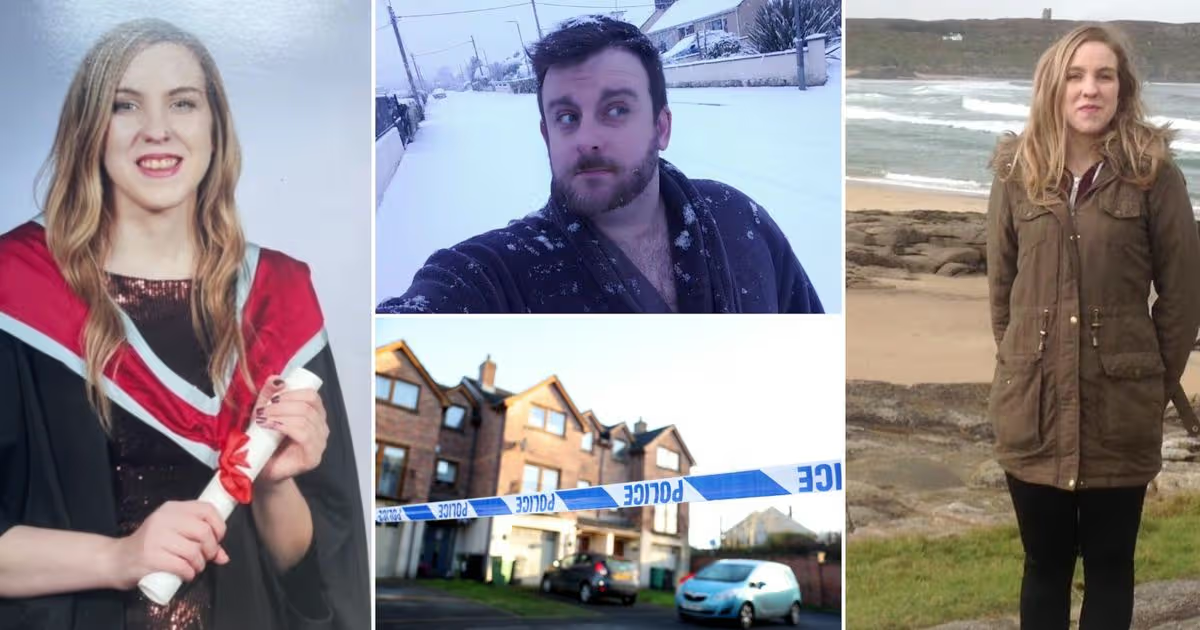
The 32-year-old was 15 weeks pregnant when she was attacked and died in her home in Lurgan a week before Christmas in 2022
Everything you need to know:
- The murder of Natalie McNally was described as “planned, calculated and pre-meditated”. The 32-year-old was 15 weeks pregnant when she was attacked and died in her home in Lurgan. The father of her unborn child Stephen McCullagh, 36, of Woodland Gardens, Lisburn, has denied her murder. Prosecuting barrister Charles MacCreanor KC said it is their case that the defendant murdered Ms McNally and then “put on an act” to cover his tracks. Click here to read the full report on the first day of the trial.
- The 999 call made by Stephen McCullagh was played to a jury at Belfast Crown Court. Prosecuting barrister Charles MacCreanor KC told the jury that the evidence they will hear during the murder trial will point to the fact Ms McNally was killed in her Silverwood Green home in Lurgan between 8.50pm and 9.30pm on Sunday December 18, 2022. At 9.59pm the following evening, McCullagh made a 999 call from her home when he hysterically told the operator “please come as soon as you can.” In his opening, Mr MacCreanor said Ms McNally had suffered “serious and multiple stab wounds”. As well as three knife wounds to her neck, she also sustained bruising to the left and right sides of her neck which the Crown say “suggested fingertips grasping.” In addition, Mr MacCreanor said there was “blunt force trauma” in the form of five lacerations which were “in keeping with having sustained at least five heavy blows to her head.” Read the full report on this part of the trial here.
- Stephen McCullagh told police at the scene that her ex-partner was responsible, the trail heard. On Tuesday morning, the trial heard from two police witnesses. Sergeant Stewart attended the scene at Miss McNally’s house on the night of Monday, December 19, and described seeing McCullagh “very upset”, and seeing him being led out of the house by a colleague. The on-call detective sergeant also gave evidence to the trial on Tuesday. He said he briefed a senior officer who instructed him that the incident should be treated as murder. He agreed that Sergeant Stewart told him McCullagh had told police at the scene: “I know what has happened, the ex-partner has done this”, and that he had directed McCullagh to be arrested for murder. Click here to read the full report of the trial on Tuesday.
- A police officer who attended the scene of Natalie McNally’s murder described on Tuesday how he saw a dog bowl filled with blood beside her head. The sergeant was called to give evidence during the second day of the trial into her murder. The officer said he saw McCullagh in the hallway who was “very upset, he was crying.” He said that after McCullagh was “led out” and taken to a police car by another officer, he walked up the stairs and observed Ms McNally’s feet at the top of the staircase. When the police officer was asked if blood was visible, he said: “Yes, there was blood visible around her neck. I noticed a puncture wound. “There was blood which was in a dog bowl. It looked almost like it had been used to collect the blood.” To read more on the court report, click here.
- The state pathologist for Northern Ireland was called to give evidence on Tuesday. Dr James Lyness confirmed he carried out a post-mortem on Ms McNally’s remains at the Northern Ireland Forensic Mortuary on December 21, 2022 and conducted a second examination the following day. He told the jury of six men and six women that he believed Ms McNally was subjected to a “prolonged assault”. When asked by Mr MacCreanor what he considered to be the cause of Ms McNally’s death, Dr Lyness replied: “The cause of death in this case was given as compression of neck, stab wounds of neck and blunt force trauma of head.” The pathologist then gave a detailed forensic descriptions of the multiple injuries Ms McNally sustained which included three stab wounds to her neck as well as compression injuries to her neck “suggestive of having been caused by fingertips.” He also outlined five lacerations to her head and said this blunt force trauma was likely to have been caused by a weapon. To read the full court report, click here.
- A so-called YouTube live stream made by Stephen McCullagh was played to the jury. They jury were also shown items removed from Ms McNally’s home in the aftermath of her murder, included a small black-handled knife located close to her head in the living room of her Lurgan home. Entitled The Violent Night Christmas Live Gaming Stream, it appeared on McCullagh’s YouTube channel between 6pm and midnight on Sunday December 18. The jury had already heard that following his arrest on suspicion of murder on December 18, McCullagh provided this so-called live stream as an alibi. The 12 members have also heard that following a forensic examination of McCullagh’s computer, experts from the PSNI’s cyber team determined that this six hour stream was not in fact live at all but had been recorded some days before. To read the full report, click here.
- The jurors also heard information regarding some evidence agreed by the Crown and defence. This included a series of WhatsApp messages exchanged between McCullagh and Ms McNally on the afternoon and evening of Sunday December 18, 2022. In the exchange, the couple discussed decorating her Christmas tree, food and a World Cup football match between Argentina and France. At 5.57pm, McCullagh messaged Ms McNally and said ‘Right, I’m off to stream the night away. Wish me luck.’ Two minutes later she replied and said ‘Good luck. I might sneak a peak at your live stream later.’ Branding the live streaming as “a cover story” with McCullagh “peddling a false alibi”, it’s the Crown’s case that instead of live streaming from his home, McCullagh got the bus from Dunmurry to Lurgan then walked to Ms McNally’s house where he murdered her. The Crown also say that following this, he got a taxi from Lurgan back home to Lisburn. The jurors also heard further agreed evidence in the form of WhatsApp messages that McCullagh sent to Ms McNally’s phone throughout Monday December 19, 2022 – all of which went unanswered. Click here to read more.
- On Thursday morning, Detective Constable Matthews, a digital forensic analyst, gave evidence following his examination of McCullagh’s computer. He said his examination of the device “provided extensive evidence indicating that the broadcast was pre-recorded and later streamed as a live event”. DC Matthews said examination of the computer and software indicated the six-hour broadcast had been recorded on December 14 and saved as a video file. He said it was broadcast as live on McCullagh’s YouTube account Votesaxon07 on December 18, explaining the software showed no signs of user activity between 6pm and just after midnight on December 19. The video file was then deleted in the early hours of December 19, and subsequently removed from the computer’s recycle bin. To read the full report, click here.
- A compilation of CCTV footage concerning a ‘person of interest’ was shown at the trial on Thursday. This footage included a clip of a male getting out of a taxi from Lurgan, throwing two objects over a hedge then walking in the front gate of the address of the man accused of her murder. During the fourth day at the trial at Belfast Crown Court, the jury of six men and six women were shown a compilation of CCTV clips and footage throughout Sunday December 18 and into the early hours of Monday 19. The footage was gleaned from businesses, bars and households as well as a cameras on a Translink bus. After being called to the witness stand, a detective sergeant was asked to play a series of clips. To read the full report, click here.
To ensure you don’t miss out on all the latest from Belfast Live, be sure to make us your preferred source on Google .


At Reach and across our entities we and our partners use information collected through cookies and other identifiers from your device to improve experience on our site, analyse how it is used and to show personalised advertising. You can opt out of the sale or sharing of your data, at any time clicking the “Do Not Sell or Share my Data” button at the bottom of the webpage. Please note that your preferences are browser specific. Use of our website and any of our services represents your acceptance of the use of cookies and consent to the practices described in our Privacy Notice and Terms and Conditions.
You must be logged in to post a comment Login