

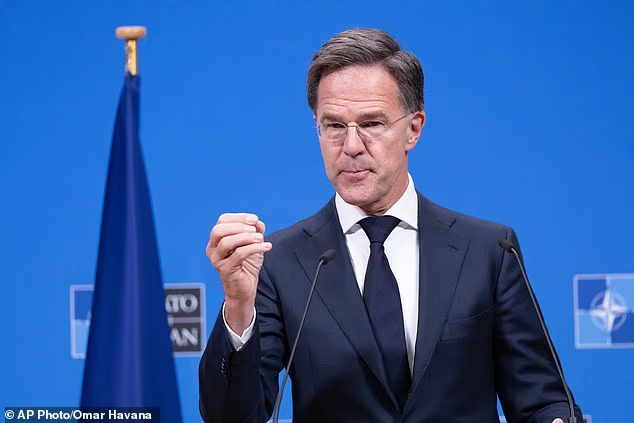
Andy Burnham is facing increasing pressure to clarify his plans for increasing defence spending from the head of Nato and Labour’s union paymasters.
Mark Rutte, the former Dutch premier is expected to use a speech in Oxford tonight to publicly hold his feet to the fire over increasing spending on the UK’s depleted military.
At the Ditchley Foundation’s annual lecture in Oxfordshire, the Nato chief will praise the UK, describing it as ‘serious about security’.
But in what could be seen as a pointed remark about the need to go further, he will add: ‘The UK is already investing more in defence. And I welcome the new Prime Minister’s assurance that his government will meet its Nato commitments.’
The Government faces a challenge in how to hike defence spending to 5 per cent over the next decade, as it grapples with rising borrowing costs caused by the US-Iran war, and multiple domestic pressures on the public finances.
UK defence spending is expected to rise to around 2.7 per cent of GDP by 2027, but Mr Burnham has raised alarms that it will not meet an interim target of 3 per cent by 2030.
Last week he sparked uproar by refusing to cut the UK welfare bill to fund a boost to defence spending, saying: ‘National security cannot come at the expense of social security.’
But the PM is also facing pressure from Labour’s union paymasters to pour money into defence to create jobs.
Unite boss Sharon Graham said that the UK had been ‘running our hand across our mouth in defence for ages’ and said it should form part of a ‘proper plan for the reindustrialisation of Britain’.
In a speech tonight the former Dutch premier is expected to publicly hold Mr Burnham’s feet to the fire over increases spending on the UK’s depleted military

UK defence spending is expected to rise to around 2.7 per cent of GDP by 2027, but Mr Burnham has skirted around a further target of 3 per cent by 2030
She told Politico: ‘I’m in conversations with members and employers in defense, and these people are making decisions now about whether they stay in Britain.’
However unions are divided, with the University and College Union using the TUC conference to pass a motion demanding the cash should be used to fight climate chance and renationalise utilities instead.
Pushing the body to back its ‘wages not weapons’ campaign, UCU general secretary Jo Grady lashed out at the US and Israel for its ‘war of aggression against the people of Iran’.
‘Our lives don’t feel more secure because BAE systems is getting another multi-billion-pound contract. A global arms race does not make us feel safer,’ she told the conference.
‘There is a choice, because every pound spent on bombs doesn’t get homeless people off the streets, it doesn’t build a new school, it doesn’t feed a hungry child, it doesn’t help the desperate NHS, the crumbling transport infrastructure or the crucial need for a programme of insourcing and renationalisation.’
Nato allies have agreed to hike their defence spending to 5 per cent of economic output by 2035, amid burgeoning threats from Russia and China, and demands from Donald Trump’s America that European member states invest more in their own security.

Unite boss Sharon Graham said that the UK had been ‘running our hand across our mouth in defence for ages’ and said it should form part of a ‘plan for the reindustrialisation of Britain’.

However the University and College Union’s Jo Grady used the TUC conference to say that the cash should be used to fight climate chance and improve schools and housing instead
Chancellor John Healey quit as defence secretary in June over Sir Keir Starmer’s refusal to commit to the 3 per cent target, saying it was the minimum needed to keep Britain safe.
Mr Rutte will use his speech to say that the UK ‘is leading, along with Nato allies, the push back against Russia’s dangerous and reckless campaign against us’.
He will add: ‘Collectively we will continue to strengthen our ability to deter and defend all allies, against any threat. Nato will not be intimidated by Russia’s campaign of hostile actions. Russia wants to stop us helping Ukraine – but their actions will only lead us to do more for Ukraine. Russia’s actions are a sign of weakness, and a symptom of Putin’s failure in Ukraine.’
Elsewhere in his speech, Mr Rutte will address the changing nature of the military alliance.
Mr Rutte will say: ‘To stay transatlantic, Nato is becoming more European. A Nato with Europe, and Canada, spending more, producing more, and doing more for their security. This is the idea of Nato 3.0.
‘Building for the future. A stronger Europe, in a stronger Nato.’













































You must be logged in to post a comment Login