



A French civil servant allegedly drugged women’s drinks because he liked to see them wet themselves.
Victims have claimed that Christian Nègre spiked their beverages with a powerful diuretic during interviews before taking them somewhere with limited toilet access and waiting for them to lose control of their bladders.
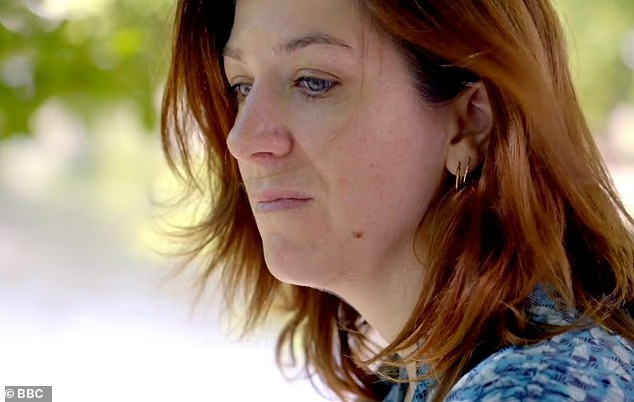
Anaïs de Vos, 42, says she was drugged while being interviewed for a job at the French Ministry of Culture in Paris in July 2011.
She says she did not usually drink coffee but accepted one after it was offered to her by Nègre, a senior civil servant who was conducting the interview.
Ms de Vos, who was 27 at the time, said he made the drink himself before suggesting they leave the office and continue the meeting outside.
But as they walked through the streets of Paris, Ms de Vos began to feel weak and developed an uncontrollable need to urinate.
‘I was really weak. I couldn’t really feel my legs any more,’ she told BBC Global Women. ‘I was scared. I didn’t know what was happening.’
Ms de Vos said she told Nègre she urgently needed to find a toilet, but claimed he appeared to take pleasure in her distress.
She added: ‘He looked me right in the eye and said, “Oh, do you need a wee?”‘
A civil servant allegedly drugged women’s drinks because he liked to see them wet themselves. Marie-Hélène Brice, another woman whose name allegedly appeared in Nègre’s notes, was interviewed by him for a Ministry of Culture job in Strasbourg in 2016

Ms Brice said Nègre told her she appeared stressed and suggested they take a walk outside to calm her nerves

Nègre, a former senior civil servant and human resources director at France’s culture ministry, is under investigation over claims he spiked 248 women’s drinks
‘I felt like a child. I thought it was really weird the way he looked at me, almost gleeful.’
She claims Nègre then directed her towards a storage cupboard beneath a bridge on the River Seine and told her: ‘You can do it here.’
Ms de Vos is one of nearly 250 women who claim to have been drugged by Nègre in alleged incidents between 2009 and 2018.
Police are thought to have uncovered a spreadsheet labelled ‘Experiments’ on Nègre’s computer, allegedly detailing dates, doses and the reactions of women who were applying for ministry jobs.
The document allegedly noted the time the women arrived for their interviews, when the diuretic was administered, how long it took before they urinated and what kind of underwear they were wearing.
Many reported trembling, dizziness, humiliation and, in several cases, wetting themselves or being forced to urinate in public.
Ms de Vos said she became increasingly alarmed and refused to enter the cupboard, fearing Nègre could push her inside and close the door behind her.
The pair instead walked to the Louvre to use the toilets, but Ms de Vos had left her purse at the ministry’s offices and Nègre allegedly claimed he had no money to pay the one euro charge.
Desperate and in pain from trying to hold her bladder, she eventually found a cafe which allowed her to use its toilet.
But by the time she reached the bathroom, she felt physically weak and lost control of her bladder.
After spending around three hours with Nègre, Ms de Vos said she was left feeling dizzy and drained.
She did not get the job and remained suspicious about what had happened, but was unable to explain why the encounter had made her feel so uncomfortable.
She received a letter from police in 2019 and was told investigators suspected she was among almost 200 women Nègre was accused of drugging during job interviews, purportedly for roles at the ministry.
Dozens more alleged victims have since emerged who believe they were subjected to chemical submission, where drugs are used to gain control over another person.
Police believed Nègre had used diuretics, which can be prescribed for conditions including high blood pressure and cause the body to produce increased amounts of urine.
Chemical submission came to prominence in France in 2024 when Gisele Pelicot’s husband was found guilty of sedating her and inviting strangers to rape her while she was unconscious.
Another of Nègre’s alleged victims, marketing expert Sylvie Delezenne, had travelled to Paris in 2015 believing she was on the brink of her dream job.
Instead, she says she was marched around the Tuileries gardens while growing increasingly ill and begging for a toilet break.
Eventually, she was forced to crouch beside a tunnel to relieve herself as Nègre ‘shielded’ her with his jacket – a moment she says left her devastated.
Marie-Hélène Brice, another woman whose name allegedly appeared in Nègre’s notes, was interviewed by him for a Ministry of Culture job in Strasbourg in 2016.
She said Nègre told her she appeared stressed and suggested they take a walk outside to calm her nerves.
But while walking along a canal, Ms Brice also developed an uncontrollable and increasingly painful need to urinate.
She claims Nègre told her he knew of a nearby public toilet, but when they reached the location there was none.
Ms Brice said she became pale and was in tears from the pain before eventually being left with no choice but to urinate in public.
Nègre allegedly offered to shield her with his jacket, but Ms Brice said he continued watching her, leaving her deeply embarrassed.
She said she carried the shame of the encounter for years before police eventually contacted her and told her she was believed to be among Nègre’s alleged victims.
The case has still not come to court, 15 years after Ms de Vos’s alleged encounter with Nègre and seven years after she first spoke to police.
Ms de Vos is among a number of accusers who have expressed frustration over the length of the investigation.
She told the BBC she first spoke to police in 2019 but heard nothing further about the case until 2023, despite repeatedly contacting them.
Meanwhile, Nègre has continued to work in human resources, according to women’s rights group Fondation des Femmes, which is supporting around 30 of the women.
Ms Brice described the lengthy wait for justice as a form of ‘secondary victimisation’.
UN Women has called for governments, police and justice systems to do more to tackle drug-facilitated sexual assault, warning that delays in alleged abuse cases can have a devastating impact on victims.

























































You must be logged in to post a comment Login