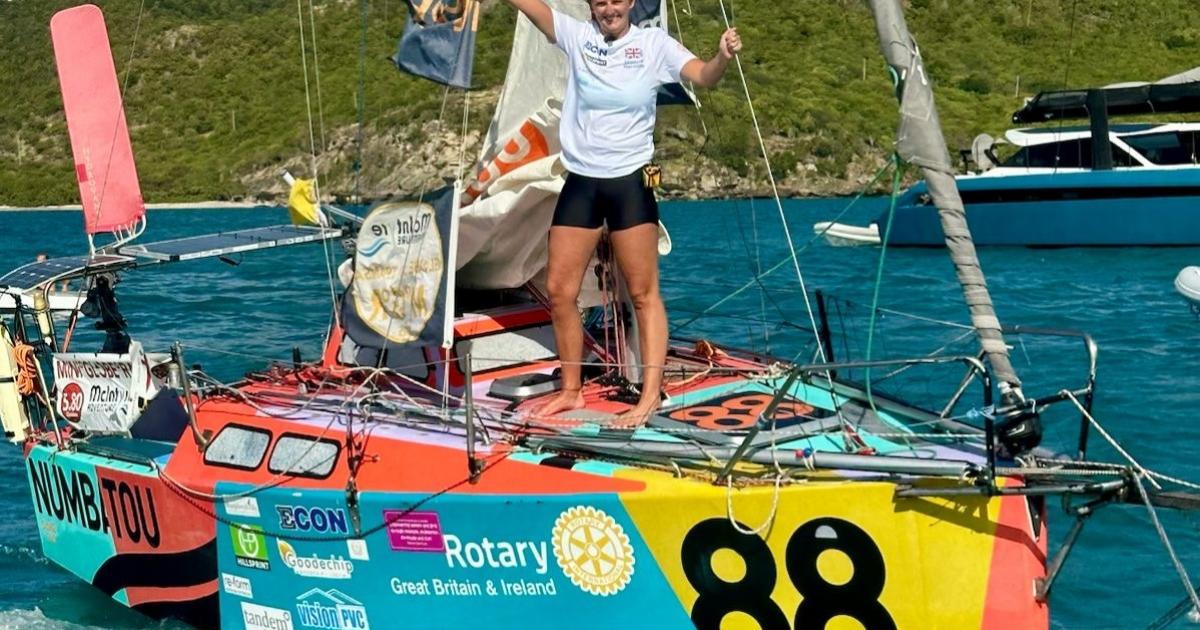
Jasmine Harrison finished the 26,000-nautical mile Mini Globe Race aboard her 5.8-metre plywood yacht, Numbatou, after 381 days at sea.
She arrived in Falmouth Harbour, Antigua, on March 11, a year and 16 days after departing from Antigua in 2025.
![]() Jasmine Harrison at the finishing line (Image: Lucy Tulloch)
Jasmine Harrison at the finishing line (Image: Lucy Tulloch)
Miss Harrison said: “I’m relieved to have finished, but also sad that’s it’s over.
“It’s been an incredible journey.
“I took one stage at a time, never really absorbing the totality of the journey until now.
“To think that I’ve sailed solo around the world, across four oceans, is surreal.
![]() Jasmine Harrison, a solo sailor from North Yorkshire, has become the first British woman to circumnavigate the globe in the smallest boat known to complete the voyage (Image: Lucy Tulloch)
Jasmine Harrison, a solo sailor from North Yorkshire, has become the first British woman to circumnavigate the globe in the smallest boat known to complete the voyage (Image: Lucy Tulloch)
“It shows that if you really want to do a challenge, then anything is possible, and it’s only by trying that you can succeed.”
She began her global circumnavigation with a solo qualifying passage from Lagos, Portugal.
She crossed the Atlantic Ocean before joining 14 other competitors at the starting line for the Mini Globe Race.
![]() Jasmine Harrison, a solo sailor from North Yorkshire, has become the first British woman to circumnavigate the globe in the smallest boat known to complete the voyage (Image: Lucy Tulloch)
Jasmine Harrison, a solo sailor from North Yorkshire, has become the first British woman to circumnavigate the globe in the smallest boat known to complete the voyage (Image: Lucy Tulloch)
Miss Harrison became the first British woman to sail solo around the world in such a small vessel, and one of only two female entrants in the race.
She and Spanish sailor Pilar Pasanau, aboard Peter Punk, are the only women known to have completed a solo circumnavigation in such small boats.
Her route took her through 15 countries and across four oceans, beginning in Antigua before sailing to Panama and then across the Pacific Ocean.
![]() Jasmine Harrison, a solo sailor from North Yorkshire, has become the first British woman to circumnavigate the globe in the smallest boat known to complete the voyage (Image: Lucy Tulloch)
Jasmine Harrison, a solo sailor from North Yorkshire, has become the first British woman to circumnavigate the globe in the smallest boat known to complete the voyage (Image: Lucy Tulloch)
She made stopovers in the Marquesas, Tahiti, Tonga and Fiji.
After a “terrifying” night-time passage through the Great Barrier Reef, she continued via Thursday Island to the remote Cocos (Keeling) Island, Rodrigues, and Mauritius.
From there, she rode fast currents to Durban and continued down the east coast of South Africa, stopping in East London, Mossel Bay and Cape Town.
After leaving Cape Town in December, her only South Atlantic stop was St
![]() Jasmine Harrison, a solo sailor from North Yorkshire, has become the first British woman to circumnavigate the globe in the smallest boat known to complete the voyage (Image: Lucy Tulloch)
Jasmine Harrison, a solo sailor from North Yorkshire, has become the first British woman to circumnavigate the globe in the smallest boat known to complete the voyage (Image: Lucy Tulloch)
Helena.
During a seven-day break on the island, Miss Harrison attempted to become the first person to swim around St Helena – a 30-mile effort in open water frequented by sharks.
She completed the challenge in 18.5 hours, despite having done no exercise, or swimming training for a year.
Her final two stops were in Recife, Brazil, and Antigua, completing the circumnavigation in March.
Miss Harrison faced numerous challenges during the voyage, including severe weather, equipment failures, torn sails, a flooded cockpit and close encounters with large cargo vessels.
She also dealt with unlit fishing boats, pirates, uncharted oil rigs and marine pollution.
Creature comforts were almost non-existent.
She used solar panels for power, carried all her water in containers, and had a bucket for a toilet.
She returned to port only occasionally for fresh food, which rarely lasted more than a week at sea.
Sleep came in short bursts of 20 minutes to two hours.
Despite the hardship, she recalled many highlights.
She said: “The highs included dolphins swimming at the bow, whales, turtles and sharks as well as the friendship and hospitality of people across the world.”
While Miss Harrison was often completely alone at sea, she said the camaraderie between fellow Mini Globe Race sailors endured through radio and phone calls and meetings in port.
Miss Harrison is no stranger to endurance feats.
In 2021, at age 21, she became the youngest woman to row solo across the Atlantic Ocean.
A year later, she became the first woman – and only the third person ever – to swim from Land’s End to John O’Groats.
She is listed on Forbes’ 30 Under 30 (Sports, Europe, 2021) and holds the Freedom of Thirsk and Sowerby in North Yorkshire.
An active supporter of environmental and humanitarian causes, she has raised more than £30,000 for charity.
She is a member of the Ocean Cruising Club and Rotary International in Great Britain and Ireland and was named Rotary UK Young Citizen of the Year in 2023.
Miss Harrison works as a swimming teacher and lifeguard and is a Squadron Sailing Associate of the Royal Yacht Squadron.
She was also awarded the Ocean Cruising Club Jester Trophy in 2025.
Despite being alone while sailing, she credited the Mini Globe Race community for its support.
She kept in touch with fellow participants through radio and phone calls and shared camaraderie and fun during port stops.
Her solo journey builds on a growing record of endurance achievements.
She has rowed, swum, and sailed record distances—each time pushing the boundaries of human possibility.
















































You must be logged in to post a comment Login