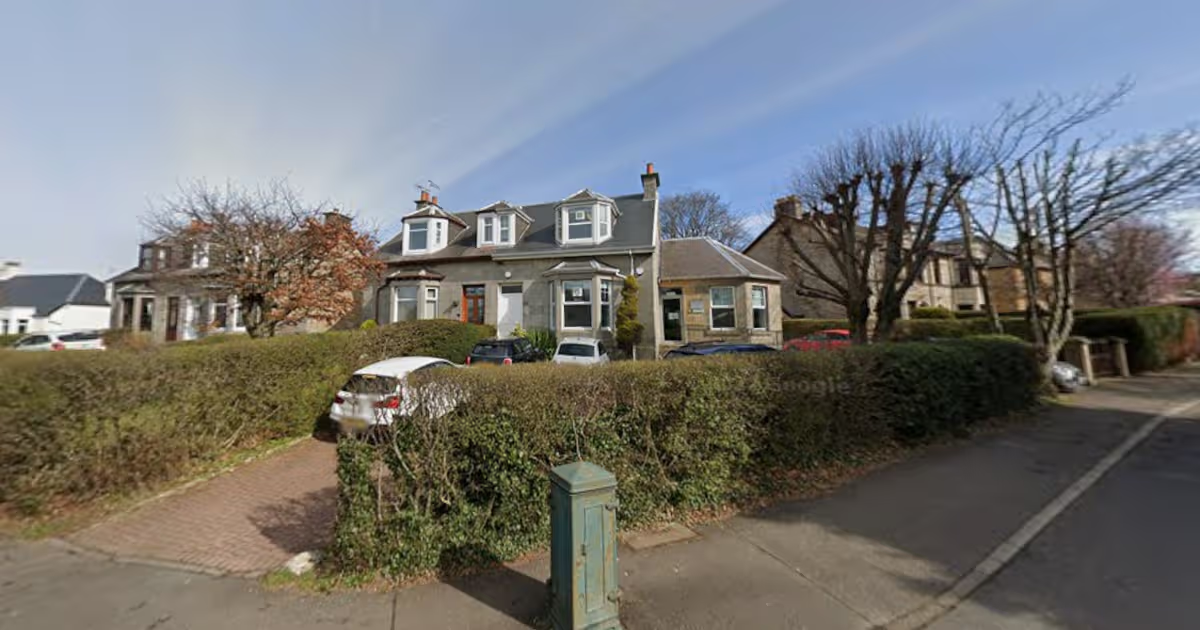
An “overwhelming” portion of responses to a North Yorkshire Council (NYC) consultation on its Experimental Traffic Regulation Order (ETRO), introduced on the North Yorkshire Coast in 2024, have objected to the scheme.
The ETRO was introduced to restrict overnight parking at Sandsend, Royal Albert Drive, and Cayton Bay after North Yorkshire council said the number of motorhomes using the specified streets had reached an “unacceptable level” and followed increasing complaints from members of the public.
However, since its introduction, thousands of residents have reportedly also complained about the “displacement effects” of the order.
Advertisement
North Yorkshire Council has been undertaking a consultation on the “impacts of the prohibitions and needs” to determine a way forward in advance of the ETRO expiring in May.
A decision on the future of the scheme will be made in April .
“With more than 3,000 responses to the consultation, there are many subject matters covered which are outside the scope of the ETRO and the decision whether it should be made permanent,” according to a report prepared for a council meeting next month.
It notes, however, that “it is clear that there was an overwhelming response to the consultation objecting to the ETRO”.
Advertisement
It adds: “It may also be interesting to note that over two-thirds of the respondents declared that they were motorhome owners, and of these 90 per cent of them objected, or strongly objected to the ETRO.
“A lot of the comments alongside these objections made reference to wanting to return to the locations to continue parking overnight.”
Members of the Scarborough and Whitby Area Committee are set to discuss the issue at a meeting in Whitby on Monday, March 2.
NYC’s report states that “motor caravans are as welcome at seafront parking locations as any other vehicle in the daytime, but extended stays, which usually include overnight parking, restrict the ability of other visitors to find suitable parking when visiting the area for recreation”.
Advertisement
Fire safety concerns have also been a key consideration, according to the council, which noted that the Fire Authority “has received a number of complaints and attended incidents on the Marine Drive and Royal Albert Drive, and has concerns with regard to fire spread”.
Alternative options have been considered by the council, such as charging for overnight parking.
However, officers said that “the concerns and issues with overnight parking would not be alleviated by this proposal and could result in exacerbating the existing adverse impacts on amenity”.
Although the council “noted that the consultation has given a large number of objections to the ETRO”, it highlighted that “the vast majority of objections did not relate to the reasons behind the scheme”.
Advertisement
“However, the objections and the comments made therein will be considered in the forthcoming review of parking in Scarborough and Whitby in the near future .”
Councillors at today’s planning committee meeting (February 24) agreed to grant permission for the change of a house at 13 Whitemoss Road into part of an enlarged dental surgery.
Plans to expand an East Kilbride dental practice have been approved despite concerns from local residents.
Councillors at today’s planning committee meeting (February 24) agreed to grant permission for the change of a house at 13 Whitemoss Road into part of an enlarged dental surgery.
Advertisement
The proposal will see the semi-detached property being incorporated into the neighbouring Avondale Dental practice at number 15, creating two additional treatment rooms and expanding specialist services in the area.
Planning officers recommended approval, noting that the development complies with local and national policy and would not have an unacceptable impact on residential amenity.
The application attracted significant opposition, with 51 objections lodged. Concerns related to increased traffic, parking pressures, noise and the loss of a residential property within the neighbourhood.
Council officials stated that road safety and drainage matters would be addressed through planning conditions, including improvements to on-site visibility and requirements to manage surface water.
Advertisement
*Don’t miss the latest headlines from around Lanarkshire. Sign up to our newsletters here.
And did you know Lanarkshire Live had its own app? Download yours for free here.
DWP minister Diana Johnson has announced employment support measures for workers over 50, including 50PLUS Champions and the Midlife MOT service.
The Department for Work and Pensions (DWP) has issued a statement about significant changes impacting people within a particular age bracket. DWP minister Diana Johnson discussed upcoming changes that could influence people’s earnings.
Advertisement
The announcement followed a written parliamentary question from Reform UK MP Lee Anderson concerning what measures are being implemented “to help improve employment opportunities for older people”. Ms Johnson delivered the Government’s reply.
She said: “Work helps everyone play active and fulfilling roles in society whilst building financial security for retirement, and we recognise the wealth of skills and experience that older workers bring both to the workplace and the economy.
“We are committed to supporting workers over the age of 50 through a wide-ranging strategy that promotes age-inclusive employment practices, flexible working, and progression and career development.” She proceeded to outline the assistance available for anyone over this age, including anyone born prior to 1976, reports the Mirror.
Ms Johnson added: “We have a dedicated offer for older workers within jobcentres, including our 50PLUS Champions who provide a critical layer of support to ensure the needs of older jobseekers are met. We also offer a Midlife MOT, which helps people to review their health, finances and skills and signpost to suitable support.”
Advertisement
The Midlife MOT is a Government service available to people aged 45 to 65. It provides resources to help you think about your career, health and finances. On the money side, the service can help you budget for your retirement and look at what benefits you may be able to claim, such as Universal Credit or the state pension.
Increasing earnings
Ms Johnson also spoke about other support on offer. She said: “Our employer and partnership teams in jobcentres work with a range of employers and partners to enhance the skills and employment support available locally for customers.”
Looking ahead, the minister also spoke about what further help is being rolled out for older workers. She said: “As part of our plans to Get Britain working and create a new jobs and careers service, we are committed to reforming employment support to ensure it is inclusive and meets the needs of our customers.
“We are considering the support we offer to those aged 50 and over so that they can access support to find good, meaningful work, and help them progress in work or increase their earnings.”
Advertisement
You may wish to check what benefits you can claim using an online benefits calculator. You could try using the one on the Turn2us website.
When planning for your later life, you may wish to factor in how much you will receive with the state pension. The age at which you can access your private pensions is currently 55, though this is set to rise to 57 from April 2028.
Britons face a longer wait to claim their state pension, which becomes available when you reach 66. This access age is rising soon, increasing gradually from April 2026 to reach 67 by April 2028.
The full new state pension currently provides £230.25 a week, and you typically require 35 years of National Insurance contributions to receive this amount.
Advertisement
Payments increase each April in line with the triple lock, which will raise payments by 4.8% this April. You can check how much state pension you are on track to receive using the state pension forecast tool on the Government website.
Katherine Short, the daughter of Hollywood comedian Martin Short, has died
Benjamin Blosse and Zara Zubeidi
21:06, 24 Feb 2026
Hollywood actor Martin Short’s daughter Katherine has died after she was found dead at home, reports say tonight.
Martin adopted Katherine alongside her siblings Oliver and Henry with his late wife Nancy Dolman, who passed away in 2010 following an ovarian cancer diagnosis. The couple shared 30 years of marriage.
Advertisement
Katherine, 42, attended numerous events with Martin. In May 2023, Martin brought his daughter to The Producers afterparty, appearing in photographs with Goldie Hawn. She also joined her father on the red carpet in 2011, reports the Mirror.
According to TMZ, the LAPD attended Katherine’s Hollywood Hills residence on Monday shortly after 6pm. A representative for Martin confirmed to the Daily Mail: “It is with profound grief that we confirm the passing of Katherine Hartley Short. The Short family is devastated by this loss, and asks for privacy at this time.”
Short’s spokesperson added: “Katherine was beloved by all and will be remembered for the light and joy she brought into the world.” It has been reported she died by suicide.
Advertisement
According to People, Katherine practised as a licensed clinical social worker in private care. She was also actively engaged with mental health charity Bring Change 2 Mind.
Discussing the passing of Katherine’s mother Nancy, Martin revealed he continues to ‘talk’ to his departed wife regularly. Speaking to AARP magazine, he reflected: ‘With real tragedy, you become a little more daring.
“It’s the yin to the yang: the positive part of life’s dark side.” In his autobiography, he characterised Nancy’s death as ‘by far the most awful thing I’ve been through.
Advertisement
This marks Martin’s second bereavement in recent weeks. He and comedy collaborator Steve Martin honoured the late Catherine O’Hara during their performance mere hours following her passing last month.
The comedy duo were appearing at their Best Of tour date in Austin, Texas, when they displayed a photograph of the Home Alone actress on screen and celebrated her as “the greatest, most brilliant, kindest, sweetest angel” they’d ever collaborated with. The pair subsequently raised their drinks and toasted the star following her death, with spectators applauding the tribute
Two British cousins have been arrested and charged with attempted murder over a stabbing on Valentine’s Day in Venice.
Italian police said the men, aged 19 and 21, had been charged with stabbing a 22-year-old local man in the neck on the even of 14 February at a bar in the city’s historic centre.
The victim reportedly come close to bleeding to death, after the incident outside La Bussola Cocktail Lar near the Rialto Bridge.
Image: Venice’s Rialto Bridge. Pic: Reuters
Police say they think it was sparked by a “trivial disagreements”. They believe the knife may have been thrown into the water, with state police diving units searching the Grand Canal in Venice’s centre to find the alleged weapon.
Advertisement
The 19-year-old is alleged to be the perpetrator and the 21-year-old the suspected accomplice, Italy’s Polizia Di Stato said in a statement.
“Officers from the Venice Flying Squad, coordinated by the local prosecutor’s office, arrested two British nationals, aged 19 and 21,” the police said.
“They are believed to be responsible for the attempted murder of a 22-year-old man, which occurred on Valentine’s Day in the historic centre.”
They added: “According to investigations, the motive appears to be trivial disagreements between young people, which escalated into violence over trivial matters”.
The police said the two men had been in Italy on holiday since the end of January, with return tickets booked. The arrests came after a search lasting more than a week.
Advertisement
Police say the cousins were found in an apartment that belonged to an Italian relative of one of the men, in Venice city centre.
The operation to locate them was supported by wiretaps, electronic surveillance, the monitoring of social media profiles and the exchange of information with British authorities.
Halve the dough. If you want to roll out the dough and stamp out shapes with a cookie cutter, shape into two discs. Alternatively, if you want to make sliced cookies, roll the dough into two logs. Either way, wrap in cling film and chill for at least two hours and up to two weeks (or keep the logs in the freezer for up to two months and slice and bake from frozen).
Would Jane Austen have even understood the question of whether she was gay? Michel Foucault, French theorist and author of The History of Sexuality (1976), would answer: “Non”.
Foucaultargues that, even though homosexual acts had been performed in the past, homosexuality as an identity did not develop until the later 19th century. Before then, you could do homosexuality, but you couldn’t be a homosexual. That’s because homosexuality as an identity didn’t exist yet.
Anne Lister, a contemporary of Austen’s who wrote coded diaries about her sexual liaisons with women and is now often hailed as the first modern lesbian, might disagree with Foucault. But it is unlikely that Austen thought of herself as gay.
In 1995 the London Review of Books (LRB) ran a review of Deidre Le Faye’s monumental edition of Austen’s letters. The piece, written by US literary critic Terry Castle was called Sister-Sister, but it was cheekily retitled “Was Jane Austen Gay?” on the cover. In her article, Castle suggested that Austen appears mainly dismissive of men in her correspondence, and was similarly dismissive of the various proposals she is said to have received.
Advertisement
Castle’s review, especially the LRB’s provocative retitling, caused a storm in a teacup of Austenian proportions. Readers of the LRB and Austen scholars fell into a fury of scandalised incomprehension, trading competing interpretations of Austen’s private life and public writing.
For Castle, Austen’s most significant relationship was with her sister, Cassandra. Her nuanced argument about the erotics of this relationship was brought to life recently in a collaboration between the LRB and City of London Sinfonia in London’s Covent Garden, the event’s name recalling the LRB coverline for Castle’s essay.
A programme from the event. City of London Sinfonia, Author provided (no reuse)
Becoming Jane and friends
A one-off show which was part of the LRB and City of London Sinfonia’s Ideas in Concert series, Was Jane Austen Gay? brought to life Castle’s essay and the tumultuous response to it. Actresses Claudie Blakley, who played Charlotte Lucas in the 2005 Pride and Prejudice, and Lost in Austen’s Jemima Rooper read out Castle’s essay, as well as letters from, to, and about Austen. A concert mixing songs from Austen’s own music collection with modern-day Austen film soundtracks accompanied the staged reading.
The show began and ended with Castle’s bewildered response to the brouhaha that erupted over her argument on Austen’s inner life. “Surely,” bemoans Castle, “literary critics writing in the London Review are still allowed to speculate about such things”. As Blakley and Rooper demonstrated in the reading of Castle’s essay, Castle herself was not above a little childishness – malevolence, even.
Advertisement
She describes – deliciously – Cassandra’s portrait of Jane as having eyes like “small astigmatic raisins”. So mean, and so Austen-like! And she also ventriloquises a taboo wish, which she detects running through writing on Jane and Cassandra: “Why did Jane have to be the one to die?”
Blakley and Rooper performed Castle’s essay in different voices, affecting an American twang for the critic’s rueful response to her British reception. They also alternated between breathless excitement for Jane, mournfulness for Cassandra, and pomposity for Austen’s family biographer James Edward Austen-Leigh.
There were voices, too, from Austen’s fiction, including Northanger Abbey’s Henry Tilney, an “unheterosexual” (to borrow critic D.A Miller’s phrase gentleman with a fondness for fine fabrics, and Emma, erotically enamoured with Harriet Smith.
The evening allowed for a deeper dive into Austen’s letters, as well as a taster of Anne Lister’s, and took great delight in dramatising the aftermath of Castle’s essay, often very funnily. This included a letter from the Independent’s arts correspondent castigating Terry Castle’s prurience, while mistaking her for a man. The LRB editors laconically responded: “We wonder what Ms McDonald would have written had she been alert to the fact that Terry Castle is a woman.”
Advertisement
The City of London Sinfonia set the Jane Austen brouhaha to music. Dale Wightman
Alexandra Wood, violinist and creative director of City of London Sinfonia, brought together a wonderful ensemble to provide a musical counterpoint to Blakley and Rooper’s dramatised reading of Castle’s essay. When Blakely and Roper discussed Jane’s flirtatious style in her letters to Cassandra, the music teased and flirted with the audience.
Another letter published in the wake of Castle’s essay, by the great Austen scholar Claudia Johnson – sadly overlooked in this event – begins: “Is she prudish? – is she queer?” Johnson playfully shifts focus from Austen’s sexuality to the oddness of one of her character’s here. Fanny Price is “queer” because she is immune to the dubious charms of Henry Crawford, who is asking these questions about her in Mansfield Park.
Reviewing attitudes to Austen’s sexuality that run the gamut from frigid to lesbian, Johnson defends Castle’s argument that sisterly bonds are among the most powerful in Austen’s writing. She expresses a preference for the naughty Austen glimpsed in her letters to Cassandra and available as a narrative voice – mischievous, stylish, “unheterosexual” – in her novels.
It is a voice that finds excitement and enjoyment by pressing at the confines of the marriage plot, which enforces a kind of normative heterosexuality on proceedings. It laughs at the misunderstandings and miscommunications that seem to bedevil all the actual marriages in Austen’s novels, and sides with characters like Henry Tilney, Emma Woodhouse and Fanny Price, who stand apart from these heterosexual demands, desiring otherwise.
Like Johnson, along with Castle and the organisers of “Was Jane Austen Gay?”, I find this naughty Austen more seductive than alternative visions of her as a heteronormative moraliser. Reading Austen’s novels queerly opens them up as works with surprising and subversive things to say about how to live and think and write. Even if Austen herself did not – and could not – think of herself as a homosexual, her writing invites queer interpretations, celebrating the mischievous, the stylish, and the “unheterosexual”.
Advertisement
Rather than asking “Was Jane Austen Gay?”, perhaps we should ask, “How can we read Austen today?” The original Castle essay and the LRB/CLS event named after it provide ways to do just that, thinking about Austen speculatively, wittily, and musically.
This article features references to books that have been included for editorial reasons, and may contain links to bookshop.org. If you click on one of the links and go on to buy something, The Conversation UK may earn a commission.
Looking for something good? Cut through the noise with a carefully curated selection of the latest releases, live events and exhibitions, straight to your inbox every fortnight, on Fridays. Sign up here.
On Tuesday, temperatures in High Beach in Essex and Frittenden in Kent reached 16.6C.
In Kinloss, in Moray, 13.7C was recorded.
In Wales and Northern Ireland, temperatures fell a little short of those recorded at the weekend but still reached 15.2C and 13.4C in Hawarden and Helen’s Bay respectively.
The mercury could rise a little further still on Wednesday in south-east England with a small chance of 18C (64F) in the best of the sunshine. Northern Ireland may also be a little warmer than on Tuesday, following a wet start.
Advertisement
In the north and west of the UK there will be more cloud and some rain, but temperatures even here will still be above average.
To put this warmer weather into context – the last time the temperature reached 18C was 13 November 2025, and the record for February is 21.2C (70.2F) on 26 February 2019 at Kew Gardens.
Wednesday is likely to be the peak of the warmth this week, with temperatures back to near average on the last day on February and a possible frost for many on Friday night.
A Boise, Idaho woman has been charged with malicious destruction of federal property by fire after prosecutors said she stole an ambulance, drove it into a building that houses U.S. Department of Homeland Security offices and then poured accelerant inside the property.
Sarah Elizabeth George, 43, was scheduled to be arraigned Tuesday afternoon in U.S. District Court in Boise.
In court documents, FBI special agent Daniel Ramirez said a suspect believed to be George stole a Canyon County Paramedics ambulance from St. Luke’s Hospital Emergency Center in the Boise bedroom community of Meridian late on Feb. 18. Ramirez said the suspect then drove the ambulance to a nearby parking lot, loaded at least two gas jugs and a plastic bag into the vehicle and then drove the ambulance through the front doors of a nearby office building before getting out and pouring the contents of the jugs on the lobby floor.
The building is owned by St. Luke’s Health System and the hospital has faced criticism for leasing space in the building to the Department of Homeland Security while President Donald Trump’s administration carries out his immigration enforcement crackdown.
Advertisement
Messages were left Tuesday for a public defender listed as George’s attorney and at a number listed for George.
Meridian Police Chief Tracy Basterrechea said during a press conference shortly after the incident that responding agencies apparently scared off the suspect before the accelerant was ignited. Police were unable to locate the suspect at the time, but Ramirez wrote in court documents that investigators were able to identify George after reviewing footage from closed-circuit cameras in the area. Camera footage and receipts from stores in the area also showed George purchased gas jugs and gas shortly before the ambulance was stolen, Ramirez said.
George’s Facebook page included a post with the words, “If it can be destroyed by the truth then it should be destroyed; it was built in lies anyways,” above an image depicting the White House in flames, Ramirez wrote in court documents.
George is also charged with malicious destruction of property used or affecting interstate or foreign commerce, according to court documents. She has not yet had the opportunity to enter a plea.
Advertisement
Each charge carries a maximum penalty of up to 20 years in prison.
When deciding whether to invest in environmental projects, it’s important to consider the economic value of any long-term benefits.
Whether climate solutions (such as offshore wind power or solar farms) are recognised as valuable or worthless depends very much on which economic model is used to evaluate it.
If the present value of the benefit (calculated by using a widely accepted financial model called “exponential discounting”) is too small compared to the cost, it may seem to damage the economy too much.
As a mathematician researching in finance, my study shows how it is possible to use another financial model called “social discounting” to value the long-term benefits far into the future. My colleague and I have demonstrated that a perfectly consistent valuation method can be established using social discounting.
Advertisement
Exponential discounting is commonly used to calculate the present value of a future benefit. Banks use this all the time to calculate the value of products linked to interest rates. Exponential discounting tells us how much to put in an account now to reach that future value – it incorporates how, when interests accumulated overnight are instantly put into the account, those interests will accumulate additional interests.
Social discounting is another way of calculating the present value of future, long-term benefits such as the prevention of drought, forest fire, or the submersion of coastal cities.
A recent University of Exeter report titled Recalibrating Climate Risk highlights a range of shortcomings in how traditional economic models are applied to climate issues.
While it makes sense to use exponential discounting if the future beneficiary of the decision made today is the same person who is making the decision, that isn’t always the case when they are different.
Advertisement
The benefits of long-term social projects for sustainable energy or climate change may only arise in 100 years. By using an exponential discounting model, a large benefit occurring in the distant future will be assigned an unfairly low value right now. This won’t be enough to justify the costs involved in funding the project, so the project might not get off the ground.
Given that future generations have no say on choices made by society today, it seems unfair to heavily discount their future benefits. Nevertheless, there is a strong argument, most notably advocated by the climate economist and Nobel laureate William Nordhaus, that investment in climate projects should be treated like any other investment; subject to the usual exponential discounting.
The Nordhaus argument is widely used to evaluate climate policies around the world. For example, a UK thinktank called the Global Warming Policy Foundation has used it to warn the government against investing in safeguarding future generations. Fossil fuel companies employ versions of the Nordhaus argument to deter public investment in climate policy and focus on the short-term benefits of an economy based on fossil fuel extraction.
Leaving aside morale and ethical debates on the use of exponential discounting, a little-known principle in finance shows that the exponential rate of discounting cannot decline over a long time horizon when benefits of climate policies are delivered.
One consequence is that the benefit of long-term social projects to tackle climate change is inevitably heavily discounted in the exponential model. This makes the investment seem less attractive, making it difficult for lawmakers to pass climate bills.
An alternative assessment follows from using social discounting, where the discounting is considerably milder so that the present value of the benefit of a climate policy far in the future may be as significant as the amount of investment required for implementing the policy, making the investment a worthwhile proposition.
In spite of its morale attraction, in the academic literature it was thought for a long time that it is not possible to evaluate future benefits in a consistent way using a social discounting. Without evaluating future benefits in a reliable, consistent way makes it difficult to argue the economic case for a climate investment. But my research shows that it is possible.
Advertisement
There are no economic or financial reasons to circumvent the use of social discounting on the basis of consistency. So it’s time to move on from the old-school economic arguments favoured by the fossil fuel industry and other climate sceptics.
“There is absolutely no truth whatsoever in any such suggestion. We have asked the MPS for the evidence relied upon to justify the arrest. Peter Mandelson’s overriding priority is to cooperate with the police investigation, as he has done throughout this process, and to clear his name.”