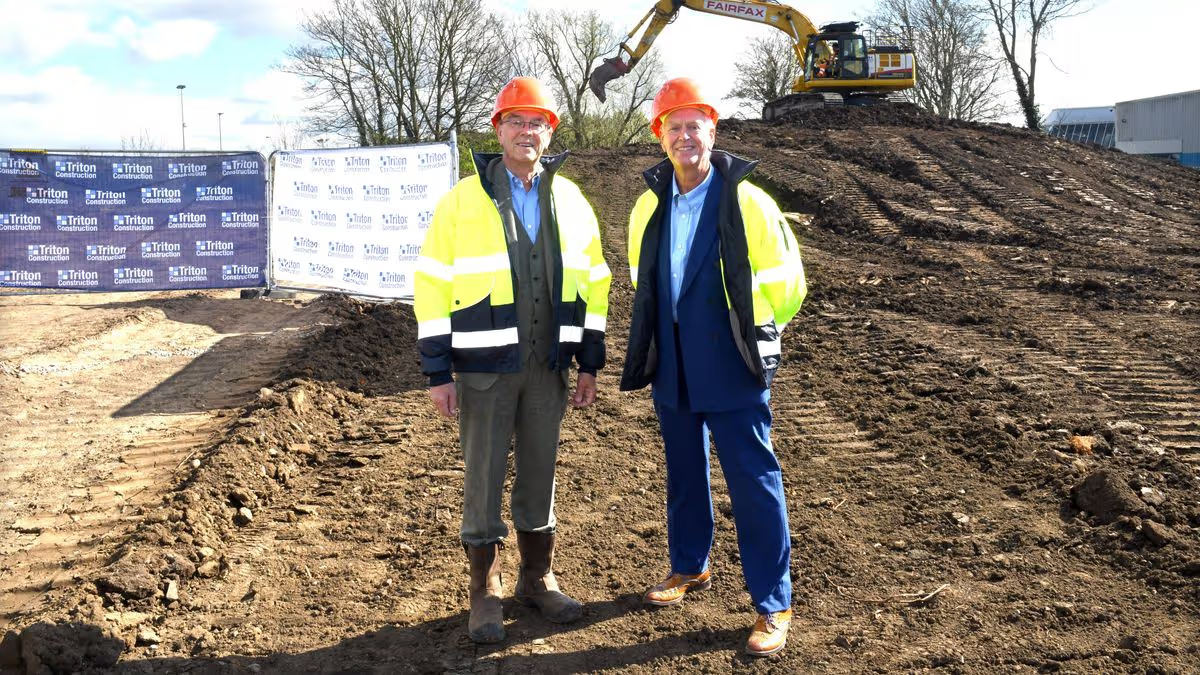
A lot has changed since the starting point, with the election of a mayor in 2017, ongoing regeneration of the former Redcar steel works (now Teesworks), the nationalising of an airport, the Teesworks Review, and the organisation now finding itself under a Best Value Notice, to name just a handful.
Local councils (like Middlesbrough and Stockton) are a necessity in this country – they have statutory duties including providing social care, while more visible services include bin collections.
In comparison, combined authorities could be described as a nicety – approximately half the country survives without a metro mayor, although the government is committed to the mayoral model and there will be an expansion of combined authorities in the coming years.
So the big question is has the combined authority been a net good?
At times it has found itself embroiled in controversy, recently incapable of fulfilling its duties to get its accounts signed off by auditors.
However, having a mayor for the region has certainly brought more attention to Tees Valley, the region hosts the UK’s largest freeport, and TVCA works with partners on transport projects, including hundreds of millions pumped into train stations across the patch, part funded by the combined authority.
Who’s in charge?
When the combined authority was brought into existence 10 years ago, it didn’t have a directly elected leader.
In fact it operated for just over a year without a metro mayor, until May 2017, when Conservative then-Councillor Ben Houchen narrowly defeated leader of Redcar & Cleveland Council, Labour’s Sue Jeffrey, to the post, with an underwhelming 21.3 per cent turnout. In Middlesbrough and Hartlepool, less than one in five eligible voters cast a ballot on the matter.
Mayor Houchen was re-elected with a huge majority in 2021 and with a comfortable lead again in 2024, surviving the anti-Conservative swing that continued into the general election just two months later.
Tees Valley residents continue to not pay a mayoral precept, which can be introduced by regional mayors.
What does TVCA want to achieve?
Initial ambitions reported back in 2016 (prior to Mayor Houchen’s tenure) for the combined authority included a new Tees crossing, which hasn’t happened yet, electrification of the Teesport to Northallerton rail line, which hasn’t happened yet, as well as A66 and A19 improvements, where work has been done, but a lot still remains to do – the two roads still regularly cause headaches for drivers to this day.
In its own words, TVCA’s website currently says its purpose is to secure investment, create jobs and grow the economy.
While being a combined authority gives the region financial benefits, TVCA does not yet have an integrated settlement, which would translate to greater funding powers, seen in “established” combined authorities.
Even though TVCA has been in existence longer than its neighbour to the north – the North East Combined Authority – which has been conferred top tier “established” status, the government confirmed in early 2025 that TVCA did not meet the criteria for receiving the higher level status.
This is due to the Tees Valley Review – which looked into Teesworks – and the resulting Best Value Notice.
While the review found no evidence of corruption or illegality, there was a list of 28 recommendations, most of which applied to the combined authority, along with some scathing remarks during the wider report.
Employment and wages
Data from Nomis, who provide labour market statistics on behalf of the Office for National Statistics (ONS), shows the levels of people who are currently in employment across Tees Valley, including both employees and self-employed.
In the final year before TVCA was established, April 2015 to March 2016, a total of 68.8 per cent of the eligible population (16-64 year olds) were in employment in the combined authority area. This compared to 69.5 per cent in the North East and 73.7 per cent nationally.
In the most recent measure available online, taken between October 2024 and September 2025, the percentage of those in employment across Tees Valley has risen to 70.4 per cent, overtaking the wider North East, which has an in-employment rate of 70.3 per cent. The greatest rise has been the national (GB) figure, which is up to 75.6 per cent.
Average (mean) pay statistics across Tees Valley, available from the ONS, shows that ‘pay as you earn’ employees are still earning significantly less than the UK average, as was the case a decade ago.
Across the country, the average monthly pay in March 2016 was £2,247, compared to £1,922 in Tees Valley at the same time. Fast forward 10 years to the latest figures from January 2026, and monthly wages averaged £3,461 across the UK, compared to £2,878 in Tees Valley.
The view from the mayor
In the context of TVCA celebrating its tenth birthday, Mayor Houchen was asked what his highlight and lowlight had been over the past decade.
He said there have been “lots of highlights” and “wouldn’t necessarily want to pick one” but said: “For me personally, the work that’s going on at Teesworks, [and] the corner the airport is now turning.”
He said “freight” developments as well as progress made over the last 12 months will make a “very significant difference” to the airport’s fortunes in the long term.
As for the flip side of the question, he asked himself: “Do I have any lowlights? No, I don’t think I do. Enjoyed it all. It’s hard, not always easy, but I don’t regret any of it,” adding: “If I had my time again, there isn’t a single decision I would have taken differently.”





















































You must be logged in to post a comment Login