

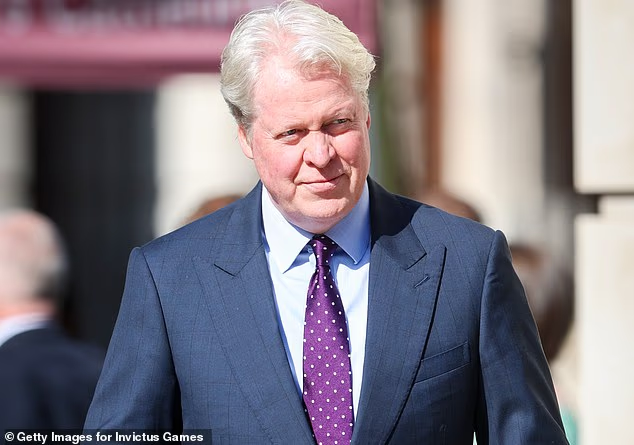
To the King’s supporters it is an act of revenge served so cold it comes with a layer of permafrost. While there has been little love lost between the House of Windsor and the Spencers over the decades, few predicted a hatchet-job of such deliberate spite.
To Prince William, the betrayal is even more personal. He has spent decades imploring those who continue to profit from his late mother’s memory to let her rest in peace. Now he must add his own uncle to that list.
Whether Earl Spencer’s explosive book is truly an exercise in fraternal devotion – an overdue righting of the wrongs many feel were done to Diana before and after her death – may be a matter of opinion. But there is little doubt that he has flashed a finely honed scalpel to reopen old wounds.
When news broke that the four-times married aristocrat had put pen to paper after almost 30 years, I was privately told William was ‘deeply disappointed’.
‘What good can ever come of it?’ one source wondered.
‘You can imagine how this has gone down,’ said another.
Yesterday I heard indirectly that William was ‘furious’. I can’t officially confirm that, as Kensington Palace is staying out of the fray, at least for now.
Let us not forget that the Prince of Wales is in an invidious position. His late mother’s resting place lies within the sprawling grounds of Althorp, the Spencer family seat. In other words: to get to her, William has to get through him.

When news broke that the four-times married aristocrat Earl Spencer had put pen to paper after almost 30 years, I was privately told William was ‘deeply disappointed’, writes Rebecca English
Of course Earl Spencer – who so memorably vowed at Diana’s funeral that William and Harry’s ‘blood family’ would protect her boys – would never deny William access to pay his respects.
But one can only imagine how difficult this episode will be for the heir to the Throne, particularly knowing that his estranged brother, Harry, has recently forged such a close relationship with their uncle.
It is a moot point whether the Duke of Sussex knew precisely what was coming. Some have reported that he was ‘aware’ of what was written in the book, and some have wondered if it might have come up when the two men met during the Sussexes’ recent stay at Althorp. Others, however, claim that like the King and Prince William, Harry was not informed about the book’s contents because security was supposedly so tight around the final manuscript – this week’s theft of the Dutch-language edition notwithstanding.
As for the King, it’s difficult for me to convey the true sense of anger and disappointment at what Earl Spencer has done.
On Wednesday night, when the Mail reported the book’s sensational claim that the then-Prince of Wales said of Diana ‘we will forget her soon enough’ shortly after she died, it took just 90 minutes for the Palace to respond.
The speed of that response shows just how much the claim incensed the King’s senior officials and the monarch himself. The statement broke the Palace’s long-held mantra of refusing to comment on any royal biography or memoir (even Harry’s) as a matter of principle.
But the phrasing used to rebut the earl’s claims, clearly designed to inflict maximum damage, was the biggest clue as to how they truly feel: ‘His Majesty is mindful that the pain of fraternal grief can cloud reason, affect judgment and colour memory in ways others do not recognise, even many years after such a loss.’ ‘“Recollections may vary” on steroids,’ one former courtier remarked to me, referring, of course, to Queen Elizabeth’s famously masterful reaction to Harry and Meghan’s bombshell Oprah interview.
There seems little doubt that a conversation between Charles and the earl took place in those fraught days back in 1997. But there are only two men in the world who know exactly what was said – and both have wildly different memories of what was discussed, and of the emotions and language used. For what it’s worth, I am told that Earl Spencer, as a historian, has always been a strict note-taker.

Earl Spencer memorably vowed at Diana’s funeral that William and Harry’s ‘blood family’ would protect her boys
Julian Payne, the King’s former communications secretary, told the BBC yesterday: ‘I personally was working for (Charles) during the 20th anniversary of the late princess’s death in 2017… He was very clear that there was never to be any criticism, never to be any pushback on the narratives that were usually highly critical of him – but he was absolutely emphatic that we were to respect her memory and not undermine it in any way.
‘It seems to me very odd that in the moment itself, with the grief of his family and his own shock, that he would choose that moment to use those words. It’s just not language that I recognise.’
Another friend of the King candidly admitted to me that the breakdown of his marriage to Diana had been ‘wretched’ and there were ‘wrongs on both sides’. But they empathised how ‘paralysed’ he was with shock, grief and, yes, self-recrimination.
They also point out that it was Charles who went against both the initial wishes of his own family, and that of Diana’s, for her to be treated as a private citizen. And it was Charles who insisted on flying to Paris to bring his ex-wife’s body back home. By all accounts, he even fought for Diana to be afforded a full state funeral.
Why, they ask, would Charles have wanted her to be ‘forgotten’ or diminished in any way, when he was privately battling for her to be given greater recognition?
Whatever the truth, it must be hard to see what good can come of all this. Scores may have been settled. But at what cost?






































You must be logged in to post a comment Login