NewsBeat
Sazan: The idyllic Adriatic island eyed up by Ivanka Trump that sparked the ‘flamingo revolution’

Rising out of the Adriatic sea with turquoise waters lapping the shore, pine forests climbing its hills and cormorants swooping along the shoreline, Albania’s Sazan Island is striking in its beauty.
It’s not hard to see why Ivanka Trump was enraptured by Sazan when she took a swim over to the island while sailing on Rothschild’s yacht several years ago, as she told the David Senra podcast last month. Ivanka spoke breathlessly of swimming from the boat to and hiking barefoot to the “top” of the island.
So taken was she by Sazan that she and her husband Jarad Kushner made plans for a real estate project of a “massive scale” to develop the island, and returned with “some of the greatest living architects of our time”.


These plans have not gone down well in Albania, with tens of thousands of people taking to the streets of the capital Tirana in protest against development in a protected area of the country.
Initially centred on environmental concerns, the protests have since swelled into huge anti-government demonstrations dubbed the “flamingo revolution’– so named after the pink wading bird that is found on this part of the Mediterranean coastline.
With protests now rolling into a nineteenth day consecutive day, activists are calling for the resignation of Prime Minister Edi Rama and a complete overhaul of the government of Albania, along with investigations into organised crime, corruption and lack of transparency.

At the heart of it all: a rugged outcrop springing out the Adriatic ocean. Sazan, Albania’s largest island, has become a symbol of resistance to oligarchy, neoliberalism and privatisation.
The 570 hectare island (around 4.8km by 2.7km) sits roughly 18km from the Albanian mainland on the southern coast, with steep cliffs, two hills and thick pine forest. A couple of rocky paths wind their way up into the hills past disused, crumbling buildings and Cold War-era bunkers. (It would be very hard, if not impossible, to hike barefoot through).
The island is often described as “untouched” but it actually has a long human history, with records that date back as far as the sixth century BC when it was mentioned by ancient Greek geographers.
Sazan has been the target of invasions since the Middle Ages, and was occupied by Italy from 1914 and then Germany for a brief time during the Second World War.
After being liberated by the Albanian army in 1944 the island was used as a military naval base and closed to the public. Some 3,600 bunkers were built across the island under the orders of communist leader Enver Hoxha who presided over a brutal regime until the early 1990s.

Now the buildings have been taken over by nature, but their ghostly structures can still be seen by climbing up poorly paved roads from the harbour: a school, hospital, homes and even a former cinema.
A small but steady stream of tourists and locals visit the island daily during the summer months, travelling over from the mainland on small speedboats and the occasional sail boat to swim and sunbathe on the rocky beach.
Biologist Bledi Hoxha is a member of the Protection and Preservation of Natural Environment in Albania (PPNEA), an organisations that has been protesting development in the region for several years.
He describes Sazan Island as a “natural laboratory for studying the distribution and evolution of species”. He explains: “It hosts a large number of plant and animal species, including endemic species of particular importance to the country’s biodiversity.”

One of these species is the Mediterranean Monk Seal, which uses the island’s sheltered coves for breeding. A critically endangered marine mammal, the Monk Seal can now only be found in a handful of areas across Europe.
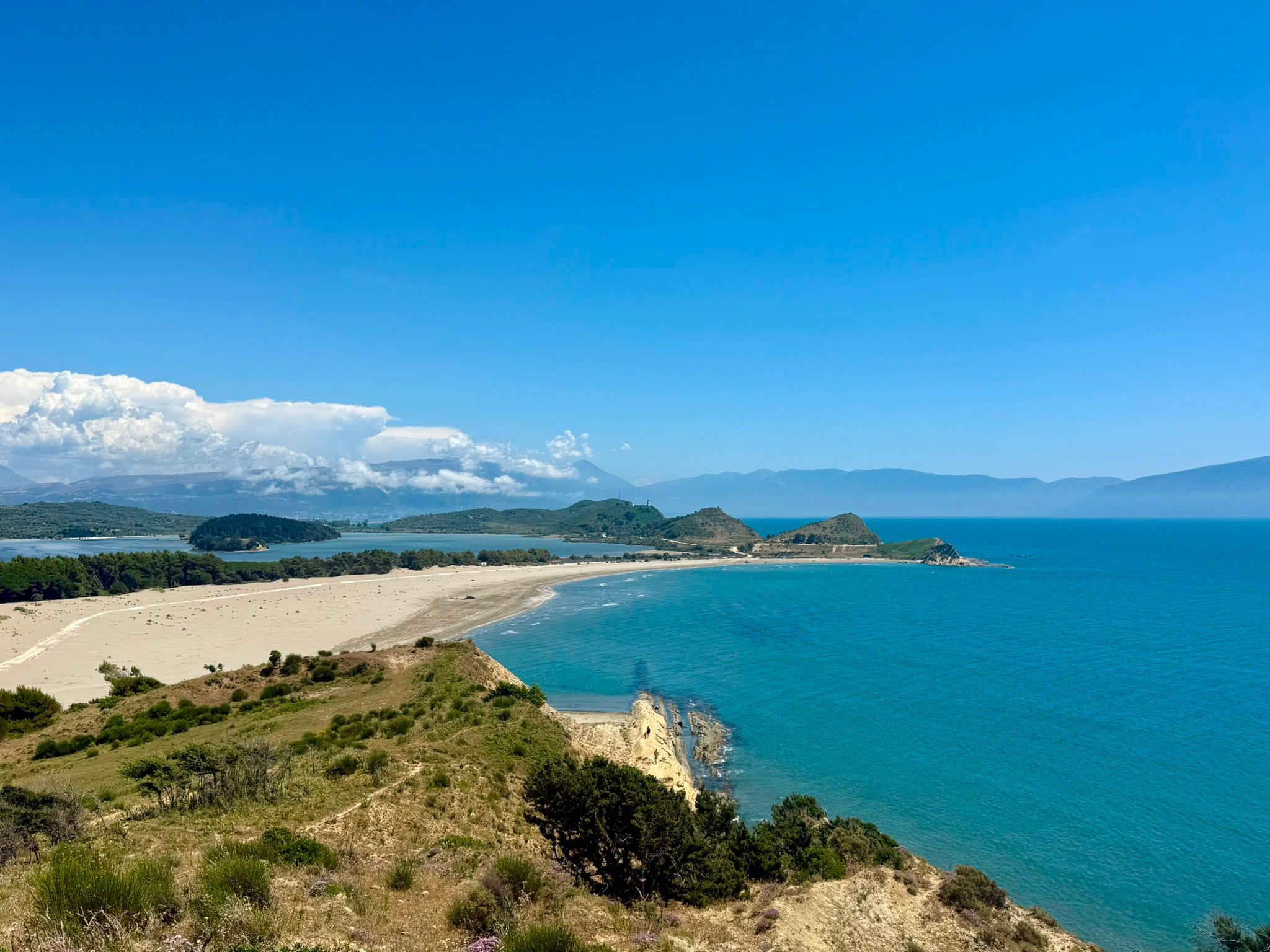
Ivanka and Jared’s plans span beyond Sazan to the Zvernec Peninsula on the mainland; a thin strip of land around 10km from the coastal city of Vlore with the Adriatic sea on one side and the Narta lagoon on the other. The peninsula sits within the Vjosa-Narta ecosystem, which is part of the last intact Mediterranean river delta system made up of wetlands, salt marshes, and coastal forest.

“It’s one of the last places where you can find massive colonies of flamingos,” says Aleksander Trajçe, executive director of PPNEA. “Hence the name flamingo revolution.” He adds: “There have been days where we’ve counted up to 10,000 individuals congregated in small patches in the lagoon.
There are currently a few campsites and beachfront restaurants on the coastline running from Vlore to the peninsula, and on Zvernec island, which is reached by a boardwalk, there are often a handful of tourists exploring the Byzantine monastery built in the 13th century.
The Narta lagoon is also an important site for birds migrating between northern Europe and Africa. Ariel Brunner, regional director of BirdLife for Europe and Central Asia, says: “It hosts regionally important populations of a host of species ranging from collard pratincoles, to avocets to gull billed terns and many more.

“The dunes and coastal scrub vegetation harbours habitats that have been wiped out by coastal development almost everywhere along the Mediterranean coasts.”
A few kilometres from the island at the spot where Kushner has spoken of building a luxury resort, a vast swathe of sand opens up, backed by dense vegetation that runs down to the lagoon where egrets and herons can be spotted wading in the shallows. Beyond here are sand dunes used by loggerhead sea turtles for nesting.
“If you want to find a place where the Mediterranean is as natural as possible, this is it,” says Mr Trajçe. “It’s the last place.”
You must be logged in to post a comment Login