

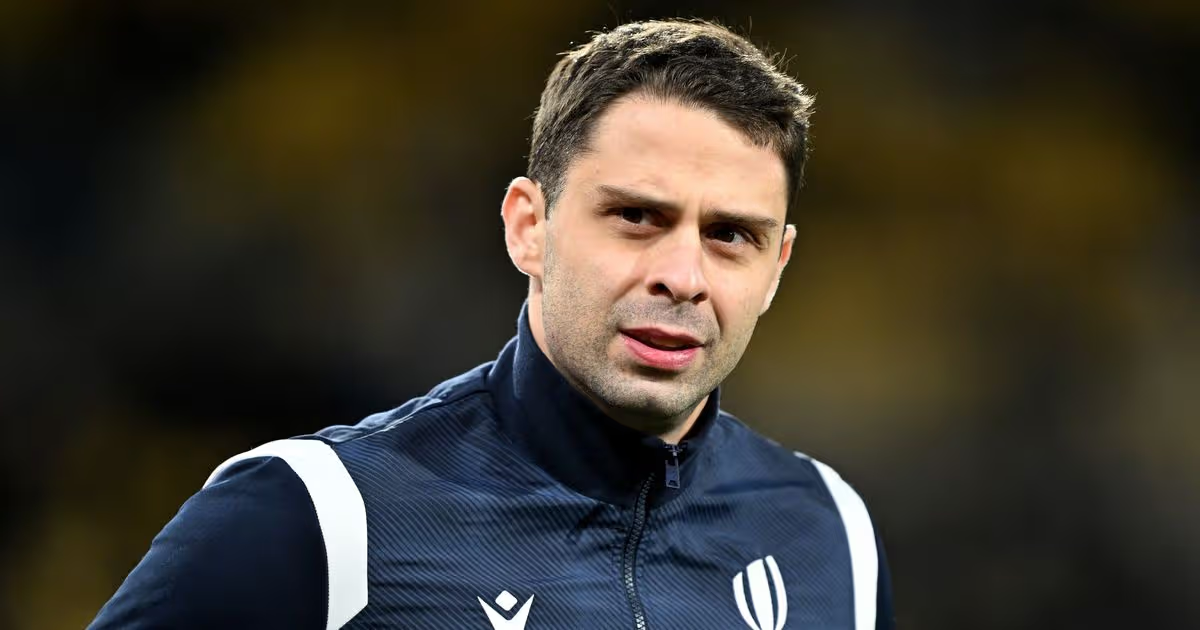
Georgian referee Nika Amashukeli is the man with the whistle for today’s Calcutta Cup match and has an extraordinary story involving a stabbing, a cruel prank and tears of joy
We’re into round two of the Six Nations this weekend one of the most anticipated fixtures of the tournament takes place today – the Calcutta Cup match between Scotland and England.
The two old foes meet at Murrayfield in the latest instalment of their fierce rivalry – one which is taken far more seriously by the Scots, claims former England international Courtney Lawes.
Scotland and England enjoyed differing fortunes on the opening weekend, with the former losing to Italy in a sodden Rome, while Steve Borthwick’s men smashed Wales on home turf at Allianz Stadium Twickenham.
Georgian referee Nika Amashukeli will take charge of proceedings in Edinburgh and he has quite a backstory. Here’s everything you need to know.
Who is Nika Amashukeli?
Born in Tbilisi in 1994, Amashukeli grew up as a football supporter but took up rugby aged 11 and, in his own words, was “literally forced” by his father to watch his first ever match — a World Cup encounter between Ireland v Georgia — on television two years later.
After becoming “hooked” on the sport, he played for Georgia at youth level and was named in the squad for the 2012 European Under-18 Rugby Union Championship. He hung up his boots aged just 20 having already sustained five concussions, fracturing an ankle and developing a knee injury, but his passion for the game remained and he chose to pursue a career in refereeing.
Amashukeli made his Test debut as a referee in 2015 when he officiated the first half of Montenegro v Estonia in a European Nations Cup Third Division fixture. He subsequently refereed at the 2019 World U20 Championship in Argentina and worked alongside his idol Wayne Barnes during the 2020 Autumn Nations Cup.
He made history as the first Georgian to officiate a tier one fixture when he oversaw Wales versus Canada in July 2021, subsequently taking charge of Ireland versus Japan, Barbarians versus Tonga and Wales versus Australia during the autumn internationals.
His Six Nations debut arrived in 2022 as Ireland demolished Italy in Dublin, with the appointment moving him to tears. While he also featured during this year’s tournament, he was especially awestruck when he refereed the marquee encounter between the Springboks and Ireland towards the end of last year.
“I remember when I was appointed to my first Six Nations match, I cried, tears were rolling down my face,” he revealed in an interview with Rugby Europe. “Then I officiated South Africa v Ireland later that year and the physicality of that game was unbelievable, I could hear ribs cracking at every breakdown and collision and after the match I just wanted to go round and shake every players hand, out of respect for their dedication and intensity.”
Cruel prank
Amashukeli fulfilled his ambition of refereeing at a World Cup in 2023, though confessed in the same Rugby Europe interview that he was initially left deflated upon receiving the phone call with the announcement. While he felt confident he would feature at the tournament in some capacity, he endured several days of uncertainty before receiving confirmation.
When his phone eventually rang, however, he was mischievously deceived by World Rugby’s Head of Match Officials, Joel Jutge, who jokingly claimed that a verdict on his selection had still not been reached.
“If I’m honest, I knew I would get the call-up,” Amashukeli said. “It was just a case of whether It would be as an assistant referee or one of the ‘top 12’ main officials.
“I knew when the management were gathering to make the selections and I knew the phone calls would come soon after but I was waiting for days and heard nothing. People from home were texting me asking if I was in and I had to tell them that I had no idea, I was just sat nervously holding my phone for three days straight.”
Despite the prank from Jutge, he shortly received the wonderful news that he would be taking charge of matches at the competition 16 years after first falling in love with the sport.
Horrific stabbing
The Georgian official’s career nearly came to a tragic end when a fixture he was overseeing in 2016 erupted into violence following the final whistle, resulting in him being stabbed in the leg.
The Didi 10 encounter, Georgia’s premier division, had witnessed Armia secure a dramatic late equaliser against Batumi, with a breakdown in communication between Amashukeli and the Batumi skipper proving costly as victory slipped from their grasp.
“There was no official timekeeping – referees controlled the time,” Amashukeli told Telegraph Sport. “I said to one of the team captains that four minutes were remaining but he misheard me and thought I’d said two minutes. They kicked the ball out after two minutes but I didn’t end the game – as there were two minutes left. Then the other team caught the line-out, won a penalty, and kicked it to draw the match.
“The home team exploded and accused me of cheating. When the supporters saw their players getting emotional and throwing their hands up in the air, they became very emotional and started swearing. After I left the pitch, there was a lot of abuse and swearing and the supporters followed. There was a big scuffle but the adrenaline was rushing through me. Someone had a knife. Suddenly, I felt something in my leg. I looked down, blood was pouring out. I had been stabbed.”
The attacker was never identified. Amashukeli confessed he initially considered walking away from the sport after the attack, but he made a complete recovery and has since progressed considerably as a match official.









































You must be logged in to post a comment Login