Connect with us

NewsBeat

Si Ferry’s new late night Glasgow restaurant confirms opening date and menu

Published

on

Daily Record

Le Set is a luxurious city centre restaurant and late-night venue which coming to the city this month

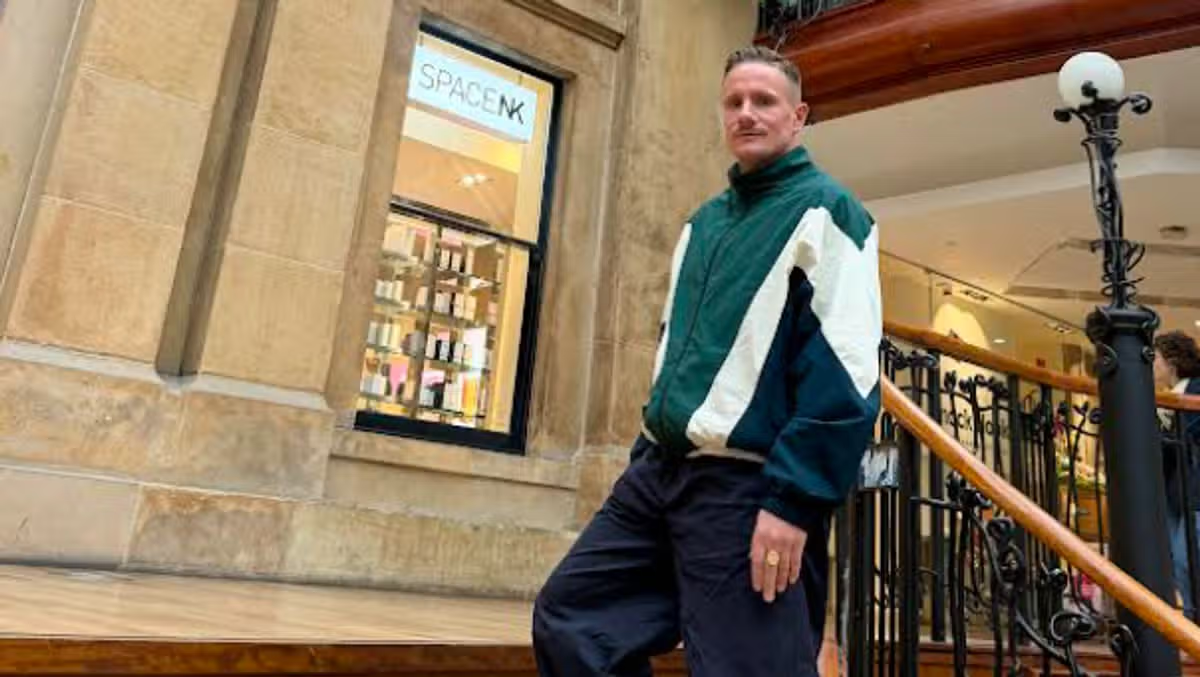
A luxuruious new Glasgow restaurant and late-night venue by Si Ferry and Jordan Allan is coming to the city this month with reservations officially open from tomorrow.

Le Set, owned by the Open Goal podcast host and his business partner, will officially open its doors at the Penthouse in Princes Square on Thursday, September 24, ahead of the September weekend.

Open seven nights a week, the highly anticipated venue will bring together elevated city-centre dining, cocktails, champagne, live music and late-night dancing.

Advertisement

The restaurant boasts a rare concept, designed to accommodate guests all evening without having to leave to head elsewhere.

Diners can enjoy lunch or dinner before moving seamlessly into cocktails, Champagne, live sax, DJs and dancing until 1am and the inside setting will be changed throughout the night to match that pace.

A launch menu has also been confirmed featuring miso black cod, Le Set Lobster French Toast, Wagyu beef tacos and Millionaire Fries finished with fresh truffle and caviar. The food can be served in small plates, sharer plates or larger plates for the table.

Advertisement

At the heart of the kitchen is Head Chef Nick Rietz, formerly head chef at Glasgow institution Two Fat Ladies and founder of Michelin Guide-listed Bilson Eleven.

Along with food will be a drinks menu consisting of carefully curated wine and Champagne as well as a cocktail programme featuring polished classics and Le Set signatures.

Meanwhile, the party will get started later in the evening with Le Set’s late-night soundtrack, which is expertly curated by So Serious Artists.

Advertisement

The company is founded by globally renowned Glasgow-born international DJ and producer Illyus Barrientos, whose credits include Hï Ibiza, Ushuaïa, Fabric, Printworks and The Warehouse Project.

It comes following an extremely successful first year for Ferry and Allan’s Glasgow restaurant Grosso, which they opened on Duke Street in Glasgow’s East End in September 2025.

Speaking of their latest venue, Open Goal host Si Ferry, said: “We wanted to create somewhere you could book for dinner and know that was your whole night sorted.

“The food has to be strong enough to make people come in for that alone, but after that we want the room to keep building around you.

Advertisement

“You start with a drink at the bar, the music lifts, the sax comes in, people stay for another bottle and then suddenly everyone’s up dancing.

“That’s the bit we’ve been obsessed with. We don’t want people thinking about where they’re going next. If we get Le Set right, they won’t need to.”

Co-founder Jordan Allan added: “Grosso gave us a really good sense of what Glasgow responds to, but Le Set is a very different proposition. It’s more polished, more layered and much more about the full evening rather than just one part of it.

Advertisement

“Nick’s food is a huge part of that, as are the drinks and the music. Illyus and his DJs understand exactly how to build a room without forcing it, and that was important to us.

“The atmosphere should evolve naturally. You come for dinner, but the night just keeps going.”

Le Set’s opening will be marked by a programme of activity across the September weekend, with a series of food, Champagne, wine and spirits activations planned in partnership with leading global drinks brands including Whispering Angel, Grey Goose and Veuve Clicquot.

Reservations to book Let Set are officially open from tomorrow on Wednesday, September 9 and can be booked on their website here.

Advertisement

Le Set will be open for business from Thursday, September 24.

Source link

Continue Reading
Click to comment

You must be logged in to post a comment Login

Leave a Reply

NewsBeat

Construction begins on new homes in Bedhampton

Published

on

Construction begins on new homes in Bedhampton

Regional housebuilder Bargate has started construction on the second phase of homes in Bedhampton, Hampshire. The new 43-home development, The Bluebells, builds on the success of its adjacent St Thomas Mead community, where residents have already established a thriving neighbourhood.

Source link

Continue Reading

NewsBeat

Dan Walker’s final conversation with Gary Speed as TV presenter admits he’ll never forget it

Published

on

Wales Online

Wales football legend Speed would have turned 57 today

TV presenter Dan Walker says he was “forever changed” by the pain of losing good friend Gary Speed – and admits he still thinks about the Wales legend every day.

Walker and Speed were colleagues on BBC show Football Focus, and appeared on-screen together in what was the Welshman’s final public appearance before he tragically took his own life aged 42 in 2011.

BBC presenter Walker was one of the last to speak to Speed – who would have turned 57 on Tuesday – and, in an interview with the Mirror last year, he explained how he vividly remembered their final conversation.

Advertisement

“We left on great terms,” he said. “Gary’s last words were: ‘I’ll ring you Monday and we’ll organize a game of golf’.”

Speed’s death sent a shockwave through the footballing world, and Walker himself was left “poleaxed” by the news, adding he has since gone over everything in “minute detail”.

“I’ve thought about that day a gazillion times about, you know, should I have seen something? Could I have had a conversation with him?,” he added.

When Football Focus aired for the final time earlier this year, Walker admitted: “I will never forget Gary Speed’s last show. That is a programme I still think about all the time.

“I know his death had a profound effect on so many people and it remains a tragic and important milestone in how we talk about mental health. That’s one of the things Focus was always able to do. We never shied away from the serious stuff and I think the viewers knew and appreciated that.”

The painful episode, Walker says, has helped shape his outlook on life, including his passion to improve children’s’ mental health. Last year, along with Olympian Jessica Ennis-Hill and comedian Jon Richardson, he launched a children’s mental health campaign called Bright Young Dreams.

“The darker times including Gary have informed a lot of conversations that I’ve been having around the charity,” he said at the time. “You can’t be unchanged by that. I think maybe, hopefully, it’s turned me to be a better listener.”

Advertisement

Looking back on the events of 15 years ago, Walker said he is heartened by how well the late footballer’s sons Tommy and Ed – who were just 13 and 14 at the time – have done in coming to terms with such a loss.

““Thankfully his two sons, Eddie and Tom, are in a decent place,” he said. “I can’t imagine what it’s like for two teenage boys to go through losing a dad like that,” he added.

The two boys featured in Walker’s book ‘Remarkable People’, which included a chapter on Speed that Walker claims sparked “the nicest email I think I’ve ever received” from Ed, who was in America at the time.

“It said ‘I hope that one day if I ever need to explain to my wife, partner, about who I am, and why I am, they need to read that chapter.’

Advertisement

“I’m glad that they were happy with how I represented them and their dad. That’s the important thing to me.”

Source link

Continue Reading

NewsBeat

England up in reading, maths and science rankings as Scotland and Wales dip

Published

on

Students in green school uniforms sit at desks reading books during a classroom lesson. Pencil pots and study materials are visible on the tables, with a noticeboard and classroom displays in the background.

English pupils have pulled ahead of the rest of the UK in international reading, maths and science tests, new data suggests, with Scotland and Wales falling further behind.

The 2025 Programme for International Student Assessment (Pisa) saw reading and maths scores slump in each UK nation except England, while all four saw an uptick in science, with that rise again most notable in England.

The latest Pisa report, which is published every three years, also warned of a worldwide decline in teenagers’ reading skills.

Teenagers were losing the skills that “matter most in the age of AI”, such as being able to critically evaluate information from different sources, it said.

Advertisement

The share of “hasty readers”, who rush through texts to give quick, incorrect answers, has almost doubled between 2018 and 2025. The report warned the fall was greatest in those from “relatively well off” families.

Run by the Organisation for Economic Cooperation and Development (OECD), the Pisa tests assess teenagers on their ability to solve problems, think critically and communicate, before asking them a wider range of questions about their education in a questionnaire.

Although the UK performed well overall, the rankings varied significantly again, with results showing England, where the curriculum is significantly different, pulling consistently ahead of Northern Ireland, Scotland and Wales.

England’s schools minister, Georgia Gould, said the government wanted to “build on” the positive results and “go further so all young people leave school with strong literacy and numeracy”.

Advertisement

Source link

Continue Reading

NewsBeat

Nigella Lawson says Bake Off struggle left her agonising over contestants

Published

on

Daily Mirror

As Nigella Lawson makes her judging debut in the tent, she wasn’t the only person to be invited in for the first time

As Channel 4 bosses hope for a ratings boost thanks to the Nigella effect, the new Bake Off judge admitted she’d found the weekly eliminations really hard. “I agonise quite a bit,” she confessed. “I just look at the floor, I’m so frightened of making eye contact.”

Speaking at the launch of the new Channel 4 series Nigella, 66, said she and fellow judge Paul Hollywood carried on talking about the cakes long after the cameras stopped rolling. “You get so involved, you can’t just switch it off.” The agonising came as she tried to fairly evaluate all the ups and downs: “This person’s done well on this front but maybe fallen down a bit here – and these things are crucial. It’s just cake – but it matters. So you really have to be sure you’ve looked at everything and really thought about it. You don’t want to make any mistakes.”

She said her aim had been to be both fair and upbeat. “I always try and look for the positive as well, because you don’t ever want criticism to be something that makes people feel inadequate. I think it’s very important to let someone know what they’re doing well and what needs to be a bit better.”

Advertisement

In the end she found that all she could actually do was tell the truth – and be herself. “Ultimately, you can’t do anything except be honest, because all you have to go on is your honest reactions. Does it help someone to say something worked if it didn’t? No. Because they’re there to get better.”

“You can only ever be the person you are. Television is very interesting in that way – in one sense it’s an artificial medium because you’re made to look nicer and all that sort of thing. And yet, it’s a great phoniness detector.”

Paul said he’d loved watching Nigella give her first ever critiques in the tent. “I was curious to see the reaction the first time Nigella gave judgment on a cake. For me, I found that the most magical time. Obviously, I did it with Mary for seven years, 10 years with Prue. So it was fascinating – it was fantastic.”

Advertisement

And while he doesn’t mind dishing out the “constructive criticism” himself, he confessed to feeling a bit choked himself, on occasion, by the departures. “It was quite emotional, this year in particular, even I felt it at times. They were a tight group.”

This year the show will have a first when it comes to the challenges – the introduction of a round in which friends and family are invited into the tent to help out. “It’s the first time we’ve ever done it. It really worked. The atmosphere changed in the tent,” Paul explained. The idea had come from the viewers at home. “It was chaos,” presenter Noel Fielding joked, saying the family members ended up having “proper full-on fights”.

The first episode is as much about Nigella Lawson’s arrival as it is about the 12 new bakers. A few days ago she claimed in an interview that she had dramatically changed her decades-long presenting style, insisting: “I’m not flirtatious.”

Advertisement

But viewers will soon see that this is not actually the case, as she sidles up to 22-year-old Moyin in the tent to tell him “You’re the only person I’ve ever seen look chic in shorts.” And tasting Tom’s chocolate and stout cake after the first Signature challenge, she informs him suggestively: “This is giving me a lot of pleasure.”

Overall, she was hugely impressed by the bakers. “I don’t think you can underestimate what it takes to be in that tent. You’re offering something up for judgment. It’s a bit like taking a driving test,” she explained. “I was just amazed at how quickly they took all that in their stride.”

Co-presenter Alison Hammond said she wanted to help out the new judge, but hadn’t needed to. “It is quite a daunting moment when you first walk into that tent so we wanted to look after Nigella and make sure she was OK. She didn’t need any advice whatsoever. She was magical with the bakers and in front of the camera.”

Advertisement

It was a different story for the emotional bakers. “You have to be there to remind them that, ultimately, we are dealing with cake.”

– The Great British Bake Off returns to Channel 4 at 8pm on 22 September

Like this story? For more of the latest showbiz news and gossip, follow Mirror Celebs on TikTok, Snapchat, Instagram, Twitter, Facebook, YouTube and Threads.

Advertisement

Source link

Continue Reading

NewsBeat

69p kitchen ingredient from Aldi can banish stains and stop smelly clothes

Published

on

Manchester Evening News

If your clothes are coming out of the wash still stained or smelling bad, try this

If you’ve ever put a wash on, only to take it out and find the stains haven’t shifted and it still smells, you’re not alone.

Advertisement

Luckily, there’s an easy trick that takes the stress out of laundry day – and could save your clothes from ending up in the bin. Advice from consumer champions at Which? say the answer could be as simple as baking soda.

Also sold as bicarbonate of soda, it’s the inexpensive cupboard staple best known as a raising agent for light, fluffy bakes – and it can be picked up for around 59p at Morrisons or about 65p at Aldi. In its top tips, Which? recommends using it to “pre-soak any smelly items” before they go in the wash.

It explains: “If your laundry basket is full of grass-stained rugby kit or sweaty gym gear, the chances are it’s already not smelling its best. Rather than chucking these items straight into the machine, give them a good soak beforehand to help minimise the chance of odours clinging on through the wash.

“You can dissolve half a cup of baking soda in a basin of warm water, soak the garments for half an hour and then wash them in the machine as normal. You can soak particularly smelly items for longer if necessary.”

Chances are you’ve already got baking soda in the cupboard, but if not, white vinegar is another option that Which? says “works well too”. Mix one part vinegar with four parts water and use it in the same way as the pre-soak. Just make sure you rinse items thoroughly before putting them into the drum, as leftover acidity could damage your machine.

According to popular baking brand, Dr Oetker, “you don’t just have to use baking soda for cooking. It’s also great for tackling all kinds of tasks around the home thanks to its alkali properties”.

This includes:

Advertisement
  • Pop some in an open bowl in your fridge to eliminate any unsavoury odours.
  • Make a paste with lemon juice to help remove grease from your oven
  • Add a scoop to your washing machine to get rid of stains in clothing
  • Try mixing bicarbonate of soda with vinegar to create a kitchen cleaning spray

Don’t leave it

As soon as the cycle ends, take your washing out and hang it up. Which? says leaving clothes sitting in a warm, damp drum for hours can make them smell worse – and fabrics like cotton and wool hold onto moisture for longer, so they’re even more likely to pong.

It explains: “The general rule is that a few hours is the limit before you’ll need to wash the items again, but in an ideal world, you’d remove your clean items as soon as possible when the cycle ends. The delay-start setting on your machine could come in handy here, allowing you to schedule a load to finish when you’ll have time to handle it.”

Skip the fabric softener

Which? explains that while it “may sound counterintuitive repeatedly adding fabric conditioner to your washes can actually make your clothes smell worse over time.” That’s because it can leave a build-up on fabrics over time, stopping detergent from soaking in and cleaning properly.

“It can also essentially ‘trap’ odours in your clothes by creating a coating over the top of them, making them much trickier to shift for good”, it adds.

Advertisement

Source link

Continue Reading

NewsBeat

‘My life-changing career break happened because I was wearing a second hand coat’ – Positive News

Published

on

‘My life-changing career break happened because I was wearing a second hand coat’ - Positive News

Richard E Grant struck gold in a charity shop – now he’s fronting a camping to inspire others to do the same

Richard E Grant has revealed that one of the most consequential pieces of secondhand clothing he ever bought was a Burberry trench coat from Oxfam – because it helped him land the role that made his name.

“My life-changing career break happened because I was wearing a second hand coat I bought in an Oxfam shop,” he says. “It was 1986 and I arrived for my ‘Withnail & I’ audition soaking wet and in a second hand Burberry trench coat. Turned out I’d nailed the look for the part without even trying – So, no Oxfam, no Withnail!”

Advertisement

Forty years later, Grant is fronting Oxfam’s Second Hand September campaign, which encourages people to buy pre-loved clothes, donate those they no longer wear, and keep their existing wardrobes in circulation for longer.

Solutions every Saturday
Uplift your inbox with our weekly newsletter. Positive News editors select the week’s top stories of progress, bringing you the essential briefing about what’s going right.
Sign up

The campaign launch comes backed up with evidence that many people are already questioning how much clothing they need. Oxfam’s new State of Style report found that 57% of UK adults deliberately tried to buy fewer clothes during the past year.

Its findings are based on polling of 3,037 UK adults carried out in July of this year. The charity plans to repeat its study annually to track whether Britain’s relationship with clothing is becoming more sustainable.

Advertisement

However, there is still a lot of clothing sitting around unused. The research found that almost a third of the pieces in an average UK wardrobe had not been worn in the previous year, while four in 10 people said they had worn an item of clothing just once. 

Richard E. Grant shot by Sane Seven for Oxfam’s Second Hand September 2026 Campaign

Advertisement

One in five people surveyed admitted to still throwing unwanted clothes away, rather than donating, repairing or reselling them.

The environmental cost goes well beyond the clothes themselves. Oxfam estimates that the water used to produce clothing currently sitting unworn in Britain’s wardrobes would be enough to provide one million people with drinking water for a lifetime.

Second Hand September was launched in 2019, but secondhand fashion has since become increasingly mainstream, helped by the growth of resale platforms alongside charity shops and vintage retailers. Oxfam has more than 500 shops around the UK as well as its online store.

It was 1986 and I arrived for my ‘Withnail & I’ audition soaking wet and in a second hand Burberry trench coat

The campaign is also tapping into an idea that buying less does not have to mean taking less pleasure in clothes. Grant says he has always loved clothes “that have lived a life before you”; he still wears pieces he has owned for decades, alongside clothes that belonged to people he loves and things he has picked up over the years.

Advertisement

“Original style isn’t about buying more. It’s about finding pieces with a story, keeping them for as long as you can, and passing them on for someone else to discover. We’ve already got too much of everything. Reusing and upcycling clothing – second-hand, vintage, call it what you like – just makes perfect sense.”

Images: Sane Seven for Oxfam’s Second Hand September 2026 Campaign

Be part of the solution

At Positive News, we’re not chasing clicks or profits for media moguls – we’re here to serve you and have a positive social impact. We can’t do this unless enough people like you choose to support our journalism.

Advertisement

Give once from just £1, or join 1,800+ others who contribute an average of £3 or more per month. Together, we can build a healthier form of media – one that focuses on solutions, progress and possibilities, and empowers people to create positive change.

Support Positive News

Source link

Advertisement
Continue Reading

NewsBeat

Miliband risks backlash from US and Israel as UK announces West Bank sanctions

Published

on

Miliband risks backlash from US and Israel as UK announces West Bank sanctions

He pointed out that Labour ministers had previously warned that “the economies of Palestine and Israel are too interconnected” for a ban on goods from illegal settlements to work, and added: “The Israeli election is in just seven weeks and many have argued, correctly, that this action will help the extreme candidates’ campaigns and not help those who are making the moderate argument for a united Israel.”

Source link

Continue Reading

NewsBeat

What went right this week: the good news that matters

Published

on

What went right this week: the good news that matters
New tool detects heart disease ‘in seconds’

Software that can detect heart disease in seconds could help change the trajectory of the condition for millions of people, experts said this week. 

The new tool, developed by Imperial College London, scans electrocardiograms (ECGs) for information that human cardiologists are unable to see. 

ECGs record electrical activity in the heart and have long proved reliable in helping cardiologists diagnose heart attacks and abnormal rhythms. But even the most experienced among them are unable to detect signs of heart disease in ECG data. For that, they must carry out echocardiograms, which many patients wait months for – valuable time lost that could be spent seeing treatment. 

Advertisement

“We looked at the ECGs to see if we could do things that are superhuman,” said Imperial’s Dr Arunashis Sau. “Not things that clinicians can already do, but things that no cardiologist, no matter how expert, can do.” 

A trial involving 67,000 patients found that the tool successfully correctly identified up to 81% of patients who had heart failure and 90% of those who had heart valve disease. The results were presented at the European Society of Cardiology annual congress in Munich, Germany. 

“A 10-second ECG, once a blunt screening tool, may soon become one of the most informative tests in medicine,” said Fu Siong Ng, professor of cardiology at Imperial. Dr Sonya Babu-Narayan, the British Heart Foundation’s clinical director, added: “When it comes to the heart, earlier diagnosis and treatment saves lives.” 

Image: peakSTOCK

Advertisement

Source link

Continue Reading

NewsBeat

We’re likely to breach 1.5C. What happens next is still in our hands

Published

on

We’re likely to breach 1.5C. What happens next is still in our hands

A new UN report says crossing the Paris climate threshold now looks unavoidable, but how far temperatures rise, how long they stay there and whether they can eventually be brought back down are still shaped by the choices we make now

For almost a decade, keeping global warming below 1.5C has been one of the defining goals of global climate action. Now, for the first time, the UN Environment Programme (UNEP) has concluded that the world is likely to breach that threshold within the next few years, while also making clear that crossing it does not mean temperatures have to remain there or that further efforts to limit warming become futile.

Published on Wednesday, UNEP’s Limiting Overshoot report describes what it calls an “overshoot, peak and decline” pathway, in which temperatures rise beyond 1.5C before peaking as greenhouse gas emissions fall towards net zero, then begin to decline if humanity succeeds in removing more carbon dioxide from the atmosphere than it releases.

Advertisement

Under the most ambitious scenario examined by UNEP, warming would peak at around 1.8C by the middle of the century. By contrast, policies currently in place would put the world on course for around 2.6C of warming by 2100, according to the report, which underlines why every fraction of a degree avoided continues to reduce the scale of harm.

Solutions every Saturday
Uplift your inbox with our weekly newsletter. Positive News editors select the week’s top stories of progress, bringing you the essential briefing about what’s going right.
Sign up

Climate scientists have long warned that 1.5C is not a line separating a safe world from one in which further action becomes pointless. Risks increase as temperatures rise, so a world that reaches 1.6C is less dangerous than one that reaches 1.7C, while spending a shorter period above 1.5C would also reduce the damage compared with remaining there for decades.

“The 1.5 limit is not ‘some magical climate cliff’ where it’s just game over,” Andrew Weaver, a climate scientists at the University of Victoria, Canada, who was not involved with the report, told the Associated Press. “Every tenth of a degree we avoid still means less damage.”

Advertisement

Although 2024 was the first individual year in which average global temperatures exceeded 1.5C above pre-industrial levels, the Paris agreement threshold is assessed over a longer period rather than a single unusually hot year. Sustained warming is now estimated at around 1.4C, meaning the world has not yet formally crossed the threshold, although UNEP now believes doing so is likely within the next few years.

‘The 1.5 limit is not some magical climate cliff where it’s just game over,’ said one climate scientist. Image: LazyBear

Advertisement

The report argues that the response should be to keep any overshoot as low and as short as possible, rather than treating the breach as evidence that the original goal should simply be abandoned. “Decisions, science and, most importantly, mindsets need to shift to seeing 1.5C as a goal we’ll be approaching from above rather than below,” said Mirey Atallah, chief of UNEP’s adaptation and resilience branch and coordinator of the report.

Returning temperatures below 1.5C would still require deep and sustained reductions in fossil fuel emissions followed by a period of net-negative emissions, with carbon dioxide removed and stored through forests and other natural approaches alongside technologies that have yet to operate at anything like the scale envisaged.

UNEP also stresses that carbon removal cannot substitute for cutting emissions, while some damage caused during an overshoot could prove irreversible. Higher temperatures increase the risks to ice sheets, the Amazon rainforest and the Atlantic circulation system, as well as intensifying heatwaves, flooding, food insecurity and ecosystem loss. Even if temperatures later fall, rising seas, lost species and other changes cannot simply be reversed.

What the report changes is not the seriousness of crossing 1.5C, but the way that threshold can be understood once it happens. The eventual peak, the length of time the world spends above 1.5C and whether temperatures can ultimately be brought down again will still depend heavily on the speed and scale of emissions cuts made in the years ahead.

Advertisement

As report co-author Richard Betts, a climate scientists at the University of Exeter, England, put it: “It’s a reality check. We have to live with this warmer world. But there’s still a lot we can do to limit warming.”

Main image: Pascual Fernandez Gomez

Be part of the solution

At Positive News, we’re not chasing clicks or profits for media moguls – we’re here to serve you and have a positive social impact. We can’t do this unless enough people like you choose to support our journalism.

Advertisement

Give once from just £1, or join 1,800+ others who contribute an average of £3 or more per month. Together, we can build a healthier form of media – one that focuses on solutions, progress and possibilities, and empowers people to create positive change.

Support Positive News

Source link

Advertisement
Continue Reading

NewsBeat

How US states approach 9/11 history in schools

Published

on

Jury says The New York Times defamed Alabama player

NEW YORK (AP) — Here’s what U.S. states expect or suggest about teaching 9/11 in public schools, according to reporting by The Associated Press.

Alabama

A 2024 revision to Alabama’s social studies standards expanded coverage of the modern era, including 9/11, the state Department of Education said. Now, fifth graders are required to “trace the United States’ military involvement in international conflicts since 1980, including those following the Sept. 11 attacks,” while high school juniors must “evaluate the effectiveness of the United States’ response” to 9/11, including the war in Afghanistan, the creation of the Department of Homeland Security, and passage of the Patriot Act. The act granted the federal government sweeping surveillance powers in the interest of pursuing possible terrorists.

Alaska

Alaska doesn’t have a statewide requirement or specific policy mandating instruction about 9/11, but the state’s “learning objectives support addressing important dates and events in history, which may include Sept. 11, within broader instructional goals,” the state Department of Education & Early Development said. Individual school districts decide whether and how to teach about 9/11, but the agency said it’s in the early stages of developing “core knowledge” documents to give more guidance on teaching specific historical events and dates.

Arizona

Arizona lawmakers decided in 2022 to require every public school to devote time on or around each 9/11 anniversary to “age-appropriate education” about the attacks. Three years later, they limited the requirement to seventh through 12th grades. State Sen. John Kavanagh, who sponsored the original law, said that he supported the change after hearing concerns about how younger students would handle the catastrophic images and complexity of 9/11. “You don’t want to introduce it too young, but by the same token, you want everybody eventually to know about it,” said Kavanagh, a Republican. State law also requires the state Department of Education to provide a list of recommended instructional materials on the subject.

Advertisement

Arkansas

Updated in 2022, Arkansas’ standards for modern U.S. history require students to be able to explain “change and continuity in foreign policy since 2001 after the Sept. 11 terrorist attacks,” including the Bush administration’s response, the Afghanistan and Iraq wars, and anti-terror efforts, such as the Patriot Act and Hamdi v. Rumsfeld, a Supreme Court case that concerned the legal rights of U.S. citizens detained as “enemy combatants.” The state Department of Education didn’t provide information to AP.

California

A 2021 California law encourages public schools to hold a moment of silence each Sept. 11. “Decisions about how and whether to address this tragic and pivotal event in our nation’s history are generally made at the local level by school districts and educators,” the state Department of Education said, but there are some recommendations in state guidance for teachers. Tenth grade world history students might get this prompt: “Since 9/11, the hopes for a more peaceful world that the end of the Cold War spawned have been displaced by a resurgence of international conflict. … Did 9/11 change everything? Or was the world in the 1990s less stable than it might have appeared at the time?” Seniors in a class on American democracy might discuss the expansion of presidential powers and the debate over national security and civil liberties after 9/11.

Colorado

Colorado’s social studies standards give school districts considerable flexibility, the state Department of Education said. But examples of topics for high school history include “the war on terror (e.g., 9/11, Afghanistan and Iraq wars, Middle Eastern discrimination and the evolution of U.S. counterterrorism efforts).”

Connecticut

Connecticut leans heavily into local decision-making for schools, and its Department of Education said the state doesn’t have a requirement or policy about covering 9/11 in the classroom. However, its education standards suggest that high school students analyze the causes and effects of the Sept. 11 attacks and how they shaped perspectives in the U.S., from the Patriot Act and creation of post-9/11 agencies to the views of Muslims and Sikhs.

Delaware

Delaware doesn’t have a law or regulation that requires teachers to cover 9/11, but it’s often addressed in high school civics and U.S. history courses, according to the state Department of Education. “Many teachers include the Sept. 11 attacks when addressing contemporary U.S. history, terrorism, foreign policy and debates about the balance between security and individual rights,” the department said.

Florida

A 2023 Florida law requires at least 45 minutes a year of 9/11-related instruction in some middle and high school classes. The statute lists points to cover: historical context on terrorism, the attack timeline, acts of heroism and charity, the “importance of respecting civil liberties while ensuring safety and security,” and more. It notably mentions not only those killed and wounded but also people who fell ill after being exposed to toxins when the World Trade Center’s burning twin towers collapsed. State standards go into still more detail. It’s all intended “to ensure this important event in America’s history is not only remembered but also integrated into civics and resiliency education statewide,” the state Department of Education said.

Advertisement

Georgia

Georgia’s social studies standards require instruction on 9/11 beginning in fifth grade, when students are expected to be able to describe the attacks and analyze their impact on American life. High school U.S. history classes analyze Sept. 11 and the war on terror under the rubric of “challenges faced by recent presidents.” The state Department of Education didn’t respond to inquiries from AP. Georgia Association of Educators President Wayne Huston, a middle school social studies teacher, said his suburban Atlanta school also holds a moment of silence each Sept. 11.

Hawaii

Hawaii has no statewide requirement or policy mandating instruction specifically on 9/11, the state Department of Education said. But the state’s standards for high school U.S. history and government mention 9/11, the war on terror and the Patriot Act in lists of “sample content” that schools might use to illustrate the rise and impact of modern conservatism.

Idaho

Idaho added Sept. 11-specific requirements to its social studies standards in an overhaul approved this year, the state Department of Education said. During the lengthy revision process, “there was clear feedback that certain major historical events, particularly those with lasting national and global impact, should be more explicitly identified to ensure they are consistently addressed,” the agency said. High school U.S. history students now must assess government responses to terrorism, “including those after Sept. 11, 2001, and analyze the causes, progression and aftermath” of the wars in Afghanistan and Iraq.

Illinois

Illinois’ education law lists Sept. 11 among “commemorative holidays” that schools may mark with instruction, activities or events, but they aren’t required to do so. The state Board of Education noted that its “ Inclusive Calendar ” offers 9/11 teaching materials, but “local school boards and educators decide what instructional materials to use and how specific topics are addressed in the classroom.”

Advertisement

Indiana

Indiana’s standards for high school U.S. history expect students to “explain the background and effects” of 9/11 “on U.S. foreign and domestic policy.”

Iowa

A hotly debated 2024 Iowa law called for focusing social studies on “United States history, Western civilization and civics” and detailed many topics and events to teach, among them 9/11 and the war on terror. The state’s new social studies standards, approved this year, require U.S. history courses to cover Sept. 11, then-President George W. Bush’s address to Congress nine days later, the war on terror and the Patriot Act. The previous standards, from 2017, made no specific mention of these or other aspects of 9/11 and were more general overall.

Kansas

Kansas does not require schools to teach about Sept. 11, the state Department of Education said. The state’s social studies standards suggest, in appendices, that high school U.S. history students learn about the period of the “diminishing Cold War to 9/11,” the war on terror and the Patriot Act.

Kentucky

In Kentucky, “how the events of Sept. 11 or its commemoration are included in a school’s curriculum is a local decision,” but the state’s social studies standards invite discussion of the subject, the state Department of Education said. For example, high school U.S. history standards suggest exploring U.S. involvement in “international alliances fighting against terrorism around the world after 9/11.”

Advertisement

Louisiana

Louisiana’s “Freedom Framework” social studies standards, inked in 2022 after a fraught process, address 9/11 at multiple points. A second grade survey of monuments includes the National Sept. 11 Memorial & Museum; eighth graders are expected to place 9/11 and the war on terror in the context of U.S.-Mideast relations. High school U.S. history students are taught about the leadup to the attacks, details of the day including then-President George W. Bush’s brief speech from Louisiana’s Barksdale Air Force Base, and aftermath ranging from the expansion of intelligence agencies to the sense of unity many Americans felt for a time. Education Superintendent Cade Brumley said officials wanted students to appreciate that “what we have seen as a country is that when our freedom is threatened, we protect and we defend and we coalesce around that.”

Maine

Maine’s broad social studies standards don’t specifically require teaching about 9/11, but many schools do incorporate it into their curricula, the state Department of Education said.

Maryland

Sept. 11 is “embedded within required coursework” in Maryland, its Department of Education said. The state’s high school U.S. history “framework” tasks students with evaluating how government responses to the attacks “challenged the balance between safety and freedom” and with assessing the causes, course, and consequences of the Afghanistan and Iraq wars.

Massachusetts

Massachusetts has incorporated 9/11 in its social science “framework” since 2003, the state Department of Elementary and Secondary Education said. The state expects high school U.S. history students to “evaluate the effectiveness of the federal government’s response to international terrorism in the 21st century,” including 9/11, the creation of the Department of Homeland Security, post-9/11 expansions of the government’s powers under the Foreign Intelligence Surveillance Act, and the Afghanistan and Iraq wars. The state education board devoted part of an April meeting to discussing materials available for teaching about 9/11 on this year’s 25th anniversary.

Advertisement

Michigan

Michigan’s social studies standards expect high school U.S history students to “analyze how the attacks on 9/11 and the response to terrorism have altered American domestic and international policies.” Suggested discussion points include not only the Department of Homeland Security, the Patriot Act and the Afghanistan and Iraq wars, but also NATO and the U.S. role in the United Nations.

Minnesota

Minnesota’s social studies standards generally focus on big themes, eras and context, and they don’t specifically mention 9/11, the state Department of Education said.

Mississippi

Mississippi’s social studies standards expect high school U.S. history students to be able to describe 9/11, the Afghanistan and Iraq wars, the Patriot Act and the creation of the Department of Homeland Security and the Transportation Security Administration. Standards for a required world history course also mention 9/11.

Missouri

Missouri’s high school U.S. history standards call for unpacking post-9/11 foreign policy, security challenges and the “balance of individual liberties and national security,” and the war on terror.

Advertisement

Montana

Montana doesn’t require schools to teach about 9/11, the state Office of Public Instruction said. But some lawmakers have been considering potential ways to change that. “We have 25-year-old young men and women right now that have no memory of this — we do need to have education along these lines,” said state Rep. Randyn Gregg, a Republican. “This changed America.”

Nebraska

Nebraska’s social studies standards mention 9/11 and its observance as Patriot Day among examples that educators might use to teach third graders about national commemorations, fourth graders about key events in U.S. history, and eighth graders about “the significance of patriotic symbols.”

Nevada

Nevada doesn’t specifically require instruction about 9/11, the state Department of Education said. The agency noted that Sept. 11 can fit within the state’s broad, thematic standards for high school history classes.

New Hampshire

New Hampshire doesn’t require teaching about 9/11, the state Department of Education said. The state’s social studies framework does mention the attacks as an optional example to teach elementary school students how major national events affect everyday life; similarly, the war on terror is a potential example for illuminating how events affect international relations.

Advertisement

New Jersey

New Jersey’s social studies standards require high school history classes to discuss the post-9/11 debate over national security and civil liberties, and to evaluate the U.S. decisions to wage the Afghanistan and Iraq wars. Teachers in lower grades are encouraged to address Sept. 11 “in a manner that is age-appropriate and sensitive to the individual and community experiences of 9/11 in their districts,” the state Department of Education said. Some state lawmakers proposed this year to expand the 9/11 instruction requirement and to require all public schools to hold 9/11 commemorations annually.

New Mexico

New Mexico’s social studies standards require high school U.S. history students to evaluate how 9/11 and other major modern world events affected diverse groups of people, the state Public Education Department said. A supplemental, optional guidance document breaks down the 9/11 discussion into “sample concepts/content” including the Afghanistan and Iraq wars, the Patriot Act, the Abu Ghraib prisoner-abuse scandal and the U.S. detention of suspected enemy combatants at the U.S. Navy base in Guantanamo Bay, Cuba. State standards for high school world history classes also suggest discussing 9/11 and the war on terror.

New York

New York, where two hijacked planes slammed into the World Trade Center on 9/11, wants to ensure that “future generations understand the profound impact the events of Sept. 11, 2001, had on our nation and state,” the Department of Education said. Under the state’s social studies “framework,” eighth graders are expected to learn about the attacks’ effects on national security, the Patriot Act, the creation of the Department of Homeland Security and the war on terror. Tenth graders examine Sept. 11 through the lens of “threats to global security.” Juniors drill down on the U.S. public’s and government’s reaction to the attacks, including “controversial foreign and domestic policies,” from the Iraq war’s basis in erroneous allegations about weapons of mass destruction to the constitutional and civil liberties concerns surrounding Patriot Act-empowered surveillance. A 2019 New York law provides for a moment of silence in schools each Sept. 11.

North Carolina

North Carolina’s social studies standards don’t specifically require teaching about 9/11, but supplemental guidance mentions it as possible material for various lessons in second, fifth and eighth grades and high school, the state Department of Public Instruction said. The high school guidance lists Sept. 11 as a potential example of multiple themes — from episodes of xenophobia and intolerance to power shifts among levels of government — and offers a sample class exercise about the Patriot Act.

Advertisement

North Dakota

North Dakota doesn’t require teaching about 9/11, the state Department of Public Instruction said, but its social studies standards mention the attacks as an event that U.S. history classes may use to “connect the changing political and social climate to the United States’ involvement as a global superpower.” The Afghanistan and Iraq wars, the debate between national security and individual liberties and the “social and cultural impacts of domestic terrorist attacks” also are mentioned.

Ohio

Ohio doesn’t require education about 9/11, as schools and districts control their curricula, the state Department of Education & Workforce said. It said schools don’t have to follow the state social studies standards, but they do offer material for high school U.S. history classes about how the nation faced “new political, national security and economic challenges” and foreign policy issues after the Sept. 11 attacks.

Oklahoma

Oklahoma’s social studies standards call for teaching high school U.S. history students about 9/11, “including examples of heroism and efforts to combat terrorism,” mentioning the Patriot Act and the creation of the Department of Homeland Security. As the state where an anti-government extremist bombed the Alfred P. Murrah Federal Building and killed 168 people in 1995, the state is forthright with students about these difficult pieces of history, state Department of Education social studies project manager Brenda Beymer-Chapman said.

Oregon

Oregon has no requirement or policy concerning teaching about 9/11, the state Department of Education said, but its social science standards “emphasize analyzing significant historical turning points, evaluating causes and consequences and examining how governments respond to crises — making 9/11 a natural fit within high school civics and history.”

Advertisement

Pennsylvania

Pennsylvania, where one of four hijacked jets crashed on 9/11 after passengers and crew members tried to regain control of the plane, “has made it a priority to ensure that our students understand the historical significance of Sept. 11, 2001,” the state Department of Education said. A 2024 Pennsylvania law requires schools to hold a moment of silence for each anniversary. The statute also required the Education Department to identify a model curriculum on 9/11 for optional use. The resulting “ toolkit ” urges schools to “use the anniversary of 9/11 as a ‘teachable moment’” and offers an array of videos, lesson plans and more.

Rhode Island

A 2025 Rhode Island law allows public schools to hold a moment of silence on 9/11. They weren’t prohibited before, but sponsor Rep. Earl Read III, a Democrat, said he reasoned: “If we can bring it to the forefront that we can be doing this, it will give people more appetite.” The state’s social studies standards expect high schoolers to debate how 9/11 affected U.S. society and foreign policy. That starts by studying U.S. policy in the Mideast before the attacks and then examining both government responses and individual reactions, ranging from increased expressions of patriotism to attacks on mosques. The state Department of Education didn’t respond to inquiries from AP.

South Carolina

South Carolina’s social studies standards call for fifth graders to compare and contrast U.S. global leadership before and after 9/11 and encourage high school U.S. history students to examine “the relationship between the Cold War and post-9/11 eras on the shaping of the American identity.” Education Superintendent Ellen Weaver visits a school each year to lead a Patriot Day commemoration. Her department said it’s also offering schools new guidance on “teaching the historical significance of Sept. 11 in an age-appropriate and meaningful way, while also reinforcing broader lessons about courage, service, resilience and unity.”

South Dakota

South Dakota added specifics about 9/11 as part of a broad — and contentious — overhaul of its social studies standards in 2023. “The ripples from Sept. 11 are a key component to understanding the history of America over the last 2.5 decades,” the state Department of Education explains. The standards now require teaching eighth graders and high school U.S. history students about the events of 9/11, the subsequent expansion of intelligence agencies and tactics, and the Afghanistan war.

Advertisement

Tennessee

Tennessee’s social studies standards call for high schoolers to discuss the impact of 9/11, including then-President George W. Bush’s response, the Afghanistan and Iraq wars and continued efforts to combat terrorism. There’s similar language in revised standards that are set to take effect in 2027-28.

Texas

A 2013 Texas law requires schools to hold one minute of silence every Sept. 11 that they’re in session. The state’s social studies standards — now undergoing a contested update — have covered 9/11 at multiple points in high school. U.S. history students have been expected to examine the attacks and their aftermath as a “turning point,” an international affairs topic and an illustration of “constitutional issues raised by federal government policy changes during times of significant events.” High school world history students have studied 9/11 under the rubric of “the development and use of radical Islamic terrorism.” The Texas Education Agency didn’t respond to inquiries from AP.

Utah

A 2026 Utah legislative resolution encourages both public and private schools to commemorate this year’s 25th anniversary. Under the state’s social studies standards, 9/11 is mentioned as a possible choice for a fifth grade exercise about the most significant event in U.S. history since 1899. In upper grades, a required high school U.S. history course addresses the war on terror, though it doesn’t mention Sept. 11 specifically. The state Board of Education said it’s also offering new primary school lesson plans with 9/11-related material at almost every grade level.

Vermont

Vermont doesn’t have a requirement or policy about 9/11 instruction, the state Agency of Education said.

Advertisement

Virginia

In Virginia, where one of four hijacked planes crashed into the Pentagon on 9/11, social studies standards require addressing 9/11 in middle and upper grades. Middle-schoolers tackle how the attacks “significantly impacted domestic policies, American society and global perspectives on the war on terror,” with special attention to the heroism displayed by passengers on the plane that went down in Pennsylvania. High school juniors analyze 9/11 and other “key events and conditions that have given rise to terrorism as an attack on democracy and the United States’ role in defending democracy.”

Washington

Washington State doesn’t require education about Sept. 11, the state Board of Education said.

West Virginia

West Virginia’s social studies standards require instruction about 9/11 and its aftermath in sixth grade, eighth grade and high school, with particulars spelled out at each level. Various high school courses, for instance, entail evaluating the causes of 9/11, studying such preceding events as the 1993 World Trade Center bombing and even the 1979-80 Iran hostage crisis, critiquing the effectiveness of the Afghanistan and Iraq wars, and debating “the necessity of infringements on American civil rights” under the Patriot Act.

Wisconsin

A 2022 Wisconsin law added Sept. 11 to a list of “ observance days ” that have to be “appropriately observed” in public schools. They decide how to commemorate the occasion.

Advertisement

Wyoming

Wyoming doesn’t require education about Sept. 11, the state Board of Education said.

___

Associated Press writer David A. Lieb in Jefferson City, Missouri, contributed to this report.

Advertisement

Source link

Continue Reading

Trending

Copyright © 2025