Carol Gillies has opened up about her family’s decades-long fight for justice as her killer still won’t reveal where Arlene’s body is
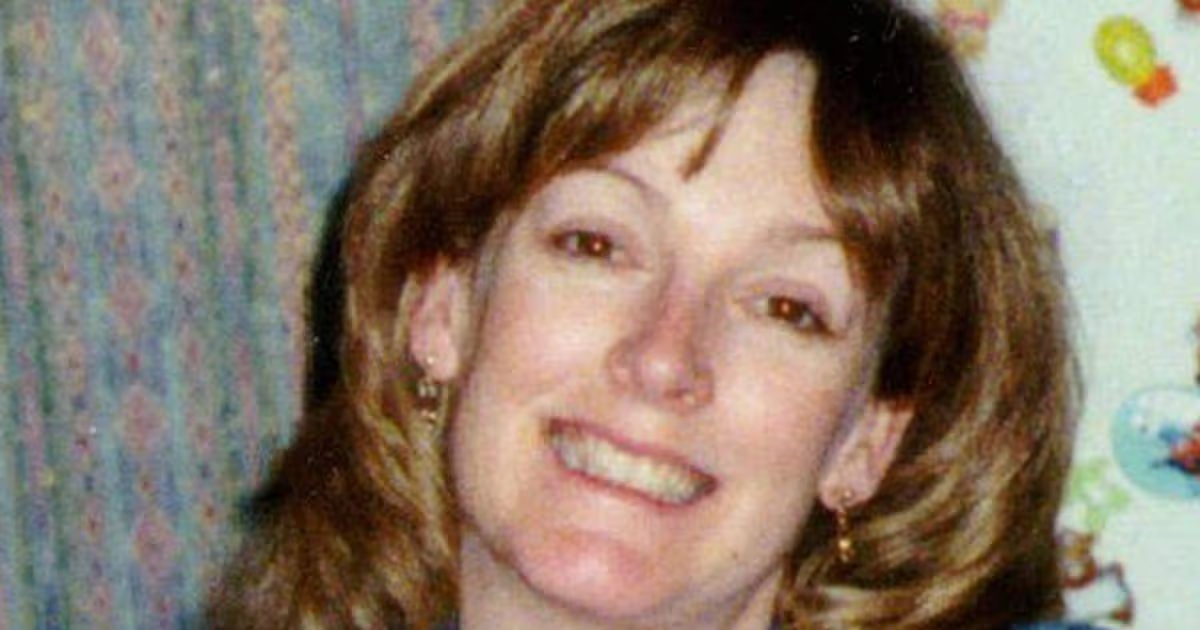
The sister of murdered mum Arlene Fraser, who vanished in 1998, has spoken candidly about the ‘horrendous torturous journey’ her family has endured for 28 years.
The 33 year old disappeared without trace on Tuesday, April 28, 1998, after her two young children came home to find the house empty. The Moray town of Elgin in the north of Scotland became the centre of attention in subsequent days as concern for Arlene mounted.
Local businessman Nat Fraser, Arlene’s husband, had a documented history of violence and faced accusations of attempting to murder his wife merely five weeks prior to her disappearance. On that fateful day, Arlene had arranged to consult with a solicitor regarding divorce proceedings.
What ensued was an agonising 14-year battle to secure Nat’s conviction, with the killer ultimately found guilty of her murder on two separate occasions. Nevertheless, the murderer, who has persistently refused to disclose Arlene’s burial location, may soon qualify for early release.
Carol Gillies, Arlene’s sister, recently featured in a BBC documentary series Murder Case: The Hunt for Arlene Fraser’s Killer, showcasing her family’s unwavering resolve to discover the truth – despite answers continuing to elude them, reports Aberdeen Live. Carol campaigned relentlessly for answers whilst advocating for changes to Scottish legislation that would prevent killers from gaining freedom whilst concealing the location of their victims’ bodies.
Speaking following the documentary’s release, Carol said: “As Nat Fraser is due for parole in 2028, I saw this documentary as an opportunity for me to shine a light on crucial matters such as violence against woman and the parole process. Indeed, I took part in filming in August 2025, during the week I met the justice minister Angela Constance to discuss Suzanne’s law.
“I had the opportunity to preview the documentary and it undeniably demonstrates how domestic abuse can spiral dangerously out of control. It was a difficult watch to see footage of Nat Fraser denying all responsibility.
“Throughout the documentary the pain caused by Nat Fraser (and his associates’) actions can be clearly seen on my parents’ faces. We feel incredibly sad that a life watching her children grow up has been taken from her by this brutal crime. It has also been extremely painful to watch videos of a living Arlene.
Ensure our latest news and sport headlines always appear at the top of your Google Search by making us a Preferred Source. Click here to activate or add us as Preferred Source.
“The documentary outlines the horrendous torturous journey that Arlene’s murder has taken us on. There has been a stream of hearings, high court trials, press conferences and of course documentaries.
“However, thanks to the efforts of the police, the media and the justice system we have overcome every hurdle and Nat Fraser was convicted and imprisoned twice despite there being ‘no body’.”
Carol expressed her anxiety about potential disappointment at the “final hurdle of the parole system”, with those implicated in Arlene’s murder persistently “deny her the right to a respectful resting place”.
Nevertheless, Nat will now encounter a fresh barrier in his attempt to secure freedom. During September 2025, Suzanne’s Law received approval in the Scottish Parliament – requiring parole boards to now consider a murderer’s unwillingness to disclose what happened to a victim’s remains.
The legislation was named after Edinburgh resident Suzanne Pilley who vanished in 2010 following the conclusion of an affair with her work associate. David Gilroy was found guilty of her murder but has never disclosed the location of her body.
Carol added: “As the years have passed, I have always worried that the final hurdle of the parole system, would let us down. Without further information as to Arlene’s whereabouts his release would mean a continuation of the crime and a loss of hope of ever gaining further information or finding Arlene. Those involved in Arlene’s murder ‘dumped’ her somewhere and continue to deny her the right to a respectful resting place.
“The passing of Suzanne’s law in September 2025 means that the parole board MUST consider a prisoner’s failure to disclose the location of a victim’s body when deciding whether to grant parole. The passing of this law has given us some hope. However, further changes are needed, and this can only be done by listening to victims and their families. The recent parole reform consultation in Scotland hopefully will address the gaps and flaws in the parole system leading to meaningful changes for the future.
“As Arlene’s family we are all incredibly grateful to everyone who has given their time and energy in taking part in this documentary and making it a success. Kate and Sean from Firecrest Films, the producers of the documentary, have treated me with the utmost respect and sensitivity, and have created something different. It is a fascinating documentary that I am proud to be part of.
“However, in saying this the media attention that Arlene’s name brings can feel overwhelming. Although I have a great support network with family and friends, at times I can struggle with the enormity of it all. For this reason, me and my family would like to extend a special thanks to former Detective Superintendent Alan Smith.
“Through taking part in the documentary and subsequent TV interviews, Alan has been a massive help in shouldering a lot of the media attention. Despite the fact 28 years has passed he remains in touch. His professional support and backing allows me to continue to voice the need for change in the parole system and keep Arlene’s name alive.
“It also means a great deal to the family, that the police officer in attendance the night Arlene was reported missing, Mark Cooper, also agreed to take part in the documentary.”
Discussing her rationale for participating in documentaries about Arlene’s killing and vanishing despite the distressing recollections it evokes, Carol highlighted the significance of “raising public awareness on important matters”. She expressed her conviction that Nat Fraser is “counting on [the family] tiring or giving up” in their pursuit of justice for Arlene.
Carol continued: “People often ask me why I put myself through the stress of taking part in documentaries and whether I should take part was something that I discussed with my family. It certainly is not something I enjoy or particularly want to do, and I am sure other participants may have felt the same, but we all see this as an opportunity to raise public awareness on important matters.
“In my case I had to think long and hard about taking part, particularly as I am potentially in danger of retraumatising myself. However, I believe part of Nat Fraser’s plan was that people would soon forget about Arlene. I feel he is counting on us tiring or giving up, but until Arlene’s remains are located, I see it as my responsibility to ensure that Arlene is never forgotten.
“Although, we have all learned to live with this horrific crime in our own way, without the support of the public and media this situation we find ourselves in would be extremely difficult to deal with. It is immensely comforting for the family to know that interest in Arlene has never faded. We are very grateful that people are still behind us and support our hunt for the truth. “.