Connect with us

NewsBeat

Six Nations coach ‘disgusted’ as investigation under way

Published

on

Wales Online

The latest rugby news from around the world

These are your evening rugby headlines on Thursday, February 19.

Advertisement

Six Nations coach ‘disgusted’

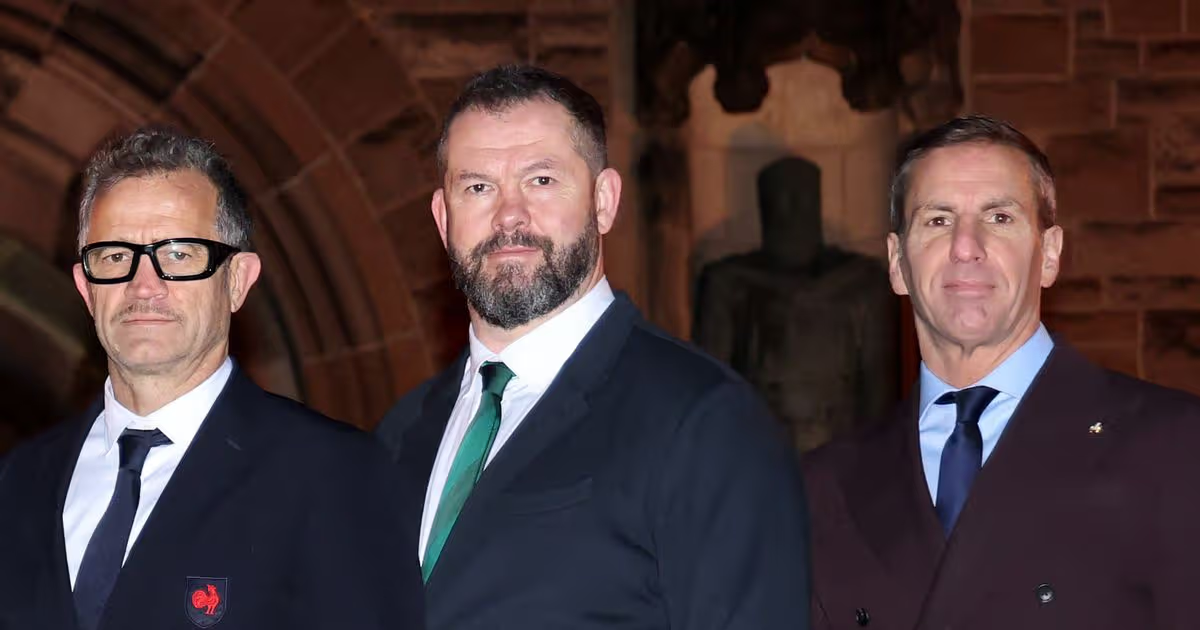
Ireland head coach Andy Farrell says the racist abuse aimed at lock Edwin Edogbo following his Test debut is “disgusting”, as he backed the 23-year-old to “crack on and ignore all the BS”.

The Munster star was targeted on social media after winning his first cap for his country in their 20-13 Six Nations win over Italy in Dublin last weekend, having come off the replacements’ bench in the 70th minute.

After Edogbo – who was born and raised in County Cork to Nigerian parents – was subjected to racist abuse, the Irish Rugby Football Union has launched an investigation.

Farrell, who on Thursday named his team to face England this weekend, condemned the abuse against his player as he said there is “no need for it in society”.

Advertisement

“First and foremost, it’s all about the player, nothing but about how he is and how it’s affecting him or not,” he told reporters. “We’ve had the conversation and he’s fine, thankfully. But it’s obviously disgusting. There’s no need for it in society.

“I didn’t read it. I don’t want to read it, I don’t want to give people anything to even think that I’m even commenting on some of the stuff that has been said really because they certainly don’t deserve that.

“But as far as I’m concerned, Edwin’s fine, he’s strong, he’s been brought up in the right way,” Farrell added. “We met his family last week, his mother and his two brothers and his sister.

“His father couldn’t make it because he works all hours God sends as an A&E nurse there down in Cork, which says it all. He’s made of the right stuff, and that’s why he’s able to just crack on and ignore all the BS.”

Advertisement

Returning Scotland duo ‘hugely determined’

By Anthony Brown, Press Association

Gregor Townsend expects Blair Kinghorn and Duhan van der Merwe to be fuelled by “huge determination” against Wales after they were restored to Scotland’s starting XV for Saturday’s Guinness Six Nations clash in Cardiff.

The British and Irish Lions duo were high-profile omissions from the 23 for the first two championship matches against Italy and England amid question marks about their form.

Toulouse back Kinghorn will start at full-back in place of Tom Jordan, who drops to the bench, while Van der Merwe, Scotland’s record try-scorer, returns at wing to take over from Jamie Dobie, who is out due to injury.

Advertisement

“Blair was back playing on Sunday night for Toulouse so it’s good to get an outlet when you’ve not been selected,” said head coach Townsend after naming his squad to face Wales.

“He played really well in that game and he’s recovered quickly after that evening game. Duhan’s trained really well and very much been part of our squad, so there’ll be a freshness around both of them coming back in and huge determination to play well.

“Like any player, you want to be part of the squad and for those players that have been in our squad for a few years, it’ll be tough for them to take.

“But they’ve backed the team and they understand the reasons why we had different selections going into our opening two games. And now they have an opportunity to represent their country again.”

Advertisement

There are three further changes to the Scotland XV that started the 31-20 victory over England last weekend – all of them in the pack.

Dave Cherry replaces George Turner at hooker, with the latter dropping to the bench.

Back-rowers Jamie Ritchie and Jack Dempsey miss out through injury, with Matt Fagerson coming in at number eight and the versatile Gregor Brown, who started in the second row last weekend, moving to blindside flanker. Glasgow lock Max Williamson comes in to take Brown’s place in the second row.

Scotland, who have been training in Spain this week, are hot favourites to defeat an ailing Wales side who have lost heavily to France and England in their opening two matches.

Advertisement

“I’m sure last week a lot of people thought England were clear favourites (against Scotland), so the game is not about predictions and previous form,” said Townsend. “It’s a lot about what you do in those 80 minutes, and we’ve got to make sure that we get our game out.”

Dropped star ‘will bounce back’

By Edward Elliot, Press Association

Ireland boss Andy Farrell backed Sam Prendergast to bounce back from being dropped as he admitted neither of his leading fly-halves were in particularly good form ahead of the Guinness Six Nations.

Prendergast has been left out of the matchday squad for Saturday’s round-three clash away to England following a tough outing in last weekend’s tense 20-13 win over Italy.

Advertisement

Jack Crowley will start at Twickenham after his impressive cameo against the Azzurri, with Ciaran Frawley providing back-up from the bench. Prendergast, 23, began six of Ireland’s last seven Six Nations fixtures and has been overlooked for a matchday 23 in the championship for the first time.

“Sam’s a fantastic international player,” head coach Farrell told a press conference, according to the Irish Independent. “He’s on a journey that’s obviously learning like all of us. That will never stop. It’s the same for Ciaran Frawley.

“We’ve talked all along about the four lads (Crowley, Prendergast, Frawley and Harry Byrne) competing against one another and the balance is right for this team this weekend. Everyone gets feedback and we talk it through and we use it in the right manner to see where we’re going to go in the not too distant future.

“I think the two lads (Prendergast and Crowley) probably came into camp, I think they’ve probably been in better form. I’m not saying they were in bad form, but you see during training which way that you’re going to go through performance.”

Advertisement

Crowley played every minute of Ireland’s triumphant 2024 Six Nations campaign but his only start in the tournament following Prendergast’s Test debut in November of that year came away to Italy last March.

The 26-year-old will partner recalled scrum-half Jamison Gibson-Park as part of five personnel changes, with prop Tadhg Furlong and back-rows Tadhg Beirne and Josh van der Flier also returning.

Asked why he opted for Crowley, Farrell said: “Because of what we’ve seen and how he’s come through and performed and playing confidently. You back what you see and all of that.

“I suppose sometimes you see people come from the back, have nothing to lose and then just rip in. And we’ve not just seen that with Jack, we’ve seen it with James Ryan – not selected to start in the first game, came on against France (a 36-14 loss) and had a storming game and has continued that.

Advertisement

“I saw that with James as well with the (British and Irish) Lions, when he was behind the eight ball there with a quad injury and he was chasing his tail to try and get into the squad and played his best rugby within that tour.

“That’s because people are able to sit back a bit, make sense of it and rip into the performance. I think you saw that with Jack’s performance last week.”

Versatile Frawley is poised to win his first international cap – and 10th overall – since coming on at centre in last summer’s 106-7 demolition of Portugal.

“He’s 100 per cent excited,” Farrell said of the 28-year-old. “He’s been certainly frustrated with the lack of game time, certainly in the autumn. From what we’ve seen in training, how sharp he is and how eager he is to get going and the balance that he gives us on the bench, he’ll be ready to go.”


Advertisement

Source link

Continue Reading
Click to comment

Leave a Reply

Your email address will not be published. Required fields are marked *

NewsBeat

Everything you need to know after Rachel Reeves visits Manchester synagogue attacked by terrorist

Published

on

Manchester Evening News
Everything you need to know after Rachel Reeves visits Manchester synagogue attacked by terrorist – Manchester Evening News

reach logo

At Reach and across our entities we and our partners use information collected through cookies and other identifiers from your device to improve experience on our site, analyse how it is used and to show personalised advertising. You can opt out of the sale or sharing of your data, at any time clicking the “Do Not Sell or Share my Data” button at the bottom of the webpage. Please note that your preferences are browser specific. Use of our website and any of our services represents your acceptance of the use of cookies and consent to the practices described in our Privacy Notice and Terms and Conditions.

Source link

Continue Reading

NewsBeat

can Bitcoin ransom demand be used to track down the criminals?

Published

on

can Bitcoin ransom demand be used to track down the criminals?

The kidnapping of Nancy Guthrie – the mother of US news anchor Savannah Guthrie – is the latest in a string of crimes where ransoms have been demanded in Bitcoin.

The 84-year-old was kidnapped from her home in Tucson, Arizona, in the middle of the night. A ransom of US$6 million (£4.4 million) has been demanded by the kidnappers.

The scale of the ransom demand, combined with the use of cryptocurrency as the payment mechanism, raises a critical question: although Bitcoin is not inherently untraceable, can the perpetrators ultimately profit without being identified?

Bitcoin is a decentralised digital currency, commonly referred to as a cryptocurrency, and is often believed to be anonymous, private and untraceable.

Advertisement

This perception has made Bitcoin attractive to some criminals, who view it as a convenient mechanism for receiving, transferring and storing payments.

As a result, Bitcoin has become increasingly associated with criminal activity, including extortion, kidnapping, fraud, ransomware and even murder.

The Guthrie case has once again drawn attention to the darker associations surrounding Bitcoin and reinforced public anxiety about cryptocurrency and its use for nefarious purposes.

At the same time, a number of high profile kidnappings around the world in 2025, involving people known to hold cryptocurrency, has intensified these concerns.

Advertisement

A common perception is that, because Bitcoin is digital, tracking transactions is difficult. Bitcoin does not exist in a physical form; it is represented as entries on the Bitcoin blockchain – a decentralised ledger used to record transactions across a network of computers. So Bitcoin is not inherently untraceable; its blockchain is transparent and permanently recorded.

Transactions do not explicitly list names, but each transaction is publicly visible and traceable between wallet addresses. Ownership is controlled through private keys and managed via a “digital wallet”, which functions conceptually like a traditional wallet in that it stores and enables the transfer of value. Thus, Bitcoin is more accurately, pseudonymous, not anonymous.

Currency conversion

In the Guthrie case, the immediate practical challenge for the kidnappers would be converting US$6 million into Bitcoin and transferring the cryptocurrency to a digital wallet. From there, the funds would need to be sent to a wallet address specified by the perpetrators – assuming the kidnappers provide such an address.

Transactions conducted through regulated cryptocurrency exchanges that impose know-your-customer checks may expose participants. These checks are mandatory processes to confirm user identities with official IDs, proof of address, and facial recognition.

Advertisement

Even before the funds reach the kidnappers, the transaction through a cryptocurrency exchange may itself create identifiable records. However, there is no guarantee of this, as there are many unregulated exchanges that operate in jurisdictions with lenient legislation.

Guthrie was reported missing on February 1 from her home near Tucson, Arizona.
Alamy (AP)

While Bitcoin transactions are traceable between wallet addresses, the kidnappers in this case may attempt to enhance anonymity through layered technical measures. These may include generating a new wallet address for each transaction, operating multiple wallets, and repeatedly transferring funds from a primary wallet through successive intermediary wallets to obscure transaction links.

Maintaining anonymity also requires avoiding any association between wallet addresses and personal information, refraining from interacting with other identifiable people, and using privacy-enhancing tools such as Tor/VPNs – software that masks a user’s location – and coin-mixing services, which enhance privacy by scrambling cryptocurrency funds with others to obscure links between senders and receivers.

Achieving this level of operational security demands significant technical knowledge and strict discipline from the kidnappers. Any human error, whether through identity exposure, exchange interaction, IP logging, or conversion into hard cash may compromise anonymity.

Advertisement

Ultimately, the critical issue is not merely tracing funds but determining how recipients convert or use the Bitcoin without triggering identification through regulatory checkpoints, forensic analysis, or operational mistakes.

Even if the US$6 million could be traced between wallet addresses, anonymity hinges on whether those addresses can be linked to real-world identities. Where wallet holders remain unidentified and operate outside regulated exchanges, investigative challenges increase.

Additional complications arise if the perpetrators operate outside the US. Cross-border enforcement faces limitations including variation in crypto-related legislation and regulation, uneven training in tracing and confiscation, and limited international coordination.

Whether perpetrators can ultimately be reached by law enforcement depends significantly on their jurisdiction and the degree of international cooperation.

Advertisement

Source link

Continue Reading

NewsBeat

Why it’s funnier when you’re not allowed to laugh

Published

on

Why it’s funnier when you’re not allowed to laugh

I don’t think I’ve ever laughed harder than during a church service, when something faintly ridiculous caught my eye. My friend saw it too, and once she started laughing, it became impossible to stop. Years later I’ve tried to explain what was so hilarious, but it seems you had to be there. What was it about the combination of the situation – sometimes referred to as “church giggles” – and shared laughter that made it so funny?

Most people recognise the experience. A solemn setting. Absolute silence. A fleeting visual detail that is, in any other context, only mildly amusing at best. Yet the harder you try to suppress the laugh, the more uncontrollable it becomes. When someone else notices it too, restraint becomes next to impossible.

This kind of laughter that comes from trying not to laugh isn’t confined to religious spaces. It happens in any setting where silence, seriousness and self-control are tightly enforced and uncontrolled laughter is frowned upon.

Rather than being bad manners or a lack of emotional maturity, it tells us something about how the brain behaves under pressure. The science behind it is surprisingly complex.

Advertisement

In highly formal settings – churches, courtrooms, funerals – the brain operates in a state of active inhibition. This is the process by which your brain deliberately suppresses brain activity.

The region most involved is the prefrontal cortex, the thinking and decision-making part at the front of your brain, particularly its medial and lateral areas. These areas handle social judgment, behavioural restraint and emotional regulation.

This part of the brain doesn’t stop emotions from arising. Instead, it works by suppressing their outward expression.

Laughter comes from a distributed network in the brain rather than a single “laughter centre”. The impulse begins in the outer regions of the brain, but the emotional drive comes from deeper structures in the limbic system, the emotional processing centre of the brain.

Advertisement

The limbic system includes the amygdala, an almond-shaped structure that processes emotions and assigns emotional importance to things, and the hypothalamus, which controls automatic body functions like heart rate and breathing. Once laughter gets released, circuits in the brainstem – the base of the brain that connects to the spinal cord – take over and coordinate facial expression, breathing and vocalisation.

This makes laughter difficult to stop voluntarily. The prefrontal cortex normally keeps this response in check, suppressing laughter when it’s socially inappropriate.

When that control weakens – through heightened arousal or shared social cues – laughter emerges as an automatic, reflex-like behaviour. It’s no longer a deliberate act.

In other words, the impulse to laugh and the effort to stop yourself come from different parts of the brain. They’re competing with each other.

Advertisement

When something unexpected or odd catches your eye, your emotional response fires rapidly and automatically. The process to control it takes effort, burns energy, and is prone to failure, especially when you have to maintain it for long periods.

The more firmly you try to exert control, the more the trigger stays active in your attention. Suppression doesn’t erase the thought – it actually rehearses and sustains it.

Laughter isn’t just a response to humour. Neurologically, it also functions as a regulatory reflex – a way of releasing emotional and physical tension.

In constrained environments, your nervous system has few outlets. You can’t move, you can’t speak, you can’t shift position much or signal discomfort.

Advertisement

At the same time, your automatic nervous system becomes slightly activated. Your heart rate increases, your breathing becomes shallower and your muscle tone rises.

This combination lowers the threshold for emotional release. Your body becomes primed to let something out.

Once laughter begins, it recruits automatic motor pathways in the brainstem that you can’t easily interrupt. This is why laughter, once triggered, often feels physically unstoppable.

You’re no longer “deciding” to laugh. The system has taken over and you’re helpless.

Advertisement
Once triggered, it feels unstoppable.
Tom Brogan/Alamy

The contagion takes hold

For many people, the tipping point isn’t the original trigger. It’s the instant someone else notices it as well.

This is where social neurobiology comes into play. Humans are highly sensitive to subtle social cues: facial tension, changes in breathing, suppressed smiles.

We process these cues rapidly through networks involving the superior temporal sulcus, a groove along the side of the brain that plays a key role in reading other people. Mirror neurons – brain cells that fire both when we act and when we watch others act – also help us pick up on these signals.

Laughing together represents a shared emotional alignment. That shared recognition does two things at once.

Advertisement

It validates your own response (I’m not imagining this). And it removes the sense of solitary transgression (you’re no longer suppressing alone).

The prefrontal control system weakens further. Laughter spreads through emotional contagion.

By this point, the original trigger hardly matters. What you’re laughing at is each other, and the absurdity of trying to regain control.

These moments are often triggered by something visual, but they don’t have to be. A mispronounced word or an unexpected phrase can provoke the same response.

Advertisement

However, visual triggers are especially potent in silent settings. They can’t be interrupted or talked away, and your brain can replay them repeatedly while suppression is in place.

Spoken triggers, by contrast, tend to be shared instantly. Whether laughter erupts depends on how quickly social inhibition can be re-established.

“Inappropriate” laughter is often framed as rudeness or childishness. But from a neurological perspective, it’s a predictable consequence of prolonged emotional suppression in a social species.

The brain is not designed for sustained inhibition without release. When restraint is tight enough – and when someone else is there with you – laughter becomes the escape route. That is why it feels impossible to stop.

Advertisement

Source link

Continue Reading

NewsBeat

Why has Andrew Mountbatten-Windsor been arrested, and what legal protections do the royal family have?

Published

on

Why has Andrew Mountbatten-Windsor been arrested, and what legal protections do the royal family have?

Andrew Mountbatten-Windsor has been arrested on suspicion of misconduct in public office. The arrest comes after the US government released files that appeared to indicate he had shared official information with financier and convicted child sex offender Jeffrey Epstein while serving as a trade envoy for the UK. But the police have not given details of exactly what they are investigating.

It is important to be clear that the arrest is not related to accusations of sexual assault or misconduct. In 2022, Mountbatten-Windsor reached a settlement with the late Virginia Giuffre for an undisclosed sum that did not include an admission of liability.

Being named in the Epstein files is not an indication of misconduct. Mountbatten-Windsor has previously denied any wrongdoing in his association with Epstein and and has previously rejected any suggestion he used his time as trade envoy to further his own interests.

What was Mountbatten-Windsor’s official role and why did he lose it?

In 2001, Tony Blair’s government made the then-prince the UK’s special representative for trade and investment. According to the government at the time, his remit was to “promote UK business internationally, market the UK to potential inward investors, and build relationships in support of UK business interests”. He did not receive a salary, but he did go on hundreds of trips to promote British businesses.

Advertisement

Members of the royal family are often deployed by the government on international missions to promote trade. When negotiating with other countries, particularly those which are also monarchies, sending a prominent figure like a royal may help seal the deal. Indeed, the then-government claimed that the former Duke of York’s “unique position gives him unrivalled access to members of royal families, heads of state, government ministers and chief executives of companies”.

It is not unusual for members of the royal family to be deployed by the government for diplomatic missions. Royals often host incoming state visits and lead similar visits abroad, and can be deployed to lead delegations on more specific missions.

However, Mountbatten-Windsor had an official role as trade envoy. He stepped down from this role in 2011 following reports about his friendship with Epstein, who was convicted of sex offences in 2011.


À lire aussi :
What exactly is misconduct in public office and could Peter Mandelson be convicted?

Advertisement

Are royals protected from prosecution?

The monarch is protected by sovereign immunity, a wide-ranging constitutional principle exempting him from all criminal and civil liability. According to the leading 19th century constitutionalist Alfred Dicey, the monarch could not even be prosecuted for “shooting the Prime Minister through the head”. The Prince of Wales also enjoys immunity as Duke of Cornwall, which protects him from punishment for breaking a range of laws.

The State Immunity Act 1978, which confers immunity on the head of state, also extends to “members of the family forming part of the household”. However, this phrase has been interpreted narrowly to apply to a very tight circle of people and does not appear to apply to the monarch’s children in general. For example, in 2002 Princess Anne was prosecuted (though not arrested) for failing to control her dogs in Windsor Great Park after they bit two children.

Nevertheless, there has often been a perception that members of the royal family are held to a different standard when it comes to the law. In 2016 Thames Valley Police were criticised by anti-monarchy groups for not prosecuting the then-prince after newspaper reports alleged he had driven his car through the gates of Windsor Great Park. In 2019 the Crown Prosecution Service declined to prosecute Prince Philip for causing a car crash which injured two people.

The monarch also cannot be compelled to give evidence in court. For example, prosecutors were unable to summon the late queen to give evidence in the trial of Princess Diana’s former butler, who was accused of stealing her jewellery.

Advertisement

In response to Mountbatten-Windsor’s arrest, the king said: “What now follows is the full, fair and proper process by which this issue is investigated in the appropriate manner and by the appropriate authorities. In this, as I have said before, they have our full and wholehearted support and co-operation. Let me state clearly: the law must take its course.”

When was the last time a royal was arrested?

You have to go back quite a long way to find the last time that a member of the British royal family was arrested. This was during the English civil war, when Charles I was taken prisoner for treason before being found guilty and ultimately executed in 1649.

A number of royals, including Princess Anne, have committed driving-related offences, including speeding. But this arrest makes Mountbatten-Windsor the first member of the royal family to be arrested in modern times, though it should be noted that he is no longer a royal – he was stripped of all his official titles in October 2025 as his friendship with Epstein came under even more scrutiny.

The former prince, pictured in 2019.
PjrNews/Alamy

What limits do police have on investigating royal estates?

Sovereign immunity also prevents police from entering private royal estates to investigate alleged crimes without permission. This can, theoretically, protect members of the royal family from arrest and prosecution. The Cultural Property (Armed Conflicts) Act 2017 also bans police from searching royal estates for stolen or looted artefacts.

Advertisement

In 2007, two hen harriers were illegally shot at Sandringham estate. However, Norfolk Police first needed to ask Sandringham officials for permission to enter the estate, by which time the dead birds’ bodies had been removed. Police questioned Prince Harry, but did not bring charges.

Other incidents have allegedly led to Sandringham being accused of becoming a wildlife crime hotspot, with at least 18 reported cases of suspected wildlife offences taking place between 2003-23 – yet only one resulting in prosecution.

Another longstanding legal precedent is that no one may be arrested in the presence of the monarch or within the precincts of a royal palace. It was thought that this rule could protect other members of the royal family and royal employees. However, Mountbatten-Windsor’s arrest at Sandringham suggests that this antiquated principle may no longer hold true today.

Advertisement

Source link

Continue Reading

NewsBeat

Exactly which benefits claimants qualify for free NHS dental treatment

Published

on

Cambridgeshire Live

Some people in England are entitled to free NHS dental care including those on Universal Credit, Pension Credit and other key benefits

Visiting the dentist isn’t exactly everyone’s favourite activity. And with routine check-ups typically costing £27.40, it’s easy to see why many individuals skip them altogether.

However, you may be surprised to discover that certain people living in England could be eligible for free dental appointments and treatments via the NHS. This particularly applies to those within a particular age range and anyone in receipt of several key benefits from the Department for Work and Pensions ( DWP ).

Below, The Express has explored who is eligible for this and what steps you can take next. If you’ve paid for NHS dental treatment but discover you are entitled to free appointments, you may also be eligible for a refund.

Advertisement

Who can receive free NHS dental appointments and treatment in England?

According to the NHS, there are five categories of individuals who automatically qualify for complimentary NHS dental care. These specifically include the following:

  • You’ve had a stillbirth in the past 12 months
  • You’re getting treatment in an NHS hospital from a hospital dentist (but you may still need to pay for dentures or bridges)
  • You receive War Pension Scheme payments, or Armed Forces Compensation Scheme payments and the treatment is for your accepted disability
  • You’re aged under 18, or under 19 and in full-time education
  • You’re pregnant or have had a baby in the last 12 months

In addition to this, you might qualify if you or your partner is in receipt of at least one of six benefits. Dependants under 20 years old may benefit from this as well, provided you are claiming:

  • Pension Credit Guarantee Credit
  • Pension Credit Guarantee Credit with Savings Credit
  • Universal Credit – but only if your income is below a certain amount
  • Income Support
  • Income-based Jobseeker’s Allowance
  • Income-related Employment and Support Allowance

It’s important to remember that these rules only apply to NHS dental treatments.

If you opt for private care, you’ll be liable for the cost. Usually, you’ll also need to provide proof of eligibility for free NHS care, although this may differ depending on your exemption basis.

Examples of evidence accepted by the NHS include:

  • A valid maternity exemption certificate
  • A maternity certificate (MatB1)
  • A notification of birth form, or your baby’s birth certificate
  • A stillbirth certificate
  • A valid HC2 certificate – available for people on a low income
  • Your birth certificate

However, official NHS guidance states: “If you receive War Pension Scheme or Armed Forces Compensation Scheme payments and get free dental treatment, you’ll usually need to pay for it yourself first and claim the money back from Veterans UK.”

How can I confirm my eligibility?

If you believe you’re eligible for free NHS dental care, visit the NHS Business Services Authority (NHSBSA) website to verify. The site offers a free eligibility check that typically takes about three minutes to complete.

Advertisement

If you’re eligible, it will guide you through the steps to claim support. Anyone who thinks they have been incorrectly charged for NHS dental appointments could be entitled to a refund.

What is the NHS Low Income Scheme?

Even if you don’t qualify for free dental care, you might still be able to receive financial help through the NHS Low Income Scheme. This scheme not only covers dental visits but also helps with other essential costs like prescriptions, eye tests, wigs, and travel expenses for treatment.

The amount you’re eligible to receive largely depends on your weekly income, savings, and essential outgoings at the time of application. You can only apply online if you have no capital or savings exceeding £6,000, and must also meet at least one of the following criteria:

  • Receiving state benefits
  • Living in a care home
  • A pensioner
  • A student
  • Earning a wage

Guidance from the NHSBSA states: “If the amount you have left is low, you may be able to get help through the NHS Low Income Scheme. Any help you’re entitled to is also available to your partner, if you have one.

“If you have already paid for treatment, you can apply for a refund at the same time as you apply for the scheme. We will normally assess your application within 18 working days from the date we get your form.”

Advertisement

For further details on the support available, visit the NHSBSA website here.

Source link

Continue Reading

NewsBeat

‘Least Royal Family can do is apologise for turning blind eye to Andrew’s abuse of power’

Published

on

Daily Mirror

“Today the king insisted that what now follows must be a ‘full, fair and proper’ investigation by the ‘appropriate’ authorities, but there was no mention of an ‘appropriate’ response from the Royal Family”

We can pretend he isn’t royal, and stumble over his new, long-winded ‘Mountbatten-Windsor’ nomenclature, but Andrew is the son of a monarch, born in Buckingham Palace 66 years ago, and he remains 8th in line to the throne.

So while reports confirm that in an unprecedented move, the former prince was arrested this morning on suspicion of misconduct in a public office, lets not fool ourselves that Andrew is no longer royal. It was precisely because of his privileged position the former Prince was ‘anointed’ trade envoy in the first place – a sop to the late Queen from the Blair Administration in 2001 after a difficult royal decade.

Advertisement

The Windsor family’s popularity tanked in the 1990s (having polled at over 80% support during the ‘80s) in the wake of infidelity scandals, three royal divorces and Diana’s tragic death. But those dark days don’t begin to compare with the current Epstein quagmire into which the former prince has dragged his family.

Ensure our latest headlines always appear at the top of your Google Search by making us a Preferred Source. Click here to activate or add us as your Preferred Source in your Google search settings.

Very small fry in comparison with today’s grotesque public unravelling of a former Prince. For far too long Andrew has been able to weaponise his royal privilege to push back against his accuser and to protect himself from legal scrutiny. Today he remains in police custody on potential charges of misconduct in a public office, but so many questions remain unanswered.

We still don’t know where the money came from that paid off Virginia Giuffre in 2022, when she accused Andrew of sexual assault under New York’s Child Victim’s Act, or how much the royal family knew about Andrew’s activities with Epstein more broadly. The latter’s female accusers have done so much to move this story forward and hold powerful men to account, surely it is time that our royal family also stepped up to the plate?

Today the king insisted that what now follows must be a ‘full, fair and proper’ investigation by the ‘appropriate’ authorities, but there was no mention of an ‘appropriate’ response from the Royal Family.

Advertisement

The late Queen protected her son Andrew, the institution of monarchy batted away questions concerning the Duke of York’s alleged misconduct since 2011 and Buckingham Palace was the address from which Andrew platformed his lies on the BBC in 2019.

Beyond what happens to their ‘ex-royal’ brother, surely the least the Royal Family can do is apologise for consistently turning a blind eye to former Duke of York’s extensive abuse of power.

Source link

Advertisement
Continue Reading

NewsBeat

Single vaccine could protect against all coughs, colds and flus, researchers say

Published

on

Single vaccine could protect against all coughs, colds and flus, researchers say

Pulendran told the BBC: “This vaccine, what we term a universal vaccine, elicits a far broader response that is protective against not just the flu virus, not just the Covid virus, not just the common cold virus, but against virtually all viruses, and as many different bacteria as we’ve tested, and even allergens.

Source link

Continue Reading

NewsBeat

Eddie Hearn reveals Anthony Joshua return date – and it’s sooner than expected

Published

on

Eddie Hearn reveals Anthony Joshua return date - and it's sooner than expected
Joshua will return to the ring this year (Picture: Getty)

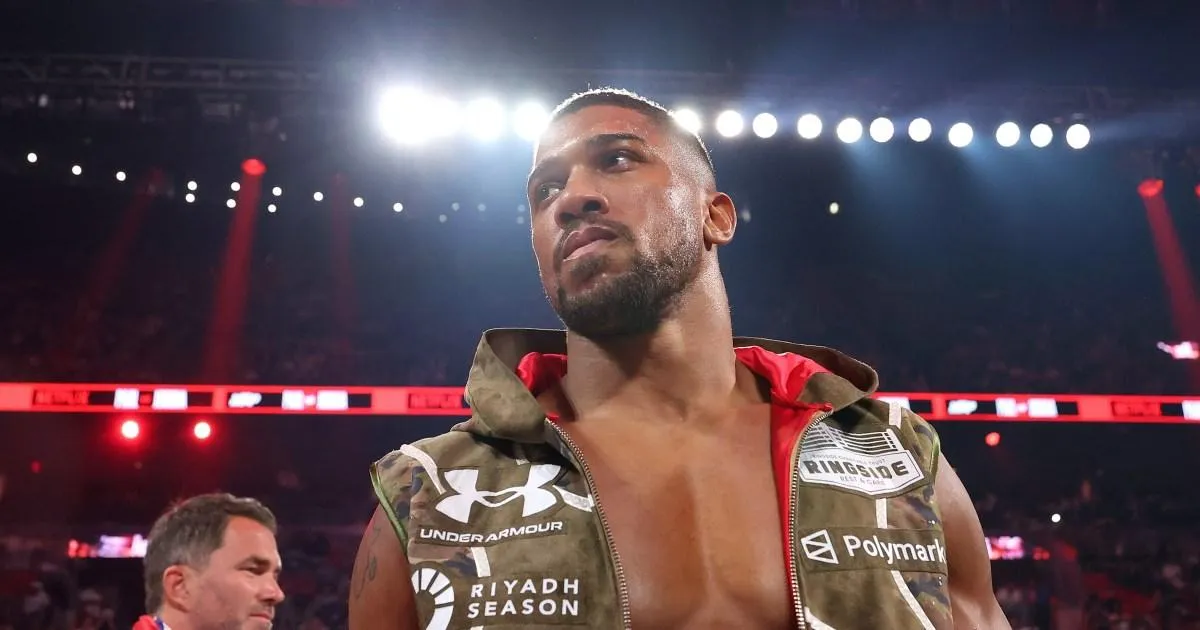
Eddie Hearn is planning for Anthony Joshua to make his return to boxing in July following the death of his two close friends at the end of 2025.

Joshua knocked out Jake Paul in devastating fashion in December and was set for a huge 2026 until tragedy struck four days after Christmas.

The two-time heavyweight champion was on holiday in Nigeria when he was involved in a fatal car crash that claimed the lives of two of his closest friends Sina Ghami and Latif Ayodele who were also long-time members of his team.

Joshua miraculously escaped with only minor injuries having swapped seats with Aoydele shortly before their SUV crashed into the back of a stationary truck.

Advertisement

Joshua has not publicly discussed a return to boxing since the accident but has been seen back in training in the Middle East where he now resides.

Hearn, who has promoted Joshua since he turned professional after the 2012 Olympics, has been careful not to put any timeline on the heavyweight’s return during his physical and mental recovery.

But a firmer plan now appears to be in place.

Joshua lost his close friends Sina Ghami and Latif Ayodele in the crash.

‘Originally the plan with ‘AJ’ was for him to fight in March and then fight Tyson Fury in August,’ Hearn told BoxingScene.

‘That’s not happening. He’s not fighting Tyson Fury next. He’s going to come back, I believe, in late summer, but physically he’s not yet in a position to return to camp.

Advertisement

‘So, I’m planning, but he’s just resting and preparing. So, for me, I’m looking at options to get him back in the ring in July time, but we’ll only know if that’s a real possibility when he returns to camp, which will hopefully be in the next couple of weeks or a month.’

Who will Anthony Joshua fight when he returns to boxing?

Anthony Joshua vs Tyson Fury is a fight that has fallen by the wayside countless times over the last six years but there was renewed hope it would take place in 2026 last year.

Anthony Joshua v Daniel Dubois: Riyadh Season - Wembley Edition
Fury will return to action in April (Picture: Getty)

Joshua’s accident derailed those plans with Hearn confirming Joshua will not mark his return against ‘The Gypsy King’ – who will fight Russian giant Arslanbek Makhmudov in April.

‘I think every fight’s dangerous coming off what he’s come off, but, yeah, I think we’re open to the Tyson Fury fight, but probably that’s more likely end of the year – maybe early 2027,’ Hearn said.  

Advertisement

Source link

Advertisement
Continue Reading

NewsBeat

Police statement in full as former prince Andrew seen for first time since arrest

Published

on

Wales Online

Thames Valley Police confirmed the former prince had been arrested on suspicion of misconduct in public office on Thursday, following the release of the Epstein files

Andrew arriving back at his house

Andrew Mountbatten-Windsor has left a police station after being released under investigation following his arrest on Thursday morning.

Thames Valley Police said on Thursday evening: “Thames Valley Police is able to provide an update in relation to an investigation into the offence of misconduct in public office. On Thursday we arrested a man in his sixties from Norfolk on suspicion of misconduct in public office.

Advertisement

“The arrested man has now been released under investigation. We can also confirm that our searches in Norfolk have now concluded.”

The force said its searches in Berkshire are still underway, and that it would make no further statement at this time, according to the Mirror.

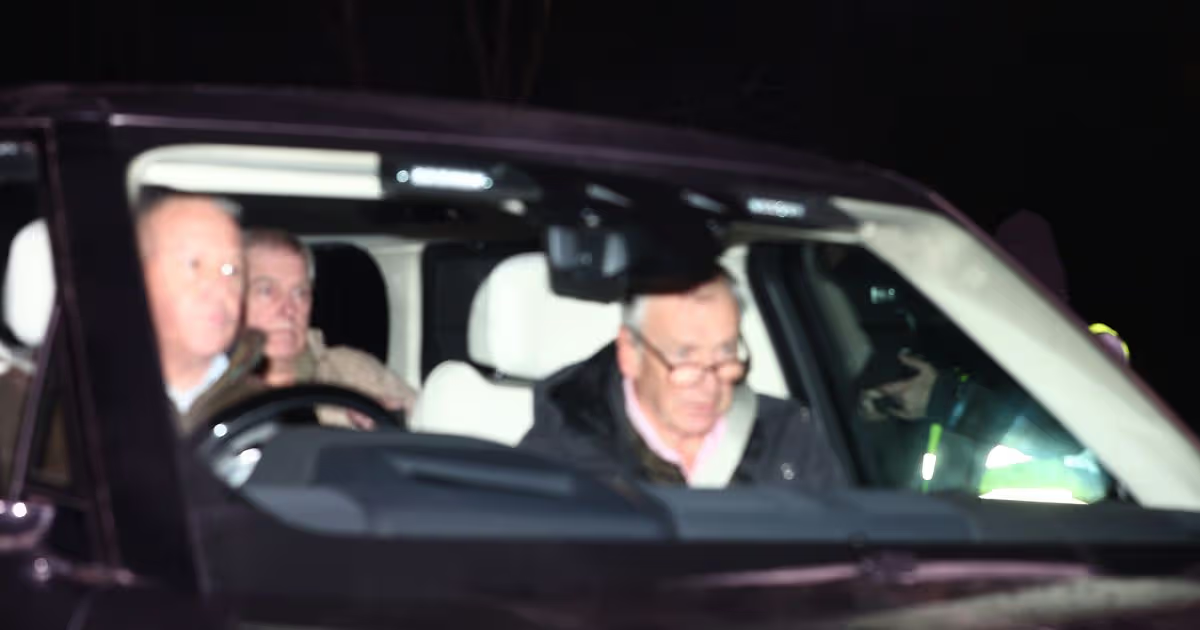
Andrew was pictured reclining in the back seat of a car almost 12 hours after his arrest. Ensure our latest news and sport headlines always appear at the top of your Google Search by making us a Preferred Source. Click here to activate or add us as Preferred Source in your Google search settings.

Thames Valley Police confirmed earlier on Thursday that the former prince had been arrested on suspicion of misconduct in public office following allegations arising out of the release of millions of pages of files related to paedophile financier Jeffrey Epstein.

Advertisement

Andrew, who was taken into police custody on his 66th birthday, has previously strenuously denied any wrongdoing in respect of allegations arising out of his links to and relationship with Epstein, but has not directly responded to the latest allegations.

Previously, Assistant Chief Constable Oliver Wright said: “Following a thorough assessment, we have now opened an investigation into this allegation of misconduct in public office.

Advertisement

“It is important that we protect the integrity and objectivity of our investigation as we work with our partners to investigate this alleged offence.

“We understand the significant public interest in this case, and we will provide updates at the appropriate time.” It is understood neither the King nor Buckingham Palace was informed in advance of Andrew’s arrest.

In response to the arrest, Charles said: “I have learned with the deepest concern the news about Andrew Mountbatten-Windsor and suspicion of misconduct in public office.

“What now follows is the full, fair and proper process by which this issue is investigated in the appropriate manner and by the appropriate authorities. In this, as I have said before, they have our full and wholehearted support and co-operation. Let me state clearly: the law must take its course.”

Advertisement

A number of police forces across the UK are assessing information released as part of the Epstein files document dump. Officers from Surrey, Bedfordshire, Essex, Norfolk, the West Midlands, Wiltshire and Scotland have all said they are reviewing information.

Get daily breaking news updates on your phone by joining our WhatsApp community here. We occasionally treat members to special offers, promotions and ads from us and our partners. See our Privacy Notice.

Source link

Advertisement
Continue Reading

NewsBeat

Winter Olympics 2026: GB’s men into curling semi-finals but women edged out

Published

on

Standings

The women’s team – European silver medallists last year – had really grown into this tournament since losing their opening two matches.

Needing three closing wins to put themselves into the semi-final conversation, they snatched an incredible final-stone win over the United States and executed a composed dismantling of Japan – both on Wednesday.

Italy – their closing round-robin opponents – were below them in the standings but had also belatedly found form and wanted to end their home Games in style.

Morrison’s rink controlled throughout, though.

Advertisement

They were 4-1 ahead after four ends and, although the Italians did cut that lead, the Scottish quartet managed the game well and eased clear again late on to earn a fifth win in their last seven matches.

However, after the immediate celebrations, they could only watch on askance as the already-qualified Swiss fell just short in the extra end and allowed the US to dash the British team’s dreams of an incredible medal with a 7-6 win.

“We’re absolutely gutted by so, so proud,” skip Sophie Jackson told BBC Sport, standing next to her tearful team-mates. “We have a tough start to the week and we did everything but we could but just left it too late.”

Source link

Advertisement
Continue Reading

Trending

Copyright © 2025