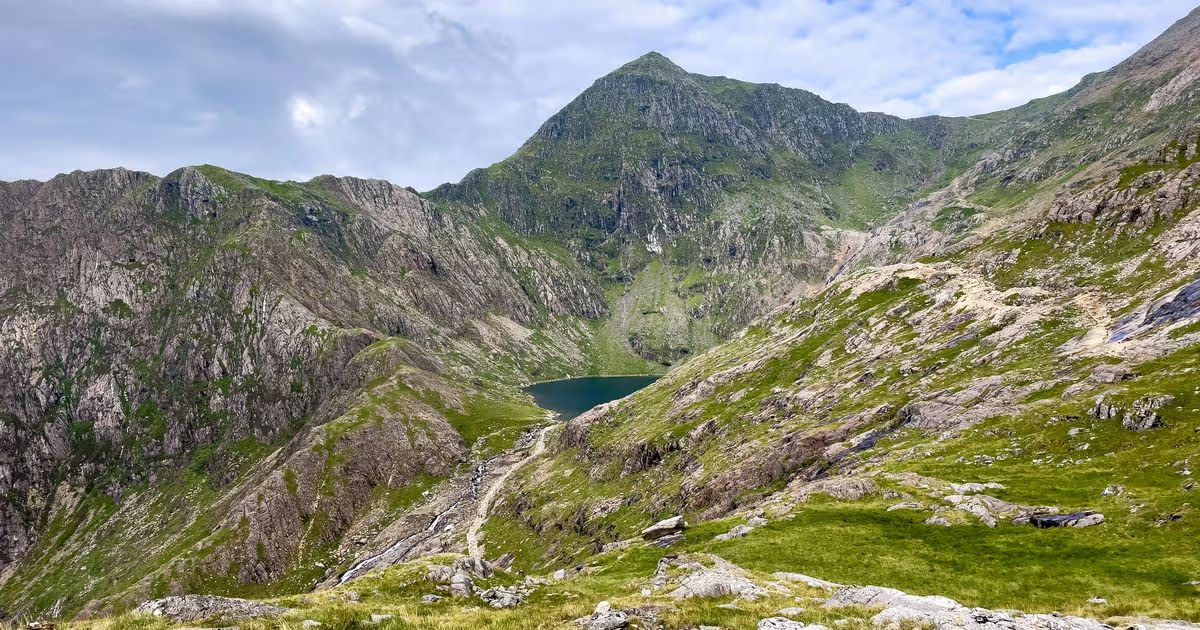
A massive rescue operation had been launched on Yr Wyddfa in Eryri National Park
The bodies of two men have been found on Snowdon after a major search operation was launched. An alert was first raised on Wednesday (February 18) after concern grew for the welfare of two men, aged 19 and 20.
Advertisement
Crews from Llanberis Mountain Rescue Team, Aberglaslyn Mountain Rescue Team, RAF Mountain Rescue Service, SARDA and HM Coastguard were deployed and carried out extensive searches on Yr Wyddfa – also known as Snowdon – until the early hours of Thursday morning. Searches resumed at approximately 8am on Thursday, 19 February on the mountain in Eryri National Park.
Bodies of the two men were tragically located and recovered as part of these co-ordinated search efforts. Both have now been formally identified, and their families have been informed, North Wales Live reports.
A police spokesperson said: “We can confirm that two bodies have been located in the Eryri mountain range during searches for two missing men, aged 19 and 20. The coroner has been notified, and we ask that the privacy of the families is respected at this difficult time.”
Advertisement
Jurgen Dissmann, Chair of Llanberis Mountain Rescue Team, said: “On behalf of Llanberis Mountain Rescue Team, I would like to extend our most heartfelt condolences to the families and loved ones of the two men who have tragically lost their lives. The team were tasked by North Wales Police and launched an extensive multi-agency operation in full winter conditions.
“Volunteers searched across challenging mountain terrain in snow and ice, working long hours through the night in difficult weather in an effort to locate the pair as quickly as possible. Despite the determined and sustained commitment of everyone involved, we are deeply saddened that, despite all efforts, the outcome was not what we had hoped for.
“I would like to sincerely thank our colleagues from Aberglaslyn Mountain Rescue Team, RAF Mountain Rescue Team, SARDA and HM Coastguard for their invaluable assistance throughout the operation.”
Advertisement
Police added: “Further updates will be provided when appropriate.”
As a last-minute packer who always stuffs my carry-on bag the night before a trip, I am curious about any way I can lessen my organising woes. According to a new viral travel hack, “sudoku packing” might be my answer for easy repeatable outfit combinations I can create with just nine anchor pieces.
Like the grid puzzle it is named after, this organising system uses three-by-three grids of a top, bottom and layering piece to create a total of 27 outfits from nine pieces of clothing. If you lay it out in your bed, the combinations should look like:
Top row has top, bottom, layer
Middle row has bottom, layer, top
Bottom row has layer, top, bottom
The “sudoku packing” term has been around since 2016, but “packing sudoku” recently went viral after multiple travellersshared their own effortless combinations for trips.
Massachusetts-based travel content creator Natalie Shaquer has popularised the packing sudoku framework.
“It takes away all of that decision fatigue,” she said. Shaquer’s video on her “sudoku packing” has been seen more than 4 million times since she first shared her outfit combinations on Instagram in February.
Advertisement
Recently, Shaquer put sudoku packing to the test on a three-week trip across the globe from Australia to Dallas, Texas, and Portland, Oregon ― and she still found it to be a successful hack, defying critics who say you can’t pack for long journeys with only a carry-on luggage.
Shaquer told HuffPost that sudoku packing “actually forces you to be a little bit more intentional and a little bit more real about what you’re going to do.”
“It forces you to think about what you actually like wearing, what looks good on you, and what you’re going to need for the trip,” she said.
How To Execute Sudoku Packing
Advertisement
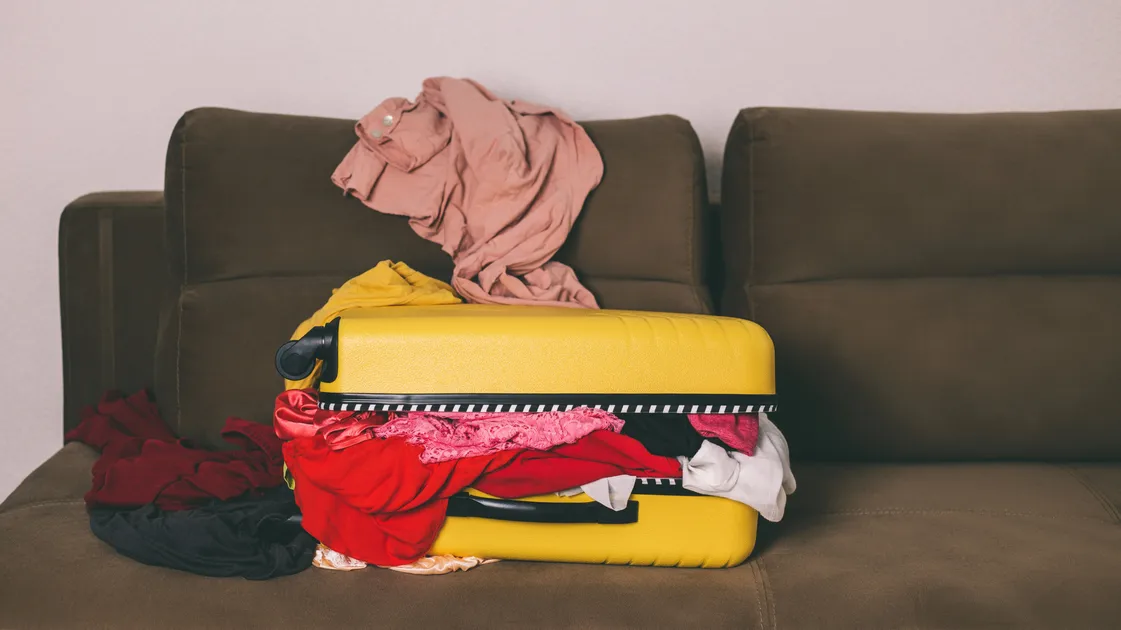
eclipse_images via Getty Images
Stressed about what to pack? Try this viral travel hack.
In the last month, Shaquer has already used this sudoku packing system for four different trips. “I think so often we like to pack for a fantasy version and not the real version,” Shaquer said. But this system pushes you to be honest about what will work for your whole trip.
“If you’ve got ten tops in your closet and you’re like, ‘This is my favorite top,’ and you lay it on the bed and it’s like, well, that top does only goes with two pairs of the pants…it doesn’t make it into the grid,” she explained.
To try this out for yourself, Shaquer suggested picking your three pairs of shoes before deciding on your outfits. For Shaquer, she likes to pick a walking shoe like white sneakers, a weather-dependent shoe like sandals or boots, and the “you shoe” that brings out her individual flair like ballet flats or stilettos.
Advertisement
After she picks her shoes, Shaquer will apply this same mentality to choosing her tops, bottoms and layers for a trip. For layers, you could do “a weather-dependent layer, a more structured layer and a cozy cardigan-type layer,” Shaquer suggested as an example. You can make your chosen clothing pieces as colorful or neutral as you need it to be, but you need to make sure they match every combination. “You’re not going to have every colour in your grid, you need to have some constraint around what you’re taking,” Shaquer suggested.
This constraint is what personal stylist Bridgette Raes recommends if you do this sudoku system. “Avoid anything overly specific or novelty-driven, because those pieces tend to limit your outfit combinations,” she said. “You can include one ‘hero’ piece, like a printed blouse or a standout colour, to anchor the palette, but everything else should support it.”
Overall, Shaquer likes playing sudoku with her closet more than the popular “5-4-3-2-1” travel hack of five tops, four bottoms, three pairs of shoes, two dresses and one set of accessories because this method has “intentional compatibility.”
“Every piece goes with every other piece,” Shaquer said. Ideally, you should give yourself an hour to sift through your clothes and pack using this method, she suggested.
Advertisement
Sudoku Packing Might Not Be For Every Trip
Lisa Zaslow, a professional organiser with Gotham Organisers, said this packing hack can be helpful because it “gives people a structure to get started.”
“Anything that prevents people from stuffing a suitcase willy nilly is a good thing,” she said.
But it might not be for everyone. “While the math might work on the sudoku method, I know I wouldn’t want only three tops for a trip that required 27 outfits,” Zaslow said. “I often wear two tops in one day while traveling. After a day roaming about or doing an activity, I need a clean top at night. And I’m not a fan of doing laundry while on vacation.”
Advertisement
More than playing sudoku with your closet, Zaslow thinks the best way to prevent overpacking is to create a packing list at least a few days before your trip. This way, you can see clearly what works and what doesn’t. “You’ll think more clearly when you’re not rushed,” she said. This cuts down on packing stress and gives you time to plan what you do ― and don’t ― need to bring.”
Shaquer said you can modify the grid system to suit your needs, and you can add additional tops if needed.
“I’m certainly not espousing that everybody needs to use this,” Shaquer said. “But if this is the kind of packing that you want to do, this is something that we have not seen before.”
President Donald Trump began his Easter Sunday with another blustery warning to Iran and claimed that U.S. forces would begin a series of strikes against Iranian civilian infrastructure targets in two days.
The U.S. president wrote early Sunday morning on Truth Social that Tuesday would be “Power Plant Day” and “Bridge Day” for American forces selecting targets in the region, adding: “Open the F***in’ Strait, you crazy b*****ds, or you’ll be living in Hell.”
“Praise be to Allah,” Trump concluded his Easter Morning statement to Americans.
U.S. forces continue to conduct strikes within Iranian airspace as the president has vowed to unleash a more devastating salvo of attacks if the key waterway which serves as a crucial passage for a large fraction of the world’s oil traffic is not opened up by Iranian forces. The closure of the Strait of Hormuz has caused global oil prices to spike past $100 per barrel.
Advertisement
There’s little sign that Trump’s threats have been effective, however, and Iranian officials maintain that peace talks are not happening in any meaningful sense. The issue has angered the president, who has spent the past week making sequentially angrier and more severe threats to Iran’s military and civilian population. Like other messages Trump has sent recently, Sunday’s indication that Trump is considering targeting Iranian civilian infrastructure is a suggestion that the U.S. military could violate international law by expanding to include non-military targets.
Donald Trump made a new threat against Iran’s infrastructure on Sunday (AP)
On Saturday, he wrote that he’d “reign down hell” on Iran if the Strait wasn’t opened, his latest messaging flub as the White House and broader administration hope to sell the president’s expanding war to a skeptical American public and Congress, where the Pentagon is asking for billions to fund the war effort.
Trump and his allies continue to insist through all of this bluster that the war is actually won already, and that Iran’s military might has been devastated.
“Never in the history of warfare has an enemy suffered such clear and devastating, large-scale losses in a matter of weeks,” Trump told Americans during a primetime address last week, before claiming that the U.S. was “winning and now winning bigger than ever before”. That address ripped largely from his Truth Social posts.
Even so, the downing of a second American fighter jet and the continued inability of the U.S. to say it has reached its military objectives — either pertaining to the Strait of Hormuz, Iran’s ballistic missiles, or other factors — cheapens that view.
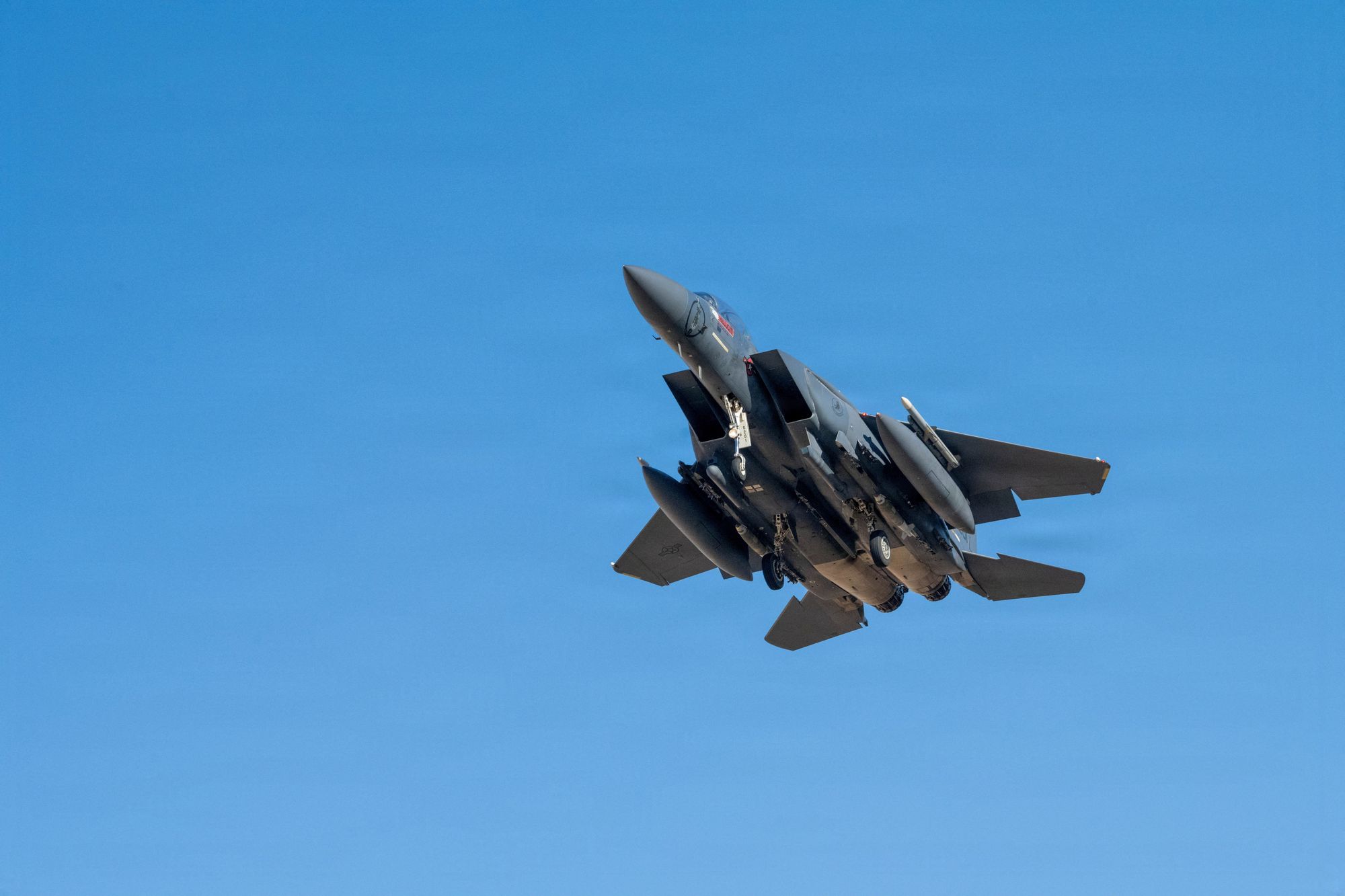
A US F-15, similar to the one shot down, is seen supporting Operation Epic Fury (via REUTERS)
The Strait’s closure has become a central point of the war as the president’s critics question why the administration did not plan for Iranian forces mining the area and shutting down sea traffic indefinitely. With the war now in its second month, U.S. predictions of a timeline for ending the conflict seem inaccurate and Trump’s own angry messages suggest that the White House is largely out of ideas to that effect.
The president separately claimed on Saturday that another U.S. strike had killed a number of senior Iranian military commanders. And in an interview Sunday with Fox’s Trey Yingst, he simultaneously claimed that Iran was on the verge of surrender and would accept a deal with his administration “by tomorrow.”
On NBC’s Meet the Press on Sunday, Sen. Tim Kaine reacted to the president’s threat and called it “juvenile.”
“I hope the White House – I doubt the president will – but please dial back the rhetoric, because you don’t need to put people like these pilots more at risk,” said the Democratic senator from Virginia. He added that he didn’t believe the threat, or others to bomb Iran “back to the Stone Age” were effective, labeling them embarrassing.
Advertisement
“It’s people trying to act like they are puffed up and tough when what we really see from this administration is the absence of a plan, the absence of a clear rationale, no effort to get our allies onboard, and thus deep unpopularity of this war with the American public,” Kaine added.
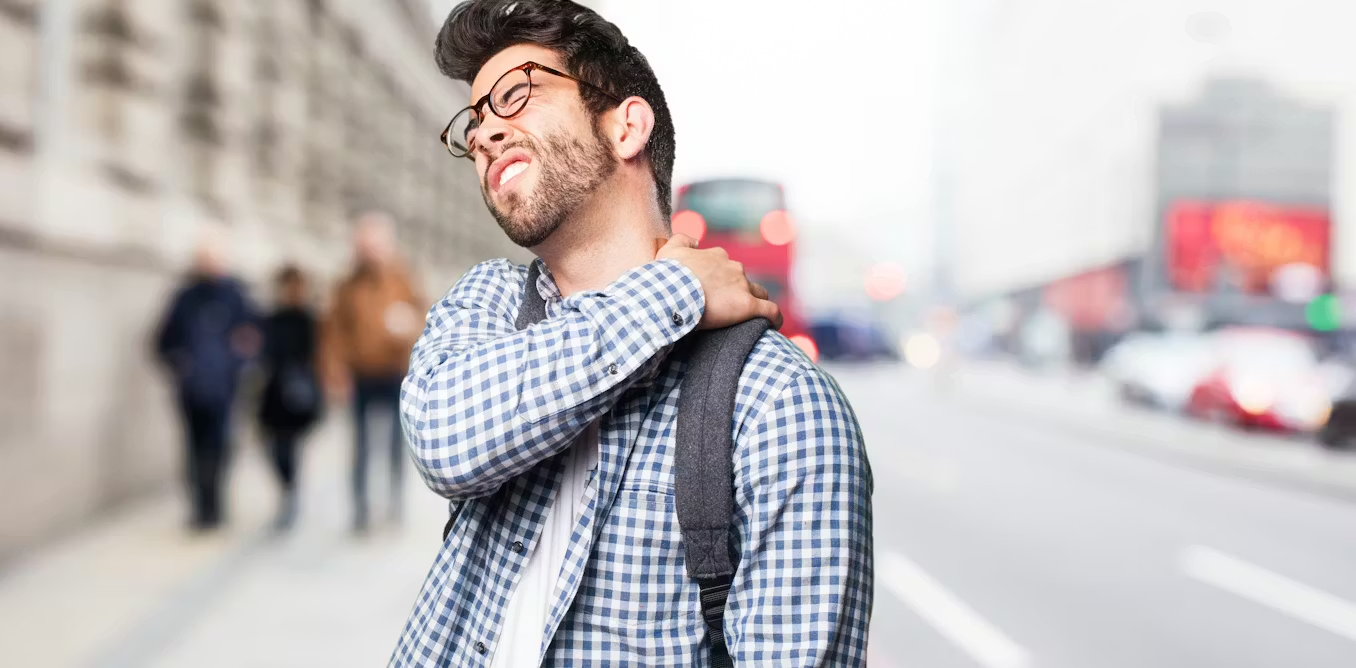
Anna spends most of her workday typing on her laptop. After a few hours, she starts rubbing her wrists as her pain sets in. A glance at her desk reveals the painkillers that she uses to ease her discomfort. And for John, his neck pain sets in every time he listens to the news about a potential economic crisis and his stress levels start to rise.
These experiences of pain are not unique. Nearly 35% of people worldwide experience pain every day, and in the UK alone, almost 20 million people live with it.
Pain used to be thought of purely as a symptom of a physical problem: you break a leg, experience pain, see a doctor and the injury is treated. However, research has shown that pain can arise not only from physical injuries but also from emotional or psychological circumstances. This suggests that people can experience pain even in the absence of a physical injury.
In light of this understanding, other research conceptualised pain as something that can be related to a person’s socioeconomic situation, their thoughts and their behaviour. This perspective suggests that pain does not simply originate and stay in the body but influences and is influenced by other aspects of people’s lives.
Advertisement
For example, one study I was involved in found that people living in countries with higher unemployment rates reported greater levels of pain than those in countries where there was less joblessness. This was true regardless of an individual’s own employment status. It indicates that pain can be shaped not only by someone’s circumstances but also by broader social and economic environments.
One possible explanation is that being surrounded by higher levels of unemployment triggers feelings of financial and job insecurity, which in turn can exacerbate pain. This is consistent with evidence suggesting that stress can contribute to inflammation, and increase physical pain.
Around 30 million work days are lost to musculoskeletal conditions in the UK each year. FOTO Eak/Shutterstock
And of course, pain has significant consequences in the workplace. For instance, in the UK, musculoskeletal conditions such as arthritis and back pain account for around 30 million lost working days each year.
Advertisement
This not only undermines the productivity of organisations, but it also affects key aspects of workers’ wellbeing. On the one hand, time lost from work can erode the sense of dignity and purpose that having a job provides, for example by limiting time spent on meaningful activities or building social relationships.
On the other, people’s capacity to earn a living may be reduced, especially in jobs where income is directly tied to the time they spend working – freelance workers, for example.
A different way of thinking about pain
More broadly, this all contributes to research into the measures used to assess how citizens in a country are feeling.
For a long time, governments have been using pure economic indicators, such as national income represented by GDP per capita to assess how well their citizens were doing. But these indicators fail to capture aspects that are key for wellbeing, including things like income inequality or air pollution.
Advertisement
As a result, researchers have suggested alternative metrics that can provide a more accurate picture of wellbeing. These include happiness and life satisfaction, which are typically assessed by asking people to report on these aspects of their experience.
But another strong metric that could be used to enhance this picture is pain. After all, pain can capture dimensions of the human experience that are not fully addressed by traditional economic indicators or by proposed wellbeing measures.
For instance, although measuring life satisfaction or emotions like sadness and anger can provide insights into how citizens are feeling, assessing them often requires complex evaluation and reflection.
In contrast, pain can be seen as a more direct and reliable indicator, as it is experienced in the body and does not require the same level of cognitive processing. One way to measure pain is to ask people to rate their pain from zero (meaning no pain) to ten (meaning the worst pain they can imagine).
Advertisement
Since everyone has felt pain at some point in their lives, this technique makes measuring it straightforward and the results relatively trustworthy.
What’s more, pain may be less susceptible to the stigma that can make people reluctant to report supposedly negative emotions like sadness or anger in certain settings or cultures.
This shows that pain may be much more than just a personal problem; it affects several domains including work and relationships. Unlike abstract numbers such as GDP or survey data, pain is something felt in the body. This can make it a powerful signal of wellbeing.
Paying attention to pain can help governments and workplaces understand what really matters for people’s quality of life – and why supporting those in pain isn’t just a health issue, but a matter of social and economic importance.
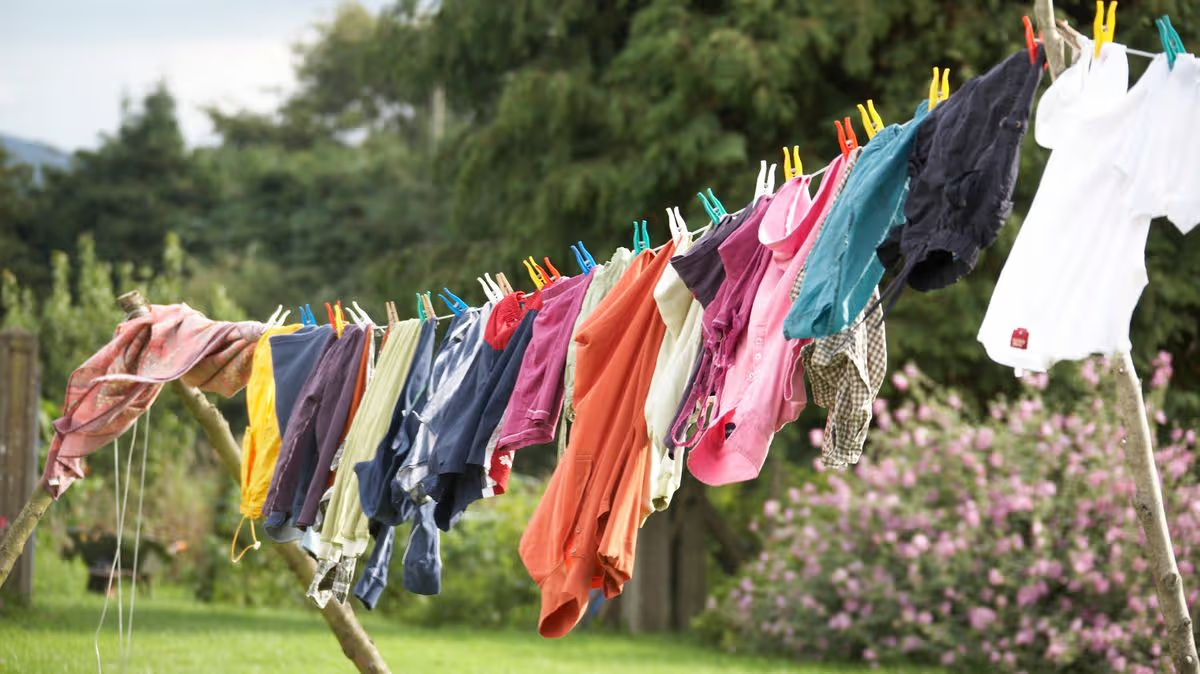
A common mistake could be making your clothes smell bad even after washing them
Washing clothes should bring a new lease of life into them and refresh any bad smells. However, sometimes when coming out of the washing machine items can smell worse than when they went in.
Advertisement
Clothes, sheets and towels can pick up a stale smell, despite being thoroughly washed. It can become a very frustrating issue, but thankfully there is a simple fix.
Cleaning expert Lynsey Crombie says the “nasty” smell can actually come from a common mistake people make while doing the laundry. When washing clothes, many of us reach for bottles of fabric detergent and fabric softener.
They come in a wide range of pleasant smells, which sometimes appears to vanish once the items come out of the wash. Lynsey, who shares tips and tricks on her Queen of Clean account, said: “Ever wondered why your clothes still smell even after washing?
“The answer could be too much fabric softener.” Lynsey explained that using too much of the cleaning product can actually make items “smell stale and nasty”.
She added: “Excess fabric conditioner creates build-up instead of freshening clothes. Less is more, avoid overuse for the best results.”
Lynsey’s followers have already listened to her advice as one said: “I used to use too much now I don’t anymore.” Another added: “Don’t know that thanks for the info.” Someone else commented: “You are absolutely right!”
Other cleaning experts have also shared their concerns about using too much fabric softener. Ann Russell, who goes by @annrussell03 on TikTok, responded to another user’s video warning that fabric softener can make your clothes ‘more flammable’.
Advertisement
Content cannot be displayed without consent
She replied: “That is why I do not recommend using fabric softener for applications which it wasn’t intended for like spraying your upholstery to make it smell good, which people do.”
Ann explained that she’s not a great fan of the product even when it is used for its intended purpose. She added: “I’m not a fan of fabric softener in general anyway. I’m not saying I never use it because I do. I use it very, very rarely.
“Three reasons, if you over use it, it can make your clothes smell. They come out and they smell of fabric softener.
“You put them away and you open the drawer and two days later it smells sour – that’s fabric softener. It builds up on clothes and when you’ve got it your clothes feel floppy, heavy, and greasy.”
Advertisement
Ann said: “If you use it generously in every wash you will find that your clothes get dirtier quickly, it smells funky and sour, and you can end up with weird patches on your clothes when you get them out of the machine.”
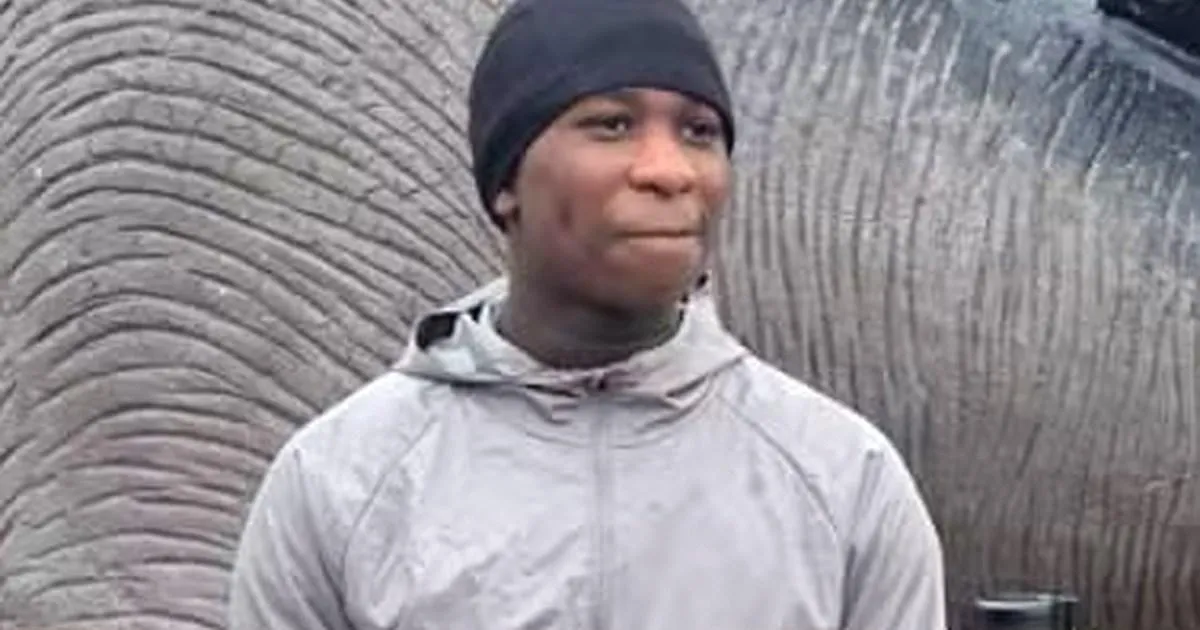
Eghosa Ogbebor, 14, was shot dead on Thursday (Metropolitan Police)
Two more teenagers have been arrested on suspicion of murder after a 14-year-old schoolboy was shot dead in south London.
Eghosa Ogbebor died on Thursday afternoon, sparking a major murder investigation, which was followed by three arrests the following day – two boys aged 14 and 16 and an 18-year-old man.
Now two further people, a 16-year-old boy and a 19-year-old man, have been arrested and are in custody, the Metropolitan Police said on Saturday.
Eghosa has been named in tributes as a Drill rapper using the name Y.Risky.
Advertisement
The teenager is thought to have recorded a song at school in the days before he was shot dead.
Police were called at about 3.40pm on Thursday after reports of a shooting on a residential street close to Woolwich Dockyard train station.
Police search the Woolwich estate (Ben Bauer/PA Wire)
Paramedics found Eghosa with fatal injuries and he was pronounced dead at the scene.
His family are aware and are being supported by specialist officers, the force said.
A 46-year-old man was also arrested on suspicion of assisting an offender and remained in custody.
Advertisement
DCI Lucie Card, whose team is leading the investigation, said: ‘Our team of dedicated detectives are continuing enquiries to investigate Eghosa’s tragic death.
‘Residents in Woolwich may have noticed a large amount of police activity last night, as officers arrested three further people in connection with the investigation.
Forensics scour the estate for clues (Ben Bauer/PA Wire)
Latest London news
To get the latest news from the capital, visit Metro’s London news hub.
Advertisement
‘We appreciate the concern that Eghosa’s death has caused, particularly among the local community who will continue to see an increased police presence around the area.
‘There may be people who have heard information or witnessed suspicious activity in the area but not yet contacted police. We urge these people to contact us and assist with the investigation.
‘We will continue to support and update Eghosa’s family as the investigation continues and our thoughts remain with them at this incredibly difficult time.’
Police have opened a murder investigation following a fatal shooting in Woolwich. (Picture: UKNIP)
Officers have released two people on bail (Ben Bauer/PA Wire)
Pictures captured on Thursday showed that flowers were laid on the road in tribute to Eghosa, which Sadiq Khan, the mayor of London, called ‘appalling’.
Khan said: ‘My thoughts are with the family, friends and wider community in Woolwich following the appalling fatal shooting of 14-year-old boy. There is absolutely no place for this heartbreaking violence.’
Advertisement
Nahom Medhanie was shot dead while sitting in a car near Euston station (Picture: Metropolitan Police/PA Wire)
It was the second fatal shooting in London in less than a week after Nahom Medhanie, 26, was shot dead while sitting in a car near Euston station during the evening on the previous Saturday.
Matthew Pennycook, the MP for Greenwich and Woolwich, said the killing ‘sees the promise of another life senselessly extinguished. It leaves yet another family grief-stricken and a community further traumatised.
‘We cannot allow serious youth violence to be normalised.’
Anyone with information or footage has been asked to call police on 101.
The crime thriller is said to be perfect for fans of Halen Coben adaptations
Peter Harris Film and TV Reporter (Screen Time, U35s)
14:30, 05 Apr 2026
A crime drama boasting a perfect 100% rating has just been made available to stream on ITVX and is said to be ideal for fans of Harlan Coben adaptations.
All episodes of The Devil’s Hour are now accessible at no extra cost on the broadcaster’s own platform. Its first season originally aired back in 2022, with the second season following in 2024. A third season is reportedly in the pipeline.
Advertisement
Initially the series was exclusively available via Prime Video, but it is now streaming for free, without the need for a premium subscription. This means even greater numbers of viewers will be able to discover the title.
According to its plot synopsis, The Devil’s Hour follows Lucy Chambers, a social worker grappling with family and relationship troubles. She wakes every night at exactly 3:33 AM at the so-called devil’s hour.
That’s not all, as she is also attempting to cope with other inexplicable occurrences. Her eight year old son is withdrawn and appears utterly emotionless, claiming to see people that others cannot, reports the Mirror.
Her mother speaks to empty chairs, also insisting she can see people that others do not. Lucy’s house is haunted by the echoes of a life that is not her own. Her name is inexplicably linked to a series of brutal murders in the area, and she finds herself drawn into the hunt for a serial killer.
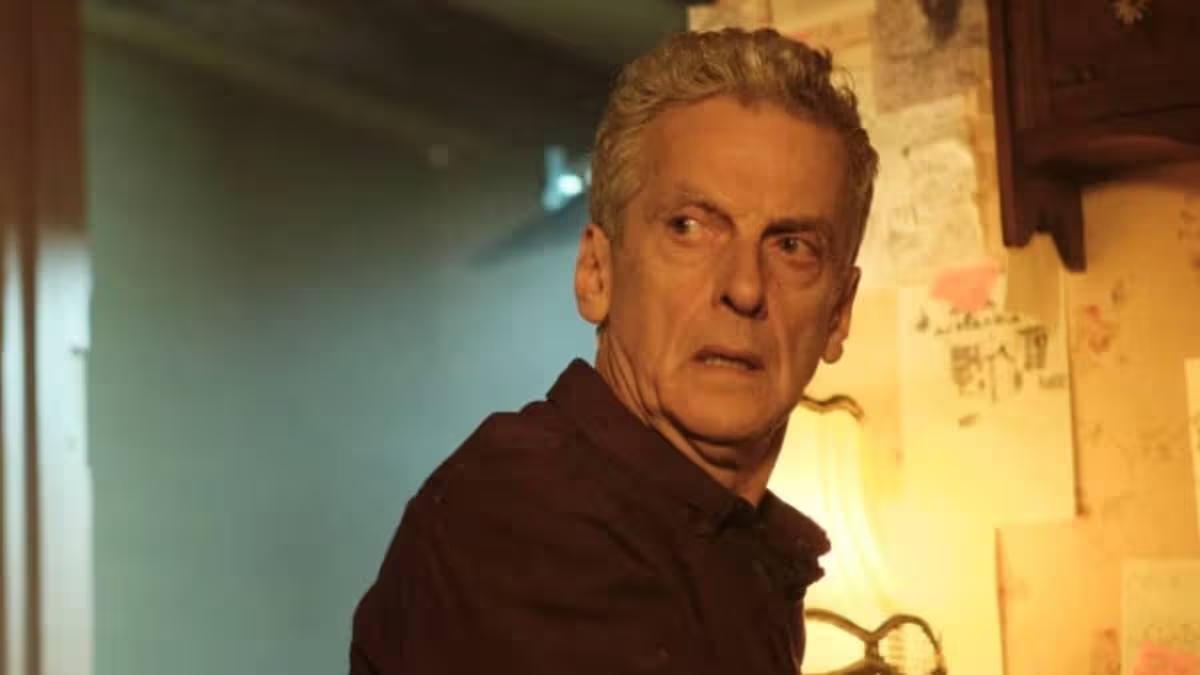
Without giving anything away, the second season’s plot delivers even more twists and turns. It functions as both a prequel and a sequel, shedding some light on the background of a character portrayed by Doctor Who’s Peter Capaldi.
He portrays a mysterious and reclusive nomad, driven by a murderous obsession, who becomes the prime target of a police manhunt headed by compassionate detective Ravi Dhillon, portrayed by Nikesh Patel. The cast also features Call the Midwife actress Jessica Raine as Lucy, Ted Lasso star Phil Dunster and The Split’s Meera Syal.
The debut season achieved the rare distinction of securing a perfect 100% rating on the website Rotten Tomatoes. Good Housekeeping claims: “If you’re a Harlan Coben fan, you’ll enjoy the genuine unpredictability of it, the endless twists and turns and the many, many surprises within the series.”
Advertisement
Viewers have also heaped praise upon it since its initial release. It’s been described as ‘an absorbing mind bender’, “the most chilling show ever” and one viewer confessed they “binged this in two days, couldn’t stop watching.”
Meanwhile someone else stated: “The Devil’s Hour is absolutely gripping from start to finish. The eerie atmosphere and mind-bending mystery kept me hooked the whole way through. The writing was clever and darkly compelling, and the performances, especially the lead, were outstanding. It balanced horror and psychological thriller perfectly – a must-watch for anyone who loves intense, unpredictable stories.”
If that’s not enough to persuade you to give it a go, one viewer remarked: “This series is probably the best ever made, and is criminally underrated. The show deserves all of the flowers. In order to properly enjoy this series, payment is requested in the form of giving yourself over to confusion, and not getting too distracted.”
Advertisement
The Devil’s Hour is streaming on ITVX and Prime Video.
Footage has emerged of Jonathan Majors and another actor unintentionally falling through a window on the set of his comeback movie amid reports that some members of the film crew have since walked out, citing safety concerns.
It was reported earlier this year that Majors is starring in an as-yet-untitled action movie produced by right-wing media company The Daily Wire, co-created by conservative commentator Ben Shapiro.
In footage obtained by Deadline, Majors and fellow actor JC Kilcoyne can be seen jumping backwards into an unsupported window, which gives way. According to reports, the two men fell about six feet to the ground, and Kilcoyne required stitches in his hands.
Advertisement
In the clip, a voice that sounds like Majors asks if the production was rolling and suggests they keep the footage, saying: “Did we shoot it? Use it.”
Jonathan Major has reportedly suffered a fall on the set of his comeback movie as the film’s crew raises concerns over safety (Amy Sussman/Getty Images)
The incident is reportedly part of the reason that the union International Alliance of Theatrical Stage Employees (IATSE) called a strike against the production at the end of last month, citing safety concerns and other labor issues.
“The producers are actively looking for replacement crew,” the union posted on social media. “All IATSE members are advised not to cross the picket line.”
The film, which is being produced by Dallas Sonnier‘s Bonfire Legend alongside The Daily Wire, is still filming.
Watch Apple TV+ free for 7 day
Advertisement
New subscribers only. £9.99/mo. after free trial. Plan auto-renews until cancelled.
ADVERTISEMENT. If you sign up to this service we will earn commission. This revenue helps to fund journalism across The Independent.
Sonnier hit back at the crew who walked off set in a statement to Variety, saying: “The actors’ fall was shorter than the failed movie careers of the now-union reps.”
Majors’ acting career was beginning to flourish following his roles in Ant-Man and the Wasp: Quantumania and Creed III, but it was derailed when he was arrested in 2023 and charged with misdemeanor assault and harassment after an altercation with Jabbari.
Later that year, he stood trial, where he was found guilty of two counts of misdemeanor assault and harassment. He was found not guilty of one count of assault in the third degree and aggravated harassment in the second degree.
Majors, who had been expected to reprise his villainous role as Kang the Conqueror in Marvel’s Avengers: The Kang Dynasty, was subsequently dropped by the studio. The film was effectively canceled and replaced by the forthcoming Avengers: Doomsday.
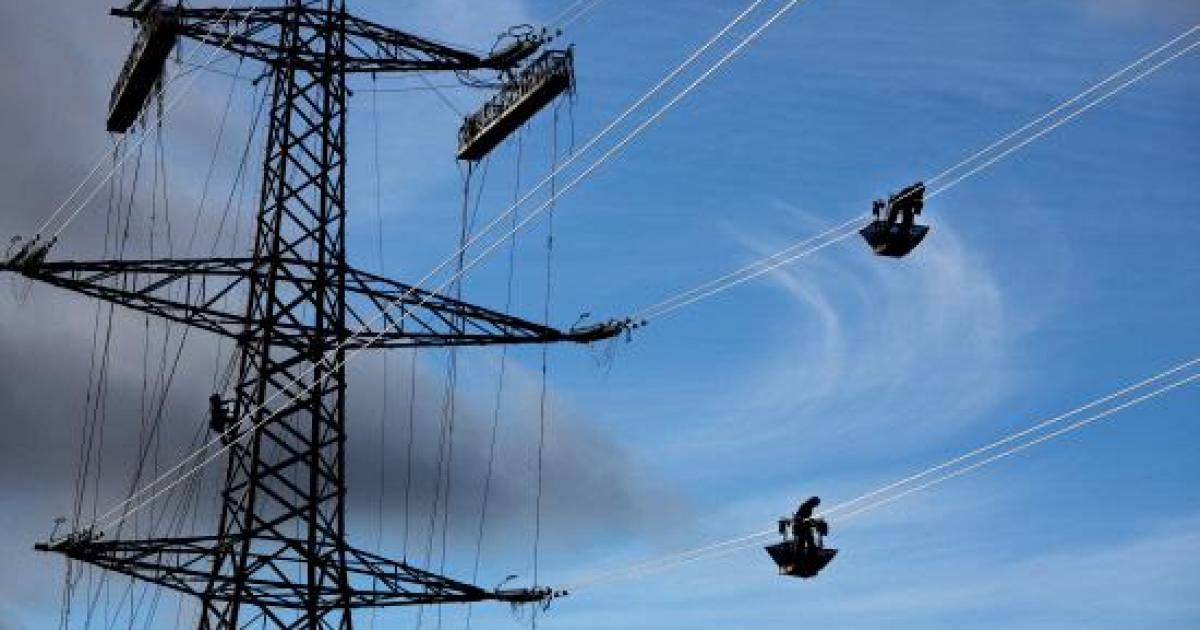
From Bishop Auckland to Consett and beyond, a number have been left without electricity, according to the Northern Powergrid.
It comes as the region continues to experience high winds that reached up to 70 and 80 miles per hour along the coast.
An amber weather warning for wind was also in place in the region between 7pm on Saturday (April 4) and 3am on Sunday, with caution that the storm could pose a danger to life.
Advertisement
Now, homeowners are bearing the brunt of the storm impact with cuts that the powergrid say they are “working hard” to fix.
A Northern Powergrid statement reads: “Storm Dave has caused damage to the network across our regions.
“We are working hard to restore power to all customers affected.
“We are aiming to give our best view and timings for getting people back on today.
Advertisement
“Our online power cut map gives the same information that is available to our contact centre team. We are updating the power cut map regularly, with more accurate estimated times, as soon as we are able.
“Supporting customers is always our priority. We know it’s difficult to be without power and we’re here to support you, 24/7.”
The amber and yellow weather warnings placed on the region by the Met Office lifted early this morning, but trees, battered by strong winds last night (Saturday, April 4), are causing disruption.
Recommended reading:
At around 2am on Sunday (April 5), the A64 was closed westbound between the A1237 near York and the A169 at Malton after a tree fell on the carriageway.
Advertisement
This was later re-opened but followed a separate incident in Bond End, Knaresborough, at 5.46pm on Saturday evening.
North Yorkshire Fire and Rescue Service was called after a “dangerously hanging” tree was spotted about a public footpath.
Crews from Knaresborough taped the area off to residents and the incident was left with Knaresborough Town Council.
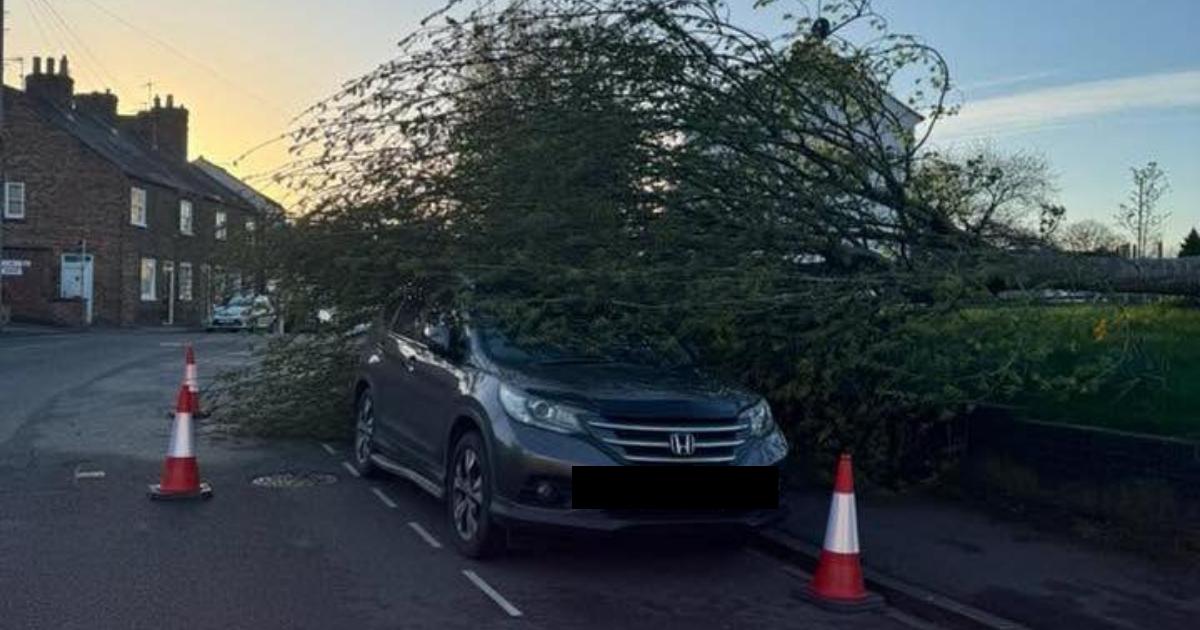
Over in Ripley, a home in Main Street was shook after a tree branches fell on a vehicle’s roof.
Advertisement
At 11.14pm, firefighters used a saw to split the branch to remove it while checking the vehicle for damage.
Meanwhile, a similar incident was reported in Oakdale Avenue, Harrogate, at 12.50am, after a tree fell on a property’s roof.
It came hours before the A166 was closed at Gate Helmsley at 2.59am.
A telegraph pole had fallen onto the road with exposed wiring.
Advertisement
A spokesperson for North Yorkshire Fire and Rescue Service said: “Crews removed the pole and liaised with engineers to isolate and remove the high voltage cable.
“The incident was left with Northern Powergrid.”
As The Press reported, numerous trains had to be cancelled after a tree blocked the rail line between York and Malton, shortly after 9.20am today.
TransPennine Express said that its 8.54am service from Scarborough to York had to be halted following the incident, with delays and cancellations expected until 4pm.
Advertisement
At 12pm, the train operator said that staff were on their way to fix the disruption.
The tragedy unfolded the day before the Tour of Flanders
A British cyclist has died after collapsing during an amateur race in Belgium.
Advertisement
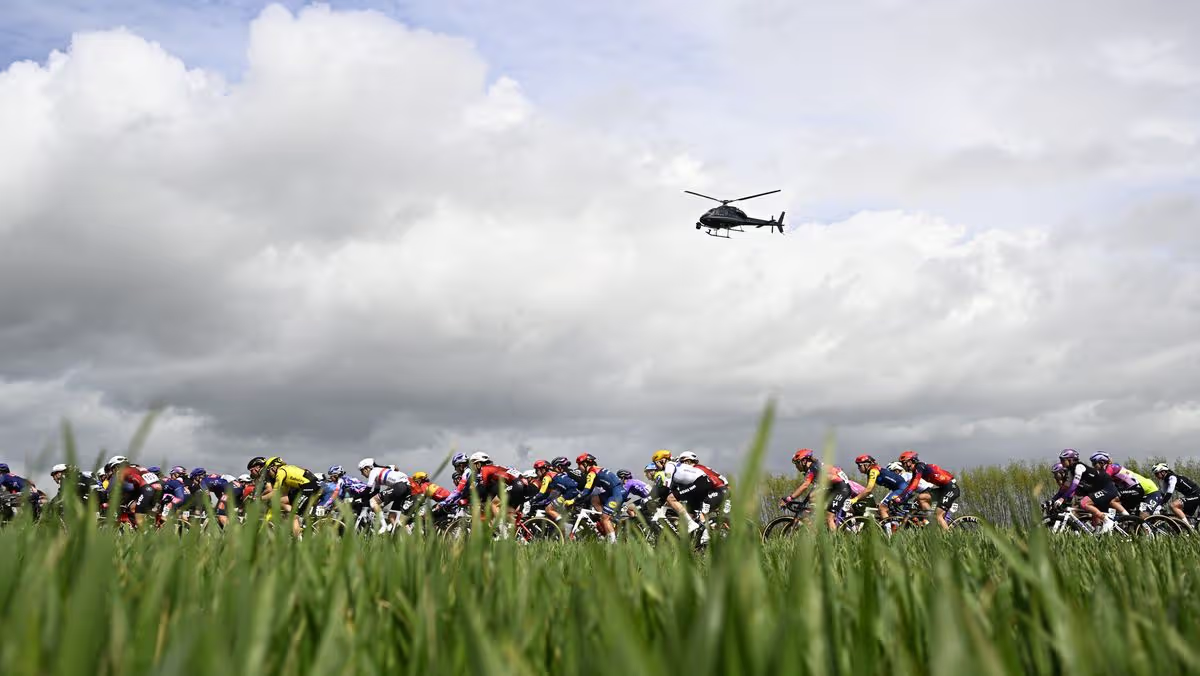
The 51-year-old was competing in the mass-participation Tour of Flanders sportive, We Ride Flanders, which takes place on the day before the elite men’s and women’s races, when he collapsed before the Hotond climb near Ronse. According to reports from Belgium, the rider, who is believed to have been participating in the amateur race alongside his son, likely suffered a heart attack and tragically died at the scene.
Event organiser Gert van Goolen told Belgian radio that medics had rushed to where the rider had collapsed and attempted to save his life, but he sadly passed away.
“We received a report that a man had fallen,” he said in a statement to Radio 1.
“A medical team was quickly on the scene and was able to resuscitate him. Unfortunately, the man died at the scene.
Advertisement
“This is the last thing you want as an organization,” van Goolen added.
“You hope that 14,000 people can have a nice day here and you know there are risks, but you really don’t want this.”
The event has routes of different distances, the longest being a 247km route starting in Antwerp and ending in Oudenaarde.
Other ride distances – 79 km, 133 km and 163 km – started and finished in Oudenaarde, although it is unclear which route the rider had attempted, as all four include the Hotond, the highest hill in the region.
Advertisement
According to reports, two other competitors also needed resuscitating during the race following separate incidents during Saturday’s event.
One involved a 57-year-old Dutch man, while the other saw a second British rider rescued on the Oude Kwaremont, a 1,500m cobbled climb which forms a famous section of the Tour of Flanders.
Both riders were taken to hospital.
Two We Ride Flanders participants also died during last year’s event, including Stéphane Krafft, a former professional rider with the Cofidis team.
Advertisement
The amateur event sees cycling fans ride the course a day before the professional riders, allowing them to “suffer on the legendary hills, shudder over the famous cobbles and enjoy an unparalleled atmosphere along the routes” as the pros.
Around 14,000 cyclists take part in the event annually.








.jpg)







































You must be logged in to post a comment Login