The National Weather Service (NWS) expects temperatures to be about 20 degrees warmer than normal for mid-March. This raises the risk of heat illness, with forecasters urging people to avoid outdoor activities during the daytime.
“If you must be outdoors, drink a lot of water,” said Richard Thompson, a meteorologist with the NWS Los Angeles office. “There’s definitely the potential for records being set.”
Thursday is anticipated as the hottest day, with the San Fernando Valley possibly hitting 95 degrees Fahrenheit (35 Celsius). Typical mid-March temperatures are usually around 70 degrees Fahrenheit (21 Celsius).
Advertisement
Los Angeles city and county officials planned to open cooling centers for residents without air conditioning (AP Photo/Damian Dovarganes)
Workers at outdoor construction sites will have plenty of drinking water and electrolyte packets available to stay hydrated. They’re instructed to take frequent breaks, said Junior Pineda, a representative with a local unit of the International Union of Bricklayers & Allied Craftworkers.
“And there’s always shade structures, if guys start feeling a little light-headed and need to take a few minutes,” he said.
Los Angeles city and county officials planned to open cooling centers for residents without air conditioning.
Zack Marquez, who uses a wheelchair, was taking care of errands Wednesday before it got too hot in LA’s Koreatown neighborhood.
“Gotta stay hydrated and stay in the shade,” he said.
Advertisement
A sea breeze on Friday should cool down the coast somewhat, but inland areas will still swelter, forecasters said.
Celebrities are streaming into Los Angeles ahead of Sunday’s Oscars, with a bevy of events this week taking advantage of the concentration of stars. But the worst of the weather should be over in time for the ceremony.
The rest of the state will also see hotter-than-normal weather starting next week. Temperatures could top 90 (32 Celsius) on Monday around San Francisco and in the Sacramento area.
The Trump administration is using a 20-year-old report to misrepresent former President Jimmy Carter’s views on mail-in and absentee ballots as it pushes for federal legislation that would impose strict new proof-of-citizenship and photo ID requirements for voting ahead of the midterm elections.
On two successive days this week, President Donald Trump and White House press secretary Karoline Leavitt invoked the 2005 report by the Commission on Federal Election Reform while advocating for the Safeguard American Voter Eligibility, or SAVE America Act. The commission’s co-chairs were Carter, a Democrat, and former Secretary of State James Baker, who held senior government positions in the administrations of three Republican presidents — Gerald Ford, Ronald Reagan and George H.W. Bush.
Trump and Leavitt falsely claimed that Carter was against the use of mail-in and absentee ballots because they can lead to fraud, a mischaracterization of the report’s conclusions.
Here’s a closer look at the facts.
Advertisement
TRUMP, at the Republican Members Issues Conference on Monday: “Jimmy Carter, the best thing he ever did, he headed a commission after he was president. It was the single best thing. And he did a thing on mail-in ballots. He said mail-in ballots should not be allowed because they are inherently dishonest.”
LEAVITT, at a White House press briefing on Tuesday: “The bipartisan 2005 report of the Commission on Federal Election Reform, shared by, of all people, former President Jimmy Carter and former Secretary of State James Baker, concluded that, quote, ‘absentee ballots remain the largest source of potential voter fraud.’”
THE FACTS: Carter supported mail-in voting and absentee ballots, according to statements by the late president, his grandson Jason Carter and The Carter Center. The 2005 report stated that absentee and mail-in ballots can create opportunities for fraud, but also suggested ways to reduce that risk and recommended further research on the issue. Experts say there is no evidence that mail-in and absentee voting leads to widespread fraud, either now or 20 years ago.
“My grandfather supported mail-in voting — so much so that he used it himself,” Jason Carter, chair of The Carter Center’s board of trustees, told The Associated Press in a statement on Wednesday. “Any claim to the contrary unnecessarily sows doubt in election integrity and undermines voter confidence in a consequential election year.”
Advertisement
President Carter himself publicly endorsed mail-in voting and absentee ballots in 2020, a view that continued until his death in 2024.
“I urge political leaders across the country to take immediate steps to expand vote-by-mail and other measures to help protect the core of American democracy — the right of our citizens the vote,” he said in May 2020 amid concerns about elections during the COVID-19 pandemic.
Four months later, in response to news reports about his opinion of absentee ballots, Carter said: “I approve the use of absentee ballots and have been using them for more than five years.”
Voting by mail remains popular with voters of both major parties. During the 2024 election, which Trump won, roughly 30% of voters cast mailed ballots, according to the U.S. Election Assistance Commission. That was higher than pre-pandemic levels, when about a quarter of voters used mailed ballots. Three of the four states where use of mailed ballots was higher than in 2020 are controlled politically by Republicans — Indiana, South Dakota and Utah.
The Commission on Federal Election Reform, organized by American University’s Center for Democracy and Election Management and funded by a group of philanthropic organizations, published a report, “Building Confidence in U.S. Elections,” in 2005. Among its findings were that “absentee ballots remain the largest source of potential voter fraud” and that voting by mail is “likely to increase the risks of fraud and of contested elections” in certain states.
However, the report did not discourage the use of mail-in and absentee ballots. Rather, it included suggestions for how to reduce the risk of fraud.
The report made three recommendations related to absentee ballots and voter registration fraud: that jurisdictions only allow specific people to handle ballots, and prohibit candidates or party workers from picking up and delivering absentee ballots; that states should pass legislation to minimize fraud from payments for voter registration, absentee ballot or signature collection efforts; and that states should not discourage legal voter registration or get-out-the-vote work.
Advertisement
It also suggested that states should implement better safeguards for ballot integrity and encouraged further research on the pros and cons of mail-in and early voting. The report noted that in Oregon, which had been using vote-by-mail for seven years, there was “little evidence of fraud.”
“The administration’s claims about President Carter’s views on mail-in voting are not true,” the Carter Center said in a statement this week to The Associated Press.
It said the claims do not “consider the rest of the report’s findings or President Carter’s acknowledgment of the safeguards that have emerged in the 20+ years since this report came out.”
“There’s no evidence that mail-in voting fraud was rampant then, and it’s not rampant now,” said Mark Lindeman, policy and strategy director at Verified Voting, a nonpartisan group focused on election technology. “Mail voting has become more common and more mature. So, over that period of time, states have learned from each other — best practices for not only avoiding fraud, but just generally administering mail balloting well.”
For example, ballot tracking, curing ballots that had initially been rejected, and the ability to identify and address duplicate voter registrations have improved.
Trump has flip-flopped on mail-in voting over the years. He preemptively argued that mail balloting was bad months before voting even began in the 2020 election. At the same time, he encouraged voters in Florida — a state he won — to vote by mail. Trump and other Republicans then blamed mail-in voting for his loss.
The GOP, and sometimes even Trump, urged voters to cast their ballots by mail ahead of the 2024 election when it was seen as a necessary course correction during a tight race.
Advertisement
Asked whether Trump stands by the statements he and Leavitt made, White House spokeswoman Abigail Jackson said: “President Trump and Karoline are completely right — and Karoline read a direct quote from the report during her briefing.”
She added that the press release The Carter Center published in May 2020 that included Carter’s endorsement of mail-in voting “does not invalidate the findings” of the 2005 report.
A drone is circling in the skies above Zaki Ramadan when he takes my call. As a humanitarian worker in Sudan’s southeastern Blue Nile state, he is helplessly watching aid dwindle and civilians be killed by the meteoric rise in drone strikes.
“We stopped all humanitarian activity. We cannot work. All the offices are closing because of the drones – some of the area has been evacuated. WFP staff left two days ago from the area, anticipating drone strikes,” he says.
Drone warfare has made Sudan’s war a death trap for a population of more than 46 million people as the Rapid Support Forces (RSF) and Sudanese Armed Forces (SAF) battle for territory.
Image: Drone attacks by Rapid Support Forces (RSF) have been stepped up
Image: Charred debris following a drone strike on a market in South Kordofan
The Armed Conflict Location & Event Data, an independent global monitor, has documented at least 198 drone strikes in Sudan launched by both sides in the first two months of 2026. At least 52 of them involved civilian casualties, killing 478 people.
“For us, when we hear the sound – we just rush and hide ourselves. We run to the river, and sometimes we can go into our foxhole. We go to the town and go to where there are no buildings sometimes,” says Zaki.
Advertisement
The area he operates in has been ravaged by armed rebellion and state violence for decades, but this time is different.
A dangerous new depth to warfare
“This war is quite different. This time they are using too many drones. Before – 20 years or 30 years ago – they did not use these drones, it was just a normal clash,” he says.
Drone warfare has added dangerous depth to Sudan’s humanitarian catastrophe by making safe aid delivery and emergency response virtually impossible in some of the hardest-hit areas.
Advertisement
“No food, no medical care, no sanitation,” says Zaki. People scrambling to safety are left with little to no option of sanctuary.
Image: Drones hits the University of Kordofan. Pic: Darfur Network for Human Rights
Image: Lecture halls are damaged in the strike. Pic: Darfur Network for Human Rights
Sky News analysis and mapping of ACLED data has found that deadly drone attacks are spread across Sudan and the number of civilian casualties is rapidly rising.
For the third consecutive day of new drone strikes on the southern White Nile state, an RSF drone hit a secondary school and shelter killing at least 17 people – mostly school girls – and injuring 10 others on Wednesday.
Image: A burial site in North Kordofan, where victims of a drone strike were laid to rest. Pic: Reuters
In just a two-day window in mid-February, more than 60 people were reported to have been killed by drones launched by both sides, with at least 15 children killed in a single Sudanese military drone strike on a shelter.
In January, a drone strike on N’djamena market in South Kordofan’s Dilling county killed 13 people and a month earlier, a triple drone strike by the RSF on a kindergarten and hospital in the same state killed 114 people – including 43 children.
Advertisement
Advertisement
UN: Sudan atrocities bear ‘hallmarks of genocide’
Detentions and deportations
The walls are closing in on civilians dealing with escalating violence as borders close. Drone strikes are spread across the eastern border to the west – even hitting the territory of neighbouring Chad which hosts close to a million Sudanese refugees.
Chad recently closed its border with Sudan after multiple cross-border attacks by the RSF. Other neighbouring countries like South Sudan, Ethiopia, and Libya are dealing with the danger of their own civil wars and are increasingly unsafe for refugees.
Advertisement
Image: Sudan’s Rapid Support Forces (RSF) paramilitary group
Image: Countries are closing their borders because of the threat from RSF
Egypt, a key safe haven for Sudanese refugees, is now deporting them en masse. Hundreds of thousands are now facing fear of detention, deportation, and death as Egyptian authorities unleash a brutal crackdown. The Sudanese embassy in Cairo has said that 578 Sudanese citizens have been deported back to Sudan in December and January.
Affected families have told Sky News that their status as asylum seekers with the United Nations Refugee agency (UNHCR) is often ignored as their loved ones are picked up. Dozens of missing person posts are being shared on Facebook to trace those suspected of being detained or deported.
Image: People, fleeing the fighting, have set up camp in North Darfur
Image: Thousands have been forced to leave Al Fashir, the capital of North Darfur
Image: Refugees are living in makeshift tents
“They took us to prison, and we were terrified. I have never been imprisoned before – in Sudan or elsewhere – and was shocked by the sight of the prison. It felt like we were in a soap opera,” a Sudanese refugee who was detained by the Egyptian authorities told Sky News.
He was a taxi driver in the Sudanese city of Al Fashir. He eventually fled the regional capital – where the RSF are accused of committing genocide and killing 6,000 people in just three days of capture – and went to Egypt for his safety.
“They split us up into four groups, and we were around 110 to a single cell. There was violence from the police and then violence within the cell from embedded guards. You are constantly dodging both.”
Advertisement
An 18-year-old called Al-Nazeer Al Sadiq was also kept in one of these cells. He was arrested from a neighbourhood in Cairo and the three friends with him at the time were deported. He eventually died in detention.
“He did not have any illness – he was healthy when they picked him up,” his brother tells us from Sudan’s capital Khartoum.
“The first day my mother visited him he was mentally exhausted and not at peace. There were three visits and each time he was deteriorating more and more – right until he died.”
Al-Nazeer’s family have returned to Sudan, despite the risks. The Egyptian government did not respond to our request for comment.
Image: There has been extensive devastation in Khartoum
Image: The capital has seen some of the fiercest battles
UK’s asylum crackdown brought into focus
Here in the UK, Home Secretary Shabana Mahmood implemented an emergency ban on study visas for students from Afghanistan, Myanmar, Cameroon, and Sudan to slow asylum claims. This has meant that Sudan’s best and brightest minds – at least 210 students – are being prevented from pursuing scholarships to some of the UK’s best universities.
At least 22 of them were meant to study at the University of Oxford, and 39 of them were accepted in a UK government-funded Chevening scholarship for emerging leaders.
Advertisement
On the ban, Ms Mahmood said: “Britain will always provide refuge to people fleeing war and persecution, but our visa system must not be abused. That is why I am taking the unprecedented decision to refuse visas for those nationals seeking to exploit our generosity. I will restore order and control to our borders.”
Image: The home secretary’s restriction on study visas is affecting Sudan’s best and brightest minds. Pic: Reuters
But the students impacted believe that they are facing the compounded cruelty of Sudan’s war.
‘It’s heartbreaking’
“What’s especially painful about the current situation is that the data simply doesn’t justify a blanket decision like this,” says Rawan, who has been blocked from enrolling in her dream masters programme in international health at the University of Oxford after being accepted.
“The Home Office has pointed to a 300% increase in asylum claims from Sudanese students, from 30 to 120 cases over five years. But when you look at the bigger picture, those 120 cases represent only about 0.1% of total asylum claims in the UK.”
Advertisement
She continued: “It’s heartbreaking to see how we’re also villainising the students who sought asylum as they are not manipulating the system, they are fleeing one of the worst humanitarian crises in the world, with more than 14 million Sudanese people displaced by the war.
“There is definitely a general sense of helplessness.”
This war is becoming a dead end as borders close and drones stalk the skies. Aid workers like Zaki do not know what to tell the people scrambling for safety.
“They get confused about where they can go to feel peace – they go to South Sudan, there is a problem. They go to Ethiopia, there is a problem,” says Zaki.
Prince Harry and Meghan Markle will visit Australia in April for private and public engagements, with the Duchess attending a luxury weekend retreat in Sydney
Prince Harry and Meghan Markle are travelling to Australia next month for a brief unofficial royal visit, where Meghan will be the star attraction at a ‘girls weekend’ retreat in Sydney.
Advertisement
The Duchess of Sussex will deliver speeches throughout the “weekend like no other,” including at a grand dinner, with VIP ticket purchasers also able to secure a photograph with the Duchess.
Supporters have been taken aback by the cost of attending the event, with tickets beginning at a staggering £1,439. This price includes participants’ accommodation at a beachside Sydney hotel and entry to three days of activities, including a gala dinner, yoga and meditation sessions, and a disco celebration.
Those wishing to get even closer to Meghan can buy the VIP experience tickets, which are being offered for £1,705 per person. Alongside the weekend’s activities, this ticket guarantees seating at a table in the front two rows for the gala dinner with Meghan, as well as a group table photograph with the Duchess of Sussex.
This means that for an additional £266 per person, devoted admirers of Meghan can get a group photograph with the Duchess during her rare Sydney visit.
Advertisement
A promotional message about the multi-day event states: “A girls’ weekend like no other! An unforgettable weekend for women ready to reconnect, recharge and have some serious fun. Join us for an intimate luxury weekend by the ocean designed to bring women together for powerful conversations, relaxation, laughter and unforgettable experience.”
The last time the Duchess of Sussex travelled to Australia, she reportedly complained that she wasn’t receiving payment for the walkabouts, according to claims in a royal book. Harry and Meghan were last down under in 2018, where they spent 16 days travelling around Australia, Fiji, Tonga, and New Zealand on their first royal tour as a married couple, reports the Mirror.
During the tour, huge crowds turned out to see them as they visited the countries and attended an impressive 76 engagements. A book written by former The Times’ royal correspondent Valentine Low claims that Meghan “enjoyed the attention” she received but did not understand the point of royal walkabouts.
Mr Low writes in Courtiers: The Hidden Power Behind the Crown that the Duchess of Sussex showed a “refreshingly informal approach to royal visits” which was “a hit with the Australian public”. However, despite being hailed as an “inspirational role model”, the royal expert revealed that it was a different story behind the scenes.
Advertisement
The book reads: “Although she enjoyed the attention, Meghan failed to understand the point of all those walkabouts, shaking hands with countless strangers.” Quoting unnamed members of staff, the book claims that Meghan was heard saying: “I can’t believe I’m not getting paid for this.”
Meghan isn’t the only one making appearances at high-profile events during their Australian tour, with Prince Harry also delivering a speech at the InterEdge Summit in Melbourne. This event is described as a “professional development summit designed to equip leaders, practitioners, and changemakers with the knowledge and tools to create mentally healthy, safe, and high-performing workplaces.”
Tickets for this mental health summit begin at £1,054, with proceeds from ticket sales being donated to Lifeline. Earlier this week, it was confirmed that Harry and Meghan would be visiting Australia for the first time in over seven years, spending time in Sydney and Melbourne in mid-April.
A representative for the couple stated: “Prince Harry and Meghan, Duke and Duchess of Sussex, will visit Australia in mid-April to take part in a number of private, business and philanthropic engagements. Further details will be shared in due course.”
Advertisement
It is understood that their children, Archie and Lilibet, will not accompany them on this trip.
Appearing at a Durham Crown Court plea hearing, Catherine Brennan pleaded not guilty to a single count of stalking, involving serious alarm or distress.
Between December 1, 2024, and February 24, last year, she is accused of making unwanted calls, sending numerous text messages, posting comments on social media and sending messages to the complainant’s family about him.
Ellen Wright, for the defendant, said during the period of the alleged offending she was suffering with psychosis, which was undiagnosed at that time, but which was subsequently diagnosed, and for which she now has medication.
Advertisement
Miss Wright asked the court to adjourn for preparation of a psychiatric report on the defendant to assess the issue of psychosis.
Judge Nathan Adams agreed and said the report should be served on the court along with the defendant’s signed defence statement, by April 30.
A further case management hearing will follow two months later, with a trial date provisionally pencilled in to start on August 10, 2027.
Advertisement
Adjourning the hearing, Judge Adams told Brennan: “There’ll be a hearing back here in late June and if there needs to be a trial, it will be at the back of a long queue, I’m afraid, in August next year.”
He granted the 38-year-old defendant of Startforth Park, Barnard Castle, bail to attend the further case management hearing at the court, on June 29.
Resident Evil Requiem – did you buy the boxed version? (Capcom)
The Thursday letters page explores the modern Nintendo vs. Sega rivalry, as one reader wants an end to Resident Evil remakes.
Games Inbox is a collection of our readers’ letters, comments, and opinions. To join in with the discussions yourself email gamecentral@metro.co.uk
Turn back the clock With Resident Evil Requiem and Pokémon Pokopia both selling out in terms of physical copies I wonder if there might still be a way to reverse the trend towards digital only? There’s lots of stories about Gen Z going retro for physical media, like CDs and DVDs. I’ve never heard game mentioned but I would’ve thought the same logic applies there.
Part of the reason behind the trend (apart from being contrary) is that they’ve realised it’s actually fun to own things, to put them on shelves, and to know they can’t be taken away from you. None of that applies to digital games so my hope is that we will see the increase in digital sales begin to slow and hopefully reverse.
Advertisement
If vinyl can make a comeback – and I hear even audio tapes and VHS – then video games absolutely should. There’s so much more to be gained by owning the games you pay for. The Bishop
Your sequel is in another decade A Fallout 3 remaster is all well and good but it’s now over 10 years since the last mainline Fallout game and we have absolutely no idea when Fallout 5 is coming out. After The Elder Scrolls 6 could mean 2033 or later. By that time we may not need a video game to experience a post-apocalyptic wasteland!
Expert, exclusive gaming analysis
Sign up to the GameCentral newsletter for a unique take on the week in gaming, alongside the latest reviews and more. Delivered to your inbox every Saturday morning.
Advertisement
If I was Microsoft I’d hand the whole franchise over to Obsidian, who made New Vegas. Bethesda has been sitting on the series for so long and they’ve done absolutely nothing with it. They’ve had all the time and money needed to get more people in and work on two games at once but that doesn’t even seem to have been a thought.
I think it’s because Todd Howard wants to do everything himself but, I’ll be honest, him not working on the next Fallout 5 would be better news than it coming out tomorrow. Focus
Super Pokopia Odyssey I see Pokémon Pokopia has sold over 2.2 million copies in four days, which puts it ahead of the pace set by Super Mario Odyssey… which went on to sell over 30 million. Very happy to see, not just because it’s a great game but because it’s a bit of a risk that’s been rewarded.
Advertisement
You can slap the Pokémon name on anything and it’ll sell something at least, but they obviously put a lot of care into this one, more it seems to me than the mainline games. We all know GC hates the Dynasty Warriors games, so they get the bonus of Omega Force being taken off that while they’re busy with Pokopia.
Looking forward to playing it some more and it already looks like there’s lots of plans for post-launch support. Zeiss
Brief rivalry It is always funny to compare Nintendo’s fortunes to Sega’s. They’ve been partners now for much longer than they were ever rivals but there’s no way Sega is in the same league as Nintendo now, if they ever were.
Advertisement
I think the reason Nintendo is reaping the benefits of good reviews, but Sega isn’t, is that Sega’s brands are just too old and tarnished. After all these years, nobody expects a Sonic game to be good and Shinobi may be a good game but nobody remembers or cares about the franchise.
On the other hand, Metaphor: ReFantazio is a weird game, with a weird name and concept, that looks basically like a PlayStation 2 game. I played it and loved it but frankly I’m surprised it did as well as it did.
Sega left it far too late to revive their Mega Drive era games and now the majority of gamers don’t even know what they are. While with Nintendo it’s the opposite and Pokémon is a household name that only boosts the sales of an already good game. Onibee
Console first Is Microsoft’s proposed combination of PC and console likely to shift Sony’s policy of putting console exclusive games on the PC, or is that something that had already shifted?
Advertisement
As an aside have just completed and really enjoyed Death Howl. Excellent game – thanks for highlighting it. Matt (he_who_runs_away – PSN ID)
GC: We’ll probably never know for sure, because Sony hasn’t commented publicly on any of its policies for years. The most recent suggestion is that Sony is more worried about Valve’s Steam Machine than they are Project Helix.
Quiet for now The build-up to a new console launch is always tiring in terms of all the nonsense companies talk. I can’t wait for the tech demos that don’t look anything like any of the games that ever get made. Anyone remember the one for the PlayStation 5, with the Tomb Raider looking woman and the promise that SSDs would change the way games are designed (spoiler: they didn’t)?
Advertisement
As usual, Microsoft just cannot shut up and let its product do its talking. They’re still going on as if they’re a big deal and it’s just getting sad. They could’ve just been the next EA and that would’ve been plenty important for them, but now we’ve got to endure Xbox One Part 3.
It should be humiliating for them that Sony don’t care what they think, they’re only worried about Steam Machine, even though it flopped once and there’s no guarantee that Valve can make it a hit at all.
And yet still Sony apparently think there’s a better chance of that happening than Xbox messing up their plans. And yet despite all that I think going for a premium price PC is actually a good idea for Microsoft. It’s not the same thing as PlayStation and it sounds like it’s going to be more expensive/more powerful than Steam Machine.
At least that’s a clear point of difference, so they may have some luck with it, even if it is for a niche audience. But for pity’s sake just stop with the hype until you’ve got something to show, by which I mean a games line-up, a price, and a release date. Jakey
Advertisement
Monster anticipation Are you planning on reviewing Monster Hunter Stories 3? I very much enjoyed the last two and the third looks like a development on an already very enjoyable series.
I have the game pre-ordered and whilst I don’t always agree with your reviews I am curious about your take on this spin-off series. BristolPete
GC: Yes, we’ll have a review this week.
Don’t miss Gaming news! Add us as a Preferred Source
As a loyal GameCentral reader, we want to make sure you never miss our articles when searching for gaming stories. We have all the latest video games news, reviews, previews, and interviews, with a vibrant community of highly engaged readers.
Advertisement
Click the button below and tick Metro.co.uk to ensure you see stories from us first in Google Search.
GameCentral has been delivering unique games news and reviews for over a decade
Keep the plates spinning Nice to see Resident Evil Requiem doing so well and looking forward to playing it. I’m cheap these days and with a sizeable backlog anyway, can wait for the sales. Still haven’t finished Resident Evil 4 remake yet.
Advertisement
As a fan of the series, though, I’m surprised Capcom and gamers (looking at the GC letters page) are so unimaginative with where they could take these now beloved characters and the absurd zombie conspiracy story they’ve cooked up over the years. Online all you hear is talk of the next remake or DLC. However, with such a rich tapestry to draw on, they could easily churn out new spin-offs and semi-sequels for a while yet.
I mean, why tie yourself down to remaking older entries at all? With the modern RE Engine perfected, just reuse assets from the previous modern games to do side entries with new stories and more regularity. Send Jill Valentine off to Latin America to battle an outbreak and meet a new bunch of scientist weirdos for an all-new direct sequel to Resident Evil 3.
Give Leon and Chris a new game taking down dodgy virus labs in made up ex-Soviet states now they’re special forces bros., etc. Maybe call it Resident Evil Revelations 3. I guess you’d risk it becoming the video game version of those supposedly bad CGI movies nobody watches… but Capcom are on such a roll I’d trust them to get the job done for a few games, before it got stale.
They don’t need to go through the mill of making Resident Evil 5 or 6 work in the modern age, just forget them. Marc
Advertisement
GC: Resident Evil spin-offs have a very mixed history, whereas almost all the remakes have been great; so it’s not hard to see why fans might prefer one over the other. That said, we’d love to see Revelations 3 happen.
Inbox also-rans A new game by he creator of Wordle? I wish you hadn’t told me that, as now I will be doing my best to pretend I didn’t know, so I don’t waste my entire morning on it. Aslan
I wonder why February has become such a big month for new releases. I guess it’s because it’s still dark out in the evening, but so is almost all of March. Seems odd to go from busy to almost nothing. John Parsnip
The small print New Inbox updates appear every weekday morning, with special Hot Topic Inboxes at the weekend. Readers’ letters are used on merit and may be edited for length and content.
You can also submit your own 500 to 600-word Reader’s Feature at any time via email or our Submit Stuff page, which if used will be shown in the next available weekend slot.
You can also leave your comments below and don’t forget to follow us on Twitter.
People who aren’t on benefits may still be entitled to some National Insurance credits depending on their circumstances
Individuals failing to claim the National Insurance credits they are entitled to could find themselves receiving reduced state pension payments. Contrary to common misconception, these credits aren’t solely available to those claiming specific benefits.
Advertisement
National Insurance credits can fill gaps in your National Insurance record, which determines your state pension entitlement. Typically, these credits are awarded to individuals receiving certain benefits such as Carer’s Allowance and Child Benefit, preventing carers from losing state pension rights whilst looking after family members.
Nevertheless, there are four situations where individuals can obtain National Insurance credits without being in receipt of any benefits. Some of these aren’t awarded automatically, meaning people must claim their entitlement or face the prospect of missing out.
Training courses
Individuals aged 18 or over who have been placed on a government-approved training course by Jobcentre Plus should receive Class 1 National Insurance credits automatically. This only applies if the course duration doesn’t exceed one year.
Should you be over 18 and attending a government-approved training course lasting no more than one year without being referred by the Jobcentre, you may still qualify for credits but will need to make an application. This requires writing to HMRC, detailing the period for which credits are being claimed and explaining your eligibility.
Advertisement
Jury service
Individuals who are not self-employed and have received a summons for jury service may qualify for National Insurance credits covering their period of court attendance. To obtain these Class 1 credits, you must submit a written application to HMRC.
Partners of people in armed forces
To potentially qualify for National Insurance credits, you must be married to or in a civil partnership with a member of the armed forces and have accompanied your partner on an overseas deployment.
For those who departed for their posting after 6 April 2010 and are now back in the UK, Class 1 credits can be requested. If your overseas posting took place after 6 April 1975, you reached state pension age on or after 6 April 2016, and you’re not receiving Class 1 credits, then you may apply for Class 3 credits as an alternative.
Wrongly imprisoned
If the Court of Appeal, or Court of Criminal Appeal in Scotland, overturned your conviction, you’re eligible to apply for Class 1 credits. You must contact HMRC in writing, providing your National Insurance number alongside an explanation of your eligibility.
Advertisement
Information regarding the application process and submission locations for these credits is available on the Gov.uk website.
Class 1 National Insurance credits contribute towards additional benefits such as Jobseeker’s Allowance as well as your state pension. Class 3 National Insurance credits exclusively contribute towards your state pension qualification.
You can review your National Insurance record and state pension forecast online to identify any gaps that could be filled with credits, and to verify that any credits you’ve requested have been correctly applied.
The sale of 25-27 Coney Steet, home to health store Holland & Barrett, to developers Helmsley Group comes ahead of their regeneration of that part of the city centre.
Cllr Katie Lomas, the council’s Labour major projects spokesperson, said officials had skilfully negotiated the best deal for residents as they did with all commercial property.
But Cllr Paula Widdowson, deputy leader of the Liberal Democrat opposition, said the administration were surrendering what leverage the council had in the redevelopment of Coney Street for little in return.
Advertisement
The decision on Tuesday, March 3 to sell the shop comes as the council’s executive backed the authority’s Asset Management Strategy for the next five years.
RECOMMENDED READING:
It sets out what the council plans to do with its property estate which is worth around £396 million and brings in about £6.9 million-a-year in income.
A council report stated the authority aimed to use its roughly 1,300 assets to produce positive outcomes for communities, generate income and reduce costs.
Advertisement
Those assets include the council’s West Offices headquarters, the Hazel Court tip and logistics hub, community buildings and land earmarked for new homes.
The council bought 25-27, Coney Street in 2019 to try and have influence over its redevelopment.
Plans approved in 2024 are set to see the street and the area behind it overlooking the River Ouse redeveloped, with work due to begin later this year.
A council report stated the influence the council had due to owning the shop helped get a riverside path included in the scheme.
Advertisement
The deal struck with Helmsley is set to see the newly-refurbished space let to the council for no rent.
It could then be offered to a commercial tenant by the council.
Other plans in the strategy include leasing land next to the LNER Community Stadium to Deep Green, the company behind plans to build a data centre there.
The firm plans to use excess energy generated by the facility to heat the stadium complex’s swimming pool.
Advertisement
Pop-up food and drink venue Spark’s lease has also been renewed for another five years as part of the strategy.
York Canoe Club is set to lease part of Rowntree Park’s maintenance depot for 15 years.
The club has been saving up for a permanent home which it has lacked for the last 20 years.
Choose 2, a social enterprise working with disabled children and adults, is set to lease a modular building in Hull Road Park where it has run a café since 2017.
Advertisement
A community garden could be set to be created in Strensall in 750sqm of land off York Road leased to the village’s parish council for a peppercorn rent.
Labour major projects executive member Cllr Lomas said the way the council was running buildings such as West Offices, where space is rented to other organisations, helped to cover costs.
She added deals with community groups allowed buildings to be put to use by residents rather than being sold off for a profit and support places like Rowntree Park.
Liberal Democrat deputy leader Cllr Widdowson said her party increased the council’s income while in power until 2023 but earnings had since stagnated.
Advertisement
She added the sale of 25-27, Coney Street was a poor deal, but council officers denied it would make a loss.
South Tyneside Council’s Planning Committee, at a meeting this week, voted unanimously to refuse an application for 410-412 South Eldon Street in the town’s Simonside and Rekendyke ward.
Plans from applicant Maytree Property Group were seeking permission for the change of use of a “C3 dwelling to a six-person HMO.”
Proposals for the four-bedroom property included six en-suite bedrooms, a communal kitchen / dining room and a cycle store in a rear yard.
The planning application from developers for 410-412 South Eldon Street noted work had started on the property in late-November, 2025, but that the “work or change of use has not been completed.”
A planning statement submitted with the HMO application noted “all bedrooms will be provided with an en-suite, ensuring a high standard of privacy and amenity for occupants” and that the internal layout “provides an appropriate standard of accommodation, exceeding the minimum space and daylight requirements”.
The planning statement added the site is “sustainably located” near public transport links and would “make an efficient use of [an] existing residential property, providing additional, high-quality accommodation that supports local housing needs without adversely impacting the character of the area or the amenities of neighbouring occupiers.”
Advertisement
During a council consultation exercise on the plan there were 17 representations in objection raising a range of concerns, including parking pressures, the “overconcentration” of HMOs in the area, impacts on community cohesion, noise and disturbance, antisocial behaviour, the plans setting a “precedent” for future HMO development in the street and more.
Councillor Kenneth Wood, Simonside and Rekendyke ward member, also objected to the development raising concerns about the number of existing HMOs in the area, the lack of off-street parking, impacts on emergency access, noise and antisocial behaviour, and asked for the Planning Committee to determine the application.
Council documents also confirmed there were two petitions objecting to the HMO plan with a combined total of 71 signatures.
The plans were formally presented for decision at a meeting of the decision-making panel on March 9, 2026, at South Shields Town Hall.
Advertisement
Council planning officers, in a report published ahead of the meeting, had recommended the plans for approval.
Council planners said the “greatest weight in deciding this application needs to be given to the NPPF [national planning policy framework] as opposed to local planning policy, given that the application includes housing development and the council’s housing land supply/delivery deficiencies”.
It was noted that the proposal would “provide social and economic gains by contributing to reducing the current shortfall in terms of housing supply” and that “no significant harm or adverse impacts have been identified in respect of visual and residential amenity, biodiversity, highway safety, or in respect of crime/antisocial behaviour/fear of crime and flood risk/drainage.”
During discussion of the planning application, concerns were raised by several members of the Planning Committee.
Advertisement
Councillor Lynne Proudlock said that “as a councillor for this ward, I genuinely believe that a well-run, well-managed HMO has a place in today’s society with the severe lack of affordable housing for people to rent”.
However, the councillor raised concerns about the lack of an on-site manager and existing parking pressures in the area, given the close proximity of a council Housing Plus scheme and associated activity around visitors and carers.
Cllr Proudlock added the HMO application should be refused on the “lack of availability of parking and also an overprovision of HMOs in the area leading to an imbalance in the community.”
Councillor Shirley Ford also raised concerns about the “cumulative impact” of HMOs in the area, parking issues “near a busy junction which regularly floods at the top of it” and impacts on the neighbours of the Housing Plus scheme.
Advertisement
Council planners said that there was no objection from the council’s highways department on parking and highway safety grounds.
In response to a question from councillor Paul Brenen on wider flooding and drainage issues in the area, council planners said because of the “scale and the nature of this [HMO] proposal”, the local flood authority were not consulted.
After being put to the vote, councillors agreed to refuse the HMO plans and cited several refusal reasons.
The proposal to refuse the HMO plan, from Cllr Proudlock, was made on the grounds of parking and highway safety, residential amenity impacts and the “overprovision of HMOs in the area.”
Advertisement
The applicant has the right to challenge the council’s refusal decision by lodging an appeal with the Secretary of State.
For more information on the plan, or to track its progress, visit South Tyneside Council’s planning portal website and search reference: 250776
Craig Alexander is no longer able to work and had to elarn how to talk again
Howard Lloyd Regional content editor
02:04, 12 Mar 2026
An architect put his headaches down to “work stress” – until a seizure revealed the devastating truth. Craig Alexander, then 35, had suffered with headaches and dizziness for years, which he put down to tiredness and dehydration from long hours working as an architect.
Craig, now 38, from Monmouth, Wales, also had tremors and visual disturbances which he put down to stress. But in early May 2023, he had a tonic-clonic (grand mal) seizure while in the car with a colleague, which saw him lose consciousness and begin jerking for several minutes.
Advertisement
He was rushed to hospital and a scan found a large tumour, 75mm by 35mm, deep and central in his brain – an astrocytoma. He had surgery as well as radio and chemotherapy which left him unable to walk or speak afterwards, due to the location of the tumour.
Craig is no longer able to work and is now an advocate for further research into brain tumours – and has regular scans to monitor the mass. He said: “Looking back, there were warning signs – but I put it all down to tiredness, dehydration and long working hours.
“Nothing prepares you for being told you have a brain tumour. One moment I was working, travelling and living my life as normal, and the next I was facing major brain surgery and the very real possibility of losing my independence.
“Because of the catastrophic risk of further impairment, there are no surgical options left for me. I live with a tumour. Right now, my focus is on my health and rebuilding my energy.”
Advertisement
After Craig’s shocking seizure he was blue-lighted to Hereford Hospital where an MRI was carried out and the mass was found in his brain. He said: “I was referred to the Queen Elizabeth Hospital in Birmingham where I had a more detailed contrast MRI.”
He was told he had a tumour which had most likely been growing slowly for years. He was prescribed steroids to control his seizures and told he was no longer able to drive.
Craig was warned if the tumour continued to grow, he could lose his sight, mobility or worse – and underwent a seven-hour craniotomy to get a biopsy. He said: “The impact of the surgery on my brain was catastrophic.
Advertisement
“The only way I can describe it is like having a stroke. Because the tumour was centre-right, afterwards I couldn’t walk and I couldn’t speak. It was an incredibly traumatic experience.”
He got private speech and physiotherapy due to NHS waiting times, and has now almost fully recovered. Craig said: “I still drag my left foot occasionally and my left side remains noticeably weaker.”
He had chemo and radiotherapy, which left him sleeping for 15 to 18 hours a day, and he still suffers with fatigue. He eventually stopped working as a result and needs regular scans to monitor the condition of the tumour.
Advertisement
He said: “Radiotherapy and chemotherapy treatment saved my life, but it has also changed it forever. I’ve had to give up my career, live with ongoing fatigue and uncertainty, and learn to accept a new version of myself. Brain tumours don’t just affect your health, they take away your future plans, your confidence and your sense of normality.”
Craig is supporting the launch of a manifesto for Wales by leading charity Brain Tumour Research at the Senedd today (March 11) that calls for urgent action to transform outcomes for brain tumour patients.
Craig said: “Something as basic as getting a blood test before a contrast MRI became a major ordeal at one point I had to travel to Hereford (from Wales) just to have my bloods taken.
“There is a real lack of joined-up care and follow-up, and it often felt like I was falling through the cracks. When you’re dealing with a brain tumour, you shouldn’t also have to fight the system to get the most basic parts of your care.”
Advertisement
Dr Karen Noble, Director of Research Policy and Innovation at Brain Tumour Research, said: “Brain tumours are the leading cause of cancer death in children and young people, yet patients (in Wales) are being locked out of innovation.
“Our manifesto for Wales is a clear, evidence-based roadmap to change by expanding access to clinical trials, embedding whole genome sequencing into standard care, and committing to targeted research funding. The time to do things differently is now.”
It’s one of the most prestigious honours for health and care charities in the UK
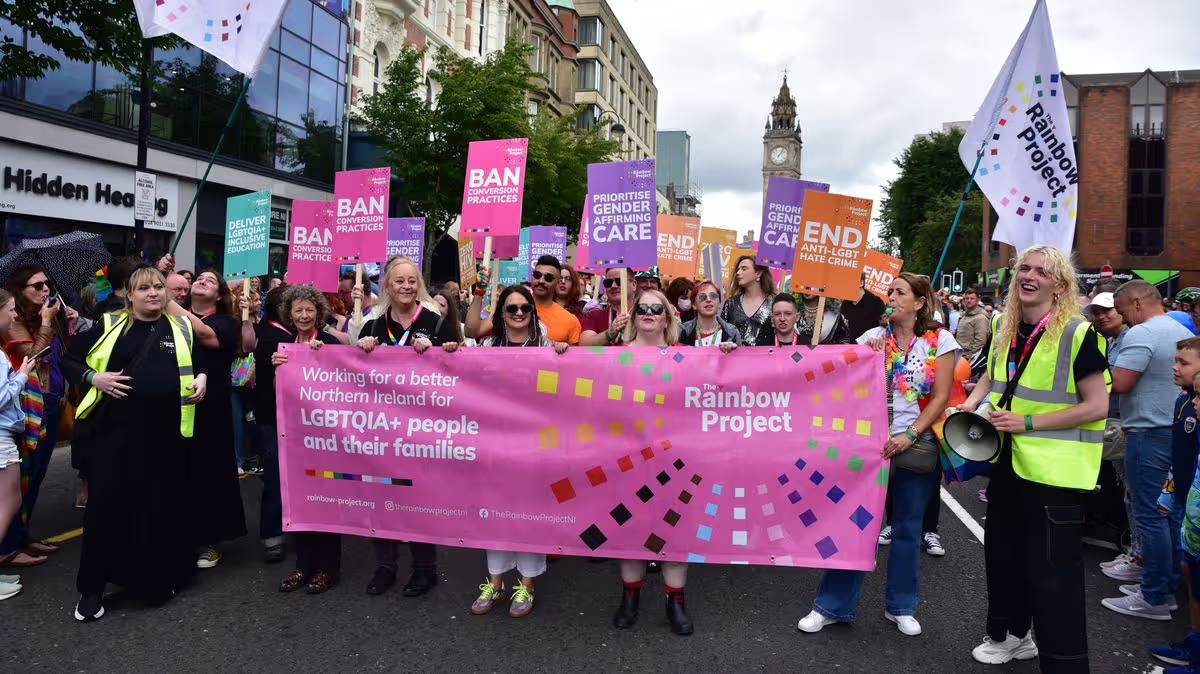
A Belfast-based charity that’s improving the physical and mental health of LGBTQIA+ people has scooped a top influential UK health award.
Advertisement
The Rainbow Project, a charity based in Belfast but serving all of Northern Ireland, has secured one of this year’s GSK IMPACT Awards, one of the most prestigious honours for health and care charities in the UK, which is awarded by global biopharma company GSK in partnership with The King’s Fund.
The award recognises the charity’s work delivering crucial health and wellbeing services for Northern Ireland’s LGBTQIA+ community, amid a context of high levels of mental distress in its community, alongside longstanding religious, political and social pressures in the country.
Socially conservative political pressures in Northern Ireland have significantly shaped the pace of LGBTQIA+ rights, contributing to delayed reforms. As a result, Northern Ireland was the last part of the UK to decriminalise homosexuality and to legalise same-sex marriage. LGBTQIA+ communities experience disproportionately poorer health outcomes and care.
Advertisement
This is particularly evident in mental health: The Rainbow Project’s own survey of more than 1,100 members highlights the scale of the issue, with 39% reporting self-harm, 45% experiencing suicidal ideation and 65% reporting depression.
Following a rigorous selection and assessment process, The Rainbow Project was chosen from a record number of award entries as one of the 10 winners of the 2026 GSK IMPACT Awards. Now in its 29th year, the awards are delivered in partnership with leading health and care charity The King’s Fund. Since its inception in 1997, more than 570 charities have received a GSK IMPACT Award.
The awards are widely seen as a hallmark of excellence in the charity health sector and are designed to recognise outstanding small and medium-sized charities working to improve people’s health and wellbeing in the UK. Award- winners will receive £40,000 in unrestricted funding, as well as a place on a highly coveted leadership- development programme provided by The King’s Fund.
The award judges were particularly impressed by The Rainbow Project’s co-cultural counselling service – the only one of its kind in Northern Ireland. All counsellors are members of the LGBTQIA+ community and deliver sensitive, tailored care using an LGBTQIA+ affirmative approach, with demand doubling over the past year. The charity is also leading efforts to ban conversion practices in Northern Ireland, which attempt to change or suppress a person’s sexual orientation or gender identity.
Advertisement
Judges also praised The Rainbow Project for its strategic partnerships across Northern Ireland, its role in meeting identified need and filling service gaps, and its innovative health and care initiatives that genuinely reflect the needs of LGBTQIA+ people.
One example is its Cancer Champions programme, developed with Macmillan Cancer Support, which supports LGBTQIA+ people affected by cancer by promoting screening, improving inclusivity and providing information and advice. This includes groundbreaking work supporting trans and non-binary people to access breast screening, with clear, accessible guidance on what to expect and how to attend.
Scott Cuthbertson, Chief Executive Officer of The Rainbow Project, said: “We are delighted to be one of the 10 winners of the 2026 GSK IMPACT Awards. The Rainbow Project is a charity about making change: as LGBTQIA+ people, we know that the status quo does not work for us, so our impact is vitally important to us.
“We have worked hard to build an organisation that meets the needs of the communities we serve, while standing resilient to the challenges faced in Northern Ireland. We are very much looking forward to the leadership development programme provided by The Kings Fund, to continue to improve our impact in future.”
Advertisement
Charities are operating in a more difficult financial environment while demand for their services continues to grow. As the Health and Social Care in Northern Ireland (HSCNI) service experiences significant pressures and undergoes structural changes, charities remain essential for meeting the needs of underserved communities and working with the service to ensure LGBTQIA+ people receive the standard of care they deserve.
Against this backdrop and amid growing demand for services, the judges were impressed by The Rainbow Project’s unwavering commitment to providing high-quality counselling services, noting that the organisation provided more than twice as many counselling sessions in 2024/25 compared with the previous year.
Established by volunteers in 1994, The Rainbow Project was initially formed in response to concerns about the spread of HIV among gay men in Northern Ireland, providing information on HIV, AIDS and other sexually transmitted infections, alongside safer sex materials.
Since then, the charity has expanded to support the entire LGBTQIA+ community, offering more holistic physical and mental health support, including counselling delivered both online and in person to reach people in more remote areas. It also provides employability advice for young people, including access to a youth work qualification.
Advertisement
In 2023/24, the charity delivered more than 1,700 counselling sessions, supporting around 240 people, distributed over 30,000 safer sex packs across Northern Ireland, and provided 189 rapid HIV or syphilis tests.
It also trained more than 800 professionals across the public, private and voluntary sectors on sexual orientation and gender awareness and delivered 314 ‘listening ear’ wellbeing sessions for people awaiting counselling.