




Connect with us

NewsBeat

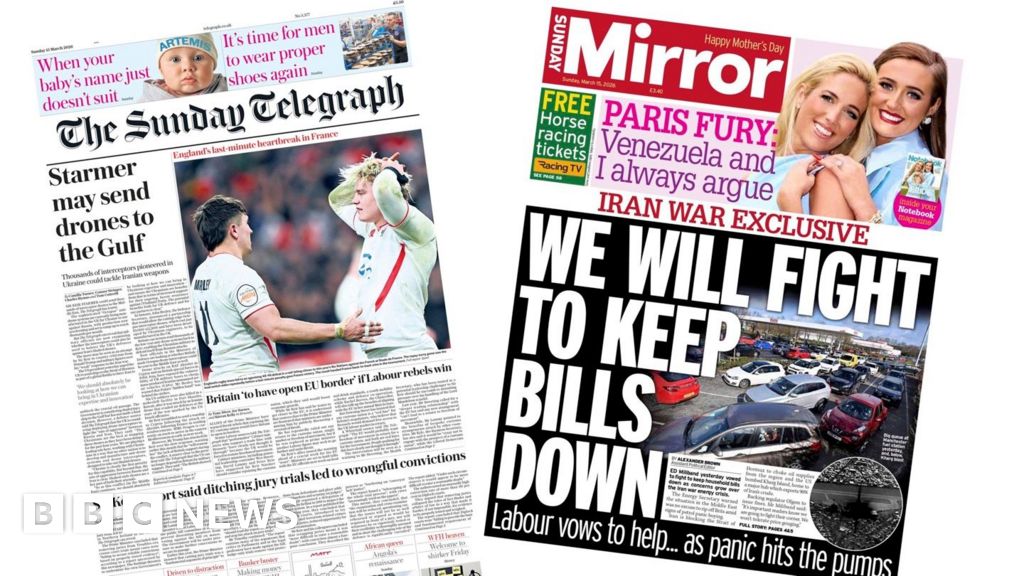
‘Starmer may send drones to the Gulf’ and ‘Panic hits the pumps’

Published

on

'Starmer may send drones to the Gulf' and 'Panic hits the pumps'
The headline on the front page of the Independent reads: "Trump urges UK to send warships to Strait of Hormuz."

Donald Trump is piling pressure on nations to step up their involvement in the war, urging the UK and others to send warships to the Strait of Hormuz to break Iran’s blockade of the waterway, says the Independent. Elsewhere, the paper features a photo of a man standing in front of his destroyed building in Lebanon’s south, which has been heavily bombarded by Israeli strikes.

Source link

Continue Reading
Click to comment

Leave a Reply

Your email address will not be published. Required fields are marked *

NewsBeat

5 of the best pubs in North Yorkshire with epic reviews

Published

on

5 of the best pubs in North Yorkshire with epic reviews

From gastropubs with national acclaim to welcoming village locals, here are five of the best across the county, according to reviews online:

The Star Inn, Harome

Main Street, Harome, near Helmsley, YO62 5JE

One of the most celebrated pubs in the region, The Star Inn in Harome has built a national reputation for its ingredient-led cooking served in a 14th-century thatched inn.

Regularly featuring in major food guides, the pub is known for combining “rustic charm” with “refined dishes” that showcase Yorkshire produce.

Advertisement

Diners frequently praise the quality of the seasonal menus, “attentive service” and the “cosy yet elegant atmosphere”.

The Malt Shovel at Brearton (Image: TRIPADVISOR)

Online reviewers often describe it as a “destination for special occasions”, with many highlighting the consistency of both food and hospitality.

Its gardens and traditional interiors only add to its appeal, according to diners.

The Alice Hawthorn

The Green, Nun Monkton, York, YO26 8EW

Advertisement

Overlooking the village green in Nun Monkton, The Alice Hawthorn offers “classic country-pub charm with a modern focus on food”, according to reviews.

Housed in a historic 18th-century building, it has been carefully restored to retain exposed beams and period features while delivering a contemporary dining experience.

Reviewers regularly commend the “warm welcome”, “well-executed British dishes” and “relaxed setting”.

Its combination of “quality food”, local ales and “stylish rooms” has made it a firm favourite with both York residents and visitors exploring the surrounding countryside.

Advertisement

The Wensleydale Heifer, West Witton

Main Street, West Witton, Leyburn DL8 4LS

Set in the heart of the Yorkshire Dales, The Wensleydale Heifer has become one of the area’s most talked-about inns.

Holding an impressive 4.8-star rating on TripAdvisor from more than 1,400 reviews, it is particularly well known for its seafood dishes alongside traditional pub favourites.

Advertisement

Visitors frequently highlight the “generous portions”, “friendly service” and “relaxed yet polished atmosphere”.

A traditional coaching inn with boutique-style rooms, it attracts walkers, food lovers and weekend break visitors alike, with many reviewers describing it as a “must-visit” when in the Dales.

The Angel at Hetton, Hetton

Back Lane, Hetton, Skipton, BD23 6LT

Tucked away in a small Dales village near Skipton, The Angel at Hetton blends historic character with ambitious, modern British cooking, according to people online,

Advertisement

The pub has earned widespread praise for its tasting menus and carefully sourced ingredients.

Online reviews often reference the “quality of presentation” and “depth of flavour”, alongside the “attentive service”.

Despite its fine-dining credentials, the setting remains rooted in traditional village pub surroundings, making it popular for celebratory meals as well as relaxed countryside dining.

The Malt Shovel, Brearton

Main Street, Brearton, Knaresborough HG3 3BX

Advertisement

A Yorkshire village pub just outside Knaresborough, The Malt Shovel offers a more traditional take on the county’s pub scene, per reviews online.

With a strong reputation for “hearty British classics”, “well-kept ales” and “welcoming staff”, it consistently earns positive reviews from locals and visitors alike.

Diners often comment on the “friendly atmosphere” and “reliable, well-portioned dishes”.

Its location in the quiet village of Brearton makes it a popular stop for walkers and those seeking a relaxed meal away from busier places.

Advertisement

Source link

Continue Reading

NewsBeat

four experts on how opera can survive, thrive and reach new audiences

Published

on

four experts on how opera can survive, thrive and reach new audiences

Earlier this month, former English National Opera artistic director John Berry said opera in the UK needed to “attract good writers and tell better stories” that could tap into the zeitgeist, making the art form more contemporary and accessible. But is this kind of approach enough to capture the attention of new and younger audiences? In the same week, actor Timothée Chalamet caused a furore when he dismissed ballet and opera as art forms that younger people “did not care about”.

Often regarded as an “elite” art form, opera undoubtedly has an image problem in that it is seen as the preserve of rich older white people, which risks alienating those who feel it excludes and is not for them. At the same time – like much of the arts – opera is under attack from funding cuts and needs to attract new and more diverse audiences if it is to survive long term. So what is the position of opera in the UK and what does it need to do to secure its future? We asked four experts in the field.

Embrace a greater range of influences

Jen Harvie, Professor of Contemporary Theatre and Performance, Queen Mary University of London

John Berry’s comment raises crucial questions: more generally, what should the arts do? And for opera: what should a traditionally “elitist” art form do? My answer: publicly subsidised arts have an ethical duty to reach as wide an audience as possible.

Advertisement

This doesn’t mean the arts should dumb down – a horrible, patronising phrase. It means traditionally elite arts like opera must adapt to broaden their appeal. I am not alone in my view. Research commissioned by Arts Council England on opera in 2024 says the same thing: that opera’s audiences are usually white, older and richer than England’s general population.

To expand audiences, opera must embrace a greater range of influences, from musicals to concept albums and music videos. It should commission new English-language librettos and mixed spoken/sung operettas. It should commission stories that resonate with audiences across all ages, classes and ethnicities. At the same time, opera’s funders must support both formal innovation and arts education, to facilitate access to opera.

Opera is full of extraordinary performance, music, song, storytelling, stagecraft, costume and design. It faces an ethical responsibility – and an opportunity – to share these riches with more of us.

Advertisement
Popular Spanish singer-songwriter Rosalia’s latest album embraces all kinds of musical forms.

Transform the operatic ecosystem

Edward Venn, Professor of Music at the University of Leeds

Beneath its attention-grabbing provocations, Berry’s call for the evolution of opera contains a deceptively simple question: how are we going to
encourage writers? Clearly, opera benefits from showcasing authentic creative
voices that speak to a wide audience.

But the answer does not lie in enticing the latest Netflix sensation to pen a libretto. Rather, evolution requires the whole operatic ecosystem to transform so that those performing, directing and creating operatic stories better reflect our society.


Advertisement

This article is part of our State of the Arts series. These articles tackle the challenges of the arts and heritage industry – and celebrate the wins, too.


The opera industry is working hard within the considerable constraints of arts and education funding cuts and a wider cost-of-living crisis to effect such a transformation. But there is still a long way to go before the demographics of performers replicate those of wider society, and longer still for the creative teams backstage.

The industry tends towards creative reworkings of canonic repertoire rather than financially more risky new commissions. This means opportunities for composers and writers to produce new work that speaks to contemporary issues become vanishingly rare.

Sustainable evolution comes from nurturing a diverse, rich talent pool; such diversity can in turn result in a wealth of authentic, compelling operatic stories. But this requires creative risk-taking at a time when opera companies can ill afford to do so.

Advertisement

Itch by Alasdair Middleton and Jonathan Dove.

Develop new writers, composers and audiences

Jennifer Daniel, Senior Lecturer in Musical Theatre at Edge Hill University

To “own the zeitgeist in the performing arts”, as Berry suggests, opera does need to develop its form, its artists – and crucially, its audiences. Is that really about drawing big names into the writing process? Opera librettists are distinctive – they create musically, often in established partnerships with composers (such as Alasdair Middleton with Jonathan Dove).

They take on dramaturgical responsibility for musical storytelling, often finding ways to write less. Writing an opera can take years, is seldom profitable, and skills most often developed for the love of it rather than acclaim or financial reward. Opera writers really want to write opera. And companies such as Opera North have made the case that the publicly funded opera company has the public responsibility to develop those distinct artists in developing the form.

Advertisement

Just as important, audiences also have to be developed in readiness to receive. In the best cases, companies’ outreach and education work extends our understanding and enhances our reception of opera, including the challenging and the new.

Such initiatives are applied across an incredibly broad social and age spectrum by companies such as Opera North, ENO, Royal Opera and the rest. The balance of cost and popularity means that relatively few full-scale new operas are produced. Small, agile productions can be hugely innovative and accessible if we can tear ourselves away from the grandeur of the mainstage auditorium.

But concurrent and equally important to the development of new work is the development of a wide audience. There must be a commitment to ensuring that each generation anew is culturally primed and able to access an art form – from the 1700s right up to the present moment – that is live, spectacular, unmediated and essentially human. If “opera if wants to own the zeitgeist” in an age of AI, technology and unprecedented mediation, this is, perhaps, where we should place our attention.

Advertisement

Invest in well-conceived outreach programmes

Kiera Vaclavik, Professor of Children’s Literature & Childhood Culture and Director of the Centre for Childhood Cultures at Queen Mary University of London

When I was a teenager my class got on a coach to London to take part in a workshop with Glyndebourne Opera, where I sang and found out about Dvořák and his gripping mermaid story, Rusalka (1901). In the evening, we went to see that story performed. I was not much of a singer and there was no way I would have seen an opera otherwise. Nor would I have been able to make much sense of it without the workshop. The entire trip cost £5 and I’ve never forgotten it.

Opera companies don’t need TV writers as much as they need well-funded and well-conceived outreach programmes. They need to be operating within a culture where, from birth, children have opportunities to experience the sheer wonder of sound that a voice can produce. Fortunately, companies like HurlyBurly in shows like You Are The Sun are already offering this with great skill and care. We need children to be regularly singing, shouting and using their voices.

Young audiences can’t tell what they like or don’t like unless they get to experience it for themselves. Invest in outreach. And as the massive success of an artist like Rosalía suggests, don’t underestimate their eclecticism and openness.

Advertisement

Source link

Continue Reading

NewsBeat

Everything you need to know about the hero firefighter who saved Glasgow Central

Published

on

Daily Record
Everything you need to know about the hero firefighter who saved Glasgow Central – Daily Record