Connect with us
DAPA Banner

NewsBeat

Stone Roses star Mani to be honoured by music legend at BRIT Awards

Published

on

Daily Mirror

Stone Roses Mani, who died last November, to be honoured by Charlatans frontman Tim Burgess , who was a close friend of the star

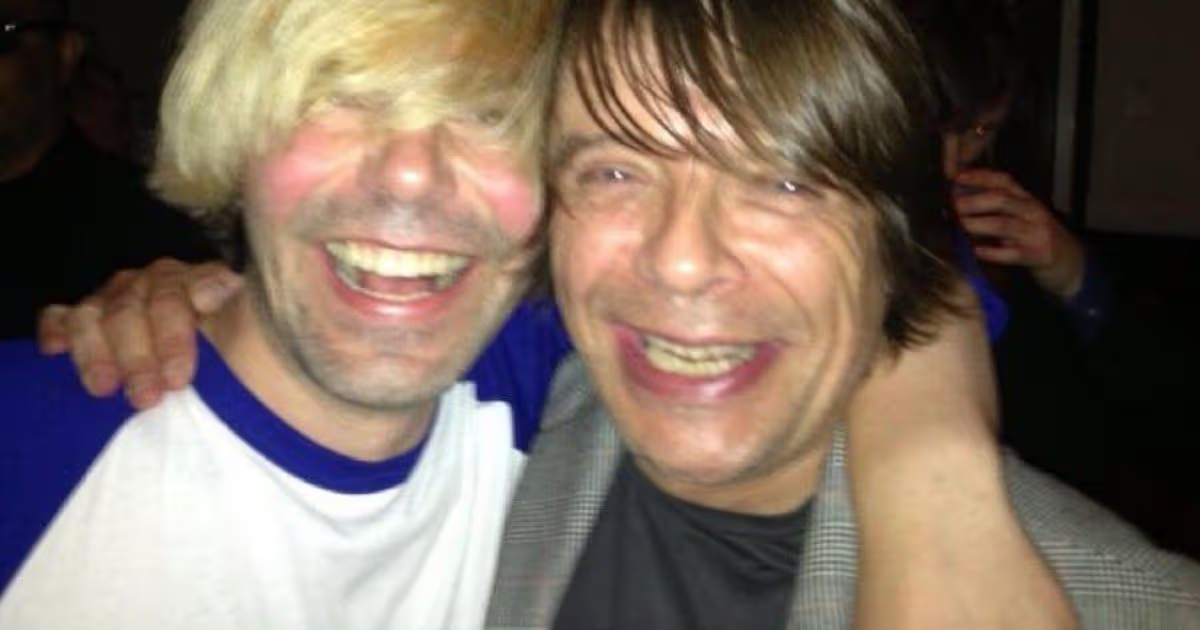
BRIT Awards bosses are set to honour Stone Roses bassist Mani at Saturday night’s show – led by Charlatans legend Tim Burgess. Gary ‘Mani’ Mounfield died suddenly aged 63 last November, and close pal Tim will be on hand to deliver an emotional speech.

A source said: “Tim is set to present the In Memoriam section, but before he does so, he is primed to talk about Mani who was both a dear friend and mentor. The fact that Mani was from Manchester too – and the awards is being held there for the first time – means it will be a really special moment. Mani will then feature heavily in the section, as will other greats we have lost including Ozzy Osbourne.”

Tim has previously spoken of his love for the Stones Roses legend. He said: “I looked up to him so much. He was a pathfinder for so many of us, like an older brother who had blazed a trail.” The Stone Roses broke up in 1996 citing musical differences and Mani joined rock band Primal Scream, who he stayed with for 15 years.

Advertisement

He would go on to record four more albums with the band before leaving in 2011 to reform The Stone Roses. The ceremony will also see Happy Mondays duo Bez and Shaun Ryder reunite as guest presenters to present an award, at Manchester’s Co-op Live arena.

The pair, who previously performed at the Brits in 1991, were top of the wish-list for organisers. A source says: “They will hopefully bring some old-school Madchester energy to proceedings…..organisers can’t wait to see them in action. They want the show to be a love letter to Manchester as it’s being held in the city for the first time, and want to channel the city’s brilliant energy.”

As well as featuring in the In Memoriam section, Osbourne will be honoured with a posthumous Brit Awards lifetime achievement award. The singer, known as the Prince of Darkness, died aged 76 in July last year just over two weeks after his Back To The Beginning farewell concert where he was reunited with his bandmates.

Advertisement

There will be a tribute performance, fronted by pop star Robbie Williams, in celebration of his “inimitable impact and influence on music worldwide”. The tribute performance, curated by Ozzy’s wife Sharon Osbourne, will consist of a special arrangement of Black Sabbath’s 1991 song No More Tears, with Williams joined on stage by musicians who have previously played as part of Ozzy’s band, including keyboardist Adam Wakeman, Metallica’s Robert Trujillo, drummer Tommy Clufetos and guitarist Zakk Wylde.

Stacey Tang, chairwoman of the 2026 Brit Awards committee, said: “Ozzy Osbourne has been a mighty force in modern music. “Possessing an unmistakable voice and unique presence, he reshaped the sound and spirit of rock, inspiring generations of artists who followed. This lifetime achievement award recognises a remarkable legacy built on originality and enduring influence that continues to connect with fans worldwide.”

The music star died of a reported heart attack on July 22 after suffering a string of health issues over the years, including multiple surgeries following a fall in February 2019 and being diagnosed with Parkinson’s disease. The show, which is presented by Jack Whitehall, will see former One Direction star Harry Styles will return to the Brits stage, where he is expected to open the show with his new song Aperture. Olivia Dean and Lola Young are topping the nominations this year with five nods apiece, whilst Sam Fender trails closely behind with four. Continuing the Manchester theme, Noel Gallagher is the recipient of this year’s Songwriter of the Year award.

Advertisement

Organisers say that his “songwriting has permeated the fabric of British culture for over 30 years, from his seminal work with Oasis to his ambitious and acclaimed solo albums with Noel Gallagher’s High Flying Birds..” They added: “His songs span generations and have continued to resonate with audiences around the world like no other.”


Source link

Continue Reading
Click to comment

You must be logged in to post a comment Login

Leave a Reply

NewsBeat

Arsenal chief Josh Kroenke came out swinging in response to fan criticism

Published

on

Daily Mirror

The Arsenal co-owner has proven that is not afraid to front up to fans when the going gets tough

Arsenal will meet Manchester City in the Carabao Cup final on Sunday, with Josh Kroenke anticipated to be present. Josh, 45, is the son of Stan Kroenke, whose Kroenke Sports and Entertainment group (KSE) became the sole proprietor of Arsenal in August 2018.

Advertisement

Having been joint owners since 2007, Stan subsequently purchased Russian oligarch Alisher Usmanov’s 30 per cent stake for more than £600m, concluding a protracted battle for ultimate ownership of Arsenal. That elevated the Kroenke’s combined holding to 97 per cent.

Josh also holds the position of president of Major League Soccer outfit, Colorado Rapids, and, as with his involvement with the Gunners, he has shown willingness to engage supporters during difficult periods, establishing himself as an intermediary between fans and the hierarchy.

FOLLOW OUR ARSENAL FB PAGE! Latest Gunners news and more on our dedicated Facebook page

The Denver Nuggets governor came under scrutiny in September 2023 when the Centennial 38 supporters group of the Rapids challenged the Kroenkes in an open letter amid a turbulent spell for the MLS club both on and off the field. Fans were forthright as they highlighted numerous issues, criticising KSE throughout.

Advertisement

They pinpointed insufficient investment in the squad and infrastructure as a principal concern. Additionally, they also alleged inadequate communication with supporters and voiced their frustration at the condition of the Rapids’ DICK’S Sporting Goods Park stadium. Josh responded forcefully.

READ MORE: Thomas Tuchel names strict condition for Max Dowman to make England’s World Cup squadREAD MORE: Arsenal land £60m transfer boost as Champions League advantage clear

He said: “Off the field, we have already engaged Legends, Civitas, Perkins and Will, and Turner Construction on a number of feasibility studies and analyses around potential infrastructure projects as we assess a future vision for DICK’S Sporting Goods Park and the Club’s training environment.

“We are also actively evaluating additional ways to enhance the gameday experience inside and outside the stadium. Over the next few months, we will be finalising the master plan for our exciting Victory Crossing Project.

Advertisement

“Our supporters will always be the lifeblood of our club. We hear you and we look forward to having an ongoing dialogue with Centennial 38 over their concerns and our plans for the future.”

Josh’s direct communication with Rapids supporters will evoke parallels for Arsenal fans. Following 16 Gunners supporter groups signing a letter and launching a petition calling on the ownership to show greater commitment and leadership in 2019, it was Kroenke Jr who broke his silence.

Josh addressed supporters head-on once more, transforming Arsenal’s trajectory over the following five years. “Is it hard to take? Absolutely,” Josh said of the letter.

Advertisement

“But I’m not in this business to make friends, I’m in it to win. If anyone is ever going to question anything about our ownership, which I view as a custodianship, the supporters trust us to be a custodian of the values – that’s what we’re trying to do. We’re trying to win whilst also respecting the values and traditions of the club.

“I’ve sat down with supporters’ groups. I’ve not been afraid to sit down to have tough conversations with people because I’m transparent, we’re transparent, we don’t have anything to hide. We all want the same thing and we’re all trying aggressively to make it happen.”

The Kroenkes delivered on that promise. The club embarked upon a transfer spending spree in the summer of 2025 that may have positioned Mikel Arteta’s squad for a remarkable campaign.

Advertisement
Content cannot be displayed without consent

Arsenal sit top of the Premier League and have progressed to the Champions League and FA Cup quarter-finals. Should they prevail against Pep Guardiola’s side in the League Cup final on Sunday, it could well prove the opening silverware of an extraordinary quadruple this season.

Join our new WhatsApp community and receive your daily dose of Mirror Football content. We also treat our community members to special offers, promotions, and adverts from us and our partners. If you don’t like our community, you can check out any time you like. If you’re curious, you can read our Privacy Notice.

Sky Sports discounted Premier League and EFL package

This article contains affiliate links, we will receive a commission on any sales we generate from it. Learn more
Content Image

£49

£35

Advertisement

Sky

Get the deal here

Sky has slashed the price of its Essential TV and Sky Sports bundle for the 2025/26 season, saving £336 and offering more than 1,400 live matches across the Premier League, EFL and more.

Sky shows at least 215 live Premier League games each season, an increase of up to 100, plus Formula 1, darts, golf and more.

Source link

Advertisement
Continue Reading

NewsBeat

Maxine Carr’s chilling four-word prison nickname shouted from jail cells

Published

on

Daily Mirror

Maxine Carr was sentenced to three-and-a-half years in prison after trying to protect her murderous boyfriend Ian Huntley after he killed two school girls – and she quickly became a target while behind bars

As the most hated woman in Britain, she quickly became a target to fellow lags behind bars.

Advertisement

Maxine Carr left the nation reeling after she tried to cover up the unimaginable crimes of her killer boyfriend Ian Huntley. She was jailed for providing her murderous lover with a false alibi on 4 August 2002 – the night he brutally killed schoolgirls Holly Wells and Jessica Chapman, before dumping their bodies in an irrigation ditch in Soham, Cambridgeshire.

The former teaching assistant attempted to protect Huntley by claiming she was at home on that dreadful night – when in reality, she was in Grimsby. Holly and Jessica, both aged 10, had left a family barbecue to buy sweets when they mysteriously disappeared, only to be tragically discovered dead 13 days later.

After Carr’s lies unravelled in court, she sentenced to three and a half years behind bars. She was released after serving half of her sentence in May 2004 and also granted a new identity, said to have cost the state millions of pounds.

READ MORE: Ruined lives of women mistaken for Maxine Carr – attacks, terror and tragic overdoseREAD MORE: Ian Huntley’s death means there’s a new No 1 target in HMP Frankland

Advertisement

During Carr’s stint at Holloway Prison, women allegedly screamed from their cells, hurling the chilling nickname “Myra Hindley Mark Two” at her. It was in reference to the 1960s crimes of Myra Hindley and Ian Brady, the British serial killers who murdered multiple children in the Manchester area. Carr did not committ murder, but her attempt to protect her killer boyfriend Huntley left the nation – and her fellow lags – disgusted.

The search operation to locate Holly and Jessica was one of the largest the nation has ever witnessed. Carr and Huntley even participated in the hunt, talking to the media and assisting locals, as well as 400 police officers and US Air Force personnel, in scouring the countryside for the missing best friends. Sick Huntley even comforted Holly’s father as the search went on.

In one interview, Carr – who was the girls’ teaching assistant – boasted about her significance to Holly and showed reporters a card Holly had made for her on the last day of term. In a conversation with a television journalist, Carr expressed: “No one believes they would ever run away. They were very close to their families. This is something that I will keep for the rest of my life. It’s what Holly gave me on the last day of term and there’s a poem written inside saying ‘to a special teaching assistant’ and that we will miss her and we will see her in the future. That was the kind of girl she was, she was just really lovely.”

Advertisement

Every registered sex offender in Cambridgeshire and Lincolnshire was questioned, yet there appeared to be no sign of the primary school pupils. A substantial media campaign ensured Holly and Jessica remained on every newspaper’s front page and in every news broadcast for 13 days, leaving no stone unturned.

It emerged that Huntley, already under police scrutiny, had returned to the location where he discarded the bodies to remove the girls’ unique Manchester United shirts and attempted to burn them. He subsequently disposed of the shirts in a bin at his place of work, concealing them beneath another rubbish bag, but the authorities discovered them in a pivotal breakthrough for the investigation.

Huntley was found guilty of murder and received two life sentences, with a minimum term of 40 years imprisonment. Carr was sentenced to three-and-a-half years for perverting the course of justice. Upon completing half of her sentence, she was released and granted a new identity. Huntley died earlier this month after a brutal prison attack left him brain damaged.

Advertisement

Carr walked free from Foston Hall prison in Derbyshire in May 2004 with a new idenity for her own protection. Over the next two years, Carr was relocated to over 10 different safe houses for protection, and in 2011, reports emerged that she had welcomed her first child – a baby boy – whilst in a secure location. By 2012, she was understood to have embarked on a committed relationship with a partner who knew about her disturbing history and was reportedly ‘absolutely besotted’ with her.

By 2014, she was believed to be residing in a coastal town. The Channel 5 true crime drama – entitled Maxine – portrays her living beside the sea, with somebody calling out her name, claiming they recognised her. Authorities cannot disclose the town’s identity due to the permanent anonymity order bestowed upon Carr by the High Court over a decade ago.

She remains one of only four former UK prisoners shielded by lifelong anonymity – alongside James Bulger’s killers Robert Thompson and Jon Venables, and child murderer Mary Bell. That same year she established her coastal existence, Carr allegedly wed a man in a secret ceremony complete with all the bells and whistles.

The revelation is believed to have been a tough blow for the devastated mums of Holly and Jessica, who were denied the chance to watch their daughters carve out their own lives. “The families of Holly and Jessica will never get to see their daughters marry,” an insider revealed to the newspaper. “They will never get to enjoy their big day. They have nothing to look forward to. Why should she?”.

Advertisement

Source link

Continue Reading

NewsBeat

Sunday roast at one of Cardiff’s best restaurants has a Yorkshire pudding surprise like nothing you’ve ever seen

Published

on

Wales Online

A stuffed Yorkshire pudding, you say?

Advertisement

A Sunday roast should rarely be described as a treat in my eyes, they’re a British staple, a family tradition, a literal meat and veg dinner that means oh so much more than it sounds.

But take a roast from a one of Cardiff’s finest, Heaneys and you’ll be betting on so much more from your Sunday dinner – or lunch as posh people call it – thanks to the Michelin Guide restaurant’s excellent menu and a meat and gravy treat you’d love to create at home, but you’re just too lazy.

I am, at least.

I’ve had a roast at Heaneys a few times and never been disappointed. I usually get the dry aged roast beef, which is always soft and pink on the inside and roasted but juicy around the outside. All roast dinners come with fantastic duck fat roasties, braised carrots, miso and bacon cabbage (drool) and cauliflower cheese.

Advertisement

They are an excellent gang of sides that complement the main event – the tender beef. But wait, there’s also a Yorkshire pudding, not any old Aunt Bessie’s Yorkshire, but a homemade one, of course, and it’s got something inside it.

Heaneys’ Yorkshires are lush. More often than not they are a browny-bronzed tower of roasted batter, sometimes a bit Pisa-esque, but lush all the same. And the bigger the better.

And in an extra special move that would make any Welsh nan proud, Heaneys team have nailed a ‘stuffed Yorkshire pudding’ as a lip-smacking addition to their beef dinner. It’s extra bonus feature is a rich, gravy soaked extra helping of beef, roughly minced but really soft and has a deep, meaty flavour.

Advertisement

Yes, it’s definitely ‘extra’ but never too much. It’s a clever way to incorporate beef cooked in a different way into the roast. Don’t get me wrong, I love it when you can slice through silky-like-butter hunk of pinky roast but turning a Yorkshire pud into more or less a meat pie-esque feature on the plate gives it that extra bit of style.

The party of side dishes, too, make sure that this is anything but a boring Sunday roast, the veg is fresh and tasty and the roasties are next level crispy.

Of course, you can’t go to Heaneys without sampling their Marmite butter, which is always as good as the last time and if you’ve nto tried it I wouldn’t skimp, either.

I tend only to write about brilliant food in Wales that’s great, it’s wonderful to be able to showcase good things created by talented folk. And I’ve had a lot of roast dinners, Heaneys’ definitely ranks among the top and always elicits excited anticipation when someone suggests booking there.

Heaneys three-course Sunday lunch is £48. Find sample menus and how to book, here. For the latest restaurant news and reviews, sign up to our food and drink newsletter here

Advertisement

Source link

Continue Reading

NewsBeat

Ten minute habit could boost your GLP-1 without medication

Published

on

Daily Record

GLP-1 helps regulate appetite and blood sugar

A world-renowned doctor has revealed some simple methods to increase GLP-1 naturally. The hormone is created in the gut and controls appetite and blood sugar levels by sending signals to the brain and pancreas.

GLP-1 drugs are presently being used by many people throughout the UK to assist with weight management. However, a medical professional has explained how individuals might be able to enhance GLP-1 levels without medication. Dr Mark Hyman, a prominent healthcare expert and educator, frequently posts updates for his millions of social media fans.

Advertisement

In a recent post on Instagram, the doctor said: “Did you know GLP-1 is a hormone your body makes naturally? GLP-1 is released in the gut after you eat. It helps regulate appetite, blood sugar, and how quickly food leaves the stomach.”

Information on the graphic he shared outlines seven methods people can use to boost GLP-1 naturally, and one takes just ten to fifteen minutes. These involve getting between seven and eight hours of sleep nightly on a regular basis, and incorporating fibre and protein into every meal.

Content cannot be displayed without consent

You might also consider reducing ultra-processed foods, creating meals centred on whole foods, eating at a slower pace, maintaining regular physical activity, and having a 10-15 minute stroll following meals. Dr Hyman continued: “Meals rich in protein and fibre tend to increase satiety hormones like GLP-1.

“Walking after meals helps the body handle glucose more efficiently. Regular exercise, good sleep, and limiting ultra-processed foods all support the metabolic pathways that regulate hunger and blood sugar.

Advertisement

“These habits are part of the biological foundation that helps your metabolism work the way it was designed to.”

Source link

Continue Reading

NewsBeat

Meatballs have replaced burrata as London’s go-to Italian dish

Published

on

Meatballs have replaced burrata as London's go-to Italian dish

The newest polpette-slinger on the block, CeCe’s, is the latest restaurant from the Public House Group (Fat Badger, The Hero and so on). Meatballs are a standalone dish here and served al sugo, plump and traditional and a little coarse. The dish is a starter rather than a main course, sitting with other big hitters such as mozzarella in carozza and sea bream carpaccio.

Source link

Continue Reading

NewsBeat

‘I lost my uncle to Covid but I don’t want his life to be defined by his death’

Published

on

Belfast Live

Since his passing, his niece has been passionate about raising awareness of what happened to him.

Lauren Mallon Remembers Her Uncle Raymond McAleese Lost To Covid

Six years ago today, March 23, Northern Ireland along with rest of the UK entered the first national lockdown to stop the spread of Covid-19.

The pandemic catapulted Northern Ireland along with the rest of the world into a new way of living but it also brought waves of heartache to thousands of families.

As the first deaths from coronavirus began to be recorded in early 2020, heartbroken families were forced to mourn the loss of loved ones in a very different way and faced an unnatural grieving process.

READ MORE: Divided Stormont led to ‘chaotic’ Covid response, public inquiry findsREAD MORE: ‘I was collateral damage’ – woman left disabled after Covid vaccine speaks out

Advertisement

Covid restrictions also saw families separated from their loved ones in hospitals and residential care facilities while attendances were also severely restricted for funerals.

Every death left behind a grieving family and friends and since then many of those impacted have chosen to speak openly about the loss of their loved ones, both young and old.

Raymond McAleese from Glenavy was just 52 when he passed away at Antrim Area Hospital in September 2021. He died within a week of contracting the virus.

His niece Lauren Mallon, 26, says her uncle “had no human rights in life or death” and since his passing, the young Co Antrim woman has been passionate about raising awareness of what happened to him.

Advertisement

But she also said she feels her uncle was “written off” as a recovery prospect because he had Down’s Syndrome and that the most vulnerable like Raymond were “let down” during the pandemic.

Speaking to Belfast Live to mark the sixth anniversary of lockdown, Lauren shared fond memories of her much-loved uncle who had lived with her family for most of his life before moving into care for what turned out to be his final two years.

Advertisement

Lauren said: “He had Down’s Syndrome, but it was definitely not a defining feature of his life. In many ways he thought he was normal and I suppose that’s because we treated him like he was normal. To us he was no different and we never knew him any differently to what he was.”

She added: “You can’t explain a pandemic to someone with a learning difficulty because to him it’s like: ‘what do you mean? you’re not sick, I’m not sick, why?’ so it was just really difficult for him to comprehend.

“He loved seeing us. The first thing he always did was give you a big hug, and he would have been giggling and laughing. He was always so excited to see everybody so not having that contact during lockdown was a really difficult time for everybody.”

In September 2021, Lauren’s mother Paulette was informed that her brother had contracted Covid and was being moved from his care home to hospital.

Advertisement

Lauren recalled: “They moved him to hospital and they put him into A&E and my mum had to go down actually and sit with him for a while because he couldn’t understand that he couldn’t walk about. A couple of days went by and he seemed to be doing OK.

“They started to talk about, right, he does have Covid but he’s on oxygen and if we can keep his levels pretty stable, we can give him oxygen in his care home so we could move him back.

“But then they said, ‘oh no he’s really, really unwell’. My mum was very concerned at that point and she just remembers saying ‘do you mean he’s dying, is that what you’re trying to tell me? They said ‘yes at this point it’s unlikely that we think he’d recover’ so then it was really just a waiting game for the inevitable.”

Advertisement

Lauren added: “He died on Sunday, September 26 2021 at 6:29 in the morning. My mum’s parking ticket for the hospital was dated or time stamped 6:31 so she missed him by two minutes because of how rapid it was at the end.

“Definitely the communication there was not what it should have been and it’s something that we struggled with then because everything was so sudden towards the end.

“When we reflected on it, we realised there were several things in that experience that were just really not right and I mean all my life I’ve been an advocate for him. I never really appreciated it until he was gone.”

Lauren is a member of the Northern Ireland Covid Bereaved Families for Justice (NICBFFJ), a group campaigning for accountability on decisions made locally in response to the pandemic.

She said: “I think in a large way the world has moved on from Covid and we all just think ‘oh it was back then’ but for so many families like mine, it’s still an ongoing experience.

“Being around other families that understand that and want to listen – it’s not that your family and your friends don’t want to listen, but I think everyone moves on – it’s nice to be around people that actually are sort of still stuck in that moment.”

The inquiry into the crisis this week said the ‘stay home, protect the NHS, save lives slogans’ used during the Covid-19 pandemic “sent the message that healthcare was closed”.

Advertisement

The message, which was created by Cabinet Office officials without input from health leaders, was part of the reason people were “deterred” from accessing healthcare during the pandemic, according to the UK Covid-19 Public Inquiry findings.

Inquiry chairwoman Baroness Heather Hallett said UK healthcare systems “teetered on the brink of total collapse” and coped “but only just”.

Her latest 387-page report says the devastating impact on the NHS was “unsurprising” given the “parlous state” the service was in at the start of the crisis.

Advertisement

The inquiry was formally launched in July 2022.

A report published in November last year found chaos at the heart of government and a failure to take Covid-19 seriously cost 23,000 lives in the first wave of the pandemic.

Lauren added: “Being part of the inquiry has been eye opening in a lot of ways to understand exactly what went on and the impact of it on people’s lives.

“It’s definitely been a good thing for me to channel some of that feeling of injustice into getting some answers, not just for me, but for other families and people involved.

Advertisement

“A lot of people are saying that those in charge at the time did the best they could with what they had but I think from hearing a lot of the evidence out of the inquiry, perhaps that wasn’t the case, and there needs to be lessons learned here.

“This is a great opportunity for us all to learn for any kind of emergency, not just a global pandemic, so a lot of the work now that we’re doing here in Northern Ireland is to reform some of those civil contingency plans.

“What we really want is people to say is ‘OK, we could have done that better, and here’s how we’re going to do it’. That’s all we really want because we can’t bring back our loved ones, they are gone.

Advertisement

“As much as what happened to my uncle Raymond was terrible, I don’t want his life to be defined by his death either. He was so much more than that and so being able to share his story and tell little stories about him and the things that he did, it’s an honour and a privilege and something that I feel very proud to do.

“Anytime that I think about him I just think he’s probably up there going, ‘go on, you’ve got this’.”

Video: Justin Kernoghan

To ensure you don’t miss out on all the latest from Belfast Live, be sure to make us your preferred source on Google.

Advertisement

Source link

Continue Reading

NewsBeat

Crime rate increase leaves Cambridgeshire town residents too scared to go after dark

Published

on

Cambridgeshire Live

The Cambridgeshire town has seen crime rates increase over the last 12 months, with residents reporting incidents ranging from knifepoint robberies to town centre assaults and anti-social behaviour

A Cambridgeshire town is being plagued by drunken men and violent youngsters, leaving residents too frightened to venture out after dark. Locals say the situation is deteriorating and are deeply concerned about what lies ahead.

Advertisement

Wisbech, a market town in the Fenland district of Cambridgeshire, has seen a surge in crime over the last 12 months. Residents have reported a range of incidents, from knifepoint robberies and town centre assaults to drug-related offences. Intimidating groups of youths are reportedly cycling through the town, whilst intoxicated homeless individuals hurl abuse at passers-by.

“I definitely wouldn’t come into the town at night,” Derek Logan told the Daily Express. His partner Gemma agreed with him

Mr Logan added: “I’ve heard some horror stories about the knives that people carry around here. That’s a big issue and makes you feel scared. There’s been stabbings and robberies recently,” reports the Express.

The 57-year-old and his partner, aged 42, were both born in Wisbech. Mr Logan said: “I don’t feel safe coming into the town to shop. I was born and raised here, but it’s changed a hell of a lot recently. I definitely wouldn’t come into the town centre after dark.

Advertisement

“Definitely not. It’s not safe. A 14-year-old got stabbed a couple of years ago. Luckily he was wearing a backpack and it took the impact so he was ok.”

According to official figures, Wisbech, with a population of approximately 27,000, recorded 3,084 reported crimes during the 12 months leading up to January 2026. This equates to a crime rate of 116.2 per 1,000 residents, marking it as the highest amongst medium-sized towns across Cambridgeshire.

In contrast, neighbouring Huntingdon recorded a rate of 84.44 whilst St Neots stood at 58.74. The national average sits at 72 per 1,000 people.

Violence and sexual offences were the most frequently reported crimes in Wisbech, with 1,357 incidents logged during the 12-month period. This represented a 2% increase compared to the previous year.

Advertisement

New Drove, situated off Weasenham Lane, saw the highest number of crimes in Wisbech with 270 offences recorded in total, averaging 22.5 per month. Theft accounted for the majority of these crimes at 84.1%, whilst burglary represented 11.1% of offences.

Geoff Scott, who relocated to Wisbech from Clacton-on-Sea nine years ago, is concerned that crime is worsening in the town. He recently cautioned his wife against visiting the shop after dark.

He said: “It’s getting worse here. I don’t go into the town centre after dark, whereas I used to.

“Last night my Mrs wanted to nip to Asda at 6.30pm, but I said no as it was dark. I told her she wasn’t going. It’s scary after dark here. It’s got out of hand over the last year or so I would say.”

Advertisement

According to Mr Scott, there has been a spate of recent knifepoint robberies in the town centre. He’s also heard of youths carrying knives and threatening residents.

“My main concern is like everyone else’s,” he continued. “We need to feel safe in our home and at the moment we don’t.”

The rising crime rate in Wisbech is also taking its toll on local businesses, with some traders believing that recent incidents have directly reduced footfall in the town, dealing a significant blow to their livelihoods.

Neil Bullen, who co-owns Evisons clothes shop on the High Street with his wife Becky, says he has witnessed criminal activity from his shop window on a number of occasions, and believes the majority of offences occur after dark.

Advertisement

“I’ve seen a bit going on in town and around the marketplace. I think the worst things happen at night, usually,” the 59-year-old explained. “You see kids in groups riding around on their bikes. It can be intimidating for the locals. You don’t know what they’re up to.

“The older generation in Wisbech will be able to remember how things used to be here. Sadly, now a lot of older people don’t feel safe coming into the town centre.”

Mr Bullen claims that customers visiting his shop report “they don’t feel safe” around the town any longer. This, he believes, is having a direct impact on footfall.

Mrs Bullen added: “There are various issues in the town. A lot of shops have closed recently which means less people are coming into Wisbech.

Advertisement

“This means that anti-social behaviour actually stands out more as when people do come in that’s all they say. There aren’t crowds of people to hide what happens. The kids might feel like they can get away with it as the place is deserted. There’s no one to report them.”

Mackenzie Miller and Emma Plumb have both allegedly been victims of crimes committed in Wisbech over recent months.

Ms Plumb, 45, was reportedly assaulted by an intoxicated man in an unprovoked attack whilst Mr Miller, a 62 year old wheelchair user, was targeted by a group of young men. Both incidents were reported to police.

“I got assaulted a couple of months ago in the town centre. It was random and a drunk man came up to me and grabbed me. Luckily there was a security guard and they intervened,” Ms Plumb explained. “It gets scarier after dark, I’d say. I wouldn’t come here any more at night. It’s not what you want for the place where you live. You want to feel safe coming into your town at any time.”

Advertisement

Mr Miller added: “There’s often drunk blokes in the town centre shouting at people and making threats. A couple of months ago I was sitting here and a group of lads kept kicking their ball at my chair. They thought it was funny and there’s nothing I could do really. I just had to leave.

“The main issues I’ve seen have come from the school kids. They just ride around on bikes being a nuisance. Anti-social behaviour is an issue.”

Just last month, a man was jailed for over a year for his role in a violent altercation that erupted outside a Wisbech pub just days before Christmas. Kyle Harris, 36, attacked a man outside the Wheatshead Inn on December 23, leaving the victim requiring hospital treatment.

Cambridge Crown Court was told how Harris became embroiled in a dispute with another man before repeatedly punching him and stamping on him whilst he lay unconscious. Police condemned his behaviour as “shameful”, stating “there is no place for violence like this in Wisbech.”

Advertisement

Separately, another man was handed a custodial sentence at the end of last year for stalking and sexual assault offences. Kehinde Quadri, 49, was imprisoned for one year after pleading guilty to three counts of stalking and one count of sexual assault. Peterborough Crown Court heard how he stalked a woman and her partner on two separate occasions in Wisbech town centre, standing outside a coffee shop and staring through the window at the pair.

In a further incident, Quadri approached a woman as she was walking her children to school, reaching into her bag before grabbing her two children and hugging them forcefully.

In response to the rising number of offences in Wisbech, Cambridgeshire Police have introduced Public Spaces Protection Orders (PSPOs) to tackle criminal behaviour. The town is also now patrolled by the Wisbech Town Wardens, who began their duties on January 5 this year.

One PSPO makes it an offence to carry open alcohol in Tillery Fields, St Peter’s Church Gardens, and the memorial garden in The Crescent, whilst authorised officers have been granted powers to address alcohol-related anti-social behaviour in Wisbech town centre.

Advertisement

A separate PSPO has resulted in the closure of the passageway connecting Norfolk Street and West Street. The alleyway, which had become a hotspot for criminal activity, has been shut to “help reduce anti-social behaviour”, according to Fenland District Council.

Daniel Short, one of the newly appointed Wisbech Town Wardens, has identified street drinkers as the primary concern in the town. The town centre is also troubled by groups of youths on bicycles, who are suspected of dealing drugs. “We’re here for people’s safety and to cut down anti-social behaviour in the town. We also help the homeless and deal with street drinkers in the PSPO areas,” he tells the Express. “I think we help give a presence to make sure people feel safe in their town again.

“The town council has had a number of worrying complaints recently that people don’t feel safe to come into the centre. That’s why they’ve hired us.”

He continues: “These things haven’t always been an issue in Wisbech. It’s very much a recent thing. That’s why they’ve got us to do what we do. There’s been more and more complaints recently about people feeling unsafe in the town.”

Advertisement

Since beginning his position in January, Mr Short has received numerous compliments from residents who say his presence, together with fellow Wisbech Warden, Evelina Jakovleva, has made them feel more secure.

Ms Jakovleva added: “We’ve spoken with shop owners who think we’ve helped them too. A worker in TG Jones said there’s been a drop in shoplifters in the last few months. That’s been a real issue in the town centre previously.”

Neighbourhood Sergeant Lee Lombardo said: “We recognise the concerns raised by residents in Wisbech, and we understand that issues such as antisocial behaviour, drug misuse and associated criminality can have a real impact on how safe people feel in their own community. Tackling these problems remains one of our top priorities.

“We’ve increased proactive patrols in and around the town centre, with both uniformed officers and PCSOs spending more time on foot to provide visibility, reassurance and a quick response to incidents. These patrols are supported by targeted operations to crackdown on drugrelated crime and persistent antisocial behaviour.

Advertisement

“We’re also working closely with partners including Fenland District Council, local businesses, housing providers and community groups to identify the root causes of issues and put long term solutions in place after dealing with incidents. Where necessary, we use enforcement tools such as Community Protection Notices and Warnings, Criminal Behaviour Orders and closure powers to deal with persistent offenders.

“Whilst there is always more work to do, the public can be assured that we are committed to improving safety in the town centre and will continue to use every tool available to us to make Wisbech a safer place for everyone.

“We also encourage members of the public to report any concerns, suspicious behaviour or incidents to us, as this information is vital in helping us target resources, identify offenders and tackle issues early.”

Source link

Advertisement
Continue Reading

NewsBeat

As Bolivia’s glaciers melt, new lakes threaten mountain communities

Published

on

As Bolivia’s glaciers melt, new lakes threaten mountain communities

A huge wall of water and debris swept down the Teesta valley in the eastern Himalayas on October 3 2023, causing widespread devastation and the tragic loss of over 50 people. This powerful flood in India was the result of a landslide which caused a glacial lake higher up the valley to spill over. This phenomenon is known as a glacial lake outburst flood, or GLOF.

In a 2025 study of glacial lakes across the Bolivian Andes, my colleagues and I found that 11 are highly susceptible to producing potentially hazardous GLOFs. Such lakes are increasing in size and number as glaciers retreat around the world. In Bolivia, we saw 60 new lakes form in just six years.

Over the same six-year period, glaciers in the region shrank rapidly. If they continue to melt at the same rate, Bolivia will be entirely ice free by the 2080s. Unfortunately, this is likely to be a conservative estimate.

We modelled the shape of the land surface underneath the existing ice to predict where lakes might form in future. We found more than 50 potential lake sites. Further monitoring will ascertain which of these emerging lakes might pose a risk to downstream populations or infrastructure.

Advertisement

In our study, we used high resolution satellite imagery to monitor glaciers and glacial lakes across the Bolivian Andes. We mapped glacier and lake boundaries at annual intervals between 2016 and 2022.

Bolivia is home to nearly one-fifth of the world’s tropical glaciers. These glaciers are important in their own right, particularly during the dry season, when meltwater provides essential supplies for human consumption, agriculture and industry. Glaciers also play a role in the cultural life and heritage of Indigenous peoples in this region.

We found an alarming rate of shrinkage among these glaciers. Between 2016 and 2022, the total surface area of glaciers in Bolivia decreased by nearly 10% – at an average rate of almost two square miles per year. If these glaciers continue to retreat at the same rate, there will be none left in the region by the 2080s.

Advertisement

Surface area (blue bars) and number of lakes (red line) by year.
Jamie MacManaway, CC BY-NC-ND

Yet this represents a best case scenario. As glaciers get smaller, they shrink more rapidly, so the rate of decline will probably increase over time.

Such rapid deglaciation not only threatens water security but may also damage ecosystems. In the Andes, high-altitude wetlands known as “bofedales” store vast amounts of carbon and help absorb water too. Should they dry out as a result of decreasing water availability, they may release the carbon they have been storing – driving further warming of the atmosphere.

As glaciers melted and shrank across the region, the number and size of glacial lakes increased. Around 60 new lakes formed over the course of the study period. Many of these lakes were small and would be unlikely to produce a GLOF capable of doing significant damage, but 120 were considered large enough to represent a potential hazard.

We analysed these lakes in order to assess their susceptibility to producing a GLOF and found that 11 were worthy of further investigation. For example, ascertaining the potential consequences on downstream populations of an outburst flood from one of these lakes could help to inform future monitoring and mitigation efforts.

Advertisement

To reduce the risk of future catastrophe, local communities can prepare in a range of ways. That includes the physical construction of spillways and diversion canals, strategic land-use planning and the design of flood-resistant infrastructure. Disaster preparedness also requires social measures, such as education and awareness raising so that residents understand clearly communicated evacuation plans or early warning systems.

satellite image with mapped lakes

Modelled lakes in the Cordillera Real, Bolivia. Blue lakes are those predicted to form given continued glacier recession, while cyan lakes were correctly predicted by the model to form between 2000 and 2022. Red lakes are those predicted by the model which did not form.
Jamie MacManaway, CC BY-NC-ND

Modelling the hollows

Using existing global glacier thickness data combined with our findings, we created a digital model representing the shape of the land surface underneath the ice. Glaciers are immensely powerful erosive agents and can carve deep hollows into the bedrock that they travel over. As the ice retreats, these hollows often fill with water and become lakes.

We found 55 potential future lake sites. Not all of these lakes will definitely form. Shallow depressions may fill with sediment instead of water while deeper ones may be drained by gorges which can’t be detected by modelling because they’re just too narrow for the tech to find. Models would be even more reliable with access to higher resolution datasets which are not currently available for the Bolivian Andes.

Future lakes across Bolivia may represent important sources of water – partially offsetting the consequences of losing glacial meltwater. Nevertheless, these lakes may be susceptible to producing GLOFs, so rapid and sustained international action to reduce the effect of climate change on the world’s glaciated regions is critical.

Advertisement

Source link

Continue Reading

NewsBeat

Jorrel Hato: Opportunity knocks for a new Liam Rosenior favourite after Chelsea FC blow

Published

on

Jorrel Hato: Opportunity knocks for a new Liam Rosenior favourite after Chelsea FC blow

Hato, now 20, felt a slow starter in those early days under Maresca and when he did get opportunities did often look short of confidence. “It takes time,” Rosenior insists, though. “He’s a young player who’s come through at Ajax, captained Ajax at 17 years old. Then he comes to a massive club, different league, different culture. It takes time to bed in. And so in terms of what has happened before me, there are loads of different contextual things.”

Source link

Continue Reading

NewsBeat

Machete swung at people outside Cardiff city centre hotel

Published

on

Wales Online

Khoresh Ameni, 19, was caught waving the weapon on CCTV and was later found in possession of cannabis.

Advertisement

A teenager swung a machete at a group of people outside a hotel in Cardiff city centre and was caught on CCTV. When he was arrested and searched by police, he was found in possession of cannabis.

Khoresh Ameni, 19, armed himself with the weapon on December 7 last year and became involved in an incident outside the Ibis hotel in Churchill Way. The police were called and CCTV was viewed which showed the defendant waving the machete at four people.

A sentencing hearing at Merthyr Tydfil Crown Court on Thursday heard Ameni was later arrested and was found in possession of a cannabis joint. For the biggest stories in Wales first sign up to our daily newsletter here.

The footage revealed some of the other men involved in the incident were also armed.

Advertisement

The defendant was taken to Cardiff Bay police station and was interviewed but he answered “no comment” to all questions.

Ameni, of Churchill Way, later pleaded guilty to possession of a bladed article and possession of a class B drug.

The court heard he has one previous conviction for offences including section 18 wounding and possession of a bladed article.

Prosecutor Ben Jones said the defendant was sentenced to a detention and training order for 20 months, which he is now in breach of.

Advertisement

In mitigation, Kevin Seal said his client had been unable to work due to his immigration status and had become alienated from his family, but he is hoping to move to the Midlands to stay with an uncle.

The defence barrister said Ameni suffered trauma during his childhood, which left him unable to cope with day to day life and resorting to violence when facing conflict.

Sentencing, Recorder Paul Lewis KC said: “The way you’re going, you are going to face longer and longer and longer periods of custody.

“Your behaviour at the moment poses a risk of violence in the future. It’s in your hands if you continue down that path or not.”

Advertisement

Ameni was sentenced to 12 months imprisonment.

Get daily breaking news updates on your phone by joining our WhatsApp community here. We occasionally treat members to special offers, promotions and ads from us and our partners. See our Privacy Notice.

Source link

Advertisement
Continue Reading

Trending

Copyright © 2025