
Americans are increasingly turning against the war in Iran and the president that launched it. According to a survey conducted in April by US-based pollster, Pew International, 61% of people in the US disapprove of the war while only 37% approve. The US president’s overall approval rating, meanwhile, has slipped to 34%.
In many other countries, however, this disenchantment looms larger. Pew’s spring 2025 survey revealed 12 months ago a strong lack of confidence in Donald Trump across much of the world. The survey was conducted in 24 mostly European countries, but also countries in Asia, Africa, the Middle East and Latin America.
Respondents were asked a question about the confidence they had in Trump to do the right thing in world affairs.
Confidence in President Trump to do the right thing
Data from Pew Research/Graph by Paul Whiteley, Author provided (no reuse)
The country with the lowest levels of confidence was Mexico with Canada, Sweden and Germany not far behind. Interestingly, proximity to the United States appears to boost a lack of confidence in the president, with Canada and Mexico much less confident than other countries.
Respondents in the UK were more likely to be confident than those in other European countries such as France, Spain and Italy. But even then, only 37% of UK respondents were confident, compared with 63% who were not. The UK score is rather similar to Japan which has also been a longstanding ally of the US.
There were five countries in which the president enjoyed a positive net level of confidence: Hungary, Kenya, India, Israel and Nigeria. These are all classified as hybrid authoritarian regimes or flawed democracies by the Economist Intelligence Unit. It shows that citizens of weak democracies or authoritarian states quite like him.
Is Trump dangerous?
This lack of confidence in the president is only part of the story. The survey asked what respondents thought about various traits that could be associated with Trump as president. It asked if they thought he was he was “well qualified”, “strong”, “honest” or “diplomatic”. It also asked if he was “arrogant” or “dangerous”.
The second chart shows the percentage of respondents who thought that he was “dangerous”. It makes sober reading. More than 50% of the respondents in 21 of the countries thought this. It seems likely that the US and Israel’s attack on Iran, which took place after the survey was in the field, will have reinforced these perceptions. The war is stalled and the economic repercussions are likely to increase its unpopularity both in the US and around the world.
Perceptions that President Trump is ‘dangerous’

Data from Pew Research/Graph by Paul Whiteley, Author provided (no reuse)
The prospects for post-Trump America
The US can, of course, recover from the Trump era. Unlike Russia, where periods of democracy have been an aberration in its history, the US has been a democracy for 250 years. That said, it is currently classified as a “flawed democracy” in the Economist Intelligence Unit database.
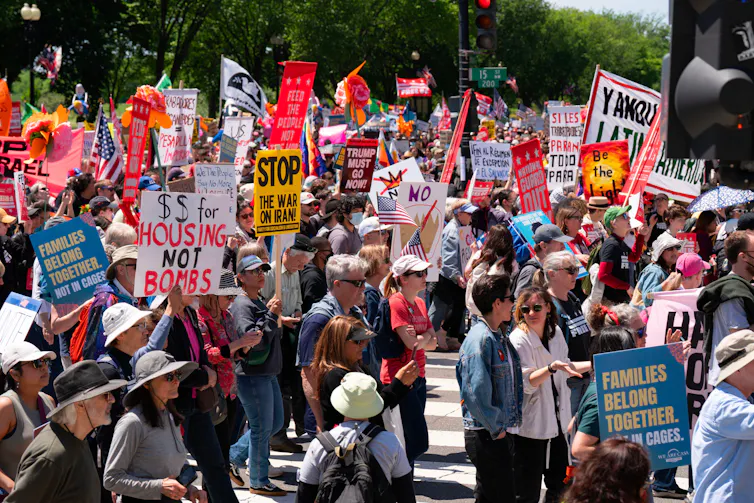
But if, as seems likely, the Democrats outperform the Republicans in the midterm elections in November this year, they will regain control of either the House or the Senate, or both. This would be a severe blow to Trumpism.
AP Photo/Jose Luis Magana

If Congress is controlled by the Democrats, they can veto any of Trump’s legislative proposals, hamstring his policies by withholding funding and at the same time initiate impeachment proceedings against him. Such actions will very likely make him a lame duck, leading to a loss of support for Republicans in the presidential elections in 2028.
Favourable and unfavourable views of the United States in 2025

Data from Pew Research/Graph by Paul Whiteley, Author provided (no reuse)
The survey also shows that America’s reputation as a reliable ally and supporter of democracy has been seriously damaged across the world in his two terms in the White House. The third chart shows the percentage of survey respondents who have a favourable or unfavourable view of the US.
It is striking that many of America’s traditional allies such as Australia, Canada, Germany and France now have a very unfavourable view of the US. This contrasts with the flawed democracies or hybrid authoritarian states who like him. Although, to be fair, attitudes to the US overall are much more favourable than attitudes to Trump.
How might the US regain the international respect it has clearly lost under Trump as president? In the realm of foreign policy, actions speak louder than words – and America’s Nato allies will need to see some kind of concrete assurance that Washington is prepared to resume the leadership and security roles it is apparently abandoning under the current administration.
Perhaps what it also needs is some kind of “truth and reconciliation commission”, along the lines of the one set up by Nelson Mandela following the collapse of apartheid in South Africa. Once Trump has left office, America needs to understand clearly what has happened so that it can avoid this in the future. It is a cliché – but nonetheless true – that people who fail to learn from history are doomed to repeat it.
You must be logged in to post a comment Login