
When football commentators analyse a World Cup match, they tend to focus on tactics, technical ability, physical conditioning and psychology. If a team wins away from home, we hear about mentality. If a player scores a spectacular goal, we praise their vision or instinct. Yet there is another factor that receives remarkably little attention: the stadium itself.
The 2026 Fifa World Cup, hosted across the United States, Mexico and Canada, presents perhaps the greatest architectural experiment in the tournament’s history. Sixteen stadiums, spread across the three countries, are staging matches in environments that differ dramatically in size, scale, form, lighting conditions and spatial character.
Some are purpose-built football grounds. Others are enormous NFL arenas adapted for the world’s game. Several feature retractable roofs. Others remain open to the elements. Together, they create a fascinating question: can the architecture of a stadium influence player performance?
As an interior designer, I have spent several years researching the relationship between footballers, spatial awareness and stadium design. My research began with a simple observation: across football, teams consistently perform better at home than away.
Traditional explanations focus on crowd support, yet during the COVID pandemic, when matches were played behind closed doors, home advantage did not disappear. This suggests there may be more complex factors at work.
Playing the space
A player receiving a pass rarely begins processing information at the moment the ball arrives. Long before that pass is played, they have already built a mental picture of their surroundings. They understand where they are positioned in relation to the touchline, the penalty area, teammates and opponents. But they also orient themselves through a series of architectural cues embedded within the stadium itself.
These cues can be obvious or subtle. The angle of a stand. The location of a tunnel. The shape of a roof. The position of advertising. The colour surrounding the pitch. The direction of sunlight. The edge of a seating tier. Together, these become reference points that help players orient themselves and make decisions faster.
John Beck, Cambridge City manager in the early 1990s, would set up key markers in each of the four corners of the team’s home ground. The markers would be hoardings printed with the word “quality”. When full backs would receive a ball deep in their own half they would look up and were asked to hit the ball as hard as they could towards the quality signs. These were nicknamed “quality passes”. While quite a primitive tactic, it was effective for Beck; he guided the club to two successive promotions and to two successive quarter-final appearances in the FA Cup.
Kurtis Toliver/Shutterstock
At the 2026 World Cup, players have encountered some of the most distinctive football environments ever assembled for a single tournament. In Dallas, matches are taking place inside a stadium capable of holding more than 90,000 spectators. For many players, this will be the largest enclosed sporting environment they have ever experienced.
Suspended above the field are giant video screens so large they have become part of the stadium’s identity. Whether consciously or unconsciously, such dominant visual elements contribute to the player’s reading of space.
In Atlanta, a retractable roof and climate-controlled interior create conditions unlike those found in most traditional football grounds. The stadium’s vast pinwheel-esque roof structure and glass end wall produce a highly controlled environment where wind, temperature and external distractions are largely removed.
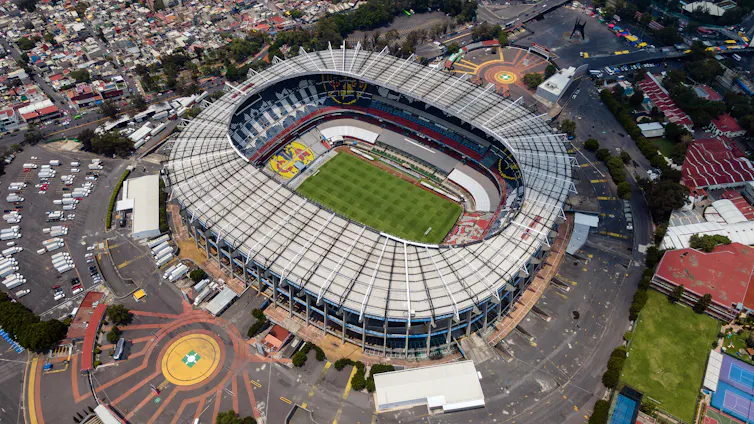
Mexico City’s Estadio Azteca provides a very different experience. It is one of football’s great cathedrals, steeped in memory and history. Generations of players have competed there, from Pelé in 1970 to Maradona in 1986. Unlike many newer venues, the Azteca was designed specifically for football, creating a spatial relationship between players and spectators that feels fundamentally different from many multipurpose grounds.
À lire aussi :
Pelé was more than a great footballer – he revolutionised Brazil’s football industry
Meanwhile, venues such as Vancouver’s BC Place, with its retractable cable-supported roof, or Seattle’s Lumen Field, with its dramatic open end framing the city skyline, create visual identities that players must quickly learn to navigate and interpret.
Macbeth_GP/Shutterstock

From a football perspective, the challenge is adaptation. The German footballer Thomas Müller once described himself as an “interpreter of space”, a phrase that captures something important about elite performance. Great footballers appear to slow down time. They often know what they are going to do before the ball reaches them. This ability is developed through experience and familiarity.
The more often players operate within a particular environment, the more effectively they build what psychologists call cognitive maps. Over time, the surroundings become familiar and require less conscious processing. This familiarity creates fractions of a second of additional thinking time. At the elite level, those fractions can make the difference between scoring and missing, winning and losing.
The challenge of a World Cup is that players rarely have this luxury. Teams move rapidly between venues. Conditions change from match to match. Architectural cues that were familiar in one stadium disappear in the next. Players must repeatedly rebuild their understanding of space and place. This is why preparation becomes so important.
For decades, coaches have analysed opposition tactics in meticulous detail. Yet comparatively little attention has been paid to preparing players for the architectural characteristics of the stadium itself. Understanding sightlines, lighting conditions, pitch orientation, roof structures and spatial landmarks could offer marginal gains that become decisive in elite competition.
From a design perspective, this raises an equally interesting question. Modern stadiums are increasingly designed around fan experience, hospitality and commercial revenue. Yet the primary performers within these spaces remain the players themselves. If architecture can influence orientation, perception and decision-making, should stadium design place greater emphasis on players? Perhaps this will be the next frontier in sporting performance.
You must be logged in to post a comment Login