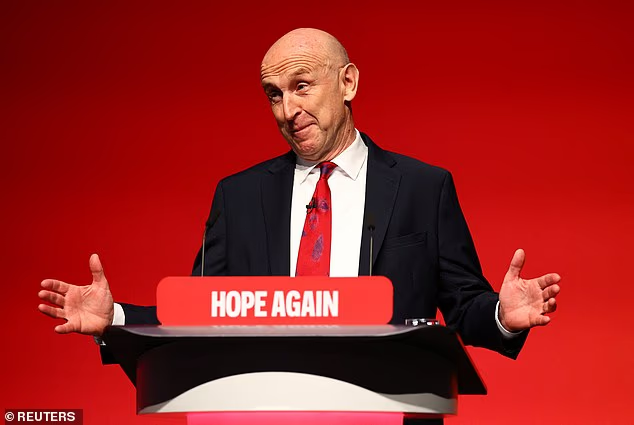
John Healey warned Labour cannot afford a Tony Blair-style spending splurge today as he tried to cool nerves about Budget tax hikes.
In a plea for realism from Left-wing activists at the party’s conference in Liverpool, the Chancellor said the money that was poured into the public sector under New Labour is ‘simply not there now’.
Mr Healey insisted that he will stick to the fiscal rules, again fuelling speculation that taxes will need to rise at the Budget.
He also argued that it is ‘not progressive’ to run up a ‘bigger and bigger benefits bill’ – and suggested that Labour would focus on getting young people into work rather than giving them welfare.
The Chancellor claimed there was still room for ‘new hope’ despite ‘everything we face’, unveiling a new local apprenticeships push overseen by mayors.
But the Government is facing an increasingly bleak backdrop as surging inflation from the Middle East crisis and sluggish growth wreaks havoc with the finances.
Ironically, lower immigration forecasts from the Treasury’s Office for Budget Responsibility watchdog could also deal a blow to Mr Healey’s ‘headroom’ against the fiscal rules – potentially as much as £7billion – by reducing expected revenues.
Meanwhile, Prime Minister Andy Burnham has made a series of big spending commitments, including a pledge yesterday to introduce an NHS-style social care service after the next election that could cost £18billion a year.
There is speculation that could be partly funded by downgrading the state pension ‘triple lock’ – which sees the payments rise by the highest out of inflation, earnings and 2.5 per cent.
Capital gains tax is among the levies floated for the Chancellor to bring in more cash and reassure markets that the Government will balance its books.
Chancellor John Healey made his first address to Labour conference in Liverpool amid mounting alarm at the state of the public finances
Andy Burnham was on the stage to watch his Chancellor’s speech today
Renewed Iran war tensions have seen Brent Crude hit $108 a barrel overnight.
And the pain for Brits could be about to get worse as Donald Trump has said he is ‘seriously’ looking at a US diesel exports embargo.
That would curb prices for Americans, but push them up dramatically in the rest of the world.
Mr Healey said: ‘I know the 90s is having a bit of a revival. To Andy’s excitement, Oasis is going back on tour, to Angela’s joy Gladiators is back on TV. But I have to level with you conference, the money New Labour had in the 90s is simply not there now.
‘Economic growth under Gordon (Brown) was more than double the Tory years that followed, and Britain has it harder now.’
Mr Healey blamed ’14 years of flatlining Tory growth and living standards’.
He said the Government wanted to restore confidence in the economy and help boost family finances.
‘Labour isn’t just here to cut the cake in a different way, we have to bake a bigger cake and make sure that it’s fairly shared,’ he said.
‘So whether it’s the cost of business or the cost of living, the only long-term answer is growth.’
Nodding to soaring interest costs on the Government’s borrowing, Mr Healey said: ‘The cost of the nation’s debt is not just a number in a Chancellor’s budget. It’s the money that we can’t spend on the NHS, on schools, on housing, on social care, on policing our streets, on controlling our borders, on defending our country.
‘I tell you, these levels of debt are an assault on our common sense. They’re an affront to our values, and that’s why the Prime Minister and I are in lockstep, that we will meet the fiscal rules, that we will maintain control of Britain’s finances.’
The Tories and Reform have been demanding Labour slashes benefits to fund more spending in areas such as defence, instead of hiking taxes.
Mr Healey said: ‘Conference, it is not progressive to allow a bigger and bigger benefits bill, and a system which offers an income but doesn’t offer a future.
‘So once again, as a Labour government, it falls to us to act. And this is more than just an economic must. This is a moral duty.
‘I refuse to write off a million young people like the Tories have done.’
He added: ‘I see a generation born this century, digital natives, whip-smart, questioning, ambitious, brave, I see the best asset we have in our young people, and I believe this generation has the potential to be a great generation.
‘And I believe we can help this generation move from generation jeopardy to generation hope.’
Mr Healey tried to strike an upbeat note, saying Britain can enter a ‘new age of industrialisation’.
The Chancellor argued that the UK cannot return to the coal mines of its past.
Describing his politics as ‘shaped by the industrial heartlands of South Yorkshire’, he pointed to the example of the former Orgreave mine, now the site of Rotherham’s Advanced Manufacturing Park.
‘Our coal mines are not coming back,’ he said.
‘But this is how Britain’s industrial past is being remade now for the modern world.
‘This is the new age of industrialisation. A new confidence in Britain.’
Mr Healey, who quit as Sir Keir Starmer’s defence secretary in a row over funding for the military, confirmed more support for Britain’s shipbuilding industry, with investment in the Royal Navy’s Scottish submarine base at its heart.
He said three new floating docks at HM Naval Base Clyde, Faslane, will be procured through a UK-only competition.
Known as Programme Euston, plans for the new docks were first set out in 2023 and are expected to upgrade Faslane’s facilities for the next generation of British submarines.
The Ministry of Defence has previously said they are expected to come into service in the early 2030s, and the docks form part of a wider £15billion upgrade programme for the Royal Navy’s shipyards.
The announcement follows a commitment by Louise Haigh, the First Secretary of State, who said on Sunday the Government would commission a new marine research vessel as part of plans for a ‘new era of reindustrialisation’.
Mr Healey announced £115million in funding for the ship, which is also set to come into service in the early 2030s.
Ahead of his speech, he said: ‘By backing British shipyards, we are not only boosting national security but also securing resilience in the industries that will drive growth today while building the capabilities the country needs for the future.’
Plans for a new age of industrialisation echo Prime Minister Andy Burnham’s pledge to prioritise ‘reindustrialisation’ as a way of boosting Britain’s sluggish growth.
But the Chancellor’s conference speech coincides with more gloomy economic news from the Confederation of British Industry (CBI).
A survey by the business group found private sector firms saw falling activity in the three months up to September, and expect activity to continue to decline for the rest of the year.
Much of that decline was driven by retail and services, with manufacturing declining more moderately.
CBI deputy chief economist Alpesh Paleja said rising energy and employment costs combined with weak demand were continuing to put pressure on profit margins.
He added: ‘Uncertainty ahead of next month’s Budget is also holding back activity in some sectors.
‘Against the backdrop of renewed fiscal pressures, the Budget must draw a clear red line under any more rises in the cost of hiring, investing and doing business.’
The pain for Brits could be about to get worse as Donald Trump has said he is ‘seriously’ looking at a US diesel exports embargo
Shadow chancellor Andrew Griffith said: ‘These are more reheated announcements without clarity on where the money is coming from. Additional docks were announced months ago in the defence investment plan, which still has a £4.7 billion black hole.
‘John Healey resigned warning that Labour’s failure to fund defence was making Britain unsafe. Now that he is Chancellor, he still won’t fund the 3% target he walked out over.
‘Labour are running scared of making the tough choices needed to pay for Britain’s defence. All they can offer is reannounced docks and more hot air from Healey. Only the Conservatives will cut the welfare bill to fund defence.’
John O’Connell, chief executive of the TaxPayers’ Alliance, said: ‘The chancellor offered next to nothing to defuse the benefits bomb sitting under Britain’s economy.
‘The plans he did announce are little more than taxpayer-funded make-work schemes and bungs to trade unions dressed up as welfare and work reforms, all the while refusing to acknowledge the damage done to businesses and employment by his predecessor.
‘If the chancellor is serious about getting young people back into work, he needs to reduce the burdens on businesses and cut welfare spending.’

























































You must be logged in to post a comment Login