Connect with us

NewsBeat

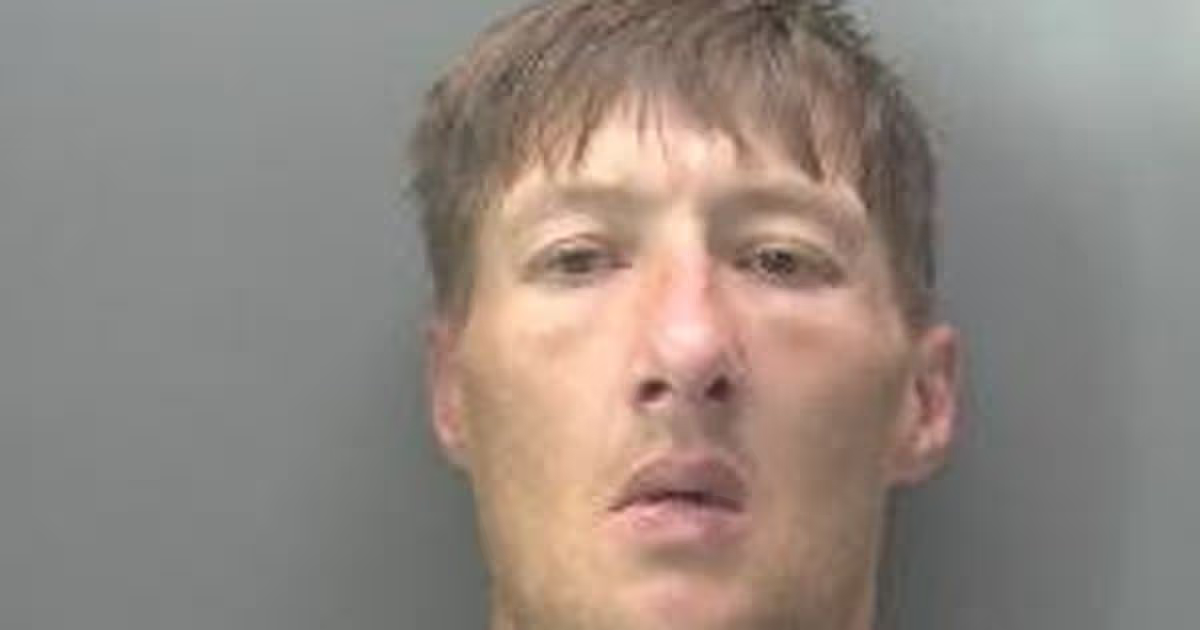
The faces and crimes of 4 Cambridgeshire criminals jailed this week

Published

on

Cambridgeshire Live

These are some of those to have been locked up recently

A drug dealer who tried to drag a woman out of her car and a career shoplifter who stole more than £2,000 worth of alcohol in nine days are among the latest Cambridgeshire offenders to be sent to prison. The list of criminals also includes a prolific criminal who burgled several homes.

Advertisement

These are some of the people were jailed after appearing at courts across the region between February 6 and February 13. CambridgeshireLive regularly reports on the criminal behaviour of people in the area.

Also on the list of offenders is a thief who stole hundreds of pounds of meat, laundry products and ready meals. He’s now been banned from every Co-op and Tesco in Cambridgeshire.

Here is a rundown of some of the Cambridgeshire criminals to have been jailed in the past few days.

Prolific burglar who struck several times in a month

Lee Edwards, 40, has been sent back to prison again after being convicted of a series of crimes. His latest spree began on April 29 last year and ran until June 5. During that period, his offending included stealing a car from one house, a motorbike from another, and taking copper piping and tools from a building site.

Advertisement

He was identified and linked to the burglaries and thefts through a combination of CCTV images and forensics before being arrested in Orchard Street, Fletton, Peterborough, on June 13. Edwards, of Queen’s Walk in Fletton, Peterborough, was jailed for three years and four months after admitting two counts of burglary. He also pleaded guilty to two counts of theft of a motor vehicle, theft of a pedal cycle, and a further burglary, for which he received no separate penalty.

Career shoplifter who stole more than £2k of alcohol

A prolific shoplifter who repeatedly targeted shops and businesses across Cambridge has been jailed. Louis Kidd, 39, of Arrington, stole more than £2,000 worth of alcohol and £142 in cash from a business in Sussex Street between December 16 and 25.

He also broke into the Asda warehouse at the Beehive Centre and targeted Co-ops in Milton Road and Hills Road on nine occasions. Kidd was given a three-year Criminal Behaviour Order (CBO) in April last year, banning him from entering any Co-op in Cambridgeshire.

Advertisement

At Cambridge Crown Court, he was sentenced to one year and 10 months in prison. He had entered guilty pleas to nine counts of breaching a CBO, nine counts of shoplifting and six counts of burglary.

Prolific thief banned from every Co-op and Tesco in Cambridgeshire

A thief who breached a banning order to steal hundreds of pounds of meat, laundry products and ready meals has been jailed. Ashley Till was given a two-year Criminal Behaviour Order (CBO) in September, banning him from entering any Co-op or Tesco in Cambridgeshire.

But between November 6 and February 1 he breached the order on 14 occasions, stealing items including steak, chocolate and laundry products from the Co-op on Milton Road and Tesco Express on Christ’s Lane. The 37-year-old, of no fixed address, also broke into a pharmacy and stole £50 of prescription medication.

Advertisement

Till was sentenced to a year in prison after pleading guilty to 14 counts of theft, 14 breaches of a CBO, bike theft and burglary.

Thug who tried dragging random woman out of her car

A convicted drug dealer who tried to drag a woman from her car outside a doctor’s surgery has been jailed. Lee Holliday, 43, ran towards the woman’s car as she was leaving the Westwood Centre, Peterborough, on July 31.

The victim stopped driving when she noticed Holliday chasing after her, thinking there might be a problem with her car. Holliday, of Welland Road, Dogsthorpe, Peterborough, immediately opened the rear passenger door of the car and got into the back, shouting “drive, drive, they’re chasing me”.

Advertisement

When the victim refused and told him to get out, Holliday did so but walked around to the driver’s side, opened the door, and tried to grab the ignition keys and the steering wheel. Holliday put his hands around the victim’s neck, attempted to pull her out of the vehicle, ripping her shirt and necklace in the struggle. The victim’s daughter, who was close by at the time, assisted in intervening and getting Holliday away from the vehicle until police arrived.

After a trial at Cambridge Crown Court, Holliday was convicted of common assault and was jailed for two years and five months, which included the activation of a two-year suspended sentence for drug offences.


Source link

Advertisement
Continue Reading
Click to comment

Leave a Reply

Your email address will not be published. Required fields are marked *

NewsBeat

The science behind the trend for showering in the dark before bed

Published

on

The science behind the trend for showering in the dark before bed

The latest wellness trend and “sleep hack” involves switching off the bathroom light before stepping into the shower. In the dimness, the water feels louder, the day’s visual clutter fades and the hope is that sleep will come more easily. This practice, often called “dark showering”, has spread on social media, with people claiming that washing before bed in near darkness leads to deeper and faster sleep.

There is little research on dark showering as a standalone sleep technique. However, sleep science is clear about two key factors this ritual changes: light and heat. Both can nudge the body toward sleep or keep it alert.

Light is not only for seeing. Bright light in the evening signals to the brain’s internal body clock that it is still daytime. This delays the release of melatonin, a hormone that helps regulate sleep and is often described as the body’s “darkness signal”.

In a laboratory study of 116 adults, typical room lighting between dusk and bedtime reduced early night melatonin levels by about 70% compared with very dim light. Exposure to room light before bed also shortened the total duration of melatonin release by about 90 minutes. Participants reported feeling more alert.

Advertisement


À lire aussi :
Light at night can disrupt circadian rhythms in children – are there long-term risks?


Bathrooms are often the brightest rooms in a home. Overhead lighting and illuminated mirrors are designed for precision tasks that are useful in the morning but less helpful late at night. Turning these lights off, or dimming them, removes a strong signal that it is still daytime.

One experiment exposed volunteers to standard bathroom lighting for just 30 minutes at bedtime. Melatonin levels dropped and self reported alertness increased, even though participants remained in the bathroom.

Advertisement

More recent research supports this. A 2025 crossover trial compared exposure before bed to cool white LED lighting with softer fluorescent lighting at the same brightness. The LED lighting delayed the time it took participants to fall asleep by about ten minutes and left them feeling less sleepy.

Another study of adolescents found that a burst of bright light in the early evening reduced melatonin levels three hours later and delayed the normal rise in sleepiness.

The same pattern appears in studies of screens. A controlled experiment comparing reading on a light emitting e-reader with reading a printed book found that the glowing device delayed the body clock, reduced melatonin and made it take longer to fall asleep.

A 2023 laboratory study that adjusted the “blue weighted” impact of screens, meaning the part of light most likely to affect the body clock, found that reducing this blue component lessened melatonin suppression and shortened the time needed to fall asleep.

Advertisement

If dark showering replaces time spent under bright bathroom lights or scrolling on a phone, it may help simply by reducing evening light exposure. The benefit will be smaller if the shower is followed by time under full lighting to dry hair, choose clothes for the next day and tidy up.

Darkness also works gradually. Melatonin does not switch on instantly when the lights go out, and a brief shower will not reset a body clock that has been running late for weeks.

Shower water may provide a second benefit. Research on passive body heating, which means warming the body without exercise, has shown that a warm shower or bath taken at the right time can help people fall asleep more quickly.

A 2019 meta analysis of 13 trials concluded that about ten minutes in warm water one to two hours before bedtime shortened the time it took to fall asleep by roughly nine minutes and improved sleep efficiency, the proportion of time in bed actually spent asleep. Warm water widens blood vessels in the hands and feet, helping core body temperature drop afterwards, a key signal for drowsiness.

Advertisement


À lire aussi :
Want better sleep? Try a warm bath or shower 1-2 hours before bedtime, study suggests


Dark showering may also help prepare the nervous system for sleep. Low light reduces the brain’s alerting signals and makes it easier to shift from a state of vigilance, often called the “fight or flight” response, into a calmer “rest and digest” state.

One lab study asked volunteers to lie in a bath while sensors monitored their heartbeat. When the water was close to normal body temperature, about 37 to 38 degrees Celsius, the parasympathetic nervous system became more active. This is the part of the nervous system that slows the heart and supports relaxation. Heart rate slowed slightly and heart rate variability increased, a sign the body is adapting and settling.

A simpler experiment found a similar effect using only warm foot baths. Young women who soaked their feet in warm water for ten minutes showed an increase in vagal tone within 15 minutes.

Advertisement

Vagal tone refers to signals carried by the vagus nerve, which helps regulate heart rate, breathing and relaxation. Higher vagal tone is linked to steadier breathing, lower stress hormone levels and an easier transition into sleep.

Darkness supports the same process from another angle. Bright, blue rich LED lighting can raise heart rate and reduce vagal tone within minutes. A 2025 systematic review found that dimmer, warmer lighting allows heart rate variability to increase, signalling a calmer nervous system.


À lire aussi :
LED face masks are popular on social media for glowing skin – but they could disrupt your sleep


Another factor is the sound of running water. A 2024 analysis found that natural sounds such as rainfall or flowing rivers can lower cortisol, a stress hormone, and stabilise heart rate more effectively than silence. Heat, darkness and soft background noise may therefore combine to signal that it is safe to relax.

Advertisement

There are important caveats. No large trial has directly compared dark showers with brightly lit showers while measuring objective sleep outcomes, so the idea is based on combining related findings rather than direct evidence.

People with mobility difficulties may need some light to reduce the risk of slips, and those who experience night-time anxiety may feel uneasy in complete darkness. As with most sleep advice, no single habit is a cure for chronic insomnia. Daytime light exposure, caffeine timing and stress management all play an important role.

Source link

Advertisement
Continue Reading

NewsBeat

The strange Cambridgeshire cemetery that forbade church rectors from entering

Published

on

Cambridgeshire Live

The cemetery was founded in 1845 and rectors were banned from it for nearly 100 years.

While many people associate cemeteries with churches, men of the cloth were once forbidden to enter a Victorian cemetery in Cambridgeshire. Cemeteries across the UK go back hundreds of years.

Advertisement

One in Cambridgeshire – the Cottenham Dissenters’ Cemetery – goes back to Victorian times. Founded in 1845, this cemetery was established as a burial ground for non-conformists. Also known as dissenters, these are members of a non-established church.

In the 1700s, there were two dissenting groups in Cottenham. The original dissenters’ group met in a barn in Broad Lane, Cottenham. The group grew over the years that followed, and in 1783, it opened the Old Baptist Chapel.

It was enlarged in 1798, then rebuilt in 1856. There was another chapel, known as Ebenezer Chapel, that opened in 1813, and the Wesleyan Chapel was built in 1865.

In 1839, there was a confrontation with Reverend John Frere when he became rector of All Saints Church. The Revd Frere was a member of the aristocracy, and people believed he didn’t fit in Cottenham.

Advertisement

For over 250 years, Cottenham had been a self-governing village, and many of those who made orders were well-educated farmers. When the church wardens had to collect a church rate from the villagers, who were dissenters, the wardens went on strike.

After the strike, the rector claimed he paid for the upkeep of the church and also the ropes for the bell ringing. In retaliation, the rector refused to bury the bodies or ring the bells.

The Revd Frere shared his concerns with the Bishop of Ely in a letter on May 27, 1843. Still in confrontation, Joseph Green, a minister at the Old Baptist Church, gave the dissenters an idea.

Mr Green suggested that the dissenters have their own burial ground – where church rectors were not allowed to set foot. So in 1845, an acre of ground in Lanes Lane was bought from a farmer for £280.

Advertisement

This money was raised from public subscription. The new cemetery officially opened in 1845. The first person reported to be buried there was three-year-old Ann Norman. Only five years after it opened, 137 bodies were buried there.

The cemetery nearly went 100 years without the rector being allowed onto the grounds. An entry from the diary of Horace Gautrey in 1937 said: “Until four or five years ago the church rector [was] not allowed to pass through the cemetery gates.” This is according to the Cambridgeshire Community Archive Network.

The cemetery is still in operation today. More than 4,000 people have been laid to rest there.

Source link

Advertisement
Continue Reading

NewsBeat

IOC under fire for selling replica 1936 Olympics t-shirt used to promote Nazi Germany

Published

on

IOC under fire for selling replica 1936 Olympics t-shirt used to promote Nazi Germany

The International Olympics Committee is under fire over the sale of a T-shirt that features artwork from the 1936 Berlin Olympic Games, which Adolf Hitler used to promote Nazi Germany.

The Olympics’ official online shop has sold out of the controversial T-shirt, which replicates designs from the propaganda used 90 years ago: a man wearing a laurel crown, the Olympic rings and the Brandenburg Gate.

Introduced as part of the Olympic Heritage Collection, the limited-edition shirt immediately sparked backlash for commemorating the dark time in Germany’s history.

“History should be taught, not merchandised,” one X user wrote on social media. Another said: “Shocking sell-out—Olympics merch team really thought Nazi-era Berlin art was a good vibe? History lesson needed ASAP.”

Advertisement

One person criticized on Reddit, “IOC is rotten to the core. Have always been.”

The International Olympics Committee is under fire for selling shirts with artwork that was used at the 1936 Berlin Olympic Games, which Adolf Hitler famously used to promote Nazi Germany

The International Olympics Committee is under fire for selling shirts with artwork that was used at the 1936 Berlin Olympic Games, which Adolf Hitler famously used to promote Nazi Germany (Olympic Shop)
The International Olympics Committee defended its sale of a controversial T-shirt by saying that it was a part of its Heritage Collection

The International Olympics Committee defended its sale of a controversial T-shirt by saying that it was a part of its Heritage Collection (Getty Images)

“Selling Berlin 1936 merch is tone-deaf; it risks normalizing Nazi propaganda rather than critically acknowledging that dark chapter in Olympic history,” another said on X.

Advertisement

Taking place three years after Hitler’s regime rose to power, the 1936 Olympics are remembered by historians for the way that Hitler used the event to push his ideals of racial supremacy and antisemitism. The Nazis blocked German-Jewish athletes from competing in the games and openly referred to Black athletes as “non-humans.”

“The 1936 Olympic Games were a central propaganda tool of the Nazi regime,” German politician Klara Schedlich said in a statement. She accused the IOC of “clearly not reflecting sufficiently on its own history,” adding that, without context: “the choice of image is problematic and unsuitable for a T-shirt.”

In response to the criticism, the IOC has defended the shirt — which reproduces the original 1936 poster by German artist Franz Würbel — as part of its Heritage Collection, which features artwork from every Olympic Games.

“Of course, we recognize the profound historical context surrounding the Berlin 1936 Olympic Games,” the IOC said in a statement to the New York Post. “The 1936 Games also brought together 4,483 athletes from 49 countries competing in 149 events and included remarkable sporting achievements.

Advertisement

“Many of them stunned the world with their athletic achievements, including Jesse Owens,” the IOC added.

Owens, a American track-and-field American Olympian, directly challenged Hitler’s racist ideology with his record-shattering victories at the 1936 Games. He won four gold medals in the 100m, 200m, 4x100m relay and long jump.

The IOC did not immediately return The Independent’s request for comment.

This is not the first time that the Olympics has sparked backlash over its reference to the 1936 games. In 2020, the IOC posted a Throwback Thursday picture commemorating the controversial year.

Advertisement

Source link

Continue Reading

NewsBeat

Barnsley and Wakefield men – hare coursing near Goole

Published

on

Barnsley and Wakefield men - hare coursing near Goole

Elijah Boswell, 38, of Smithy’s Lane in Barnsley, and Shaun Price, 54, of Dunningly Lane in Wakefield, were both fined for hare coursing offences, after a trial held at Beverley Magistrates’ Court last week.

Boswell was ordered to pay £1,061, while Price, was fined £1,339.


RECOMMENDED READING:

Advertisement

The incident took place in December 2023 in Faxfleet, Goole, and after receiving reports, officers stopped a vehicle near the scene and found lurcher-type dogs and a thermal scope.

Both men gave no explanation for the items during police interviews.

PC Rich Fussey of the Rural Task Force said: “Illegal hare coursing is not only a priority for our Rural Task Force, but also for the UK Wildlife Crime partnership.

“This kind of criminality involved is serious, and perpetrators are organised and sophisticated in their planning, often involving cross-border offending.”

Advertisement

“Not only does it involve barbaric acts against protected wildlife species, but it causes harassment, alarm, distress and annoyance to the rural communities.

“Poachers do not care about trespassing across farmland, intimidation to farmers and landowners, and the damage they cause. However, they do care about the zero-tolerance response that we have towards their illegal activities.

“I hope this case and the seizure of the thermal scope used in the commission of hare coursing offences sends out a strong message.”

The public are urged to report suspected hare coursing by calling 101 and quoting Op Galileo.

Advertisement

Source link

Continue Reading

NewsBeat

Five reasons Trump’s plan for Ukrainian elections and a peace referendum will only prolong the war

Published

on

Five reasons Trump’s plan for Ukrainian elections and a peace referendum will only prolong the war

In a surprise announcement on February 10, Ukraine’s president, Volodymyr Zelensky, said that his administration was preparing to hold presidential elections before the middle of May. Alongside these elections, he is reported to be planning to hold a referendum on a peace deal with Russia.

This is a dramatic shift in Zelensky’s stance: the president has long resisted elections under conditions of war, despite the fact his mandate ran out in 2024. One possible explanation for the turnaround is that US pressure on Ukraine is having some real effects. A few days ago, Zelensky indicated as much, saying that his US counterpart, Donald Trump, was pushing for a negotiated end to the war by June.

Trump’s timeline – probably with an eye towards the US mid-term elections, when the White House would like to present a Ukraine deal as another major foreign policy success – is one thing. The feasibility of elections and, even more so, a peace deal between Russia and Ukraine is quite another.

1. Organising a free and fair vote in wartime

The first problem is logistics. Who will be eligible to vote? Where and who could monitor the elections to ensure they are free and fair? Apart from the hundreds of thousands serving in the trenches defending Ukraine against Russia’s aggression, there are also 3.7 million internally displaced Ukrainians and almost 6 million refugees abroad – plus approximately 5 million Ukrainians currently living under Russian occupation.

Advertisement

There is also the uncertainty of a Russian ceasefire – needed to facilitate not only the conduct of the elections but the preceding election campaign – and the near certainty of large-scale Russian election interference.

We can expect something similar to what Moldova experienced during its presidential elections, European integration referendum in 2024 and parliamentary elections in 2025, when voters were flooded with disinformation. Moscow even recruited Orthodox priests to try to sway the electorate. Russia’s attempts to influence the outcomes of these votes were shown to have clear limitations. But this will not deter it from trying again, and harder, in Ukraine.

Given all this, the prospects of organising any vote – let alone one of such consequence for the country and its people – look worse than daunting.

2. There’s no realistic peace deal yet

A second problem is the feasibility of any peace deal between Russia and Ukraine. At present, it is hard to imagine the gaps between Russia and Ukraine can be bridged in a meaningful way that does not cross either side’s red lines – especially on territory and security guarantees.

Advertisement

Even if it were possible to find a form of words to which the Russian and Ukrainian presidents could both sign up, the approval of any such deal in a referendum in Ukraine looks remote. Likely to be held on the same day as the presidential elections, a referendum would face all the same logistical and eligibility pressures.

3. Ukrainians might say no to peace

It is not clear what would happen if a majority of Ukrainians rejected the settlement put to them in the referendum. Would this mean a return to negotiations, or to war? The latter is the more likely scenario.

A third option would be the continuation of a shaky ceasefire and the implementation of parts of any settlement beneficial to both sides, such as prisoner exchanges.

But as was the case with the ill-fated Minsk agreements of 2014 and 2015, a return to all-out war would remain firmly on the cards.

Advertisement
Uncertain future: Ukrainians in Mariupol vote in a sham referendum on the annexation of their illegally occupied region by Russia, September 2022.
EPA/stringer

4. Europe must play a part

So far, Ukraine’s European partners have mostly been on the sidelines of the peace negotiations. They may not be a direct party to the war, but they clearly have a stake in the peace terms that might now be hammered out between Moscow, Kyiv and Washington. The mostly European coalition of the willing is expected to play a key role in the implementation of US-backed security guarantees, and to do the heavy lifting on Ukraine’s post-war reconstruction.

But after more than 12 months of hostility from Washington towards Brussels, there is little trust left in the dependability of US backing for Ukraine. The fourth problem, therefore, is that European acquiescence with a US-imposed peace deal cannot anymore be taken for granted either.

This does not necessarily mean a peace deal is impossible – but it will almost certainly be unless Europe has played a part in its negotiation.

The French president, Emmanuel Macron, recently dispatched his most senior diplomat, Emmanuel Bonne, to Moscow for talks in the Kremlin. And the country’s former permanent representative on the UN security council, Nicolas de Rivière, has been appointed as the new French ambassador to Moscow, signalling the importance that Paris assigns to direct contacts with Russia.

Advertisement

The EU, according to its foreign policy chief, Kaja Kallas, might also appoint a special representative for contacts with Moscow – after the bloc has agreed on the messages it wants to send.

However, despite the fact that Brussels holds some powerful cards – including frozen Russian assets and a wide range of sanctions – there is no indication for now that either Washington or Moscow are willing to grant Brussels a seat at the negotiating table.

5. Russia can’t be trusted

The final problem is whether Russia will accept even the best possible terms in a peace agreement, and then stick to it. The US push to seal a deal in the coming months suggests there is some confidence in the White House that a deal acceptable to the Kremlin can be forged, and that Ukraine and its allies can be coerced to go along with it.

US president Donald Trump walks and talks with Russian president, Vladimir Putin. In the background is Air Force One.
Donald Trump hostng the Russian president, Vladimir Putin, for talks in Alaska in August 2025.
EPA/Gavril Grigorov/Sputnik/Kremlin pool

There is a lot in what has transpired in recent days that will be to Russia’s liking: presidential elections in Ukraine; the US using its support for security guarantees as leverage to push Kyiv towards accepting more and more compromises; and the parallel US-Russia negotiations on an economic deal.

Russia’s president, Vladimir Putin, has got to this situation without making any concessions. He has played the US president perfectly so far, and there is no indication that he is done playing him. Trump is almost certain to continue to do Putin’s bidding – and to walk away as and when his grandiose plan unravels.

Advertisement

Is there a backup plan?

It is not clear what the backup plan is for Zelensky and his European allies. Given there is little to suggest the current US plan and timeline for a deal will lead to a happy ending, they need to come up with credible contingencies very quickly.

Offering logistically almost-impossible elections and a referendum with a highly uncertain outcome would be a smart way for the Ukrainian president and his European allies to buy themselves the time they need for a new strategy.

Putin may think he has successfully tricked Trump into doing his bidding. But on this occasion, Zelensky may have outsmarted them both – albeit at the price of the war against his country continuing.

Advertisement

Source link

Continue Reading

NewsBeat

Kidnapper ‘removed woman’s teeth and lips’ in sick experiment, leaving gaping hole

Published

on

Małgorzata

WARNING: DISTRESSING CONTENT. A young woman by the name of Małgorzata reportedly sustained horrific facial mutilations during her four years spent at the mercy of Mateusz J, the depraved kidnapper dubbed ‘Poland’s Josef Fritzl’ who has this month faced sentencing

A young woman went to meet a man she’d connected with on a dating app, only to enter a four-year living nightmare. Now the monster who subjected her to such cruelties has finally faced justice.

Advertisement

The survivor, known only by her first name, Małgorzata, was taken prisoner by village “weirdo” Mateusz J, who brought her back to the farm he lived on with his parents. It was here that he locked her away in a disused animal barn used as an outdoor utility room, subjecting her to unimaginable torture. The makeshift cell in which Małgorzata was kept, in the sleepy village of Gaiki, near Glogow, Poland, had no electricity, running water or heating. She also allegedly had no access to a toilet or even the comfort of sunlight, with the window blocked off with a false window and a curtain.

Earlier this month, J. was sentenced to life imprisonment in a therapeutic setting after Judge Michał Misiak found him guilty of abuse and deprivation of liberty, as per Polish publication Onet. The perpetrator must now also pay the survivor PLN 500,000 (approximately £100,000) in compensation, and has also been banned from contacting her or coming within 100 meters of her for the next 15 years.

This ordeal finally came to light in September 2024, when Małgorzata was taken to the hospital with a dislocated shoulder. It was here that she told other patients that she’d been repeatedly raped and tortured while locked inside an outbuilding, and that she’d even become pregnant with and given birth to her abductor’s baby. Doctors observed that Małgorzata, who was in her twenties at the time of her 2019 kidnapping, had suffered extensive facial damage and that her body was covered in various abrasions and scars. Horrifyingly, Małgorzata reportedly suffered extreme mutilation during her time in captivity, with her kidnapper having allegedly removed her lips and teeth.

READ MORE: Man who violently shook baby to death before scrolling Facebook jailed for life

Advertisement

A source close to the investigation told the Mail Online: “From what we heard, the girl does not have lips now because of everything he had done to her. Her face is covered in bruises, and she just has an open hole [where her mouth is] without the lips. The woman said he [J]was doing some kind of trial on her. He was experimenting on her. He was trying out different things on her.” During her four years of imprisonment, Małgorzata was allowed out of her cell a few times for hospital treatment… However, she was too afraid of her captor to tell medics what was really going on.

Małgorzata, from Leszno, told Polish publication MyGlogow.pl: “I couldn’t tell the doctors the truth, I was afraid, he threatened me that if I complained, it would get even worse.” She also revealed how, during journeys to the hospital, J. made sure she wore a balaclava so that she couldn’t figure out whereabouts she was being kept. This same precaution was adhered to when J. took her out to wash at night, sometimes just using a hose to spray her. If she obeyed his commands, Małgorzata was permitted hot water.

Recalling how she sustained the shoulder dislocation which led to her final hospitalisation, Małgorzata shared: “I didn’t meet his sexual expectations. And that had been happening very often lately. Back then, I was beaten and not fed. He only fed me better when I had no strength left, when my chest hurt. He was probably afraid I would die…”

Advertisement

A statement released by the prosecutor’s office details the torment Małgorzata endured: “He kicked her, choked her, pushed her, pulled her, twisted her arms, pulled her hair, and isolated her from other people, humiliated her, called her vulgar names, took her outside with a balaclava forcibly put on, maliciously shaved her hair, constantly monitored all of her behaviour. And moreover, during this period of time, repeatedly, at his own discretion and against the will of the injured party, by violence and unlawful threats of beating, bodily harm and deprivation of life, he led the injured party to sexual intercourse, and also forced her to submit and perform other sexual acts and he recorded this at least twice using a mobile phone.”

Chillingly, Małgorzata’s makeshift cell was situated close to neighbours, who were left shocked by the torture allegedly occurring so close by. Meanwhile, his parents have also denied having any prior knowledge of the terrible situation. As per Polish media outlet Onet, J’s father wept as he insisted, “This is a shock for us. It’s impossible. My wife and I really didn’t see any girl here. It’s a shock for us. It’s impossible. It couldn’t have lasted years, maybe a few months, but not that long, because it would have been revealed sooner.”

TVP 3 reports that, throughout his trial, which began in June 2025, Mateusz J. maintained that his relationship with Małgorzata had been consensual, and it was noted that he showed no remorse for his actions. Psychiatric and psychological experts also concluded that the rapist had been fully sane at the time of his crimes. The court heard, “I have never met a man who committed so much evil.”

In his justification for the verdict on February 3, Judge Misiak told The District Court in Legnica that it was “impossible to disagree” with the prosecutor’s claim that “this case defies all convention.” He also remarked that this case “exceeded the professional experience” of officers and experts from a variety of fields.

Advertisement

If you’ve been the victim of sexual assault, you can access help and resources via www.rapecrisis.org.uk or calling the national telephone helpline on 0808 802 9999

READ MORE: Child sex offender Paul Tyler jailed for further 18 years for historic abuse

Source link

Continue Reading

NewsBeat

Man dies after being pulled from flooded Derbyshire brook following police chase | UK News

Published

on

Formal identification of the deceased man has not yet taken place. Pic: PA

A man has died after being pulled from a flooded brook following a police chase.

Police had been chasing a stolen caravan in Oakerthorpe, Derbyshire, in the early hours of Saturday.

Two men in the vehicle towing the caravan rammed into the police cars before coming to a stop and fleeing on foot.

Advertisement

One man was arrested shortly afterwards, while a second was described by police as having “entered the flooded Egginton Brook”.

Several hours later the man was recovered from the water and treated by ambulance crews at the scene before being taken to Royal Derby Hospital, where he was pronounced dead, police said.

Advertisement

Because the death happened after police contact, the force has referred itself to the Independent Office for Police Conduct (IOPC).

Formal identification of the man has not yet taken place, and efforts are ongoing to trace his next of kin, the force added.

Read more from Sky News:
Van camps are growing in numbers – here’s why
Man fatally stabbed in London

Adrian Osiecki, 34, of Harnall Lane West, Coventry, has been charged with dangerous driving, including failing to stop for police, and criminal damage to police vehicles; driving without insurance; driving while disqualified and theft of a caravan.

Advertisement

He is due to appear at Southern Derbyshire Magistrates’ Court on Monday.

Source link

Advertisement
Continue Reading

NewsBeat

Ross Kemp to return as Grant Mitchell in BBC soap EastEnders

Published

on

Ross Kemp to return as Grant Mitchell in BBC soap EastEnders

The return will see his iconic character reunited with his estranged son and drawn into a storyline involving a family friend.

The 61-year-old actor previously returned for the BBC One soap’s 40th anniversary in 2025.

When was Grant Mitchell last in EastEnders?

Ross Kemp is returning as Grant Mitchell for a short stint in EastEnders (Image: BBC/Jack Barnes/Kieron McCarron)

Ross Kemp was last seen as Grant Mitchell back in February 2025, having returned for the series’ 40th anniversary celebrations, following concerns about brother Phil’s mental health.

The actor first joined EastEnders in 1990 and was one of its main characters during the 90s.

Advertisement

He left in 1999 and returned for short stints in both 2005 and 2006, and a guest stint in 2016.

Grant Mitchell has also been played by actor Teddy Jay in a special flashback episode about the Mitchell family in September 2022 and as part of the 40th anniversary in February 2025.

He also featured in a hallucination in the 1990s during a special episode heavily focused on Nigel Bates’ (Paul Bradley) worsening dementia.

During his time in EastEnders, and being the younger brother of Steve McFadden’s Phil Mitchell, Ross’ character has been involved in several big storylines.

Advertisement

One of his most iconic arcs was his turbulent romance and marriage to Sharon Watts, which unravelled when Sharon began an affair with Phil.

The explosive 1994 reveal, often referred to as “Sharongate”, became one of the most famous moments in British soap history.

Grant’s darker side was further explored through his abusive marriage to Tiffany Mitchell, creating one of the show’s most controversial and talked-about domestic abuse storylines of the 1990s.

Tiffany’s death shortly after attempting to escape Grant marked a turning point for the character.

Advertisement

Family loyalty remained a core theme throughout Grant’s time on the show, particularly in his bond with his mother, Peggy Mitchell.

Despite frequent clashes, Grant was fiercely protective of the Mitchell name and legacy.

His various departures and dramatic returns over the years have typically reignited old feuds and unfinished emotional business.

Ross Kemp to return as Grant Mitchell in BBC soap EastEnders

A statement shared on the EastEnders social media pages said: “Grant Mitchell is set to make a dramatic return to Walford this spring with Ross Kemp reprising the iconic role for a short stint.

Advertisement

“Grant is called upon by his estranged son Mark to return to Walford, marking the first time the pair will be reunited since Mark learned the truth about his true parentage.

“Grant’s arrival on Albert Square also comes amidst the deteriorating health of long-time family friend Nigel.

“While full details of Grant’s comeback remain under wraps, viewers can expect explosive drama.”

On his return, Mr Kemp said: “I’m truly delighted to be stepping back into Grant Mitchell’s shoes and returning to EastEnders later this year.

“As well as exploring Grant’s attempts to reconnect with his son Mark, it’s especially an honour to be part of Nigel’s powerful ongoing dementia storyline, which holds deep personal meaning for me due to a close family connection in real life.”

Advertisement

After EastEnders, Kemp has since built a career in documentary filmmaking with series such as Ross Kemp On Gangs, Ross Kemp In Afghanistan and Ross Kemp: Extreme World.

His 2016 appearance on the soap marked Dame Barbara Windsor’s final episode as Peggy Mitchell.

More recently, Mr Kemp has presented the BBC gameshow Bridge Of Lies.

Ben Wadey, executive producer of EastEnders, said: “We are absolutely thrilled to welcome Ross back once more to the legendary role of Grant.

Advertisement

“The Mitchells remain one of EastEnders’ defining dynasties, and we can’t wait to see them reunited again.

“As always, when Grant is around, drama inevitably follows him.”

Are you excited to see Ross Kemp return as Grant Mitchell? Let us know in the comments.

EastEnders airs Monday to Thursday on BBC One and BBC iPlayer.

Advertisement

Source link

Continue Reading

NewsBeat

The new police partnership protecting Holcombe Moor

Published

on

The new police partnership protecting Holcombe Moor

It’s a place I walk regularly with friends and family members and took great pleasure in doing ‘roly polies’ down some of the more forgiving grassy slopes as a kid.

I tell anyone from out of town about the army assault course, which was used in Granada’s Krypton Factor TV programme, the tragic story of Ellen Strange and indulge in a pub lunch after trekking to the Pilgrims Cross and back.

But as I discovered for the first time this week – despite being born and raised in Bury – this particular area is so much more than just a pleasant picnic spot to look at the Manchester skyline from.

PC Tim Elliott with ranger Oliver Smith (Image: GMP)

Holcombe Moor, which is cared for by the National Trust, is part of the West Pennine Moors Site of Special Scientific Interest (SSSI), a nationally protected upland landscape between Chorley, Blackburn, Bolton and Haslingden.

Advertisement

A group of around 20 hardworking volunteers and rangers spend their free time looking after the delicate moorland, which includes heather, bog and upland heath.

One of their main jobs on the moor is to repair damaged peat.

I learned that healthy peatlands retain moisture, soaking up rain, locking in carbon and slowing the flow of water into Ramsbottom and Holcombe, which is vital to help tackle flooding. 

The Trust and its partners have put in thousands of small peat and stone dams and low banks in the bog. These hold water on the moor, help sphagnum moss grow back and stop bare peat washing away.

Advertisement

Volunteers and police are working together to help preserve the area (Image: GMP)

National Trust area ranger Nikolas Taylor also told me that they have planted an impressive 1.5 million sphagnum plugs in the last six years or so.

The group also looks after paths, fences and signs so people can still enjoy walking on the moor, while protecting ground‑nesting birds and delicate plants.

Sadly, the moorland was subject to vandalism last month, causing more than £25,000 worth of damage in the Bull Hill area of Holcombe Moor.

A range of pickup trucks, all-terrain vehicles, quad bikes and motorcycles have all been using the land, which is only accessible by foot, to ride recreationally.

Advertisement

I joined volunteers from Greater Manchester Police (GMP) and the National Trust on Tuesday morning (February 10) to learn more about the work they do in the area.

PC Charles Reece, a Ramsbottom Neighbourhood Officer and volunteer Wildlife Officer, also told me that there had recently been some damage to Peel Tower, with bars being pulled off windows and a door being kicked in on the historic landmark.

These acts highlight the vulnerabilities of the land and the importance of early reporting if members of the public spot anything of concern.

PS Sam De Gouveia is part of the Force Prevention Branch and is the Subject Matter Expert for wildlife for GMP, overseeing rural and wildlife crimes.

Advertisement

She explained that there are currently more than 20 wildlife officers who volunteer as Wildlife Officers, liaising with rural residents and groups to help protect the land and wildlife, alongside their usual policing roles.

PS Sam De Gouveia with PC Tim Elliott (Image: GMP)

PC Charles Reece, a Ramsbottom Neighbourhood Officer, said: “It’s about monitoring logs that come through.

“Sometimes, we can find they can fall through the cracks, just because we’re trying to solidify an understanding of the legislation at the moment.

“Covering Ramsbottom, I knew this [an NT hub on the moor] was up here but I’ve never had a full day of engagement with the National Trust so it’s really great to see what they do, and they’re really passionate.

Advertisement

“They have fantastic knowledge so it’s going to be great to engage with them further.”

Mr Taylor said: “Unfortunately, over the Christmas period and New Year, we’ve had a bit of damage on our peatland restoration area, which had some off-roaders come in off the tracks.

“It is an area of special scientific interest, and therefore, it does have protection against such activities. We want this to be a place where people come and enjoy, and where wildlife and people meet.”

He explained that while these examples of criminal activities set them back “quite a lot”, he is hopeful that by raising awareness of what this area actually means, it’ll make people realise “the value of these areas far more than they ever used to”.

Advertisement

He added: “Whether it’s capturing carbon, whether it’s doing natural flood management, habitat improvement or general access for local people and visitors alike.

“[They’re] really important areas therefore we should look after them in such a way that makes them even better in the future.”

He also urged dog walkers to keep dogs on leads around wildlife, especially during the upcoming lambing season.

Holcombe Moor and Stubbins Estate is home to birds such as skylark, golden plover, curlew, dunlin and snipe, who nest on the wet moor, along with meadow pipits, stonechats and winter thrushes.

Advertisement

Kestrels and owls also hunt there, feeding on shrews and voles.

In the woods and cloughs, there are great spotted woodpeckers, jays, dippers and other small songbirds. Foxes, badgers and bats use the slopes and field edges.

The peat and rough grassland attracts common lizards, other reptiles and insects, while nearby ponds hold frogs, toads and newts.

GMP is actively working on growing its partnership with the National Trust to help protect the rural environment and encourage stronger reporting from the community, including those who may feel more isolated or out of sight, such as rural residents.

Advertisement

The officers receive practical education on how the moorland functions, why it is environmentally significant, and the challenges faced by those who manage it, which will help officers respond more effectively to future incidents.

This growing relationship also means that, should an incident occur on the moor, officers will now have a clearer understanding of how to safely reach remote areas and can rely on the support and expertise of National Trust rangers.

PC Tim Elliott, Neighbourhood Officer for Whitefield and volunteer Wildlife Officer, said: “It’s something that I’ve had an interest in as my dad was a Wildlife Officer for Lancashire Constabulary so I’ve sort of followed in his footsteps.

“I really enjoy being in the outdoors, and I’d like to say that I think, as a team, we’ve been at the forefront of trying to gain a relationship with the rangers.

Advertisement

“We found that they’ve been quite unlucky because they’re on the Lancashire side but they are also on the Bury side, so when they are reporting things, it’s been like a table tennis match of whose crime it is.

“We’re finding that because there isn’t a dedicated team for wildlife, crimes are being closed without being investigated so we’re trying to jump in before that happens, and try and get some positive outcomes.”

National Trust ranger, Oliver Smith, is responsible for land management and has been part of the team for around three years.

He said: “I love the fact that this job is so diverse. One day I can be walling, one day I can be out fencing or doing moorland restoration or working with partners from universities.

Advertisement

“I love working with the volunteers on volunteer days. There are no two days the same, that’s why I think it’s so great up here.”

Protecting the land is about more than just pretty scenery – it’s about keeping a major store of carbon in the ground, saving rare upland wildlife, looking after historic sites and preserving a much-loved open space for people to use now and in the future.

Source link

Advertisement
Continue Reading

NewsBeat

Man taken to hospital after Chester-le-Street incident

Published

on

Man taken to hospital after Chester-le-Street incident

Paramedics found the man injured after being called to Fifth Avenue on Saturday (February 14), afternoon, around 12.40pm.

The North East Ambulance Service (NEAS) said his injuries were “possibly as the result of an assault.”

One resident said she saw “at least 30 coppers” descend on the area, and said the field was cordoned off as police dealt with the incident. Durham Police has been contacted for information.

The mum-of-two, who did not want to be named, said: “Around one o’clock there were about 30 coppers and the whole field was cornered off.

Advertisement

Fifth Avenue in Chester le Street (Image: THE NORTHERN ECHO)

“I saw police go into one house and then to another.

“This area doesn’t feel safe at all and it’s unfair on the kids who live here. Whenever my seven-year-old son hears a bang, he’s terrified and doesn’t want to leave the house.

“I hate living here. You see things like this happen all the time. The kids are just petrified.”

Another resident said he saw armed police in the area earlier that afternoon.

Advertisement

He said: “I saw armed police here about 1pm, there were helicopters above as well. I went into my garden to keep out the way. I keep myself to myself.”

While another elderly resident, Janet, said: “There’s always trouble around here. Police are here a lot. But I didn’t see anything happen, I hope everyone is okay.”

Another resident said she saw “loads of police” opposite her house.

Fifth Avenue in Chester le Street (Image: THE NORTHERN ECHO)

“Sadly stuff like this happens all the time around here,” she added.

Advertisement

A NEAS spokesperson confirmed: “We received a call on Saturday (February 14) at 12.41pm to concerns for a person injured on Fifth Avenue, Chester-le-Street, possibly as the result of an assault.

“One emergency ambulance crew attended the scene along with police, and one male patient was taken to hospital for further treatment.”

Source link

Advertisement
Continue Reading

Trending

Copyright © 2025